
2014 2020 Overview of the Hungarian strategy documents

- Slides: 30
2014 -2020 Overview of the Hungarian strategy documents for the development of logistics Workshop Imre Gódány project coordinator Scientific Association for Spatial Development
My role was to overview the relevant strategical documents, plans, programmes which is related and supports the Hungarian Logistical Strategy. -Key documents - Europe 2020 - Partnership agreements - The main national development priorities - ESB
Key documents 1. Europe 2020 - COMMUNICATION FROM THE COMMISSION Intelligent, sustainable and inclusive growth strategy NATIONAL DEVELOPMENT 2020 - National Development Plan and the National Spatial Development Concept development of government policy for 2030 and 20142020 are designed to track marked strategic objectives and priorities
Key documents 2. • Hungarian Partnership Agreement for the 2014 -2020 development period 1) Identifies Hungary’s key challenges and sets out the main priorities for development 2) Fixes the useage of EU development funds to Hungary for the aims of the EU 2020 and the Cohesion Policy
I. EU 2020 The Europe 2020 puts forward three mutually reinforcing priorities in mind: 1) Smart growth: developing an economy based knowledge and innovation. 2) Sustainable growth: promoting a more resource efficient, greener and more competitive economy. 3) Inclusive growth: high-employment rate, economy delivering social and territorial cohesion, fostering.
II. Partnership Agreement The comprehensive national development objectives of the 2014 -2020 programming cycle are: • Sustainable • high value-added production • expand employment Based economic growth. q The development resources compared to the current planning cycle – need to be expended much greater than before and will be paid directly to economic development.
II/1. The main national development priorities with the European Union 1) To improve competitiveness and enhance international engagement for the first operators. 2) Increasing employment (by economic development, employment, education, social inclusion policies with regard to regional differences) 3) To enhance energy and resource efficiency 4) Tackling societal challenges of convergence and population, and a Good Government 5) Implementation of local and regional development in support of economic growth Sources: (OFTK, Sector Strategies)
II/2. Thematic objectives 1. 2. Strengthen the research, technological development and innovation Access to information and communication technologies, improve the use and quality of technologies 3. Small and medium-sized enterprises, improving the agricultural sector, fisheries and aquaculture sector 4. A step towards to the low-carbon economy 5. Adapting to climate change, promotion of risk prevention and management 6. Promoting environmental protection and the efficiency of resource use, 7. Promoting sustainable transport and reducing the lack of capacity in the main areas of infrastructure 8. Employment and labor mobility, 9. The fight against poverty and the promotion of social inclusion 10. Investment to education, skills and the project of life-long learning 11. Enhancing institutional capacity and an efficient public administration.
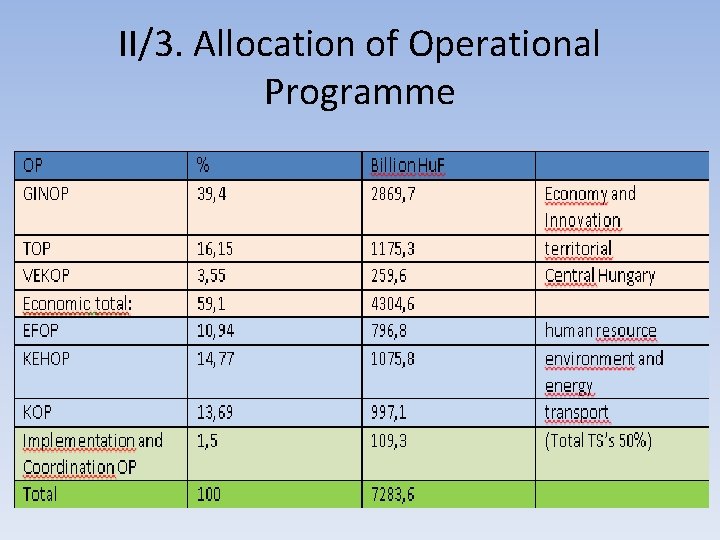
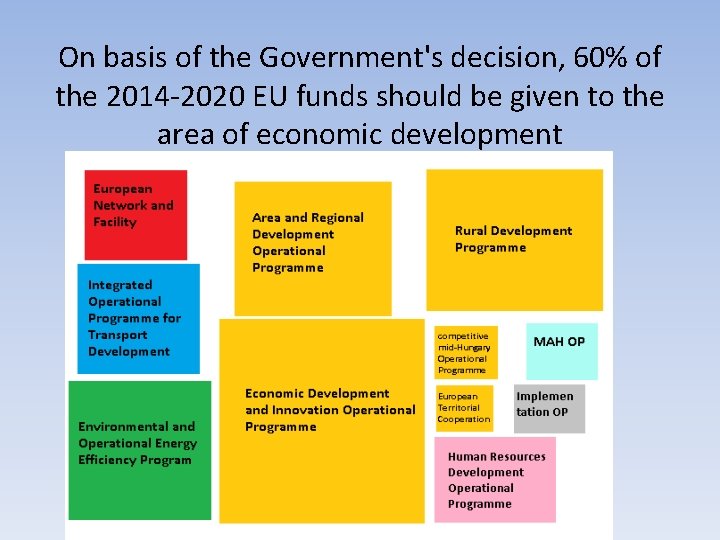
II/3. Allocation of Operational Programme
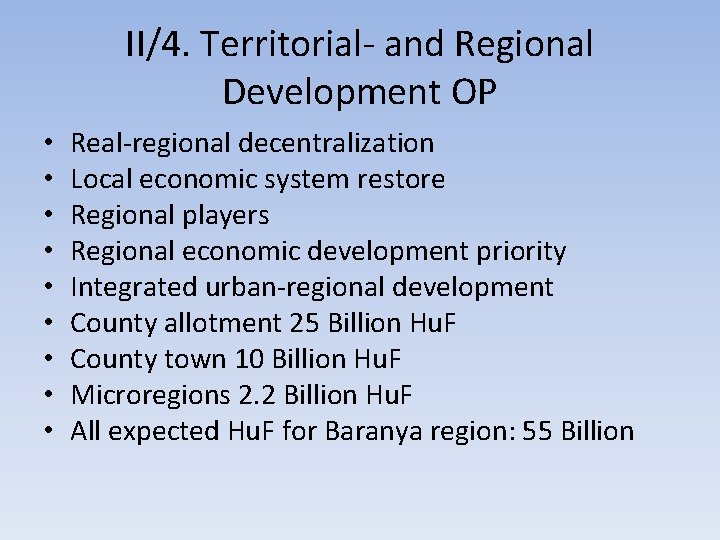
II/4. Territorial- and Regional Development OP • • • Real-regional decentralization Local economic system restore Regional players Regional economic development priority Integrated urban-regional development County allotment 25 Billion Hu. F County town 10 Billion Hu. F Microregions 2. 2 Billion Hu. F All expected Hu. F for Baranya region: 55 Billion
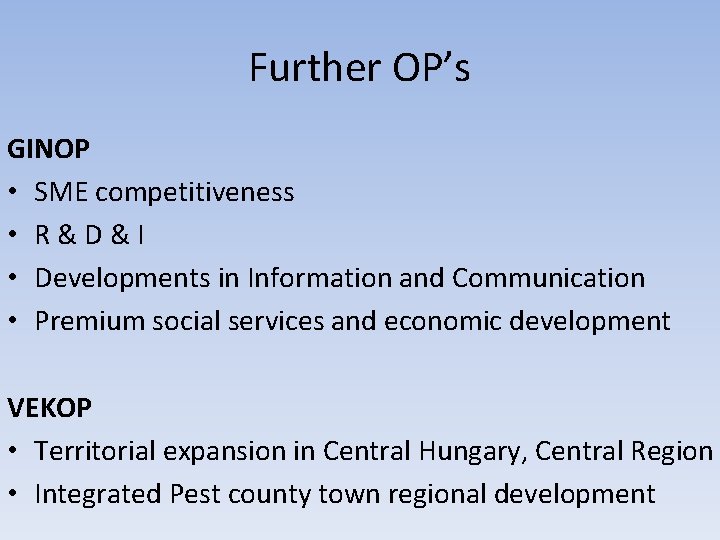
Further OP’s GINOP • SME competitiveness • R&D&I • Developments in Information and Communication • Premium social services and economic development VEKOP • Territorial expansion in Central Hungary, Central Region • Integrated Pest county town regional development
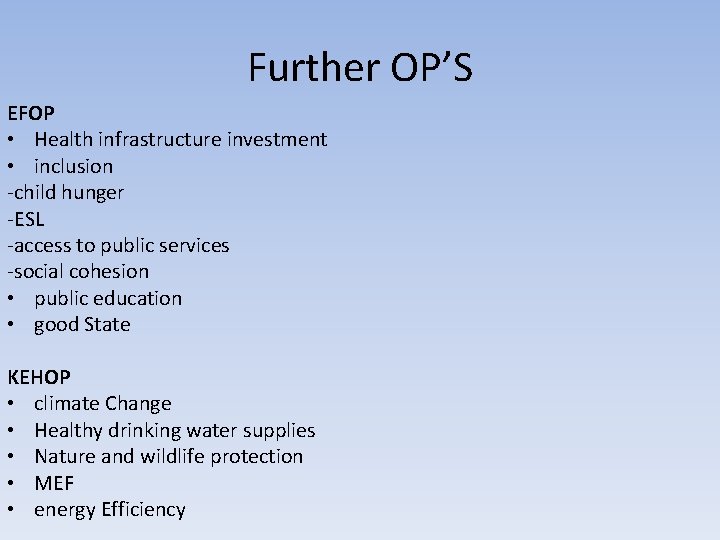
Further OP’S EFOP • Health infrastructure investment • inclusion -child hunger -ESL -access to public services -social cohesion • public education • good State KEHOP • climate Change • Healthy drinking water supplies • Nature and wildlife protection • MEF • energy Efficiency
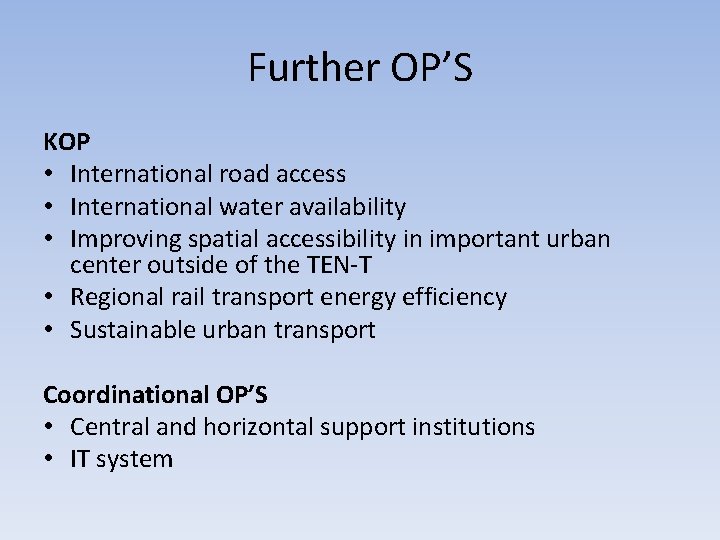
Further OP’S KOP • International road access • International water availability • Improving spatial accessibility in important urban center outside of the TEN-T • Regional rail transport energy efficiency • Sustainable urban transport Coordinational OP’S • Central and horizontal support institutions • IT system
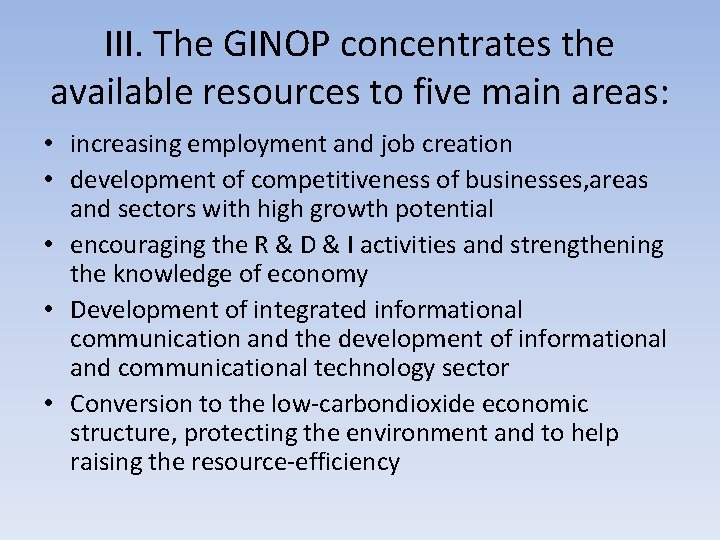
III. The GINOP concentrates the available resources to five main areas: • increasing employment and job creation • development of competitiveness of businesses, areas and sectors with high growth potential • encouraging the R & D & I activities and strengthening the knowledge of economy • Development of integrated informational communication and the development of informational and communicational technology sector • Conversion to the low-carbondioxide economic structure, protecting the environment and to help raising the resource-efficiency
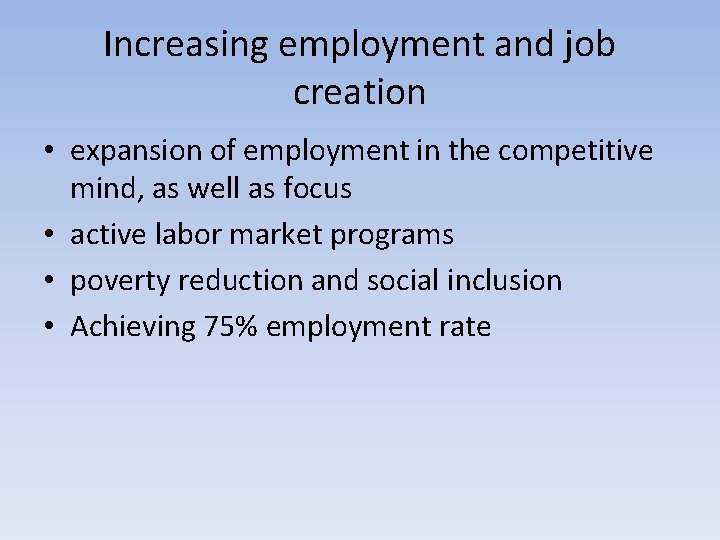
Increasing employment and job creation • expansion of employment in the competitive mind, as well as focus • active labor market programs • poverty reduction and social inclusion • Achieving 75% employment rate
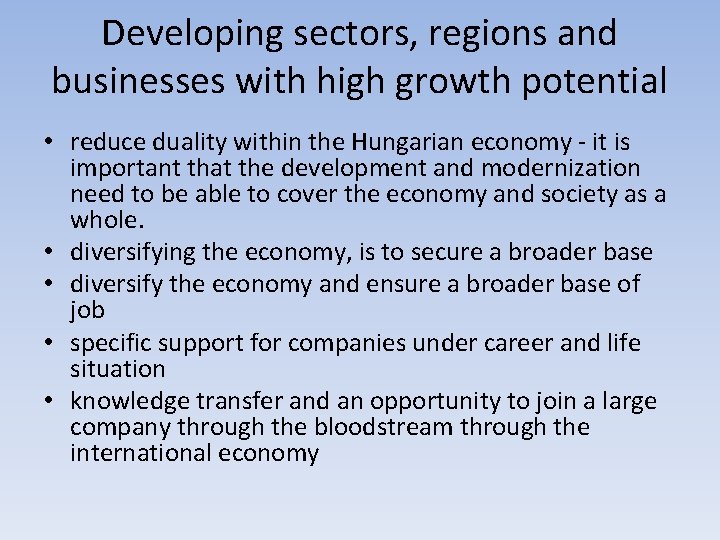
Developing sectors, regions and businesses with high growth potential • reduce duality within the Hungarian economy - it is important that the development and modernization need to be able to cover the economy and society as a whole. • diversifying the economy, is to secure a broader base • diversify the economy and ensure a broader base of job • specific support for companies under career and life situation • knowledge transfer and an opportunity to join a large company through the bloodstream through the international economy
IV. Preparation of the Hungarian National Transport Strategy This planning process started several years ago, and the final version, but from the side of the government, it is not accepted yet.
IV/1. Unified Transport development Strategy The HNTS is the direct strategic antecedent of the UTDS, which: • builds on the 2006. revision of the EU White Book • complement and further develop the document by the Hungarian Transport Policy 2003 -2015 HNTS aims to develop a strategic framework for the creation of the Transport Operational Programme start (drawdown of EU funds)
Hungarian National Transport Strategy In line with the Community policy time horizon of the NKS has large, medium and long-term goals for the medium and longterm vision and scheduling - project elements - should be fixed. • Medium-term time horizon: the first seven years of the EU budget in the 2014 -2020 cycle. • Long-term time horizon: 2020 -2030. Projects determining a second seven-year EU budget cycle in the 2021 -2027 • High-term time horizon: 2030 -2050.
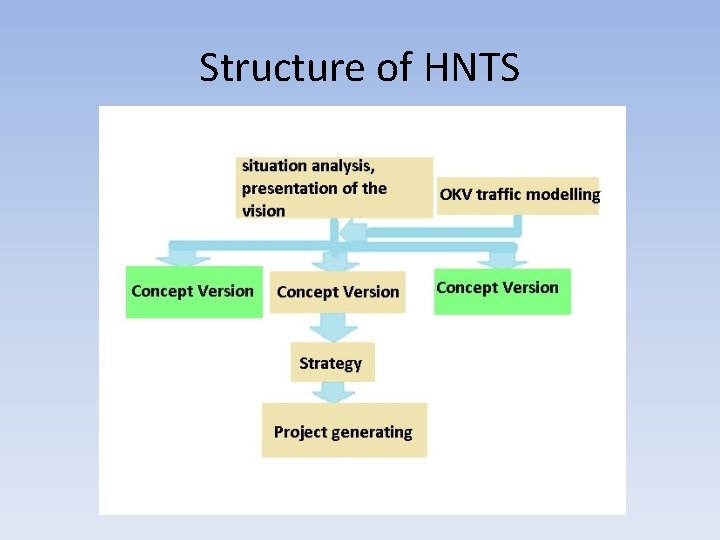
Structure of HNTS
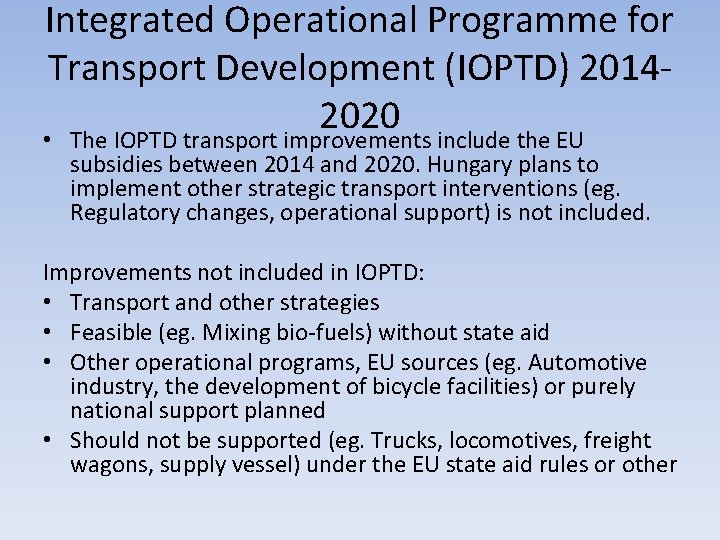
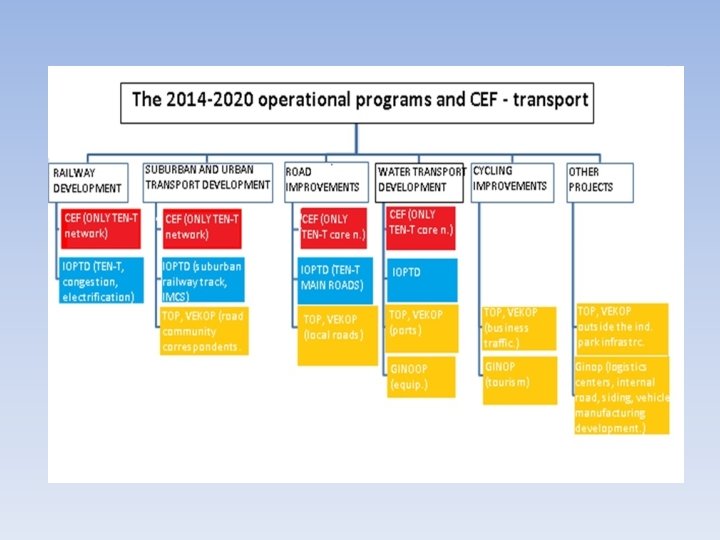
Integrated Operational Programme for Transport Development (IOPTD) 20142020 • The IOPTD transport improvements include the EU subsidies between 2014 and 2020. Hungary plans to implement other strategic transport interventions (eg. Regulatory changes, operational support) is not included. Improvements not included in IOPTD: • Transport and other strategies • Feasible (eg. Mixing bio-fuels) without state aid • Other operational programs, EU sources (eg. Automotive industry, the development of bicycle facilities) or purely national support planned • Should not be supported (eg. Trucks, locomotives, freight wagons, supply vessel) under the EU state aid rules or other
On basis of the Government's decision, 60% of the 2014 -2020 EU funds should be given to the area of economic development
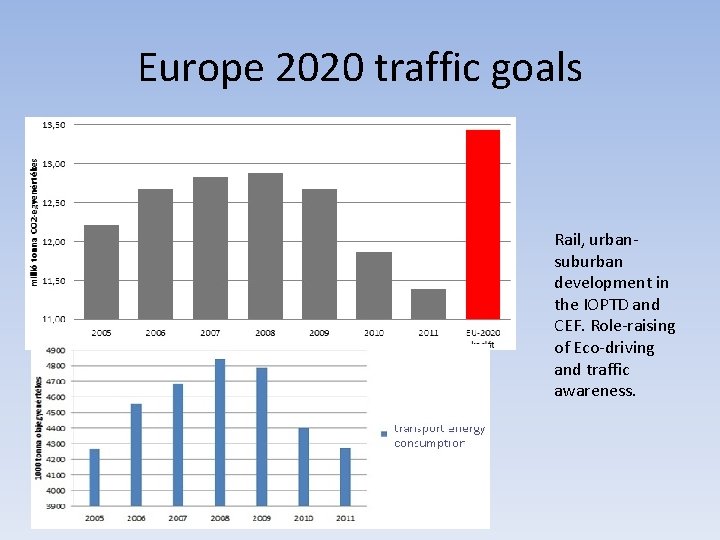
Europe 2020 traffic goals Rail, urbansuburban development in the IOPTD and CEF. Role-raising of Eco-driving and traffic awareness.
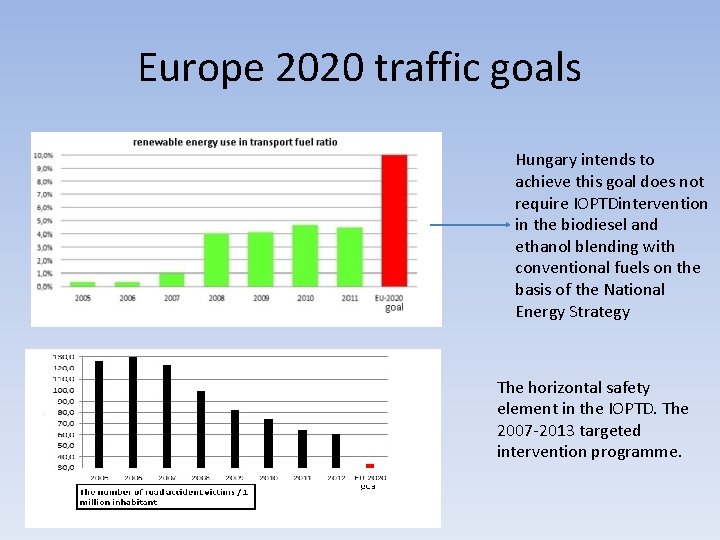
Europe 2020 traffic goals Hungary intends to achieve this goal does not require IOPTDintervention in the biodiesel and ethanol blending with conventional fuels on the basis of the National Energy Strategy The horizontal safety element in the IOPTD. The 2007 -2013 targeted intervention programme.
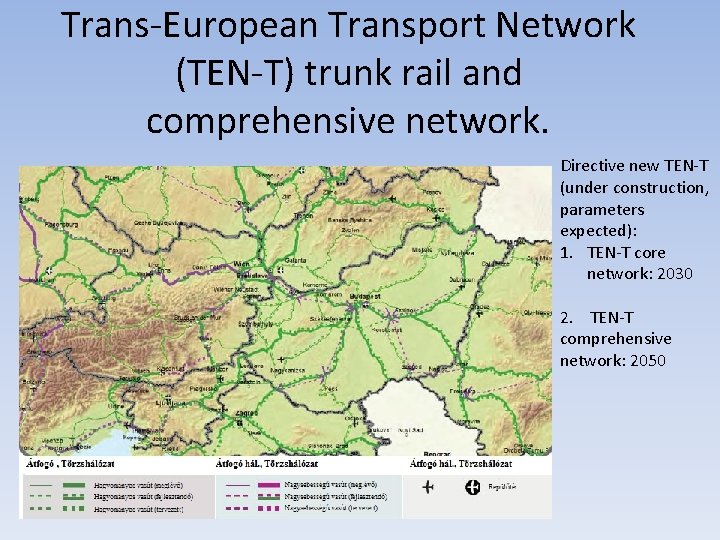
Trans-European Transport Network (TEN-T) trunk rail and comprehensive network. Directive new TEN-T (under construction, parameters expected): 1. TEN-T core network: 2030 2. TEN-T comprehensive network: 2050
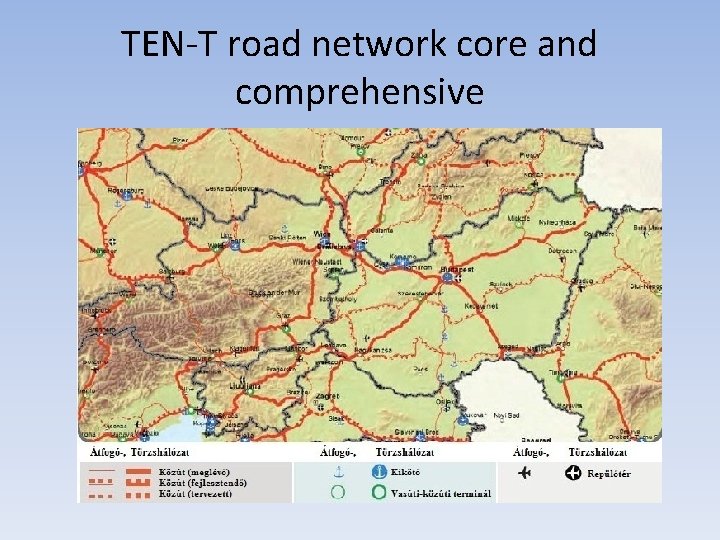
TEN-T road network core and comprehensive
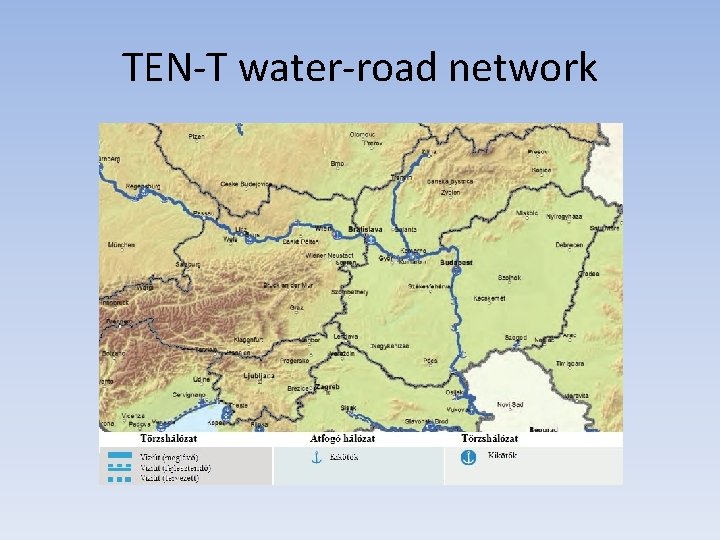
TEN-T water-road network
Only the well-prepared transport improvement projects will be added to the IOPTD’s list Conditions canal project developed by the European Commission, which should be the development of transportation projects for the operational program list aversion meet: 1. Feasibility study completed 2. Positive socio-economic cost-benefit analysis, the future financing of the operation and demonstrate the EU's financial contribution is required. 3. Environmental impact assessment and other assessments (eg. Habitat and water framework directives) have been completed, or at least sufficiently advanced (eg. other public authorities closed the discussion) 4. Detailed implementation schedule is available. (eg, . area expropriation) Following the formal submission of the Operational Programme Monitoring Committee will have the opportunity to meet the inclusion criteria for development of the project list.
Thank you for your attention!