
2013 Using Case Studies and Problem Based Learning
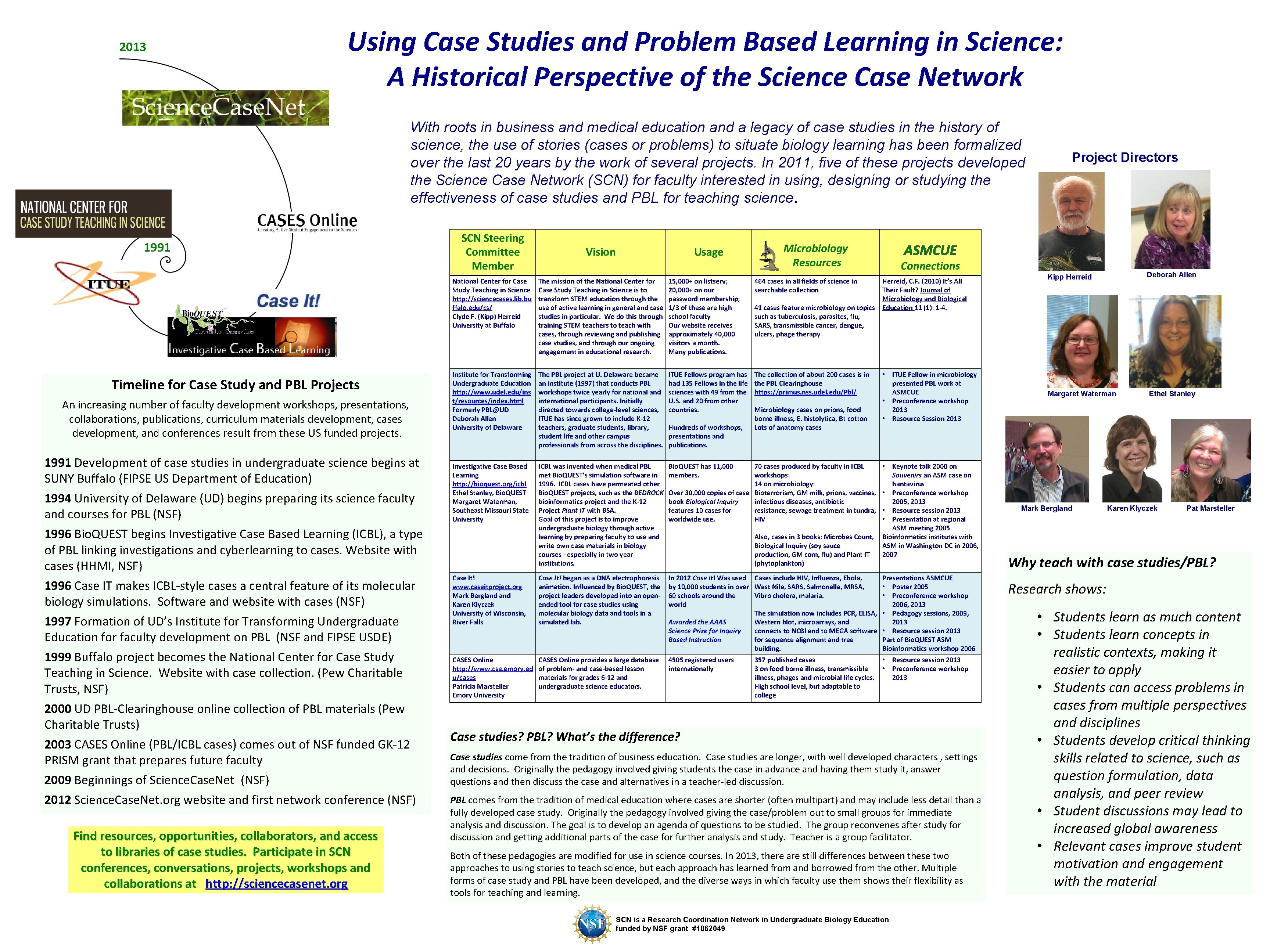
2013 Using Case Studies and Problem Based Learning in Science: A Historical Perspective of the Science Case Network With roots in business and medical education and a legacy of case studies in the history of science, the use of stories (cases or problems) to situate biology learning has been formalized over the last 20 years by the work of several projects. In 2011, five of these projects developed the Science Case Network (SCN) for faculty interested in using, designing or studying the effectiveness of case studies and PBL for teaching science. 1991 Timeline for Case Study and PBL Projects An increasing number of faculty development workshops, presentations, collaborations, publications, curriculum materials development, cases development, and conferences result from these US funded projects. 1991 Development of case studies in undergraduate science begins at SUNY Buffalo (FIPSE US Department of Education) 1994 University of Delaware (UD) begins preparing its science faculty and courses for PBL (NSF) 1996 Bio. QUEST begins Investigative Case Based Learning (ICBL), a type of PBL linking investigations and cyberlearning to cases. Website with cases (HHMI, NSF) 1996 Case IT makes ICBL-style cases a central feature of its molecular biology simulations. Software and website with cases (NSF) 1997 Formation of UD’s Institute for Transforming Undergraduate Education for faculty development on PBL (NSF and FIPSE USDE) 1999 Buffalo project becomes the National Center for Case Study Teaching in Science. Website with case collection. (Pew Charitable Trusts, NSF) 2000 UD PBL-Clearinghouse online collection of PBL materials (Pew Charitable Trusts) 2003 CASES Online (PBL/ICBL cases) comes out of NSF funded GK-12 PRISM grant that prepares future faculty 2009 Beginnings of Science. Case. Net (NSF) 2012 Science. Case. Net. org website and first network conference (NSF) Find resources, opportunities, collaborators, and access to libraries of case studies. Participate in SCN conferences, conversations, projects, workshops and collaborations at http: //sciencecasenet. org SCN Steering Committee Member Vision Usage The mission of the National Center for Case Study Teaching in Science is to transform STEM education through the use of active learning in general and case studies in particular. We do this through training STEM teachers to teach with cases, through reviewing and publishing case studies, and through our ongoing engagement in educational research. 15, 000+ on listserv; 20, 000+ on our password membership; 1/3 of these are high school faculty Our website receives approximately 40, 000 visitors a month. Many publications. 464 cases in all fields of science in searchable collection Institute for Transforming Undergraduate Education http: //www. udel. edu/ins t/resources/index. html Formerly PBL@UD Deborah Allen University of Delaware The PBL project at U. Delaware became an institute (1997) that conducts PBL workshops twice yearly for national and international participants. Initially directed towards college-level sciences, ITUE has since grown to include K-12 teachers, graduate students, library, student life and other campus professionals from across the disciplines. ITUE Fellows program has had 135 Fellows in the life sciences with 49 from the U. S. and 20 from other countries. The collection of about 200 cases is in the PBL Clearinghouse https: //primus. nss. udel. edu/Pbl/ Investigative Case Based Learning http: //bioquest. org/icbl Ethel Stanley, Bio. QUEST Margaret Waterman, Southeast Missouri State University ICBL was invented when medical PBL met Bio. QUEST’s simulation software in 1996. ICBL cases have permeated other Bio. QUEST projects, such as the BEDROCK bioinformatics project and the K-12 Project Plant IT with BSA. Goal of this project is to improve undergraduate biology through active learning by preparing faculty to use and write own case materials in biology courses - especially in two year institutions. Bio. QUEST has 11, 000 members. Case It! www. caseitproject. org Mark Bergland Karen Klyczek University of Wisconsin, River Falls Case It! began as a DNA electrophoresis animation. Influenced by Bio. QUEST, the project leaders developed into an openended tool for case studies using molecular biology data and tools in a simulated lab. In 2012 Case It! Was used Cases include HIV, Influenza, Ebola, by 10, 000 students in over West Nile, SARS, Salmonella, MRSA, 60 schools around the Vibro cholera, malaria. world The simulation now includes PCR, ELISA, Awarded the AAAS Western blot, microarrays, and Science Prize for Inquiry connects to NCBI and to MEGA software Based Instruction for sequence alignment and tree building. CASES Online http: //www. cse. emory. ed u/cases Patricia Marsteller Emory University CASES Online provides a large database of problem- and case-based lesson materials for grades 6 -12 and undergraduate science educators. 4505 registered users internationally Hundreds of workshops, presentations and publications. ASMCUE Microbiology Resources National Center for Case Study Teaching in Science http: //sciencecases. lib. bu ffalo. edu/cs/ Clyde F. (Kipp) Herreid University at Buffalo Connections Herreid, C. F. (2010) It’s All Their Fault? Journal of Microbiology and Biological 41 cases feature microbiology on topics Education 11 (1): 1 -4. such as tuberculosis, parasites, flu, SARS, transmissible cancer, dengue, ulcers, phage therapy Microbiology cases on prions, food borne illness, E. histolytica, Bt cotton Lots of anatomy cases Project Directors • ITUE Fellow in microbiology presented PBL work at ASMCUE • Preconference workshop 2013 • Resource Session 2013 70 cases produced by faculty in ICBL workshops: 14 on microbiology: Over 30, 000 copies of case Bioterrorism, GM milk, prions, vaccines, book Biological Inquiry infectious diseases, antibiotic features 10 cases for resistance, sewage treatment in tundra, worldwide use. HIV • Keynote talk 2000 on Souvenirs an ASM case on hantavirus • Preconference workshop 2005, 2013 • Resource session 2013 • Presentation at regional ASM meeting 2005 Also, cases in 3 books: Microbes Count, Bioinformatics institutes with Biological Inquiry (soy sauce ASM in Washington DC in 2006, production, GM corn, flu) and Plant IT 2007 (phytoplankton) Presentations ASMCUE • Poster 2005 • Preconference workshop 2006, 2013 • Pedagogy sessions, 2009, 2013 • Resource session 2013 Part of Bio. QUEST ASM Bioinformatics workshop 2006 357 published cases • Resource session 2013 3 on food borne illness, transmissible • Preconference workshop illness, phages and microbial life cycles. 2013 High school level, but adaptable to college Case studies? PBL? What’s the difference? Case studies come from the tradition of business education. Case studies are longer, with well developed characters , settings and decisions. Originally the pedagogy involved giving students the case in advance and having them study it, answer questions and then discuss the case and alternatives in a teacher-led discussion. PBL comes from the tradition of medical education where cases are shorter (often multipart) and may include less detail than a fully developed case study. Originally the pedagogy involved giving the case/problem out to small groups for immediate analysis and discussion. The goal is to develop an agenda of questions to be studied. The group reconvenes after study for discussion and getting additional parts of the case for further analysis and study. Teacher is a group facilitator. Both of these pedagogies are modified for use in science courses. In 2013, there are still differences between these two approaches to using stories to teach science, but each approach has learned from and borrowed from the other. Multiple forms of case study and PBL have been developed, and the diverse ways in which faculty use them shows their flexibility as tools for teaching and learning. SCN is a Research Coordination Network in Undergraduate Biology Education funded by NSF grant #1062049 Kipp Herreid Deborah Allen Margaret Waterman Ethel Stanley Mark Bergland Karen Klyczek Pat Marsteller Why teach with case studies/PBL? Research shows: • Students learn as much content • Students learn concepts in realistic contexts, making it easier to apply • Students can access problems in cases from multiple perspectives and disciplines • Students develop critical thinking skills related to science, such as question formulation, data analysis, and peer review • Student discussions may lead to increased global awareness • Relevant cases improve student motivation and engagement with the material
- Slides: 1