
2013 Sutta Vibhanga Course Discourse Analysis Lesson Ten
2013 Sutta Vibhanga Course (Discourse Analysis) Lesson Ten Happiness Of Meditation Conducted by – Ven. K. Rathanasara Organized by 1
Happiness Of Meditation 2
What is Meditation (bhāvanā)? Buddha says Nāhaṃ bhikkhave aññaṃ ekadhammaṃ Samanupassāmi yaṃ evaṃ bhāvitaṃ Bahulīkataṃ sukhāvahaṃ hoti Yatayidaṃ cittaṃ No other thing do I know, O monks, that brings so much happiness as a developed and cultivated mind. A developed and cultivated mind truly brings Happiness. A. N. I, iii 3
Two inter-related meditation systems 1. Development of Serenity – Samatha Bhāvanā 2. Development of Insight – Vipassanā Bhāvanā 4
Samatha Bhāvanā The outcome of Serenity Meditation: Sublime spiritual Happiness achieved through • suppressing and • taming defilements in the mind 12
Vipassanā Bhāvanā • Direct penetration of 3 characteristics of phenomena, taking 5 aggregates as its object. 13
Vipassanā Bhāvanā The outcome of Insight Meditation: Perfect, sublime, highest peace and happiness (Nibbāna) achieved through • Eradication of all defilements in the mind 14
Happiness & Meditation Buddha says to Ven Ānanda… Fivefold, Ānanda, are sensual bonds, what are the Five? 1. Forms cognizable by the Eye 2. Sound cognizable by the Ear 3. Odours cognizable by the Nose 4. Flavors cognizable by the Tongue 5. Contacts cognizable by the Body Desirable, lovely, charming, infatuating, accompanied by thirst, and arousing the dust of Passion. M. N. - Bahuvedanīya Sutta 15
1. These Ānanda, are the Five sensual bonds. Whatever happiness or pleasure arises from these sensual bonds is known as Sensual Happiness. Whoever should declare “This is the highest happiness and pleasure which beings may experience” I do NOT grant him that and why? Because there is other happiness more exalted and sublime. 16
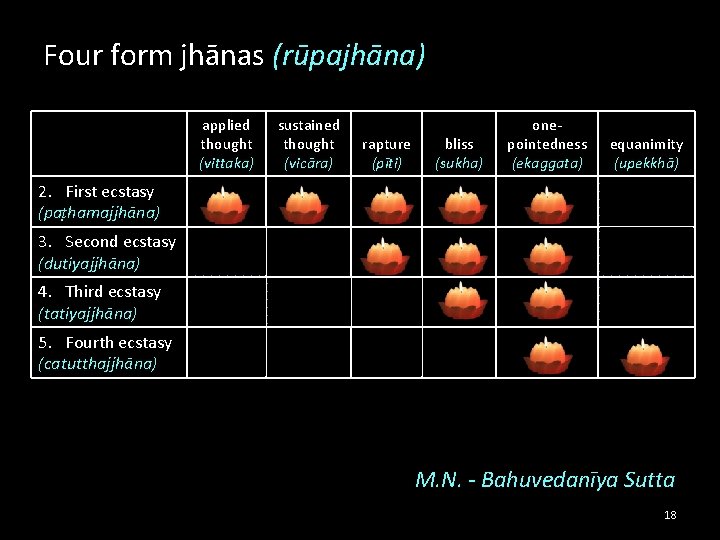
Four form jhānas (rūpajhāna) applied thought (vittaka) sustained thought (vicāra) rapture (pīti) bliss (sukha) onepointedness (ekaggata) equanimity (upekkhā) 2. First ecstasy (paṭhamajjhāna) 3. Second ecstasy (dutiyajjhāna) 4. Third ecstasy (tatiyajjhāna) 5. Fourth ecstasy (catutthajjhāna) M. N. - Bahuvedanīya Sutta 18
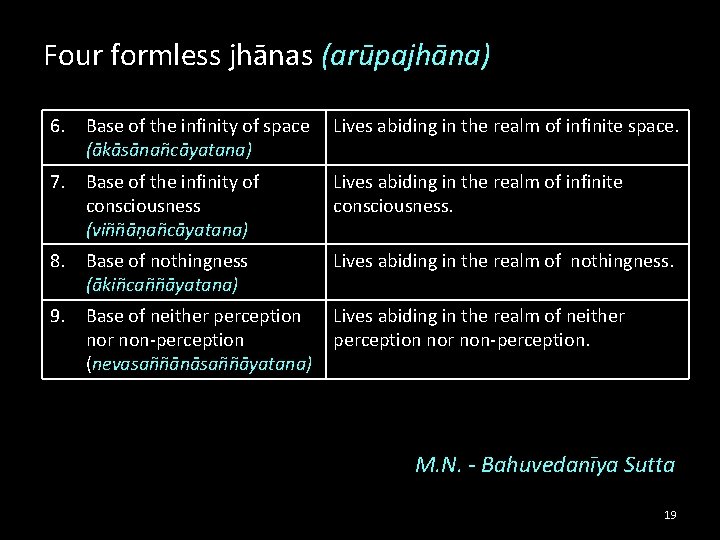
Four formless jhānas (arūpajhāna) 6. Base of the infinity of space (ākāsānañcāyatana) Lives abiding in the realm of infinite space. 7. Base of the infinity of consciousness (viññāṇañcāyatana) Lives abiding in the realm of infinite consciousness. 8. Base of nothingness (ākiñcaññāyatana) Lives abiding in the realm of nothingness. 9. Base of neither perception nor non-perception (nevasaññānāsaññāyatana) Lives abiding in the realm of neither perception nor non-perception. M. N. - Bahuvedanīya Sutta 19
10. Cessation of Perception and Sensation (saññāvedayita nirodha) • Lives, having attained to the Cessation of Perception and Sensation. • Nibhanic bliss experienced by the Enlightened Ones. M. N. - Bahuvedanīya Sutta 20
Four Divine abodes & Happiness Brahmin student Subha said to the Blessed One: “Master Gotama, I have heard that the ascetic Gotama teaches the path to the company of Brahma. It would be good if Master Gotama would teach me the path to the company of Brahma. " 21
Buddha taught him Four Divine abodes 1. 2. 3. 4. Loving Kindness (mettā) Compassion (karuṇā) Appreciation Joy (muditā) Equanimity (upekkhā) M. N. - Subha Sutta Refer to Course Notes 22
Why should you practice Mettā? 1. Mettā is the base for all the Meritorious deeds. Buddha says… “Monks, whatever grounds there are for making merit productive of a future birth, all these do not equal a sixteenth part of the liberation of mind by loving-kindness. The liberation of mind by loving-kindness surpasses them and shines forth, bright and brilliant. ” Itivuttaka Refer to Course notes 23
2. Mettā is the base for Happiness here and here after death. 3. Mettā is a powerful Tool of Protection. • Khanda Paritta Buddha taught monks to radiate mettā as a means of Protection from poisonous snakes. • Karaṇīya Metta Sutta Buddha advised monks to practice mettā to avoid disturbances from unseen beings. 24
4. Mettā is a strong antidote for unwholesome destructive defilements like Hatred, Ill-will, Jealousy, Anger and Cruelty. 5. Mettā is one of the 10 Perfections that Bodhisatvās cultivate. 6. Mettā practice leads someone to be born in fine material realm (brahma loka). 7. Mettā can bring 11 benefits in our life. A. N. - Mettānisaṃsa Sutta 25
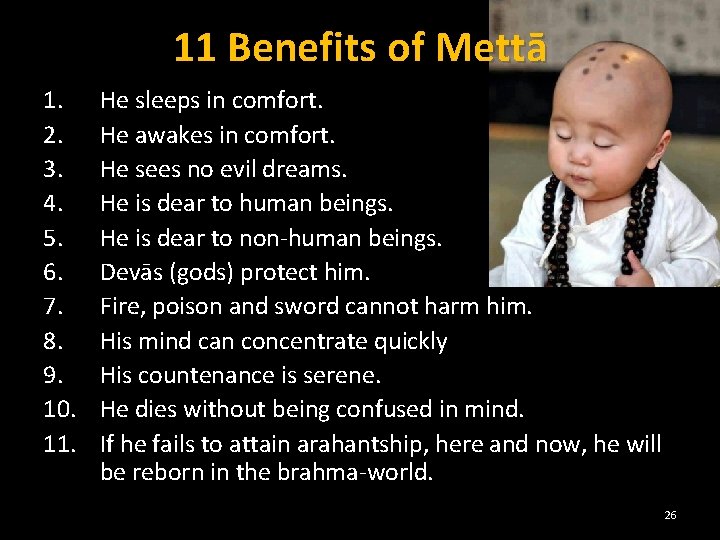
11 Benefits of Mettā 1. 2. 3. 4. 5. 6. 7. 8. 9. 10. 11. He sleeps in comfort. He awakes in comfort. He sees no evil dreams. He is dear to human beings. He is dear to non-human beings. Devās (gods) protect him. Fire, poison and sword cannot harm him. His mind can concentrate quickly His countenance is serene. He dies without being confused in mind. If he fails to attain arahantship, here and now, he will be reborn in the brahma-world. 26
How to Practice Mettā? 27
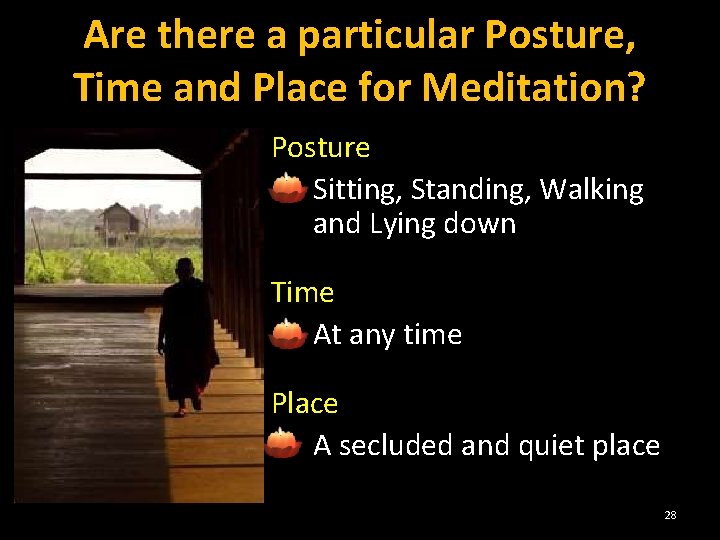
Are there a particular Posture, Time and Place for Meditation? Posture • Sitting, Standing, Walking and Lying down Time • At any time Place • A secluded and quiet place 28
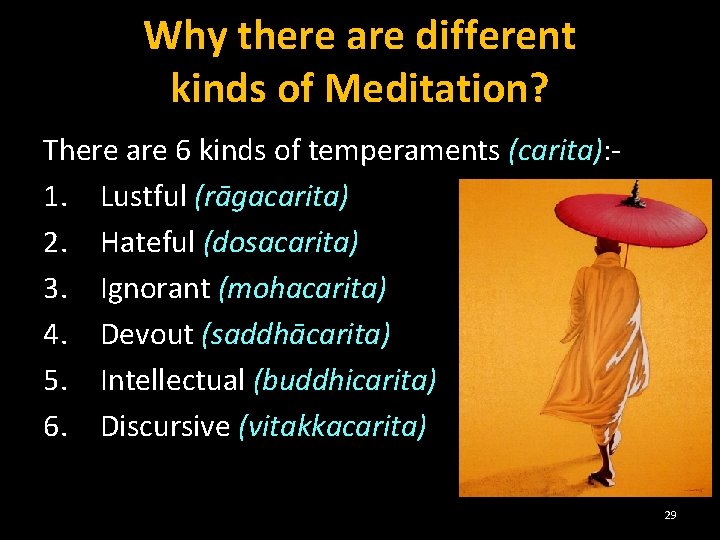
Why there are different kinds of Meditation? There are 6 kinds of temperaments (carita): 1. Lustful (rāgacarita) 2. Hateful (dosacarita) 3. Ignorant (mohacarita) 4. Devout (saddhācarita) 5. Intellectual (buddhicarita) 6. Discursive (vitakkacarita) 29
What are the 5 Hindrances (pañca nīvaraṇa)? 1. 2. 3. 4. 5. Sensual desire (kāmacchanda) Anger or ill-will (vyāpāda) Sloth and torpor (thīnamiddha) Restlessness and worry (uddhacca-kukkucca) Doubt (vicikicchā) 30
Highlights 1. 2. 3. 4. 5. What is Meditation? What are the TWO systems of Meditation? What are the SIX temperaments? What are the FOUR divine abodes? Why should you practice Metta? 37
Highlights 6. 7. 8. 9. What are the ELEVEN benefits of practicing Metta? What is the Purpose of practicing Meditation? What is the End Product of Successful Meditation Practice? What are the FIVE hindrances for meditation? 38
Self Reflection What I have learnt Today… What I can do to be Better…. 39
- Slides: 25