
2013 National Instruments Week Smart Grid Communications Prof
- Slides: 54
2013 National Instruments Week Smart Grid Communications Prof. Brian L. Evans Dept. of Electrical & Computer Engineering Wireless Networking & Communications Group The University of Texas at Austin 7 August 2013 In collaboration with Ms. Jing Lin, Mr. Yousof Mortazavi, Mr. Marcel Nassar & Mr. Karl Nieman at UT Mr. Mike Dow & Dr. Khurram Waheed at Freescale Semiconductor (Austin) Dr. Anuj Batra, Dr. Anand Dabak & Dr. Il Han Kim at Texas Instruments (Dallas) Dr. Doug Kim, Mr. James Kimery, Mr. Mike Trimborn and Dr. Ian Wong (NI) http: //users. ece. utexas. edu/~bevans/projects/plc/index. html Austin, Texas USA
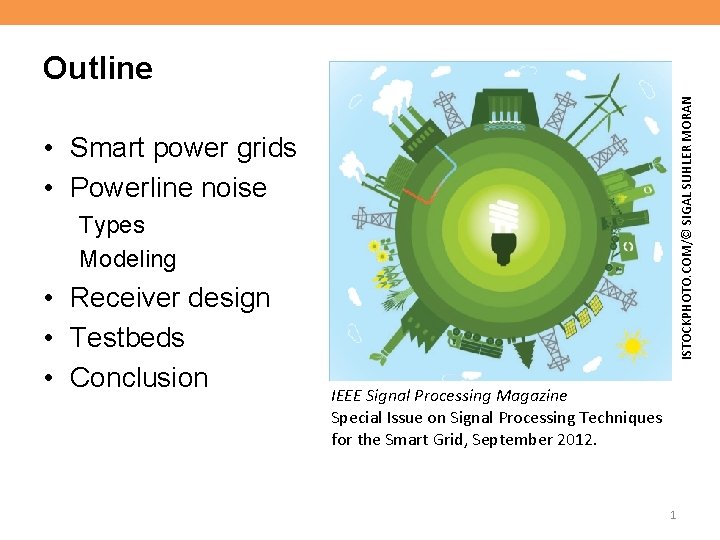
ISTOCKPHOTO. COM/© SIGAL SUHLER MORAN Outline • Smart power grids • Powerline noise Types Modeling • Receiver design • Testbeds • Conclusion IEEE Signal Processing Magazine Special Issue on Signal Processing Techniques for the Smart Grid, September 2012. 1
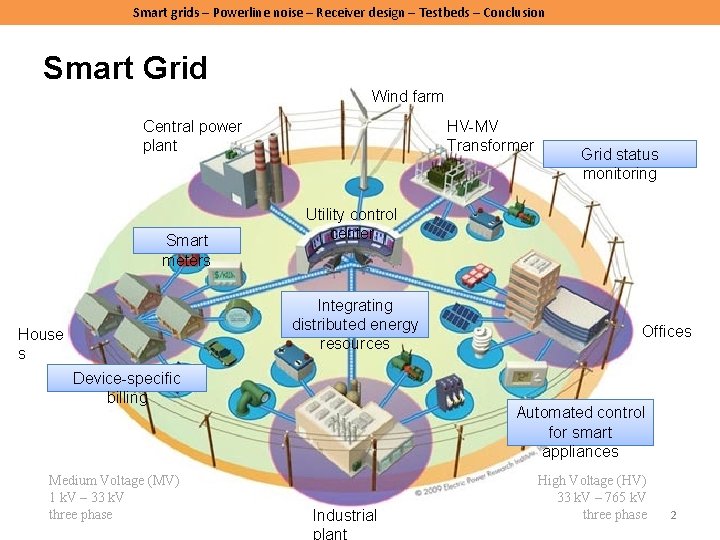
Smart grids – Powerline noise – Receiver design – Testbeds – Conclusion Smart Grid Wind farm HV-MV Transformer Central power plant Smart meters Utility control center Integrating distributed energy resources House s Device-specific billing Medium Voltage (MV) 1 k. V – 33 k. V three phase Grid status monitoring Offices Automated control for smart appliances Industrial plant High Voltage (HV) 33 k. V – 765 k. V three phase 2
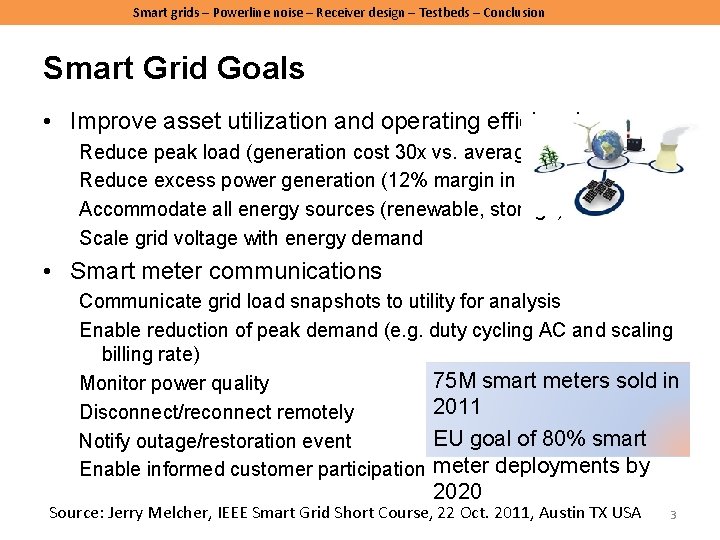
Smart grids – Powerline noise – Receiver design – Testbeds – Conclusion Smart Grid Goals • Improve asset utilization and operating efficiencies Reduce peak load (generation cost 30 x vs. average load) Reduce excess power generation (12% margin in US) Accommodate all energy sources (renewable, storage) Scale grid voltage with energy demand • Smart meter communications Communicate grid load snapshots to utility for analysis Enable reduction of peak demand (e. g. duty cycling AC and scaling billing rate) 75 M smart meters sold in Monitor power quality 2011 Disconnect/reconnect remotely EU goal of 80% smart Notify outage/restoration event Enable informed customer participation meter deployments by 2020 Source: Jerry Melcher, IEEE Smart Grid Short Course, 22 Oct. 2011, Austin TX USA 3
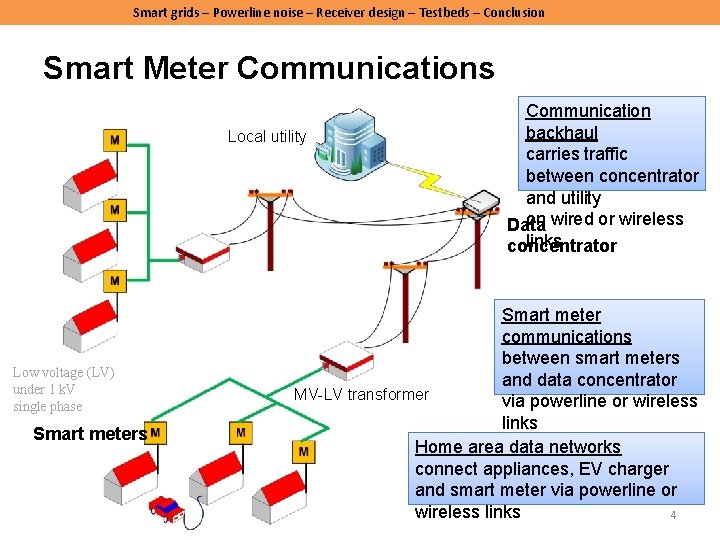
Smart grids – Powerline noise – Receiver design – Testbeds – Conclusion Smart Meter Communications Local utility Low voltage (LV) under 1 k. V single phase Smart meters Communication backhaul carries traffic between concentrator and utility on wired or wireless Data links concentrator Smart meter communications between smart meters and data concentrator MV-LV transformer via powerline or wireless links Home area data networks connect appliances, EV charger and smart meter via powerline or wireless links 4
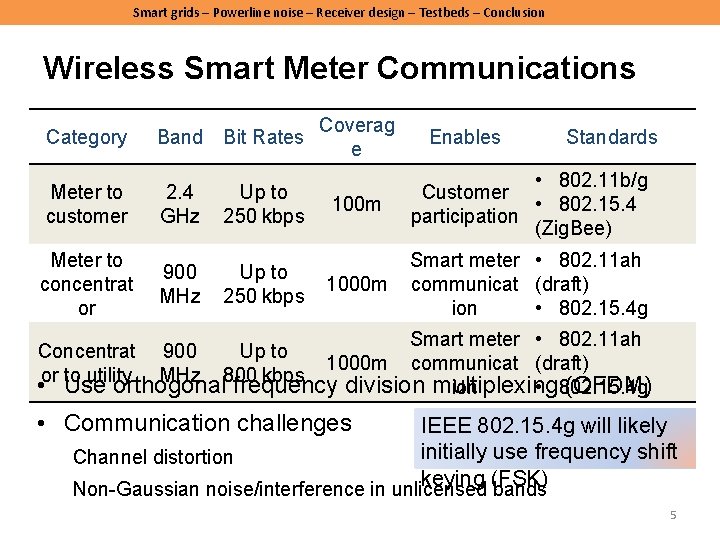
Smart grids – Powerline noise – Receiver design – Testbeds – Conclusion Wireless Smart Meter Communications Category Band Bit Rates Meter to customer 2. 4 GHz Up to 250 kbps Meter to concentrat or 900 MHz Up to 250 kbps Concentrat or to utility 900 MHz Up to 800 kbps • Use orthogonal Coverag e Enables Standards 100 m • 802. 11 b/g Customer • 802. 15. 4 participation (Zig. Bee) 1000 m Smart meter • 802. 11 ah communicat (draft) ion • 802. 15. 4 g Smart meter • 802. 11 ah 1000 m communicat (draft) frequency division multiplexing (OFDM) ion • 802. 15. 4 g • Communication challenges IEEE 802. 15. 4 g will likely initially use frequency shift Channel distortion keying (FSK) Non-Gaussian noise/interference in unlicensed bands 5
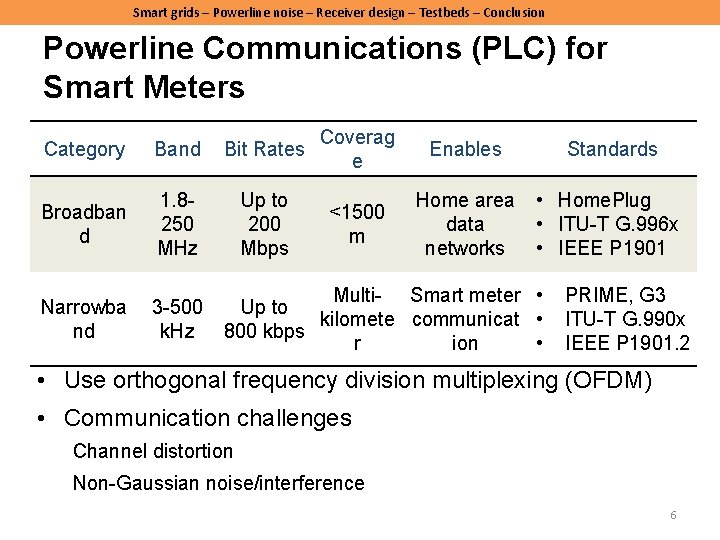
Smart grids – Powerline noise – Receiver design – Testbeds – Conclusion Powerline Communications (PLC) for Smart Meters Category Band Bit Rates Coverag e Enables Standards Broadban d 1. 8250 MHz Up to 200 Mbps <1500 m Home area data networks • Home. Plug • ITU-T G. 996 x • IEEE P 1901 Narrowba nd 3 -500 k. Hz Multi- Smart meter • Up to kilomete communicat • 800 kbps r ion • PRIME, G 3 ITU-T G. 990 x IEEE P 1901. 2 • Use orthogonal frequency division multiplexing (OFDM) • Communication challenges Channel distortion Non-Gaussian noise/interference 6
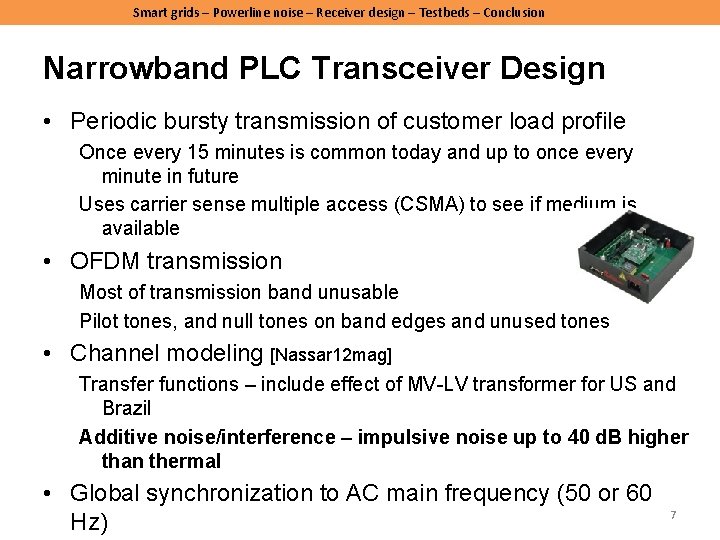
Smart grids – Powerline noise – Receiver design – Testbeds – Conclusion Narrowband PLC Transceiver Design • Periodic bursty transmission of customer load profile Once every 15 minutes is common today and up to once every minute in future Uses carrier sense multiple access (CSMA) to see if medium is available • OFDM transmission Most of transmission band unusable Pilot tones, and null tones on band edges and unused tones • Channel modeling [Nassar 12 mag] Transfer functions – include effect of MV-LV transformer for US and Brazil Additive noise/interference – impulsive noise up to 40 d. B higher than thermal • Global synchronization to AC main frequency (50 or 60 Hz) 7
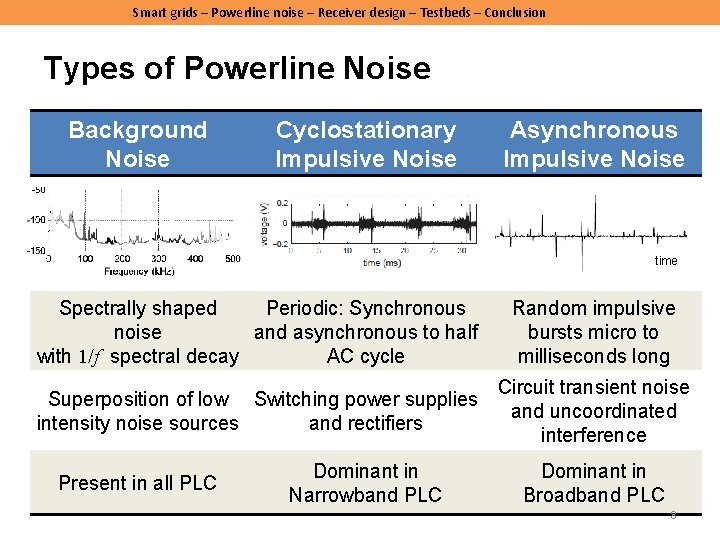
Smart grids – Powerline noise – Receiver design – Testbeds – Conclusion Types of Powerline Noise Background Noise Cyclostationary Impulsive Noise Asynchronous Impulsive Noise time Periodic: Synchronous Spectrally shaped and asynchronous to half noise with 1/f spectral decay AC cycle Random impulsive bursts micro to milliseconds long Superposition of low Switching power supplies intensity noise sources and rectifiers Circuit transient noise and uncoordinated interference Present in all PLC Dominant in Narrowband PLC Dominant in Broadband PLC 8
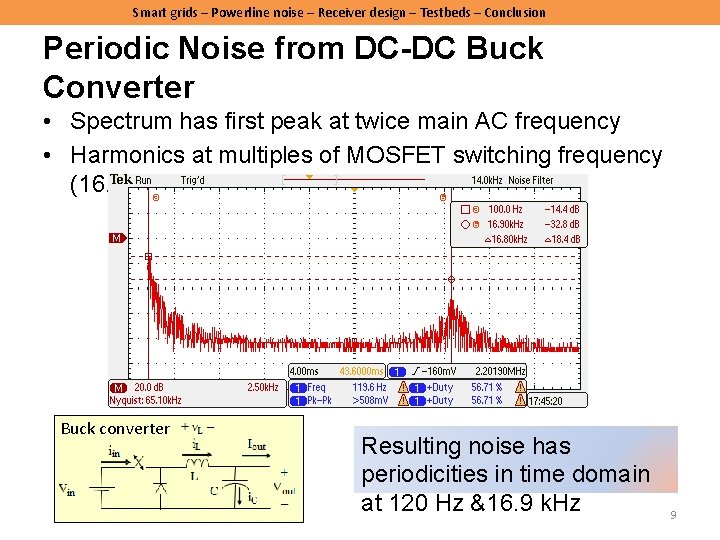
Smart grids – Powerline noise – Receiver design – Testbeds – Conclusion Periodic Noise from DC-DC Buck Converter • Spectrum has first peak at twice main AC frequency • Harmonics at multiples of MOSFET switching frequency (16. 9 k. Hz) Buck converter Resulting noise has periodicities in time domain at 120 Hz &16. 9 k. Hz 9
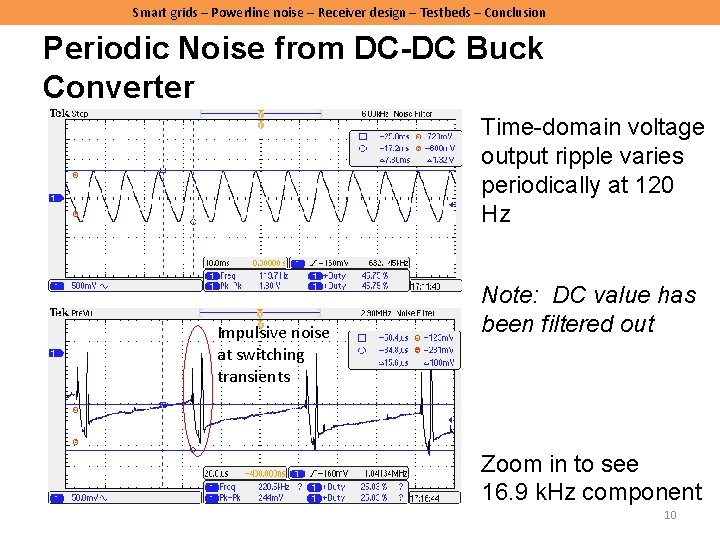
Smart grids – Powerline noise – Receiver design – Testbeds – Conclusion Periodic Noise from DC-DC Buck Converter Time-domain voltage output ripple varies periodically at 120 Hz Impulsive noise at switching transients Note: DC value has been filtered out Zoom in to see 16. 9 k. Hz component 10
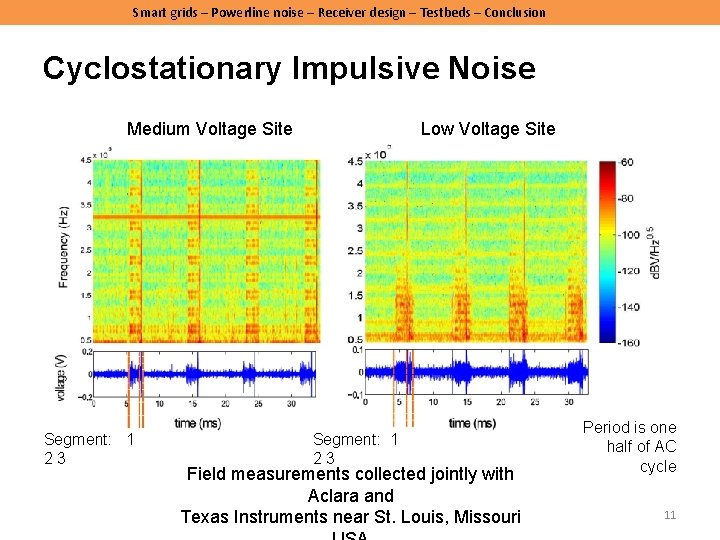
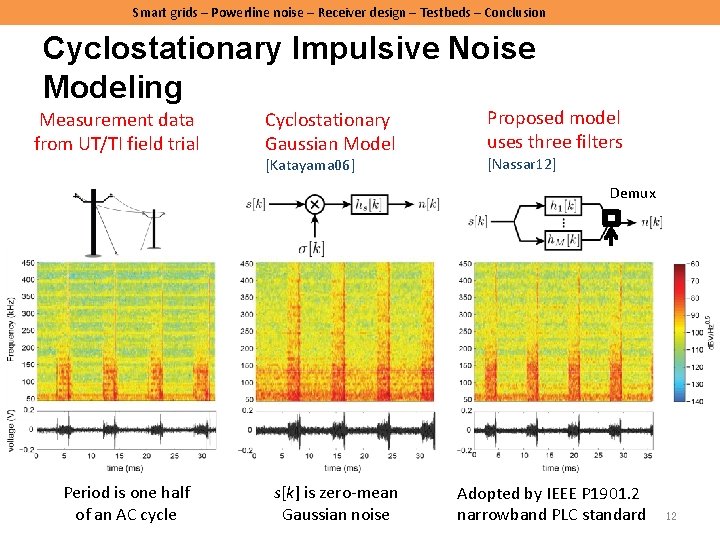
Smart grids – Powerline noise – Receiver design – Testbeds – Conclusion Cyclostationary Impulsive Noise Medium Voltage Site Segment: 1 23 Low Voltage Site Segment: 1 23 Field measurements collected jointly with Aclara and Texas Instruments near St. Louis, Missouri Period is one half of AC cycle 11
Smart grids – Powerline noise – Receiver design – Testbeds – Conclusion Cyclostationary Impulsive Noise Modeling Measurement data from UT/TI field trial Cyclostationary Gaussian Model [Katayama 06] Proposed model uses three filters [Nassar 12] Demux Period is one half of an AC cycle s[k] is zero-mean Gaussian noise Adopted by IEEE P 1901. 2 narrowband PLC standard 12
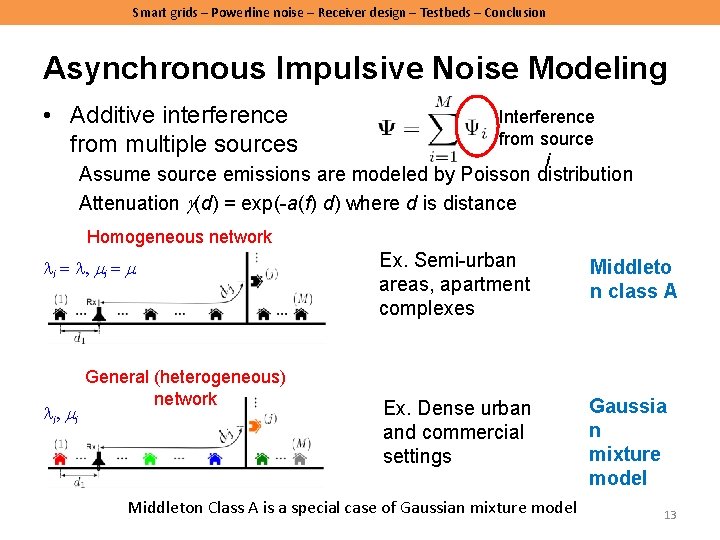
Smart grids – Powerline noise – Receiver design – Testbeds – Conclusion Asynchronous Impulsive Noise Modeling • Additive interference from multiple sources Interference from source i Assume source emissions are modeled by Poisson distribution Attenuation g(d) = exp(-a(f) d) where d is distance Homogeneous network li = l, mi = m l i , mi General (heterogeneous) network Ex. Semi-urban areas, apartment complexes Middleto n class A Ex. Dense urban and commercial settings Gaussia n mixture model Middleton Class A is a special case of Gaussian mixture model 13
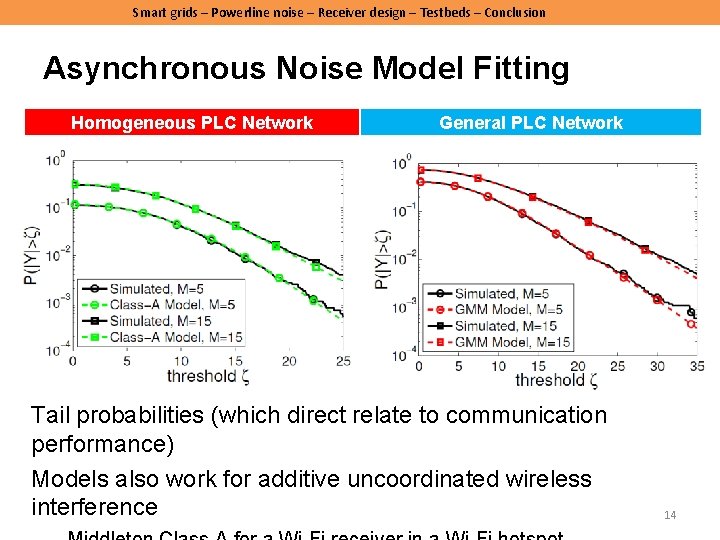
Smart grids – Powerline noise – Receiver design – Testbeds – Conclusion Asynchronous Noise Model Fitting Homogeneous PLC Network General PLC Network Tail probabilities (which direct relate to communication performance) Models also work for additive uncoordinated wireless interference 14
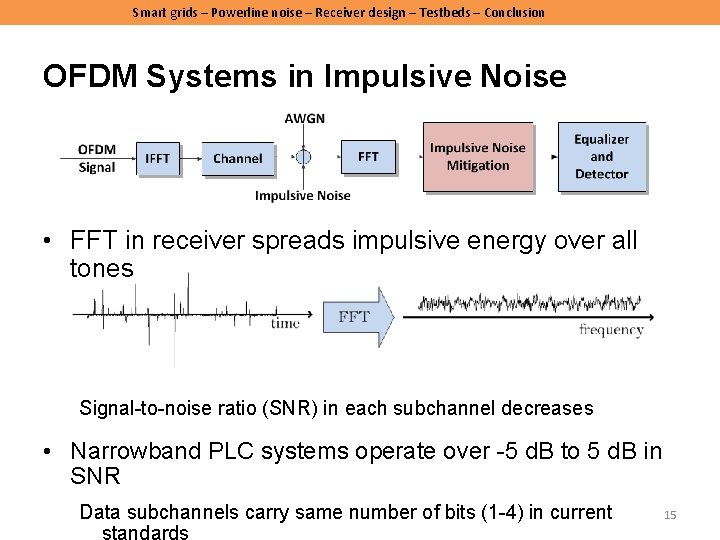
Smart grids – Powerline noise – Receiver design – Testbeds – Conclusion OFDM Systems in Impulsive Noise • FFT in receiver spreads impulsive energy over all tones Signal-to-noise ratio (SNR) in each subchannel decreases • Narrowband PLC systems operate over -5 d. B to 5 d. B in SNR Data subchannels carry same number of bits (1 -4) in current 15
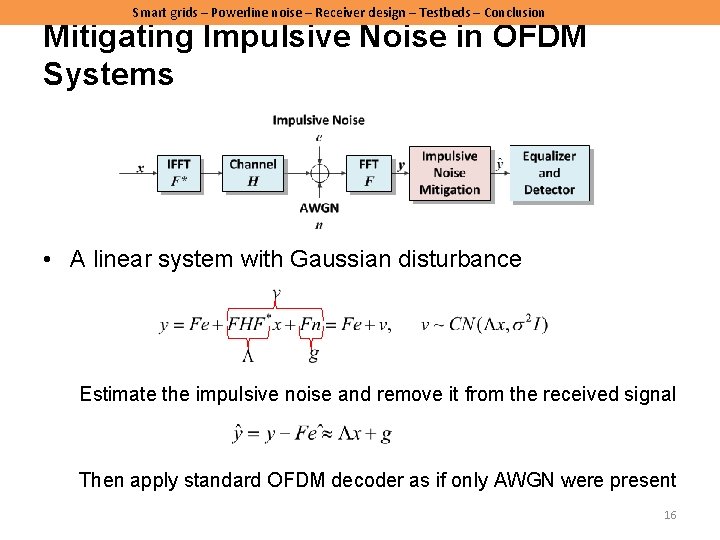
Smart grids – Powerline noise – Receiver design – Testbeds – Conclusion Mitigating Impulsive Noise in OFDM Systems • A linear system with Gaussian disturbance Estimate the impulsive noise and remove it from the received signal Then apply standard OFDM decoder as if only AWGN were present 16
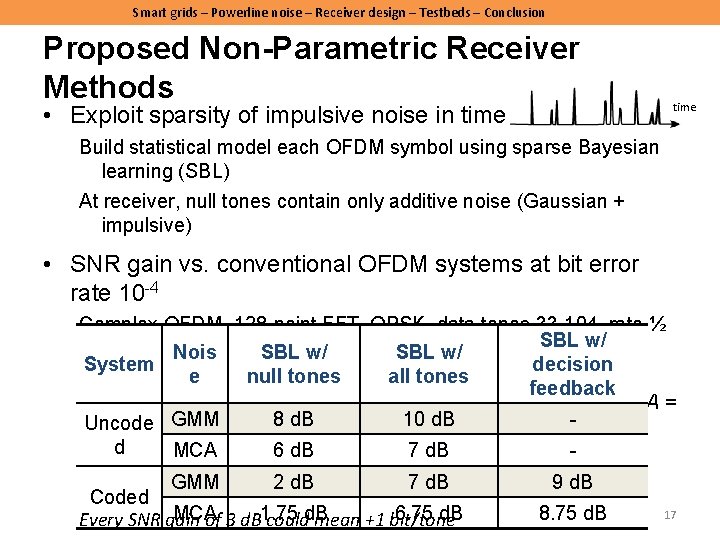
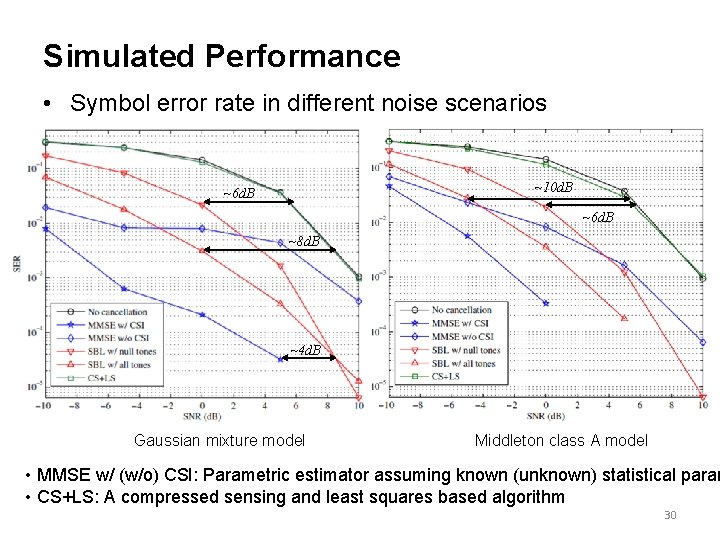
Smart grids – Powerline noise – Receiver design – Testbeds – Conclusion Proposed Non-Parametric Receiver Methods • Exploit sparsity of impulsive noise in time domain time Build statistical model each OFDM symbol using sparse Bayesian learning (SBL) At receiver, null tones contain only additive noise (Gaussian + impulsive) • SNR gain vs. conventional OFDM systems at bit error rate 10 -4 Complex OFDM, 128 -point FFT, QPSK, data tones 33 -104, rate ½ SBL w/ conv. code Nois SBL w/ System decision e null tones all tones Test SBL algorithms using additive three-term Gaussian mixture feedback model (GMM) noise and Middleton Class A (MCA) noise with A = 10 d. B Uncode 0. 1 and GMM = 0. 01 8 d. B d MCA 6 d. B 7 d. B GMM 2 d. B 7 d. B Coded MCA 6. 75 d. B Every SNR gain of 3 d. B 1. 75 couldd. B mean +1 bit/tone 9 d. B 8. 75 d. B 17
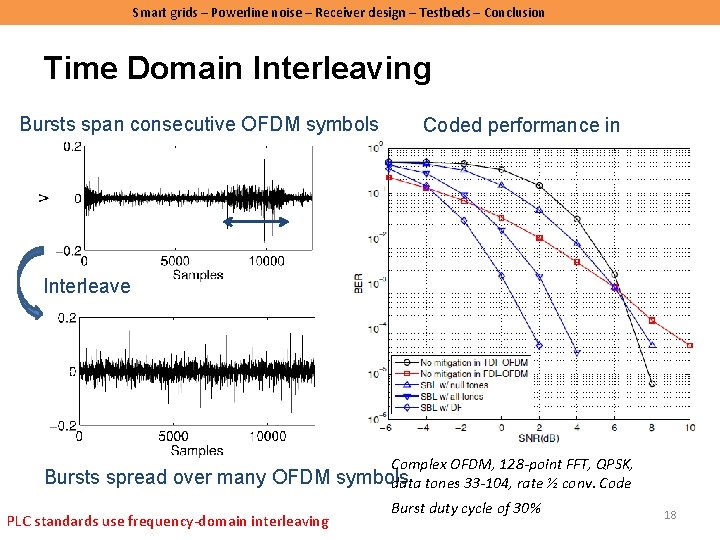
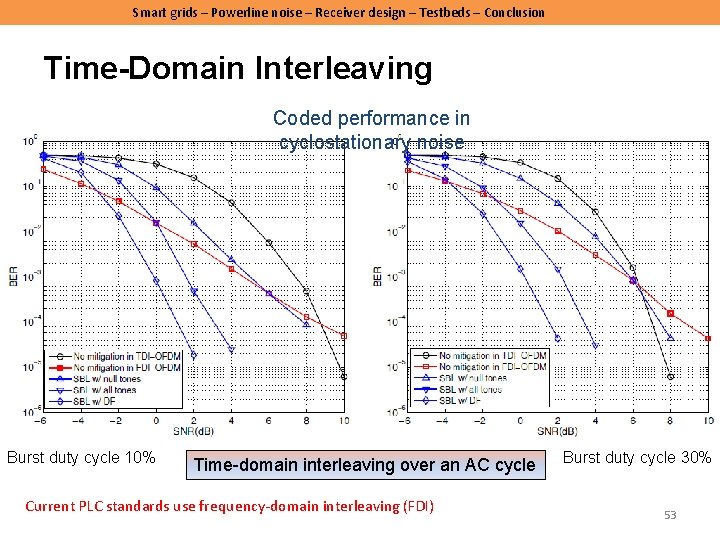
Smart grids – Powerline noise – Receiver design – Testbeds – Conclusion Time Domain Interleaving Bursts span consecutive OFDM symbols Coded performance in cyclostationary noise Interleave Complex OFDM, 128 -point FFT, QPSK, Bursts spread over many OFDM symbols data tones 33 -104, rate ½ conv. Code PLC standards use frequency-domain interleaving Burst duty cycle of 30% 18
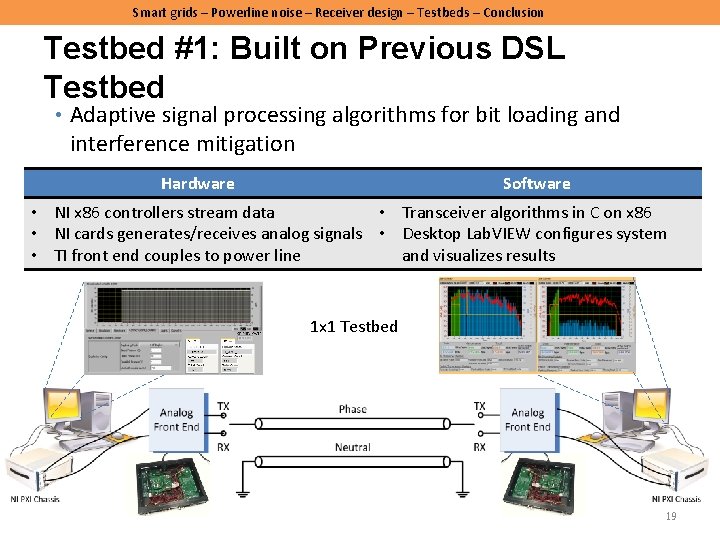
Smart grids – Powerline noise – Receiver design – Testbeds – Conclusion Testbed #1: Built on Previous DSL Testbed • Adaptive signal processing algorithms for bit loading and interference mitigation Hardware Software • NI x 86 controllers stream data • Transceiver algorithms in C on x 86 • NI cards generates/receives analog signals • Desktop Lab. VIEW configures system • TI front end couples to power line and visualizes results 1 x 1 Testbed 19
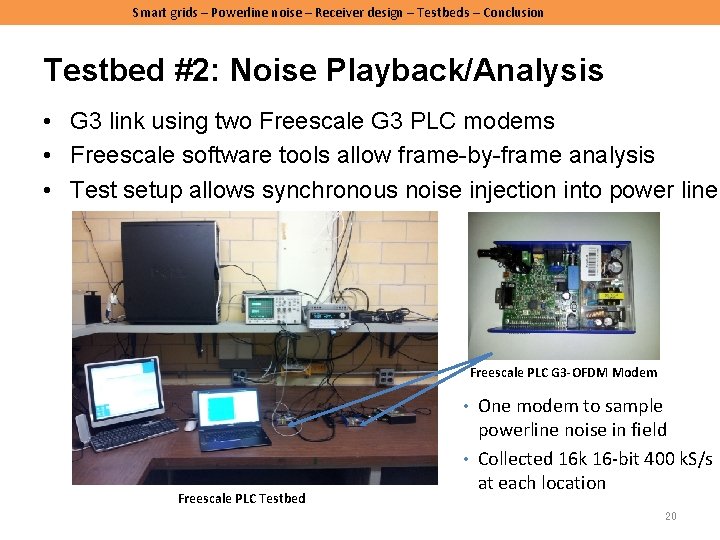
Smart grids – Powerline noise – Receiver design – Testbeds – Conclusion Testbed #2: Noise Playback/Analysis • G 3 link using two Freescale G 3 PLC modems • Freescale software tools allow frame-by-frame analysis • Test setup allows synchronous noise injection into power line Freescale PLC G 3 -OFDM Modem • One modem to sample Freescale PLC Testbed powerline noise in field • Collected 16 k 16 -bit 400 k. S/s at each location 20
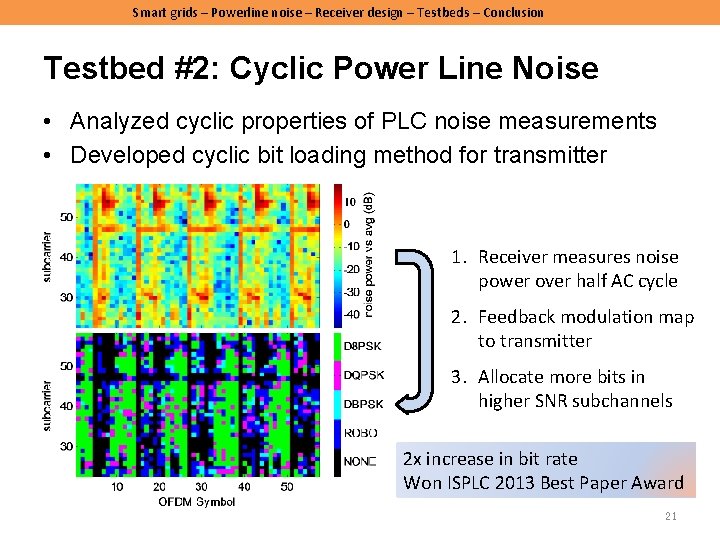
Smart grids – Powerline noise – Receiver design – Testbeds – Conclusion Testbed #2: Cyclic Power Line Noise • Analyzed cyclic properties of PLC noise measurements • Developed cyclic bit loading method for transmitter 1. Receiver measures noise power over half AC cycle 2. Feedback modulation map to transmitter 3. Allocate more bits in higher SNR subchannels 2 x increase in bit rate Won ISPLC 2013 Best Paper Award 21
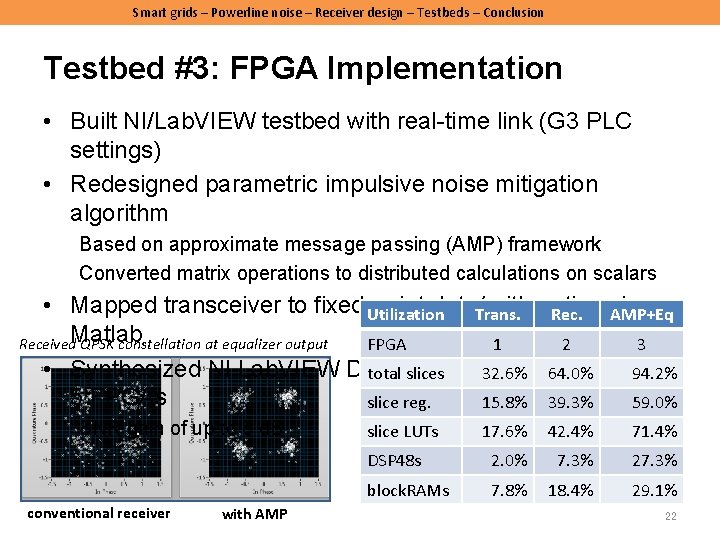
Smart grids – Powerline noise – Receiver design – Testbeds – Conclusion Testbed #3: FPGA Implementation • Built NI/Lab. VIEW testbed with real-time link (G 3 PLC settings) • Redesigned parametric impulsive noise mitigation algorithm Based on approximate message passing (AMP) framework Converted matrix operations to distributed calculations on scalars • Mapped transceiver to fixed-point data/arithmetic Utilization Trans. Rec. using AMP+Eq Received. Matlab QPSK constellation at equalizer output FPGA 1 2 3 • Synthesized NI Lab. VIEW DSP onto 64. 0% Xilinx Vertex total Diagram slices 32. 6% 94. 2% 5 FPGAs slice reg. 15. 8% 39. 3% 59. 0% SNR gain of up to 8 d. B conventional receiver with AMP slice LUTs 17. 6% 42. 4% 71. 4% DSP 48 s 2. 0% 7. 3% 27. 3% block. RAMs 7. 8% 18. 4% 29. 1% 22
Smart grids – Powerline noise – Receiver design – Testbeds – Conclusion • Powerline communication systems are interference limited • Statistical models powerline interference Cyclostationary model is synchronous with zero crossings of AC cycle Gaussian mixture model is for asynchronous impulsive noise • Interference mitigation algorithms give up to 10 d. B of SNR gain Non-parametric sparse Bayesian learning algorithms do not map well to FPGAs Parametric distributed approximate message algorithms map well to FPGAs Project Web site: http: //users. ece. utexas. edu/~bevans/projects/plc/index. html 23
Smart grids – Powerline noise – Receiver design – Testbeds – Conclusion References • • • [Caire 08] G. Caire, T. Y. Al-Naffouri, and A. K. Narayanan. Impulse noise cancellation in OFDM: an application of compressed sensing. Proc. IEEE Int. Symp. Information Theory, pages 1293– 1297, 2008. [Cho 04] J. H. Cho. Joint transmitter and receiver optimization in additive cyclostationary noise. IEEE Trans. on Information Theory, vol. 50, no. 12, 2004. [Garcia 07] R. Garcia, L. Diez, J. A. Cortes, and F. J. Canete. Mitigation of cyclic shorttime noise in indoor power-line channels. Proc. IEEE Int. Symp. Power Line Comm. and Its Applications, pp. 396– 400, 2007. [Haring 02] J. Haring. Error Tolerant Communication over the Compound Channel. Aachen, 2002. [Haring 03] J. Haring and A. J. H. Vinck. Iterative decoding of codes over complex numbers for impulsive noise channels. IEEE Trans. on Information Theory, 49(5): 1251 – 1260, 2003. [Katayama 06] M. Katayama, T. Yamazato, and H. Okada. A mathematical model of noise in narrowband power line communication systems. IEEE J. Sel. Areas in Commun. , vol. 24, no 7, pp. 1267 -1276, 2006. [Lampe 11] L. Lampe. Bursty impulse noise detection by compressed sensing. Proc. IEEE Int. Symp. Power Line Commun. and Appl. , pages 29– 34, 2011 [Liano 11] A. Liano, A. Sendin, A. Arzuaga, and S. Santos. Quasi-synchronous noise interference can- cellation techniques applied in low voltage PLC. Proc. IEEE Int. Symp. Power Line Comm. and Its Applications, 2011. [Lin 11] J. Lin, M. Nassar, and B. L. Evans, “Non-Parametric Impulsive Noise Mitigation 24 in OFDM Systems Using Sparse Bayesian Learning”, Proc. IEEE Int. Global Comm.
Smart grids – Powerline noise – Receiver design – Testbeds – Conclusion References • • [Nassar 09] M. Nassar, K. Gulati, M. De. Young, B. L. Evans, and K. Tinsley. Mitigating near-field interference in laptop embedded wireless transceivers. Journal of Signal Proc. Systems, pp. 1– 12, 2009. [Nassar 11] M. Nassar and B. L. Evans. Low Complexity EM-based Decoding for OFDM Systems with Impulsive Noise. In Proc. Asilomar Conf. on Sig. , Systems, and Computers, 2011. . [Nassar 12] M. Nassar, A. Dabak, I. H. Kim, T. Pande, and B. L. Evans. Cyclostationary noise modeling in narrowband powerline communication for smart grid applications. Proc. IEEE Int. Conf. on Acoustics, Speech and Sig. Proc. , pages 3089– 3092, 2012. [Nassar 12 mag] M. Nassar, J. Lin, Y. Mortazavi, A. Dabak, I. H. Kim and B. L. Evans, “Local Utility Powerline Communications in the 3 -500 k. Hz Band: Channel Impairments, Noise, and Standards”, IEEE Signal Processing Magazine, vol. 29, no. 5, pp. 116 -127, Sep. 2012. [Nieman 13] K. Nieman, J. Lin, M. Nassar, K. Waheed and B. L. Evans, “Cyclic Spectral Analysis of Power Line Noise in the 3 -200 k. Hz Band”, Proc. IEEE Int. Sym. on Power Line Communications and Its Applications, Mar. 24 -27, 2013. [Pauli 06] V. Pauli, L. Lampe, and R. Schober. ”turbo dpsk” using soft multiple-symbol differential sphere decoding. IEEE Trans. on Information Theory, 52(4): 1385– 1398, 2006. [Raphaeli 96] D. Raphaeli. Noncoherent coded modulation. IEEE Trans. on Comm. , vol. 44, no. 2, pp. 172– 183, 1996. [Tipping 01] M. E. Tipping. Sparse Bayesian learning and the relevance vector 25 machine. Journal of Machine Learning Research, vol. 1, pp. 211– 244, 2001.
Backup Slides 26
Research Group • • Present: 9 Ph. D, 0 MS, 4 BS Alumni: 21 Ph. D, 9 MS, 142 BS 1376 alumni of real-time DSP course Communication systems Powerline communications (interference modeling & mitigation) Cellular, Wimax & Wi-Fi (interference modeling & mitigation) Mixed-signal IC design (mostly digital ADCs and synthesizers) • Image processing • Electronic design automation (EDA) tools/methods • Part of Wireless Networking & Communications Group 160 grad students, 20 faculty members, 13 affiliate companies
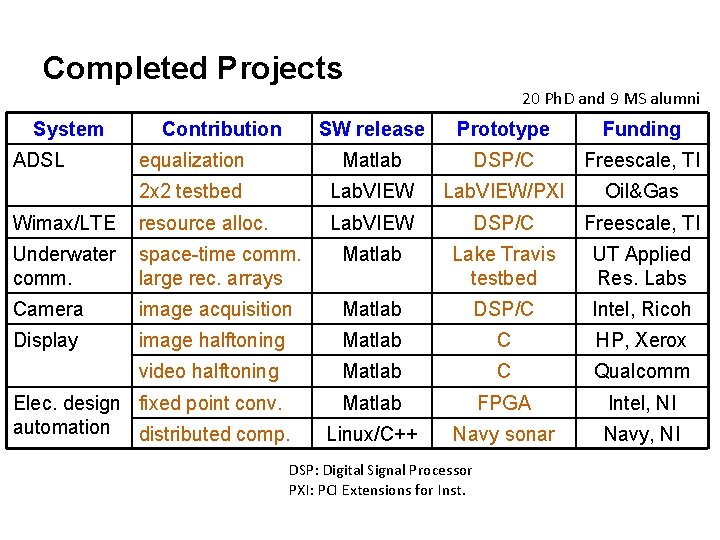
Completed Projects 20 Ph. D and 9 MS alumni System SW release Prototype Funding equalization Matlab DSP/C Freescale, TI 2 x 2 testbed Lab. VIEW/PXI Oil&Gas Wimax/LTE resource alloc. Lab. VIEW DSP/C Freescale, TI Underwater comm. space-time comm. large rec. arrays Matlab Lake Travis testbed UT Applied Res. Labs Camera image acquisition Matlab DSP/C Intel, Ricoh Display image halftoning Matlab C HP, Xerox video halftoning Matlab C Qualcomm Matlab FPGA Intel, NI Linux/C++ Navy sonar Navy, NI ADSL Contribution Elec. design fixed point conv. automation distributed comp. DSP: Digital Signal Processor PXI: PCI Extensions for Inst.
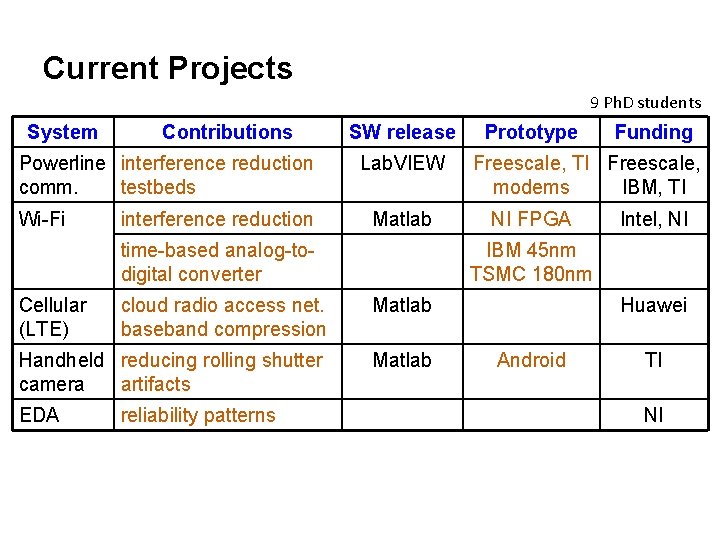
Current Projects 9 Ph. D students System Contributions Powerline interference reduction comm. testbeds Wi-Fi interference reduction SW release Lab. VIEW Matlab time-based analog-todigital converter Cellular (LTE) Matlab Handheld reducing rolling shutter camera artifacts Matlab reliability patterns Funding Freescale, TI Freescale, modems IBM, TI NI FPGA Intel, NI IBM 45 nm TSMC 180 nm cloud radio access net. baseband compression EDA Prototype Huawei Android TI NI
Simulated Performance • Symbol error rate in different noise scenarios ~10 d. B ~6 d. B ~8 d. B ~4 d. B Gaussian mixture model Middleton class A model • MMSE w/ (w/o) CSI: Parametric estimator assuming known (unknown) statistical param • CS+LS: A compressed sensing and least squares based algorithm 30
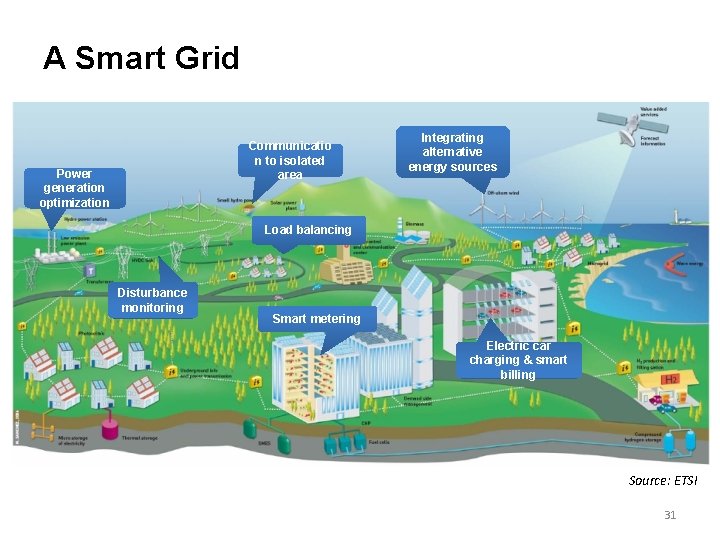
A Smart Grid Communicatio n to isolated area Power generation optimization Integrating alternative energy sources Load balancing Disturbance monitoring Smart metering Electric car charging & smart billing Source: ETSI 31
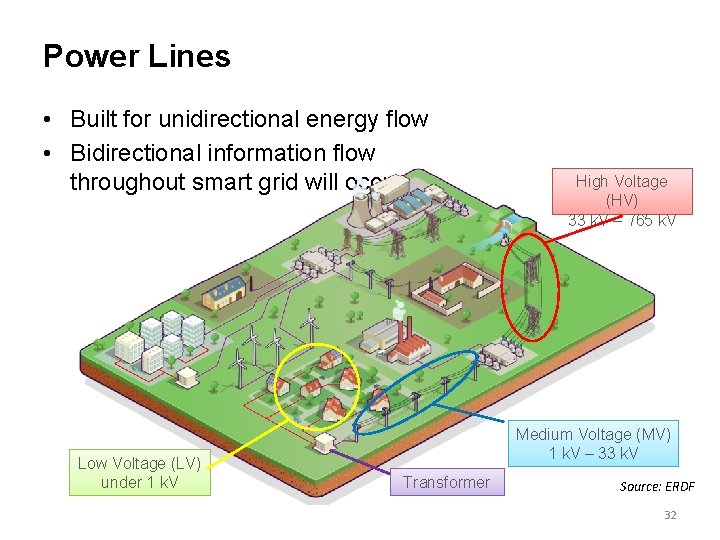
Power Lines • Built for unidirectional energy flow • Bidirectional information flow throughout smart grid will occur Low Voltage (LV) under 1 k. V High Voltage (HV) 33 k. V – 765 k. V Medium Voltage (MV) 1 k. V – 33 k. V Transformer Source: ERDF 32
Today’s Power Grids in the United States • 7 large-scale power grids each managed by a regional utility company 700 GW generation capacity in total for long-haul high-voltage power transmission Synchronized independently, and exchange power via DC transfer • 130+ medium-scale power grids each managed by a local utility Local power distribution to residential, commercial and industrial customers • Heavy penalties in US for blackouts (2003 legislation) Utilities generate expected energy demand plus 12% Energy demand correlated with time of day Effect of plug-in electric vehicles (EVs) on energy demand uncertain Generation cost 30 x higher during peak times vs. normal load Jerry Melcher, IEEE to Smart Grid Shortcapacity Course, 22 Oct. TX USA • Source: Traditional ways increase to 2011, meet. Austin peak 33
Smart Power Meters at Customer Site • Enable local utilities to improve Operating efficiency System reliability Customer participation • Automatic metering infrastructure functions Interval reads (every 1/15/30/60 minutes) and on-demand reads and pings Transmit customer load profiles and system load snapshots Power quality monitoring Remote disconnect/reconnect and outage/restoration event notification • Need low-delay highly-reliable communication link to local utility • Source: 75 MJerry smart meters sold in. Short 2011 (20% increase vs. TX 2010) Melcher, IEEE Smart Grid Course, 22 Oct. 2011, Austin USA 34
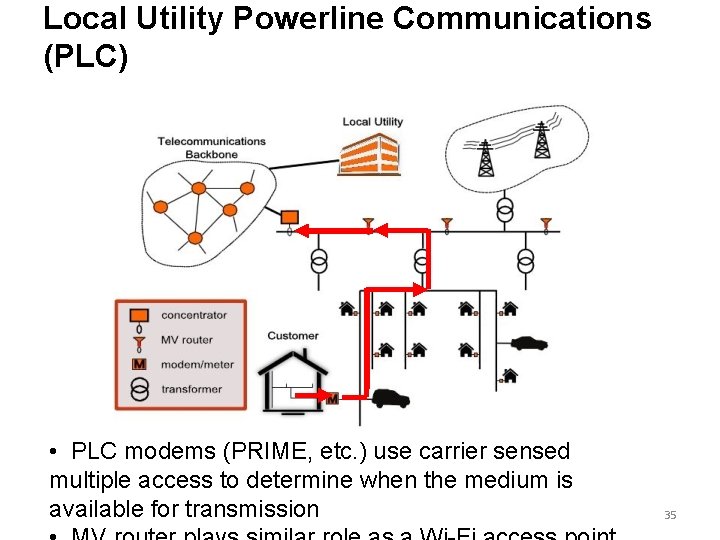
Local Utility Powerline Communications (PLC) • PLC modems (PRIME, etc. ) use carrier sensed multiple access to determine when the medium is available for transmission 35
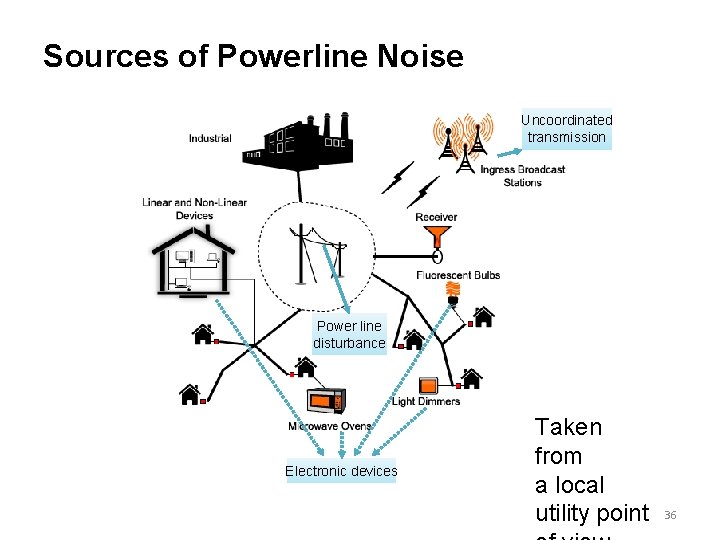
Sources of Powerline Noise Uncoordinated transmission Power line disturbance Electronic devices Taken from a local utility point 36
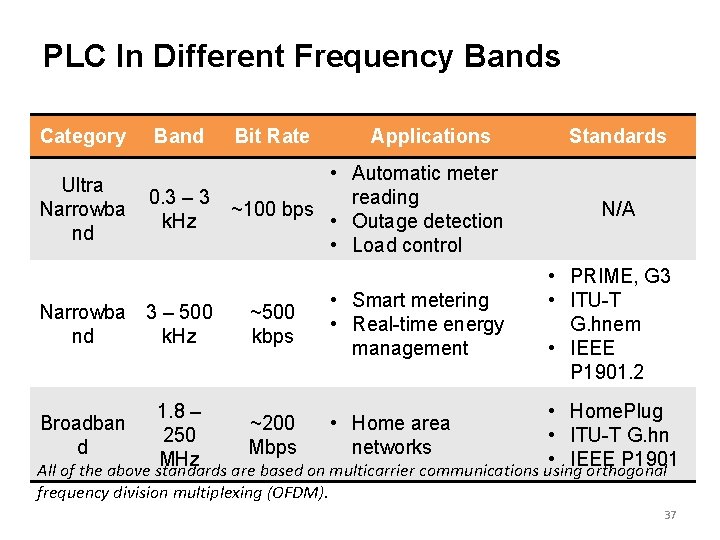
PLC In Different Frequency Bands Category Ultra Narrowba nd Band Bit Rate 0. 3 – 3 k. Hz • Automatic meter reading ~100 bps • Outage detection • Load control Narrowba 3 – 500 nd k. Hz Broadban d 1. 8 – 250 MHz Applications Standards N/A ~500 kbps • Smart metering • Real-time energy management • PRIME, G 3 • ITU-T G. hnem • IEEE P 1901. 2 ~200 Mbps • Home area networks • Home. Plug • ITU-T G. hn • IEEE P 1901 All of the above standards are based on multicarrier communications using orthogonal frequency division multiplexing (OFDM). 37
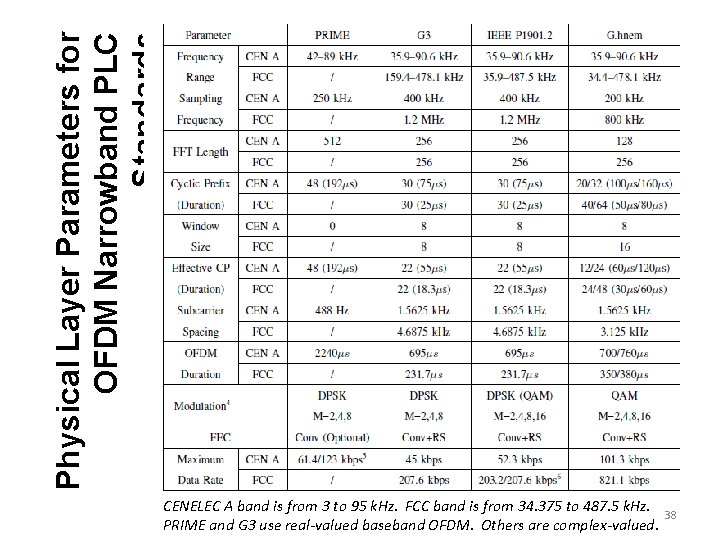
Physical Layer Parameters for OFDM Narrowband PLC Standards CENELEC A band is from 3 to 95 k. Hz. FCC band is from 34. 375 to 487. 5 k. Hz. PRIME and G 3 use real-valued baseband OFDM. Others are complex-valued. 38
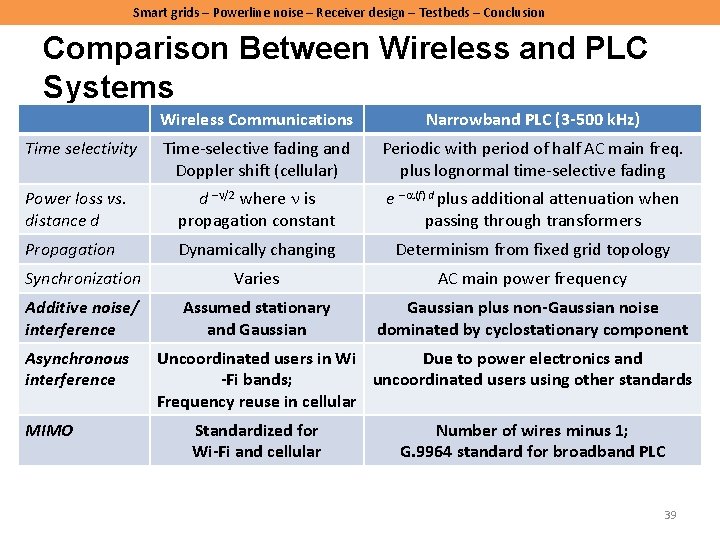
Smart grids – Powerline noise – Receiver design – Testbeds – Conclusion Comparison Between Wireless and PLC Systems Wireless Communications Narrowband PLC (3 -500 k. Hz) Time selectivity Time-selective fading and Doppler shift (cellular) Periodic with period of half AC main freq. plus lognormal time-selective fading Power loss vs. distance d d –n/2 where n is propagation constant e – a(f) d plus additional attenuation when passing through transformers Propagation Dynamically changing Determinism from fixed grid topology Synchronization Varies AC main power frequency Additive noise/ interference Assumed stationary and Gaussian plus non-Gaussian noise dominated by cyclostationary component Asynchronous interference MIMO Uncoordinated users in Wi Due to power electronics and -Fi bands; uncoordinated users using other standards Frequency reuse in cellular Standardized for Wi-Fi and cellular Number of wires minus 1; G. 9964 standard for broadband PLC 39
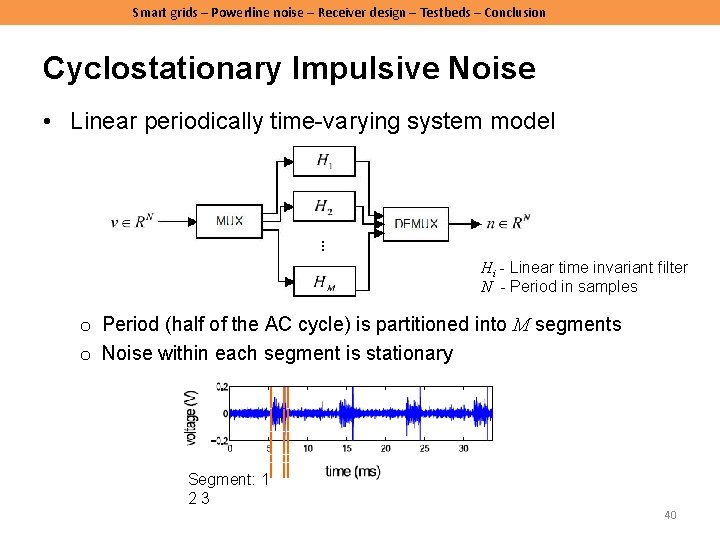
Smart grids – Powerline noise – Receiver design – Testbeds – Conclusion Cyclostationary Impulsive Noise • Linear periodically time-varying system model … Hi - Linear time invariant filter N - Period in samples o Period (half of the AC cycle) is partitioned into M segments o Noise within each segment is stationary Segment: 1 23 40
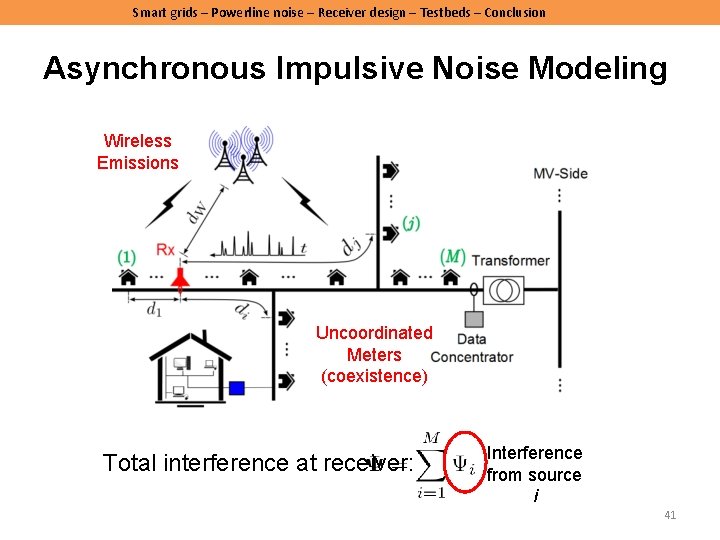
Smart grids – Powerline noise – Receiver design – Testbeds – Conclusion Asynchronous Impulsive Noise Modeling Wireless Emissions Uncoordinated Meters (coexistence) Total interference at receiver: Interference from source i 41
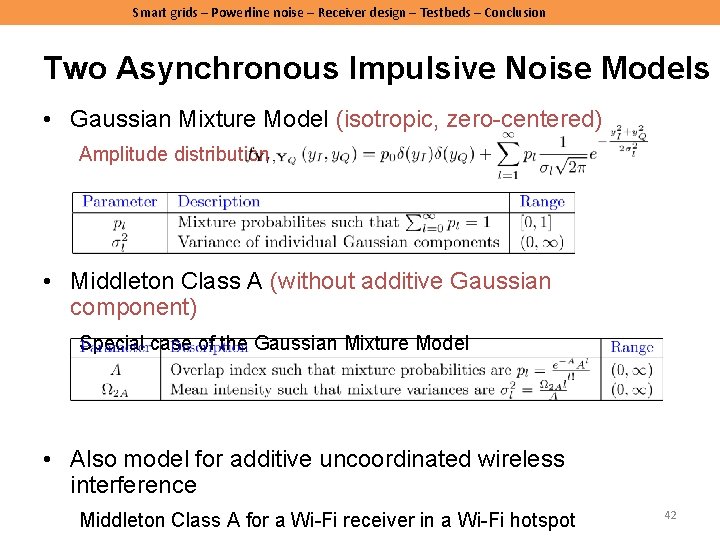
Smart grids – Powerline noise – Receiver design – Testbeds – Conclusion Two Asynchronous Impulsive Noise Models • Gaussian Mixture Model (isotropic, zero-centered) Amplitude distribution • Middleton Class A (without additive Gaussian component) Special case of the Gaussian Mixture Model • Also model for additive uncoordinated wireless interference Middleton Class A for a Wi-Fi receiver in a Wi-Fi hotspot 42
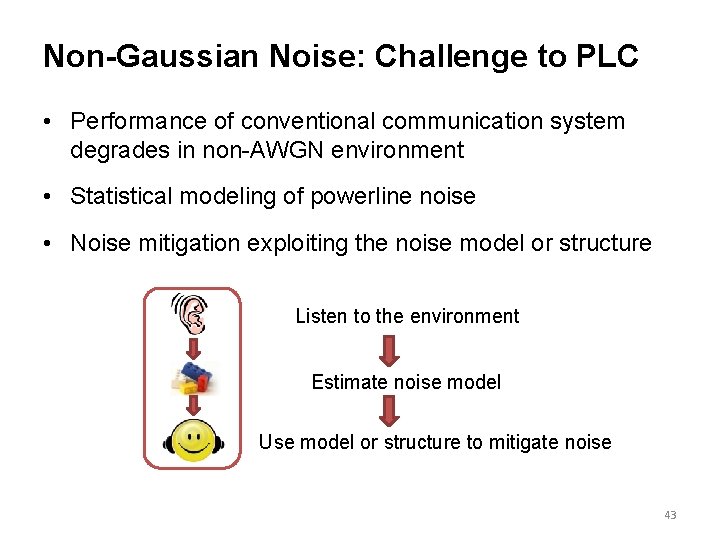
Non-Gaussian Noise: Challenge to PLC • Performance of conventional communication system degrades in non-AWGN environment • Statistical modeling of powerline noise • Noise mitigation exploiting the noise model or structure Listen to the environment Estimate noise model Use model or structure to mitigate noise 43
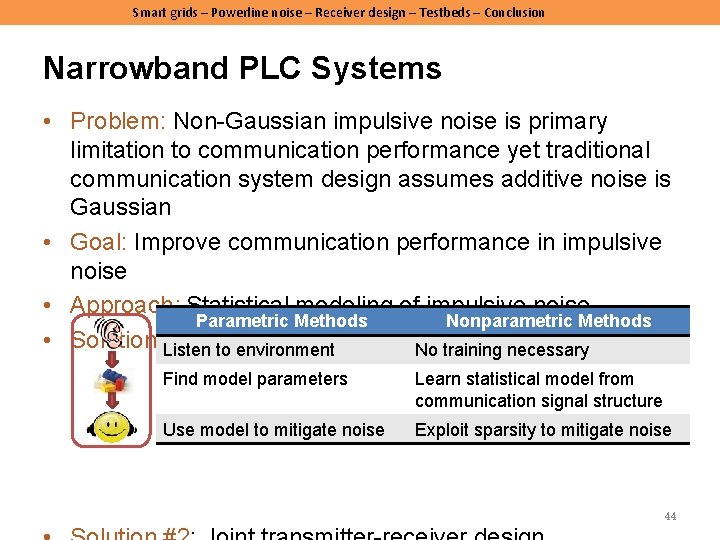
Smart grids – Powerline noise – Receiver design – Testbeds – Conclusion Narrowband PLC Systems • Problem: Non-Gaussian impulsive noise is primary limitation to communication performance yet traditional communication system design assumes additive noise is Gaussian • Goal: Improve communication performance in impulsive noise • Approach: Statistical modeling of impulsive noise Parametric Methods Nonparametric Methods • Solution Listen #1: Receiver design (standard compliant) to environment No training necessary Find model parameters Learn statistical model from communication signal structure Use model to mitigate noise Exploit sparsity to mitigate noise 44
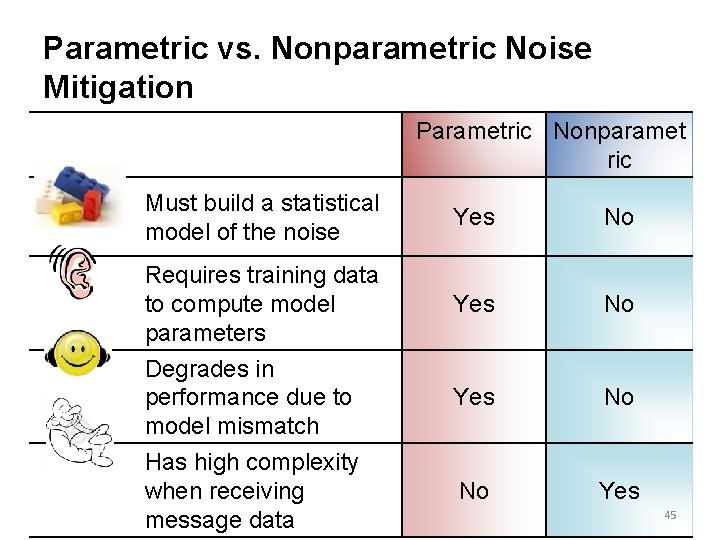
Parametric vs. Nonparametric Noise Mitigation Parametric Nonparamet ric Must build a statistical model of the noise Requires training data to compute model parameters Degrades in performance due to model mismatch Has high complexity when receiving message data Yes No No Yes 45
Cyclostationary Noise Modeling in Narrowband PLC (3 -500 k. Hz) 1. M. Nassar, A. Dabak, I. H. Kim, T. Pande and B. L. Evans, “Cyclostationary Noise Modeling In Narrowband Powerline Communication For Smart Grid Applications”, Proc. IEEE Int. Conf. on Acoustics, Speech, and Signal Proc. , Mar. 25 -30, 2012, Kyoto, Japan. 2. M. Nassar, J. Lin, Y. Mortazavi, A. Dabak, I. H. Kim and B. L. Evans, “Local Utility Powerline Communications in the 3 -500 k. Hz Band: Channel Impairments, Noise, and Standards”, IEEE Signal Processing Magazine, Special Issue on Signal Processing Techniques for the Smart Grid, Sep. 2012, 14 pages.
Impulsive Noise in Broadband PLC: Modeling and Mitigation 3. M. Nassar, K. Gulati, Y. Mortazavi, and B. L. Evans, “Statistical Modeling of Asynchronous Impulsive Noise in Powerline Communication Networks”, Proc. IEEE Int. Global Communications Conf. , Dec. 5 -9, 2011, Houston, TX USA. 4. J. Lin, M. Nassar and B. L. Evans, “Non-Parametric Impulsive Noise Mitigation in OFDM Systems Using Sparse Bayesian Learning”, Proc. IEEE Int. Global Communications Conf. , Dec. 5 -9, 2011, Houston, TX USA.
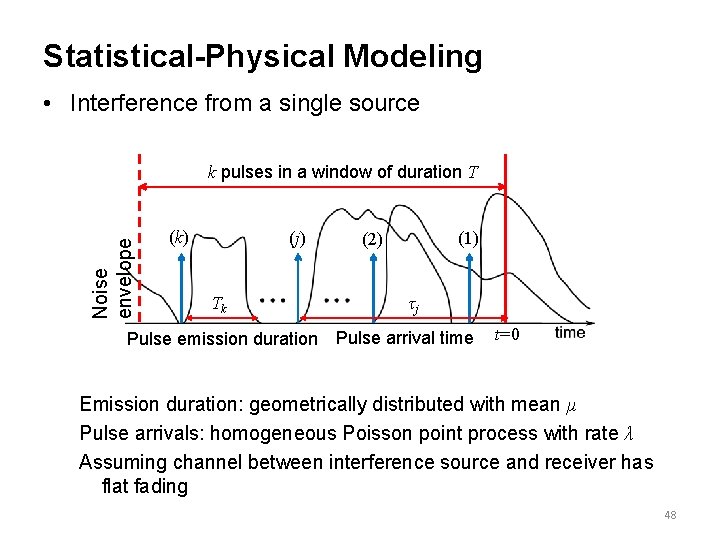
Statistical-Physical Modeling • Interference from a single source Noise envelope k pulses in a window of duration T (k) (j) Tk Pulse emission duration (1) (2) τj Pulse arrival time t=0 Emission duration: geometrically distributed with mean μ Pulse arrivals: homogeneous Poisson point process with rate λ Assuming channel between interference source and receiver has flat fading 48
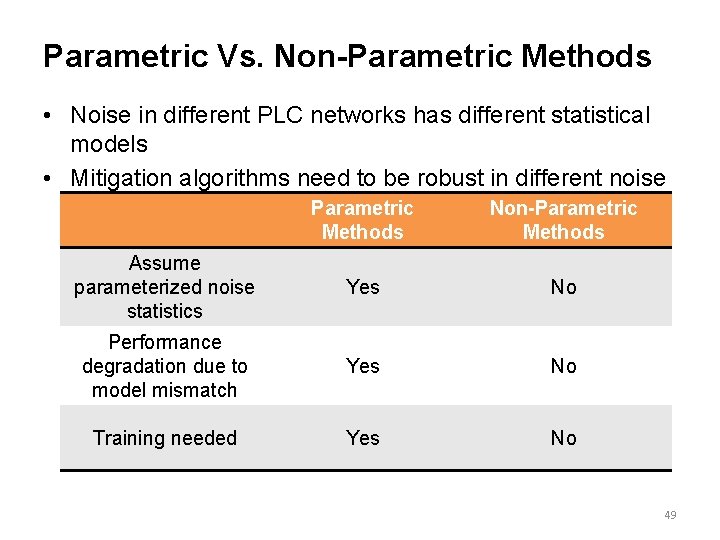
Parametric Vs. Non-Parametric Methods • Noise in different PLC networks has different statistical models • Mitigation algorithms need to be robust in different noise Parametric Non-Parametric scenarios Methods Assume parameterized noise statistics Yes No Performance degradation due to model mismatch Yes No Training needed Yes No 49
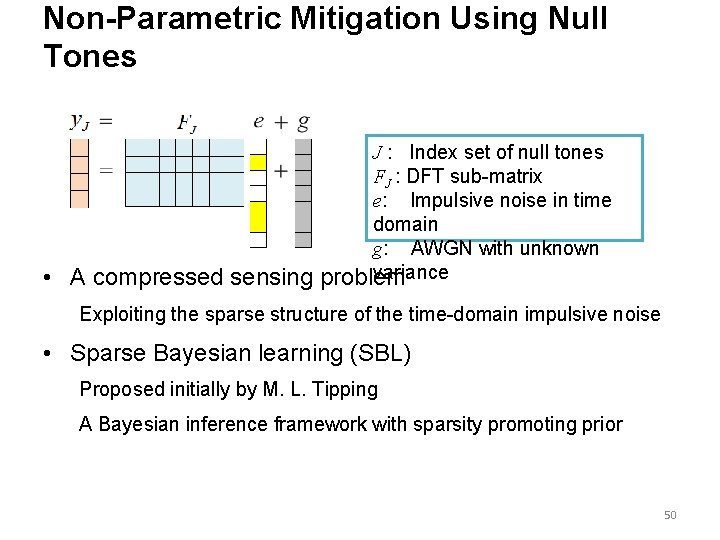
Non-Parametric Mitigation Using Null Tones • A compressed sensing J : Index set of null tones FJ : DFT sub-matrix e: Impulsive noise in time domain g: AWGN with unknown variance problem Exploiting the sparse structure of the time-domain impulsive noise • Sparse Bayesian learning (SBL) Proposed initially by M. L. Tipping A Bayesian inference framework with sparsity promoting prior 50
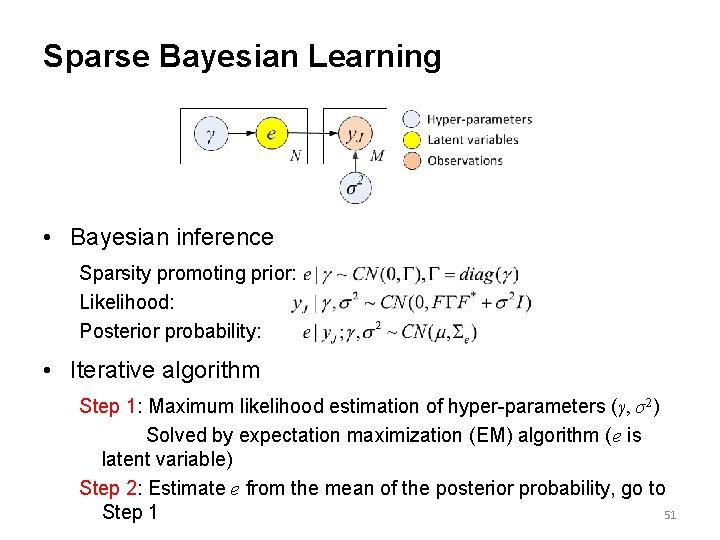
Sparse Bayesian Learning • Bayesian inference Sparsity promoting prior: Likelihood: Posterior probability: • Iterative algorithm Step 1: Maximum likelihood estimation of hyper-parameters (γ, σ2) Solved by expectation maximization (EM) algorithm (e is latent variable) Step 2: Estimate e from the mean of the posterior probability, go to Step 1 51
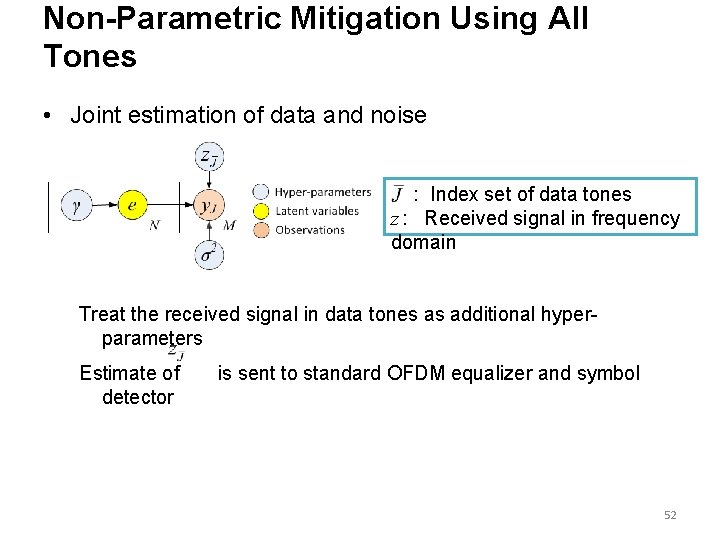
Non-Parametric Mitigation Using All Tones • Joint estimation of data and noise : Index set of data tones z : Received signal in frequency domain Treat the received signal in data tones as additional hyperparameters Estimate of detector is sent to standard OFDM equalizer and symbol 52
Smart grids – Powerline noise – Receiver design – Testbeds – Conclusion Time-Domain Interleaving Coded performance in cyclostationary noise Burst duty cycle 10% Time-domain interleaving over an AC cycle Current PLC standards use frequency-domain interleaving (FDI) Burst duty cycle 30% 53