
2013 Cengage Learning Behavior and Conflict within a
© 2013 Cengage Learning Behavior and Conflict within a Group 1
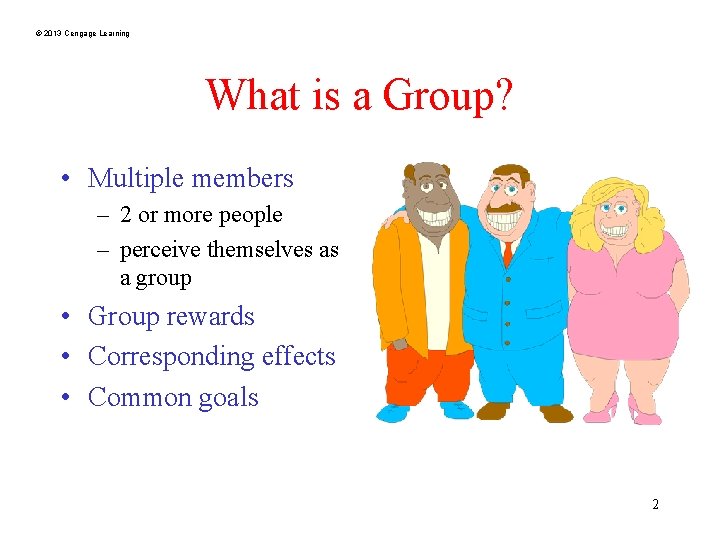
© 2013 Cengage Learning What is a Group? • Multiple members – 2 or more people – perceive themselves as a group • Group rewards • Corresponding effects • Common goals 2
© 2013 Cengage Learning Why People Join Groups • Psychological Needs – Affiliation – Identification • Survival Needs – Emotional support – Assistance or help • Commonality – Common interests – Common goals • Situational Reasons – Physical proximity – Assignment 3
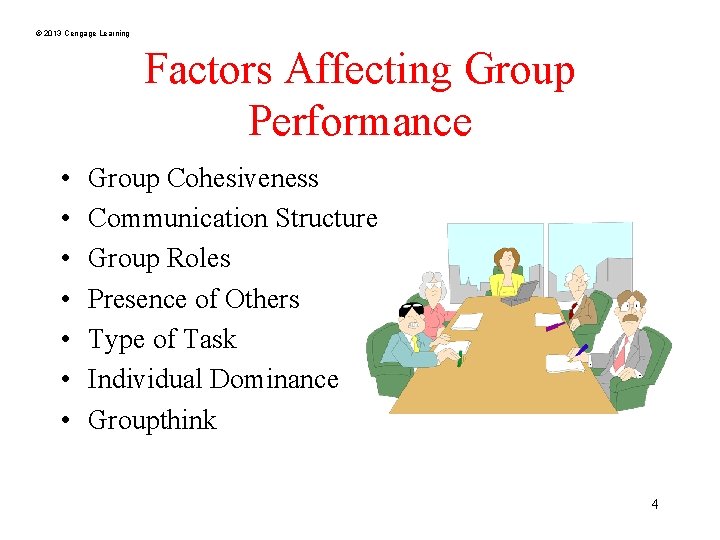
© 2013 Cengage Learning Factors Affecting Group Performance • • Group Cohesiveness Communication Structure Group Roles Presence of Others Type of Task Individual Dominance Groupthink 4

© 2013 Cengage Learning Factors Affecting Group Cohesiveness • Group Homogeneity – Homogeneous – Heterogeneous – Slightly heterogeneous • • • Stability of Membership Isolation Outside Pressure Group Size Group Status 5
© 2013 Cengage Learning Group Size • Smaller is best for cohesiveness • Performance depends on task type – additive tasks – conjunctive tasks – disjunctive tasks 6
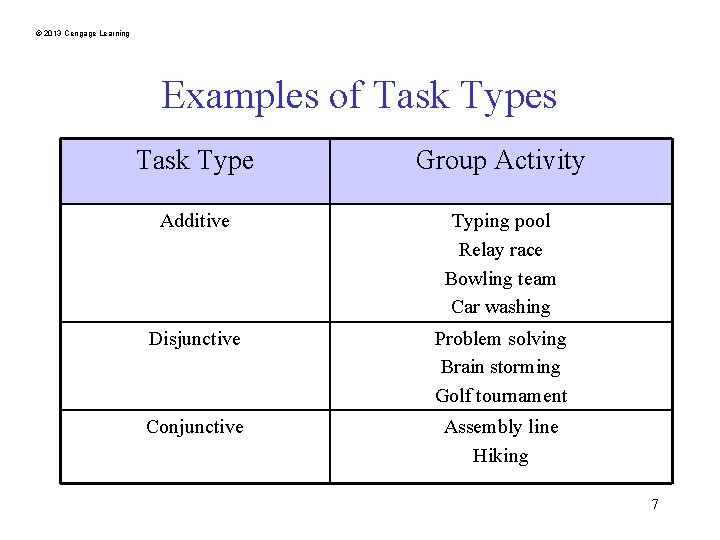
© 2013 Cengage Learning Examples of Task Types Task Type Group Activity Additive Typing pool Relay race Bowling team Car washing Disjunctive Problem solving Brain storming Golf tournament Conjunctive Assembly line Hiking 7
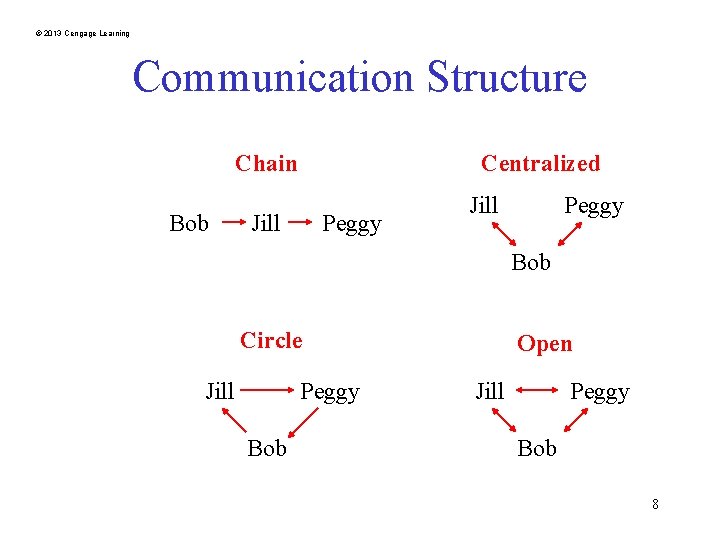
© 2013 Cengage Learning Communication Structure Chain Bob Centralized Jill Peggy Bob Circle Jill Peggy Bob Open Jill Peggy Bob 8
© 2013 Cengage Learning Group Roles • Task Oriented – offering new ideas – coordinating activities • Social Oriented – encouraging cohesiveness – encouraging participation • Individual – blocking group activities – calling attention to oneself 9
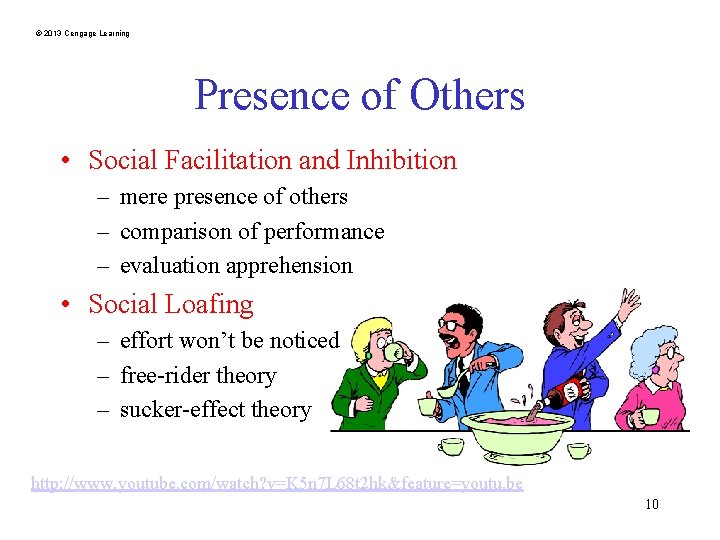
© 2013 Cengage Learning Presence of Others • Social Facilitation and Inhibition – mere presence of others – comparison of performance – evaluation apprehension • Social Loafing – effort won’t be noticed – free-rider theory – sucker-effect theory http: //www. youtube. com/watch? v=K 5 n 7 L 68 t 2 hk&feature=youtu. be 10
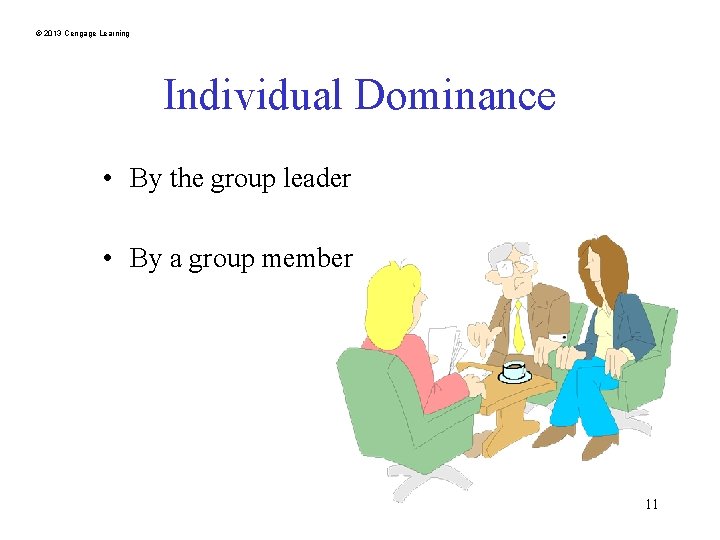
© 2013 Cengage Learning Individual Dominance • By the group leader • By a group member 11
© 2013 Cengage Learning Groupthink Can occur when the group: • • is cohesive is insulated from outsiders believes it is infallible it is morally superior is under pressure to conform has a leader who promotes a favorite solution has gatekeepers who keep information from members http: //www. youtube. com/watch? v=9 b. H_f. Cv. NLCw&feature=related 12

© 2013 Cengage Learning Group versus Individual Performance • Interacting Groups – Have higher quality decisions – Are more risky • Individuals (nominal groups) – Are more creative – Make a decision more quickly 13
© 2013 Cengage Learning Teams 14
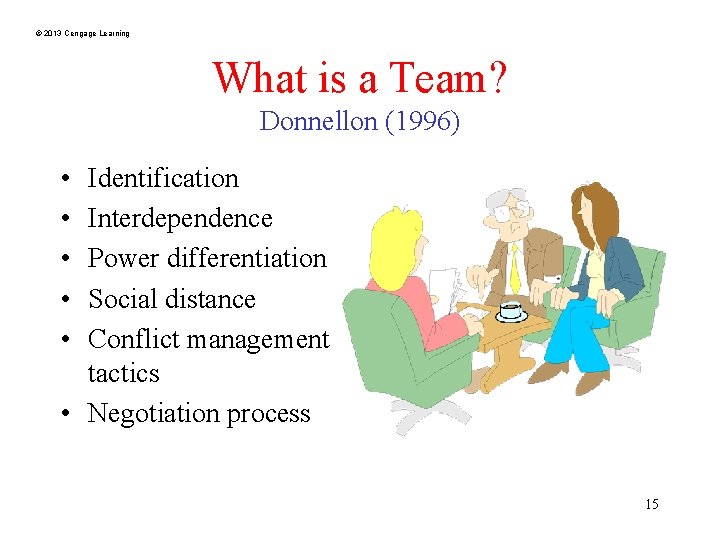
© 2013 Cengage Learning What is a Team? Donnellon (1996) • • • Identification Interdependence Power differentiation Social distance Conflict management tactics • Negotiation process 15

© 2013 Cengage Learning Types of Teams • • Work Teams Parallel Teams Project Teams Management Teams 16
© 2013 Cengage Learning How Teams Develop Tuckman (1965) Theory • Forming – Team members get to know one another – Everyone is on their good behavior – Group clarifies its mission • Storming – Disagreement and frustration set in • Norming – Group members work at easing tension – Acceptance of team leader • Performing – Goals get accomplished http: //www. youtube. com/watch? v=h. EJaz 3 sin. Es 17
© 2013 Cengage Learning How Teams Develop Punctuated Equilibrium. Theory (Gersick, 1988) • Teams do not go through set stages • Basic method of formation – Develop direction and strategy during first meeting – Follow this direction for a period of time – Revise their strategy about half way thorough the life of the team 18
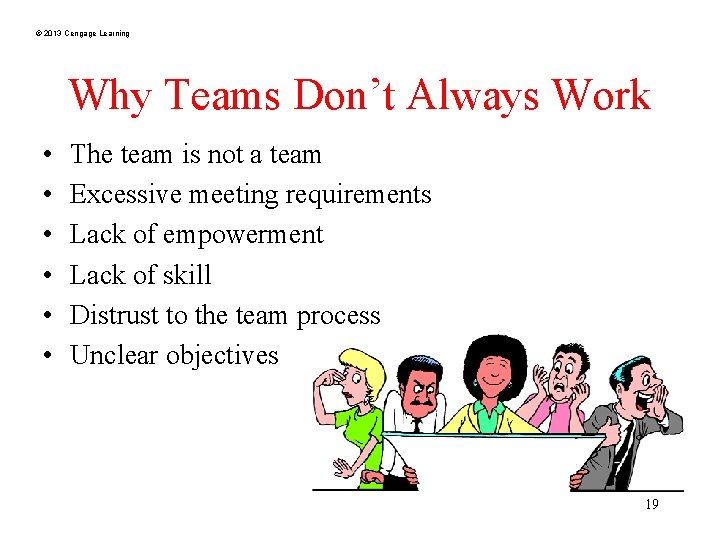
© 2013 Cengage Learning Why Teams Don’t Always Work • • • The team is not a team Excessive meeting requirements Lack of empowerment Lack of skill Distrust to the team process Unclear objectives 19
© 2013 Cengage Learning Group Conflict 20
© 2013 Cengage Learning Conflict Defined • Psychological and behavioral reaction to a perception that another person is – Keeping you from reaching a goal – Taking away your right to behave a certain way – Violating the expectancies of a relationship • Types of Conflict – Functional – Dysfunctional 21
© 2013 Cengage Learning Consequences of Dysfunctional Conflict • • Decreased productivity Low morale Absenteeism Stress Turnover Law suits Violence 22
© 2013 Cengage Learning Types of Conflict • Interpersonal • Individual - Group • Group - Group 23
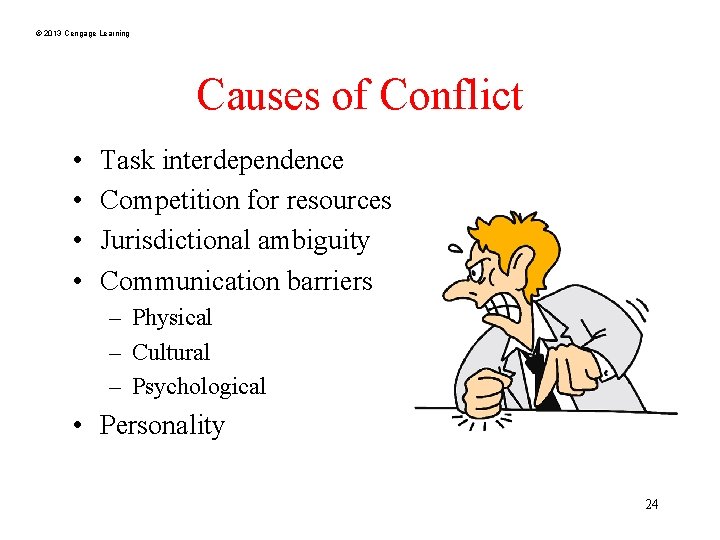
© 2013 Cengage Learning Causes of Conflict • • Task interdependence Competition for resources Jurisdictional ambiguity Communication barriers – Physical – Cultural – Psychological • Personality 24
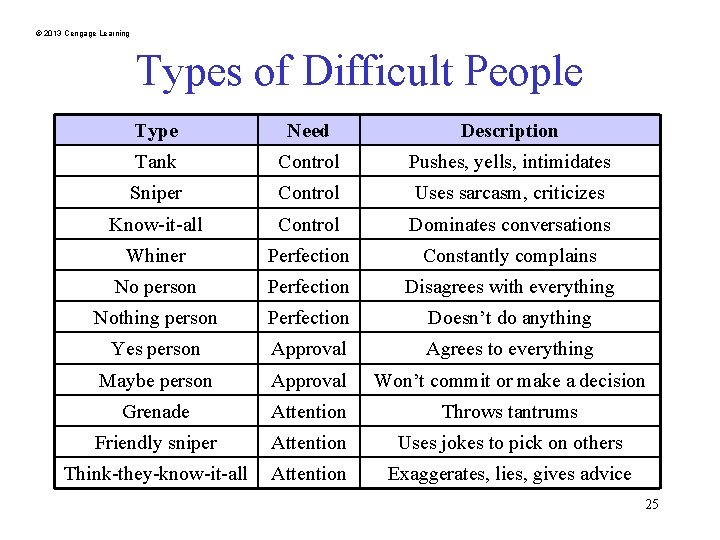
© 2013 Cengage Learning Types of Difficult People Type Need Description Tank Control Pushes, yells, intimidates Sniper Control Uses sarcasm, criticizes Know-it-all Control Dominates conversations Whiner Perfection Constantly complains No person Perfection Disagrees with everything Nothing person Perfection Doesn’t do anything Yes person Approval Agrees to everything Maybe person Approval Won’t commit or make a decision Grenade Attention Throws tantrums Friendly sniper Attention Uses jokes to pick on others Think-they-know-it-all Attention Exaggerates, lies, gives advice 25
© 2013 Cengage Learning Who has worked with a difficult person? http: //www. youtube. com/watch? v=5 GJD 2 em 5 fgo&feature=related 26
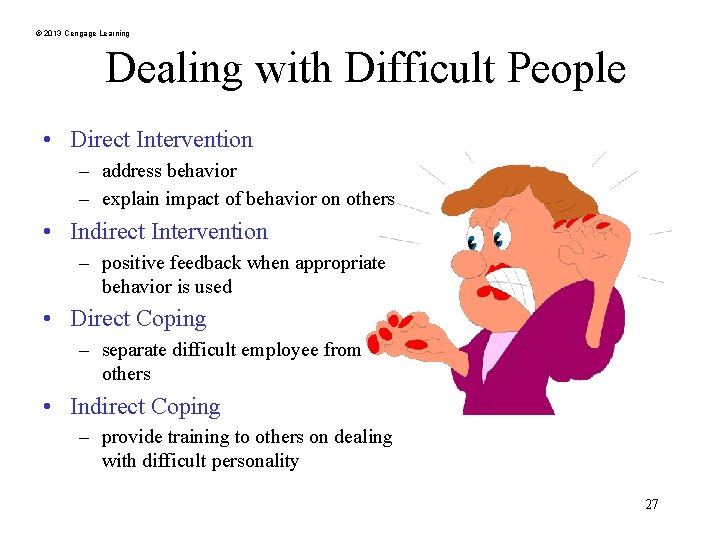
© 2013 Cengage Learning Dealing with Difficult People • Direct Intervention – address behavior – explain impact of behavior on others • Indirect Intervention – positive feedback when appropriate behavior is used • Direct Coping – separate difficult employee from others • Indirect Coping – provide training to others on dealing with difficult personality 27
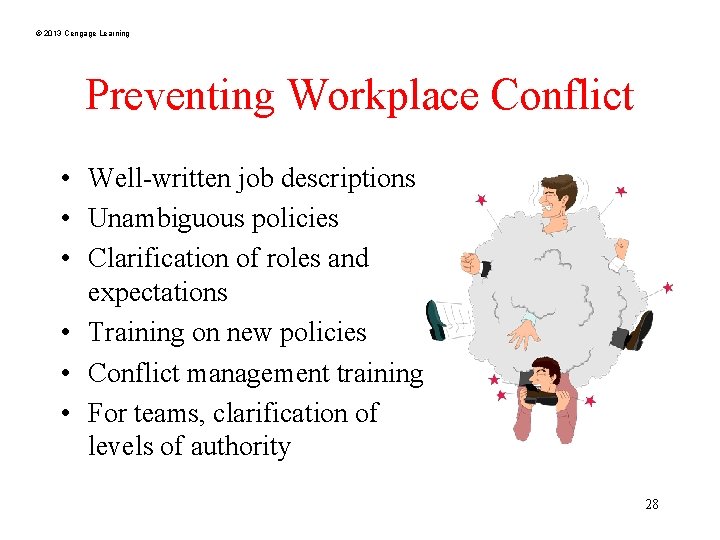
© 2013 Cengage Learning Preventing Workplace Conflict • Well-written job descriptions • Unambiguous policies • Clarification of roles and expectations • Training on new policies • Conflict management training • For teams, clarification of levels of authority 28
© 2013 Cengage Learning Conflict Styles • Avoiding style – Withdrawal – Triangling • • Accommodating style Forcing style Collaborating style Compromising style 29
© 2013 Cengage Learning Conflict Response Styles The Sage • • Problem-solver Win/Win orientation Cooperative problem solving Emphasis on preserving relationship and meeting own goals as well as that of others 30
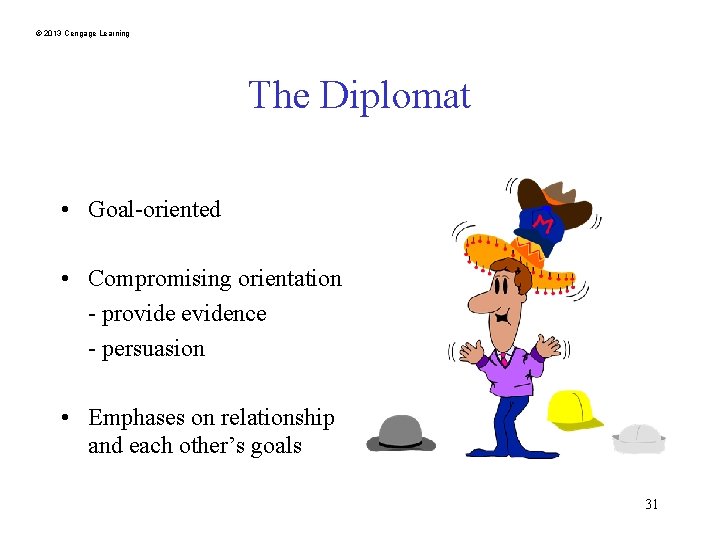
© 2013 Cengage Learning The Diplomat • Goal-oriented • Compromising orientation - provide evidence - persuasion • Emphases on relationship and each other’s goals 31
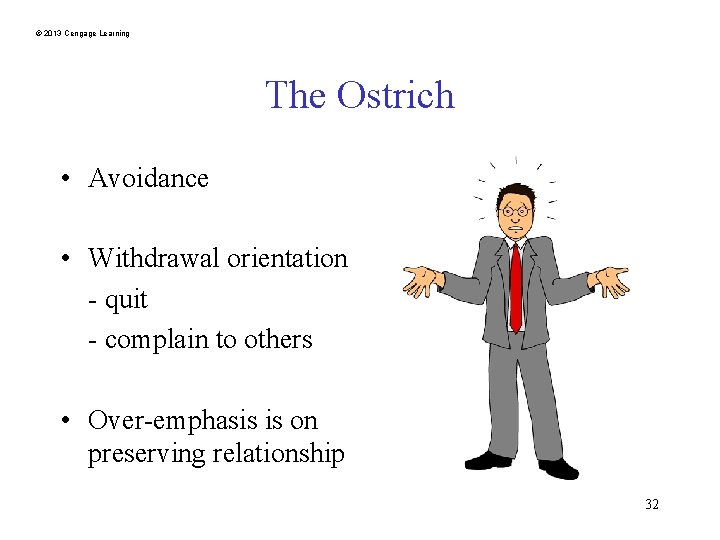
© 2013 Cengage Learning The Ostrich • Avoidance • Withdrawal orientation - quit - complain to others • Over-emphasis is on preserving relationship 32
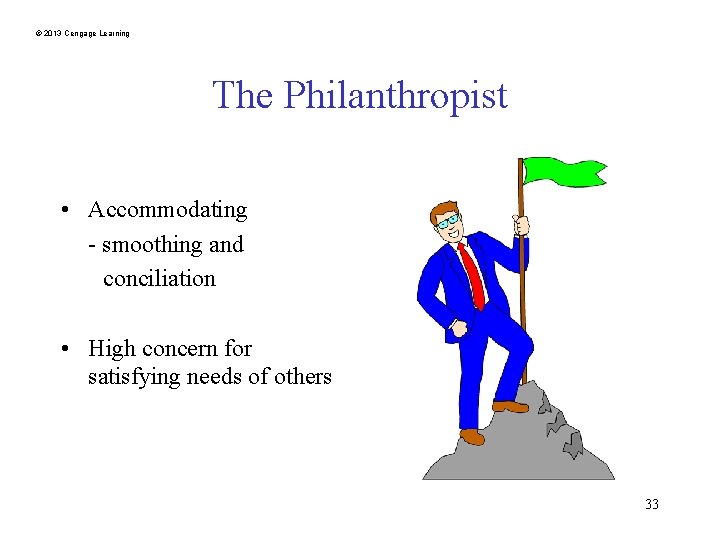
© 2013 Cengage Learning The Philanthropist • Accommodating - smoothing and conciliation • High concern for satisfying needs of others 33
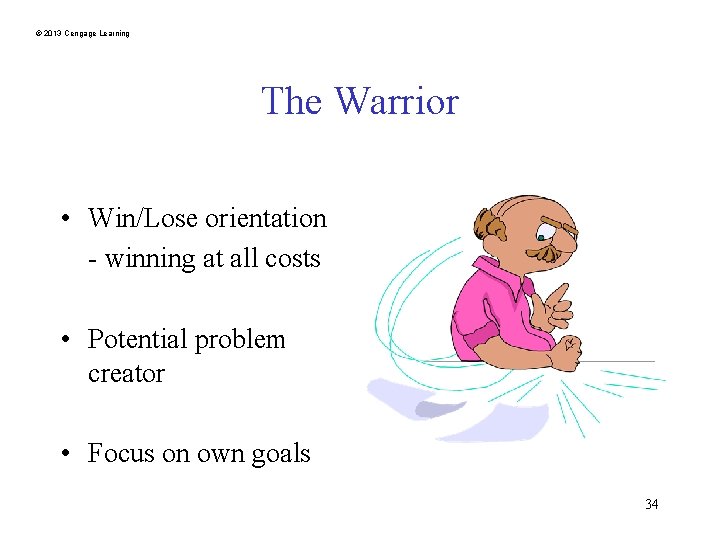
© 2013 Cengage Learning The Warrior • Win/Lose orientation - winning at all costs • Potential problem creator • Focus on own goals 34
© 2013 Cengage Learning Resolving Conflict • Prior to Conflict Occurring – Formal policies – Employee training • When Conflict Occurs – Employees should try to solve conflict – Third-party intervention 35
© 2013 Cengage Learning Third Party Intervention • • Dictation Arbitration Mediation Negotiation 36
© 2013 Cengage Learning Third Party Intervention Dictation • Supervisor dictates the solution • Dictation is best when: – – – – parties are irrational no trust exists too angry to be realistic have mental health issues alcohol or drugs are involved when violent behavior is potential parties have poor communication skills there are time constraints 37
© 2013 Cengage Learning Third Party Intervention • Mediation and negotiation are best when: – – parties are rational parties want to work out a solution together some trust still exists there are no time constraints • Arbitration – same as mediation but use when parties get stuck during mediation – Types • Binding • Nonbinding 38
© 2013 Cengage Learning Mediation Examples http: //youtu. be/f 0 ZFJEcd. KKk 39
© 2013 Cengage Learning Applied Case Study: Conflict at a nonprofit agency 40
© 2013 Cengage Learning Focus on Ethics Group Hazing 41
© 2013 Cengage Learning What Do You Think? • Do you think the stunts described above are harmless jokes or a form of hazing? If you consider it to be hazing, are they then, unethical? • Are practical jokes ever acceptable in the workplace? Are some less ethical than others? • Do you think it is ethical for management to support such practical jokes? • Is it unethical for a manager not to warn new employees that they may be subject to a practical joke as part of an initiation process? 42
- Slides: 42