
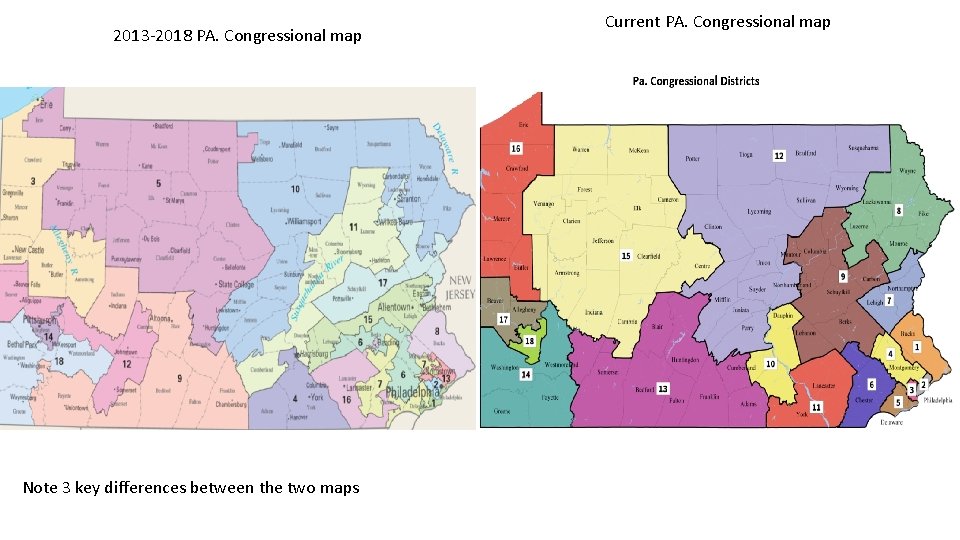
2013 2018 PA Congressional map Note 3 key

- Slides: 15
2013 -2018 PA. Congressional map Note 3 key differences between the two maps Current PA. Congressional map
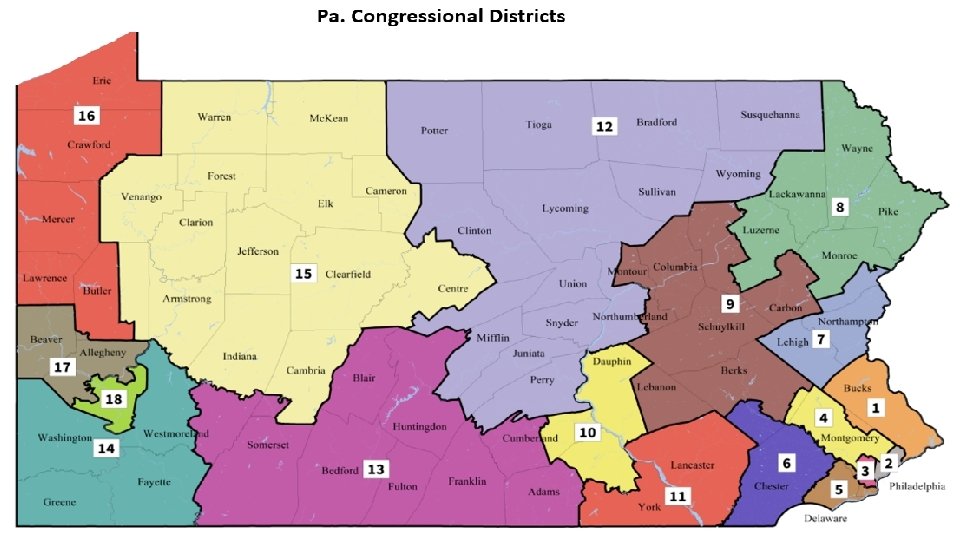
2012 redistricting and gerrymandering challenge Following the 2010 Census, redistricting in Pennsylvania was controlled by elected officials from the Republican party. In 2012, Pennsylvania realigned a number of districts. A number of sitting Congressional Representatives had their districts modified or merged as part of the redistricting. The merger of Districts 4 and 12 forced a primary runoff between the two sitting Congressional representatives. The 2012 redistricting process resulted in a map that disproportionately favored Republican candidates. In the 2012 Congressional elections, Democratic candidates won 50. 5% of the total votes cast. However, only five of the state's 18 Federal Representatives (27. 78%) were Democrats. On June 14, 2017, the League of Women Voters of Pennsylvania filed a lawsuit, alleging that the district boundaries constituted an unconstitutional partisan gerrymander. The case was eventually appealed to the Pennsylvania Supreme Court. On January 22, 2018, the Pennsylvania Supreme Court ruled that the Congressional Districts were unlawfully gerrymandered in violation of the Pennsylvania Constitution. The court ordered the General Assembly and the governor to adopt a remedied map, to be used for the 2018 Congressional elections. Pennsylvania Republicans requested a stay from the United States Supreme Court, to delay the drawing of new district boundaries; however, that request was denied on February 5, 2018. The governor and General Assembly failed to reach an agreement regarding the district boundaries, thus the Pennsylvania Supreme Court drew its own remedial map. On February 19, 2018, the Pennsylvania Supreme Court released a new congressional map, to take effect for the May 15, 2018, primaries. The Court voted to implement the new map by a 4– 3 vote. The map was designed with the assistance of Stanford University law professor Nathaniel Persily. The districts in the Court's map were significantly more compact, and its map split fewer municipalities and counties than the prior Republican-drawn map. [16] While the GOP-drawn map had favored Republican candidates, the court-drawn map is expected not to favor one party over the other. Republican lawmakers from Pennsylvania requested that the Supreme Court block the implementation of the court-drawn map; however, on March 19, 2018, the United States Supreme Court denied their request. A Pennsylvania federal district court dismissed a parallel suit on the same day.
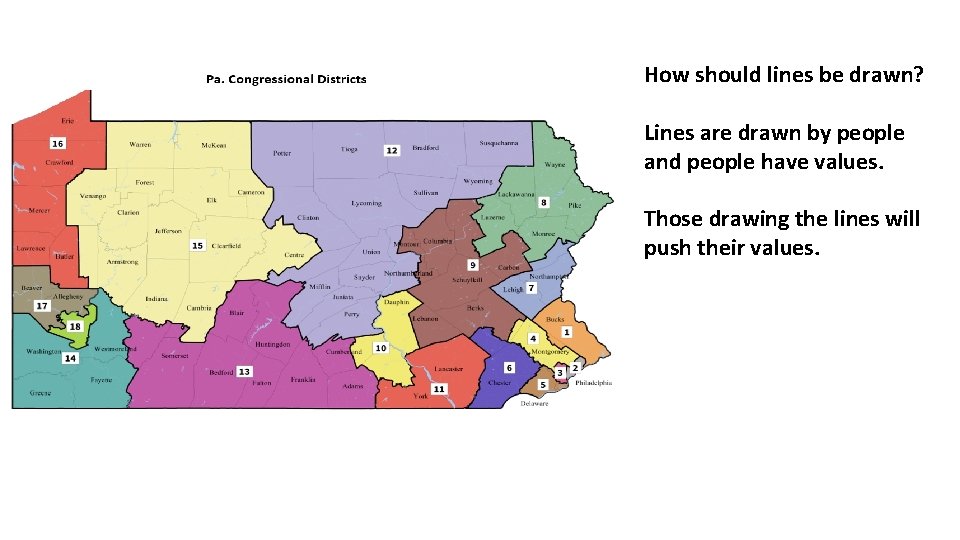
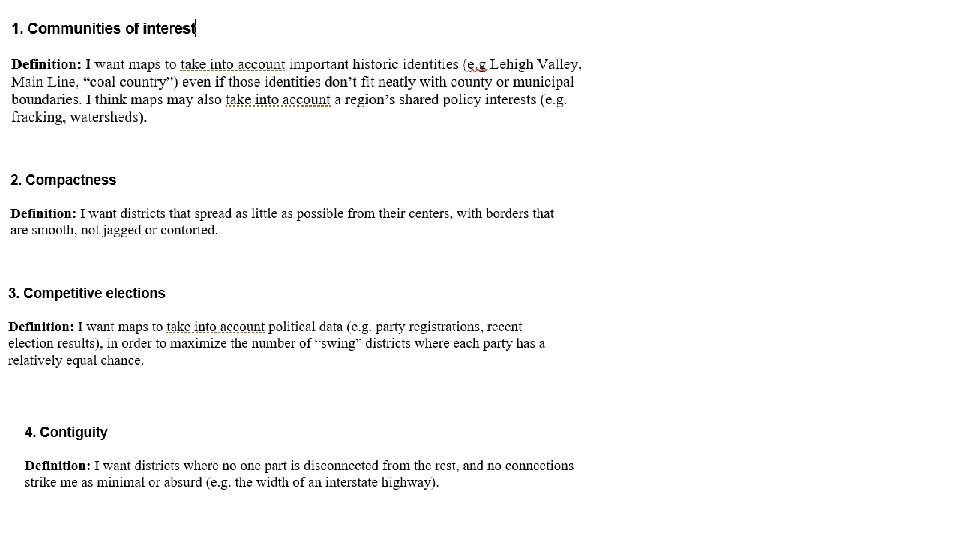
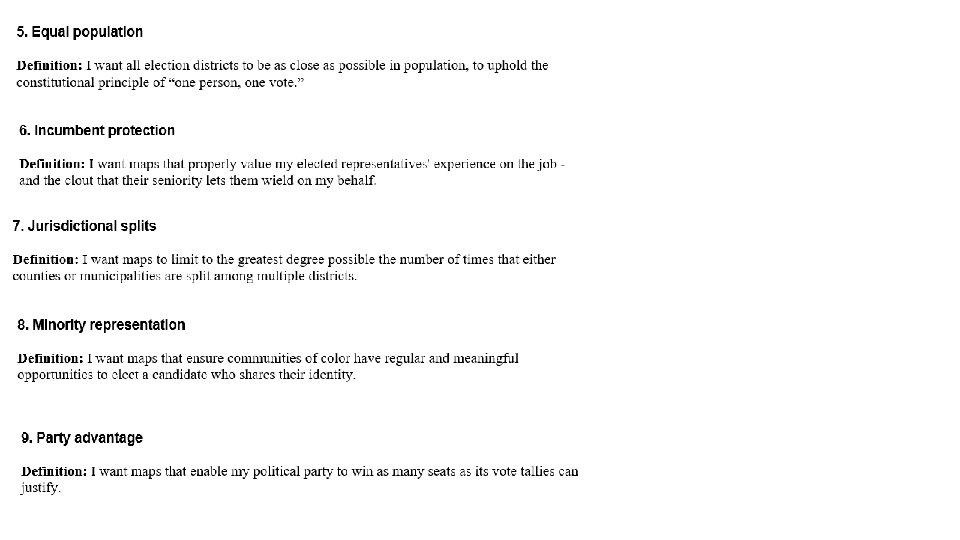
How should lines be drawn? Lines are drawn by people and people have values. Those drawing the lines will push their values.
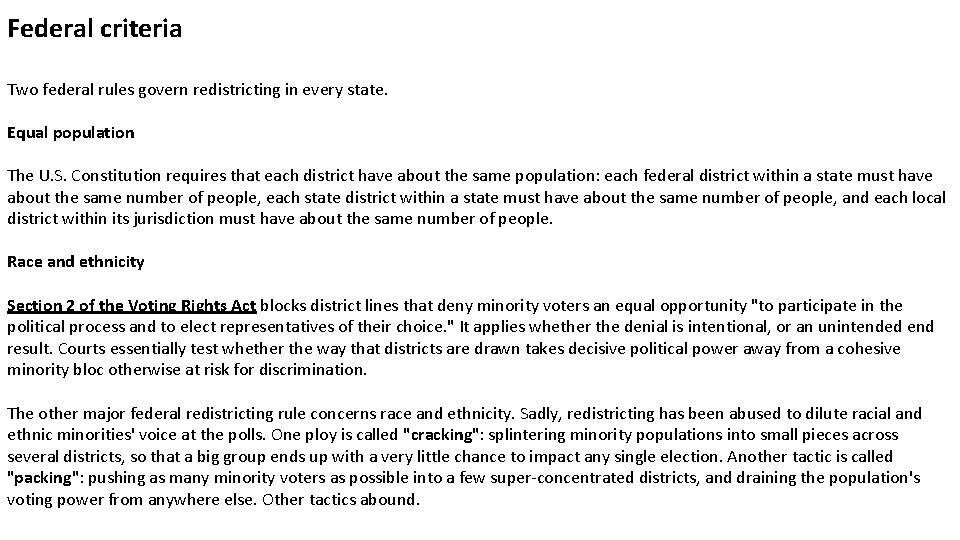
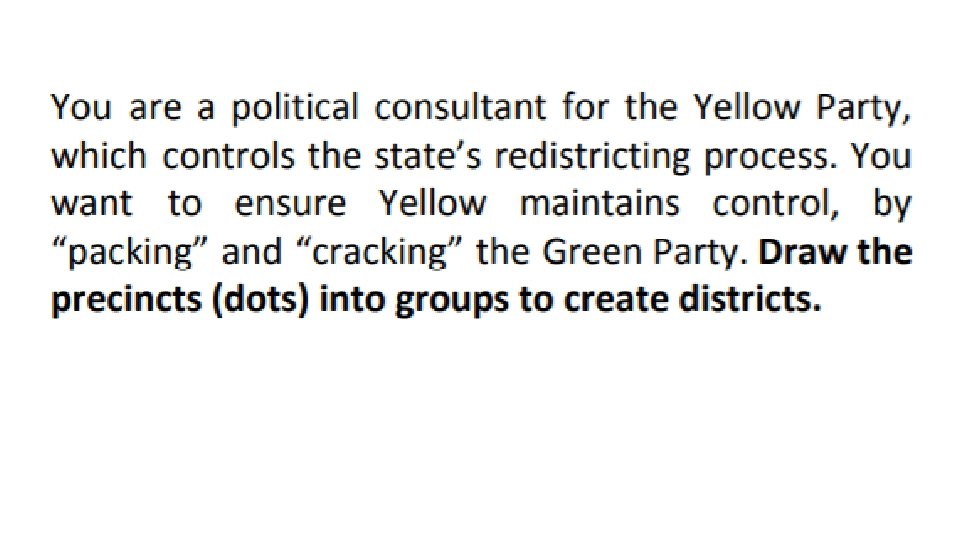
Federal criteria Two federal rules govern redistricting in every state. Equal population The U. S. Constitution requires that each district have about the same population: each federal district within a state must have about the same number of people, each state district within a state must have about the same number of people, and each local district within its jurisdiction must have about the same number of people. Race and ethnicity Section 2 of the Voting Rights Act blocks district lines that deny minority voters an equal opportunity "to participate in the political process and to elect representatives of their choice. " It applies whether the denial is intentional, or an unintended end result. Courts essentially test whether the way that districts are drawn takes decisive political power away from a cohesive minority bloc otherwise at risk for discrimination. The other major federal redistricting rule concerns race and ethnicity. Sadly, redistricting has been abused to dilute racial and ethnic minorities' voice at the polls. One ploy is called "cracking": splintering minority populations into small pieces across several districts, so that a big group ends up with a very little chance to impact any single election. Another tactic is called "packing": pushing as many minority voters as possible into a few super-concentrated districts, and draining the population's voting power from anywhere else. Other tactics abound.