
2012 Training Conference Joint Labor Management Solutions to
2012 Training Conference Joint Labor- Management Solutions to Current Human Resources Challenges September 11, 2012 Elliot R. Susseles, CCP Senior Vice President esusseles@segalco. com Copyright © 2012 by The Segal Group, Inc. , parent of The Segal Company. All rights reserved.
Labor Management Committees in the Public Sector Examples of LMC Work Recipe for Success Discussion Copyright © 2012 by The Segal Group, Inc. , parent of The Segal Company. All rights reserved.
Current Public Sector HR Challenges ØPublic sector employers doing more with less (revenue drop off, stagnant home prices) ØRe-organization ØCompetitiveness of pay ØOutdated classification structures ØClarity of career progression ØPerformance Management What other issues are you currently facing? 2
Labor-Management Committee Approaches to Address These Challenges Unique public sector challenges make LMCs an attractive option ØStrained financial resources ØIncreased transparency on government salaries, benefits ØNegative perceptions about government services relative to their cost ØMaintaining / encouraging employee involvement in solving problems LMCs can be an opportunity to look beyond typical “bread and butter” economic bargaining issues ØThey are the most common form of worker participation, yet not widely used ØThey avoid the “tradeoff mentality” often found in typical contract negotiations that can impede resolution ØMajor benefits of LMC collaboration are: · Structural change to organization of government · “Gainsharing” projects that link employee productivity with economic rewards · “Contracting-In” initiatives that can reduce jurisdiction expense and stabilize union member employment 3
What is a Labor-Management Committee A Labor-Management Committee (LMC) is comprised of representatives from management and labor and their purpose is to address a Human Resources challenge, need, or issue. ØSuccessful LMCs have the following design features: · · Equal number of management and labor members Neutral chairperson Charter (outlining the purpose, mission, and ground rules of the LMC) Clear lines of communication between LMC members and their management and labor constituents ØFrequently, they are negotiated into collective bargaining agreement to address a particular concern The true value of a LMC lies in its composition. 4
Why use a Labor-Management Committee Often, communication between management and labor relies on the formal grievance process and contract negotiations. That “Win-Lose” atmosphere is not conducive to solving matters that are of mutual concern. LMCs can provide a constructive forum for improving the labor relations climate in an organization by: ØGiving management a forum to address business conditions, quality problems, production concerns, and personnel issues ØProviding an opportunity to establish trust between union leaders and top management ØGiving union leaders a channel of communication to top management ØProviding an avenue to express employee complaints/concerns without the rigidities of a formal grievance process LMCs do not substitute for the negotiating process, but complement it. 5
Role of Neutral Chairperson A neutral chairperson should have the ability to: ØFacilitate consensus decisions ØDraw every one of the LMC members into committee discussions and deliberations ØLead the committee to group decision making ØEnsure adherence to the Charter’s principles and ground rules ØHave an understanding of needs of management and labor ØBe respected by LMC members and outside constituents Labor and Management LMC members, NOT the neutral, ultimately make the decisions. 6

Role of Charter The LMC Charter should include statements on: ØThe purpose of the committee ØThe structure, size, and composition of the committee ØThe time, place, duration, and frequency of meetings ØA method for taking and maintaining minutes of the meetings ØProcedures for designating “alternate” representatives if primary committee members cannot attend ØProtocol for disseminating information Labor and management must acknowledge a mutual problem and a have a commitment to resolve it. 7
Labor Management Committees in the Public Sector Examples of LMC Work Recipe for Success Discussion Copyright © 2012 by The Segal Group, Inc. , parent of The Segal Company. All rights reserved.
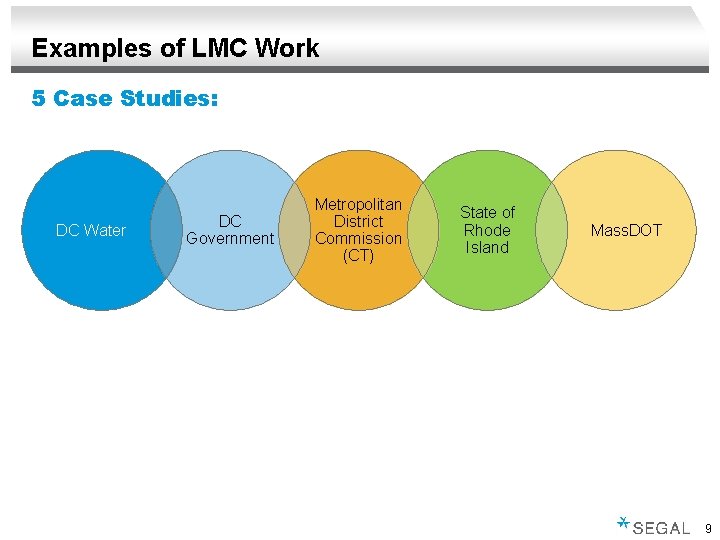
Examples of LMC Work 5 Case Studies: DC Water DC Government Metropolitan District Commission (CT) State of Rhode Island Mass. DOT 9
DC Water Engagement Problem: Ensure competitive pay; lack of clarity of job content; absence of career ladders In 2010, Segal conducted a comprehensive classification and compensation study for unionized jobs (5 CBAs). The process included: ØDevelopment and approval of the Job Analysis Questionnaire (JAQ) ØAnalysis and discussion of the relevant labor markets and which peer employers to include in the survey ØDevelopment of Classification Matrices and the levels associated with compensable factors to clearly differentiate roles, responsibilities, minimum job requirements and career ladders 10
DC Water Engagement Example Factor Complexity Level Ø A—Work consists of routine and repetitive tasks, processes, or operations requiring the selection and execution of straightforward actions. Makes day-to-day decisions and choices within a narrowly defined set of rules and guidelines. Examples are Laborer, Clerk. Ø B—Work consists of a wider variety of tasks and activities, performed within standard operating procedures. Some analytic ability is required, such as determining the appropriate tool/equipment to use for a particular assignment, straightforward mathematical computations, comparison of facts in selecting the correct action, and similar activities. The employee makes decisions based on a set of defined choices and alternatives based on the situation, precedent, or standard guidelines. Ø C—Work requires the direct application of a variety of procedures, policies, and/or precedents. The employee frequently assesses, researches, reports AND/OR troubleshoots and repairs. Makes decisions within generally accepted practices, protocols, or guidelines. Keeps supervisors aware of daily decisions and actions, but employee is generally expected to handle most situations within a welldefined scope of authority. 11
DC Water Engagement Example Factor Complexity Level continued Ø D—Work is substantially complex and varied and requires the interpretation of technical and detailed guidelines, policies, and procedures in combination. Analytic ability is needed to gather and interpret data where answers can be found only after careful analysis of several facts. The employee frequently investigates, audits, develops/recommends solutions and makes decisions within a wider, less-defined scope of authority. Ø E—Work is very non-standardized and widely varied, involving many complex and significant variables. Analytic ability and inductive thinking are required in extensively adapting policies, procedures, and methods to fit unusual or complex situations. The employee may be responsible for drafting or reviewing new standards or designs, developing standards for investigations or audits, or similar activities. The employee is likely to be a recognized expert in a specialized occupation or field. Example is Engineer III. 12
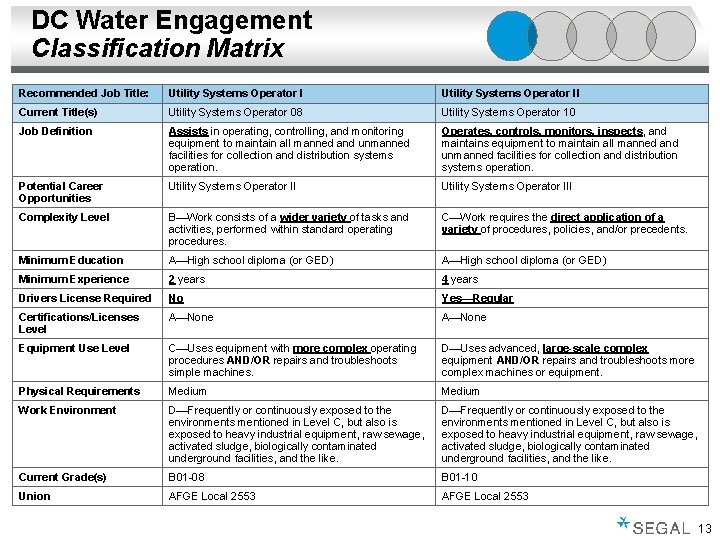
DC Water Engagement Classification Matrix Recommended Job Title: Utility Systems Operator II Current Title(s) Utility Systems Operator 08 Utility Systems Operator 10 Job Definition Assists in operating, controlling, and monitoring equipment to maintain all manned and unmanned facilities for collection and distribution systems operation. Operates, controls, monitors, inspects, and maintains equipment to maintain all manned and unmanned facilities for collection and distribution systems operation. Potential Career Opportunities Utility Systems Operator III Complexity Level B—Work consists of a wider variety of tasks and activities, performed within standard operating procedures. C—Work requires the direct application of a variety of procedures, policies, and/or precedents. Minimum Education A—High school diploma (or GED) Minimum Experience 2 years 4 years Drivers License Required No Yes—Regular Certifications/Licenses Level A—None Equipment Use Level C—Uses equipment with more complex operating procedures AND/OR repairs and troubleshoots simple machines. D—Uses advanced, large-scale complex equipment AND/OR repairs and troubleshoots more complex machines or equipment. Physical Requirements Medium Work Environment D—Frequently or continuously exposed to the environments mentioned in Level C, but also is exposed to heavy industrial equipment, raw sewage, activated sludge, biologically contaminated underground facilities, and the like. Current Grade(s) B 01 -08 B 01 -10 Union AFGE Local 2553 13
DC Water Engagement Key outcomes of the LMC included: ØRevised classification structure reflecting career levels and key differences between job titles ØUpdated job descriptions that reflect the actual duties, responsibilities, knowledge, skills, and abilities associated with each classification ØMarket competitive pay grade assignments for both union and nonunion jobs ØCombined functions of Water Services Worker with Sewer Services Worker (example of taking segmented functions and broadening them) The LMC provided guidance and decisions throughout the entire process. 14
DC Government Engagement Problem: multiple bargaining units covering same job title; different pay for identical work; Non-competitive pay progression; IT system inadequate The LMC work included: ØWeighing the pros and cons of modifying the pay structure to account for occupational differences in pay ØAligning jobs covered by multiple CBAs onto uniform pay structures ØCollaborated on selecting benchmark jobs that were representative of the various pay grades/structures, occupational groups, and bargaining units The LMC developed principles for the study that guided the process and fostered mutually beneficial outcomes. 15
DC Government Engagement LMCs Can Arise Out of Collective Bargaining Promulgating Collective Bargaining Language Memorandum of Understanding, 1/30/01 …The Parties hereby agree that the District and the Unions shall commence a joint labor-management classification and compensation collaborative review of District jobs. This project shall examine the current classification and compensation systems in order to ensure that the job classifications fairly represent actual work performed by the District employees as well as the appropriateness of the District’s current classification and compensation systems. 16
DC Government Engagement Guiding Principles of Classification & Compensation Reform ØStrengthen market competitiveness of compensation ØUpdate classification specifications to reflect current positions ØImprove administrative efficiency ØIncrease employee and management understanding about classification and compensation systems through training and communication 17
DC Government Engagement Classification Reform Guiding Principles ØProvide a framework to organize the relationship among jobs within and between occupational groups ØProvide an expanded framework for Labor and Management to negotiate compensation ØReflect the skills that employees need to do their jobs ØBe streamlined to reduce the overall number of job classifications, as well as the number of factors used in the classification (job evaluation) process 18
DC Government Engagement Task Force Membership Unions in coalition: ØAmerican Federation of Government Employees (AFGE) ØAmerican Federation of State, County, and Municipal Employees (AFSCME) ØCommunications Workers of America (CWA) ØFraternal Order of Police (FOP) ØNational Association of Government Employees/International Brotherhood of Police Officers Service Employees International Union (NAGE/IBPO/SEIU) ØPublic Service Employees Union ØService Employees International Union (SEIU) 19
DC Government Engagement Task Force Membership Management Representatives ØDC Office of Personnel ØDC Public Libraries ØDepartment of Human Services ØDepartment of Public Works ØOffice of Budget and Planning ØOffice of Labor Relations and Collective Bargaining ØOffice of Pay and Retirement Technical assistance provided by The Segal Company. 20
DC Government Engagement Benefits of Classification Reform ØBetter employee understanding about classification and career progression ØGreater consistency in how positions are classified ØEasier to conduct job evaluations, so system will be more efficient to administer ØBetter link to the compensation system ØLess time used for classification reviews ØBetter basis for human resources initiatives such as training and development ØBetter utilization of DCOP staff for other critical HR initiatives 21
DC Government Engagement Recommended Classification Structure ØImplement a four-level class structure for most classifications: · · Entry Level Developmental Level Full Performance or Journey Level Lead/Specialist Level ØSome classifications may require fewer levels, and some classifications may include a Trainee or Apprentice level 22
DC Government Engagement Guiding Principles of Compensation Reform ØBe market competitive ØFiscally responsible ØSupport the District’s ability to recruit and retain employees ØSupport market differentiation by occupational group ØFoster a strong workforce that supports improved service delivery 23
DC Government Engagement Salary Structure Recommendations ØSchedules for white-collar jobs should have 10 steps ØSchedules for blue-collar jobs should have 5 steps ØAll schedules should have consistent range widths and consistent intervals between steps ØPay progression—or the years it takes someone to reach the maximum step in a grade—should be consistent with the market and result in competitive career earnings for District employees 24
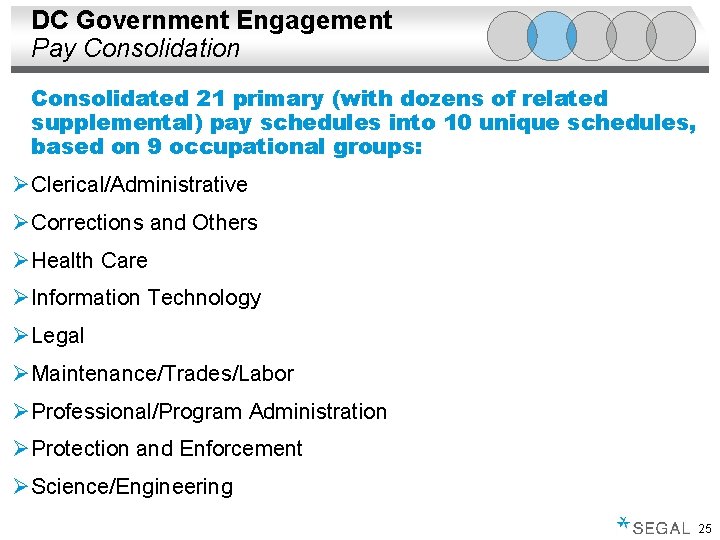
DC Government Engagement Pay Consolidation Consolidated 21 primary (with dozens of related supplemental) pay schedules into 10 unique schedules, based on 9 occupational groups: ØClerical/Administrative ØCorrections and Others ØHealth Care ØInformation Technology ØLegal ØMaintenance/Trades/Labor ØProfessional/Program Administration ØProtection and Enforcement ØScience/Engineering 25
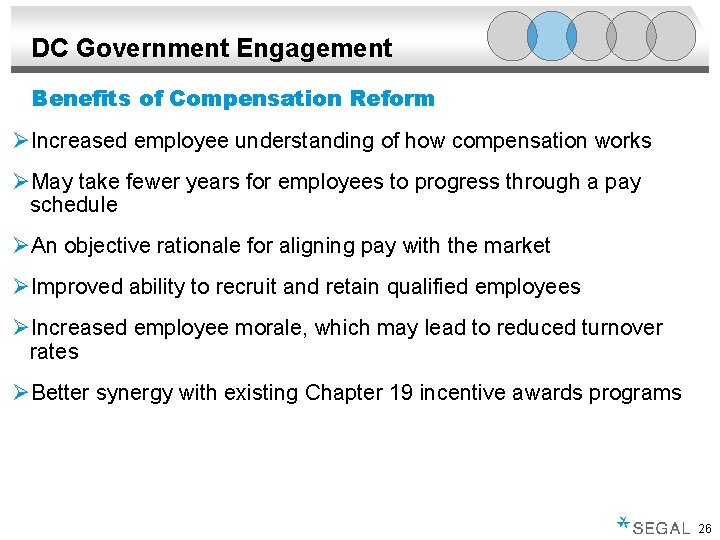
DC Government Engagement Benefits of Compensation Reform ØIncreased employee understanding of how compensation works ØMay take fewer years for employees to progress through a pay schedule ØAn objective rationale for aligning pay with the market ØImproved ability to recruit and retain qualified employees ØIncreased employee morale, which may lead to reduced turnover rates ØBetter synergy with existing Chapter 19 incentive awards programs 26
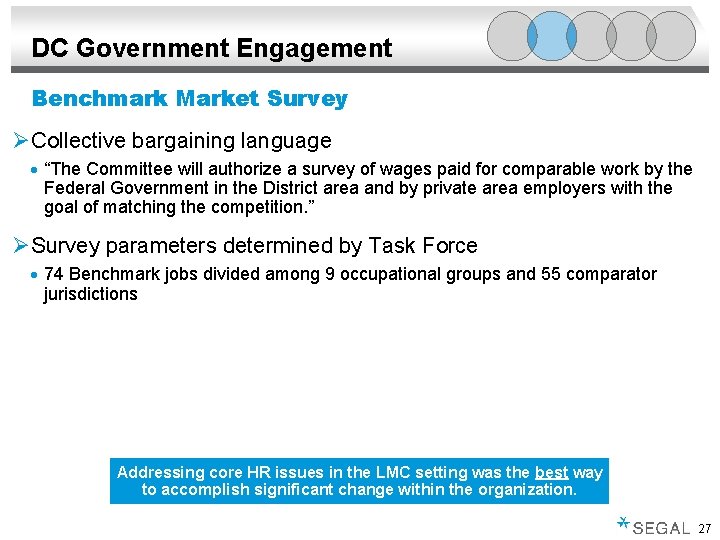
DC Government Engagement Benchmark Market Survey ØCollective bargaining language · “The Committee will authorize a survey of wages paid for comparable work by the Federal Government in the District area and by private area employers with the goal of matching the competition. ” ØSurvey parameters determined by Task Force · 74 Benchmark jobs divided among 9 occupational groups and 55 comparator jurisdictions Addressing core HR issues in the LMC setting was the best way to accomplish significant change within the organization. 27
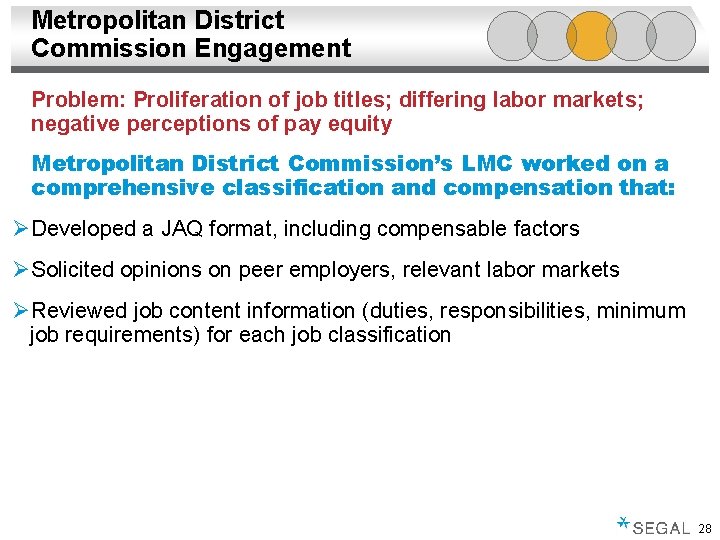
Metropolitan District Commission Engagement Problem: Proliferation of job titles; differing labor markets; negative perceptions of pay equity Metropolitan District Commission’s LMC worked on a comprehensive classification and compensation that: ØDeveloped a JAQ format, including compensable factors ØSolicited opinions on peer employers, relevant labor markets ØReviewed job content information (duties, responsibilities, minimum job requirements) for each job classification 28
Metropolitan District Commission Engagement Key outcomes of the LMC included: ØStreamlined classification structure that reflected actual work being performed and the “right” number of job titles ØPay scales that were market competitive and internally equitable ØInformal career paths that incentivized employees to gain additional skills and abilities Three LMCs had disparate objectives yet worked collaboratively to achieve optimal outcomes. 29
State of Rhode Island Engagement Problem: Reduction in pay & retirement benefits; proliferation of job titles; Inefficient personnel practices and policies; inflexibility in HR Administration; poor communication & understanding of pay system The State of Rhode Island its Labor Management Advisory Committee worked on the following: ØStakeholder interviews with agency representatives, union leaders, and private sector representatives ØReview of the HR function, process, and administration ØReview of competitiveness of pay and benefits ØReview of classification structure The current system dates back to 1956 and both labor and management recognize the current drawbacks. 30
State of Rhode Island Engagement Anticipated key outcomes of the LMC will include: ØIdentify potential changes to streamline classification structure and to align with work actually performed ØIdentify approach to improve competitiveness of compensation in order to support recruitment and retention ØRecommendations on HR Policies geared toward attracting and retaining a high quality and diverse workforce ØRecommendations on making HR Administration efficient, effective, and easy to understand by all users and stakeholders 31
Mass. DOT Engagement Problem: Consolidation of Turnpike, Highway, RMV and Aeronautics; internal and external pay equity concerns Mass. DOT and its LMC are conducting the following: ØDevelopment and distribution of JAQ ØInterviews with staff to clarify job content and understand related jobs ØReview of classification structure 32
Mass. DOT Engagement Anticipated key outcomes of the LMC will include: ØRecommendations on appropriate job title assignments for all staff ØRecommendations on HR policies that ease administrative burden and improve efficiency ØRecommendations for adding titles to the State’s current classification structure 33
Labor Management Committees in the Public Sector Examples of LMC Work Recipe for Success Discussion Copyright © 2012 by The Segal Group, Inc. , parent of The Segal Company. All rights reserved.
Recipe for Success Defining model committee behavior Ø Acknowledge each other's roles and responsibilities Ø Be candid and share appropriate information/data with the other party Ø Maintain the confidence of the other party so that representatives can speak freely Ø Awareness that the parties may need to be more flexible than in the past Reliance of outside expertise when needed Ø Job description and job content analysis—outsider view can be valuable Ø Health care utilization analysis—complex and varied in approach and design Ø Cost-containment strategies—ability to “say what needs to be said” does not reside internally Ø Communication with Stakeholders Ø Value in having one clear voice of the LMC, and not many different voices Ø Must be clear, concise, and direct and reach all levels of stakeholders (front-line employees, mid-level managers, union leadership, elected officials) 35
Labor Management Committees in the Public Sector Examples of LMC Work Recipe for Success Discussion Copyright © 2012 by The Segal Group, Inc. , parent of The Segal Company. All rights reserved.
Discussion 1920 N Street, NW, Suite 400 Washington, DC 20036 -1659 202 -833 -6436 www. segalco. com Elliot R. Susseles, CCP esusseles@segalco. co m 37
- Slides: 38