
2012 Texas Instruments Motor Control Training V 3


- Slides: 46
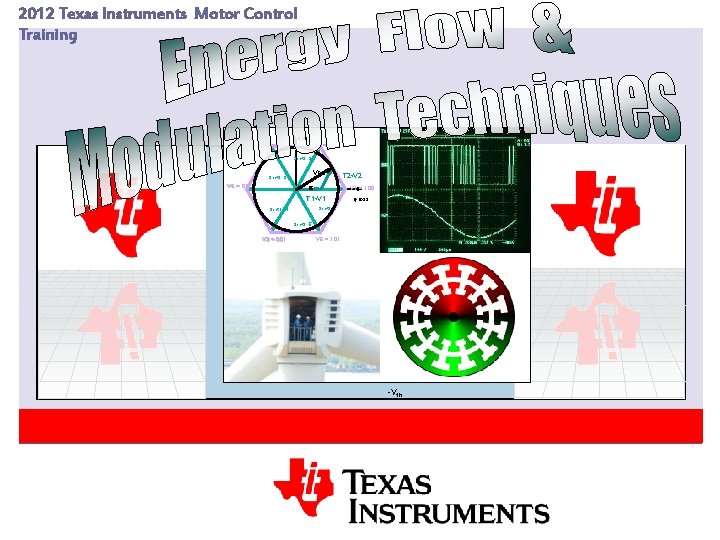
2012 Texas Instruments Motor Control Training V 3 = 010 d-axis V 2 = 110 Sector 2 Vref Sector 3 V 4 = 011 V 1 = 100 T 1 • V 1 T 2 • V 2 q-axis Sector 6 Sector 4 Sector 5 V 5 = 001 V 6 = 101 -Vth
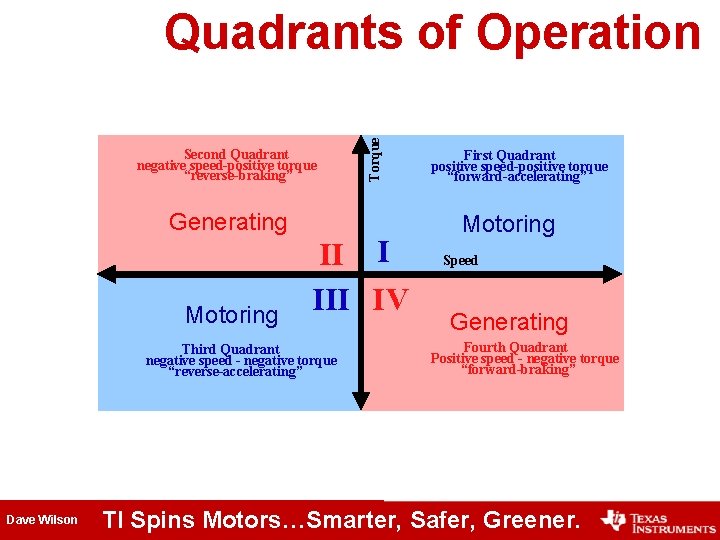
Second Quadrant negative speed-positive torque “reverse-braking” Generating Motoring II I III IV Third Quadrant negative speed - negative torque “reverse-accelerating” Dave Wilson Torque Quadrants of Operation First Quadrant positive speed-positive torque “forward-accelerating” Motoring Speed Generating Fourth Quadrant Positive speed - negative torque “forward-braking” TI Spins Motors…Smarter, Safer, Greener.
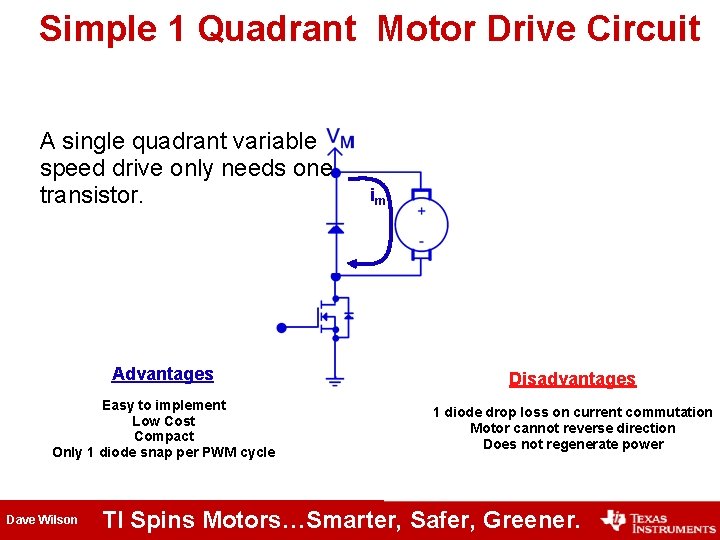
Simple 1 Quadrant Motor Drive Circuit A single quadrant variable speed drive only needs one transistor. im Advantages Disadvantages Easy to implement Low Cost Compact Only 1 diode snap per PWM cycle 1 diode drop loss on current commutation Motor cannot reverse direction Does not regenerate power Dave Wilson TI Spins Motors…Smarter, Safer, Greener.
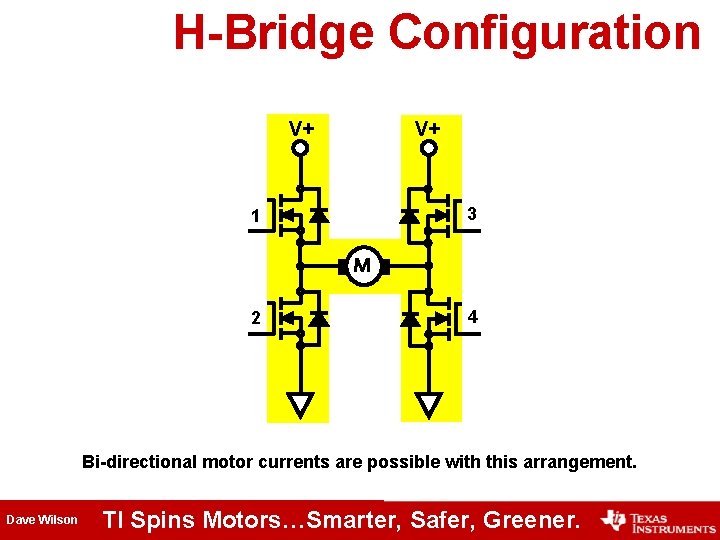
H-Bridge Configuration V+ V+ 3 1 M 2 4 Bi-directional motor currents are possible with this arrangement. Dave Wilson TI Spins Motors…Smarter, Safer, Greener.
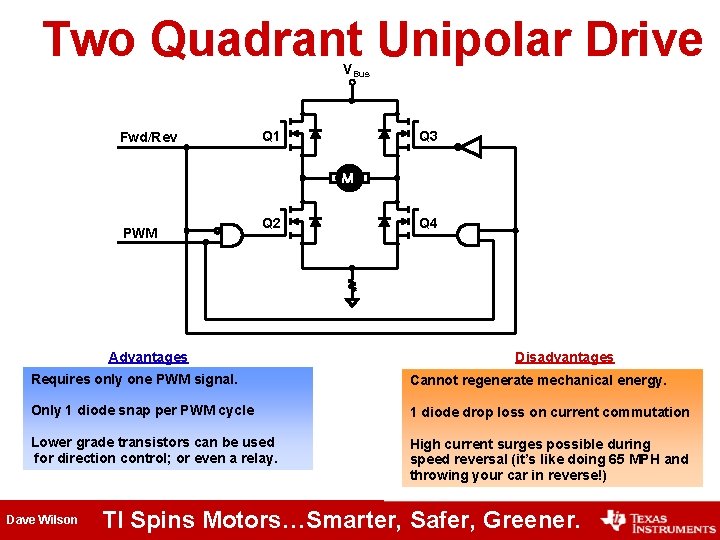
Two Quadrant Unipolar Drive VBus Fwd/Rev Q 3 Q 1 M PWM Q 2 Advantages Q 4 Disadvantages Requires only one PWM signal. Cannot regenerate mechanical energy. Only 1 diode snap per PWM cycle 1 diode drop loss on current commutation Lower grade transistors can be used for direction control; or even a relay. High current surges possible during speed reversal (it’s like doing 65 MPH and throwing your car in reverse!) Dave Wilson TI Spins Motors…Smarter, Safer, Greener.
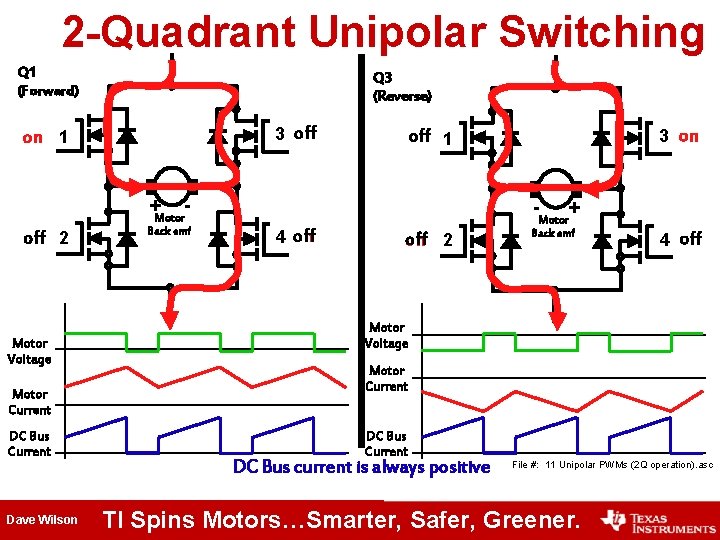
2 -Quadrant Unipolar Switching Q 1 (Forward) Q 3 (Reverse) 3 off on 1 +Motoroff 2 Motor Voltage Motor Current DC Bus Current Dave Wilson Back emf on 4 off 3 on off 1 -Motor+ off on 2 Back emf 4 off Motor Voltage Motor Current DC Bus current is always positive File #: 11 Unipolar PWMs (2 Q operation). asc TI Spins Motors…Smarter, Safer, Greener.
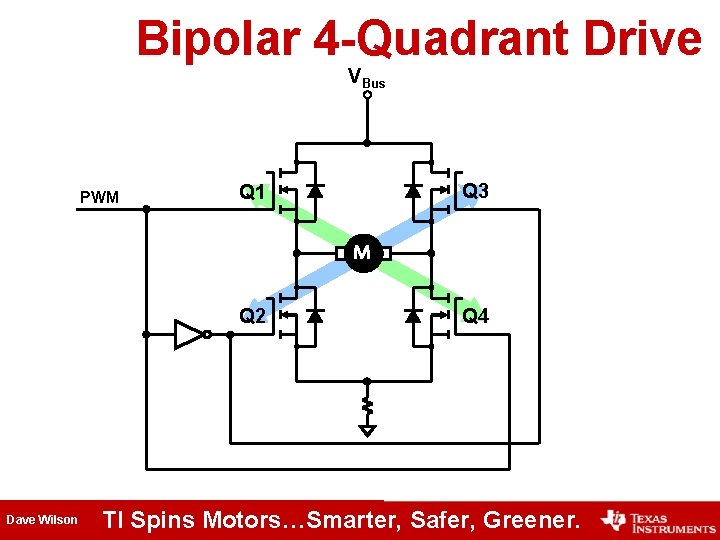
Bipolar 4 -Quadrant Drive VBus PWM Q 3 Q 1 M Q 2 Dave Wilson Q 4 TI Spins Motors…Smarter, Safer, Greener.
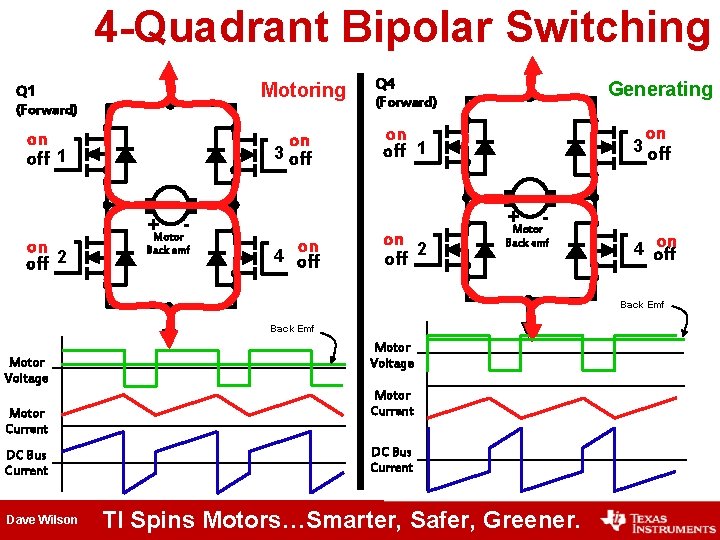
4 -Quadrant Bipolar Switching Motoring Q 1 (Forward) on off 1 on off 2 on 3 off +Motor. Back emf on 4 off Q 4 (Forward) Generating on on off 1 on off 2 3 off +Motor. Back emf on 4 off Back Emf Motor Voltage Motor Current DC Bus Current Dave Wilson Motor Voltage Motor Current DC Bus Current TI Spins Motors…Smarter, Safer, Greener.
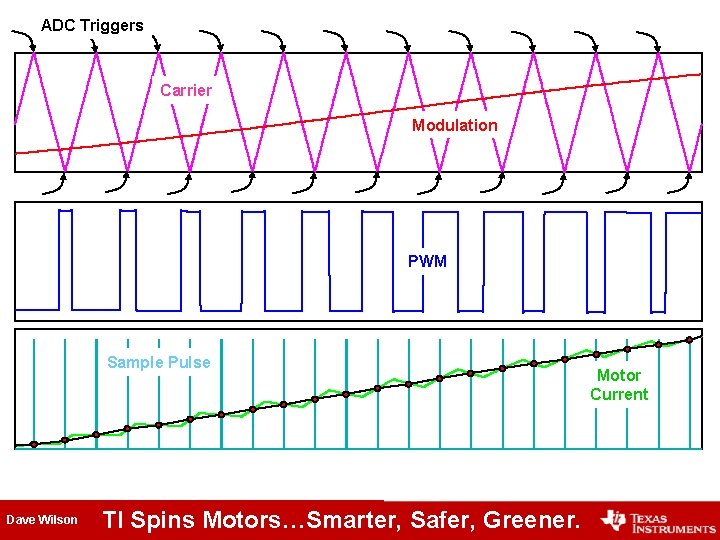
ADC Triggers Carrier Modulation PWM Sample Pulse Dave Wilson TI Spins Motors…Smarter, Safer, Greener. Motor Current
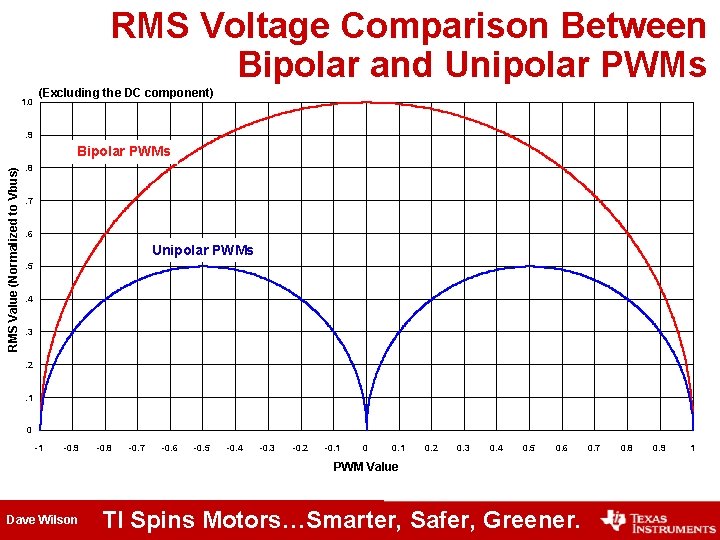
RMS Voltage Comparison Between Bipolar and Unipolar PWMs 1. 0 (Excluding the DC component) . 9 RMS Value (Normalized to Vbus) Bipolar PWMs. 8 . 7 . 6 Unipolar PWMs. 5 . 4 . 3 . 2 . 1 0 -1 -0. 9 -0. 8 -0. 7 -0. 6 -0. 5 -0. 4 -0. 3 -0. 2 -0. 1 0. 2 0. 3 0. 4 0. 5 0. 6 PWM Value Dave Wilson TI Spins Motors…Smarter, Safer, Greener. 0. 7 0. 8 0. 9 1
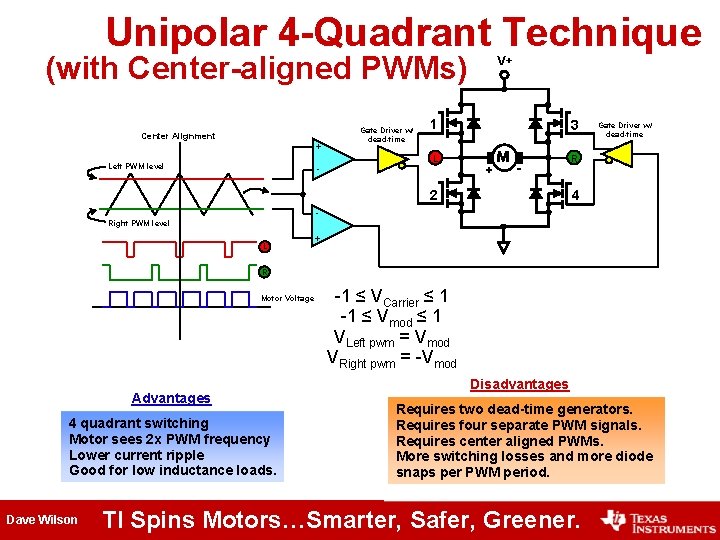
Unipolar 4 -Quadrant Technique (with Center-aligned PWMs) Center Alignment + Left PWM level - Gate Driver w/ dead-time V+ 1 L 3 + M - Gate Driver w/ dead-time R 4 2 Right PWM level L + R Motor Voltage Advantages 4 quadrant switching Motor sees 2 x PWM frequency Lower current ripple Good for low inductance loads. Dave Wilson -1 ≤ VCarrier ≤ 1 -1 ≤ Vmod ≤ 1 VLeft pwm = Vmod VRight pwm = -Vmod Disadvantages Requires two dead-time generators. Requires four separate PWM signals. Requires center aligned PWMs. More switching losses and more diode snaps per PWM period. TI Spins Motors…Smarter, Safer, Greener.
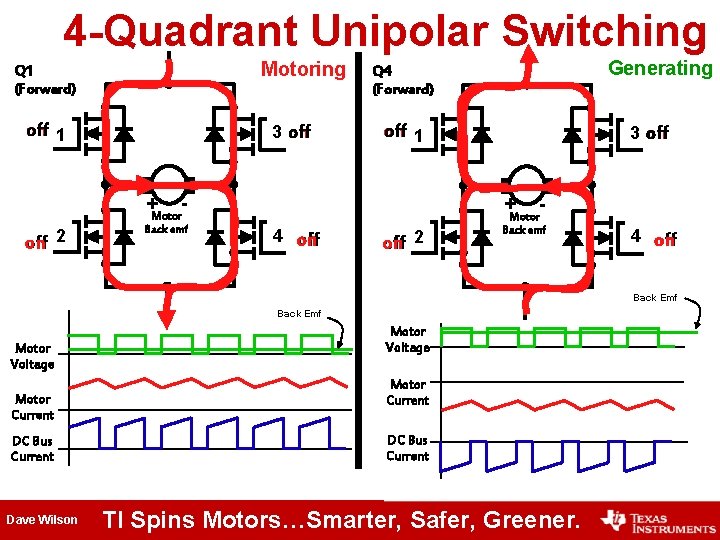
4 -Quadrant Unipolar Switching Motoring Q 1 (Forward) on off 1 on 3 off on off 1 +Motoron off 2 Back emf Generating Q 4 (Forward) on 3 off +Motor- 4 on off 2 Back emf 4 on off Back Emf Motor Voltage Motor Current DC Bus Current Dave Wilson Motor Voltage Motor Current DC Bus Current TI Spins Motors…Smarter, Safer, Greener.
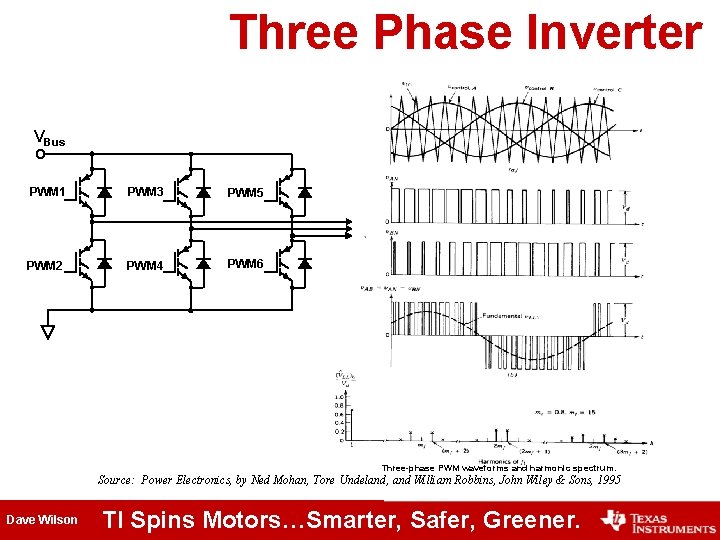
Three Phase Inverter VBus PWM 1 PWM 3 PWM 5 PWM 2 PWM 4 PWM 6 Three-phase PWM waveforms and harmonic spectrum. Source: Power Electronics, by Ned Mohan, Tore Undeland, and William Robbins, John Wiley & Sons, 1995 Dave Wilson TI Spins Motors…Smarter, Safer, Greener.
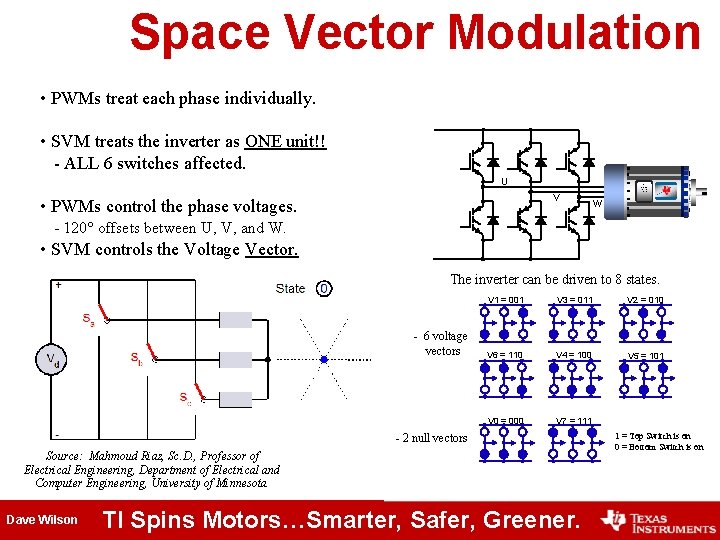
Space Vector Modulation • PWMs treat each phase individually. • SVM treats the inverter as ONE unit!! - ALL 6 switches affected. U V • PWMs control the phase voltages. - 120° offsets between U, V, and W. • SVM controls the Voltage Vector. TI Dave’s Control Center W The inverter can be driven to 8 states. - 6 voltage vectors V 1 = 001 V 3 = 011 V 2 = 010 V 6 = 110 V 4 = 100 V 5 = 101 V 0 = 000 V 7 = 111 - 2 null vectors Source: Mahmoud Riaz, Sc. D. , Professor of Electrical Engineering, Department of Electrical and Computer Engineering, University of Minnesota Dave Wilson TI Spins Motors…Smarter, Safer, Greener. 1 = Top Switch is on 0 = Bottom Switch is on
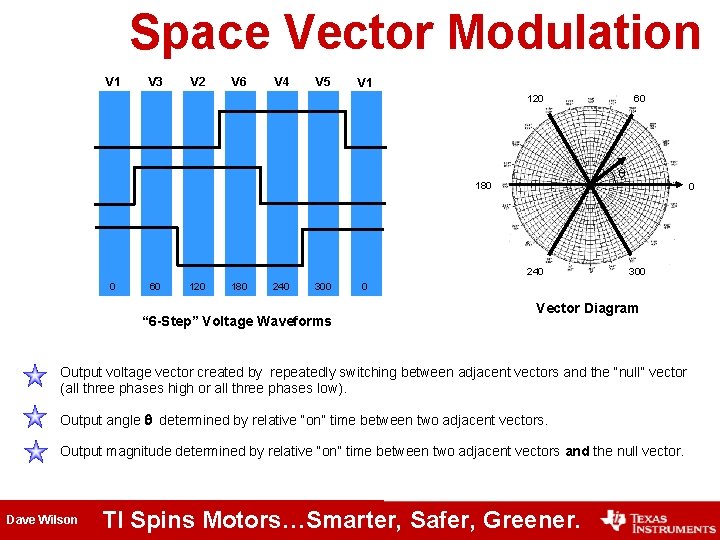
Space Vector Modulation V 1 V 3 V 2 V 6 V 4 V 5 V 1 120 180 240 0 60 120 180 240 300 “ 6 -Step” Voltage Waveforms 60 0 300 0 Vector Diagram Output voltage vector created by repeatedly switching between adjacent vectors and the “null” vector (all three phases high or all three phases low). Output angle determined by relative “on” time between two adjacent vectors. Output magnitude determined by relative “on” time between two adjacent vectors and the null vector. Dave Wilson TI Spins Motors…Smarter, Safer, Greener.
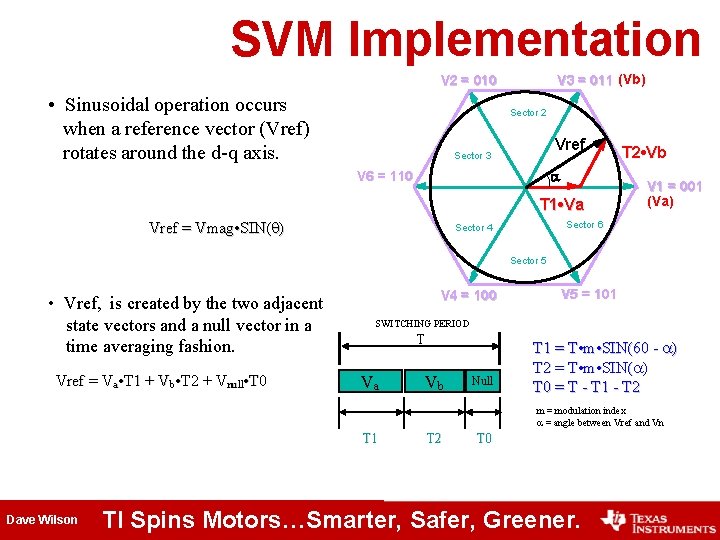
SVM Implementation V 3 = 011 (Vb) V 2 = 010 • Sinusoidal operation occurs when a reference vector (Vref) rotates around the d-q axis. Sector 2 Vref Sector 3 V 6 = 110 T 1 • Va Vref = Vmag • SIN( ) T 2 • Vb V 1 = 001 (Va) Sector 6 Sector 4 Sector 5 • Vref, is created by the two adjacent state vectors and a null vector in a time averaging fashion. Vref = Va • T 1 + Vb • T 2 + Vnull • T 0 V 4 = 100 V 5 = 101 SWITCHING PERIOD T Va Vb Null T 1 = T • m • SIN(60 - ) T 2 = T • m • SIN( ) T 0 = T - T 1 - T 2 m = modulation index = angle between Vref and Vn T 1 Dave Wilson T 2 T 0 TI Spins Motors…Smarter, Safer, Greener.
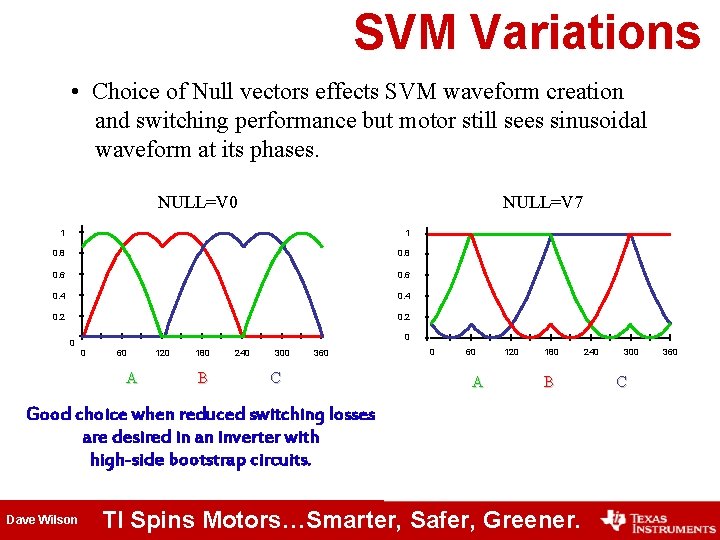
SVM Variations • Choice of Null vectors effects SVM waveform creation and switching performance but motor still sees sinusoidal waveform at its phases. NULL=V 7 NULL=V 0 1 1 0. 8 0. 6 0. 4 0. 2 0 0 0 60 A 120 180 B 240 300 360 C 0 60 A 120 180 B Good choice when reduced switching losses are desired in an inverter with high-side bootstrap circuits. Dave Wilson TI Spins Motors…Smarter, Safer, Greener. 240 300 C 360
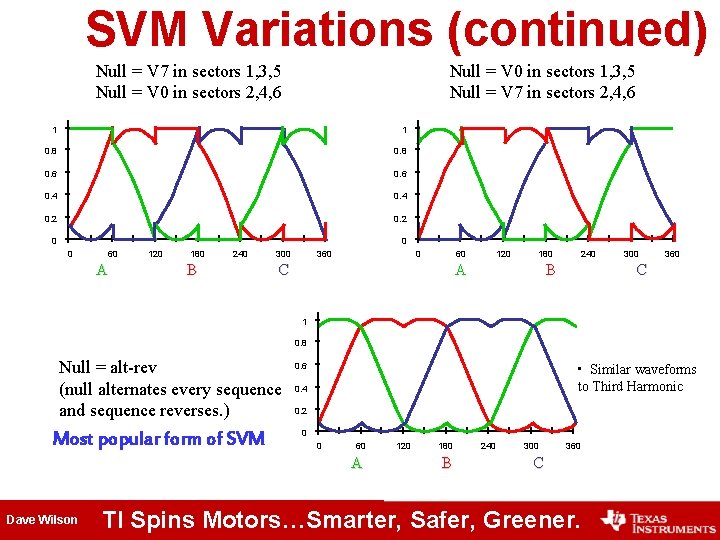
SVM Variations (continued) Null = V 7 in sectors 1, 3, 5 Null = V 0 in sectors 2, 4, 6 Null = V 0 in sectors 1, 3, 5 Null = V 7 in sectors 2, 4, 6 1 1 0. 8 0. 6 0. 4 0. 2 0 0 0 60 A 120 180 240 B 300 360 0 60 C 120 180 A 240 B 300 360 C 1 0. 8 Null = alt-rev (null alternates every sequence and sequence reverses. ) Most popular form of SVM 0. 6 • Similar waveforms to Third Harmonic 0. 4 0. 2 0 0 60 A Dave Wilson 120 180 B 240 300 360 C TI Spins Motors…Smarter, Safer, Greener.
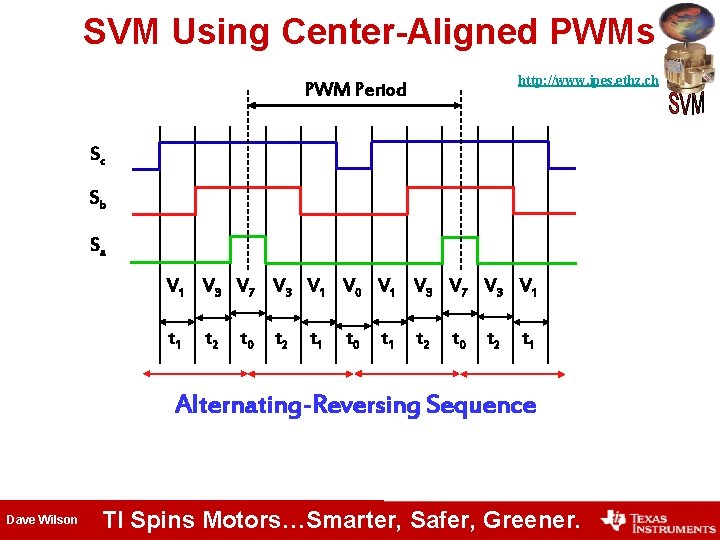
SVM Using Center-Aligned PWMs http: //www. ipes. ethz. ch PWM Period Sc Sb Sa V 1 V 3 V 7 V 3 V 1 V 0 V 1 V 3 V 7 V 3 V 1 t 2 t 0 t 2 t 1 t 0 t 1 t 2 t 0 t 2 t 1 Alternating-Reversing Sequence Dave Wilson TI Spins Motors…Smarter, Safer, Greener.
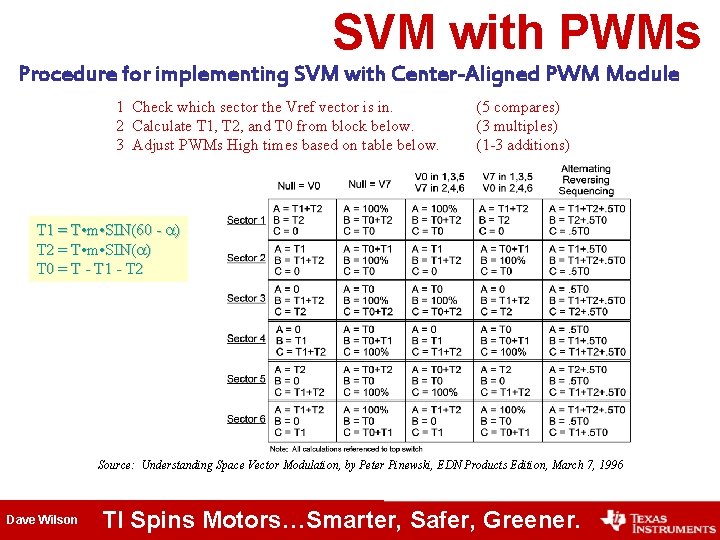
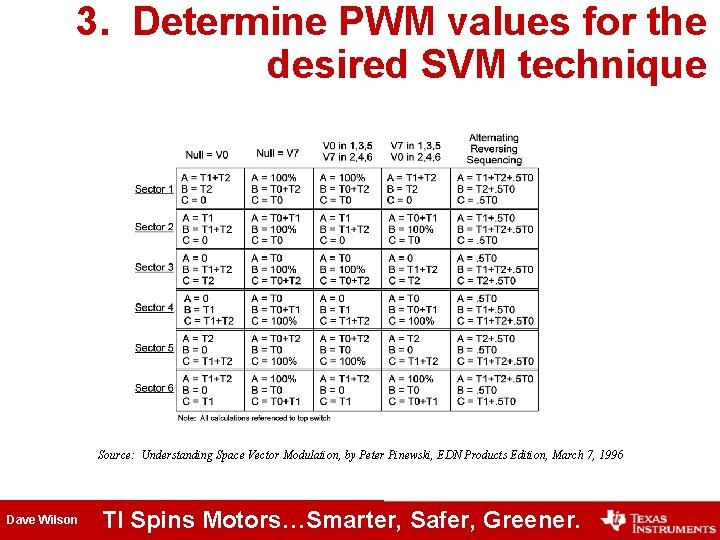
SVM with PWMs Procedure for implementing SVM with Center-Aligned PWM Module 1 Check which sector the Vref vector is in. (5 compares) 2 Calculate T 1, T 2, and T 0 from block below. (3 multiples) 3 Adjust PWMs High times based on table below. (1 -3 additions) T 1 = T • m • SIN(60 - ) T 2 = T • m • SIN( ) T 0 = T - T 1 - T 2 Source: Understanding Space Vector Modulation, by Peter Pinewski, EDN Products Edition, March 7, 1996 Dave Wilson TI Spins Motors…Smarter, Safer, Greener.
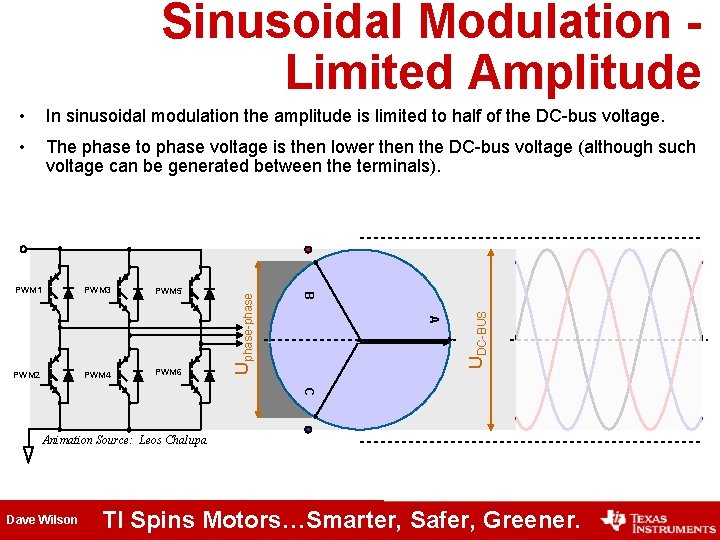
Sinusoidal Modulation Limited Amplitude In sinusoidal modulation the amplitude is limited to half of the DC-bus voltage. • The phase to phase voltage is then lower then the DC-bus voltage (although such voltage can be generated between the terminals). PWM 2 PWM 4 PWM 6 UDC-BUS PWM 5 A PWM 3 B PWM 1 Uphase-phase • C Animation Source: Leos Chalupa Dave Wilson TI Spins Motors…Smarter, Safer, Greener.
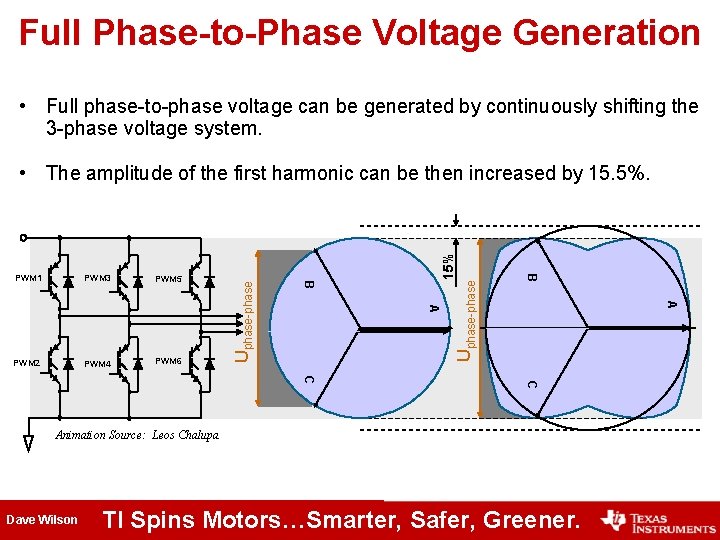
Full Phase-to-Phase Voltage Generation • Full phase-to-phase voltage can be generated by continuously shifting the 3 -phase voltage system. Uphase-phase PWM 6 Uphase-phase PWM 4 A PWM 2 B PWM 5 A PWM 3 B PWM 1 15% • The amplitude of the first harmonic can be then increased by 15. 5%. C C Animation Source: Leos Chalupa Dave Wilson TI Spins Motors…Smarter, Safer, Greener.
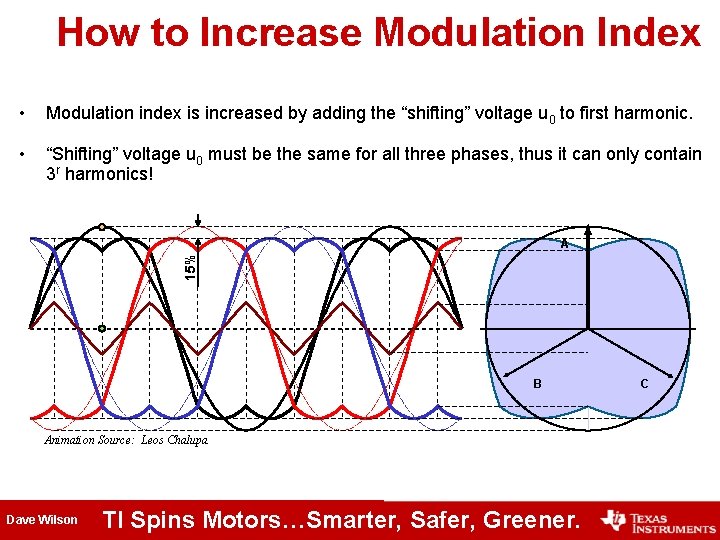
How to Increase Modulation Index • Modulation index is increased by adding the “shifting” voltage u 0 to first harmonic. • “Shifting” voltage u 0 must be the same for all three phases, thus it can only contain 3 r harmonics! 15% A B Animation Source: Leos Chalupa Dave Wilson TI Spins Motors…Smarter, Safer, Greener. C
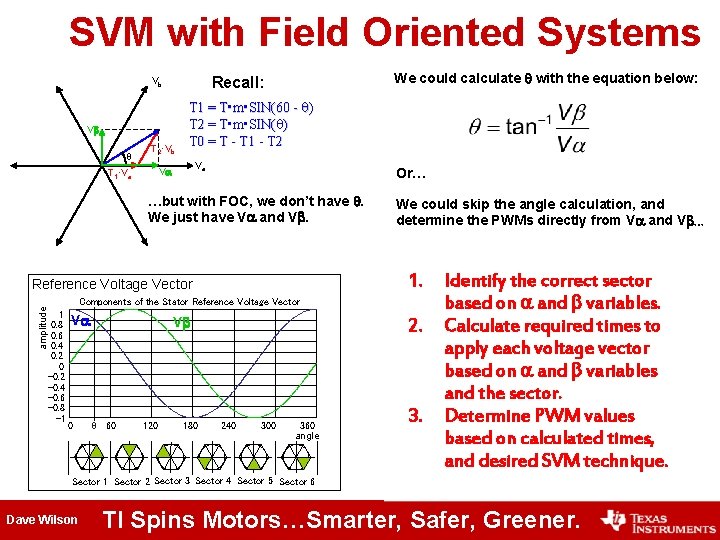
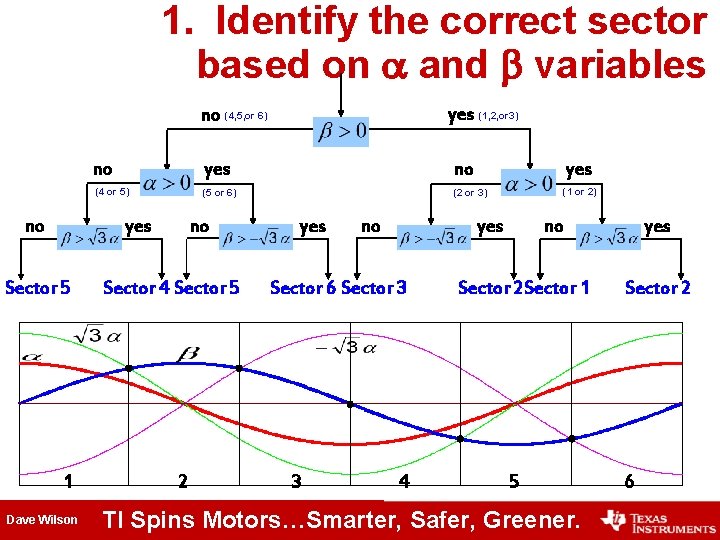
SVM with Field Oriented Systems Vb T 2·Vb T 1 = T • m • SIN(60 - ) T 2 = T • m • SIN( ) T 0 = T - T 1 - T 2 Va V T 1·Va We could calculate with the equation below: Recall: Vb Or… …but with FOC, we don’t have . We just have V and Vb. 1. amplitude Reference Voltage Vector 1 0. 8 0. 6 0. 4 0. 2 0 -0. 2 -0. 4 -0. 6 -0. 8 -1 We could skip the angle calculation, and determine the PWMs directly from V and Vb. . . Components of the Stator Reference Voltage Vector V 0 Vb 60 120 180 2. 240 300 360 angle 3. Identify the correct sector based on and b variables. Calculate required times to apply each voltage vector based on and b variables and the sector. Determine PWM values based on calculated times, and desired SVM technique. Sector 1 Sector 2 Sector 3 Sector 4 Sector 5 Sector 6 Dave Wilson TI Spins Motors…Smarter, Safer, Greener.
1. Identify the correct sector based on and b variables no (4 or 5) no yes Sector 5 1 Dave Wilson no (4, 5, or 6) yes (1, 2, or 3) yes no yes (5 or 6) (2 or 3) (1 or 2) no Sector 4 Sector 5 2 yes no yes Sector 6 Sector 3 3 4 no Sector 2 Sector 1 5 TI Spins Motors…Smarter, Safer, Greener. yes Sector 2 6
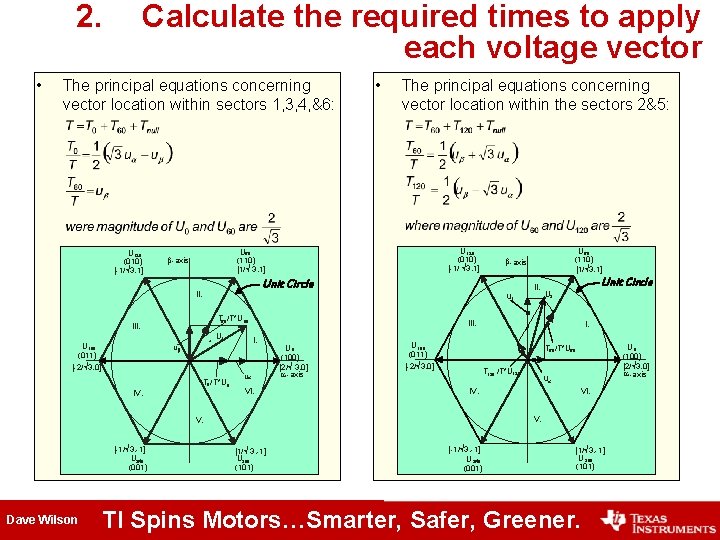
2. • Calculate the required times to apply each voltage vector The principal equations concerning vector location within sectors 1, 3, 4, &6: U 120 (010) [-1/ 3, 1] The principal equations concerning vector location within the sectors 2&5: U 120 (010) [-1/ 3, 1] U 60 (110) [1/ 3, 1] b -axis Unit Circle II. US T 0 /T* U 0 IV. u VI. U 0 (100) [2/ 3, 0] -axis Dave Wilson Unit Circle US I. U 180 (011) U 0 (100) [2/ 3, 0] -axis T 60/T*U 60 [-2/ 3, 0] T 120 /T*U 120 u VI. IV. V. [-1/ 3, -1] U 240 (001) II. III. I. ub U 60 (110) [1/ 3, 1] b-axis ub T 60 /T*U 60 III. U 180 (011) [-2/ 3, 0] • [1/ 3, -1] U 300 (101) [-1/ 3, -1] U 240 (001) [1/ 3, -1] U 300 (101) TI Spins Motors…Smarter, Safer, Greener.
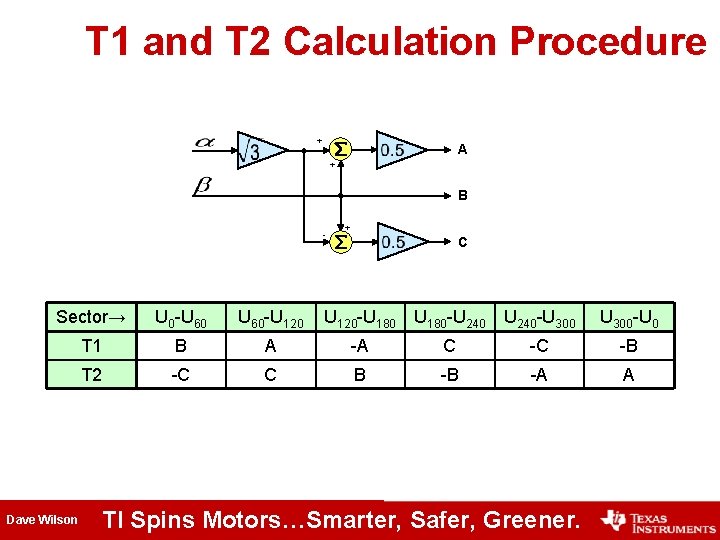
T 1 and T 2 Calculation Procedure + A + B - + C Sector→ U 0 -U 60 -U 120 T 1 B A -A C -C -B T 2 -C C B -B -A A Dave Wilson U 120 -U 180 -U 240 -U 300 TI Spins Motors…Smarter, Safer, Greener. U 300 -U 0
3. Determine PWM values for the desired SVM technique Source: Understanding Space Vector Modulation, by Peter Pinewski, EDN Products Edition, March 7, 1996 Dave Wilson TI Spins Motors…Smarter, Safer, Greener.
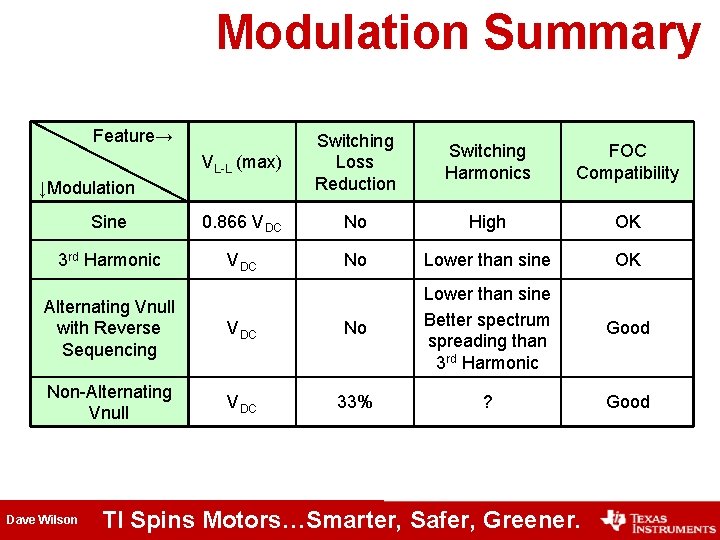
Modulation Summary Feature→ VL-L (max) Switching Loss Reduction Switching Harmonics FOC Compatibility Sine 0. 866 VDC No High OK 3 rd Harmonic VDC No Lower than sine OK Good ↓Modulation Alternating Vnull with Reverse Sequencing VDC No Lower than sine Better spectrum spreading than 3 rd Harmonic Non-Alternating Vnull VDC 33% ? Dave Wilson TI Spins Motors…Smarter, Safer, Greener.
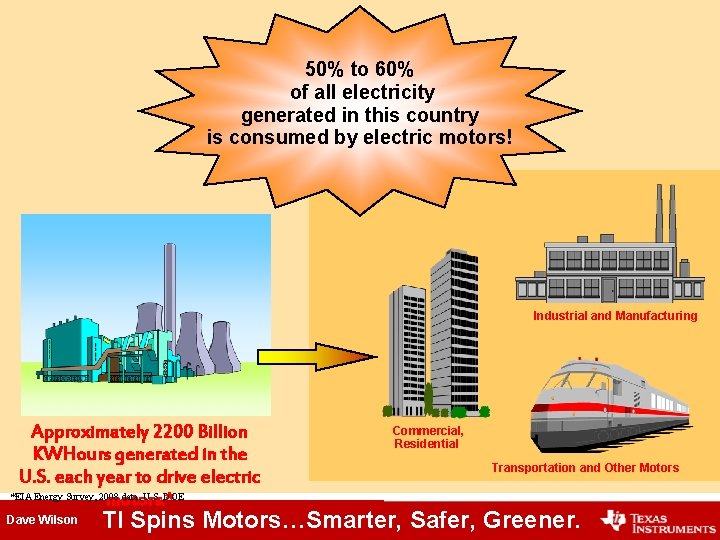
50% to 60% of all electricity generated in this country is consumed by electric motors! Industrial and Manufacturing Approximately 2200 Billion KWHours generated in the U. S. each year to drive electric *EIA Energy Survey, 2008 data, U. S. DOE motors. * Dave Wilson Commercial, Residential Transportation and Other Motors TI Spins Motors…Smarter, Safer, Greener.
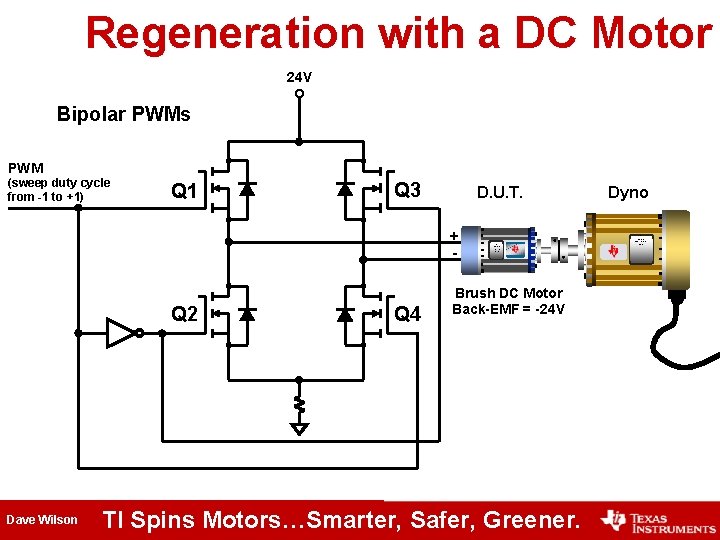
Regeneration with a DC Motor 24 V Bipolar PWMs PWM (sweep duty cycle from -1 to +1) Q 1 Q 3 D. U. T. + - Q 2 Dave Wilson Q 4 Dyno TI TI Dave’s Control Center Brush DC Motor Back-EMF = -24 V TI Spins Motors…Smarter, Safer, Greener. Dave’s Most Excellent Motor
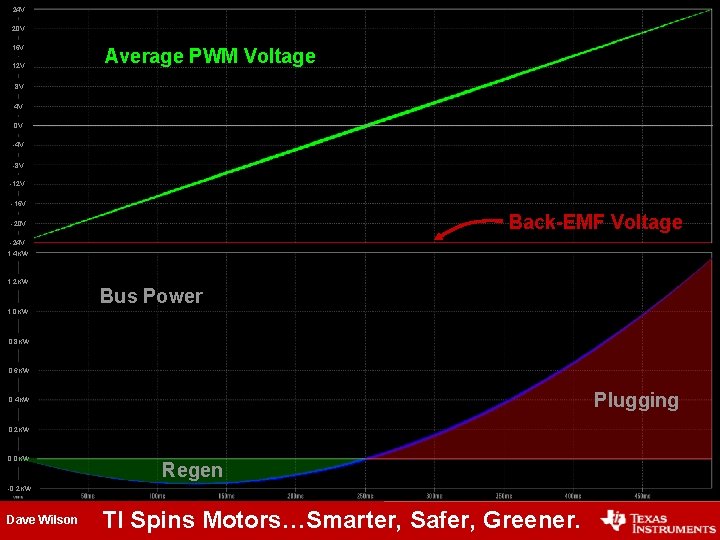
24 V 20 V 16 V 12 V Average PWM Voltage 8 V 4 V 0 V -4 V -8 V -12 V -16 V Back-EMF Voltage -20 V -24 V 1. 4 KW 1. 2 KW 1. 0 KW Bus Power 0. 8 KW 0. 6 KW Plugging 0. 4 KW 0. 2 KW 0. 0 KW Regen -0. 2 KW Dave Wilson TI Spins Motors…Smarter, Safer, Greener.
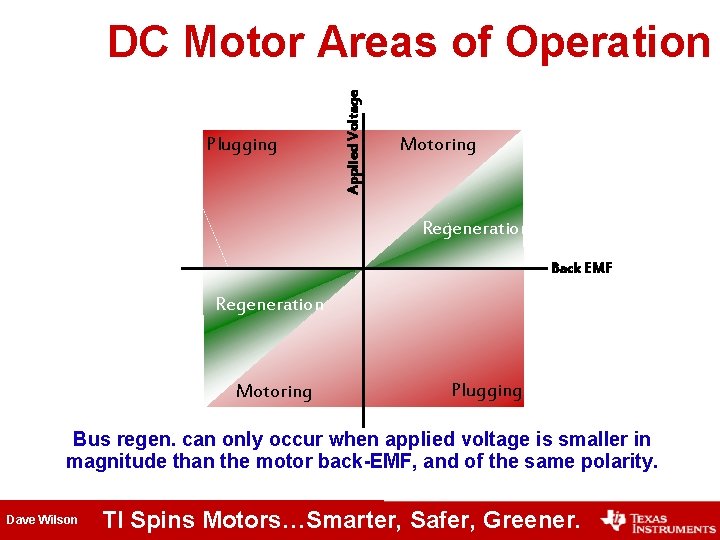
Plugging Applied Voltage DC Motor Areas of Operation Motoring Regeneration Back EMF Regeneration Motoring Plugging Bus regen. can only occur when applied voltage is smaller in magnitude than the motor back-EMF, and of the same polarity. Dave Wilson TI Spins Motors…Smarter, Safer, Greener.
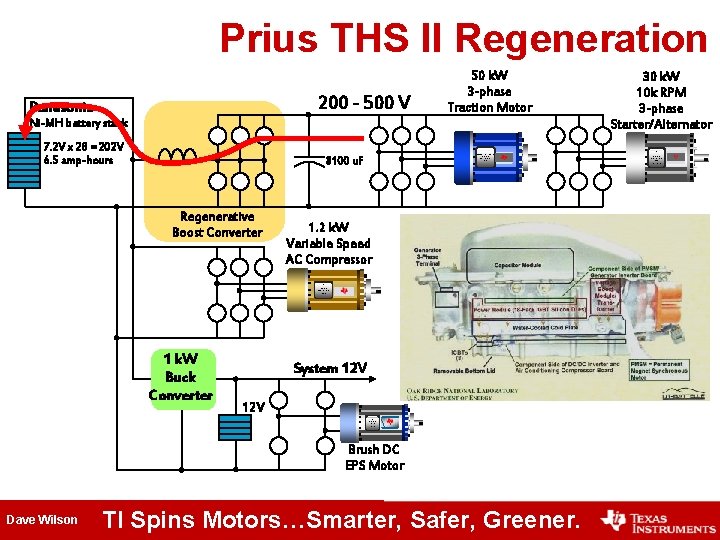
Prius THS II Regeneration 200 - 500 V Panasonic 50 k. W 3 -phase Traction Motor Ni-MH battery stack 7. 2 V x 28 = 202 V 6. 5 amp-hours TI Texas Instruments Dave’s Most Excellent Motor 8100 u. F Regenerative Boost Converter 1. 2 k. W Variable Speed AC Compressor TI Dave’s Most Excellent Motor 1 k. W Buck Converter System 12 V TI Dave’s Control Center Brush DC EPS Motor Dave Wilson 30 k. W 10 k RPM 3 -phase Starter/Alternator TI Spins Motors…Smarter, Safer, Greener. Dave’s Most Excellent Motor Controller
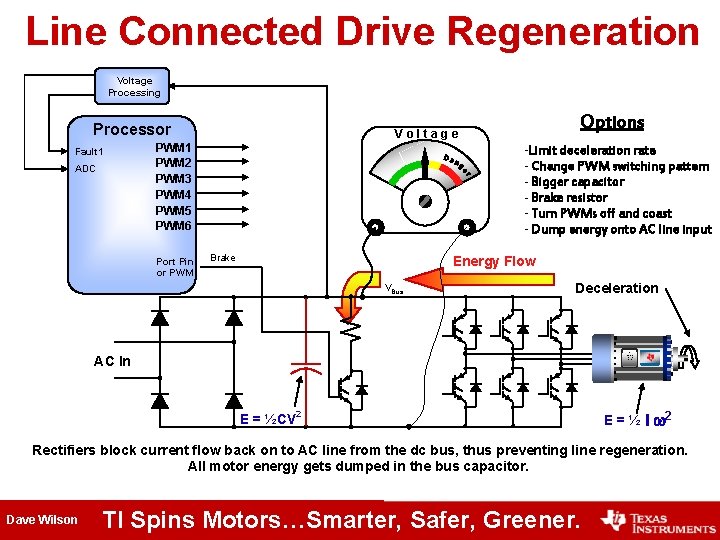
Line Connected Drive Regeneration Voltage Processing Processor Fault 1 ADC PWM 1 PWM 2 PWM 3 PWM 4 PWM 5 PWM 6 Port Pin or PWM Options Voltage -Limit deceleration rate - Change PWM switching pattern - Bigger capacitor - Brake resistor - Turn PWMs off and coast - Dump energy onto AC line input Brake Energy Flow VBus Deceleration TI Dave’s Control Center AC In E = ½CV 2 E = ½ I w 2 Rectifiers block current flow back on to AC line from the dc bus, thus preventing line regeneration. All motor energy gets dumped in the bus capacitor. Dave Wilson TI Spins Motors…Smarter, Safer, Greener.
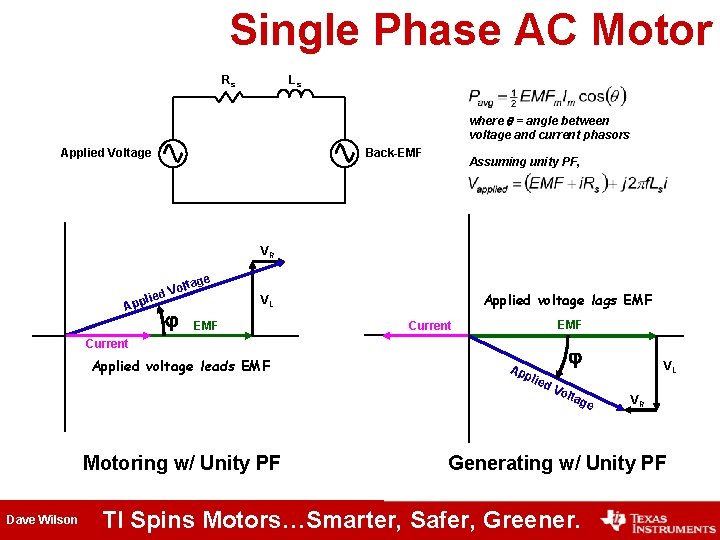
Single Phase AC Motor Rs Ls where q = angle between voltage and current phasors Applied Voltage Back-EMF Assuming unity PF, VR tage ol ed V li App j Applied voltage lags EMF VL EMF Current Applied voltage leads EMF j Ap plie d. V olt age Motoring w/ Unity PF Dave Wilson VL VR Generating w/ Unity PF TI Spins Motors…Smarter, Safer, Greener.
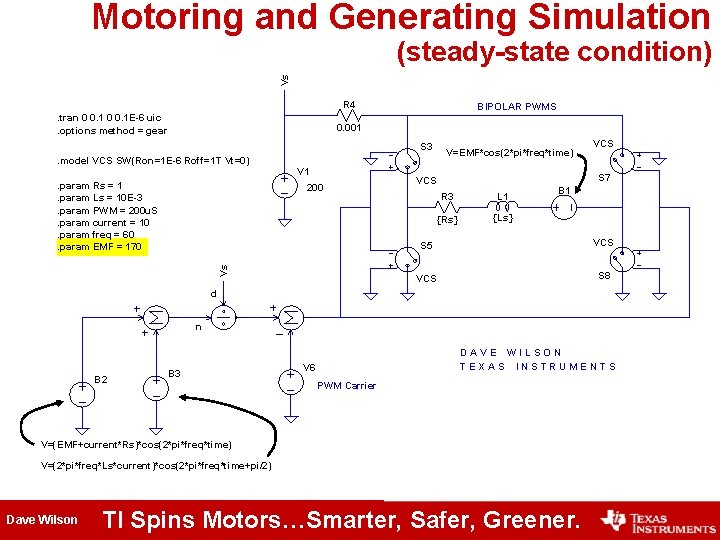
Motoring and Generating Simulation Vs (steady-state condition) R 4. tran 0 0. 1 E-6 uic. options method = gear BIPOLAR PWMS 0. 001 S 3 . model VCS SW(Ron=1 E-6 Roff=1 T Vt=0). param Rs = 1. param Ls = 10 E-3. param PWM = 200 u. S. param current = 10. param freq = 60. param EMF = 170 V 1 Vs 200 V=EMF*cos(2*pi*freq*time) VCS S 7 VCS R 3 L 1 {Rs} {Ls} B 1 S 5 VCS S 8 d n B 2 B 3 DAVE WILSON TEXAS INSTRUMENTS V 6 PWM Carrier V=(EMF+current*Rs)*cos(2*pi*freq*time) V=(2*pi*freq*Ls*current)*cos(2*pi*freq*time+pi/2) Dave Wilson TI Spins Motors…Smarter, Safer, Greener.
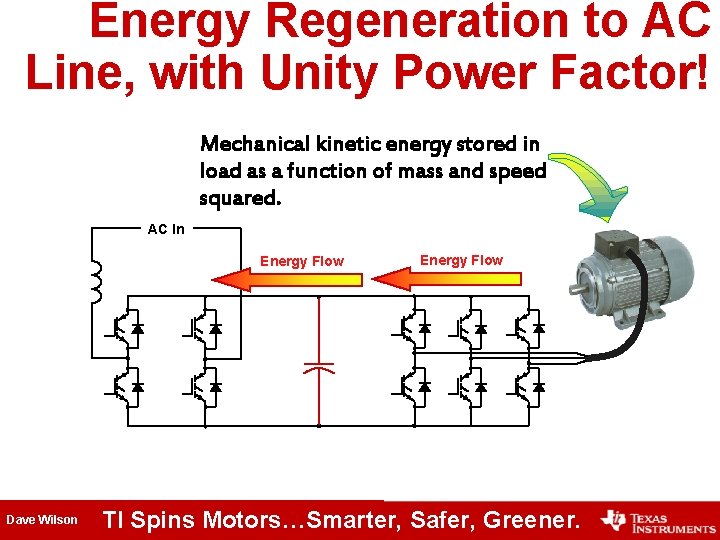
Energy Regeneration to AC Line, with Unity Power Factor! Mechanical kinetic energy stored in load as a function of mass and speed squared. AC In Energy Flow Dave Wilson Energy Flow TI Spins Motors…Smarter, Safer, Greener.
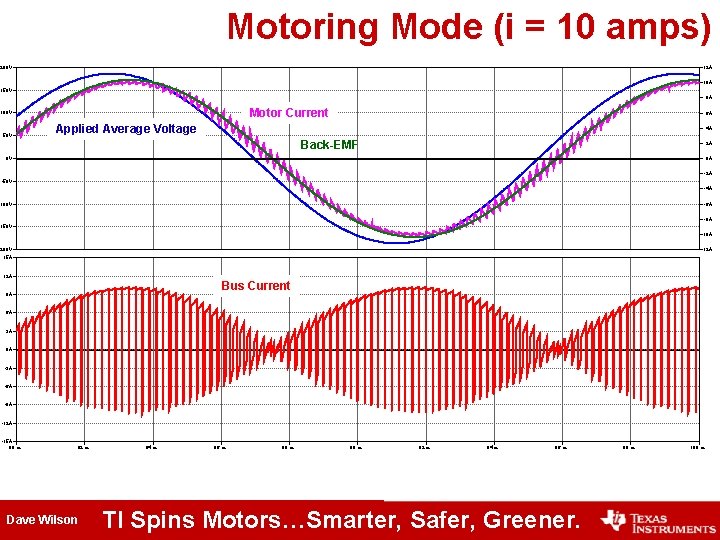
Motoring Mode (i = 10 amps) 200 V 12 A 10 A 150 V 8 A Motor Current 100 V 50 V 6 A Applied Average Voltage 4 A Back-EMF 2 A 0 V 0 A -2 A -50 V -4 A -100 V -6 A -8 A -150 V -10 A -200 V -12 A 15 A 12 A Bus Current 9 A 6 A 3 A 0 A -3 A -6 A -9 A -12 A -15 A 80 ms 82 ms Dave Wilson 84 ms 86 ms 88 ms 90 ms 92 ms 94 ms 96 ms TI Spins Motors…Smarter, Safer, Greener. 98 ms 100 ms
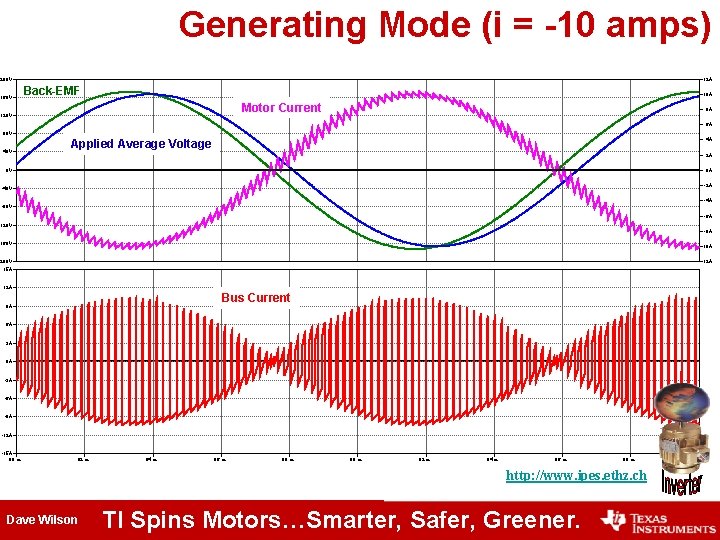
Generating Mode (i = -10 amps) 200 V 160 V 12 A Back-EMF 10 A Motor Current 120 V 8 A 6 A 80 V 4 A Applied Average Voltage 2 A 0 V 0 A -2 A -40 V -4 A -80 V -6 A -120 V -8 A -160 V -10 A -200 V -12 A 15 A 12 A Bus Current 9 A 6 A 3 A 0 A -3 A -6 A -9 A -12 A -15 A 80 ms 82 ms 84 ms 86 ms 88 ms 90 ms 92 ms 94 ms 96 ms 98 ms http: //www. ipes. ethz. ch Dave Wilson TI Spins Motors…Smarter, Safer, Greener. 100 ms
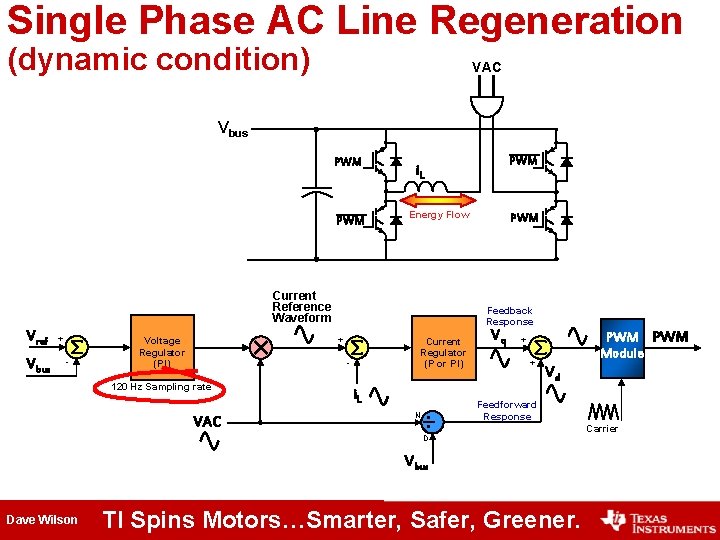
Single Phase AC Line Regeneration (dynamic condition) VAC Vbus PWM Energy Flow Current Reference Waveform Vref Vbus + - Current Regulator (P or PI) - 120 Hz Sampling rate VAC PWM Feedback Response + Voltage Regulator (PI) PWM i. L N ÷ Vq PWM Module + + Vd Feedforward Response D Vbus Dave Wilson TI Spins Motors…Smarter, Safer, Greener. Carrier
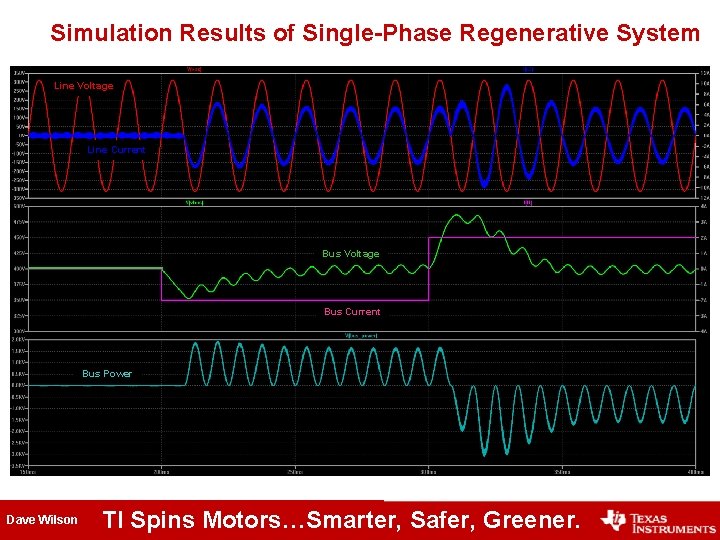
Simulation Results of Single-Phase Regenerative System Line Voltage Line Current Bus Voltage Bus Current Bus Power Dave Wilson TI Spins Motors…Smarter, Safer, Greener.
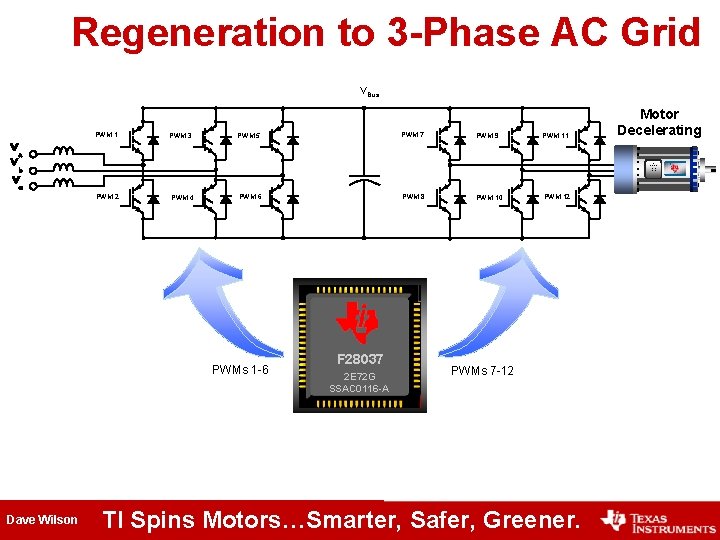
Regeneration to 3 -Phase AC Grid VBus va vb vc PWM 1 PWM 3 PWM 9 PWM 11 TI Dave’s Control Center PWM 2 PWM 4 PWM 6 PWMs 1 -6 Dave Wilson PWM 7 PWM 5 Motor Decelerating PWM 8 F 28037 2 E 72 G SSAC 0116 -A PWM 10 PWM 12 PWMs 7 -12 TI Spins Motors…Smarter, Safer, Greener.
Three-Phase Regenerative System 6 transistor converter AC Line Angle θ Demodulator a b c PWM C a b c PWM B PWM A Vbus q iq 0 amps + d - P id vq q Desired Bus Voltage + PI + - P vd d - Vbus Dave Wilson TI Spins Motors…Smarter, Safer, Greener. a b c PWM A PWM B PWM C
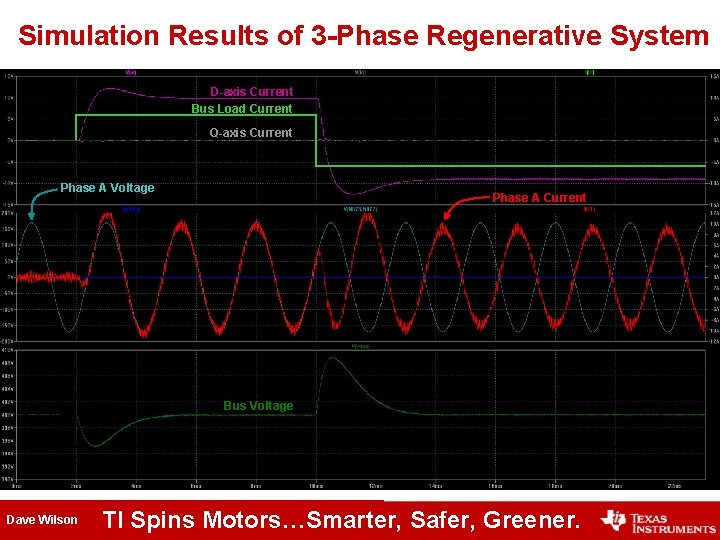
Simulation Results of 3 -Phase Regenerative System D-axis Current Bus Load Current Q-axis Current Phase A Voltage Phase A Current Bus Voltage Dave Wilson TI Spins Motors…Smarter, Safer, Greener.
Applications Standby Power Supplies Energy Flow Connecting asynchronous power sources Elevator Drives Static Disconnect Switch Battery Driving high inertial loads Hybrid vehicles Load Inverter Combined starter/alternator AC Utility Solar Converters Wind Energy Dave Wilson Variable Speed Generator Variable Frequency AC Power Processing Unit 50 or 60 Hz TI Spins Motors…Smarter, Safer, Greener. AC Utility