
2012 Great Commission Discipleship Leadership Seminar with Greg


- Slides: 54
2012 Great Commission Discipleship Leadership Seminar with Greg Ogden Sponsored by Ambassadors for Christ, Inc.
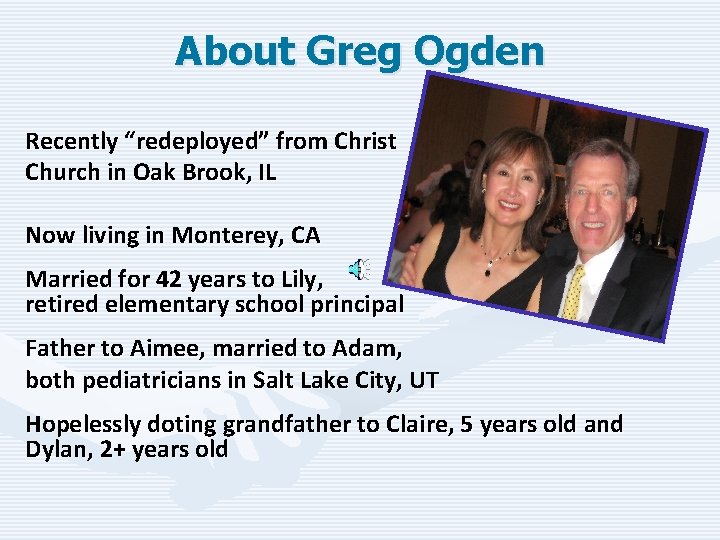
About Greg Ogden Recently “redeployed” from Christ Church in Oak Brook, IL Now living in Monterey, CA Married for 42 years to Lily, retired elementary school principal Father to Aimee, married to Adam, both pediatricians in Salt Lake City, UT Hopelessly doting grandfather to Claire, 5 years old and Dylan, 2+ years old
Overview of our Time • Biblical/Theological Foundations for Discipleship S The Pastors’ Role as Equipper for Ministry S The Pastor’s Role as Disciple-Maker • Vision for Biblical Discipleship S Why small reproducible discipleship groups are a key environment for making disciples • Practical Considerations for Implementing a Discipleship Strategy S Need for Discipleship Curriculum S Coaching strategy for implementing and sustaining group life mulitiplication
Biblical/Theological Foundations for Discipleship The Pastor’s Role as Equipper and Discipler
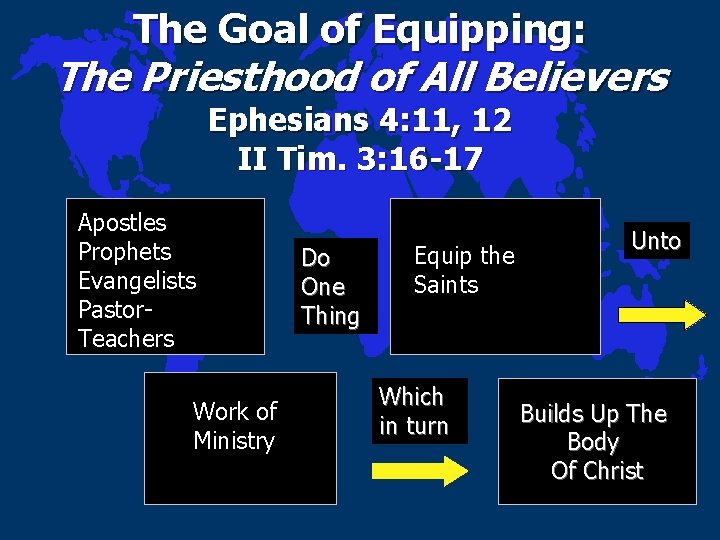
The Goal of Equipping: The Priesthood of All Believers Ephesians 4: 11, 12 II Tim. 3: 16 -17 Apostles Prophets Evangelists Pastor. Teachers Work of Ministry Do One Thing Equip the Saints Which in turn Unto Builds Up The Body Of Christ
The Biblical Model of Disciple-Making Jesus called his disciples (Luke 6: 12 -13) What were the strategic reasons for the selection of the twelve in the light of… l l Why would Jesus risk the dynamics of jealousy? Why not just expand the crowd?
Reasons for Focus on a Few: Internalization Distrust of the populace John 2: 23 -25 l Palm Sunday to Good Friday l “But for the twelve, the doctrine, the works, the image of Jesus might have perished from human resemblance, nothing remaining but a vague mythical tradition, of historical value, of little practical importance. ”--A. B. Bruce
Reasons for Focus on a Few: Internalization b. Disciples not mass produced “This careful, painstaking education of the disciples secured the teacher’s influence on this world should be permanent; that His kingdom should be founded on the rock of deep and indestructible convictions in the minds of a few, not on the shifting sands of superficial impressions in the minds of the many. ” -- A. B. Bruce
Reasons for Focus on a Few: Internalization c. Causes of Superficiality • Diverted leaders from equipping • Focus on programs
Reasons for Focus on a Few: Internalization Characteristics of Programs: q Content or knowledge based q One preparing for the many q Regimentation or synchronization q Low Accountability
Reasons for Focus on a Few: Internalization “Disciples cannot be massed produced. We cannot drop people into a program and see disciples emerge at the end of a production line. It takes time to make disciples. It takes individual personal attention. ” (Leroy Eims, The Lost Art of Disciplemaking)
Reasons for Focus on a Few: Multiplication Have Enough Vision to Think Small A. Jesus had a heart for the multitudes “Jesus it must be remembered, restricted 9/10 of His ministry to 12 Jews because it was the only way to reach all Americans. ” --Eugene Peterson
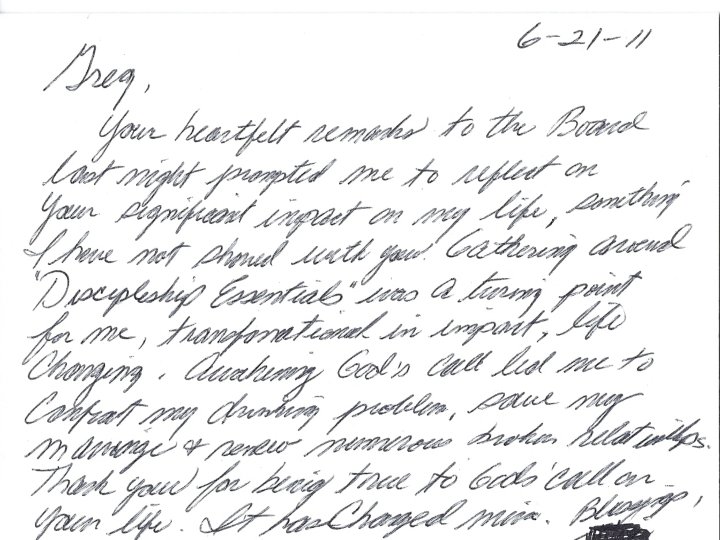
DISCUSSION The Letter from Jane What are the significant disciplemaking principles or practices reflected in this letter? (circle them)
The Disciple-Making Challenge: Three Years of Ministry “Perhaps today’s pastor should imagine that they are going to have three more years in their parish as pastor--and that there will be no replacement for them when they leave. If they acted as if this were going to happen, they would then put the highest priority on selecting, motivating, and training lay leaders that could carry on the mission. The results of three sustained years of such an approach would be quite significant. Even revolutionary. ” --George Martin
Reflection Exercise (in groups of 3; 1 pastor with 2 lay leaders) 1. How do we take seriously the pastoral role as equipper/discipler and then translate this into an actual strategy? 2. If we were to follow Jesus’ model and plan to turn leadership over to those in our church after we were gone, how would you best spend your time now getting people ready? What might the laity come to expect of themselves?
Vision for Biblical Discipleship The Power of Small, Reproducing Discipleship Groups
From One-on-One Discipleship to Small, Reproducible Groups
Frustrations with Discipling § Meet one on one weekly § Mutual sharing § Teach basics of faith § Apply faith to family, work, ethics, etc. § Study together § Pray together §. . . but no multiplication…why? ? !? !?
What Do YOU Think? § What are the obstacles to reproduction? § Why don’t we see more multiplication?
Biblical Models of Disciple-Making § Paul--Timothy § Father-Son § Teacher-Student § Mature-Immature § Motivator-Motivated § What pressure does the discipler feel? § What does this model foster?
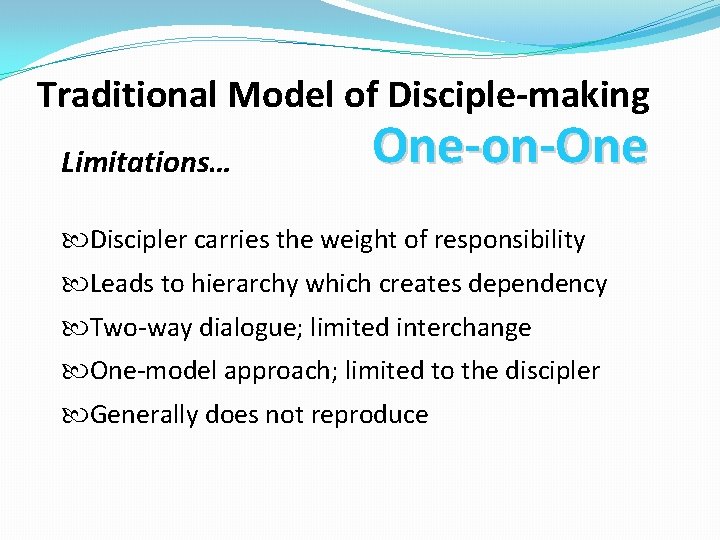
Traditional Model of Disciple-making Limitations… One-on-One Discipler carries the weight of responsibility Leads to hierarchy which creates dependency Two-way dialogue; limited interchange One-model approach; limited to the discipler Generally does not reproduce
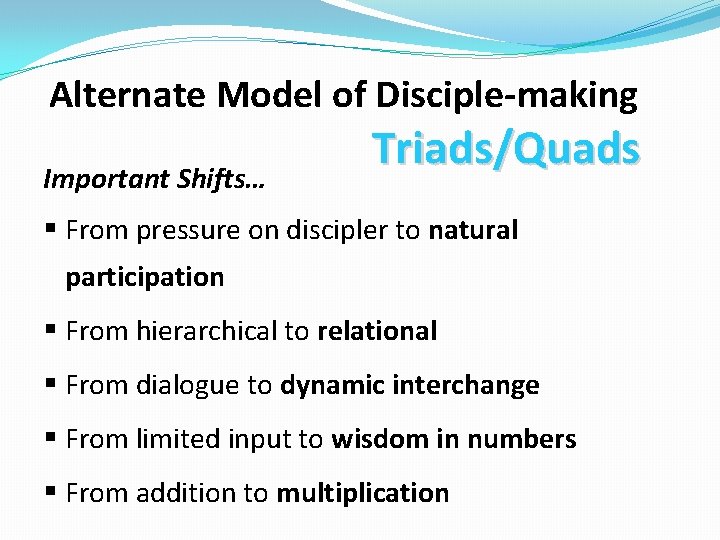
Alternate Model of Disciple-making Important Shifts… Triads/Quads § From pressure on discipler to natural participation § From hierarchical to relational § From dialogue to dynamic interchange § From limited input to wisdom in numbers § From addition to multiplication
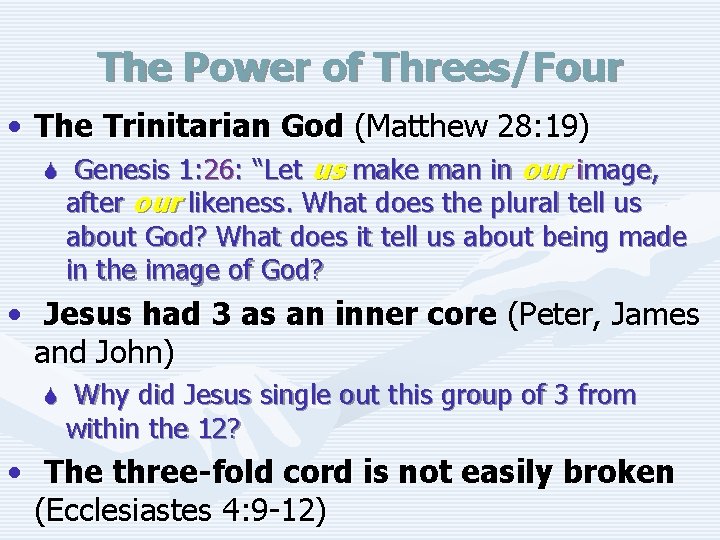
The Power of Threes/Four • The Trinitarian God (Matthew 28: 19) S Genesis 1: 26: “Let us make man in our image, after our likeness. What does the plural tell us about God? What does it tell us about being made in the image of God? • Jesus had 3 as an inner core (Peter, James and John) S Why did Jesus single out this group of 3 from within the 12? • The three-fold cord is not easily broken (Ecclesiastes 4: 9 -12)
The Environment for Transformation Why small groups of 3 or 4 provide the right environment for transformation into Christlikeness?
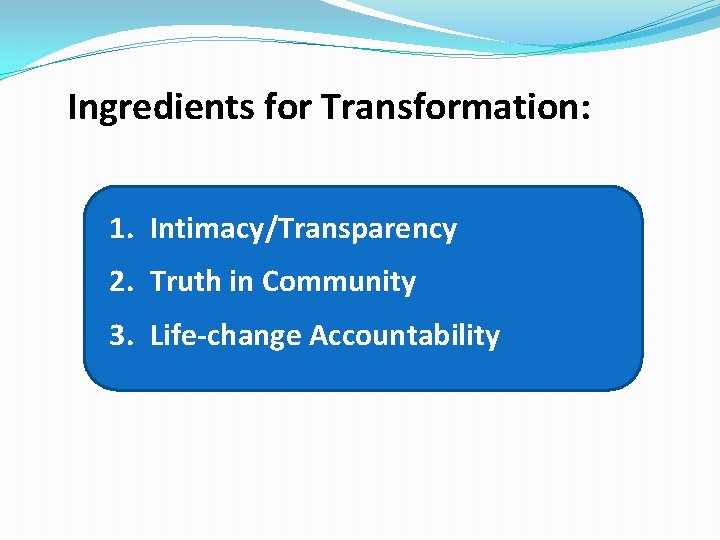
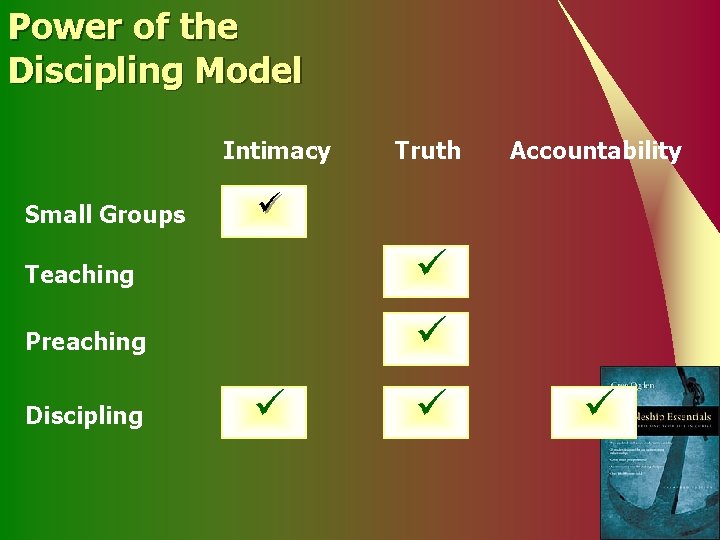
Ingredients for Transformation: 1. Intimacy/Transparency 2. Truth in Community 3. Life-change Accountability
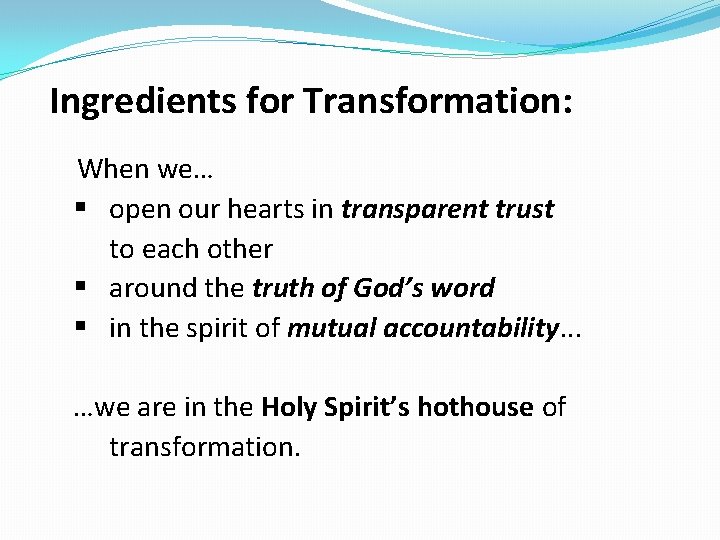
Ingredients for Transformation: When we… § open our hearts in transparent trust to each other § around the truth of God’s word § in the spirit of mutual accountability. . . …we are in the Holy Spirit’s hothouse of transformation.
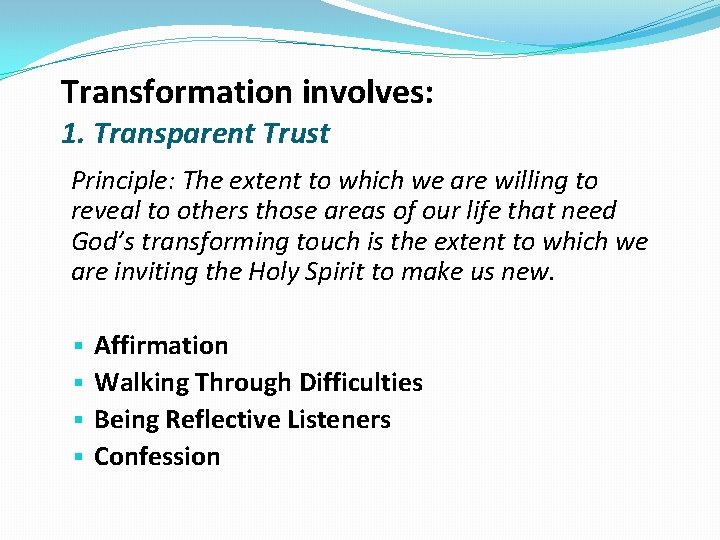
Transformation involves: 1. Transparent Trust Principle: The extent to which we are willing to reveal to others those areas of our life that need God’s transforming touch is the extent to which we are inviting the Holy Spirit to make us new. § Affirmation § Walking Through Difficulties § Being Reflective Listeners § Confession
Transformation involves: 2. Truth in Community II Timothy 3: 16, 17 --profitable for… Teaching Reproof Correction Training in righteousness § Need for systematic teaching and a tool § Mosaic Image
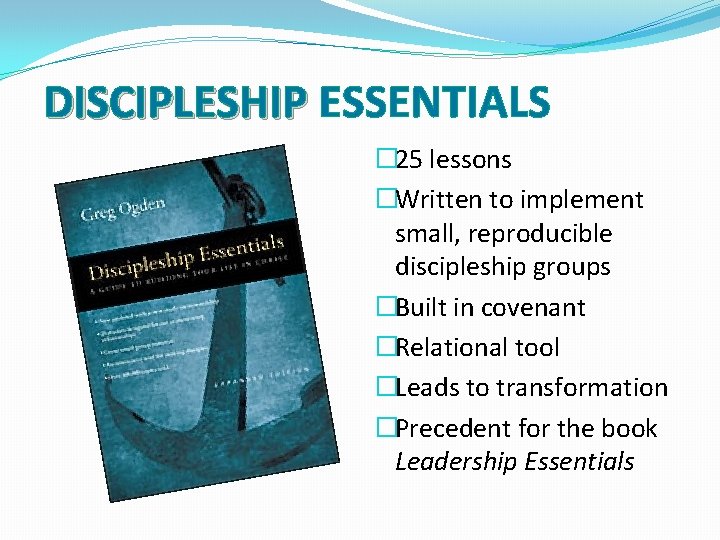
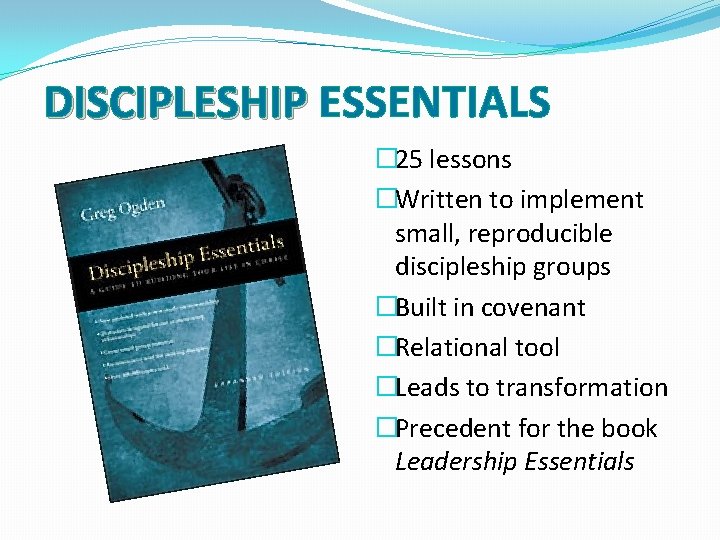
DISCIPLESHIP ESSENTIALS � 25 lessons �Written to implement small, reproducible discipleship groups �Built in covenant �Relational tool �Leads to transformation �Precedent for the book Leadership Essentials
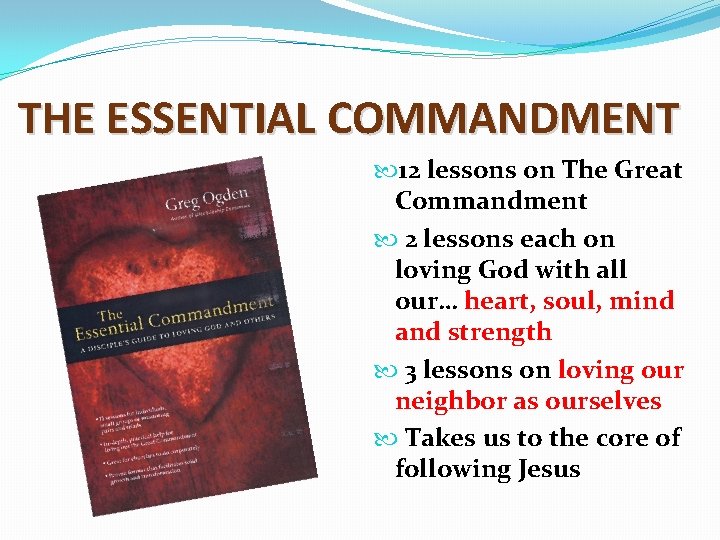
THE ESSENTIAL COMMANDMENT 12 lessons on The Great Commandment 2 lessons each on loving God with all our… heart, soul, mind and strength 3 lessons on loving our neighbor as ourselves Takes us to the core of following Jesus
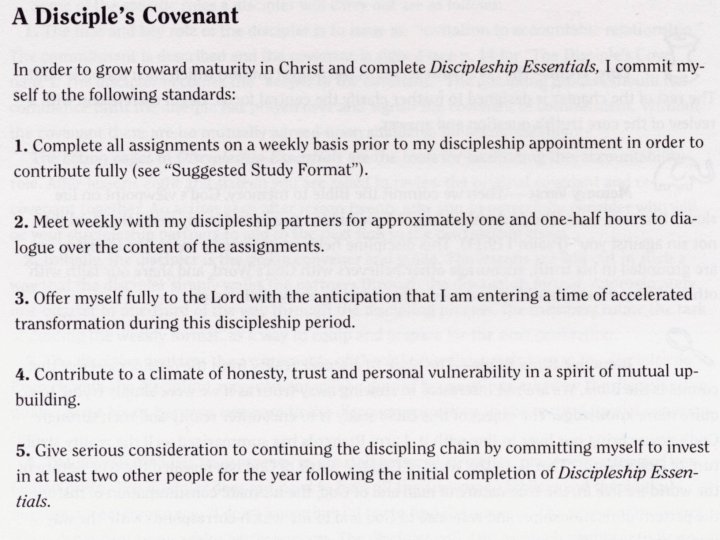
Transformation involves: 3. Life-change Accountability � � What is accountability? � Submission to mutually agreed standards � Giving partners authority to call you to account What are the standards? (p. 14) � Minimum commitments � Recommitment to the standards (p. 80, 146)
Power of the Discipling Model Intimacy Small Groups Truth ü Teaching ü Preaching ü Discipling Accountability ü ü ü
Good Curriculum Importance and Characteristics
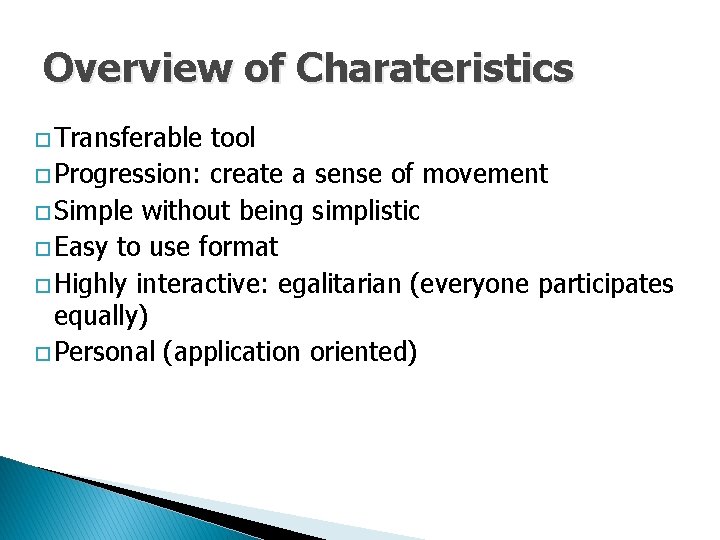
Overview of Charateristics o Transferable tool o Progression: create a sense of movement o Simple without being simplistic o Easy to use format o Highly interactive: egalitarian (everyone participates equally) o Personal (application oriented)
Transferable Tool o Content can be used and reused o The framework for teaching o Gives discipler the confidence. Do not need to know it all o Someone who is new to the faith can use and master o Overcomes a hit and miss approach
Progression o Gives a sense of movement o Mosaic Image o Four Parts with two lessons as intro Growing Up In Christ þ The Message of Christ þ Becoming Like Christ þ Serving Christ þ
DISCIPLESHIP ESSENTIALS � 25 lessons �Written to implement small, reproducible discipleship groups �Built in covenant �Relational tool �Leads to transformation �Precedent for the book Leadership Essentials
Section 1 Growing Up In Christ o Lesson 1 and 2 What is discipling? þ Who is a disciple? þ o Lessons 3 -6: Personal and Corporate Disciplines Quiet Time þ Bible Study þ Prayer þ Worship þ
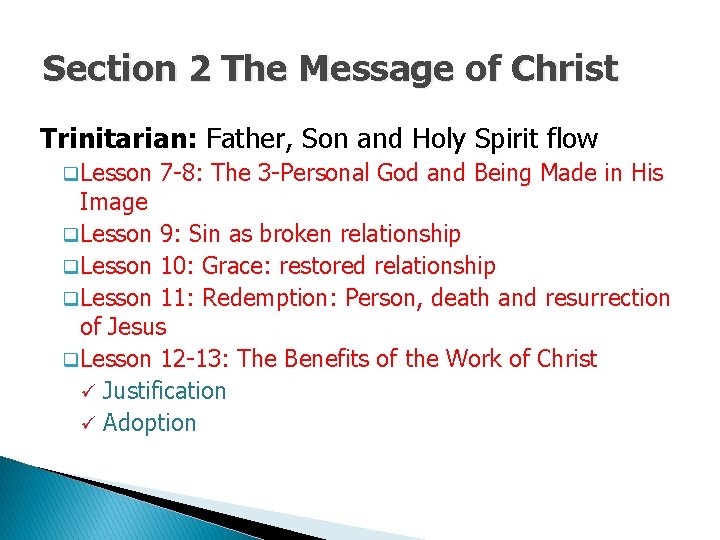
Section 2 The Message of Christ Trinitarian: Father, Son and Holy Spirit flow q. Lesson 7 -8: The 3 -Personal God and Being Made in His Image q. Lesson 9: Sin as broken relationship q. Lesson 10: Grace: restored relationship q. Lesson 11: Redemption: Person, death and resurrection of Jesus q. Lesson 12 -13: The Benefits of the Work of Christ ü Justification ü Adoption
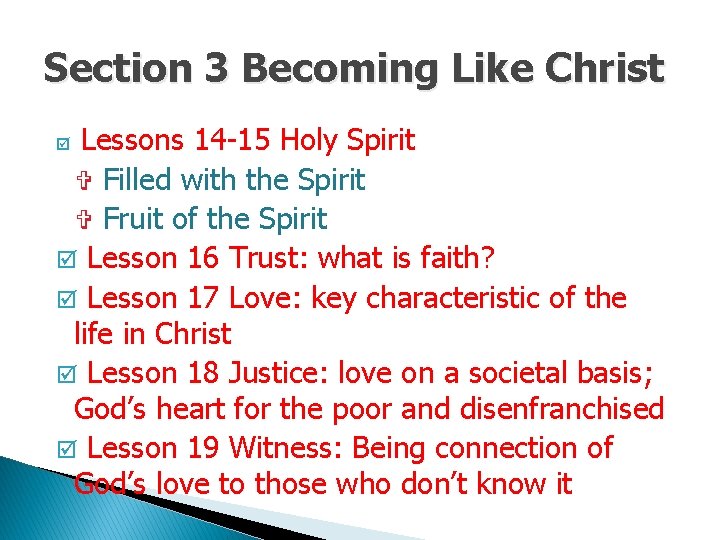
Section 3 Becoming Like Christ Lessons 14 -15 Holy Spirit V Filled with the Spirit V Fruit of the Spirit þ Lesson 16 Trust: what is faith? þ Lesson 17 Love: key characteristic of the life in Christ þ Lesson 18 Justice: love on a societal basis; God’s heart for the poor and disenfranchised þ Lesson 19 Witness: Being connection of God’s love to those who don’t know it þ
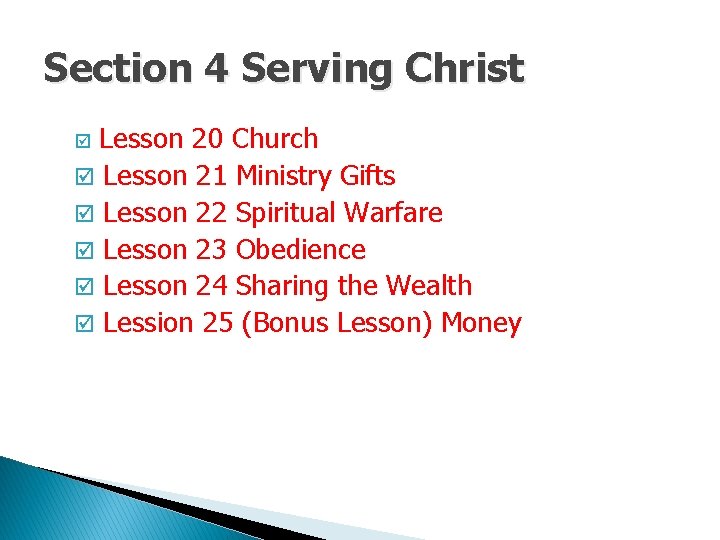
Section 4 Serving Christ Lesson 20 Church þ Lesson 21 Ministry Gifts þ Lesson 22 Spiritual Warfare þ Lesson 23 Obedience þ Lesson 24 Sharing the Wealth þ Lession 25 (Bonus Lesson) Money þ
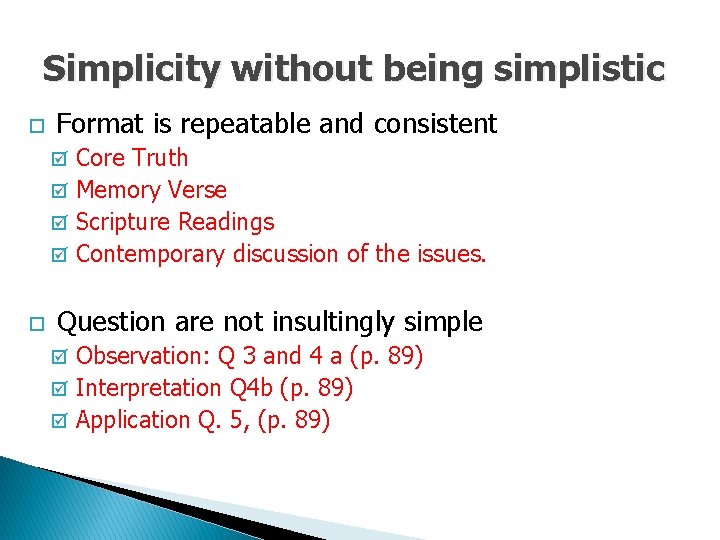
Simplicity without being simplistic o Format is repeatable and consistent Core Truth þ Memory Verse þ Scripture Readings þ Contemporary discussion of the issues. þ o Question are not insultingly simple Observation: Q 3 and 4 a (p. 89) þ Interpretation Q 4 b (p. 89) þ Application Q. 5, (p. 89) þ
Format is easy to use Questions are laid out to make for a progressive use. o Created a simplified way to cover the content. o
Interactive Group size keeps everyone participating. o The tool is the teacher. Stay away from an answer person. o If an unorthodox thought is uttered, take people back to what the Scriptures say. o Everyone has a voice and brings their life experience. o
Personal Application o Life change does not occurred until truth intersects the real issues of our life and leads to change… þ þ þ Attitudes Behaviors Values Relationships Life Direction
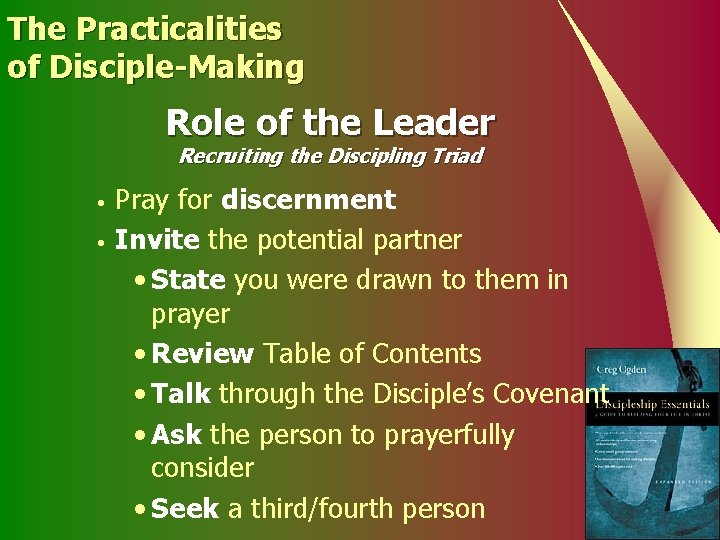
The Practicalities of Disciple-Making Role of the Leader Recruiting the Discipling Triad • • Pray for discernment Invite the potential partner • State you were drawn to them in prayer • Review Table of Contents • Talk through the Disciple’s Covenant • Ask the person to prayerfully consider • Seek a third/fourth person
Role of the Leader (Cont. ) • • Set the first meeting time Guide the partners through the first session Complete all lessons and participate Model transparency
First Few Meetings Review the Covenant V Get to know each other V Share your faith journey V Lead the first 4 -6 lessons, then rotate facilitators V Keep alive the vision of reproduction V
Growing a Disciple-making Network Develop a small oversight group Ø Also a place for problem solving Ø Keep track of those in the network V Create a network newsletter Ø Articles Ø Testimonies Ø Stories of second/third generation leadership V Hold semi-annual gatherings of all in the network V
Closing Exhortation • We have made an unbiblical distinction between being a Christian and being a disciple as if discipleship is largely optional • Growing disciples is a longer process of personal investment. There are no short-cuts to growing people. • A person has turned the corner to maturity when they start taking responsibility for the spiritual health of others. • Leadership Shortage is really a discipleship shortage • II Timothy 2: 2: Our legacy is the transformed people we have left in place.