
2011 TOP TO BOTTOM RANKING Understanding How the
2011 TOP TO BOTTOM RANKING Understanding How the Ranking is Calculated
TOP TO BOTTOM (TTB) RANKING The statewide top-to-bottom ranking takes into account both student achievement on state tests and graduation rates. Student achievement on state tests is included in the statewide top to bottom ranking in the following three ways: § Achievement at the elementary, middle, and high school levels § Improvement in achievement over time § The largest achievement gap between two subgroups calculated based on the top scoring 30% of students versus the bottom scoring 30% of students
TTB RANKING In addition to the achievement components, student graduation is included in the statewide top-to-bottom ranking for schools with a graduation rate in the two following ways: § Graduation Rate § Improvement in graduation rate over time
WHO RECEIVES A RANKING? Schools with 30 or more full academic year (FAY) students tested over the last two years in at least two state-tested content areas: § Mathematics § Reading § Science § Social Studies § Writing
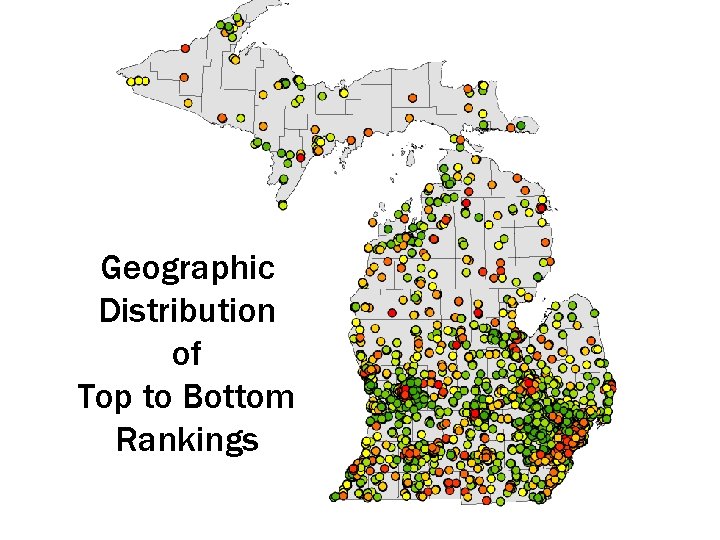
Geographic Distribution of Top to Bottom Rankings
WHAT IS A Z-SCORE? Quick Reference for ZScores
WHY DO WE USE Z SCORES? Z-scores are a standardized measure that helps you compare individual student (or school) data to the state average data (average scores across populations). Z-scores allow us to “level the playing field” across grade levels and subjects Each Z-score corresponds to a value in a normal distribution. A Z-Score will describe how much a value deviates from the mean.
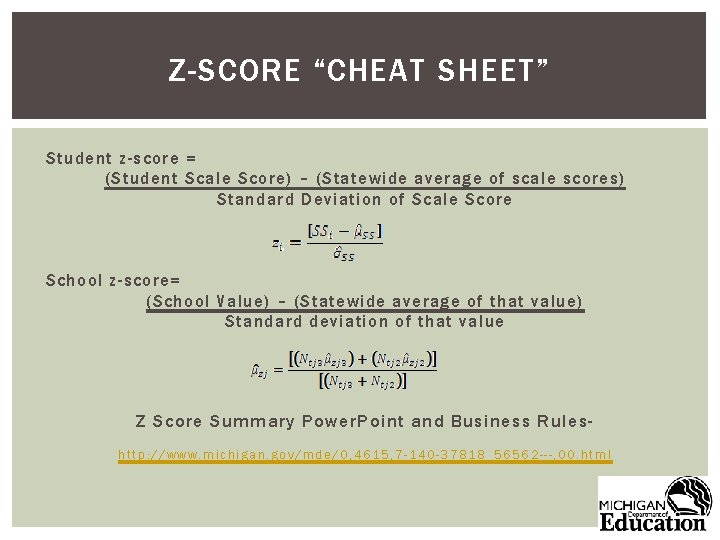
Z-SCORE “CHEAT SHEET” Student z-score = (Student Scale Score) – (Statewide average of scale scores) Standard Deviation of Scale Score School z-score= (School Value) – (Statewide average of that value) Standard deviation of that value Z Score Summary Power. Point and Business Ruleshttp: //www. michigan. gov/mde/0, 4615, 7 -140 -37818_56562 ---, 00. html
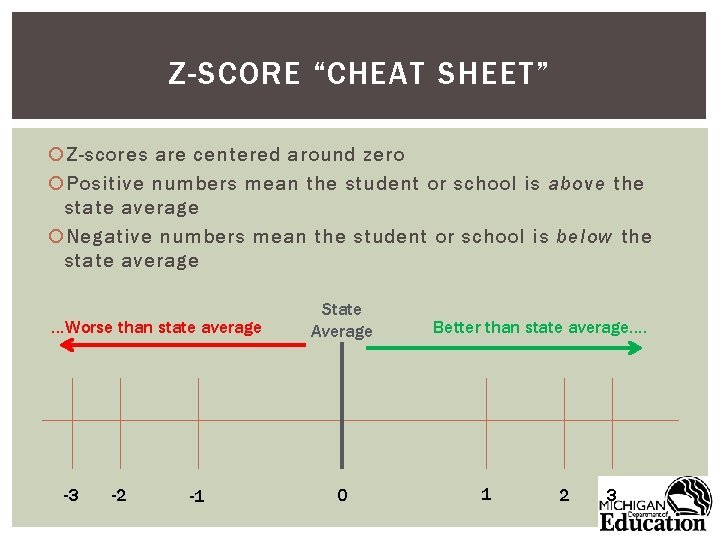
Z-SCORE “CHEAT SHEET” Z-scores are centered around zero Positive numbers mean the student or school is above the state average Negative numbers mean the student or school is below the state average …Worse than state average -3 -2 -1 State Average 0 Better than state average…. 1 2 3
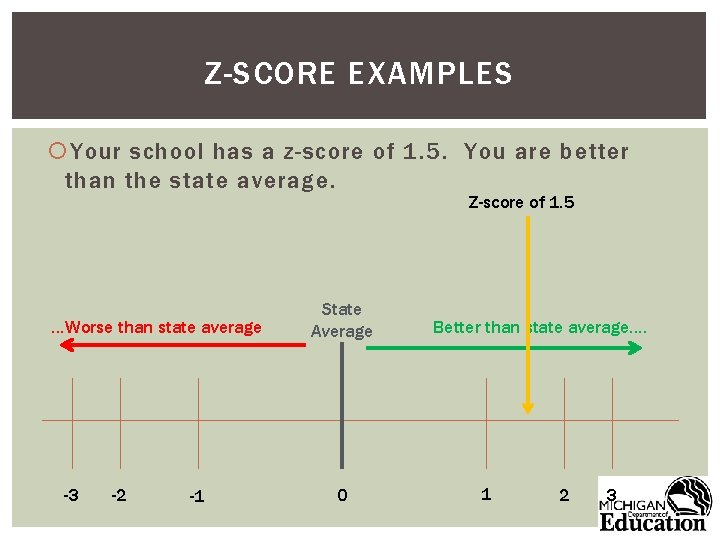
Z-SCORE EXAMPLES Your school has a z-score of 1. 5. You are better than the state average. Z-score of 1. 5 …Worse than state average -3 -2 -1 State Average 0 Better than state average…. 1 2 3
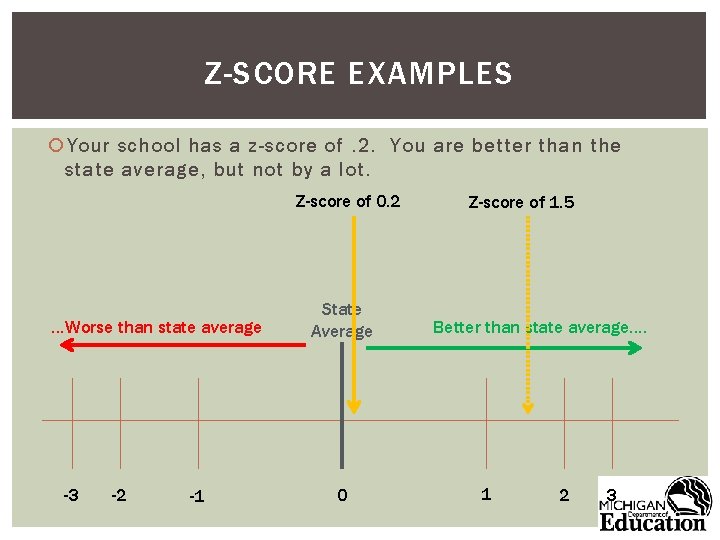
Z-SCORE EXAMPLES Your school has a z-score of. 2. You are better than the state average, but not by a lot. Z-score of 0. 2 …Worse than state average -3 -2 -1 State Average 0 Z-score of 1. 5 Better than state average…. 1 2 3
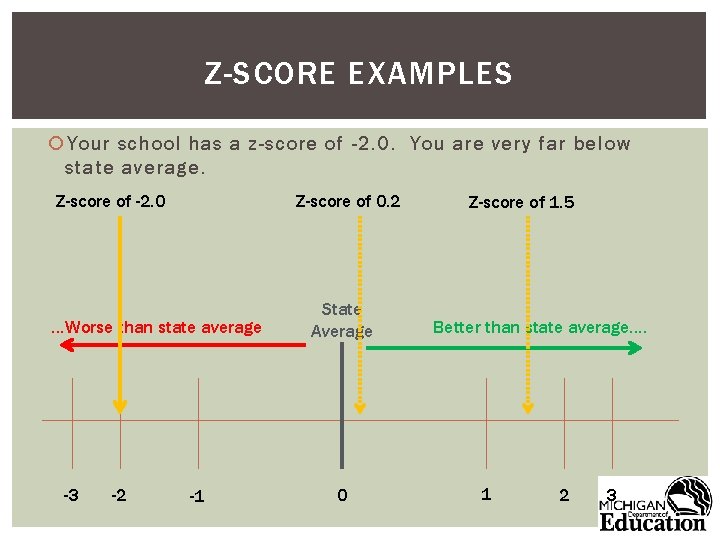
Z-SCORE EXAMPLES Your school has a z-score of -2. 0. You are very far below state average. Z-score of -2. 0 Z-score of 0. 2 …Worse than state average -3 -2 -1 State Average 0 Z-score of 1. 5 Better than state average…. 1 2 3
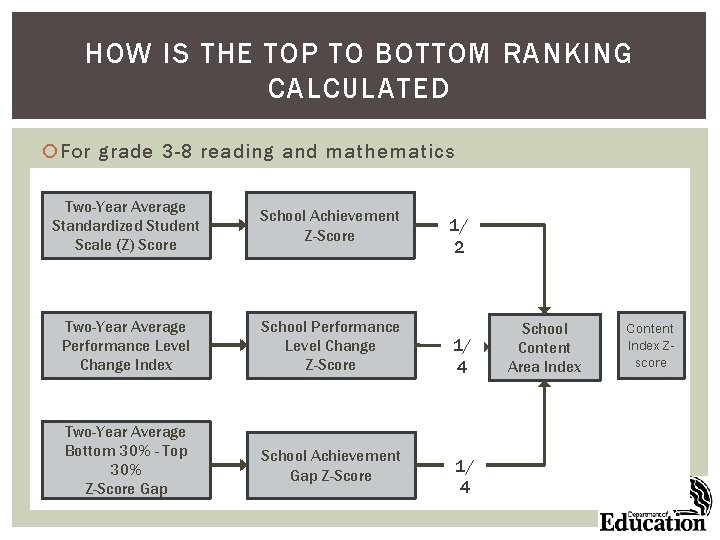
HOW IS THE TOP TO BOTTOM RANKING CALCULATED For grade 3 -8 reading and mathematics Two-Year Average Standardized Student Scale (Z) Score School Achievement Z-Score Two-Year Average Performance Level Change Index School Performance Level Change Z-Score Two-Year Average Bottom 30% - Top 30% Z-Score Gap School Achievement Gap Z-Score 1/ 2 1/ 4 School Content Area Index Content Index Zscore
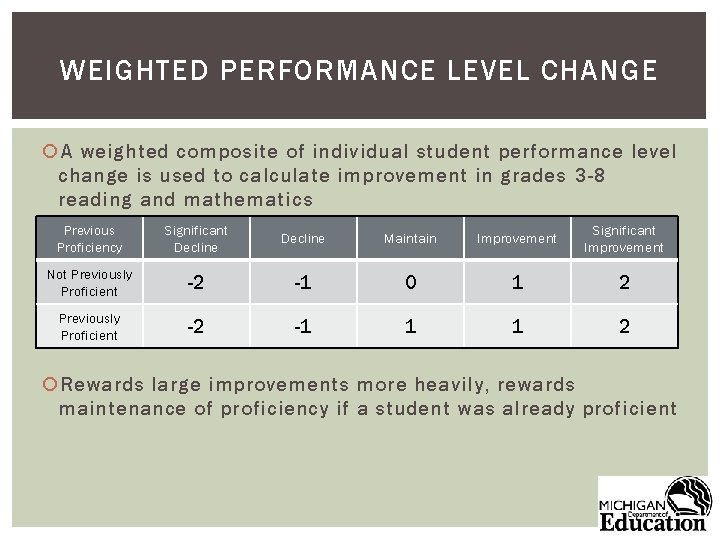
WEIGHTED PERFORMANCE LEVEL CHANGE A weighted composite of individual student performance level change is used to calculate improvement in grades 3 -8 reading and mathematics Previous Proficiency Significant Decline Maintain Improvement Significant Improvement Not Previously Proficient -2 -1 0 1 2 Previously Proficient -2 -1 1 1 2 Rewards large improvements more heavily, rewards maintenance of proficiency if a student was already proficient
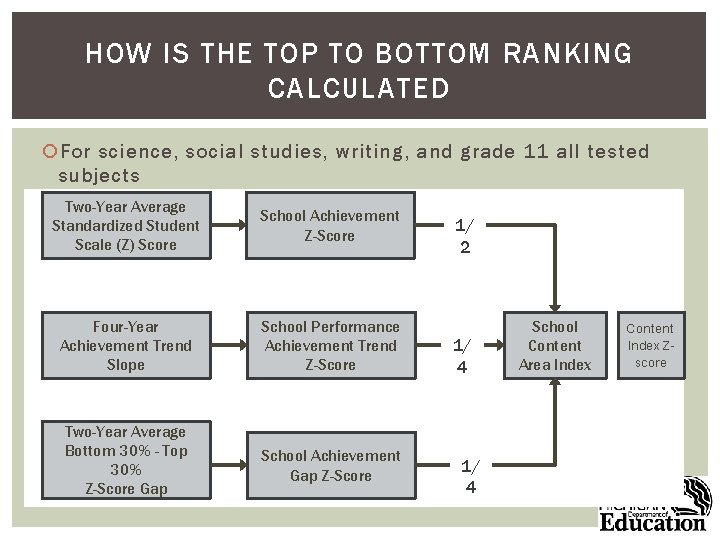
HOW IS THE TOP TO BOTTOM RANKING CALCULATED For science, social studies, writing, and grade 11 all tested subjects Two-Year Average Standardized Student Scale (Z) Score School Achievement Z-Score Four-Year Achievement Trend Slope School Performance Achievement Trend Z-Score Two-Year Average Bottom 30% - Top 30% Z-Score Gap School Achievement Gap Z-Score 1/ 2 1/ 4 School Content Area Index Content Index Zscore
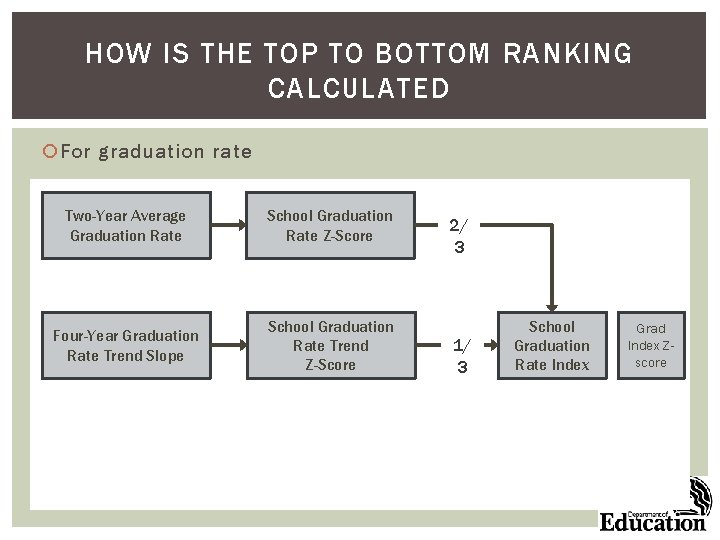
HOW IS THE TOP TO BOTTOM RANKING CALCULATED For graduation rate Two-Year Average Graduation Rate School Graduation Rate Z-Score Four-Year Graduation Rate Trend Slope School Graduation Rate Trend Z-Score 2/ 3 1/ 3 School Graduation Rate Index Grad Index Zscore
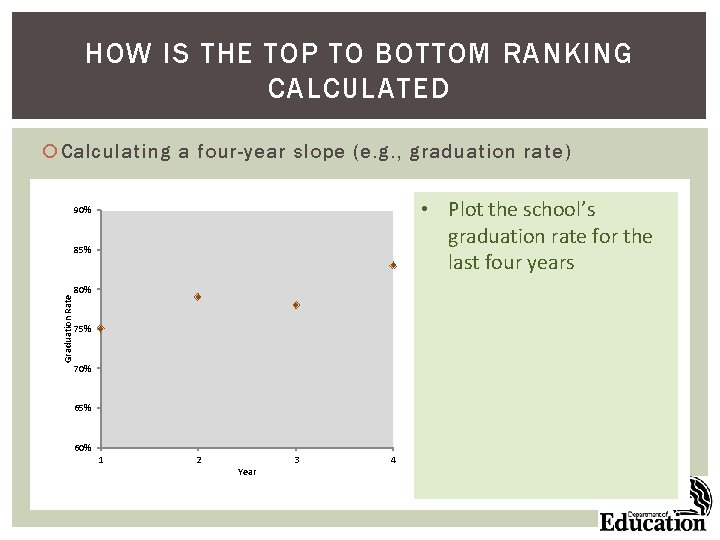
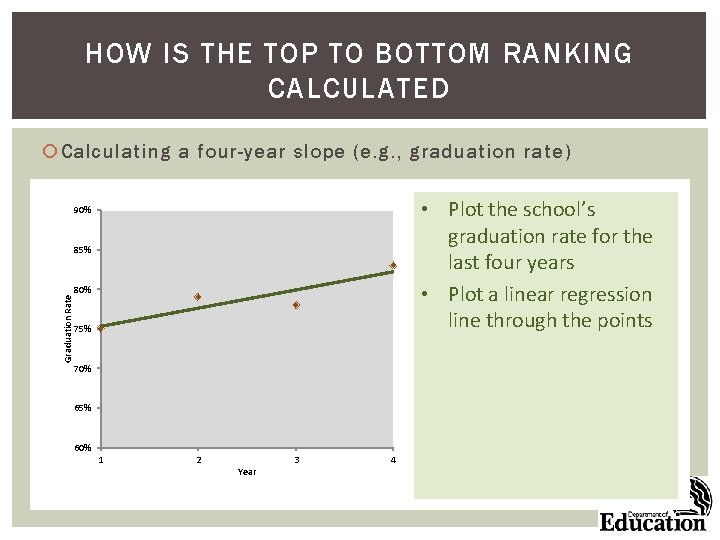
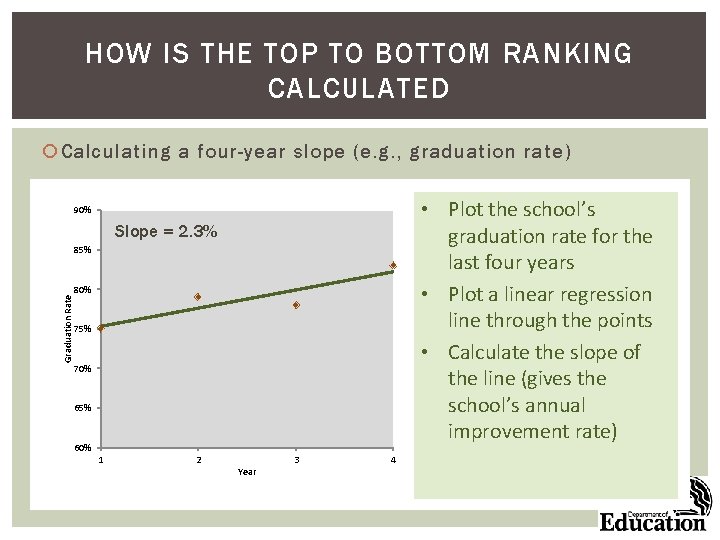
HOW IS THE TOP TO BOTTOM RANKING CALCULATED Calculating a four-year slope (e. g. , graduation rate) • Plot the school’s graduation rate for the last four years • Plot a linear regression line through the points • Calculate the slope of the line (gives the school’s annual improvement rate) 90% Graduation Rate 85% 80% 75% 70% 65% 60% 1 2 Year 3 4
HOW IS THE TOP TO BOTTOM RANKING CALCULATED Calculating a four-year slope (e. g. , graduation rate) • Plot the school’s graduation rate for the last four years • Plot a linear regression line through the points • Calculate the slope of the line (gives the school’s annual improvement rate) 90% Graduation Rate 85% 80% 75% 70% 65% 60% 1 2 Year 3 4
HOW IS THE TOP TO BOTTOM RANKING CALCULATED Calculating a four-year slope (e. g. , graduation rate) • Plot the school’s graduation rate for the last four years • Plot a linear regression line through the points • Calculate the slope of the line (gives the school’s annual improvement rate) 90% Slope = 2. 3% Graduation Rate 85% 80% 75% 70% 65% 60% 1 2 Year 3 4
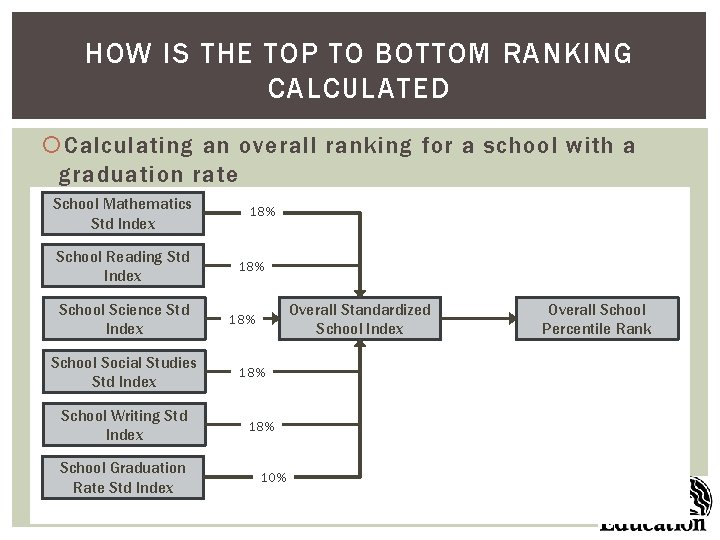
HOW IS THE TOP TO BOTTOM RANKING CALCULATED Calculating an overall ranking for a school with a graduation rate School Mathematics Std Index School Reading Std Index School Science Std Index School Social Studies Std Index School Writing Std Index School Graduation Rate Std Index 18% Overall Standardized School Index 18% 18% 10% Overall School Percentile Rank
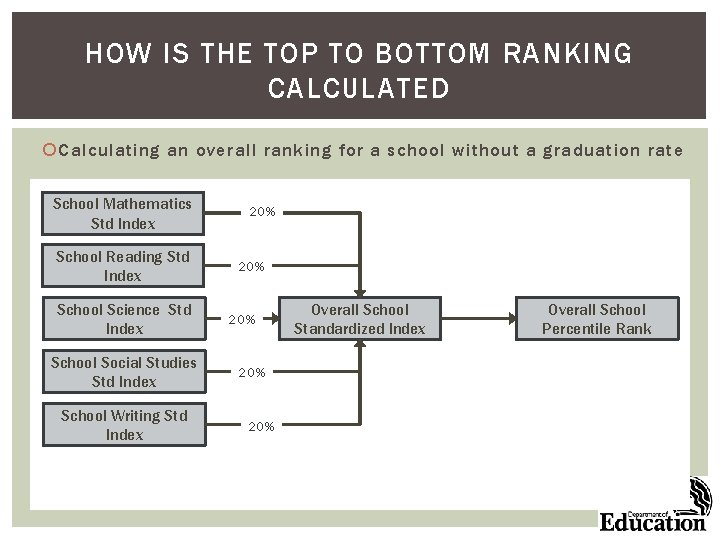
HOW IS THE TOP TO BOTTOM RANKING CALCULATED Calculating an overall ranking for a school without a graduation rate School Mathematics Std Index School Reading Std Index School Science Std Index School Social Studies Std Index School Writing Std Index 20% 20% 20% Overall School Standardized Index Overall School Percentile Rank
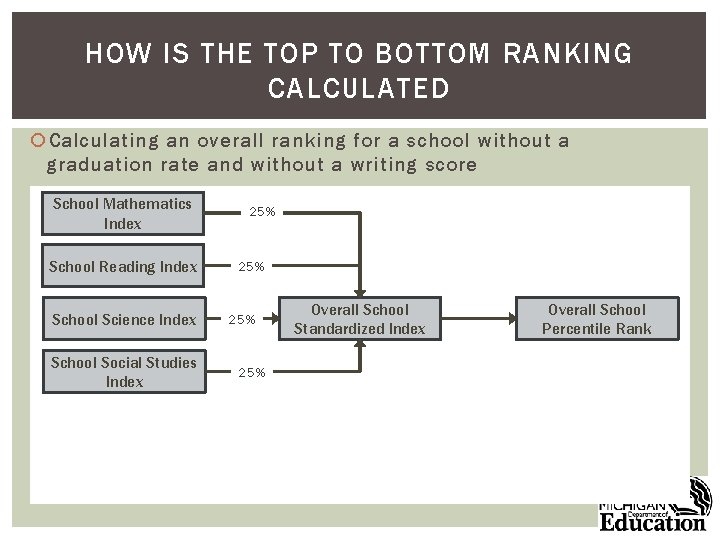
HOW IS THE TOP TO BOTTOM RANKING CALCULATED Calculating an overall ranking for a school without a graduation rate and without a writing score School Mathematics Index School Reading Index School Science Index School Social Studies Index 25% 25% Overall School Standardized Index Overall School Percentile Rank
WHICH YEARS OF DATA ARE IN THE RANKING?
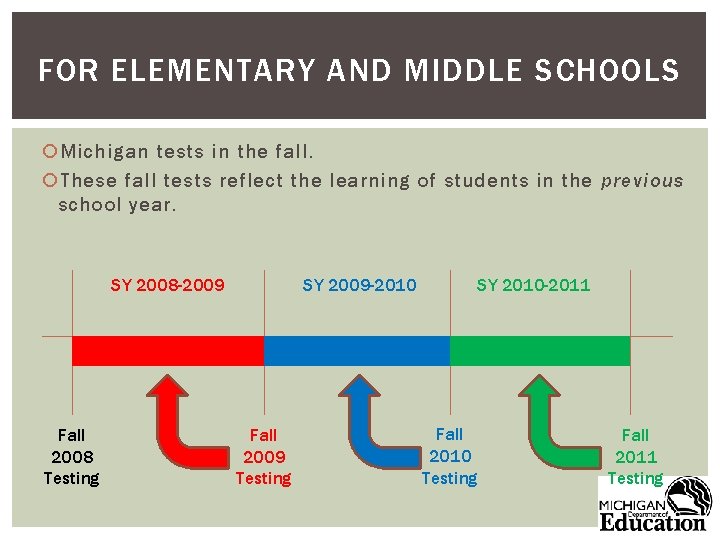
FOR ELEMENTARY AND MIDDLE SCHOOLS Michigan tests in the fall. These fall tests reflect the learning of students in the previous school year. SY 2008 -2009 Fall 2008 Testing SY 2009 -2010 Fall 2009 Testing SY 2010 -2011 Fall 2010 Testing Fall 2011 Testing
FOR HIGH SCHOOLS Michigan tests in the spring The spring test (MME and MIAccess) measures what students have learned from grades 9, 10 and grade 11 prior to the MME testing.
WHAT DO THE 2011 RANKINGS REFLECT? For elementary/middle schools: § Performance on the MEAP and MI-Access tests in fall 2010 (which represents learning from school year 2009 -2010) and before For high schools: § Performance on the MME and MI-Access tests in spring 2011 (which represents learning from school year 2010 -2011 prior to testing) and before.
WHEN IS PERFORMANCE IN 2010 -2011 MEASURED? For elementary/middle schools: §Fall 2010 MEAP & MI-Access For high schools §Spring 2011 MME & MIAccess
WHEN IS PERFORMANCE IN 2011 -2012 MEASURED? For elementary/middle schools: §Fall 2011 MEAP, MI-Access & MEAP-Access For high schools §Spring 2012 MME & MI-Access

HOW IS THIS DIFFERENT FROM THE PLA LIST? TTB vs PLA
TTB VERSUS PLA This list represents a ranking of all schools in the state of Michigan, using our preferred methodology developed in collaboration with many stakeholders. MDE also published, according to state statute, a list of Persistently Lowest Achieving schools. This is the PLA list. The PLA list of schools was generated by a set of federallyapproved and required rules that differ from our Top to Bottom ranking.
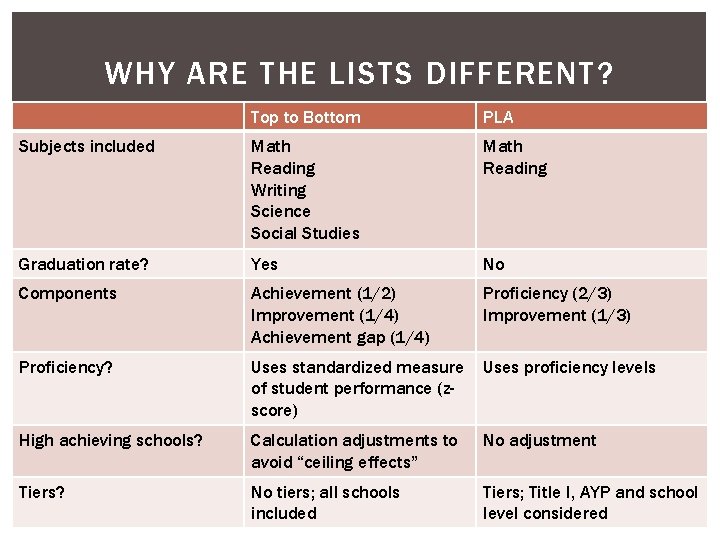
WHY ARE THE LISTS DIFFERENT? Top to Bottom PLA Subjects included Math Reading Writing Science Social Studies Math Reading Graduation rate? Yes No Components Achievement (1/2) Improvement (1/4) Achievement gap (1/4) Proficiency (2/3) Improvement (1/3) Proficiency? Uses standardized measure of student performance (zscore) Uses proficiency levels High achieving schools? Calculation adjustments to avoid “ceiling effects” No adjustment Tiers? No tiers; all schools included Tiers; Title I, AYP and school level considered
RESOURCES TO UNDERSTAND MY RANKING
RESOURCES AVAILABLE Complete list of all schools and their ranking Individual school look-up to see your school’s results Overview presentation with voice over FAQ Business rules by which the rankings were calculated Complete data file and validation file You can access these resources at: http: //www. michigan. gov/baa Click on “Michigan Schools Top to Bottom Ranking” You can also request individual assistance by calling the Evaluation, Research and Accountability unit at 517 -373 -1342, or emailing mde-accountability@michigan. gov
- Slides: 33