
2011 Academy Keynote Lecture Nigerian Engineering Academy by
2011 Academy Keynote Lecture Nigerian Engineering Academy by Mammo Muchie: DST/NRF Research Professor, IERI, Tshawane University of Technology, Pretoria, South Africa & DIR, Aalborg University, Aalborg , Denmark, & Senior Research Associate, International Development, QEH, Oxford University, UK. June 14, 2011 2021/9/24 1
2011 Academy Keynote Lecture Title The End of African Dependence and Fragmentation: Science, Engineering and Technology (SET) for Building the Learning, Integrated , Competent and Innovative African National Economy 2021/9/24 2
Lecture Outline Objectives, Motivation & Inspiration Problems of African Economic Growth African Integration and/or African Unity First (AUF) Theory of Productive Power (SET) to Africa The National System of Innovation Approach to Africa Some Research Challenges? Concluding Remark 2021/9/24 3
Objectives Africa has been rejected by those who have had leadership bestowed upon them to accelerate its economic growth- these are the countries that have high income today. Africa is rich in minerals and agriculture, but its population suffers from possessing low income. The question is: can the Africa the current high income possessors rejected become the cornerstone of the arch? The late Chris Freeman says ’yes’ -the last can be first’in the foreword to our book : Putting Africa First: the Making of African Innovation Systems, Aalborg University Press, 2003)! 2021/9/24 4
Objectives. . A learning, integrating, competent and innovative African national economy is what is required to put Africa move with the motto of ’forward ever, backward never’(K. Nkrumah) Why acknowledging the Africa-nation as the primary unit for knowledge, innovation, learning and comptence building is necessary By the comprehensive application, and utilisation of science, engineering and technology (SET) training, application and utilisation 2021/9/24 5
Objectives And embedding a total innovation, learning and comptence building culture in economy, society, institutions and the wider population A system framework to sustain a continuous and science, technology and innovation learning building process that sustains interactions By developing an authentic home grown African national , smart and clean economic growth strategy to bring structural transformation Become at the centre of the on-going data revolution where products are acquiring senses…by embedding sensors 2021/9/24 6
Goodbye to. . By saying goodbye to enclosed-enclave economic fragile arrengements -currently the economic reality in Africa Economies that remain tailor made to be far from neigbours and near to far away distant metropolis With Africans not engaging with Africans first! With perverse infrastructure Lacking engineering and design comptence except for South Africa, Nigeria, Egypt ( NEPAD 2010 Africa Innovation Outlook) Weak human capital base 2021/9/24 7
Good bye. . Continuing to suffering from an import (luxury), and export monocrop and mono-mineral syndrome Weak regional ties Weak labour skill depth Continuing with weak SET, state capacity and education system, uneven population spread and economies. 2021/9/24 8
The Motivation! ”I do not understand human existence, and the struggles needed to improve it, apart from hope and dream. Hope is an ontological need. . We need to unveil opportunities for hope, no matter what the obstacles may be. After all, without hope there is little we can do. It will be hard to struggle on. . ” Paul Freire, Pedagogoy of Hope, Continuum Publishing Company, 1999 (4 th edn. ), New York, pp. 8 -9) 2021/9/24 9
In Africa hope is an ontological need! Pessimism– condemnation: diagnosis Pesimism- despair: destiny Prejudice- the preferred style to look at Africa Description-often reproachful, negative Hope suppressed African agency denied Description- patient Prescription. . More aid to cure patient Despair taken for granted! 2021/9/24 10
Africa is no victim! Africa : change victim mentality to building a strong Africann national project Africa have been through a lot. Diagnosis: Start by a value that any problem, no matter how difficult has solution Destiny and future… bright, will be the leading economy in the world within a generation if we all work with focus and united purpose! No room for despair! Hope unleashed A united African agency is overdue but it can be forged. It must be made by Africans themselves and not by others for Africans ! 2021/9/24 11
Putting Africa unity first Those who put Africa last must be opposed Those who claim Africa is ’underdeveloped’ must be rejected Africa may have low income, but it rich in many ways others are not! Those who have high income are not truly developed. Their pockets may be rich, but they may be empty in many other ways! Africans who put Africa last must stop doing so! Africans must put African unity first above everything else to promote hope and possibility! 2021/9/24 12
Nigeria’s Role in Africa Nigeria is part of the hope builder of Africa. It must not be seen as part of the ’despair. ” The negative brand must be changed by Nigeria encouraged to produce shining examples that can make Africa proud. The Nigerian success in building the engineering and design base is recognised( See NEPAD Innovation Outlook) Building SET leadership can be a way for Nigeria to provide hope! Nigeria is regarded by MGI amongst the African countries grouped as ’lions on the move!’ Lions on the move is realised when the African econoomy is integrated. Nigeria must play a central role in bringing about the fully integrated, innovative , comptent and learning African national economy. 2021/9/24 13
Inspiration “The three principal reactive-reactionary theses are, which I call the perversity thesis or thesis of the perverse effect, the futility thesis, and the jeopardy thesis. According to the perversity thesis, any purposive action to improve some feature of the political, social, or economic order only serves to exacerbate the condition one wishes to remedy. The futility thesis holds that attempts at social transformation will be unavailing, that they will simply fail to ’make a dent. ’ Finally, the jeopardy thesis argues that the cost of the proposed change or reform is too high as it endangers some previous, precious accomplishment. ” ( Hirshman, 1991, p. 7) 2021/9/24 14
Inspiration I should add to Hirshman’s three theses, a fourth one: and that is what people often say when I argue for an integrated African national economy, they say it is too unrealistic and even illusory. Thus I encapsulate their worries as the ‘illusory thesis’, which says that the pursuit of African integration and/or nationalism is too pie in the sky dream, fantasy, utopian, unrealistic , which distracts from taking realistic incremental actions and thus by foreclosing such options becomes itself dangerous! 2021/9/24 15
inspiration So I plan to do the dangerous thing of arguing for building an integrated African national economy by developing grounded appreciative theorising from the bottom of the pyramid up! The only risk to avoid is not to take risk, even if that may lead you to land in ridicule! 2021/9/24 16
2021/9/24 17
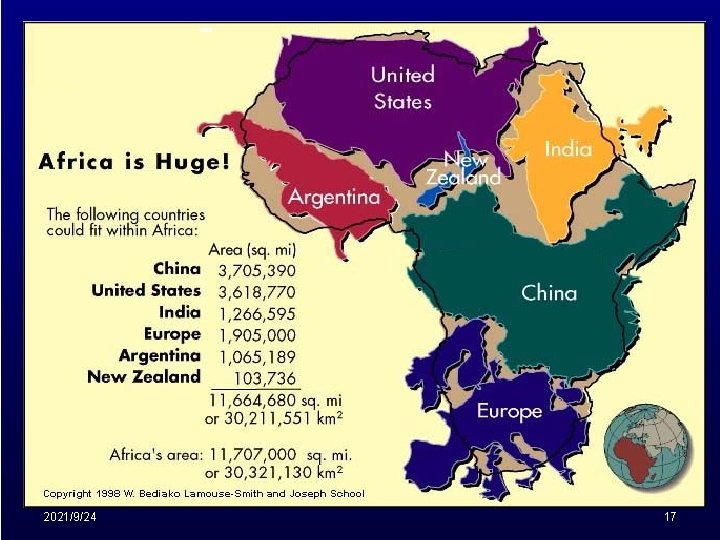
Despite the Size: Problems of African economic Growth continue! After half a century of colonial freedom: Africa as a continent is said still to have an economic size less than the economic size of France! Sub-Saharan Africa’s economic size is said even to be less than the economic size of Holland! Yet there are 54 states, 54 policies plus the unwelcome imposition of often the ’one size fits all policies’ from outside that most of these states do not seem able to avoid or afford, or can reject if harmful! 2021/9/24 18
Problems of African Economic Growth Politically. . . formal independence without an African agency Economically. . . Continued fragmentation means dependence will still continue, poverty and insecurity too! Intellectually : knowledge creation and use often not geared to bring about structural transformation of an integrated African economy Integrating research, training, creativities, governing, producing and circulating within an Africa wide economic system not in existence yet Creation of an African national system of production and consumption: a major challenge Linking academy, industry, government and labour on an African scale and scope often talked about but not implemented. 2021/9/24 19
Problems of African Economic Growth? Agriculture-manufacture-services are weakly integrated in nearly all current African States Agriculture remains primary occupation for the majority African population, manufacture grows very unevenly and slowly, service caters mostly for outside consumers The informal and informal economies are bifurcated and not connected The informal is very large, the formal is smaller 2021/9/24 20
Problems of African Economic Growth? SET is not embedded systematically to create products with added value and unite the African economic system at any level at the moment! The world is going through a data revolution that is creating products with senses, while Africa remains an economy mainly and largely that exports primary resources: minerals and agriculture! Can we truly say we have an African economic growth strategy? Or each of the states have developed a strategy that works for Africa and the wellbeing of the people? I sincerely doubt it. 2021/9/24 21
Problems of African Economic Growth In addition: Indigenous knowledge is not mapped and researched systematically SET is not communicated or exchanged at the community level to upgrade and develop the community level knowledge Knowledge that is useful has not been promoted to innovation Those who have the knowledge do not often know the economic value of what they own There is thus a great need to excavate this knowledge And develop indicators appropriate to this knowledge The African research area is still waiting to be made! 2021/9/24 22
How to make a turn around? There is room to integrate agriculture, manufacture and services Linking community level indigenous knowledge with SET From a resource to a knowledge, learning, innovative and competent independent economy Connecting or articulating informal with formal economy To use SET infrastructure, training and research to build an integrated learning, comptent African national economy. To develop a unifying economic growth strategy that works for Africa! 2021/9/24 23
What has been tried to date? Officially driven integrations Tinkering by attempting to drive economic growth by the existing states Trying to use the current states to create distinct national economies in Ghana, Nigeria, Ethiopia and so on No unified African econmic system yet! 2021/9/24 24
The Officially driven integration Current approach is to try to coordinate politics at the continental level through AU Economics via NEPAD and regional Economic groupings of the existing states Each state also tries to go it alone These processes are continuing 2021/9/24 25
Official Integration tends to be mainly economic, instrumental, pragamatic and functional Integration encourages exchanges in relation to trade, investment, knowledge and when possible migration But the communication and exchange to date is still not strong compared to other regional efforts in the world. 2021/9/24 26
Official Integration vs. Pan-African Unity Pan-African unity has been talked about, but it has not been made. By building on the Pan-African ideals, the historical legacies and movements starting from 1900 by building a shared project To realise the vision of Putting African Unity First in dealing with and responding to the world. 2021/9/24 27
The unity that is not tried yet! Putting Africa Unity first is built from a desire to create the Africa-nation to fulfil the original purpose for Pan. African liberation and unity! It is value anchored, history anchored, experience anchored, project anchored and hope anchored, passion anchored and purpose anchored and not necessarily origin defined and framed! There is a real need for a paradigm shift from tinkering with functionalist integration that is not working at the speed and level to make Africa unpenterable to putting African unity First as the Africa nation! Let us think how to realise the unity that will change Africa to realise a free and independent future. 2021/9/24 28
Africa Unity First (AUF) Africa Unity First(AUF) appreciates the shared resistance to overcome earlier challenges That success is a positive data to build a new shared identity in building unity to make Africa strong and a leading moral, intellectual and liberation player in the world It calls for a strategy to come together to build an African national SET and other infrastructure to create MAINLY inter African producer-user interactions! It sees the offical integration not promoting this unification at a desirable level, system and speed! A new unity direction is needed Speeding along the integration route may not get Africa to realise a fully free and independent future. 2021/9/24 29
Problems with African integration Now? Over 200 integration schemes, but no recognisable and substantive integration yet! The question is whether or not Africa is indeed integrate-able with the existing processes? And how can it be integrated! And at what spatial and economic levels? And how to harmonise and standardise these uneven levels? 2021/9/24 30
Argument for Integration There are compelling reasons for regional integration in Africa. Among other reasons, Africa is threatened with further marginalisation in the global economy; It has fragmented populations with only 5 of the 53 countries on the continent having a population of more than 30 million and over a quarter with a population of less than 3 million. Integration is said to create bigger markets and stimulates large scale production (Nyong’o 1990: 12). 2021/9/24 31
Arguments for Integration is said to help mitigate Africa’s dependence on the world economy, its status as a supplier of raw materials and an importer of manufactured goods (Asante 2007: 29). Regional integration insulates Africa’s nascent industries against international competition. For these and related reasons regional integration is said to be necessary. Integration holds the key to unlocking the door to Africa’s development (Akokpari, 2005) Regional integration may minimise Africa’s dependence on external donors. Africa’s hope may very well lie in a development model that minimises such dependence on external actors. 2021/9/24 32
Problems of African Integration 15 African countries are landlocked and transport and communications links on the continent still rudimentary. Markets too small to attract investments and too balkanised to generate meaningful economies of scale (Only 5 have a population of over 30 milion. ) (8 have less than 1 m each; and 14 between 1 -4 m) As a single economic sphere, Africa has a potential market of over 700 m, a natural resource base of huge dimensions and a diversity unsurpassed by any other continent on the planet. (see map before) If integrated, every African should be richer, at least should not be poorer! 2021/9/24 33
The Current Regional Integration Picture Intra-regional Trade in Africa as a share of total trade has been low compared to other regions: only 8. 4 % in 1993 for Africa, 69. 9 % for Western Europe, 49. 7 % for Asia, 33 % for North America, 19. 4 % for Latin America (WTO Sources quoted in Mc. Carthy, 1995, p. 21) Economic context unfavourable (macro economic disequilibria, foreign debt service burdens, over-valued currencies, lack of trade finance, narrow tax base. economic cost of participation higher than anticipated long-term gains. The economics of distribution in allocating hardships and benefits not seen as fair or even handed both procedurally and substantively 2021/9/24 34
If Regional Integration is to Continue… as we cannot stop it Harmonisation, streamlining and restricting membership to one regional grouping: e. g. One country Tanzania should not be a member of East African Federation, COMESA, SADAC and so on. Creates loyalty and commitment problems! Must begin to simplify regional membership! African integration cannot imitate and must necessarily be different from that in Europe, East Asia and the Americas. It is ‘African-African’’ integration of economies with weak industrial bases which, are generally reliant on agriculture and have relatively low levels of intra-regional trade. 2021/9/24 35
If regional integration is to continue Issues such as improving competitiveness, integrating markets through trade liberalization, harmonizing monetary policies, and promoting private sector investment demand focus in existing types of integration For all this to happen a recognition that expanding and interconnecting Africa’s infrastructure would be critical. The role of pivotal states has to be recognised: South Africa, Nigeria and a few others have sheer market size and industrial base, Can have a special role to play in pushing regional integration, but others may not buy into this role for these countries These countries certanly have potential to act as poles of growth, and/or lead the way, whereby it is possible for certain states to proceed on an accelerated track of regional integration. They must be willing, others must also be willing to recognise a role for them! Not easy to do so! 2021/9/24 36
Some of the Challenges Developing Institutional and human capacity. Recognition that almost all of the big issues confronting Africa – and certainly the regional trade and investment issues – require stronger and more financially viable subregional and regional organizations. Social psychology of the elite still problematic: Fanon calls the elite ’useless. ’ Elite often said to lack moral intelligence and existential seriousness being rent-seekers rather than honest servers Sustained political commitment to take politically difficult rationalization steps, which only the brave leaderships of national governments can see through. 2021/9/24 37
Regional Integration: to continue or not Continue! Regional integration will continue It will not stop But the success from it is not reassuring If we judge by the way it has gone to date Alternatives should continue to be explored As the stakes are high! We propose Putting Africa Unity First to end Africa’s woes for good! 2021/9/24 38
Why integration is slow in Africa All nation states are ’social inventions’ With Africa there was an external divider to this social invention Our states as we know them are penterated nations! Africa has not fully overcome this divide and rule driven social invention in its national formation The main trouble of this hiccup lies in the constraints it puts whenever Africans decide to design and follow an African agenda no matter whether it is right or wrong Africans can meet together but they cannot follow yet a united African policy even after they agree to do so and produce wonderful documents (e. g. ) The 1980 Lagos Long Term African Transformation!) In 1981 35 of them want one by one and signed to the WB’s Berg Report , the precursor to SAP! 2021/9/24 39
The Existing States as they are They are not successful either, they too continue to plod on! We have now talk of a few of the states that are described as’ lions on the Move’ But these are no more than 8! Nigeria is among them. 2021/9/24 40
The Lesson to be Drawn Something new must be tried Change is necessary The post-colonial balance sheet shows bold steps need to be taken Fresh thinking, thinking big, thinking deep and thinking with commitment necessary!! Fresh reconceptualisation 2021/9/24 41
Alternative: Build African Unity First Nation (AUFN) in a new way! Not functional integration Not to go on with the states we have as they are now We upgrade to being Africans first: Nigerians become first and foremost Africans; all others also do the same! Not to degrade to ethnicity, vernacularity, religion and other self-enclosures Not to confuse the expression of rights for language, ethnicity, region with defining the knowldge, economic and political level with being Africans first! 2021/9/24 42
Africa Unity First This Africanity , Africa first, or Africa Unity first or African nationalism follows logically from Africa’s specific experience and history(past) and the project to transform the economy structurally from its fragile state into a selfsustaining robust state (future)! A recognition of Africa’s experience and history implies locating the core of itseconomic transformation in the dynamics of uniting to freeing African nationalism is one of the few things that remains to advance Africa’s independence, agency and postcolonial freedom. 2021/9/24 43
The Concept of a nation! Nation is more than a community of origin; it is now becoming a community of opinion and purpose. Africa has shared experience and history to forge a shared value by constructing an African imagined community. The Africa-renascent nation can be the ‘logo’ for a project and the shared imagination to shape a sustainable future of all Africans Between each individual and entire humanity stands the nation (F. List, 1856) Let Africa stand between the individual and humanity as a nation! 2021/9/24 44
The Africa Unity First Nation (AUF) Can AUF Cancel the problems that the current fragmentations continue to reproduce Can fully restore African full dignity by ending all humilations directed from outside End all negative gaze on Africans Make it impossible for outsiders to repeneterate Africa To practice ubuntu- African humanism and solidarity to end all negative branding A willingness to confront and resist historical injustice and humiliation that comes indiscrimnately to all with African origin in them in some form or variety! 2021/9/24 45
AUFN Can Mean? The composition of an African personality; Forge a shared striving to free Africa from post-colonial donor dependency A means of achieving social, political, economic and cultural renewal, development and transformation A rejection of Afro pessimism and a striving to make a shared future with Afro-optimism An African project, passion for launching Africa on a pathway to taking it into the 21 st Century; The aspiration to the African right and opportunity that it can develop and shape its own future! Africa should have the right to be wrong too, and learn to correct the wrong! 2021/9/24 46
Part II The Relevance of the. Theory of Productive Power to Africa National interest, union of labour rather than division of labour, productive power, preference and accent from the private to the national economy, infant industry, protection of a national economy from international trade, national unification and economic growth and transformation What is good for the individual may not be for the nation, the country, the society or humanity! 2021/9/24 47
The Theory of Productive Power It contexualises its theory of productive power with the idea of not only the national interest but also the national passion, national sentiment, and the national purpose, national project! Africa’s transformation needs: national Passion, shared sentiment, purpose and project at the same time! Africa must not degrade and disperse by going back to origin, it must value shared experience, history, project, dream, passion, sentiment and purpose! 2021/9/24 48
The Theory of Productive Power A national political economy facing constraints needs to find a way to organise transformation! Those that trade in raw materials and agriculture remain stagnant Those that build productive power have made it (e. g. USA, Germany, Japan, East Asian Tigers) The lesson is clear: if a nation wants to be transformed, it has to organise its national system of political economy with a logic of stimulating rapidly and comprehensively productive power. Otherwise it can have very rich minerals and agriculture , natural resources, and territorial size, but will remain where it has been! Africa is rich in minerals, but it remains poor and will remain so unless it emerges as an integrated African innovative, learning national economy. 2021/9/24 49
Productive Power theory The theory of productive power can be built as providing a core theme for transformation Individuals, nations and humanity are distinct The sum of individual interests is not to be equated with the interest of a nation (1856: 74) Social interests diverge from private interests(ibid. : 245) 2021/9/24 50
Productive Power Theory The economy of the individual is different from the economy of the nation, and the economy of the global human interest is different from both (p. vi) Some nations can be concerned more for their national welfare than the welfare of humanity! So they can choose expanding productive forces through protection than expanding global welfare through free trade They preach free trade, but they practice protection! Could it be that was in the interest of each is thought to be in the interest of the world, ! 2021/9/24 51
Productive Power Theory The production based economics is different from the exchangeable values and allocations through international trade (Adam Smith of the Wealth of Nations) Trading in cooked and manufactured vs raw and agricultural goods not the same thing! 2021/9/24 52
Why Productive Power theory Theory of productive power is more than commodities, money and factors of production or natural advantages It is above all a realisation that division of labour presupposes national unity, national independence, a shared project and cooperation of productive forces ( List, p. 74) 2021/9/24 53
Strategies coming Industralisation and manufacturing to be driven by a capable nation and state Incentives to those who take risks of creating new industries Building the capital of the mind and training and spreading education to cover comprehensively the nation as a whole Choice of industries for protection on the basis of knowledge, experience and linkages with the rest of the national economy (p. 69) Transformation of agriculture necessary to industralise, and Industries of luxury to recieve attention until in the last phase( List, p. 392) 2021/9/24 54
The Puzzle for Africa The national system of innovation concept derived from the Listian tradition in the context of Africa may be a ’provocation’ In the context where the ’national’ in Africa is not well defined! In the context where ’institutions’do not function with a predictable system and rationality Where learning and capability are not mobilised to advance African transformation with deliberation and focus! Where inter-African interaction is lower than inter -other interactions! 2021/9/24 55
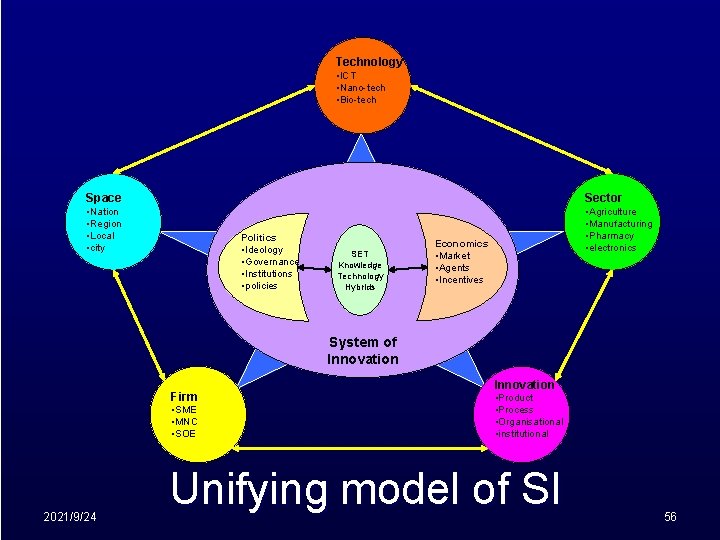
Technology • ICT • Nano-tech • Bio-tech Space Sector • Nation • Region • Local • city • Agriculture • Manufacturing • Pharmacy • electronics Politics • Ideology • Governance • Institutions • policies SET Knowledge Technology Hybrids Economics • Market • Agents • Incentives System of Innovation Firm • SME • MNC • SOE 2021/9/24 Innovation • Product • Process • Organisational • institutional Unifying model of SI 56
Productive Power driven Innovation Systems. Building innovation systems anchored on productive power/SET Stimulate and understand inter economic and non-economic actor interactions and dynamics, Co-evoution of economic and noneconomic governing institutions, practices and understanding (Richard Nelson) The interaction of policies, knowledge, incentives, institutions, practices and the understanding involved in the process 2021/9/24 57
System of Innovation System building, to identify significant interactions and interfacing of parts, Bridge the gap between theory and reality, The sources and organisation for stimulating innovation, imagination and creativity, learning and comptence building To understand how routines are formed, path dependencies are set and broken and novelties emerge and prepare and design policy frames! 2021/9/24 58
System of innovation Integrating Africa or making the Africa nation itself is a problem of dynamic innovation systems, of creative destruction, requiring systemic approaches to understanding and creating knowledge in interaction with policies, instituitions, system of innovation actors, incentives Innovation systems are useful to assist in stimulating how an African unity can be forged! 2021/9/24 59
System of Innovation If Africa has to survive in a difficult world, it needs to apply new tools to assist its build up of its future! For example if the main development problem is to integrate Africa or to imagine the Africa nation and make it, then NSI is useful! A system that is capable of using received knowldge and creating new knowledge 2021/9/24 60
Acquiring and making In fact to acquire better and better existing knowledge an African nation must build its own R & D capability also. It is not either acquiring the existing or making new. . It is making to acquire in order to make new and build on a continuous spiral enhancing a simulatenous mutuality in the practice and the understanding of knowldge making! It is both know how as practice and the learning and understanding to create novel practices that recreate more and better learning that continues in time and space! 2021/9/24 61
Why the NSI for Africa? A national system of innovation to promote a national system of production To enable a system creation to produce what Africa consumes, and to consume what Africa produces To create Africa. . . wide producers and users interactions (Lundvall: 85) To embed knowledge creation, innovation, learning in Africa’s institutions, societies To inject a total learning and innovation culture in Africa To retain African resources and apply to transform the African economy. 2021/9/24 62
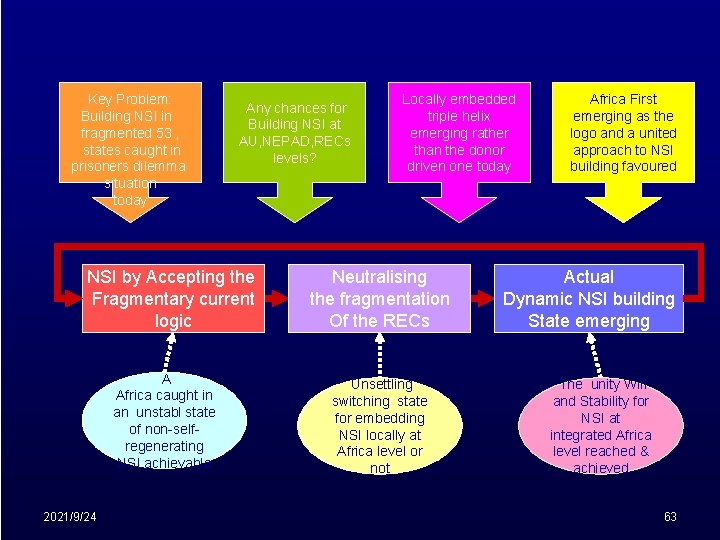
Key Problem: Building NSI in fragmented 53 , states caught in prisoners dilemma situation today Any chances for Building NSI at AU, NEPAD, RECs levels? NSI by Accepting the Fragmentary current logic A Africa caught in an unstabl state of non-selfregenerating NSI achievable 2021/9/24 Locally embedded triple helix emerging rather than the donor driven one today Neutralising the fragmentation Of the RECs Unsettling switching state for embedding NSI locally at Africa level or not Africa First emerging as the logo and a united approach to NSI building favoured Actual Dynamic NSI building State emerging The unity Will and Stability for NSI at integrated Africa level reached & achieved 63
The Research Challenge for Africa The economy of the nation Systems Co-evoutions Interactions Innovation Learning Comptence building The organisation of productive power 2021/9/24 Africa. . nation Integration Structural transformation Forging equitable relation with the world economy Agency and independence capability accumulation 64
Building the Greater African Research Area(GARA) RESEARCH PROGRAMME ON SYSTEM OF INNOVATION BUILDING AT THE AFRICA LEVEL a challenge! REVIEW THE EXISTING WORK ON SET IN AFRICA BOTH DONE BY THOSE FROM INSIDE AND THOSE FROM OUTSIDE AFRICA IDENTIFY THE RESEARCH CENTRES ACTIVELY INVOLVED IN SET WORK IN ALL REGIONS OF AFRICA 2021/9/24 65
GARA -FIND WAYS OF HOW TO UNDERTAKE THE DEVELOPMENT OF AN AFRICA WIDE RESEARCH SURVEY ON SET: - REGION BY REGION , RECs, AU/NEPAD - COUNTRY BY COUNTRY, - SECTOR BY SECTOR, - FIRM BY FIRM, - COMMUNITY BY COMMUNITY LEVELS - TO GENERATE DATA FOR : a) POLICY LEARNING, b) SYSTEM OF INNOVATION BUILDING and c) FOR BRINGING ABOUT WAYS OF BETTER INTEGRATION OF AFRICAN ECONOMIES 2021/9/24 66
The Research Orientation to Decline Continue to search for solution within the existing arbitrary arrangements as they are in Africa now That continues to engage, interrogate and critique them That tinkers with fragmented Africa That does not question dependence, Continues to take the fragmentated status of Africa as ‘normal’ Fashions ideas and policies without questioning such fragmentations, often approved by others with dubious record in dealing with Africa Blames Africans when conceptual and policy results show more poverty creation than wealth creation 2021/9/24 67
Concluding Remark Fragmented states– can they succeed as they evolve now? Regional integrations, can they succeed? Pan-African liberation. . What chance for it to be re-centred? African unification through Africa integration or the Africa-nation building for putting African unity first ? How to align the AU, Nepad and other processes to this goal to succeed? 2021/9/24 68
Concluding Remark Not all the states in Africa can catch up with high income economies today as they are now! Not sure even if they can catch up even if regrouped as regions Important to emerge united to deal with a world economy and respond to its many challenges. No alternative to learning and the social innovation of uniting, if Africans and Africa are to attain full dignity, end all humiliations and retain their humanity in a difficult and uncertain world. 2021/9/24 69
Concluding Remark Putting the Africa Unity First Nation is the Road that has not been travelled by that Africans must take combining with many Africans as one Africa and one Africa that maintains the rich diversity as an asset that can be harnessed to build a bright future
The Last Word-to three Great Africans- Nkrumah ”If we are to remain free, if we are to enjoy the full benefits of Africa's rich resources, we must unite to plan for our total defense and the full exploitation of our material and human means in the full interest of our people. To go it alone will limit our horizon, curtail our expectations and threaten our liberty. ” Kwame Nkrumah. 2021/9/24 71
---From the great Africans- Haile Selassie ”Our liberty is meaningless unless all Africa is free” Emperor Haile Selassie Like Ghana’s independence is meaningless without all of Africa being free Emperor Haile Selassie also said Ethiopia’s liberty is meaningless unless all of Africa is free!
From three Great Africans- Nnamdi Azikiwe “My stiffest earthly assignment is ended and my major's life's work is done. My country is now free and I am honoured to be the first indigenous head of state. What more could one desire in life. “ Nnamdi Azikiwe, Author of Renascent Africa, 1937!) But Nigeria's independence is necessary but not sufficient until all of Africa is full free, sovereign, united and forever strong by all of Africa standing up together! All Nigerians must build on Azikiwe’s legacy and re- think, act, do, speak and work to bring united and free Africa! Nigeria must be a leading player in building Africa’s ontological hope. For Africa more than anywhere else in the world hope is an ontological need. Nigeria , I challenge you to be it!!! Thank you! Mammo Muchie
- Slides: 73