
2010 Scientific Computing Face Recognition Image database A
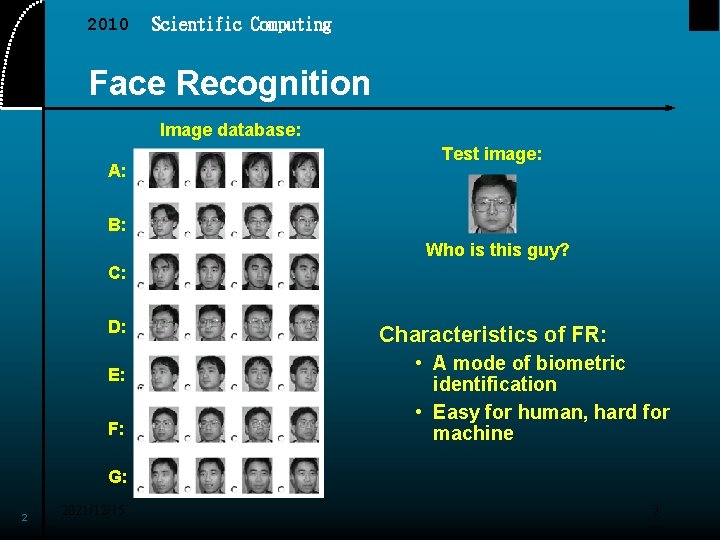
2010 Scientific Computing Face Recognition Image database: A: Test image: B: Who is this guy? C: D: E: F: Characteristics of FR: • A mode of biometric identification • Easy for human, hard for machine G: 2 2021/12/15 2
2010 Scientific Computing Biometric Identification of people from their physical characteristics, such as • • 3 2021/12/15 faces voices fingerprints palm prints hand vein distributions hand shapes and sizes retinal scans 3
2010 Scientific Computing FR via PCA First paper: • M. Turk and A. Pentland, "Eigenfaces for Recognition", Journal of Cognitive Neuroscience, vol. 3, no. 1, pp. 71 -86, 1991 Characteristics • Efficient computation • Proven mathematics • Applicable to face detection 4 2021/12/15 4

2010 Scientific Computing Problem Definition Input • A dataset of face images of n person • An unknown person’s face image Output: • Determine the identity of the unknown person 5 2021/12/15 5
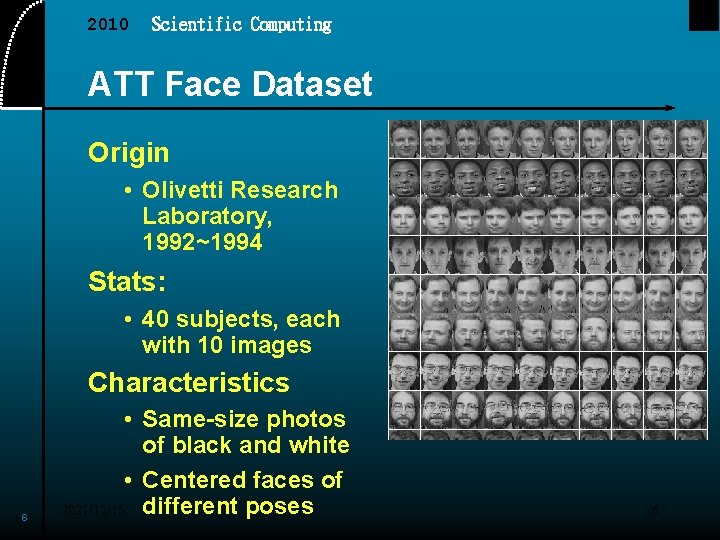
2010 Scientific Computing ATT Face Dataset Origin • Olivetti Research Laboratory, 1992~1994 Stats: • 40 subjects, each with 10 images Characteristics 6 • Same-size photos of black and white • Centered faces of 2021/12/15 different poses 6
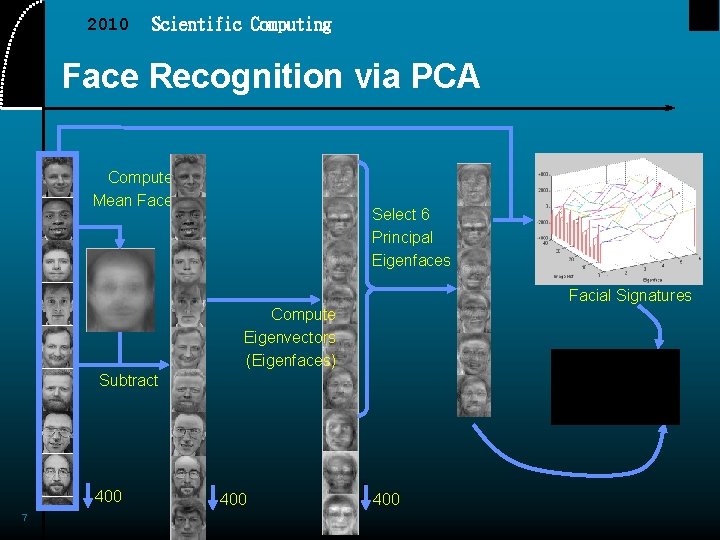
2010 Scientific Computing Face Recognition via PCA Compute Mean Face Select 6 Principal Eigenfaces Facial Signatures Compute Eigenvectors (Eigenfaces) Subtract 400 7 400
2010 Scientific Computing Steps of Feature Extraction via PCA 3 simple steps: 1. Data preprocessing - Each sample image is rearranged into a column vector of length 112*92=10304. All images are put into a matrix F of size 10304 x 400. - Mean face is subtracted from each column. 2. PCA - Find the eigenvectors of F*F’. 3. Projection - Select top k eigenvectors with k largest eigenvalues k eigenfaces! - Do projection along these eigenfaces to find new features for classification 8 2021/12/15 8

2010 Scientific Computing Details for Step 2: PCA Problem: is large, 10304 x 10304! (849 MB!) How to compute the eigenvectors of ? Observation: • • If u is the eigenvector of F’F, then Fu is the eigenvector of FF’. If l is the eigenvalue of F’F, then l is also the eigenvalue of FF’. Note that: • • 9 2021/12/15 FF’ has 10304 eigenvalues. F’F has 400 eigenvalues, corresponding to the 400 largest eigenvalues of FF’. 9
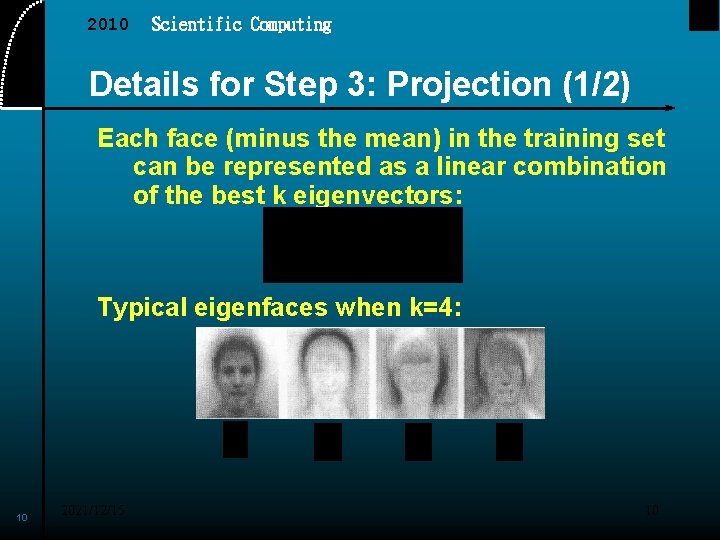
2010 Scientific Computing Details for Step 3: Projection (1/2) Each face (minus the mean) in the training set can be represented as a linear combination of the best k eigenvectors: Typical eigenfaces when k=4: 10 2021/12/15 10
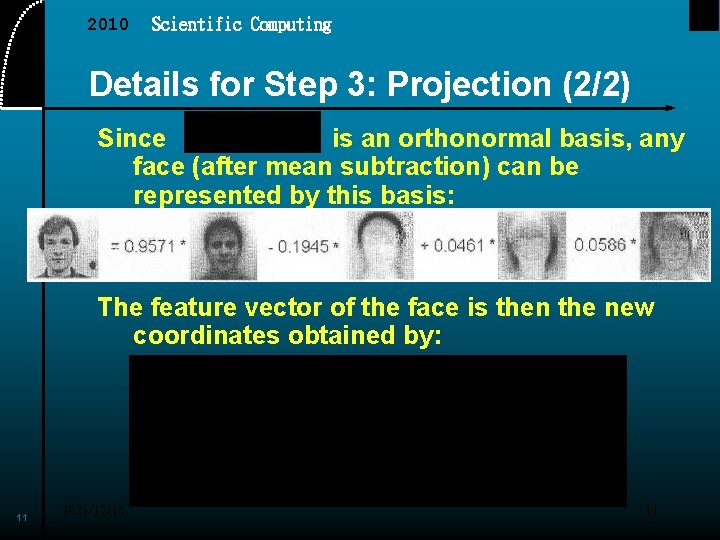
2010 Scientific Computing Details for Step 3: Projection (2/2) Since is an orthonormal basis, any face (after mean subtraction) can be represented by this basis: The feature vector of the face is then the new coordinates obtained by: 11 2021/12/15 11
2010 Scientific Computing Classification Once the features for images are extracted, we can then apply any classification methods to obtain the final recognition results, including • • • 12 2021/12/15 Minimum distance classifier Support vector machines Neural networks Quadratic classifier Gaussian mixture models 12
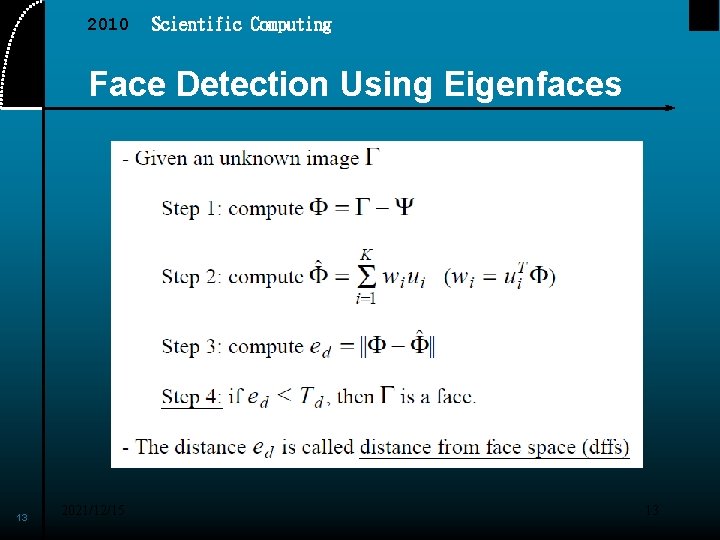
2010 Scientific Computing Face Detection Using Eigenfaces 13 2021/12/15 13
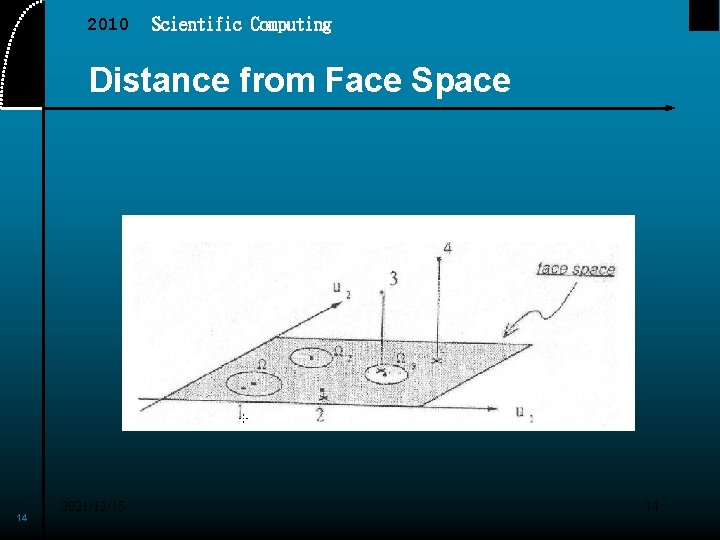
2010 Scientific Computing Distance from Face Space 14 2021/12/15 14
- Slides: 13