
2010 NATIONAL MODEL CONSTRUCTION CODES Stairs Ramps Handrails

- Slides: 32
2010 NATIONAL MODEL CONSTRUCTION CODES Stairs, Ramps, Handrails and Guards Philip Rizcallah, P. Eng. NRC Canadian Codes Centre February 2011 1
Introduction • Presentation is part of a series on the 2010 National Model Construction Codes • Model codes developed by Canadian Commission on Building and Fire Codes • These codes must be adopted by provincial/territorial authorities to become law 2
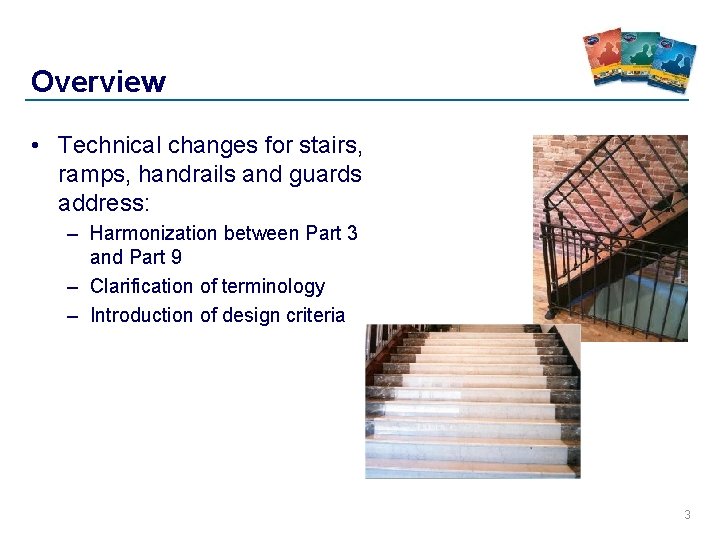
Overview • Technical changes for stairs, ramps, handrails and guards address: – Harmonization between Part 3 and Part 9 – Clarification of terminology – Introduction of design criteria 3
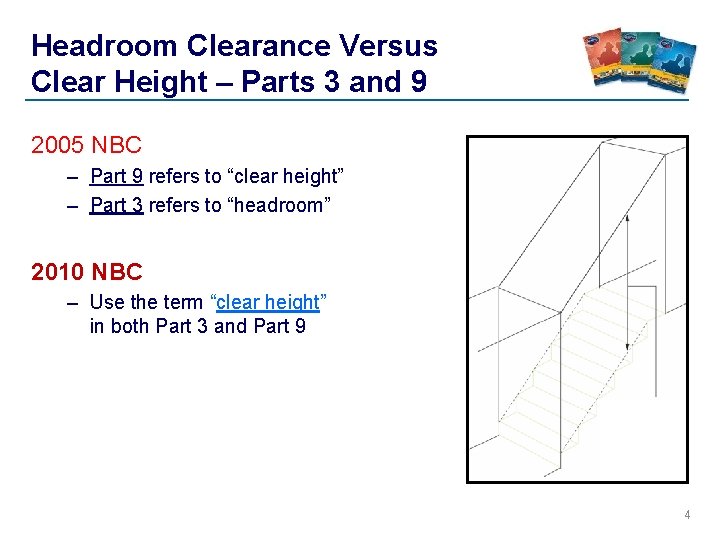
Headroom Clearance Versus Clear Height – Parts 3 and 9 2005 NBC – Part 9 refers to “clear height” – Part 3 refers to “headroom” 2010 NBC – Use the term “clear height” in both Part 3 and Part 9 4
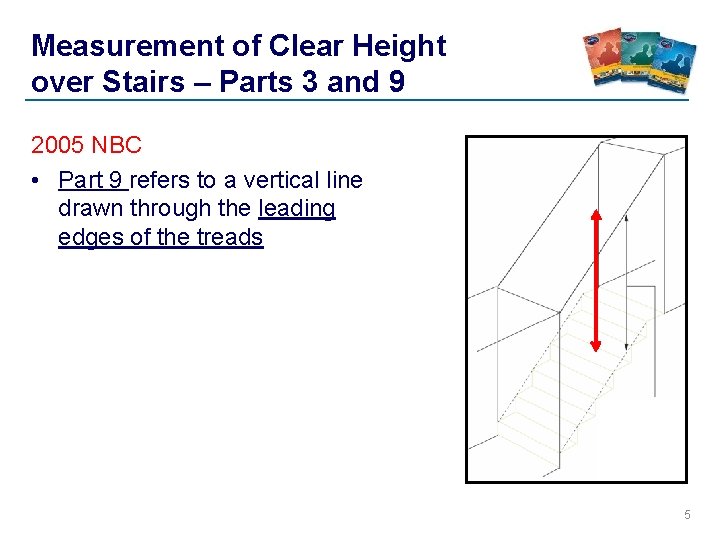
Measurement of Clear Height over Stairs – Parts 3 and 9 2005 NBC • Part 9 refers to a vertical line drawn through the leading edges of the treads 5
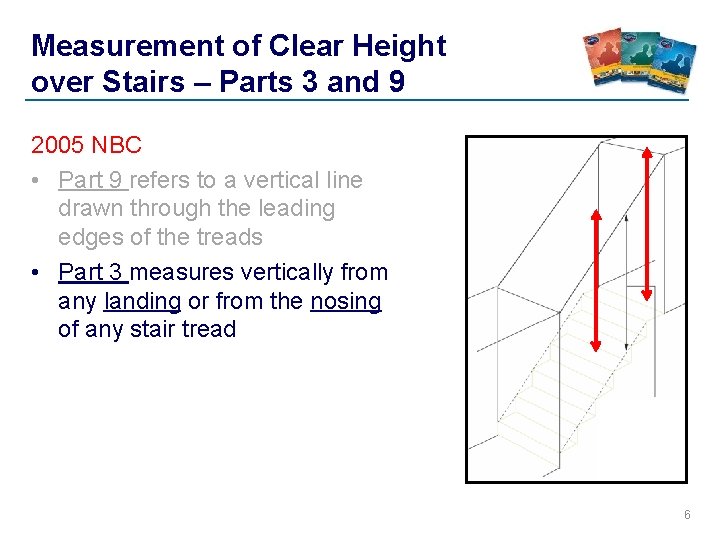
Measurement of Clear Height over Stairs – Parts 3 and 9 2005 NBC • Part 9 refers to a vertical line drawn through the leading edges of the treads • Part 3 measures vertically from any landing or from the nosing of any stair tread 6
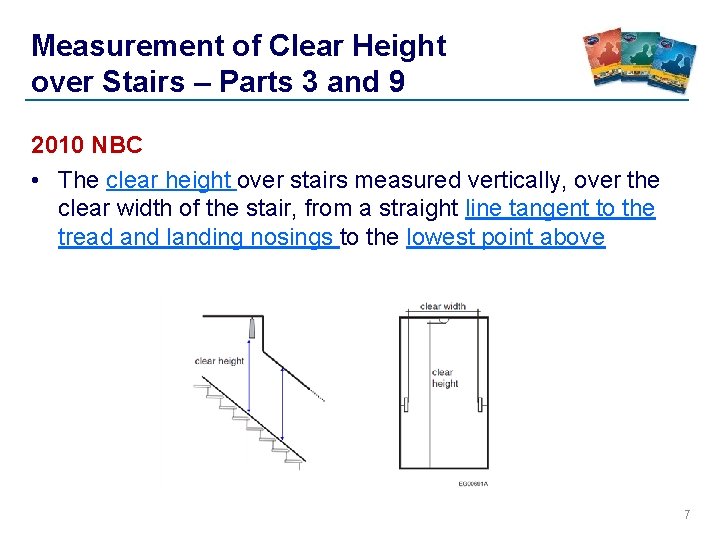
Measurement of Clear Height over Stairs – Parts 3 and 9 2010 NBC • The clear height over stairs measured vertically, over the clear width of the stair, from a straight line tangent to the tread and landing nosings to the lowest point above 7
Minimum Clear Height over Stairs, Ramps and Landings – Part 3 2005 NBC • ≥ 2100 mm headroom clearance 2010 NBC • ≥ 2050 mm clear height 8
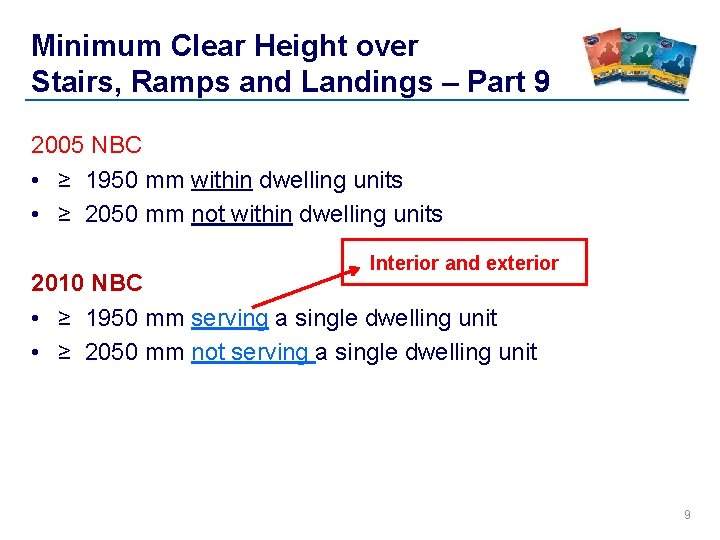
Minimum Clear Height over Stairs, Ramps and Landings – Part 9 2005 NBC • ≥ 1950 mm within dwelling units • ≥ 2050 mm not within dwelling units Interior and exterior 2010 NBC • ≥ 1950 mm serving a single dwelling unit • ≥ 2050 mm not serving a single dwelling unit 9
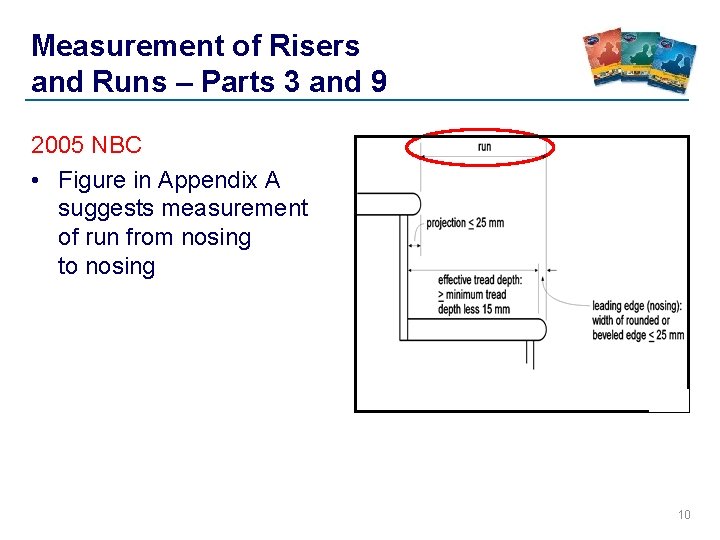
Measurement of Risers and Runs – Parts 3 and 9 2005 NBC • Figure in Appendix A suggests measurement of run from nosing to nosing 10
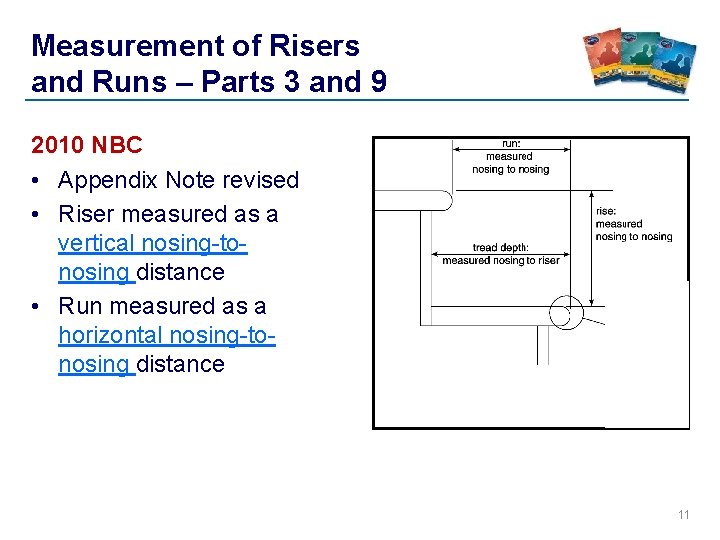
Measurement of Risers and Runs – Parts 3 and 9 2010 NBC • Appendix Note revised • Riser measured as a vertical nosing-tonosing distance • Run measured as a horizontal nosing-tonosing distance 11
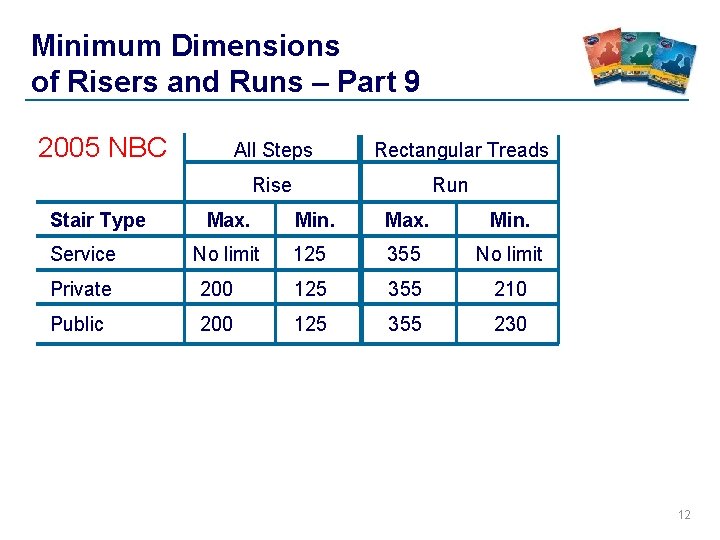
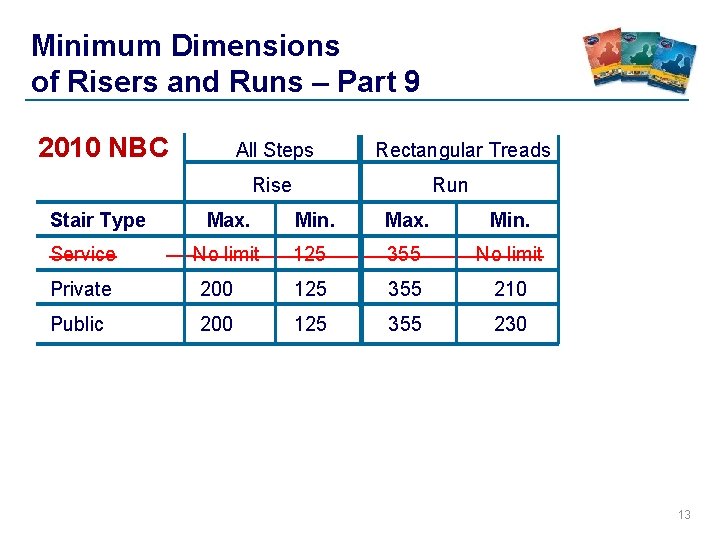
Minimum Dimensions of Risers and Runs – Part 9 2005 NBC All Steps Rectangular Treads Rise Stair Type Service Run Max. Min. No limit 125 355 No limit Private 200 125 355 210 Public 200 125 355 230 12
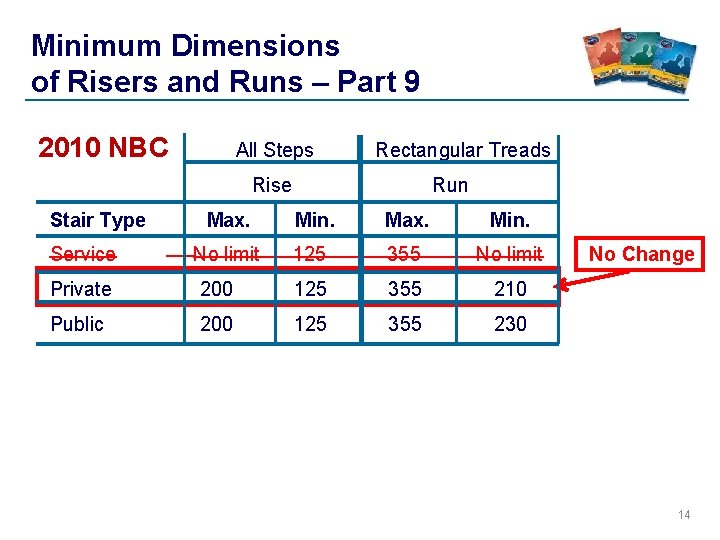
Minimum Dimensions of Risers and Runs – Part 9 2010 NBC All Steps Rectangular Treads Rise Stair Type Service Run Max. Min. No limit 125 355 No limit Private 200 125 355 210 Public 200 125 355 230 13
Minimum Dimensions of Risers and Runs – Part 9 2010 NBC All Steps Rectangular Treads Rise Stair Type Service Run Max. Min. No limit 125 355 No limit Private 200 125 355 210 Public 200 125 355 230 No Change 14
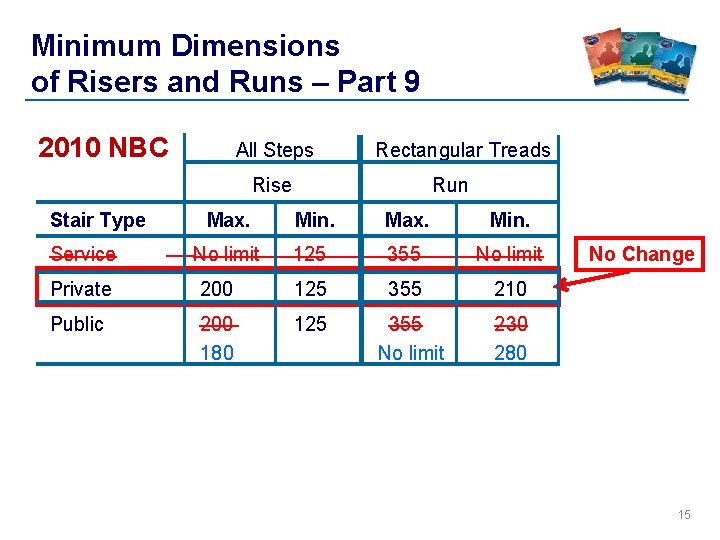
Minimum Dimensions of Risers and Runs – Part 9 2010 NBC All Steps Rectangular Treads Rise Stair Type Service Run Max. Min. No limit 125 355 No limit Private 200 125 355 210 Public 200 180 125 355 No limit 230 280 No Change 15
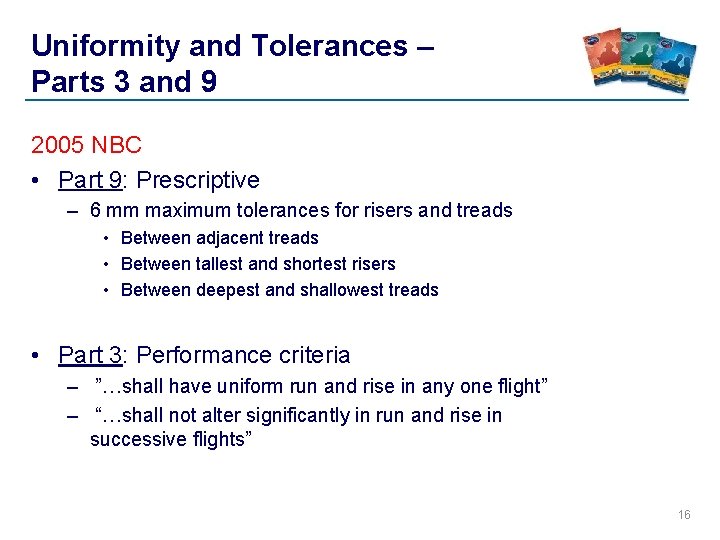
Uniformity and Tolerances – Parts 3 and 9 2005 NBC • Part 9: Prescriptive – 6 mm maximum tolerances for risers and treads • Between adjacent treads • Between tallest and shortest risers • Between deepest and shallowest treads • Part 3: Performance criteria – ”…shall have uniform run and rise in any one flight” – “…shall not alter significantly in run and rise in successive flights” 16
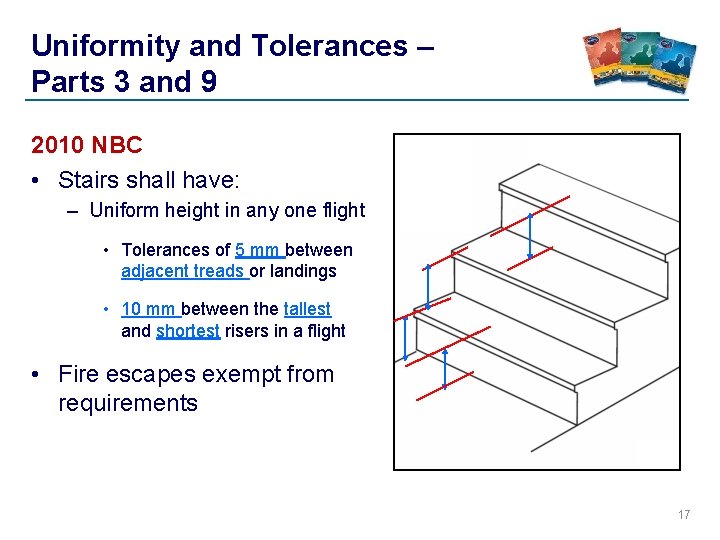
Uniformity and Tolerances – Parts 3 and 9 2010 NBC • Stairs shall have: – Uniform height in any one flight • Tolerances of 5 mm between adjacent treads or landings • 10 mm between the tallest and shortest risers in a flight • Fire escapes exempt from requirements 17
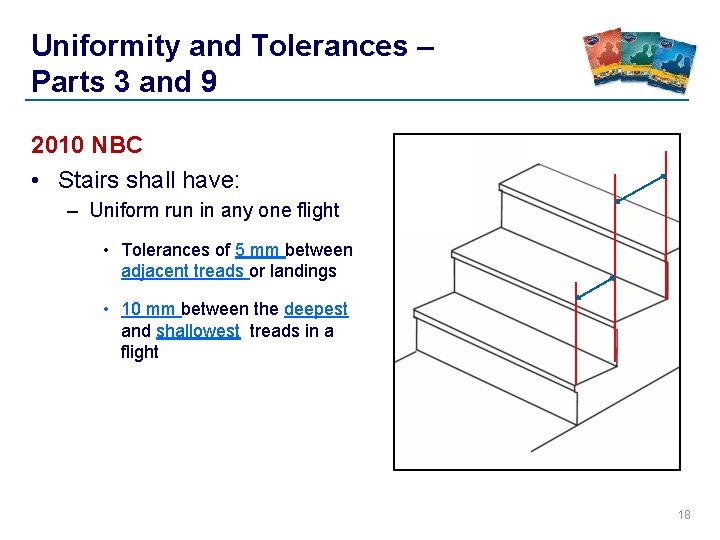
Uniformity and Tolerances – Parts 3 and 9 2010 NBC • Stairs shall have: – Uniform run in any one flight • Tolerances of 5 mm between adjacent treads or landings • 10 mm between the deepest and shallowest treads in a flight 18
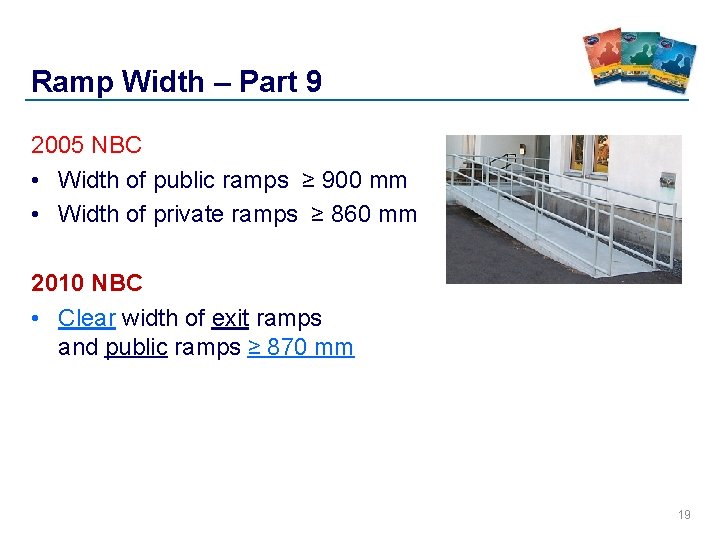
Ramp Width – Part 9 2005 NBC • Width of public ramps ≥ 900 mm • Width of private ramps ≥ 860 mm 2010 NBC • Clear width of exit ramps and public ramps ≥ 870 mm 19
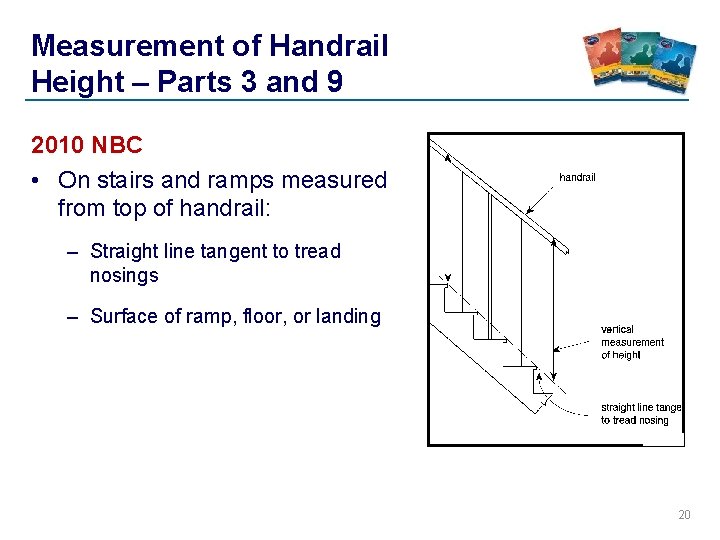
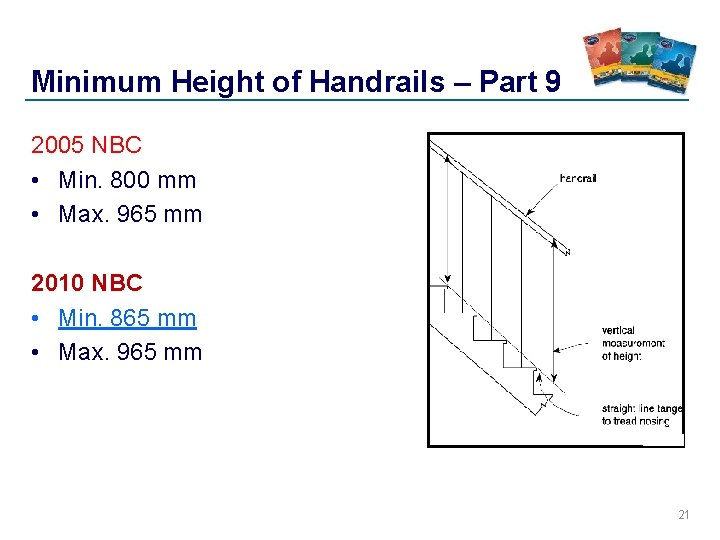
Measurement of Handrail Height – Parts 3 and 9 2010 NBC • On stairs and ramps measured from top of handrail: – Straight line tangent to tread nosings – Surface of ramp, floor, or landing 20
Minimum Height of Handrails – Part 9 2005 NBC • Min. 800 mm • Max. 965 mm 2010 NBC • Min. 865 mm • Max. 965 mm 21
Intermediate Handrail on Wide Stairs and Ramps – Part 9 2005 NBC (Part 9) • No requirement 2010 NBC (Part 3 and 9) • Stairs or ramps ≥ than 2200 mm – Intermediate handrail such as no position is more than 825 mm from a handrail 22
Landings in Garages – Dwelling Units 2005 NBC • Landings are required at the top of stairs in attached garages of dwelling units regardless of number of risers 2010 NBC - New sentence • Requirements that apply to stairs, ramps handrails and guards within dwelling units also apply to stairs, ramps handrails and guards in garages 23
Ramps and Landings – Part 3 Dwelling Units 2005 NBC • Interior ramps and landings must comply with Part 3 requirements for public ramps • Exterior stairs, ramps, landings, handrails must comply with Part 3 requirements for public stairs, ramps, handrails and guards 24
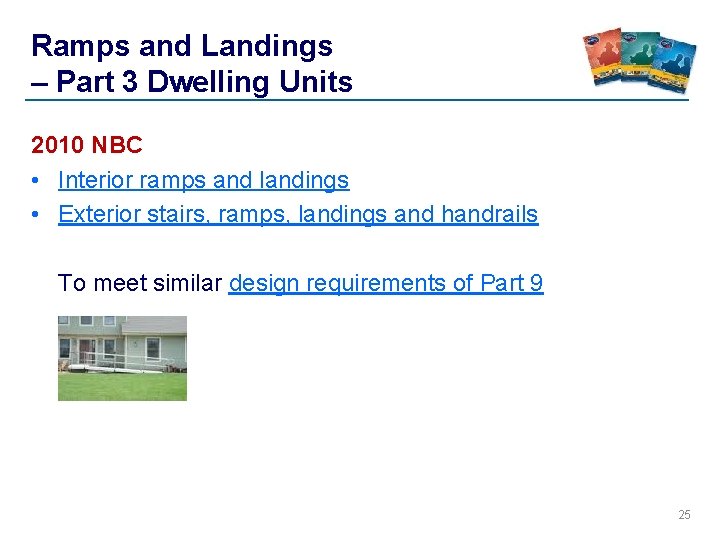
Ramps and Landings – Part 3 Dwelling Units 2010 NBC • Interior ramps and landings • Exterior stairs, ramps, landings and handrails To meet similar design requirements of Part 9 25
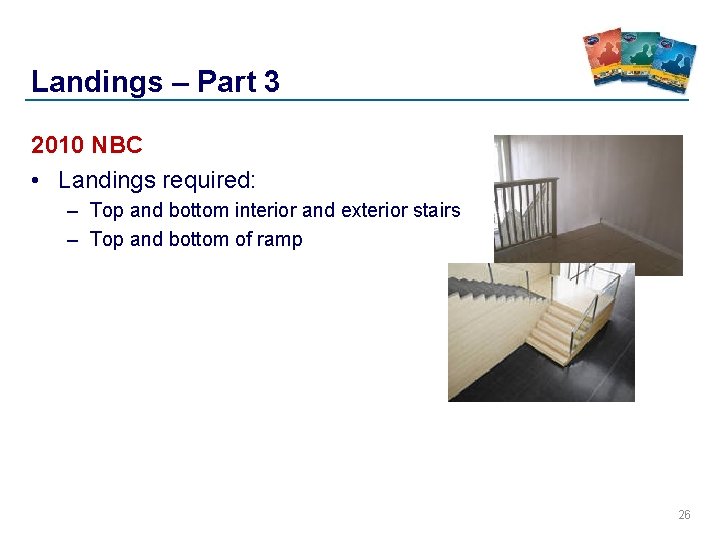
Landings – Part 3 2010 NBC • Landings required: – Top and bottom interior and exterior stairs – Top and bottom of ramp 26
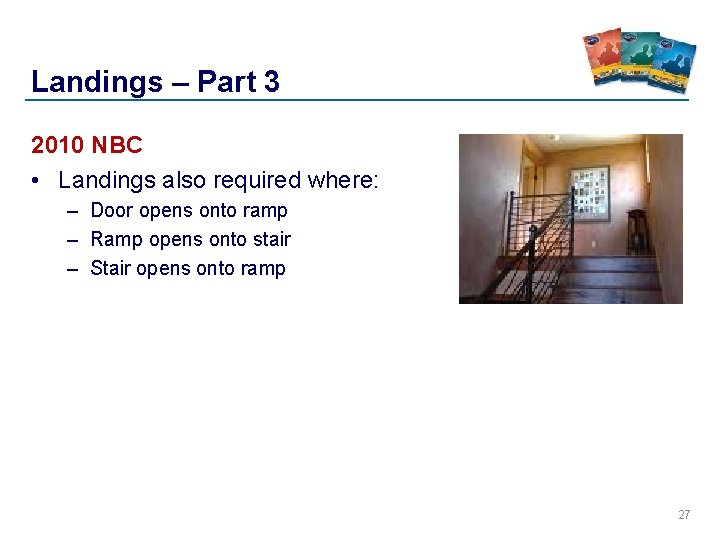
Landings – Part 3 2010 NBC • Landings also required where: – Door opens onto ramp – Ramp opens onto stair – Stair opens onto ramp 27
Slope for Treads and Landings – Parts 3 and 9 2005 NBC • Part 9: Cross-slope of treads shall not exceed 1 in 100 • Part 3: No requirement 2010 NBC • Slope on treads and landings shall not exceed 1 in 50 28
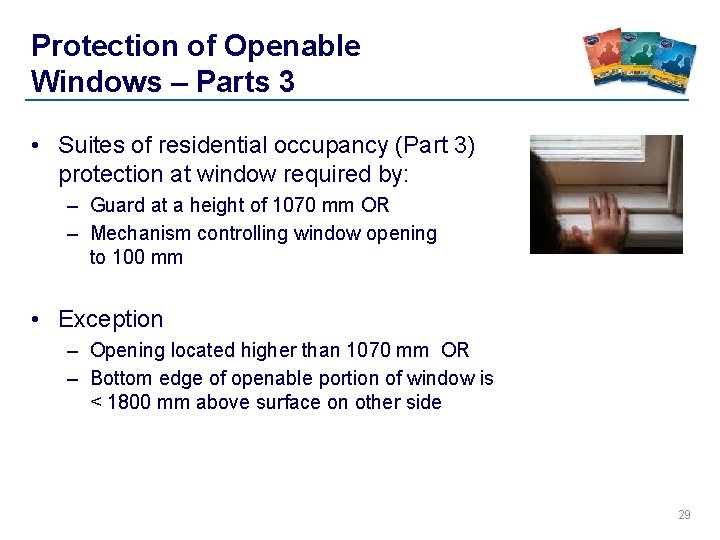
Protection of Openable Windows – Parts 3 • Suites of residential occupancy (Part 3) protection at window required by: – Guard at a height of 1070 mm OR – Mechanism controlling window opening to 100 mm • Exception – Opening located higher than 1070 mm OR – Bottom edge of openable portion of window is < 1800 mm above surface on other side 29
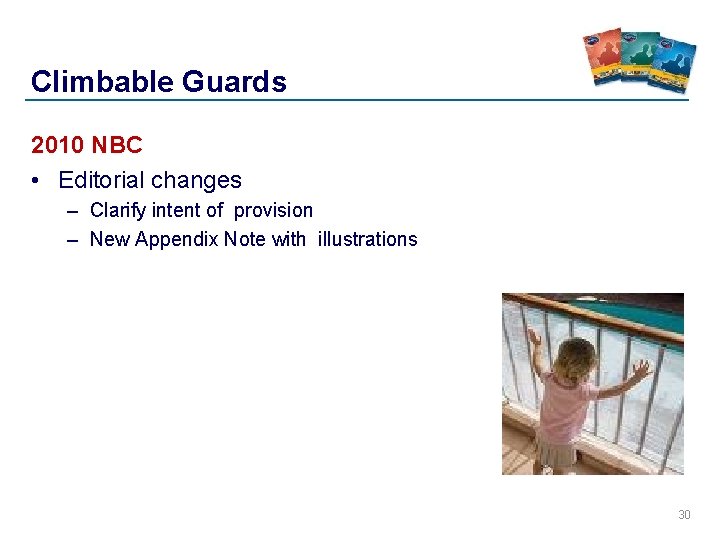
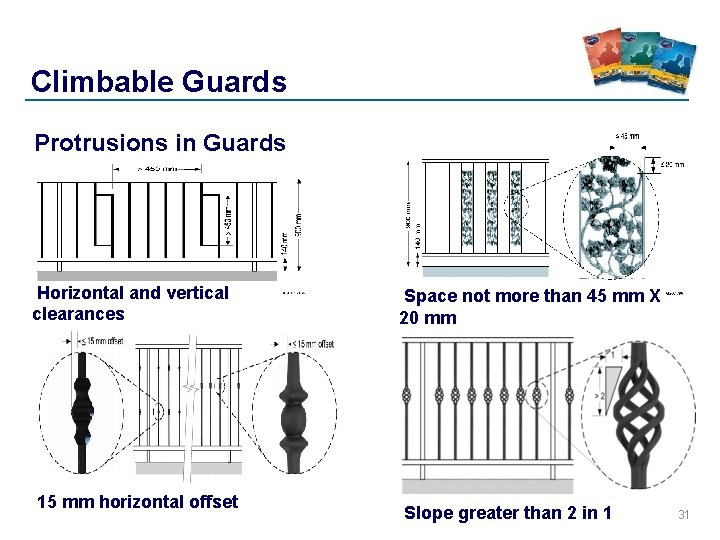
Climbable Guards 2010 NBC • Editorial changes – Clarify intent of provision – New Appendix Note with illustrations 30
Climbable Guards Protrusions in Guards Horizontal and vertical clearances 15 mm horizontal offset Space not more than 45 mm X 20 mm Slope greater than 2 in 1 31
www. nationalcodes. ca Questions? Send them to us at codes@nrc-cnrc. gc. ca Thank you! 32