
2010 INFORMS Marketing Science Conference Cologne Germany June
- Slides: 82
2010 INFORMS Marketing Science Conference Cologne, Germany, June 16 -19, 2010. The University of Cologne Cluster : Innovation, Session Information: Saturday Jun 19, 10: 30 - 12: 00, Title: Innovation I Consumer Innovativeness and Structure of Innovation Diffusion * V. 1. 3 Masataka Yamada Nagoya University of Commerce and Business, 4 -4 Sagamine, Komenoki-cho, Nissin-shi, Aichi-ken 470 -0193, Japan, myamada@nucba. ac. jp Toshihiko Nagaoka Team Leader, Nippon Boehringer Ingelheim/Sales Marketing Osaka, 1 -1 -5, Shinsenri Higasimati, Toyanaka 560 -0082, Japan, nagaoka@kaw. boehringer-ingelheim. com * A part of this study has been supported by Scientific Research (C) #19530394 of the Grant-in-Aid for Scientific Research, JSPS
Problems in Diffusion Theory • With regard to adopter categorization of innovation diffusion theory, there are two major approaches : (1) Rogers scheme where adopters are classified by their time of adoption assuming a normal distribution, along with diffusion time axis, into five categories (Rogers 1962): innovator, early adopter, early majority, late majority, and laggard. Although a statistical method to obtain the number of adopter categories was proposed by Peterson (1973), Rogers scheme has been generally well accepted by academics and practitioners. 2020/11/6 (C) Yamada and Nagaoka 2
Problems in Diffusion Theory (continued) (2) Bass model and its extensions where adopters are categorized by their traits/behaviors such as innovators / influentials and imitators (Bass 1969; Van den Bulte and Joshi 2004). It is well known that the innovator coefficient and imitator coefficient, p and q are only mathematical artifacts. 2020/11/6 (C) Yamada and Nagaoka 3
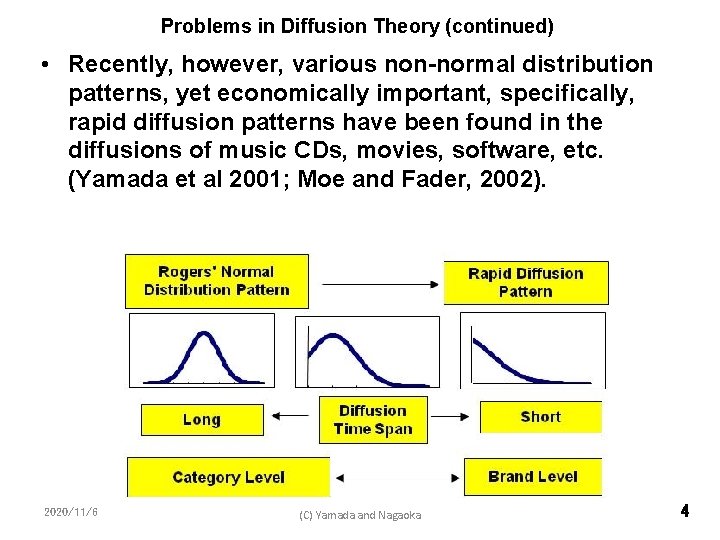
Problems in Diffusion Theory (continued) • Recently, however, various non-normal distribution patterns, yet economically important, specifically, rapid diffusion patterns have been found in the diffusions of music CDs, movies, software, etc. (Yamada et al 2001; Moe and Fader, 2002). 2020/11/6 (C) Yamada and Nagaoka 4
Problems in Diffusion Theory (continued) • As a result, we lost a reasonable basis for adopter categorizations of innovation, namely the normal distribution of adoption times. • Therefore, it is time to revisit the concept of consumer innovativeness itself so that we can better understand consumer innovativeness conceptually and behaviorally. 2020/11/6 (C) Yamada and Nagaoka 5
Order of Presentation 1. Objectives 2. Critical Review of Literature 3. Carnap’s Framework for Construct 4. Reconstruction of Research Framework for Consumer Innovativeness and Adoption and Diffusion of Innovation ------5. Innovation Adoption Model with Process Initiation Mechanism 6. Summary of Study 2020/11/6 (C) Yamada and Nagaoka 6
1. Objectives (1) Clarify the construct of innovativeness (2) Reconstruct the research framework of adoption and diffusion process of innovation ------(3) Propose a new initiation mechanism for adoption and diffusion process of innovation 2020/11/6 (C) Yamada and Nagaoka 77
2. Critical Review of Literature • Mudd (1990) pointed major theoretical views: – – Hirshman (1980), Midgley and Dowling (1978), Foxall (1986), Goldsmith (1987). • We only review the following studies directly related to our current study: – – – Midgley and Dowling (1978), Goldsmith and Hofacker (1991), Im et al (2003), Reohrich (2004), Hoffmann and Soyez (2010), Bartels and Reinders (2010). 2020/11/6 (C) Yamada and Nagaoka 8
2. Critical Review of Literature Midgley and Dowling (1978) • There was a thorough conceptual study done by Midgley and Dowling (1978). • They defined that innovativeness is a personality trait possessed, to a greater or lesser degree, by all members of a society. • Innovativeness is the degree to which an individual makes innovation decisions independently of the communicated experience of others. 2020/11/6 (C) Yamada and Nagaoka 99
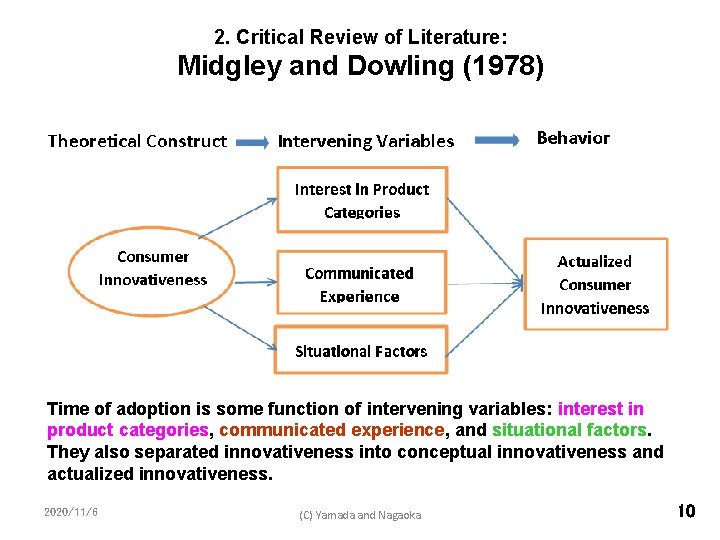
2. Critical Review of Literature: Midgley and Dowling (1978) Time of adoption is some function of intervening variables: interest in product categories, communicated experience, and situational factors. They also separated innovativeness into conceptual innovativeness and actualized innovativeness. 2020/11/6 (C) Yamada and Nagaoka 10
2. Critical Review of Literature: Midgley and Dowling (1978): Measurement of Innovativeness • They investigated 23 studies. 49 percent of them used relative time of adoption, 23 percent of them used ownership of new products or cross-sectional method and the rests used purchase intentions as a measure of innovativeness. • The problem we can see is that they regarded the adoption behavior as a construct, namely “actualized innovativeness. ” 2020/11/6 (C) Yamada and Nagaoka 11
2. Critical Review of Literature: Midgley and Dowling (1978) Measurement of Innovativeness • Since relative time of adoption and ownership of new products are just numbers, we do not think that such numbers can give us some meaningful thing such as innovativeness. • They did admit that the Rogers’ definition of innovativeness is tautology. 2020/11/6 (C) Yamada and Nagaoka 12
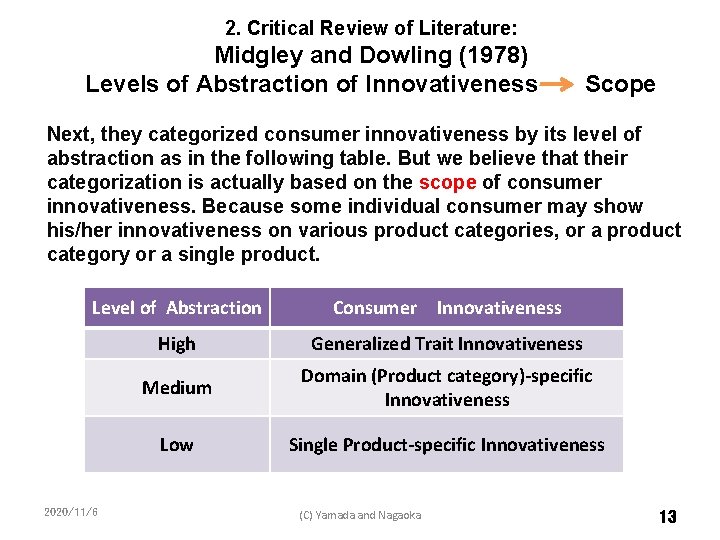
2. Critical Review of Literature: Midgley and Dowling (1978) Levels of Abstraction of Innovativeness Scope Next, they categorized consumer innovativeness by its level of abstraction as in the following table. But we believe that their categorization is actually based on the scope of consumer innovativeness. Because some individual consumer may show his/her innovativeness on various product categories, or a product category or a single product. Level of Abstraction Consumer Innovativeness High Generalized Trait Innovativeness Medium Domain (Product category)-specific Innovativeness Low Single Product-specific Innovativeness 2020/11/6 (C) Yamada and Nagaoka 13
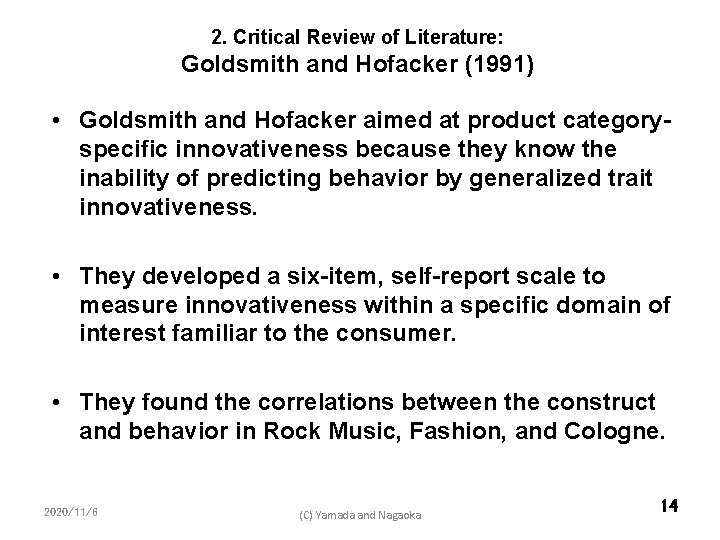
2. Critical Review of Literature: Goldsmith and Hofacker (1991) • Goldsmith and Hofacker aimed at product categoryspecific innovativeness because they know the inability of predicting behavior by generalized trait innovativeness. • They developed a six-item, self-report scale to measure innovativeness within a specific domain of interest familiar to the consumer. • They found the correlations between the construct and behavior in Rock Music, Fashion, and Cologne. 2020/11/6 (C) Yamada and Nagaoka 14
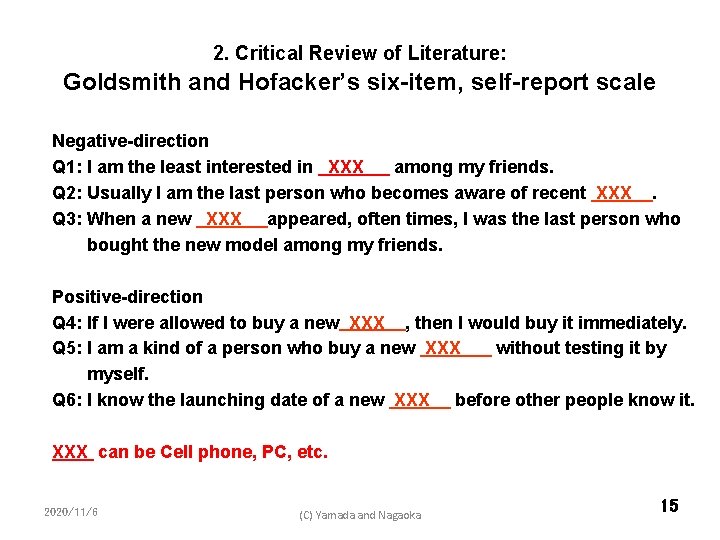
2. Critical Review of Literature: Goldsmith and Hofacker’s six-item, self-report scale Negative-direction Q 1: I am the least interested in XXX among my friends. Q 2: Usually I am the last person who becomes aware of recent XXX . Q 3: When a new XXX appeared, often times, I was the last person who bought the new model among my friends. Positive-direction Q 4: If I were allowed to buy a new XXX , then I would buy it immediately. Q 5: I am a kind of a person who buy a new XXX without testing it by myself. Q 6: I know the launching date of a new XXX before other people know it. XXX can be Cell phone, PC, etc. 2020/11/6 (C) Yamada and Nagaoka 15
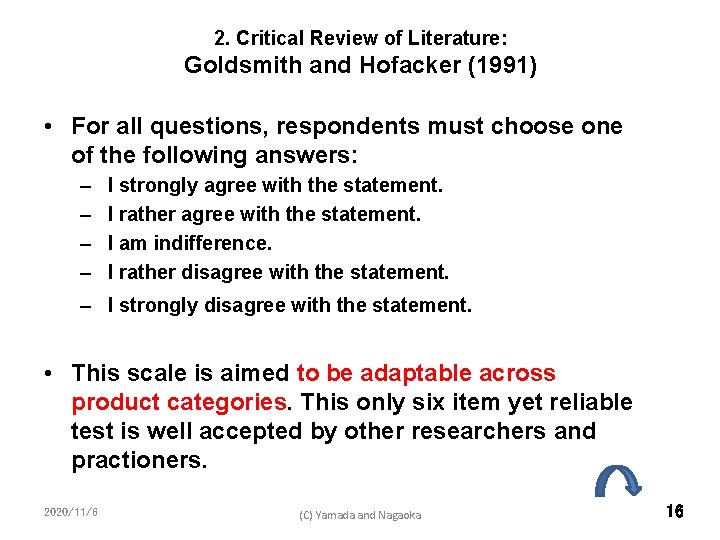
2. Critical Review of Literature: Goldsmith and Hofacker (1991) • For all questions, respondents must choose one of the following answers: – – I strongly agree with the statement. I rather agree with the statement. I am indifference. I rather disagree with the statement. – I strongly disagree with the statement. • This scale is aimed to be adaptable across product categories. This only six item yet reliable test is well accepted by other researchers and practioners. 2020/11/6 (C) Yamada and Nagaoka 16
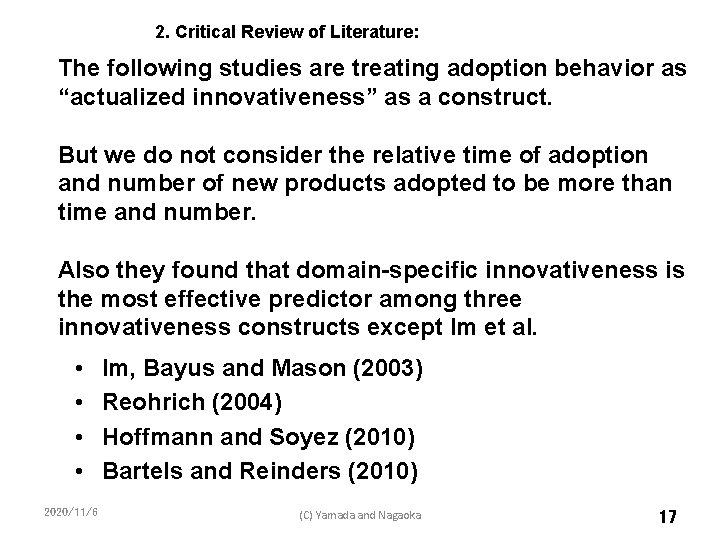
2. Critical Review of Literature: The following studies are treating adoption behavior as “actualized innovativeness” as a construct. But we do not consider the relative time of adoption and number of new products adopted to be more than time and number. Also they found that domain-specific innovativeness is the most effective predictor among three innovativeness constructs except Im et al. • • 2020/11/6 Im, Bayus and Mason (2003) Reohrich (2004) Hoffmann and Soyez (2010) Bartels and Reinders (2010) (C) Yamada and Nagaoka 17
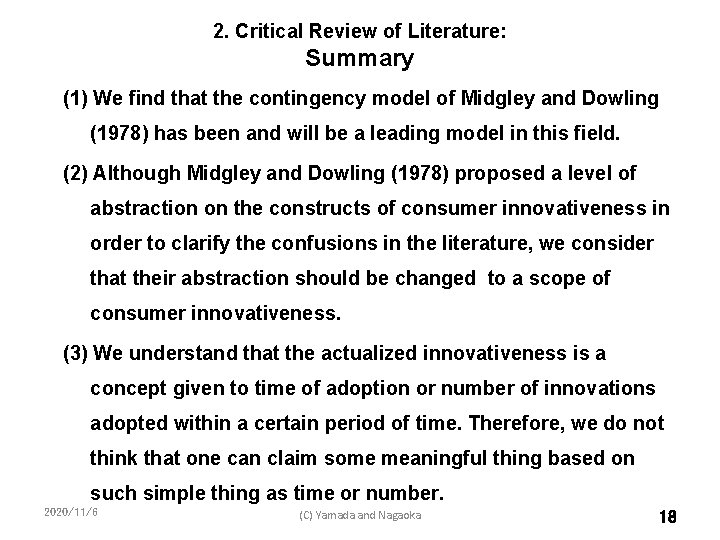
2. Critical Review of Literature: Summary (1) We find that the contingency model of Midgley and Dowling (1978) has been and will be a leading model in this field. (2) Although Midgley and Dowling (1978) proposed a level of abstraction on the constructs of consumer innovativeness in order to clarify the confusions in the literature, we consider that their abstraction should be changed to a scope of consumer innovativeness. (3) We understand that the actualized innovativeness is a concept given to time of adoption or number of innovations adopted within a certain period of time. Therefore, we do not think that one can claim some meaningful thing based on such simple thing as time or number. 2020/11/6 (C) Yamada and Nagaoka 18
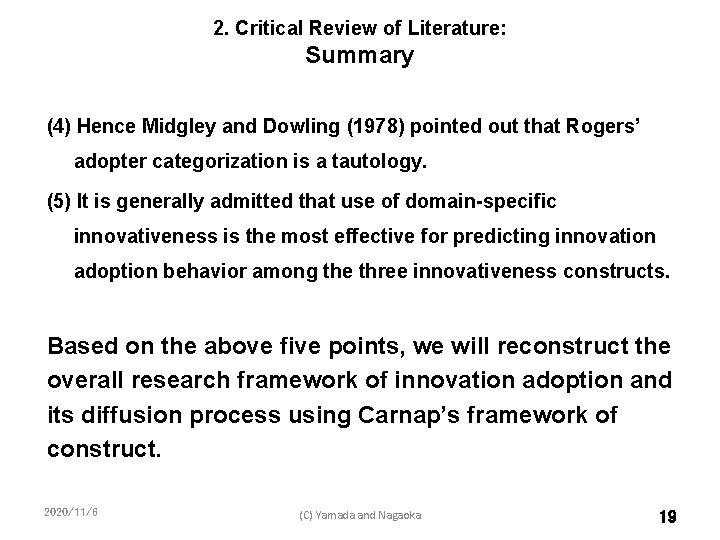
2. Critical Review of Literature: Summary (4) Hence Midgley and Dowling (1978) pointed out that Rogers’ adopter categorization is a tautology. (5) It is generally admitted that use of domain-specific innovativeness is the most effective for predicting innovation adoption behavior among the three innovativeness constructs. Based on the above five points, we will reconstruct the overall research framework of innovation adoption and its diffusion process using Carnap’s framework of construct. 2020/11/6 (C) Yamada and Nagaoka 19
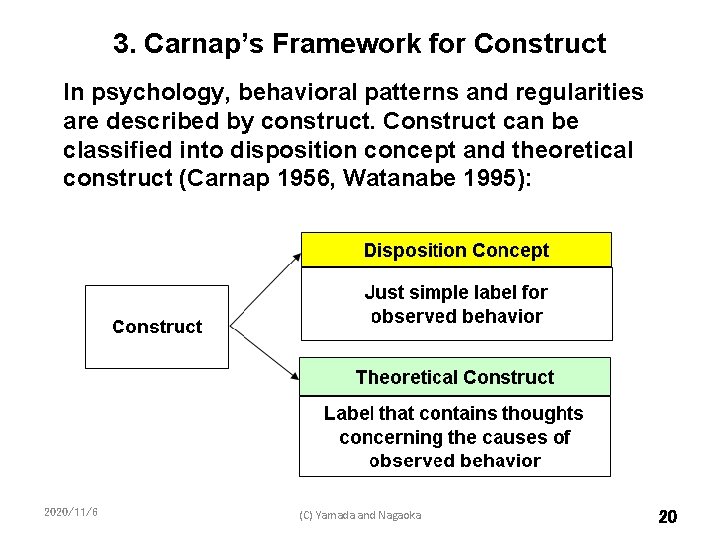
3. Carnap’s Framework for Construct In psychology, behavioral patterns and regularities are described by construct. Construct can be classified into disposition concept and theoretical construct (Carnap 1956, Watanabe 1995): 2020/11/6 (C) Yamada and Nagaoka 20
4. Reconstruction of Research Framework for Consumer Innovativeness and Adoption and Diffusion of Innovation We propose this to overcome the five points in the summary of critical review of literature. (1) Definition of Innovativeness • We adopt Midgley and Dowling’s Definition for our proposal since it has been well accepted by researchers: Innovativeness is the degree to which an individual makes innovation decisions independently of the communicated experience of others. Implicit in this definition is the assumption that all members of society possess a greater or lesser degree of innovativeness, and that the position an individual takes on this continuum is dependent on how much interpersonal information is required before making an adoption/rejection decision. 2020/11/6 (C) Yamada and Nagaoka 21
4. Reconstruction of Research Framework for Consumer Innovativeness and Adoption and Diffusion of Innovation (2) Replacing ‘Actualized innovativeness’ to New Disposition Concepts • ‘Actualized innovativeness’ of Midgley and Dowling (1978) should be considered as disposition concept which is just a label for convenience to describe observed behavioral pattern. The meaning of the construct is reduced to the observations completely. • In order to avoid confusion, we propose to use simply ‘# of new products adopted’ and ‘time of adoption’ as concepts instead of ‘actualized innovativeness. ’ • Therefore, theoretical argument using disposition concept like Rogers adopter categorization becomes tautology. 2020/11/6 (C) Yamada and Nagaoka 22
4. Reconstruction of Research Framework for Consumer Innovativeness and Adoption and Diffusion of Innovation (3) Scope of Innovativeness • Suppose there exists general innovativeness: he is interested in innovations over various product categories in general. Then we say he has generalized traits/innate innovativeness. We replace this to all/multiple domain-specific innovativeness. • Suppose a guy owns three generations of Play Station. We say he has domain (product category)-specific innovativeness. • Sometimes we need to investigate people’s innovativeness on a particular product: single product-specific innovativeness. 2020/11/6 (C) Yamada and Nagaoka 23
4. Reconstruction of Research Framework for Consumer Innovativeness and Adoption and Diffusion of Innovation (4) Need an Intermediate Level of Abstraction Construct for Better Prediction of Behavior • Each construct has its own scale to measure itself. Looking over the past studies, while the scale of theoretical construct consists of abstract items, the scale of disposition concept consists of items directly related to innovation adoption behavior. • The effectiveness of the domain-specific innovativeness for predicting innovation adoption behavior can be attributed to the items not directly related to but close to innovation adoption behavior and intervening variables. 2020/11/6 (C) Yamada and Nagaoka 24
4. Reconstruction of Research Framework for Consumer Innovativeness and Adoption and Diffusion of Innovation (4) Need an Intermediate Level of Abstraction Construct for Better Prediction of Behavior(continued) • The Goldsmith-Hofacker’s scale for Domain-Specific innovativeness happened to have the above condition. • Comparing Goldsmith and Hofacker’s scale items and Kiuchi or Kasserjan’s I-O scale items, while the items of the former are close to adoption behavior, the items of the latter consist of indirect contents to adoption behavior. • Hence, with regard to the correlation between adoption behavior and the scale scores, domain-specific category innovativeness scale is higher than all/multiple category innovativeness scale. • The supporting evidences will be listed next: 2020/11/6 (C) Yamada and Nagaoka 25
4. Reconstruction of Research Framework for Consumer Innovativeness and Adoption and Diffusion of Innovation (4) Need an Intermediate Level of Abstraction Construct innovativeness (continued) Supporting evidences: • Hassinger(1959): selective exposure / perception behavior → Domain-specific innovativeness. • Goldsmith and Hofacker(1991). • Goldsmith et al. (1995). • Reohrich (2004): Goldsmith and Hofacker’s scale is the most effective scale. • Hoffmann and Soyez (2010): they said that consumer innovativeness should be measured in a specific interest category (Gatignon and Robertson, 1985). • Mischel (1968): emphasized the importance of situational factors since Personality and behavior have less than 0. 3 correlation. 2020/11/6 (C) Yamada and Nagaoka 26
4. Reconstruction of Research Framework for Consumer Innovativeness and Adoption and Diffusion of Innovation (4) Need an Intermediate Level of Abstraction Construct innovativeness (continued) • It is said that higher abstraction constructs are not suitable to measure a specific event in other fields in social sciences. Therefore, less abstraction construct should be used (Ajzen, 1991; Buss, 1989; Lastovicka and Joachimsthaler, 1988). Our conclusion is that if the contents of theoretical construct were close to (adoption) behavior then the predictability should increase. But most of the scale contents for theoretical construct have been designed to be very abstract. That is why the predictability has been generally weak. 2020/11/6 (C) Yamada and Nagaoka 27
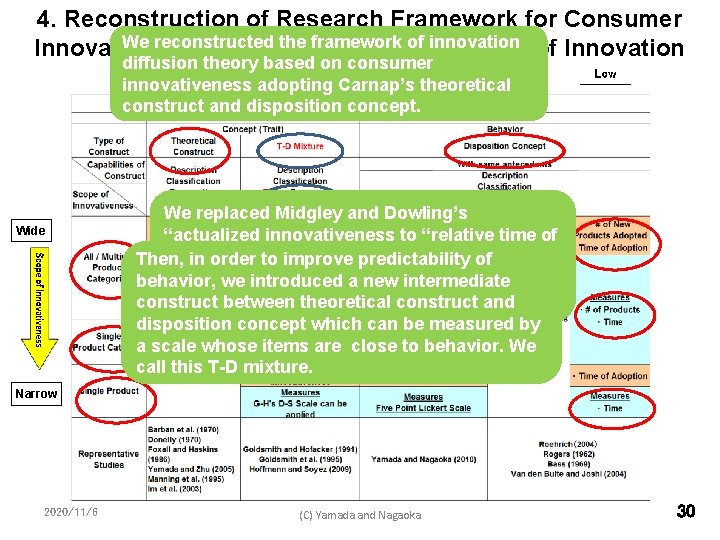
4. Reconstruction of Research Framework for Consumer Innovativeness and Adoption and Diffusion of Innovation (4) Need an Intermediate Level of Abstraction Construct innovativeness (continued) • Based on this fact, we introduce a new construct in an intermediate level of abstraction between theoretical construct and disposition concept. We name this T-D mixture. • Its scale items must consist of contents close to adoption behavior. 2020/11/6 (C) Yamada and Nagaoka 28
4. Reconstruction of Research Framework for Consumer Innovativeness and Adoption and Diffusion of Innovation • The following table summarizes the reconstruction. 2020/11/6 (C) Yamada and Nagaoka 29
4. Reconstruction of Research Framework for Consumer We reconstructed the framework of innovation Innovativeness and Adoption and Diffusion of Innovation diffusion theory based on consumer innovativeness adopting Carnap’s theoretical construct and disposition concept. Wide We replaced Midgley and Dowling’s “actualized innovativeness to “relative time of adoption” and “number of new products Then, in order to improve predictability of adopted” and also abstraction level of behavior, we introduced a new intermediate innovativeness to scope of innovativeness. construct between theoretical construct and disposition concept which can be measured by a scale whose items are close to behavior. We call this T-D mixture. Narrow 2020/11/6 (C) Yamada and Nagaoka 30
Summary of Study • We reconstructed the framework of innovation diffusion theory based on consumer innovativeness adopting Carnap’s theoretical construct and disposition concept. • We replaced Midgley and Dowling’s “actualized innovativeness to “relative time of adoption” and “number of new products adopted” and also abstraction level of innovativeness to scope of innovativeness. • Then, in order to improve predictability of behavior, we introduced a new intermediate construct between theoretical construct and disposition concept which can be measured by a scale whose items are close to behavior. We call this TD mixture. 2020/11/6 (C) Yamada and Nagaoka 31
Summary of Study(continued) • We would like to present our results elsewhere about (1) a new initiation mechanism for adoption and diffusion process of innovation and (2) forecasting relative time of adoption with this results by survival function. 2020/11/6 (C) Yamada and Nagaoka 32
Thank you! 2020/11/6 (C) Yamada and Nagaoka 33
References • Barban, Arnold M. , C. H. Sandage, Waltraud M. Kassarjian, and Harold H. Kassarjian, (1970), “A Study of Riesman’s Inner-Other Directedness Among Farmers, ” Rural Sociology, 35, 232 -243. • Bartels, J. and Reinders MJ(2010), “Consumer innovativeness and its correlates: A propositional inventory for future research, ” Journal of Business Research, doi: 10. 1016/j. jbusres. 2010. 05. 002. • Bass, F. M. (1969), "A New Product Growth Model for Consumer Durables, " Management Science, 15, 215 -227. • Carnap, Rudolf (1956), “The Methodological Character of Theoretical Concepts, ” The Foundations of Science and the Concepts of Psychology and Psychoanalysis, Vol. 1, Minnesota Studies in The Philosophy of Science Edited by Herbert Feigl and Michael Scriven, University of Minnesota Press, Minneapolis, Sixth Printing, 1968, 38 -76. • Goldsmith, R. E. and C. F. Hofacker (1991), “Measuring Consumer Innovativeness, “ Journal of the Academy of Marketing Science, 19(3), 209 -22. 2020/11/6 34 (C) Yamada and Nagaoka
References • Hoffmann S. and K. Soyez (2010), “A cognitive model to predict domain-specific consumer innovativeness, ” Journal of Business Research, Vol. 63, 7, July. 778 -785. • Im, S, B. J. Bayus and C. H. Mason (2003), “An Empirical Study of Innate Consumer Innovativeness, Personal Characteristics, and New-Product Adoption Behavior, ” Journal of the Academy of Marketing Science, 31, 1, 61 -73. • Kirton, M. (1976), “Adaptors and innovators: A description and measure, ” Journal of Applied Psychology, Vol. 61, No. 5, pp. 622 629. • Kiuchi, Aki (1996), “Independent-Interdependent Self Construal, Relationship of Cultural Influence and Personality Trait, ” Research in Psychology, 67, 308 -313 (translated by the authors). • Ma. Corquadale, K. and Meehl, P. E. (1948), “On a Distinction between Hypothetical Constructs and Intervening Variables, ” Psychological Review, 55, 95 -107. 2020/11/6 (C) Yamada and Nagaoka 35 35
References • Manning, Kenneth C. , William O. Bearden, and Thomas J. Madden (1995), “Consumer Innovativeness and the Adoption Process, ” Journal of Consumer Psychology, 4(4), 329 -345. • Markus, H. R. , & Kitayama, S. 1991 Culture and the self : Implication for cognition, emotion, and motivation. Psychological Review, Vol. 98, 224 -253. • Midgley, David F. and Grahame R. Dowling (1978), “Innovativeness: The concept and its measurement, ” Journal of Consumer Research, 4 (March) 229 -242. • Mischel, W (1968), Personality and Assessment, New York: John Wiley & Sons, Inc. • Mudd, Samuel (1990), “The place of innovativeness in models of the adoption process: an integrative review, ” Technovation 10 (2), 119 -134. • Peterson, Robert A. (1973), "A Note on Optimal Adopter Category Determination, " Journal of Marketing Research, 10 (August), 325 -9. 2020/11/6 (C) Yamada and Nagaoka 36
References • Rogers, Everett M. (1962). Diffusion of Innovations. The Free Press. New York. • Roehrich, Gilles (2004), “Consumer innovativeness Concepts and measurements, ” Journal of Business Research, 57, 671– 677. • Watanabe, Yoshiyuki (1995), “CONSTRUCTS AND CAUSAL EXPLANATIONS IN PSYCHOLOGY, ” Bulletin of School of Nursing & Social Services, Health Sciences University of Hokkaido, 2, 1 -7. • Yamada, Masataka and Xiaoying Zhu (2005), “A basic model for identifying adopter’s category (adoption time) with personality score, ” Marketing Science Conference 2005. Emory University, Atlanta Georgia, INFORMS, Society for Marketing Science. 2020/11/6 (C) Yamada and Nagaoka 37
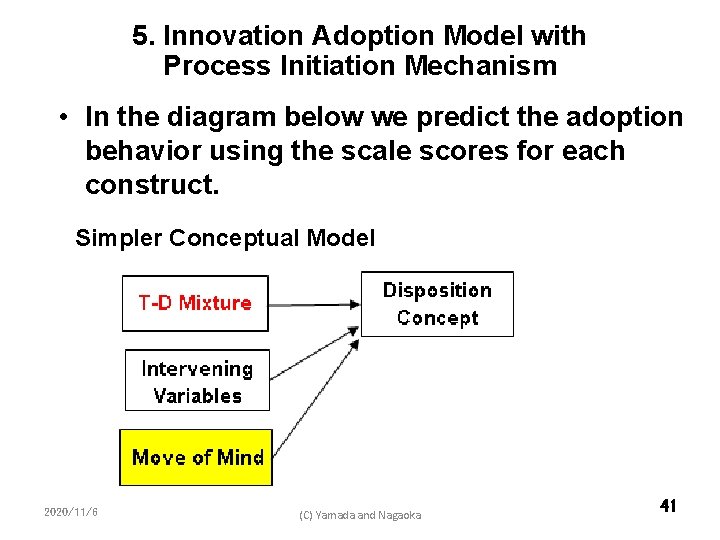
5. Innovation Adoption Model with Process Initiation Mechanism • Although we have reviewed the literature such as Midgley and Dowling (1978) so far, it seems to us that there is no theoretical explanation why people adopt the innovation, especially that there is no theory with regard to the initiation mechanism of innovation adoption process. • Since innovations are generally new to us, consumers do not have its category recognition and even consumption experiences. Nevertheless, some adopt it immediately, some start to collect its information, to prepare funds to purchase it. People initiate actions at various levels for adopting it. Of course, there are people who do not initiate any actions at all too. 2020/11/6 (C) Yamada and Nagaoka 38
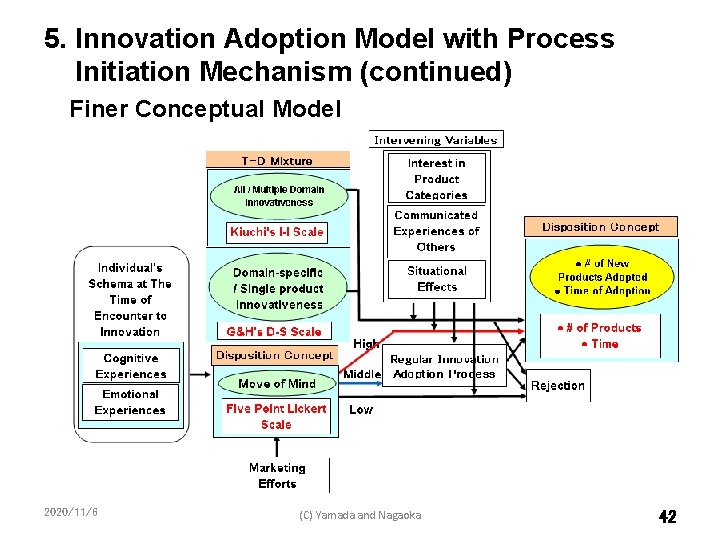
5. Innovation Adoption Model with Process Initiation Mechanism • Here, we propose a disposition concept, “positive move of mind” as an initiation mechanism for innovation adoption process. • “Move of mind” is defined as the degree of positive move of one’s mind at the time of hearing and seeing an innovation. If it is high, then one starts the adoption process. If it is low, then one does not start the process. Here, we do not seek the reasoning and treat this construct as a disposition concept on managerial purpose. • Unless one feels like wow! It’s cool, adoption process will not be initiated. • The measurement scale is five point Likert scale. 2020/11/6 (C) Yamada and Nagaoka 39
5. Innovation Adoption Model with Process Initiation Mechanism • The antecedents of “move of mind” are individual’s schema which consists of cognitive experiences and emotional experiences until one’s encounter of innovation and firm’s business efforts such as marketing. These are considered as given to each individual. • Conceptual models are given in the next pages. 2020/11/6 (C) Yamada and Nagaoka 40
5. Innovation Adoption Model with Process Initiation Mechanism • In the diagram below we predict the adoption behavior using the scale scores for each construct. Simpler Conceptual Model 2020/11/6 (C) Yamada and Nagaoka 41
5. Innovation Adoption Model with Process Initiation Mechanism (continued) Finer Conceptual Model 2020/11/6 (C) Yamada and Nagaoka 42
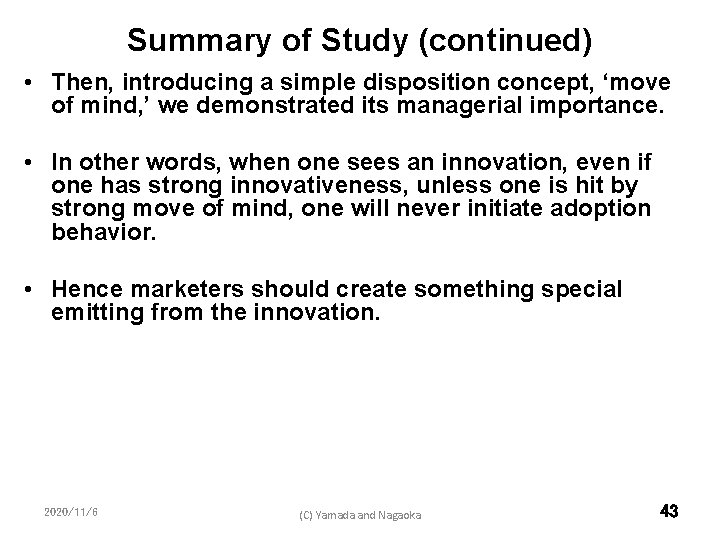
Summary of Study (continued) • Then, introducing a simple disposition concept, ‘move of mind, ’ we demonstrated its managerial importance. • In other words, when one sees an innovation, even if one has strong innovativeness, unless one is hit by strong move of mind, one will never initiate adoption behavior. • Hence marketers should create something special emitting from the innovation. 2020/11/6 (C) Yamada and Nagaoka 43
Summary of Study (continued) • We have succeeded the estimation of a contingency model for time of innovation adoption using a survival model with T-D mixture, move of mind and intervening variables. We would like to present this elsewhere. 2020/11/6 (C) Yamada and Nagaoka 44
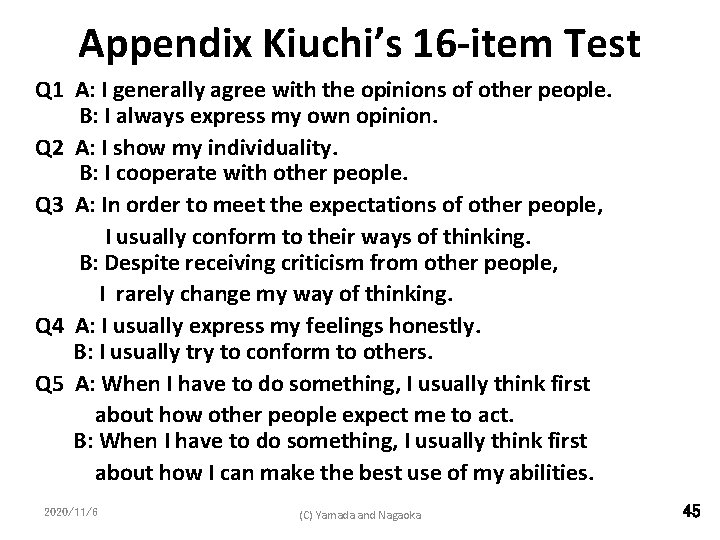
Appendix Kiuchi’s 16 -item Test Q 1 A: I generally agree with the opinions of other people. B: I always express my own opinion. Q 2 A: I show my individuality. B: I cooperate with other people. Q 3 A: In order to meet the expectations of other people, I usually conform to their ways of thinking. B: Despite receiving criticism from other people, I rarely change my way of thinking. Q 4 A: I usually express my feelings honestly. B: I usually try to conform to others. Q 5 A: When I have to do something, I usually think first about how other people expect me to act. B: When I have to do something, I usually think first about how I can make the best use of my abilities. 2020/11/6 (C) Yamada and Nagaoka 45
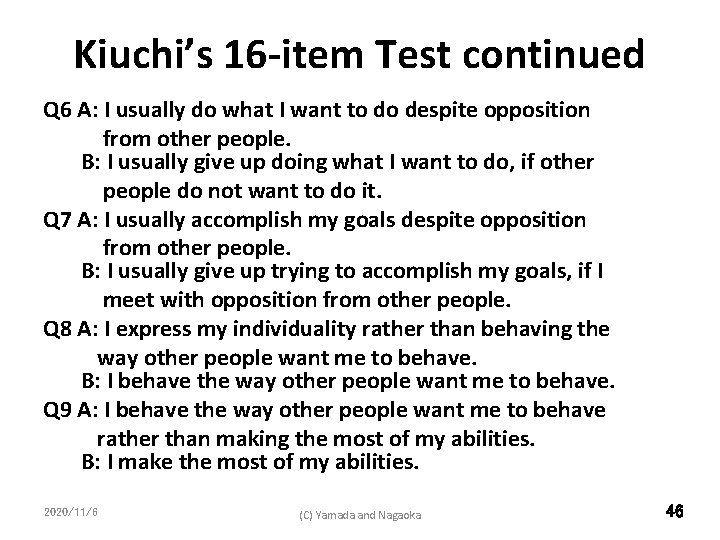
Kiuchi’s 16 -item Test continued Q 6 A: I usually do what I want to do despite opposition from other people. B: I usually give up doing what I want to do, if other people do not want to do it. Q 7 A: I usually accomplish my goals despite opposition from other people. B: I usually give up trying to accomplish my goals, if I meet with opposition from other people. Q 8 A: I express my individuality rather than behaving the way other people want me to behave. B: I behave the way other people want me to behave. Q 9 A: I behave the way other people want me to behave rather than making the most of my abilities. B: I make the most of my abilities. 2020/11/6 (C) Yamada and Nagaoka 46
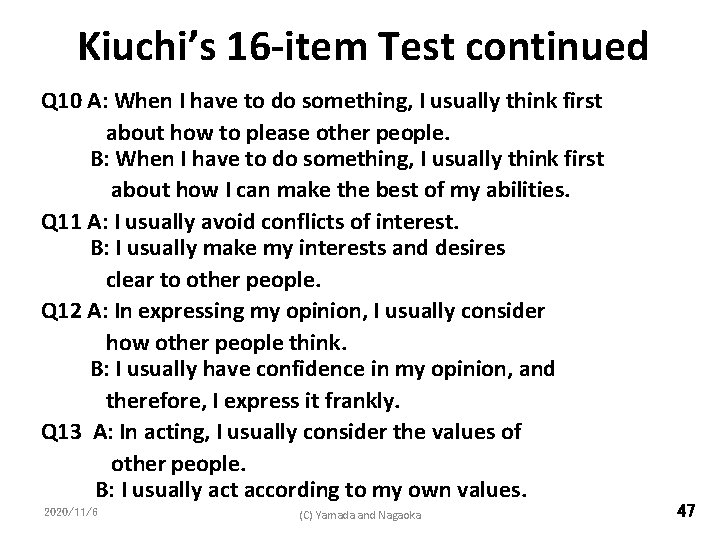
Kiuchi’s 16 -item Test continued Q 10 A: When I have to do something, I usually think first about how to please other people. B: When I have to do something, I usually think first about how I can make the best of my abilities. Q 11 A: I usually avoid conflicts of interest. B: I usually make my interests and desires clear to other people. Q 12 A: In expressing my opinion, I usually consider how other people think. B: I usually have confidence in my opinion, and therefore, I express it frankly. Q 13 A: In acting, I usually consider the values of other people. B: I usually act according to my own values. 2020/11/6 (C) Yamada and Nagaoka 47
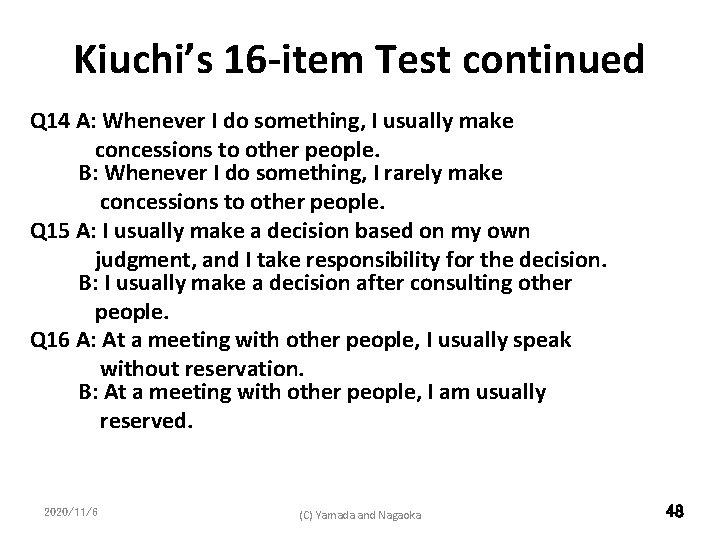
Kiuchi’s 16 -item Test continued Q 14 A: Whenever I do something, I usually make concessions to other people. B: Whenever I do something, I rarely make concessions to other people. Q 15 A: I usually make a decision based on my own judgment, and I take responsibility for the decision. B: I usually make a decision after consulting other people. Q 16 A: At a meeting with other people, I usually speak without reservation. B: At a meeting with other people, I am usually reserved. 2020/11/6 (C) Yamada and Nagaoka 48
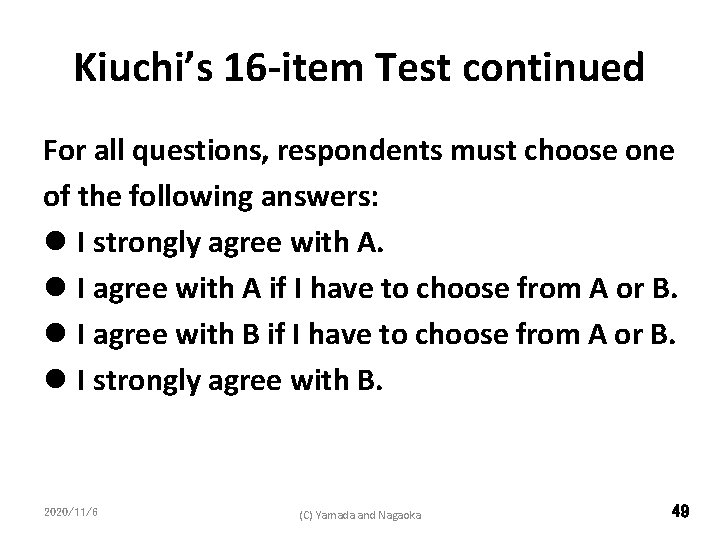
Kiuchi’s 16 -item Test continued For all questions, respondents must choose one of the following answers: l I strongly agree with A. l I agree with A if I have to choose from A or B. l I agree with B if I have to choose from A or B. l I strongly agree with B. 2020/11/6 (C) Yamada and Nagaoka 49
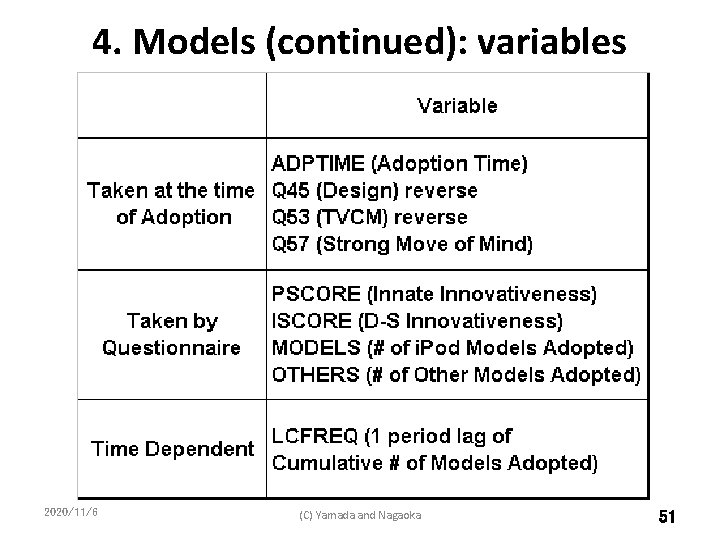
5. Innovation Adoption Model with Process Initiation Mechanism(continued): variables • Since innovation diffuses with communication, we adopted one period lag of cumulative number of models adopted (LCFREQ) into our model as communication effect. • Other variables are shown in the following table. • It should be noted that ‘strong move of mind=Q 57’ is introduced in this model. 2020/11/6 (C) Yamada and Nagaoka 50
4. Models (continued): variables 2020/11/6 (C) Yamada and Nagaoka 51
5. Data • Data was collected on the college students at KSU from May 23 to July 4, 2008 by questionnaire on the Web. • The products chosen for this study are portable music players, specifically i. Pods. We believe that the college students are one of the most important segments for this product category. • 987 responded out of 1926. The effective response rate was 43. 7%(= 841/1926). 2020/11/6 (C) Yamada and Nagaoka 52
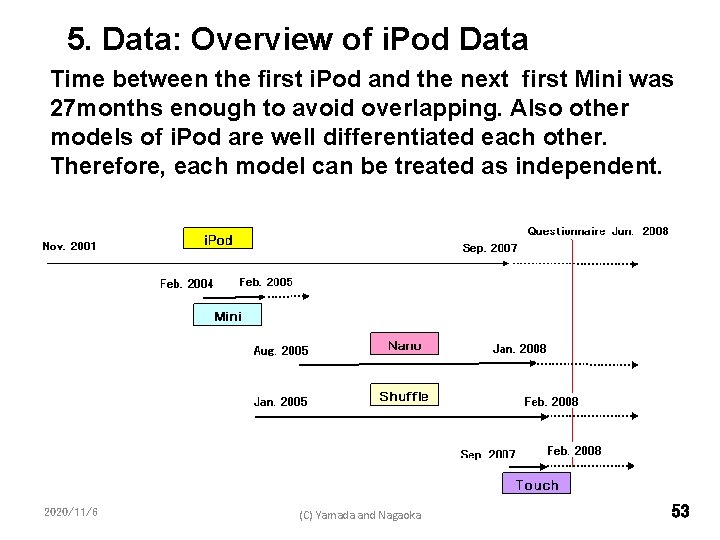
5. Data: Overview of i. Pod Data Time between the first i. Pod and the next first Mini was 27 months enough to avoid overlapping. Also other models of i. Pod are well differentiated each other. Therefore, each model can be treated as independent. 2020/11/6 (C) Yamada and Nagaoka 53
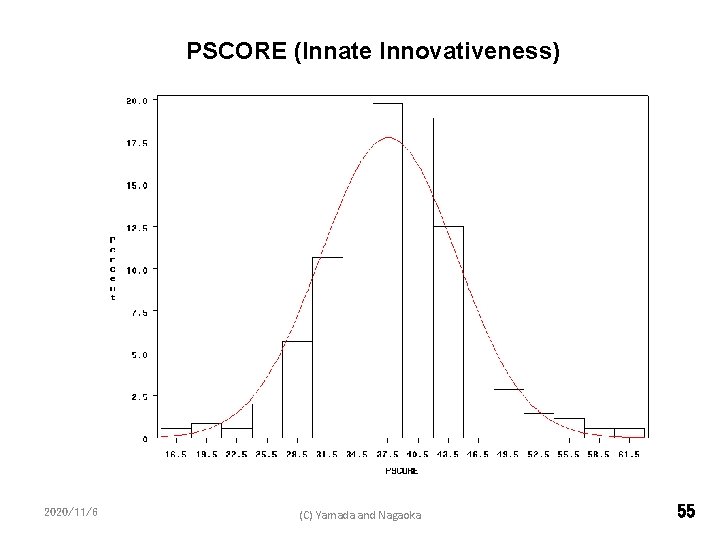
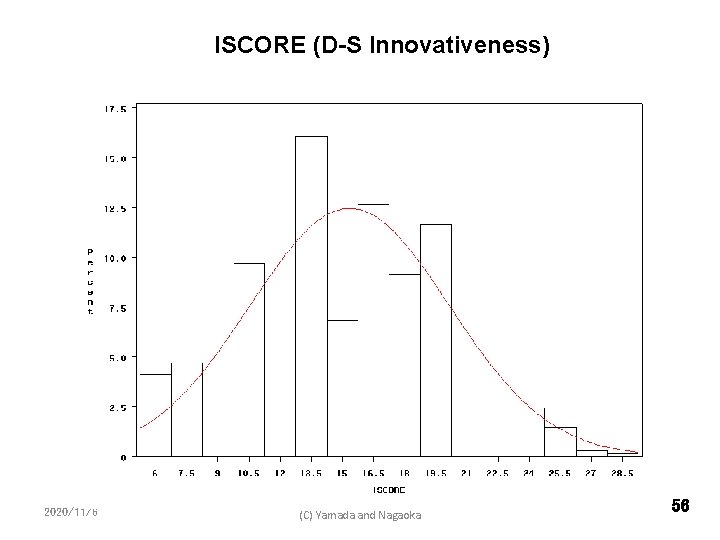
6. Results and Analyses: Distributions of PSCORE (Innate Innovativeness) and ISCORE (D-S Innovativeness) They are approximately normally distributed. Or at least unimodally and symmetrically distributed which is suitable for measuring the concepts. 2020/11/6 (C) Yamada and Nagaoka 54
PSCORE (Innate Innovativeness) 2020/11/6 (C) Yamada and Nagaoka 55
ISCORE (D-S Innovativeness) 2020/11/6 (C) Yamada and Nagaoka 56
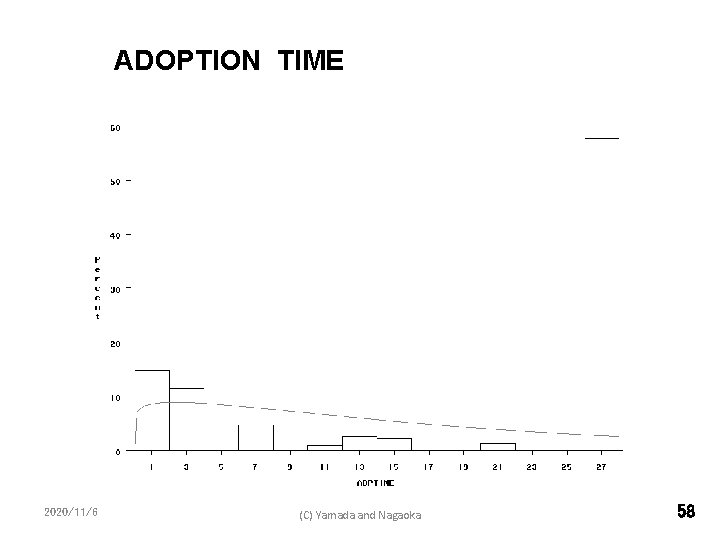
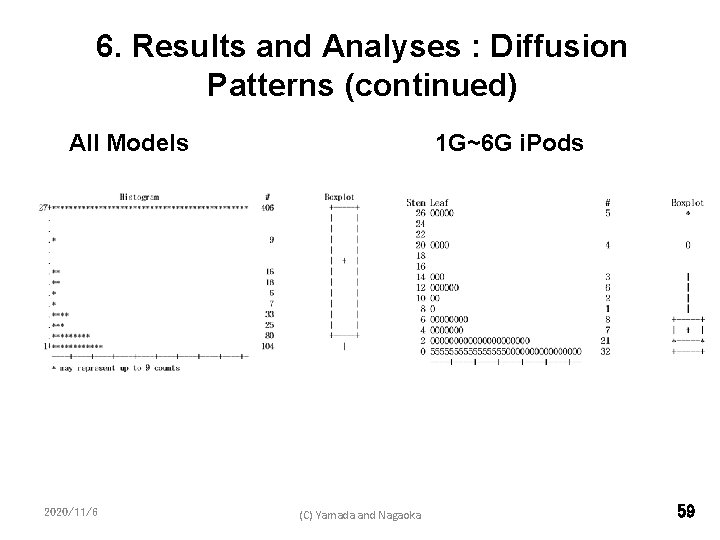
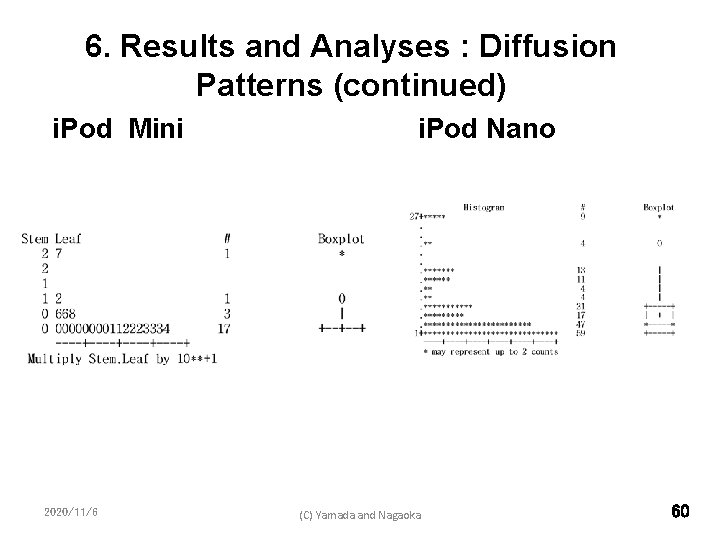
6. Results and Analyses : Diffusion Patterns • The diffusion patterns of all models, the first to sixth generation of i. Pod (P), i. Pod mini (M), and i. Pod nano (NA), are graphed. i. Pod shuffle (S) and i. Pod Touch (T) are not shown because number of observations are too small. • Weibull distribution can be fitted. 2020/11/6 (C) Yamada and Nagaoka 57
ADOPTION TIME 2020/11/6 (C) Yamada and Nagaoka 58
6. Results and Analyses : Diffusion Patterns (continued) All Models 2020/11/6 1 G~6 G i. Pods (C) Yamada and Nagaoka 59
6. Results and Analyses : Diffusion Patterns (continued) i. Pod Mini 2020/11/6 i. Pod Nano (C) Yamada and Nagaoka 60
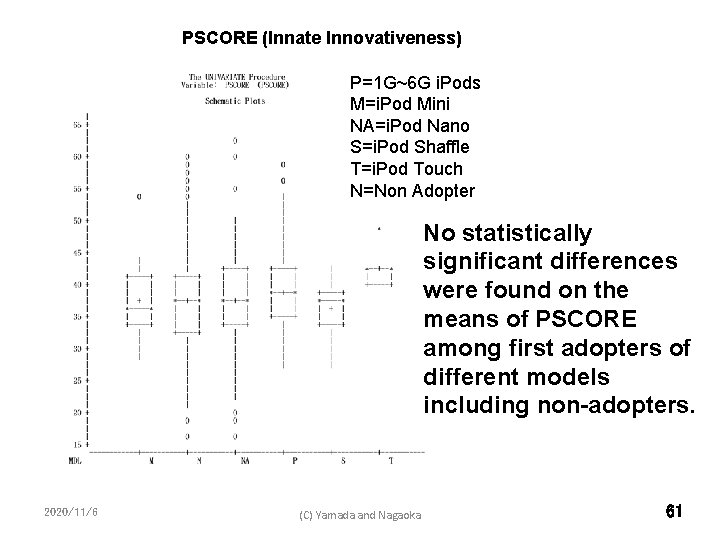
PSCORE (Innate Innovativeness) P=1 G~6 G i. Pods M=i. Pod Mini NA=i. Pod Nano S=i. Pod Shaffle T=i. Pod Touch N=Non Adopter No statistically significant differences were found on the means of PSCORE among first adopters of different models including non-adopters. 2020/11/6 (C) Yamada and Nagaoka 61
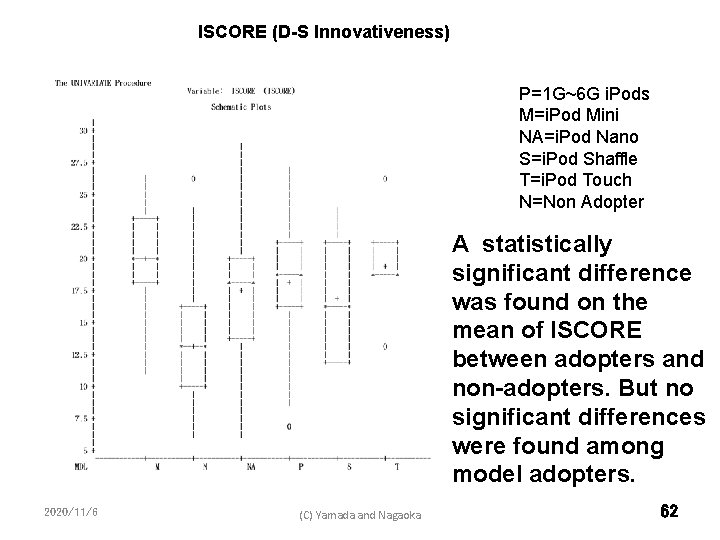
ISCORE (D-S Innovativeness) P=1 G~6 G i. Pods M=i. Pod Mini NA=i. Pod Nano S=i. Pod Shaffle T=i. Pod Touch N=Non Adopter A statistically significant difference was found on the mean of ISCORE between adopters and non-adopters. But no significant differences were found among model adopters. 2020/11/6 (C) Yamada and Nagaoka 62
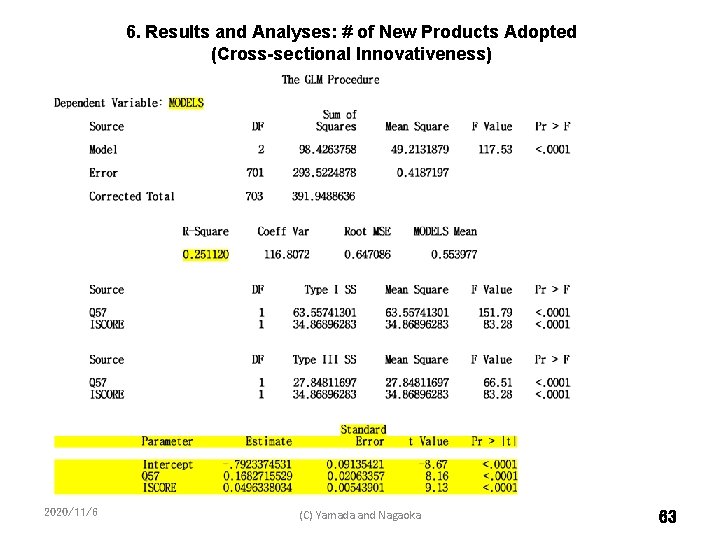
6. Results and Analyses: # of New Products Adopted (Cross-sectional Innovativeness) 2020/11/6 (C) Yamada and Nagaoka 63
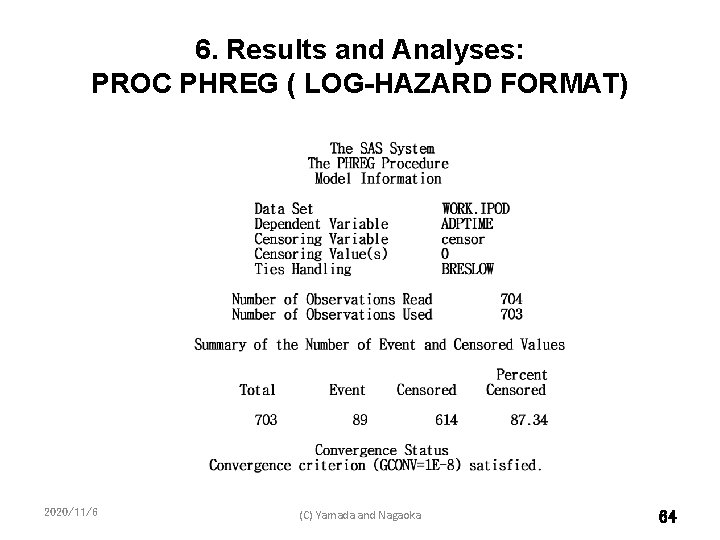
6. Results and Analyses: PROC PHREG ( LOG-HAZARD FORMAT) 2020/11/6 (C) Yamada and Nagaoka 64
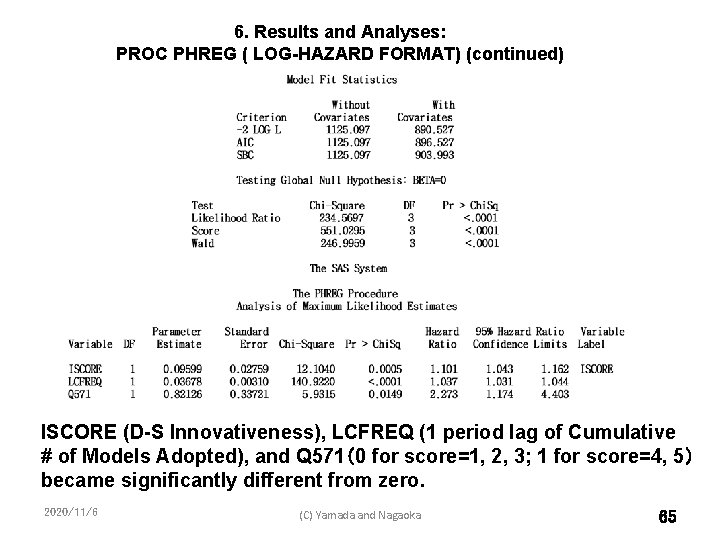
6. Results and Analyses: PROC PHREG ( LOG-HAZARD FORMAT) (continued) ISCORE (D-S Innovativeness), LCFREQ (1 period lag of Cumulative # of Models Adopted), and Q 571(0 for score=1, 2, 3; 1 for score=4, 5) became significantly different from zero. 2020/11/6 (C) Yamada and Nagaoka 65
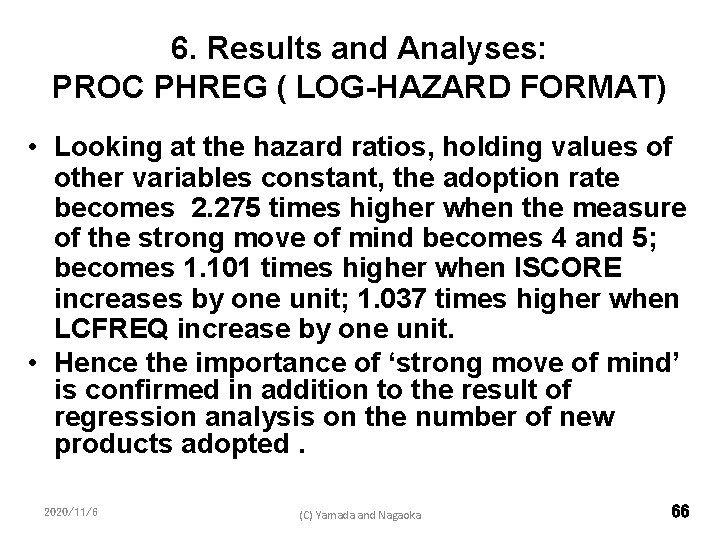
6. Results and Analyses: PROC PHREG ( LOG-HAZARD FORMAT) • Looking at the hazard ratios, holding values of other variables constant, the adoption rate becomes 2. 275 times higher when the measure of the strong move of mind becomes 4 and 5; becomes 1. 101 times higher when ISCORE increases by one unit; 1. 037 times higher when LCFREQ increase by one unit. • Hence the importance of ‘strong move of mind’ is confirmed in addition to the result of regression analysis on the number of new products adopted. 2020/11/6 (C) Yamada and Nagaoka 66
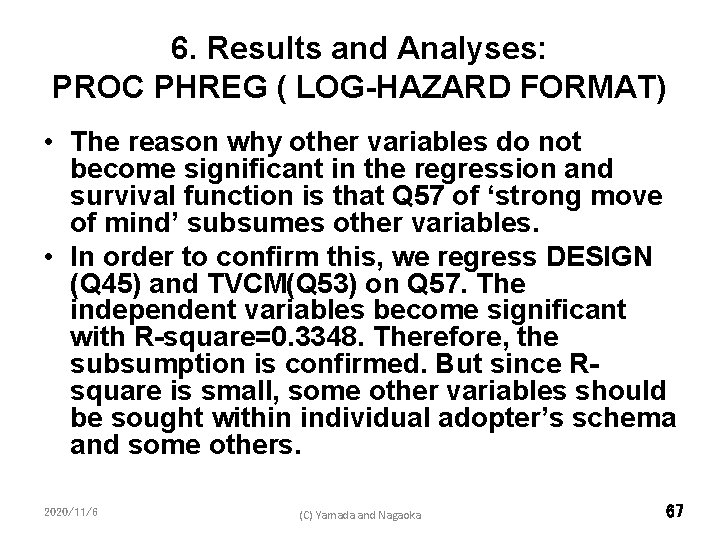
6. Results and Analyses: PROC PHREG ( LOG-HAZARD FORMAT) • The reason why other variables do not become significant in the regression and survival function is that Q 57 of ‘strong move of mind’ subsumes other variables. • In order to confirm this, we regress DESIGN (Q 45) and TVCM(Q 53) on Q 57. The independent variables become significant with R-square=0. 3348. Therefore, the subsumption is confirmed. But since Rsquare is small, some other variables should be sought within individual adopter’s schema and some others. 2020/11/6 (C) Yamada and Nagaoka 67
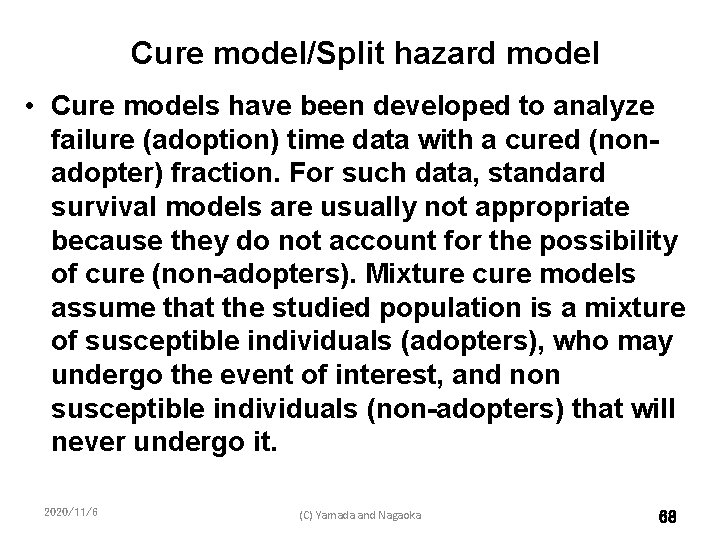
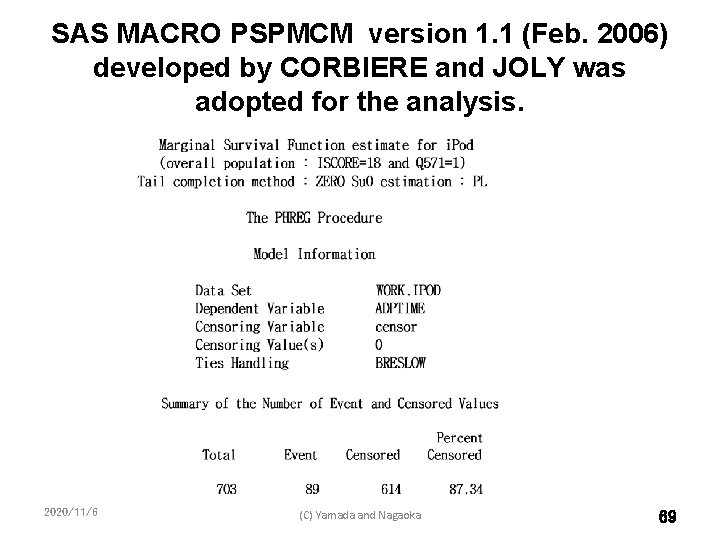
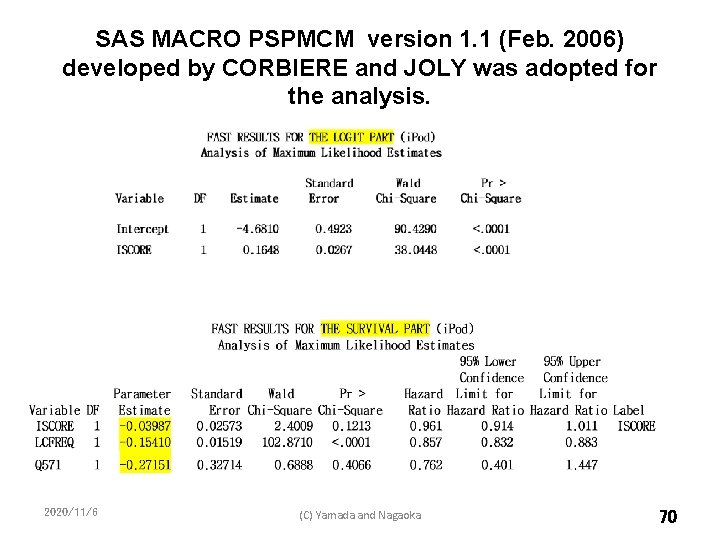
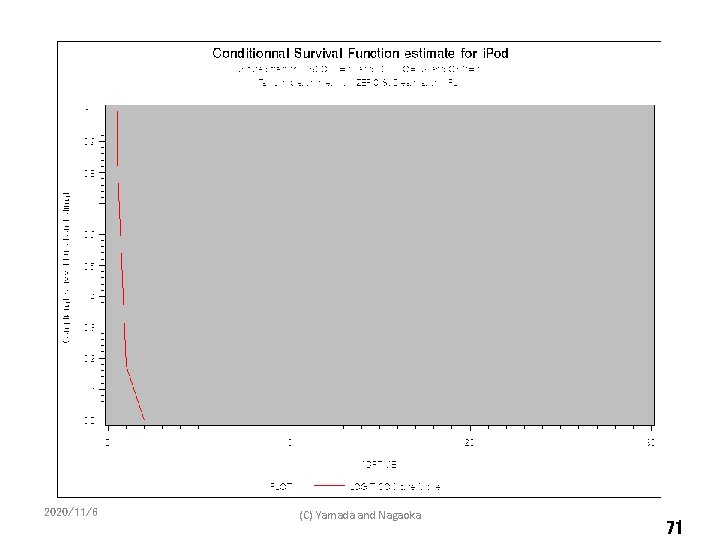
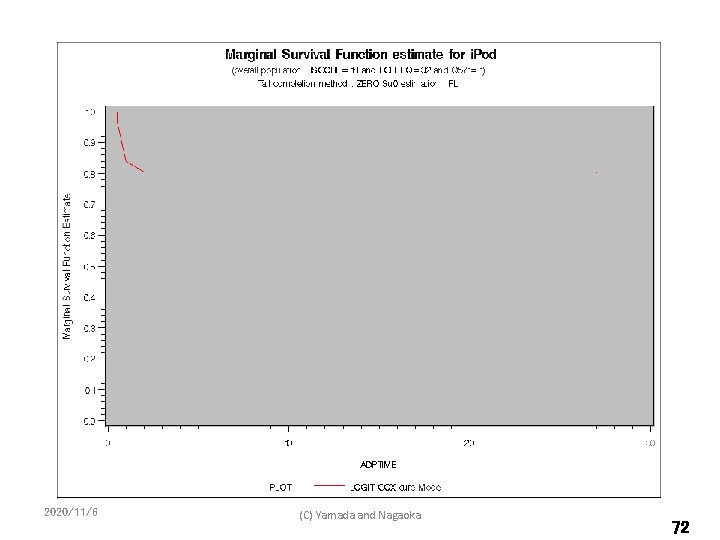
Cure model/Split hazard model • Cure models have been developed to analyze failure (adoption) time data with a cured (nonadopter) fraction. For such data, standard survival models are usually not appropriate because they do not account for the possibility of cure (non-adopters). Mixture cure models assume that the studied population is a mixture of susceptible individuals (adopters), who may undergo the event of interest, and non susceptible individuals (non-adopters) that will never undergo it. 2020/11/6 (C) Yamada and Nagaoka 68
SAS MACRO PSPMCM version 1. 1 (Feb. 2006) developed by CORBIERE and JOLY was adopted for the analysis. 2020/11/6 (C) Yamada and Nagaoka 69
SAS MACRO PSPMCM version 1. 1 (Feb. 2006) developed by CORBIERE and JOLY was adopted for the analysis. 2020/11/6 (C) Yamada and Nagaoka 70
2020/11/6 (C) Yamada and Nagaoka 71
2020/11/6 (C) Yamada and Nagaoka 72
Direction of Future Study • Further analyses are required on this data. • The result from the cure model should be investigated further. • Bayesian approach should be taken as a next step. • Systematic comparison of construct measures should be necessary to develop better measures. 2020/11/6 (C) Yamada and Nagaoka 73
2. Critical Review of Literature: Reohrich (2004) • Reohrich (2004) is a study of the construct of consumer innovativeness and its scale. The first half introduces various constructs of innate consumer innovativeness in the literature. The second half analyzes the scales to measure those constructs. • Among them he admitted that the scale of Goldsmith and Hofacker (1991) has the highest predictability. 2020/11/6 (C) Yamada and Nagaoka 74
2. Critical Review of Literature: Hoffmann and Soyez (2010) • The paper suggests conceptualizing both innovativeness and its antecedents on a domain -specific level of abstraction. • This is because domain-specific innovativeness, the intermediate level of abstraction, predicts innovative buying behavior better than innovativeness measured on higher or lower levels of abstraction (Goldsmithet al. , 1995). • Consequently, research should identify characteristics of innovative consumers on a domain-specific level. 2020/11/6 (C) Yamada and Nagaoka 75
2. Critical Review of Literature: Bartels and Reinders (2010) • Through extensive systematic and manual searches, they found seventy-nine relevant articles. Based on these, they offered propositions. • This is a good survey study for future research. • They also admitted that use of domain-specific innovativeness is the most effective for predicting innovation adoption behavior. 2020/11/6 (C) Yamada and Nagaoka 76
2. Critical Review of Literature: Im, Bayus and Mason (2003) • They examined the relationships between innate consumer innovativeness, personal characteristics, and new product adoption behavior. • To do this, they analyze cross-sectional data from a household panel using a structural equation model. • They found that the personal characteristics of age and income are stronger predictors of new product ownership than innate consumer innovativeness as a generalized personality trait in the consumer electronics category. 2020/11/6 (C) Yamada and Nagaoka 77
3. Carnap’s Framework for Construct (continued) Disposition Concept • Disposition concept is a construct that describes an observed behavioral pattern under a certain condition just in the abstract and the meaning of the construct is reduced to the observations completely. • Since the described content of disposition concept depends on the antecedent prior to the observed behavioral pattern, if the antecedent were changed for example, then the validity of the described content would not be assured. • At the same time, disposition concept have no information regarding the causes of the observed behavioral pattern. 2020/11/6 (C) Yamada and Nagaoka 78
3. Carnap’s Framework for Construct (continued) Disposition Concept (continued) • Although the observed pattern may be caused either by the actor’s inner factors or by situational factors, the disposition concept itself does not show neither of them. The most of constructs that can be defined as so called operational definitions are disposition concepts. • Constructs used in psychology such as ‘Behavioral Tendency, ’ ‘Behavioral Characteristics, ’ ‘Operant conditioning’ etc. are considered to be disposition concepts (Watanabe 1995). 2020/11/6 (C) Yamada and Nagaoka 79
3. Carnap’s Framework for Construct (continued) Theoretical Construct • The second type of construct is theoretical construct (occasionally called hypothetical construct). • Different from disposition concept, theoretical construct has surplus meanings which cannot be reduced to observations (Ma. Corquadale and Meehl 1948). • Surplus meaning often corresponds to theoretical entity which is inner process of organism that governs the observed behavioral pattern essentially independent from external situational factors. • In this sense, theoretical construct keeps the contents of construct valid however the situational factors change and contain information concerning the causes of observed behavioral pattern. 2020/11/6 (C) Yamada and Nagaoka 80
3. Carnap’s Framework for Construct (continued) Theoretical Construct (continued) • The psychological constructs such as ‘desire , ’ ‘emotion, ’ ‘cognition, ’ etc. are most of times related to physiological factors of inner process of organism and therefore are considered as theoretical constructs. In describing behavioral patterns and classifying individuals, disposition concepts and theoretical constructs are equally usable, but crosssituational predictions and causal explanations of behavior are permitted only in theoretical constructs (Watanabe 1995). 2020/11/6 (C) Yamada and Nagaoka 81
Part of Kiuchi’s Independent-Interdependent Self Construal Scale For all questions, respondents must choose one of the following answers: • I strongly agree with A. • I agree with A if I have to choose from A or B. • I agree with B if I have to choose from A or B. • I strongly agree with B. 2020/11/6 (C) Yamada and Nagaoka 82