
2008 International Counseling Psychology Conference March 6 Chicago
- Slides: 9
2008 International Counseling Psychology Conference March 6, Chicago, IL, USA Opening Session keynote panelists
Maria Eduarda Duarte University of Lisbon Faculty of Psychology & Education mecduarte@netcabo. pt
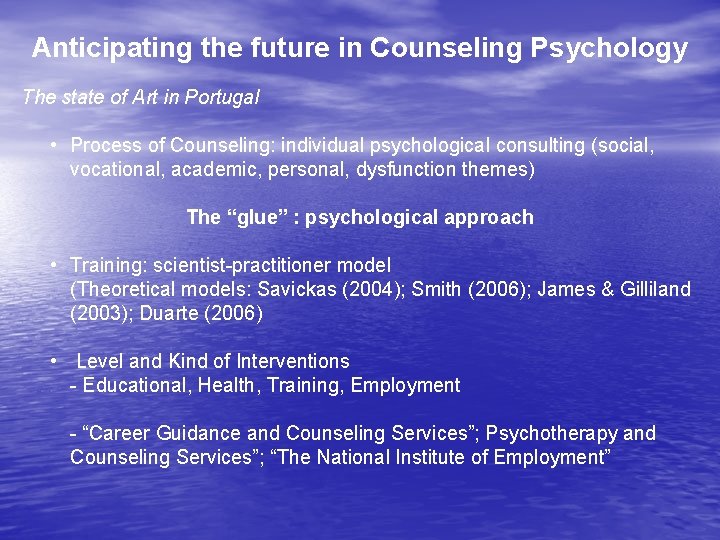
Anticipating the future in Counseling Psychology The state of Art in Portugal • Process of Counseling: individual psychological consulting (social, vocational, academic, personal, dysfunction themes) The “glue” : psychological approach • Training: scientist-practitioner model (Theoretical models: Savickas (2004); Smith (2006); James & Gilliland (2003); Duarte (2006) • Level and Kind of Interventions - Educational, Health, Training, Employment - “Career Guidance and Counseling Services”; Psychotherapy and Counseling Services”; “The National Institute of Employment”
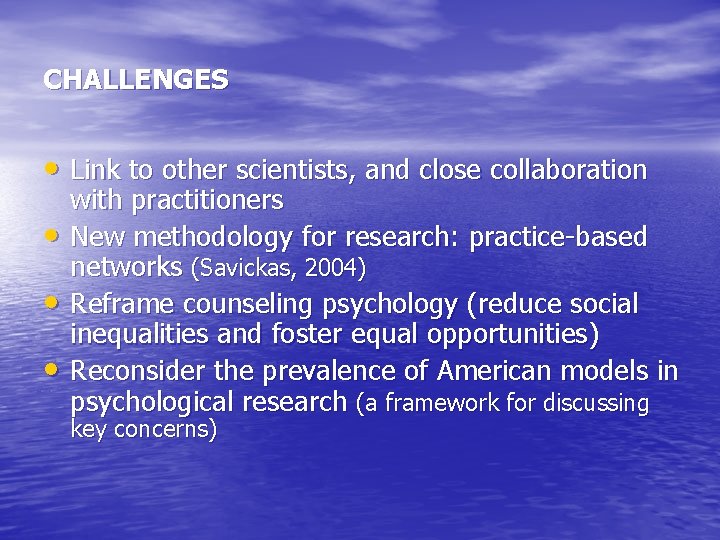
CHALLENGES • Link to other scientists, and close collaboration • • • with practitioners New methodology for research: practice-based networks (Savickas, 2004) Reframe counseling psychology (reduce social inequalities and foster equal opportunities) Reconsider the prevalence of American models in psychological research (a framework for discussing key concerns)
What we can do? • Try harder to make research relevant and • • communicate Try new counseling techniques Re-consider the role of practice --- Conciliate the challenges with what we can do ---
Paths for future research • Construct contextualized models • Face counseling as process of continuous interactions • Use of interventions methods and techniques (from • • • theoretical): self-knowledge and ecological variables Psychological analysis, along with the analysis of cultural contexts Production of inclusive models (based on the construction of plans for life). A psychology for life construction: comprehensive models raised on inclusive constructs, in which differences, psychological and contextual, have to be consider
The Future? • To develop theory (empirically tested and systematically improved) • which identifies, evaluates, specifies and establishes connections Identifies idiographic definitions of success (the meaning of psychological dimensions) • Evaluate adjustments (the relationship of the individual within the context) • Specifies the components of knowledge acquisition (adaptability as a possibility of maintaining the identity) • Establishes connections with the individual and social, political, economic and cultural contexts
Counseling psychology is a psychology for life construction Counseling is a procedure to create a sense of shared citizenship Thank you!
References Duarte, M. E. (2002). The career counselling process with adults: just career counselling? Revista Portuguesa de Psicologia, 36, 25 -34. Duarte, M. E. (2005). Assessment and “The global research village”: adapting psychological instruments. International Journal for Educational and Vocational Guidance, 5 , 163 -173. Duarte, M. E. (2006 a). Desenvolvimento e gestão de carreiras. Prelúdio e fugas (ou a psicologia da construção da vida). [Developing and managing careers. Prelude and fugues (or a psychology for life construction]. Revista Portuguesa de Psicologia, 39, 41 -62. Duarte, M. E. (2006 b). Career counseling must construct contextualized models. In M. Savickas & R. Young (Convenors) Invited Symposium presented at the 26 th International Congress of Applied Psychology, Athens, Greece, July 16 -21. Duarte, M. E. , Paixão, M. P. , & Lima, M. R. (2007). Perspectives on Counseling Psychology: Portugal at a glance. Applied Psychology: An International Review, 56 (1), 119 -130. James R. , & Gilliland, B. (2003). Theories and strategies in counselling and psychotherapy (5 th ed. ) Boston, MA: Allyn and Bacon. Savickas, M. (2004 a). The theory and practice of career construction. In S. Brown & R. Lent (Eds. ), Career development and counselling. Putting theory and research to work (pp. 4270). Hoboken, NJ: Wiley. Savickas, M. (2004 b). New methods for counselling research and its utilization. In Z. Hou (Chair) Symposium presented at the 28 th International Congress of Psychology, Beijing, People´s Republic of China, August 8 -13. Smith, E. (2006). The strength-based counselling model. The Counselling Psychologist, 34 (1), 13 -79. Williamson, E. , & and Bordin, E. (1941). The evaluation of vocational and educational counseling: A critique of the methodology of experiments. Educational and Psychological Measurement, 1, 5 -24.