
2008 How Kidney works for Calcium Homeostasis Based
2008 대한전해질 혈압학회-추계 학술대회 How Kidney works for Calcium Homeostasis. - Based on the action of Renal calcium transport proteins - Oct 18, 2008 US Jeon M. D. Ph. D. POSTECH Biotech Center
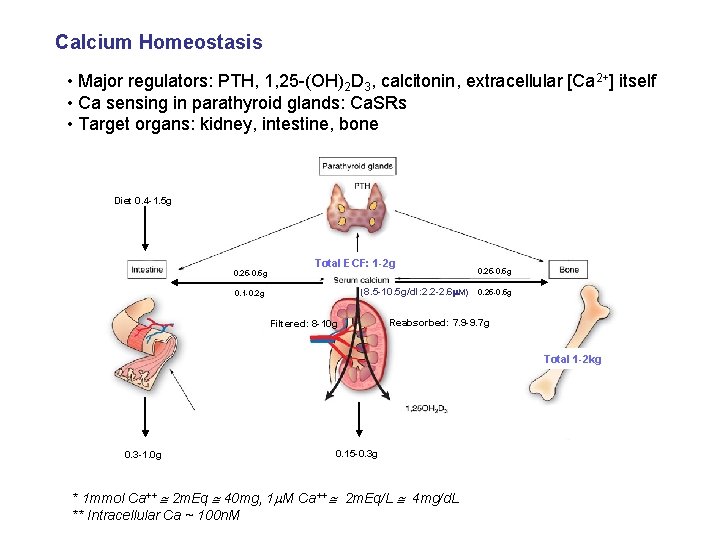
Calcium Homeostasis • Major regulators: PTH, 1, 25 -(OH)2 D 3, calcitonin, extracellular [Ca 2+] itself • Ca sensing in parathyroid glands: Ca. SRs • Target organs: kidney, intestine, bone Diet 0. 4 -1. 5 g 0. 25 -0. 5 g Total ECF: 1 -2 g (8. 5 -10. 5 g/dl: 2. 2 -2. 6 M) 0. 1 -0. 2 g Filtered: 8 -10 g 0. 25 -0. 5 g Reabsorbed: 7. 9 -9. 7 g Total 1 -2 kg 0. 3 -1. 0 g 0. 15 -0. 3 g * 1 mmol Ca++ 2 m. Eq 40 mg, 1 M Ca++ 2 m. Eq/L 4 mg/d. L ** Intracellular Ca ~ 100 n. M
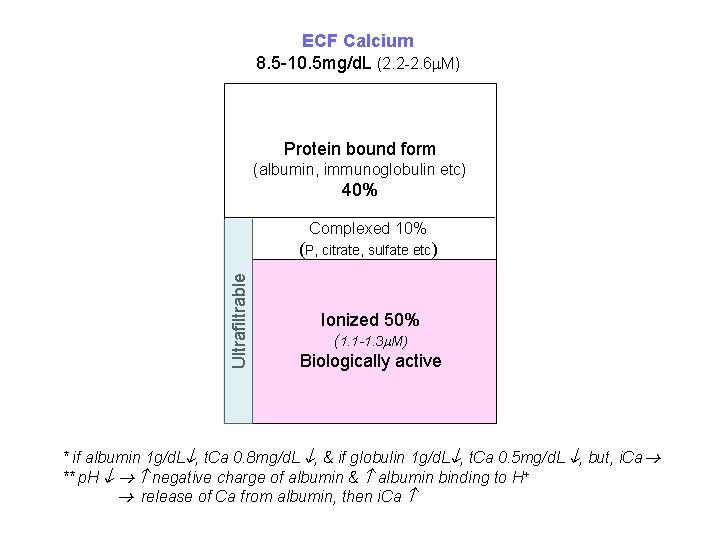
ECF Calcium 8. 5 -10. 5 mg/d. L (2. 2 -2. 6 M) Protein bound form (albumin, immunoglobulin etc) 40% Complexed 10% Ultrafiltrable (P, citrate, sulfate etc) Ionized 50% (1. 1 -1. 3 M) Biologically active * if albumin 1 g/d. L , t. Ca 0. 8 mg/d. L , & if globulin 1 g/d. L , t. Ca 0. 5 mg/d. L , but, i. Ca ** p. H negative charge of albumin & albumin binding to H+ release of Ca from albumin, then i. Ca
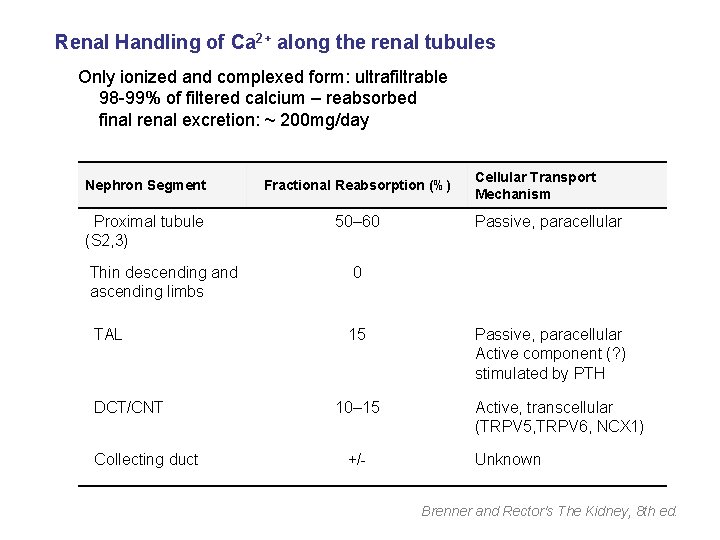
Renal Handling of Ca 2+ along the renal tubules Only ionized and complexed form: ultrafiltrable 98 -99% of filtered calcium – reabsorbed final renal excretion: ~ 200 mg/day Nephron Segment Fractional Reabsorption (%) Proximal tubule (S 2, 3) 50– 60 Thin descending and ascending limbs 0 TAL 15 DCT/CNT Collecting duct 10– 15 +/- Cellular Transport Mechanism Passive, paracellular Active component (? ) stimulated by PTH Active, transcellular (TRPV 5, TRPV 6, NCX 1) Unknown Brenner and Rector's The Kidney, 8 th ed.
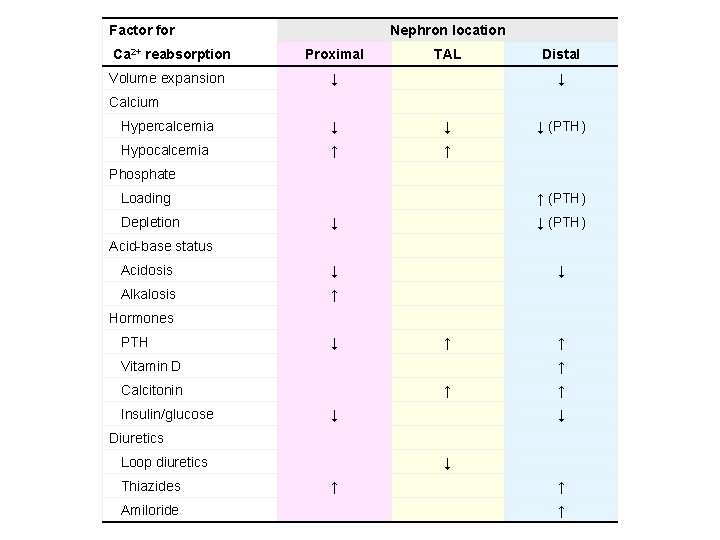
Factor for Ca 2+ reabsorption Volume expansion Nephron location Proximal TAL ↓ Distal ↓ Calcium Hypercalcemia ↓ ↓ Hypocalcemia ↑ ↑ ↓ (PTH) Phosphate Loading Depletion ↑ (PTH) ↓ ↓ (PTH) Acidosis ↓ ↓ Alkalosis ↑ Acid-base status Hormones PTH ↓ ↑ Vitamin D ↑ Calcitonin Insulin/glucose ↑ ↑ ↓ Diuretics Loop diuretics Thiazides Amiloride ↓ ↑ ↑ ↑
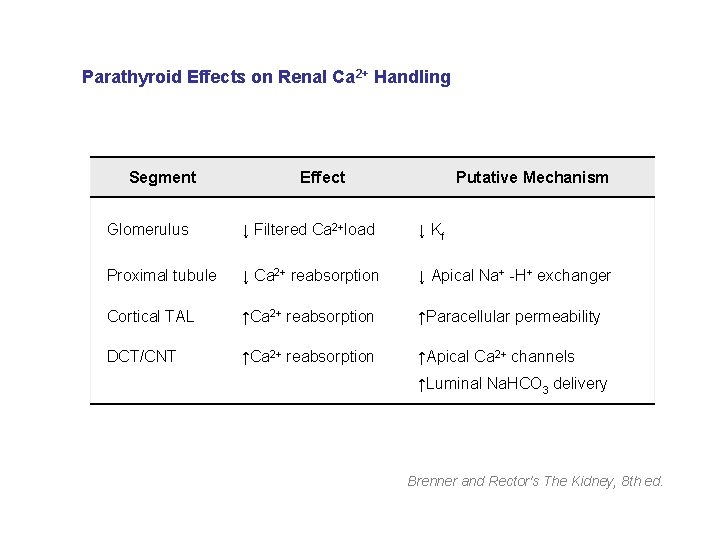
Parathyroid Effects on Renal Ca 2+ Handling Segment Effect Putative Mechanism Glomerulus ↓ Filtered Ca 2+load ↓ Kf Proximal tubule ↓ Ca 2+ reabsorption ↓ Apical Na+ -H+ exchanger Cortical TAL ↑Ca 2+ reabsorption ↑Paracellular permeability DCT/CNT ↑Ca 2+ reabsorption ↑Apical Ca 2+ channels ↑Luminal Na. HCO 3 delivery Brenner and Rector's The Kidney, 8 th ed.
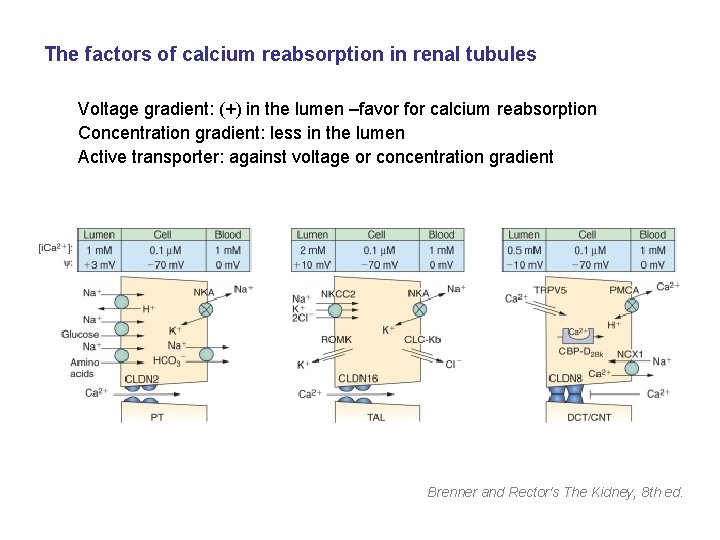
The factors of calcium reabsorption in renal tubules Voltage gradient: (+) in the lumen –favor for calcium reabsorption Concentration gradient: less in the lumen Active transporter: against voltage or concentration gradient Brenner and Rector's The Kidney, 8 th ed.
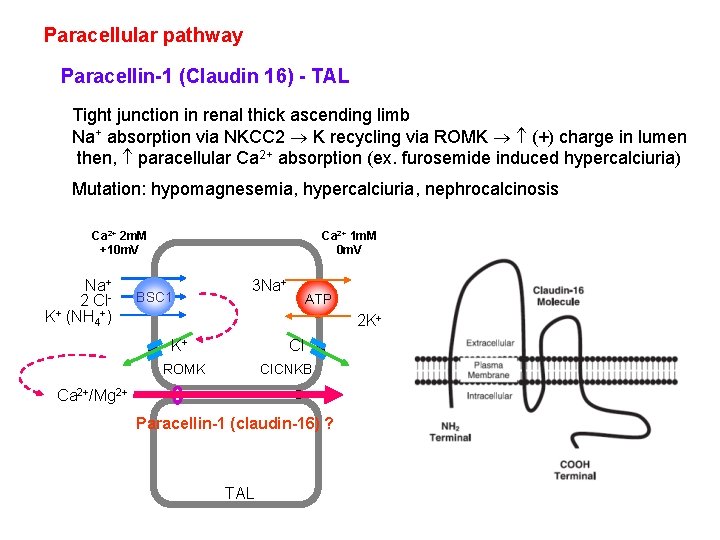
Paracellular pathway Paracellin-1 (Claudin 16) - TAL Tight junction in renal thick ascending limb Na+ absorption via NKCC 2 K recycling via ROMK (+) charge in lumen then, paracellular Ca 2+ absorption (ex. furosemide induced hypercalciuria) Mutation: hypomagnesemia, hypercalciuria, nephrocalcinosis Ca 2+ 2 m. M +10 m. V Na+ 2 Cl. K+ (NH 4+) Ca 2+ 1 m. M 0 m. V BSC 1 3 Na+ ATP 2 K+ K+ Cl ROMK CICNKB Ca 2+/Mg 2+ Paracellin-1 (claudin-16) ? TAL
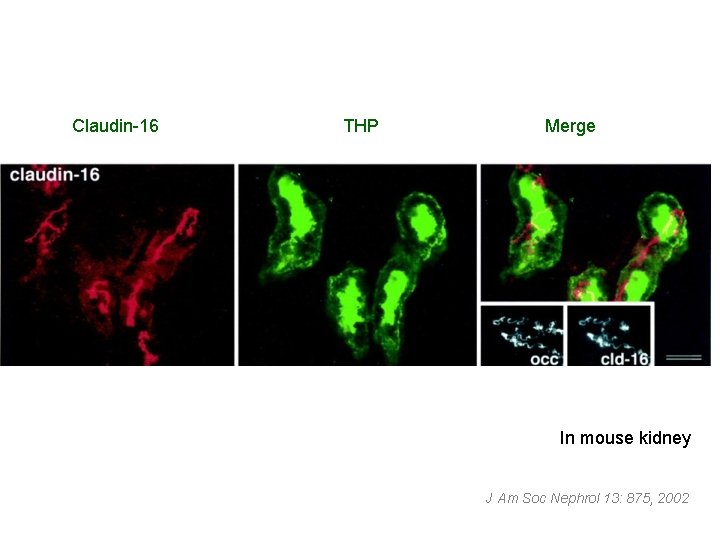
Claudin-16 THP Merge In mouse kidney J Am Soc Nephrol 13: 875, 2002

Transcellular pathway – DCT/CNT The mechanism of Ca 2+ absorption in the renal epithelium 1) Entry of Ca 2+ through the channels (TRPV 5/TRPV 6) in apical membrane 2) Ca 2+ bound to calbindin, diffusion in the cytoplasm (without change in free Ca 2+ concentration) 3) Ca 2+ extrusion via a active Ca 2+-ATPase (PMCA 1 b) & Na+-Ca 2+ exchanger (NCX 1) in the basolateral membrane
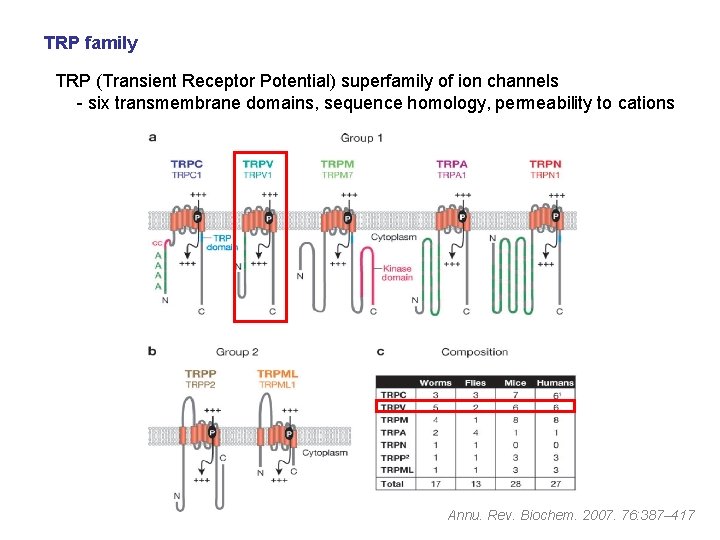
TRP family TRP (Transient Receptor Potential) superfamily of ion channels - six transmembrane domains, sequence homology, permeability to cations Annu. Rev. Biochem. 2007. 76: 387– 417
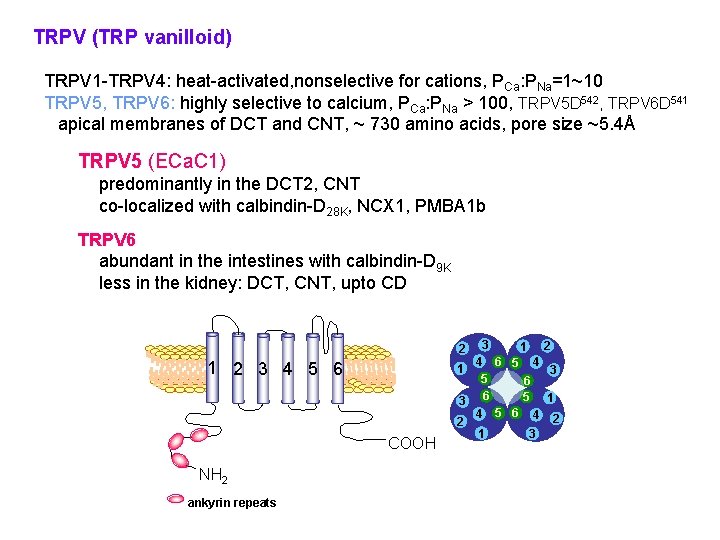
TRPV (TRP vanilloid) TRPV 1 -TRPV 4: heat-activated, nonselective for cations, PCa: PNa=1~10 TRPV 5, TRPV 6: highly selective to calcium, PCa: PNa > 100, TRPV 5 D 542, TRPV 6 D 541 apical membranes of DCT and CNT, ~ 730 amino acids, pore size ~5. 4Å TRPV 5 (ECa. C 1) predominantly in the DCT 2, CNT co-localized with calbindin-D 28 K, NCX 1, PMBA 1 b TRPV 6 abundant in the intestines with calbindin-D 9 K less in the kidney: DCT, CNT, upto CD 3 1 2 4 6 5 4 1 3 5 6 5 1 3 6 4 5 6 4 2 2 1 3 2 1 2 3 4 5 6 COOH NH 2 ankyrin repeats
Calbindin Vitamin D-dependent Ca 2+-binding proteins - expressed in cells that are challenged by a high Ca 2+ influx - brain, bone, teeth, inner ear, placenta, mammary gland, kidney, intestine Calbindin-D 28 K: exclusively in the kidney – DCT, CNT, CD Calbindin-D 9 K: primary in the intestine Buffering cytoplasmic Ca 2+ and diffusion through the cytoplasm - continuous influx of Ca 2+ through the apical Ca channel - strict regulation of intracellular Ca 2+ concentration for protecting the cells intracellular i[Ca 2+] 100 n. M << plasma i[Ca 2+] 1 -1. 2 M - diffuse without affecting other intracellular processes to the basolateral side
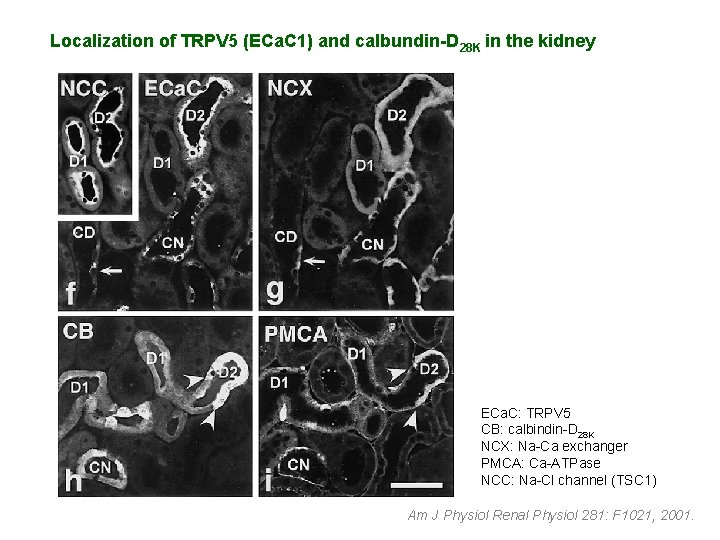
Localization of TRPV 5 (ECa. C 1) and calbundin-D 28 K in the kidney ECa. C: TRPV 5 CB: calbindin-D 28 K NCX: Na-Ca exchanger PMCA: Ca-ATPase NCC: Na-Cl channel (TSC 1) Am J Physiol Renal Physiol 281: F 1021, 2001.
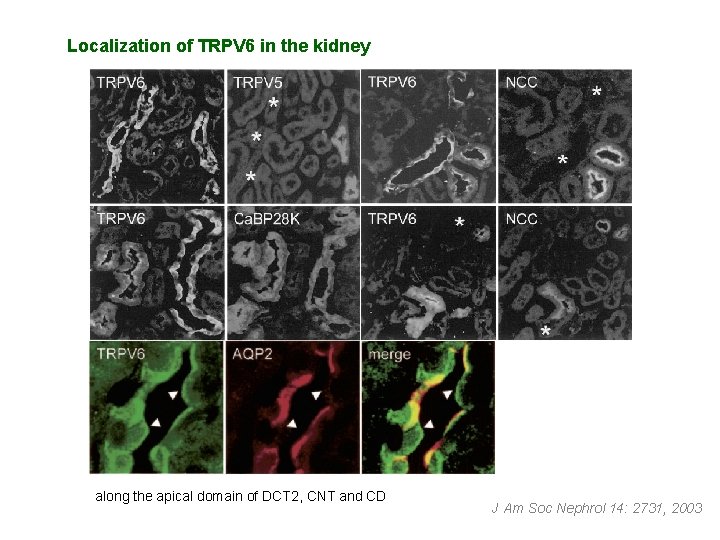
Localization of TRPV 6 in the kidney along the apical domain of DCT 2, CNT and CD J Am Soc Nephrol 14: 2731, 2003
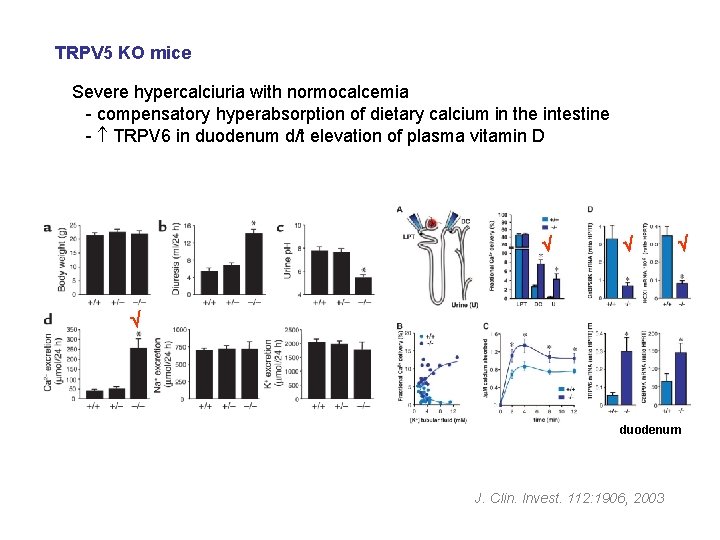
TRPV 5 KO mice Severe hypercalciuria with normocalcemia - compensatory hyperabsorption of dietary calcium in the intestine - TRPV 6 in duodenum d/t elevation of plasma vitamin D duodenum J. Clin. Invest. 112: 1906, 2003
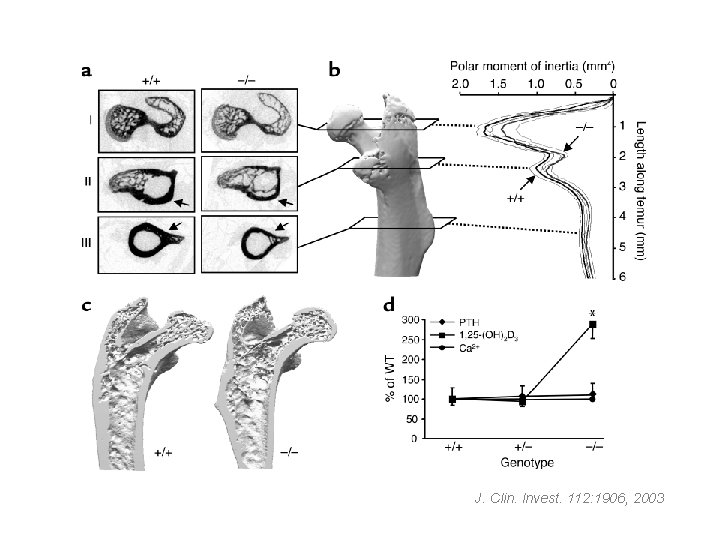
J. Clin. Invest. 112: 1906, 2003
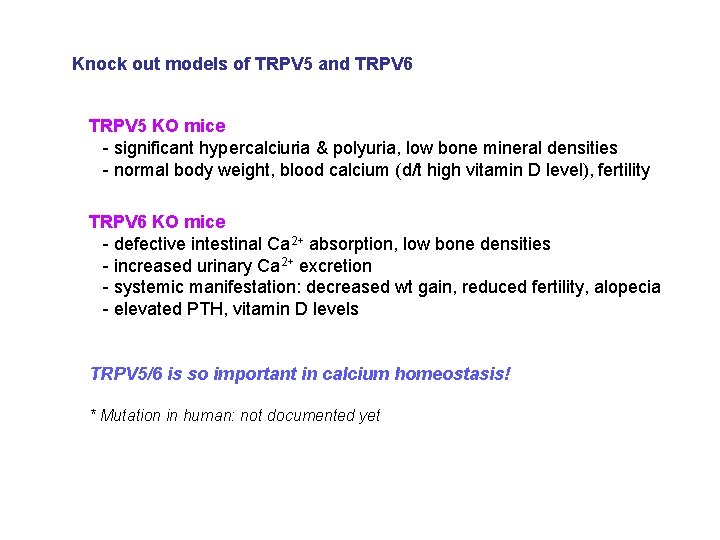
Knock out models of TRPV 5 and TRPV 6 TRPV 5 KO mice - significant hypercalciuria & polyuria, low bone mineral densities - normal body weight, blood calcium (d/t high vitamin D level), fertility TRPV 6 KO mice - defective intestinal Ca 2+ absorption, low bone densities - increased urinary Ca 2+ excretion - systemic manifestation: decreased wt gain, reduced fertility, alopecia - elevated PTH, vitamin D levels TRPV 5/6 is so important in calcium homeostasis! * Mutation in human: not documented yet
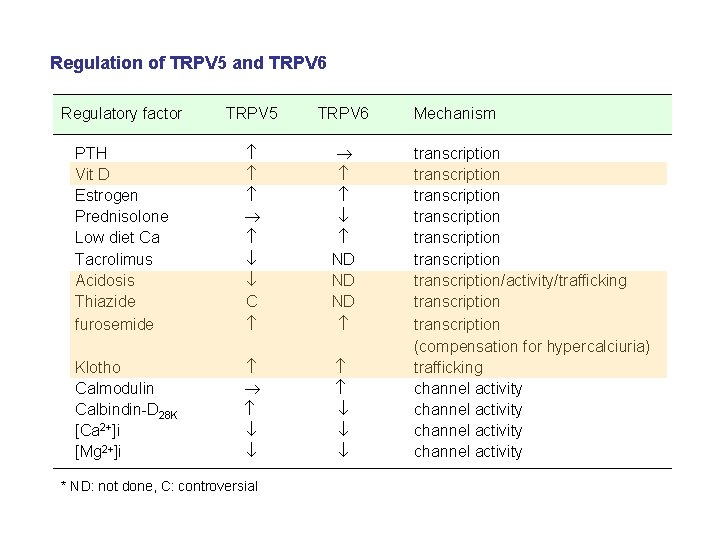
Regulation of TRPV 5 and TRPV 6 Regulatory factor TRPV 5 TRPV 6 PTH Vit D Estrogen Prednisolone Low diet Ca Tacrolimus Acidosis Thiazide furosemide C ND ND ND Klotho Calmodulin Calbindin-D 28 K [Ca 2+]i [Mg 2+]i * ND: not done, C: controversial Mechanism transcription transcription/activity/trafficking transcription (compensation for hypercalciuria) trafficking channel activity
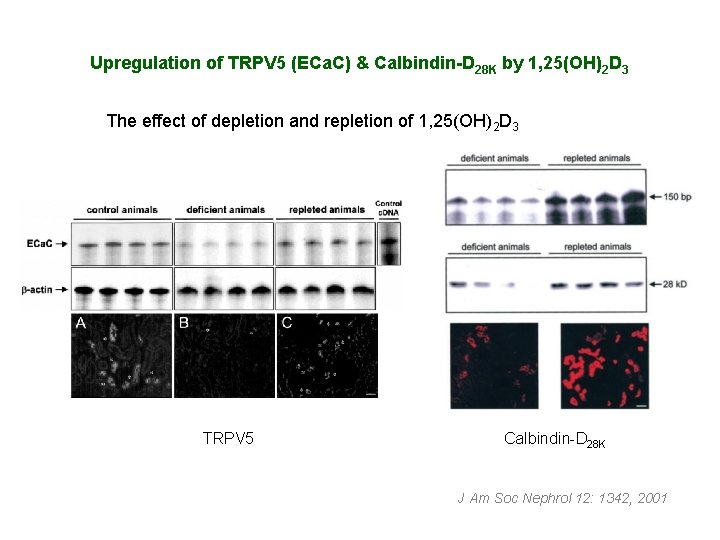
Upregulation of TRPV 5 (ECa. C) & Calbindin-D 28 K by 1, 25(OH)2 D 3 The effect of depletion and repletion of 1, 25(OH)2 D 3 TRPV 5 Calbindin-D 28 K J Am Soc Nephrol 12: 1342, 2001
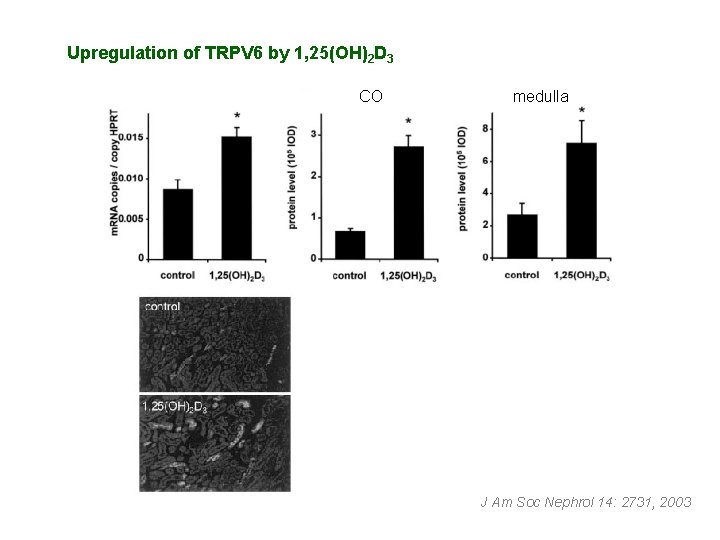
Upregulation of TRPV 6 by 1, 25(OH)2 D 3 CO medulla J Am Soc Nephrol 14: 2731, 2003
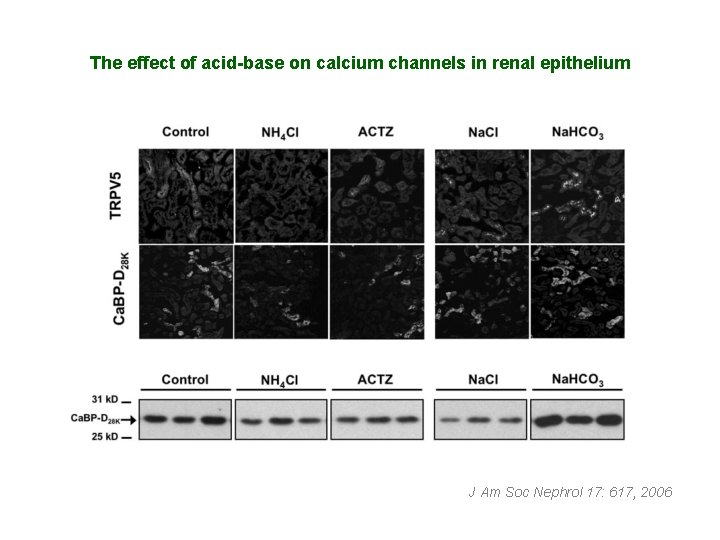
The effect of acid-base on calcium channels in renal epithelium J Am Soc Nephrol 17: 617, 2006
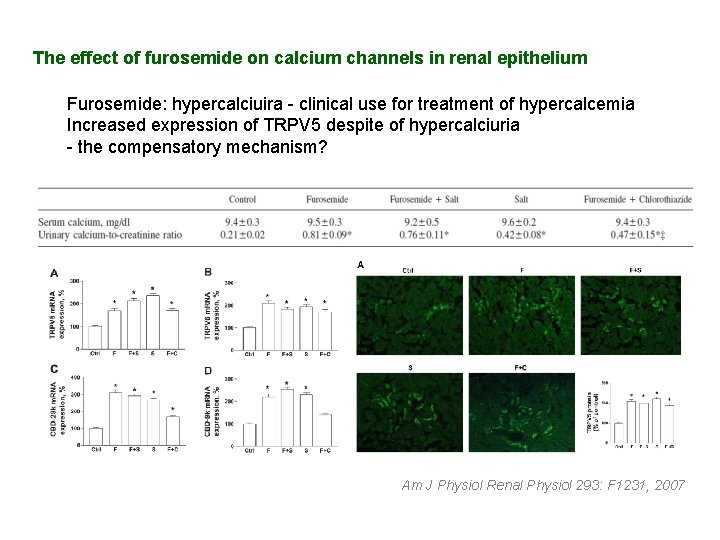
The effect of furosemide on calcium channels in renal epithelium Furosemide: hypercalciuira - clinical use for treatment of hypercalcemia Increased expression of TRPV 5 despite of hypercalciuria - the compensatory mechanism? Am J Physiol Renal Physiol 293: F 1231, 2007
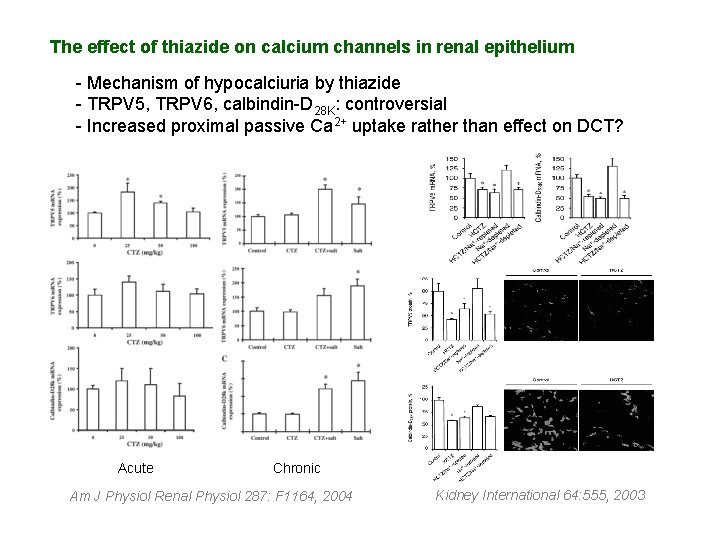
The effect of thiazide on calcium channels in renal epithelium - Mechanism of hypocalciuria by thiazide - TRPV 5, TRPV 6, calbindin-D 28 K: controversial - Increased proximal passive Ca 2+ uptake rather than effect on DCT? Acute Chronic Am J Physiol Renal Physiol 287: F 1164, 2004 Kidney International 64: 555, 2003
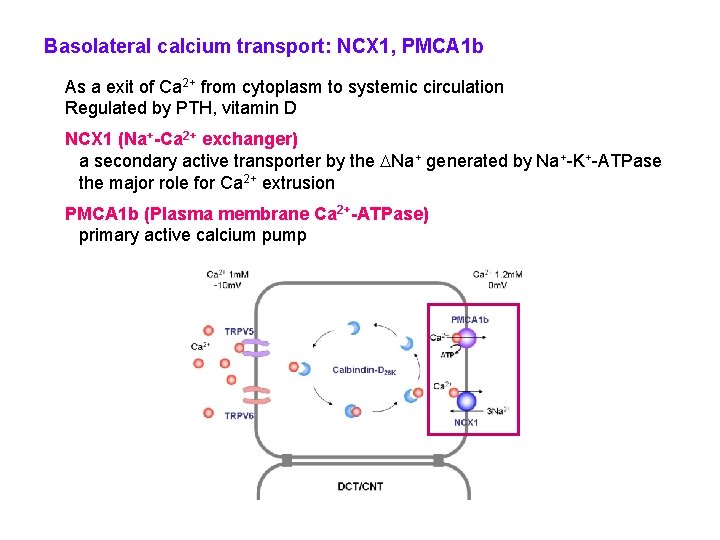
Basolateral calcium transport: NCX 1, PMCA 1 b As a exit of Ca 2+ from cytoplasm to systemic circulation Regulated by PTH, vitamin D NCX 1 (Na+-Ca 2+ exchanger) a secondary active transporter by the Na+ generated by Na+-K+-ATPase the major role for Ca 2+ extrusion PMCA 1 b (Plasma membrane Ca 2+-ATPase) primary active calcium pump
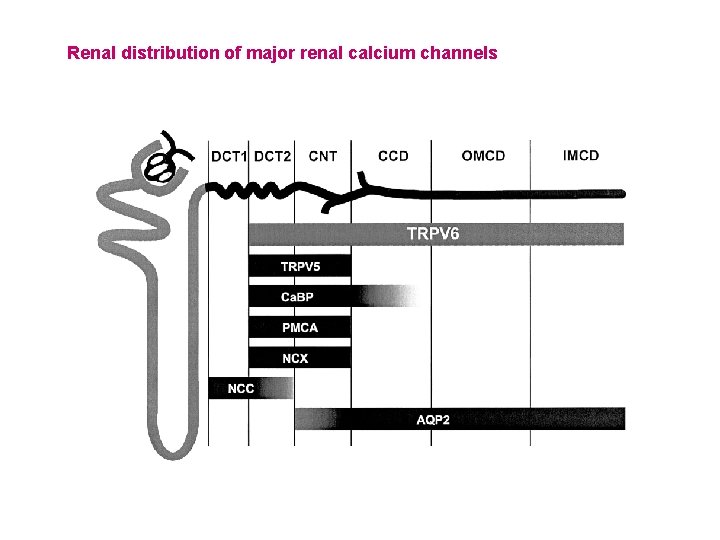
Renal distribution of major renal calcium channels
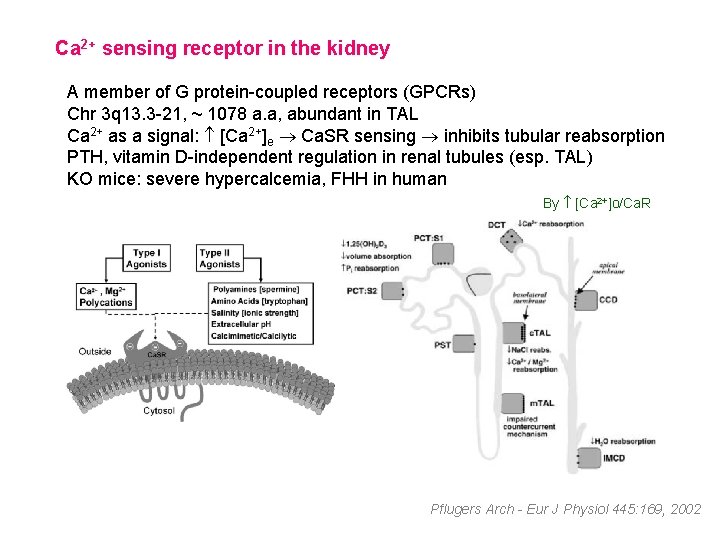
Ca 2+ sensing receptor in the kidney A member of G protein-coupled receptors (GPCRs) Chr 3 q 13. 3 -21, ~ 1078 a. a, abundant in TAL Ca 2+ as a signal: [Ca 2+]e Ca. SR sensing inhibits tubular reabsorption PTH, vitamin D-independent regulation in renal tubules (esp. TAL) KO mice: severe hypercalcemia, FHH in human By [Ca 2+]o/Ca. R Pflugers Arch - Eur J Physiol 445: 169, 2002
![Klotho & FGF 23: New players in calcium homeostasis Klotho [Clotho] : the "spinner“,](http://slidetodoc.com/presentation_image_h2/c2d726833f3ae46ad7dc401582bd25d4/image-28.jpg "Klotho & FGF 23: New players in calcium homeostasis Klotho [Clotho] : the \"spinner“,")
Klotho & FGF 23: New players in calcium homeostasis Klotho [Clotho] : the "spinner“, the youngest of the Moirae (The Fates) of Greek mythology (Clotho, Lackesis, Atropos) governing over the lives of humans, control the life and destiny Klotho gene First documented in 1997 by Kuro-o et als Klotho KO mice: accelerated aging related disorders atherosclerosis, ectopic calcification, decreased bone density, emphysema, atrophy of skin severe hyperphosphatemia with increased 1, 25(OH)2 D 3 Encodes type I membrane protein (a 130 -k. Da) with -glucuronidase activity - expressed predominantly in the kidney, PTH, choroid plexus - located Chr 13 q 12 in human
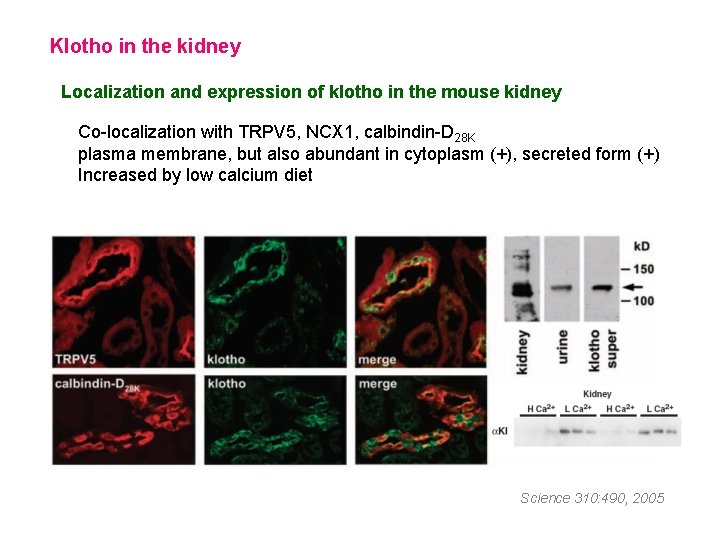
Klotho in the kidney Localization and expression of klotho in the mouse kidney Co-localization with TRPV 5, NCX 1, calbindin-D 28 K plasma membrane, but also abundant in cytoplasm (+), secreted form (+) Increased by low calcium diet Science 310: 490, 2005
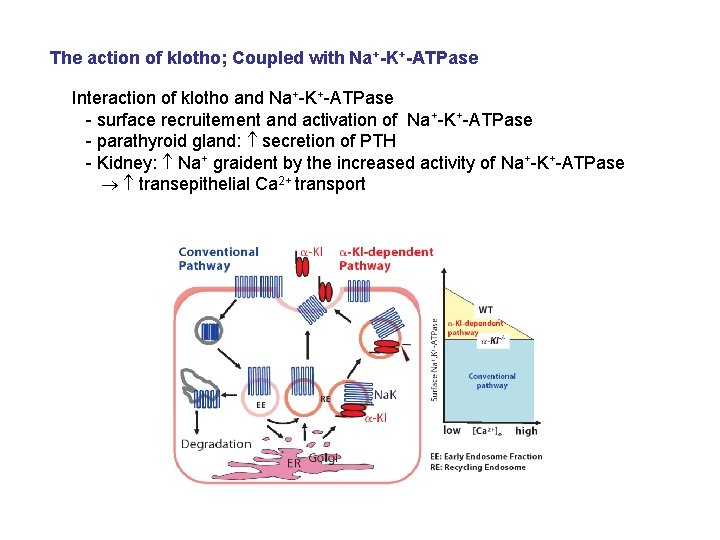
The action of klotho; Coupled with Na+-K+-ATPase Interaction of klotho and Na+-K+-ATPase - surface recruitement and activation of Na+-K+-ATPase - parathyroid gland: secretion of PTH - Kidney: Na+ graident by the increased activity of Na+-K+-ATPase transepithelial Ca 2+ transport
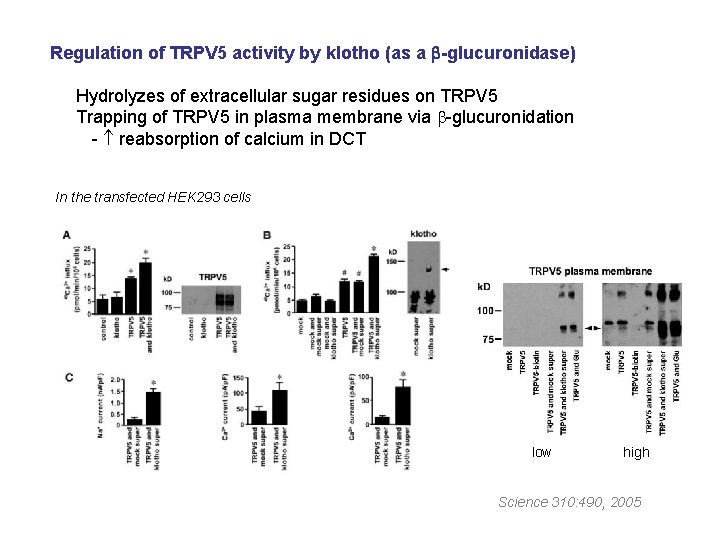
Regulation of TRPV 5 activity by klotho (as a -glucuronidase) Hydrolyzes of extracellular sugar residues on TRPV 5 Trapping of TRPV 5 in plasma membrane via -glucuronidation - reabsorption of calcium in DCT In the transfected HEK 293 cells low high Science 310: 490, 2005
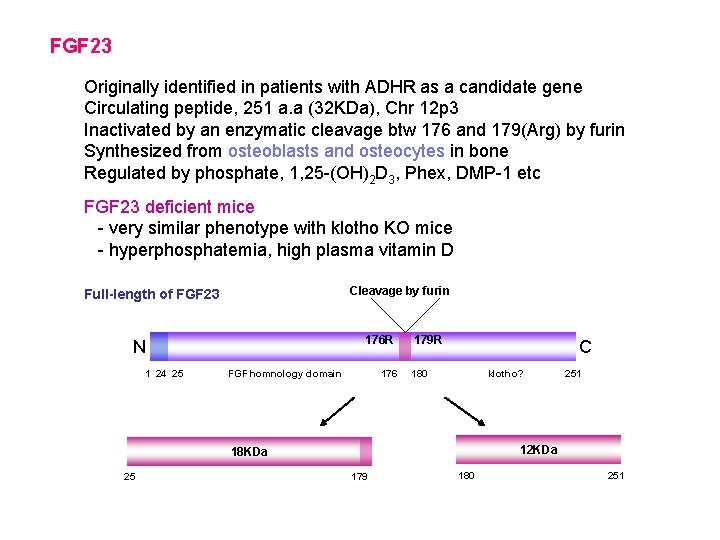
FGF 23 Originally identified in patients with ADHR as a candidate gene Circulating peptide, 251 a. a (32 KDa), Chr 12 p 3 Inactivated by an enzymatic cleavage btw 176 and 179(Arg) by furin Synthesized from osteoblasts and osteocytes in bone Regulated by phosphate, 1, 25 -(OH)2 D 3, Phex, DMP-1 etc FGF 23 deficient mice - very similar phenotype with klotho KO mice - hyperphosphatemia, high plasma vitamin D Cleavage by furin Full-length of FGF 23 176 R N 1 24 25 FGF homnology domain 176 179 R C 180 klotho? 12 KDa 18 KDa 25 251 179 180 251
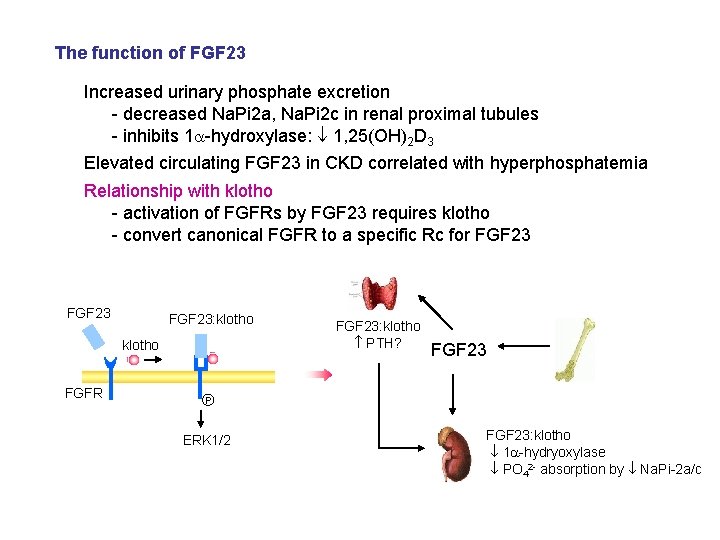
The function of FGF 23 Increased urinary phosphate excretion - decreased Na. Pi 2 a, Na. Pi 2 c in renal proximal tubules - inhibits 1 -hydroxylase: 1, 25(OH)2 D 3 Elevated circulating FGF 23 in CKD correlated with hyperphosphatemia Relationship with klotho - activation of FGFRs by FGF 23 requires klotho - convert canonical FGFR to a specific Rc for FGF 23: klotho FGFR FGF 23: klotho PTH? FGF 23 P ERK 1/2 FGF 23: klotho 1 -hydryoxylase PO 42 - absorption by Na. Pi-2 a/c
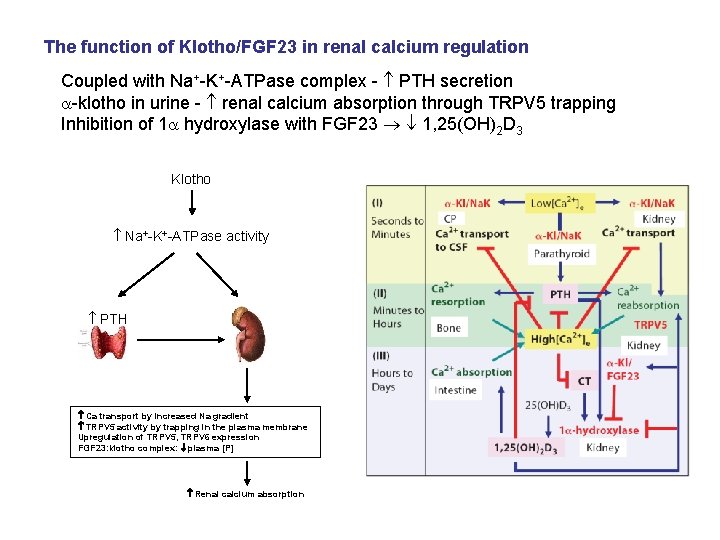
The function of Klotho/FGF 23 in renal calcium regulation Coupled with Na+-K+-ATPase complex - PTH secretion -klotho in urine - renal calcium absorption through TRPV 5 trapping Inhibition of 1 hydroxylase with FGF 23 1, 25(OH)2 D 3 Klotho Na+-K+-ATPase activity PTH Ca transport by increased Na gradient TRPV 5 activity by trapping in the plasma membrane Upregulation of TRPV 5, TRPV 6 expression FGF 23: klotho complex: plasma [P] Renal calcium absorption
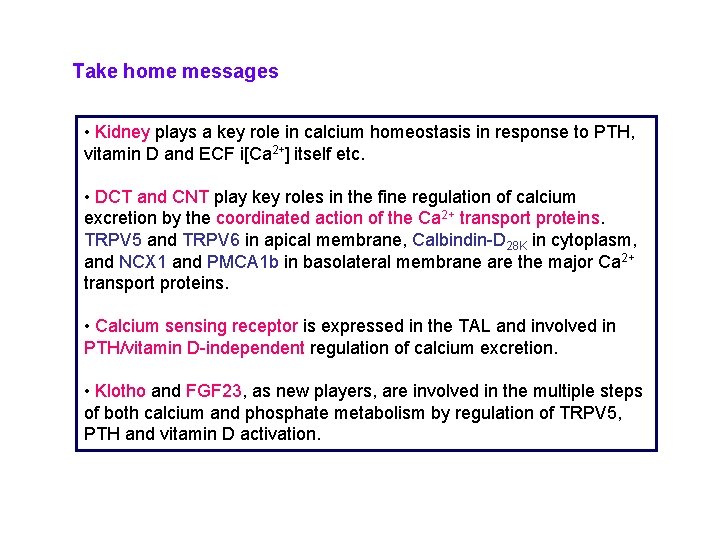
Take home messages • Kidney plays a key role in calcium homeostasis in response to PTH, vitamin D and ECF i[Ca 2+] itself etc. • DCT and CNT play key roles in the fine regulation of calcium excretion by the coordinated action of the Ca 2+ transport proteins. TRPV 5 and TRPV 6 in apical membrane, Calbindin-D 28 K in cytoplasm, and NCX 1 and PMCA 1 b in basolateral membrane are the major Ca 2+ transport proteins. • Calcium sensing receptor is expressed in the TAL and involved in PTH/vitamin D-independent regulation of calcium excretion. • Klotho and FGF 23, as new players, are involved in the multiple steps of both calcium and phosphate metabolism by regulation of TRPV 5, PTH and vitamin D activation.
- Slides: 35