
2005 Scientific Learning Corporation The Problems Children Face
© 2005 Scientific Learning Corporation
The Problems Children Face Ø We all know children who are bright and motivated to learn, but hit some kind of a wall when they go to school Ø They don’t seem to make progress, they don’t listen well, and they have trouble learning to read Ø So much potential, but how to unlock it? © 2005 Scientific Learning Corporation
Does Your Child. . . Ø Misunderstand what you say? Ø Request that information be repeated? Ø Give slow or delayed responses? Ø Use only a few descriptive words when speaking? Ø Seem reluctant to engage in conversations? Ø Have difficulty reconstructing a story in its appropriate order? © 2005 Scientific Learning Corporation
In school or at home, does your child. . . Ø Have difficulty remembering/following oral instructions? Ø Not remember the question when asked? Ø Have difficulty with ambiguous language, idioms or jokes? Ø Have difficulty with phonics, reading or spelling? Ø Have unexplained behavior problems? © 2005 Scientific Learning Corporation
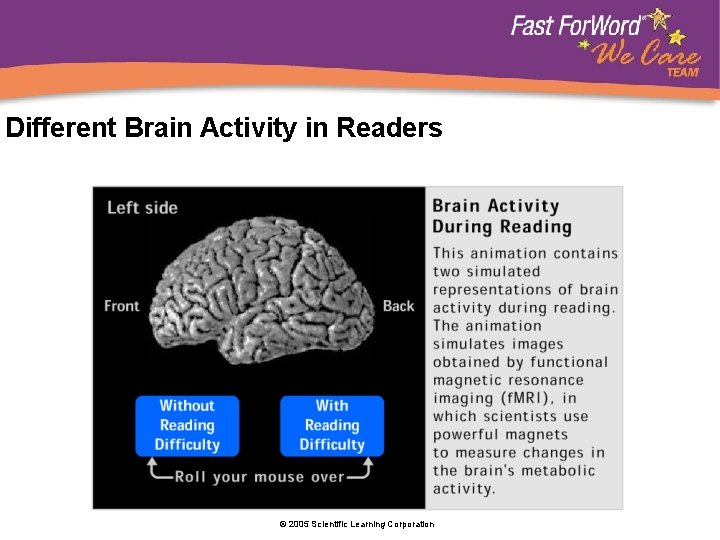
Different Brain Activity in Readers © 2005 Scientific Learning Corporation
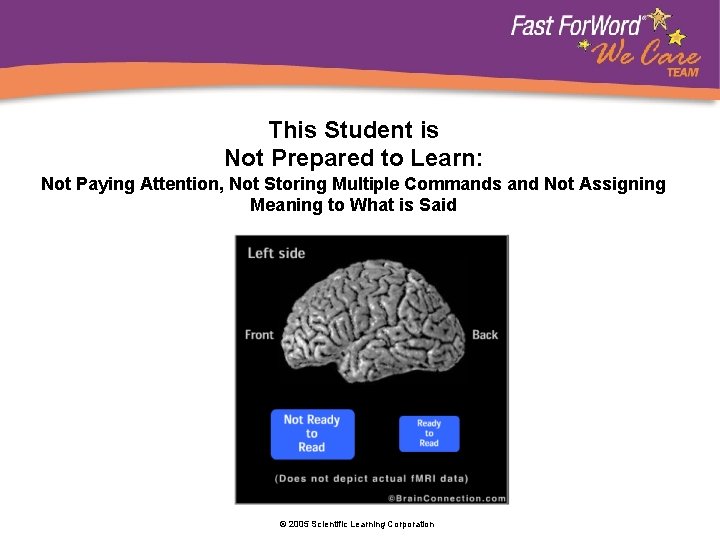
This Student is Not Prepared to Learn: Not Paying Attention, Not Storing Multiple Commands and Not Assigning Meaning to What is Said © 2005 Scientific Learning Corporation
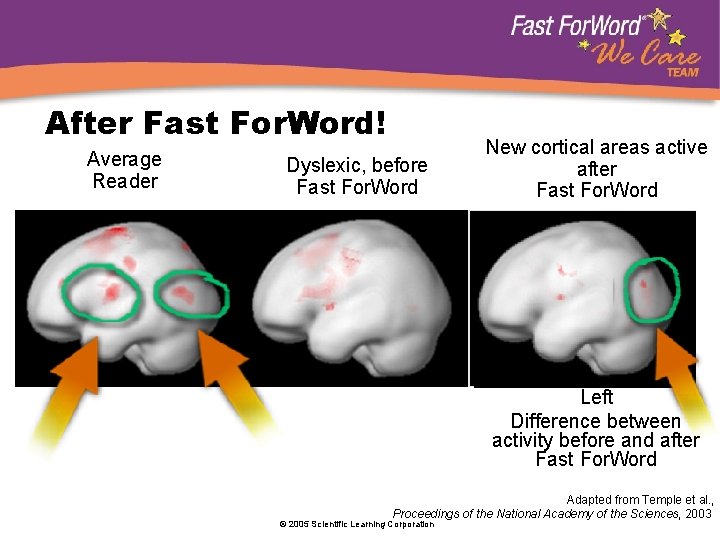
After Fast For. Word! Average Reader Dyslexic, before Fast For. Word Dyslexic Reader before Fast For. Word New cortical areas active Dyslexic Reader after Fast For. Word Left Difference between activity before and after Fast For. Word Adapted from Temple et al. , Proceedings of the National Academy of the Sciences, 2003 Adapted from Temple et al. , Adapted Temple et al. , Proceedings of thefrom National Academy of the Sciences, 2003 © 2005 Scientific Learning Corporation Proceedings of the National Academy of the Sciences, 2003
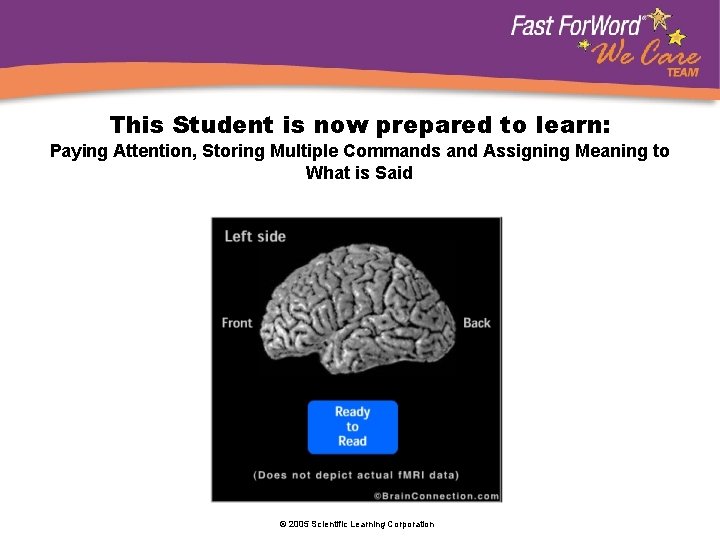
This Student is now prepared to learn: Paying Attention, Storing Multiple Commands and Assigning Meaning to What is Said © 2005 Scientific Learning Corporation
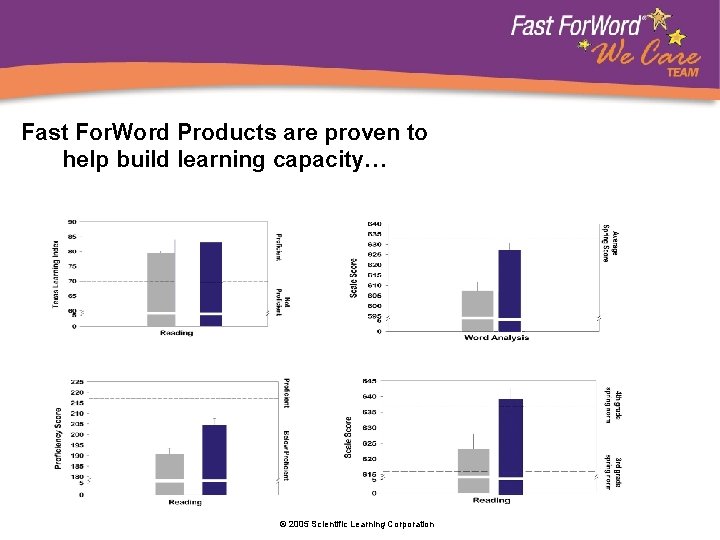
Fast For. Word Products are proven to help build learning capacity… © 2005 Scientific Learning Corporation
How do Fast For. Word Products Improve Reading? Ø These products use neuroscience design methods to improve essential cognitive skills. Ø Learning MAPSTM - critically important prerequisite skills for successful reading. Ø When Learning MAPS are stronger, students are able to benefit from good reading instruction. © 2005 Scientific Learning Corporation
What are the Learning MAPS? Ø Memory—the capacity to store information and concepts, essential for word recognition, sentence comprehension, and remembering instructions Ø Attention—the ability to focus on tasks and ignore distractions Ø Processing—the ability to distinguish sounds quickly to discriminate their differences, a prerequisite for phonemic awareness and reading Ø Sequencing—a cognitive skill that relies on memory, attention, and processing, essential for phonics, word fluency, reading and oral comprehension © 2005 Scientific Learning Corporation
How does Fast For. Word do this? • Frequency and intensity- rigorous schedule • Adaptivity- adapts to each click of the mouse • Simultaneous development- students are building and strengthening multiple skills in each exercise • Timely motivation- immediate feedback and reward of points Neuroscience research tells us these are the elements of a successful program to create new neural networks and build learning capacity. © 2005 Scientific Learning Corporation
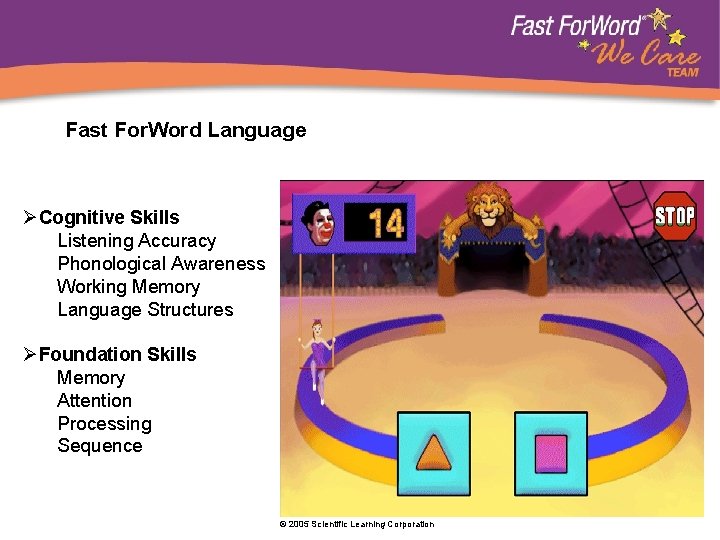
Fast For. Word Language ØCognitive Skills Listening Accuracy Phonological Awareness Working Memory Language Structures ØFoundation Skills Memory Attention Processing Sequence © 2005 Scientific Learning Corporation
Fast For. Word Language Schedule Options Ø 100 min/day, 5 days a week for 4 -8 weeks Ø 75 min/day, 5 days a week for 6 -10 weeks Ø 50 min/day, 5 days a week for 8 -12 weeks *Number of weeks is variable based on individual student progress © 2005 Scientific Learning Corporation
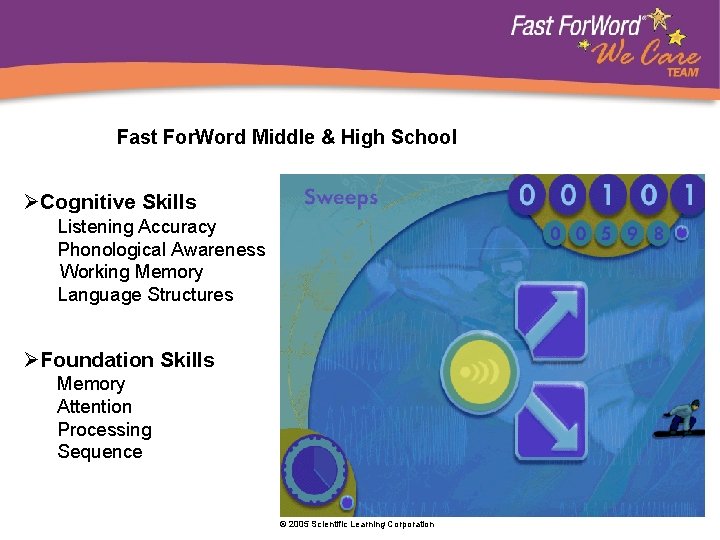
Fast For. Word Middle & High School ØCognitive Skills Listening Accuracy Phonological Awareness Working Memory Language Structures ØFoundation Skills Memory Attention Processing Sequence © 2005 Scientific Learning Corporation
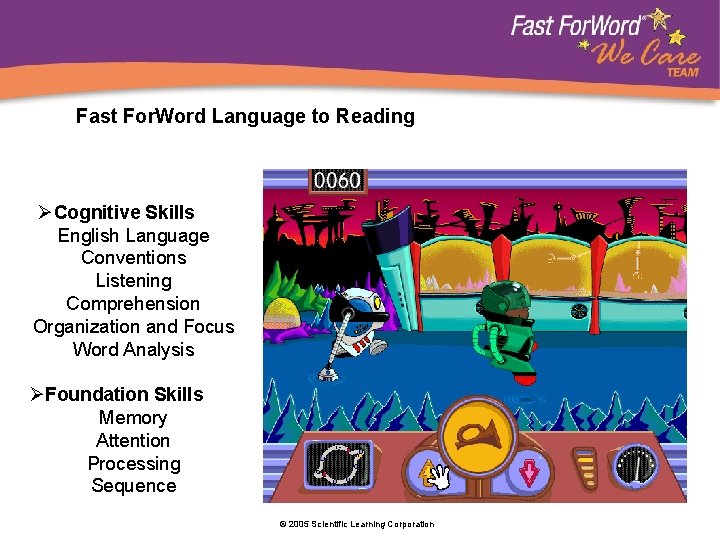
Fast For. Word Language to Reading ØCognitive Skills English Language Conventions Listening Comprehension Organization and Focus Word Analysis ØFoundation Skills Memory Attention Processing Sequence © 2005 Scientific Learning Corporation
What can parents do to help? Ø Ensure their child attends school as much as possible during Fast For. Word training Ø Provide a good night’s sleep and breakfast Ø Ask about their progress, to see their graphs and reports Ø Fill out Parent Observational Survey before and after Fast For. Word training to discover behavioral changes © 2005 Scientific Learning Corporation
- Slides: 17