
2005 REPUTATION MANAGEMENT A Holistic Business Tool PPT
![® 2005 REPUTATION MANAGEMENT: A Holistic Business Tool [PPT] Reputation Management - Slide 1](https://slidetodoc.com/presentation_image_h2/26669a07603cafb91e997260414e1fca/image-1.jpg "® 2005 REPUTATION MANAGEMENT: A Holistic Business Tool [PPT] Reputation Management - Slide 1")
® 2005 REPUTATION MANAGEMENT: A Holistic Business Tool [PPT] Reputation Management - Slide 1 File Format: Microsoft Powerpoint - View as HTML A company's market value is driven by its anticipated earning potential – the net present value of its future economic profit; Intangibles are. . . Market value as a multiple of net book value: Taken from e. CFO, Wiley 2001, p 95. . . www. pr-school-london. com/ppt/REPNEW. ppt Presented by: John Dalton Director of LSPR Worldwide 1
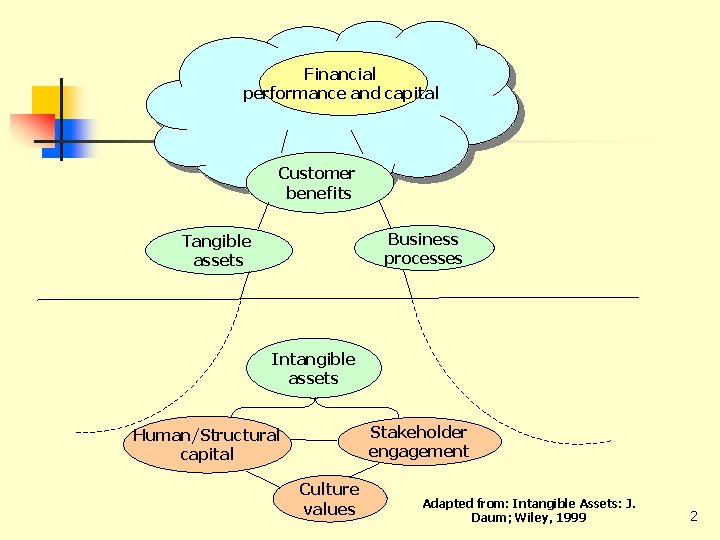
Financial performance and capital Customer benefits Business processes Tangible assets Intangible assets Stakeholder engagement Human/Structural capital Culture values Adapted from: Intangible Assets: J. Daum; Wiley, 1999 2
REPUTATION: n “If we picture a company as a living organism, say a tree, then half of the mass or more of that tree is underground in the root system. And whereas the flavour of the fruit and the colour of the leaves provides evidence of how healthy that tree is right now, understanding what is going on in the roots is a far more effective way to learn how healthy that tree will be in years to come” Leif Edvinsson and Michael S. Malone; Intellectual Capital 3
REPUTATION: An overview n n What does reputation mean to you? How much is your company’s reputation worth? Can you measure and manage your reputation? How much of your organisation is made up of intangible assets? 4

REPUTATION: An Overview What one mistake do businesses keep making? Answer: n Asking the wrong questions n n Issues facing business change little, but the answers do Ask not what I should be doing, but WHAT NEEDS TO BE DONE: source P. Drucker “We must become the change we want to see” - Ghandi 5
REPUTATION: An overview n n n Corporate image can be created, but corporate reputation must be earned What exactly does reputation mean? Various perspectives and meaning, both in a business and cultural sense 6
REPUTATION: An Overview n Hill and Knowlton’s Corporate Reputation Watch 2004 Survey: Some key findings www. hillandknowlton. com n n n 93% of senior executives believe that customers consider corporate reputation important or extremely important 79% of senior executives believe that investors and lenders consider CR either important or very important The impact of corporate governance has increased dramatically since 5 years ago: now 40% of senior executives believe that strong corporate governance is a critical factor that potential investors consider before committing, whereas 5 years only 19% thought the same. 7
REPUTATION: An Overview n In 2001, the insurance firm Aon polled 2000 top UK’s private companies and showed that “loss of reputation” was viewed as the greatest risk, followed by failure to change” www. aon. co. uk 8
WHO IS AT RISK? You are at particular risk if you: n Offer life-saving or life threatening products – pharmaceuticals or arms n Enjoy high, global brand awareness – luxury brands n Are based on new technology – GM, mobiles Confront changing social mores – fashion, n Produce significant spill-over effects – n alcohol, tobacco mining, waste, oil 9
GLOBAL BUSINESS CONTEXT n n n Pluralism: over time markets are inherently entropic This leads to CREATIVE DESTRUCTION Sustaining a competitive brand now relies more on reputation than it did a decade ago: reputation is one of the key sustaining factors 10
TRUST: the engineering of consent Trust vs. Trustworthiness 1. 2. 3. 4. 5. Increased fraud – reward based incentives Loss of authority from key institutions Media distortion and anti-campaigning Growth of urban decay and ant-social behaviour Poor corporate governance and corporate behaviour – The Precautionary Principle 11
CHANGE IN ATTITUDES n n n In the Industrial age, the marketing model was driven by advertising For knowledge-intensive products, inherent value cannot be as easily communicated in 5 -10 sec commercial Therefore, products and services rely more on reputation – the key vehicle for which is the BARND and its ability to create value 12
CHANGING ATTITUDES n n n Corporate value can no longer be determined by short-term profit and sales Long-term, sustainability is the key Mobile phone industry is a classic example Old systems deemed employees as cost factors, not as value creating elements and stakeholders 13
CHANGING ATTITUDES Transition from the neo-classical economic theory to socio-economic theory – stakeholders n n n Triple bottom line and sustainability: Economic Social Environmental Differentiate by behaviour 14
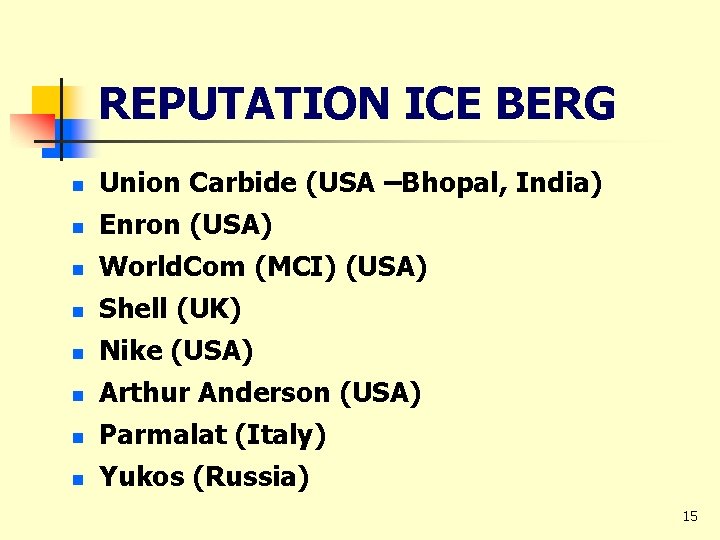
REPUTATION ICE BERG n n n n Union Carbide (USA –Bhopal, India) Enron (USA) World. Com (MCI) (USA) Shell (UK) Nike (USA) Arthur Anderson (USA) Parmalat (Italy) Yukos (Russia) 15
REPUTATION: An Overview Reputation is the sum values that stakeholders attribute to a company, based on their perception and interpretation of the image that the company communicates over time John Dalton – Managing Corporate Reputation 16
REPUTATION: An Overview Reputation is the principal means through which a market economy deals with consumer ignorance Professor John Kay Reputation exists because of asymmetric information 17
REPUTATION: An Overview Reputation is a collective term referring to all stakeholders’ views of corporate reputation, including identity and image Professor Gary Davies –Manchester Business School Reputation = experience - expectations 18
IT ALL ABOUT ISSUE MANAGEMENT Good reputation management is based on issue management n Issue identification n Issue Analysis n Issue Change Strategy Options n Issue Action Programme n Evaluation of Results Monitoring Weblogs and user groups online 19
SOME “HOT” ISSUES n n n Obesity, salt and food labelling GM technology Mobile phone radiation Stem cell and embryo technology Nanotechnology Biodiversity loss and pollution Compliance, governance & CSR Off-shoring Innovation and value creation IP theft & counterfeiting Customer retention and equity Development of an amateur media online 20
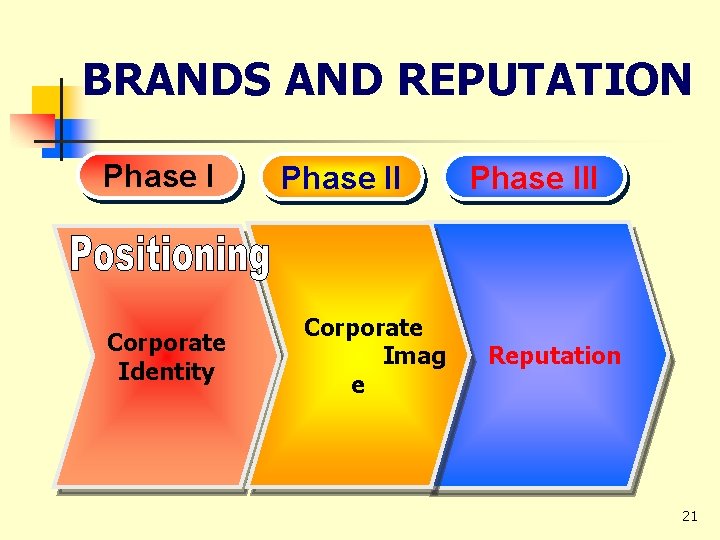
BRANDS AND REPUTATION Phase I Corporate Identity Phase II Corporate Imag e Phase III Reputation 21
CORPORATE IDENTITY n n n n n Logo –TM Name – typeface Slogan or tagline Packaging and uniforms Colour and semiology Brochure and advertising Annual Report Websites Photography 22
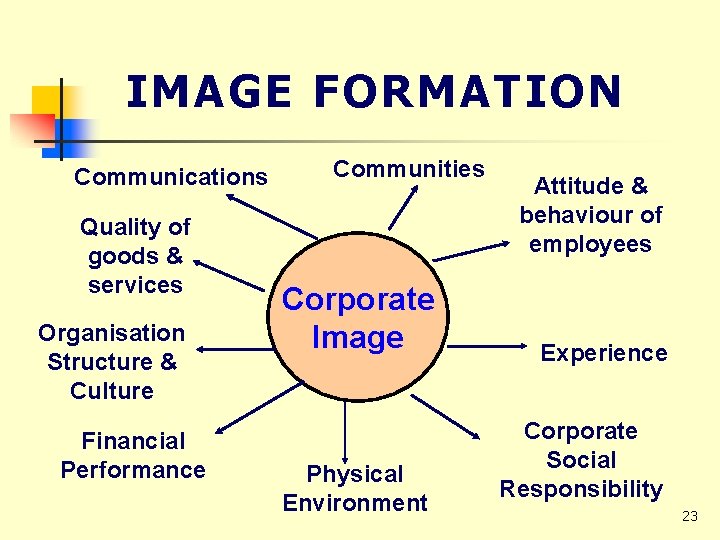
IMAGE FORMATION Communications Quality of goods & services Organisation Structure & Culture Financial Performance Communities Corporate Image Physical Environment Attitude & behaviour of employees Experience Corporate Social Responsibility 23
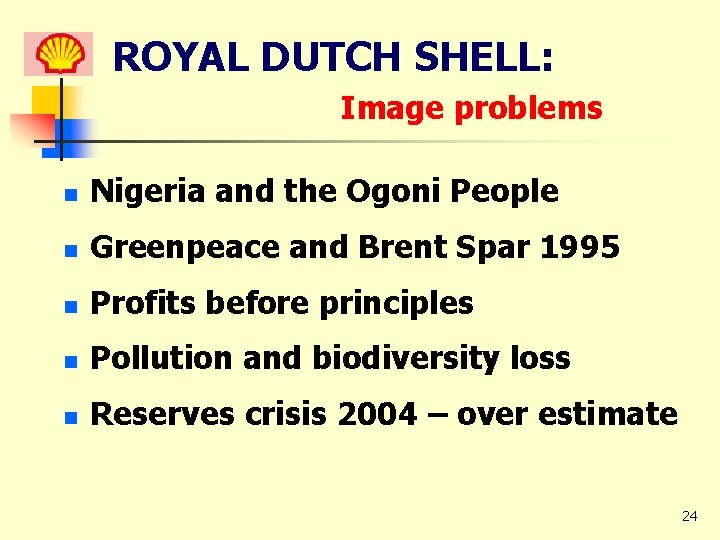
ROYAL DUTCH SHELL: Image problems n Nigeria and the Ogoni People n Greenpeace and Brent Spar 1995 n Profits before principles n Pollution and biodiversity loss n Reserves crisis 2004 – over estimate 24
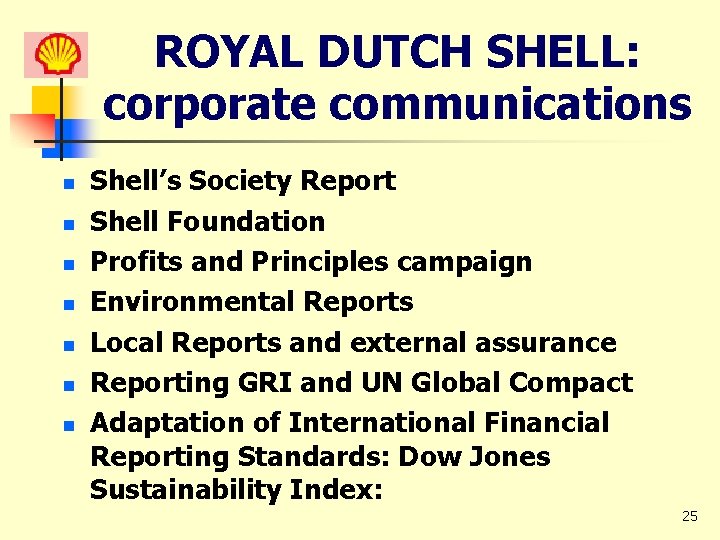
ROYAL DUTCH SHELL: corporate communications n n n n Shell’s Society Report Shell Foundation Profits and Principles campaign Environmental Reports Local Reports and external assurance Reporting GRI and UN Global Compact Adaptation of International Financial Reporting Standards: Dow Jones Sustainability Index: 25
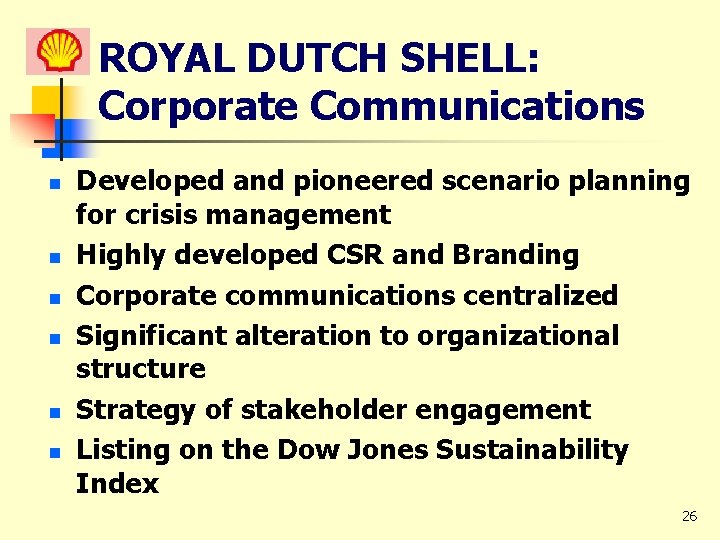
ROYAL DUTCH SHELL: Corporate Communications n n n Developed and pioneered scenario planning for crisis management Highly developed CSR and Branding Corporate communications centralized Significant alteration to organizational structure Strategy of stakeholder engagement Listing on the Dow Jones Sustainability Index 26
TELECOMS: Orange - rags to riches Classic example of corporate brand-building success n n n 1994 equity worth little – by 2000, Market Cap - $50 billion Strategy – brand focused Good use of corporate identity – name and slogan: use of semiotics 1996 IPO – youngest company ever to enter FTSE-100 Integrated marketing communications campaign: strong positioning against competitors 27
TELECOMS: Vodafone n Vodafone is the world’s largest mobile telecommunications community, employing over 65, 000 staff and over 130 million customers n Success and reputation because of its brand: brand driven 28
TELECOMS: Vodafone Brand strategy – key to its success n n n Operates over 300 of its own stores Sells through independent retailers Extensive sponsorship Advertising - high profile-celebrity endorsement Extensive below the line promotion High profile involvement in CSR: award winning 29
TELECOMS: Vodafone n Extensive market research and focus groups n Innovation – Vodafone live! n Increased penetration of new data services Sponsorship of: n Ferrari and Formula 1 n Manchester United n English cricket n Epsom Derby 30
GUINNESS: A REPUTABLE DRINK n n n 250 year-old beer brand Well know and identifiable Irish provenance Made from nature ingredients Owned by Diageo- UK Sold in 150 countries & brewed in 49 Brewed for local tastes In UK, Europe, USA – Guinness Draught In Africa, Asia and Caribbean – Foreign Extra Stout Nigeria – largest overseas market A pint of Guinness has less calories than equivalent Semiskinned milk In Muslim countries –sold as Malta Guinness – non-alcoholic 31
GUINNESS: A Brilliant Brand n n n Brilliant marketing communications: advertising Highly innovative and adaptive: -introduced larger – Harp -introduced Guinness Draft Extra Cold -in Nigeria it is seen as a Nigerian brand Large degree of passion involved with the brand Single global brand vision: Power; Goodness; Communion Brand experience; “perfect pint “ campaign Good congruence in sponsorship 32
INTANGIBLES n n n The last two decades have witnessed a revolution - transfer from industrial capitalism to a new knowledge-based economy Industrial capital based mainly on physical assets New economy based on intangible assets and value creation 33
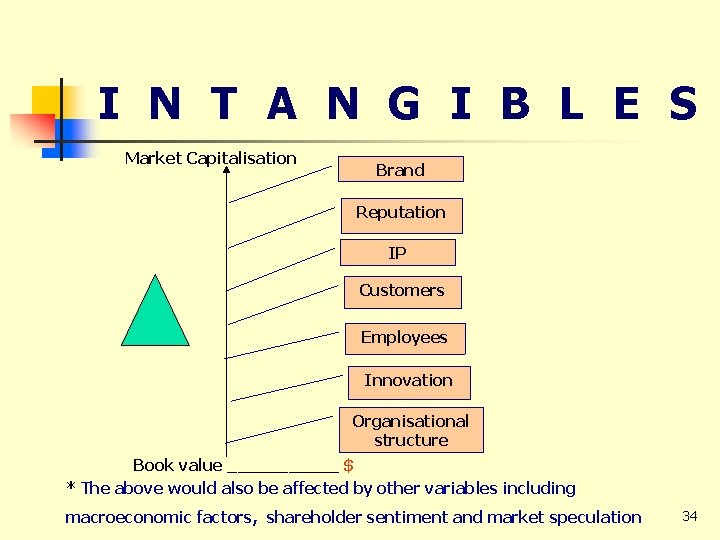
I N T A N G I B L E S Market Capitalisation Brand Reputation IP Customers Employees Innovation Organisational structure Book value ______ $ * The above would also be affected by other variables including macroeconomic factors, shareholder sentiment and market speculation 34
INTANGIBLES n n A company’s market value is driven by its anticipated earning potential – the net present value of its future economic profit Intangibles are systematically underreported within existing accounting practice 35
INTANGIBLES n n The Brookings Institute found that in 1962 - 62% of an average company’s value was represented by physical or hard capital - by 1992 this had decreased to 38% and in 2000 was as low as 20% The market to book value ratio 36
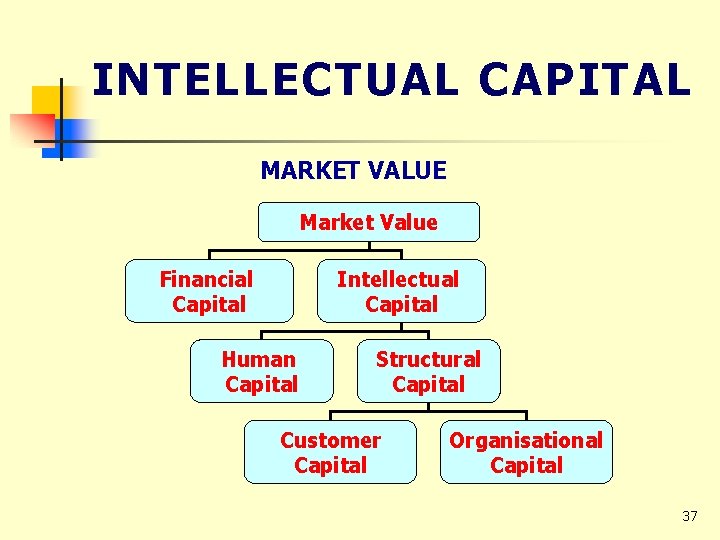
INTELLECTUAL CAPITAL MARKET VALUE Market Value Financial Capital Intellectual Capital Human Capital Structural Capital Customer Capital Organisational Capital 37
INTANGIBLES Welcome to the world of intellectual capital n Human capital n Structural and organisational capital n Customer or stakeholder capital 38
INTANGIBLES Market to book ratio: Dell – 17. 5 Pfizer – 18. 2 n n Capital is now not just financial – it is anything that adds wealth and value Back in 1999, only 6. 6% of Cocacola’s market capitalization was reported as book value 39
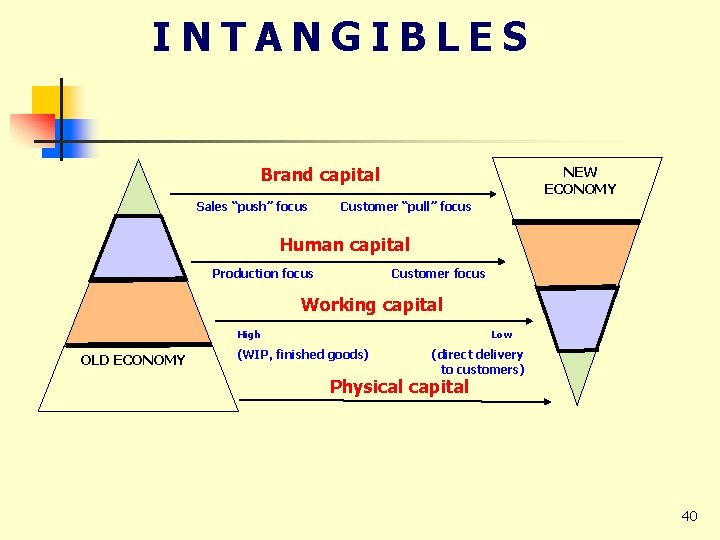
INTANGIBLES NEW ECONOMY Brand capital Sales “push” focus Customer “pull” focus Human capital Production focus Customer focus Working capital High OLD ECONOMY Low (WIP, finished goods) (direct delivery to customers) Physical capital 40
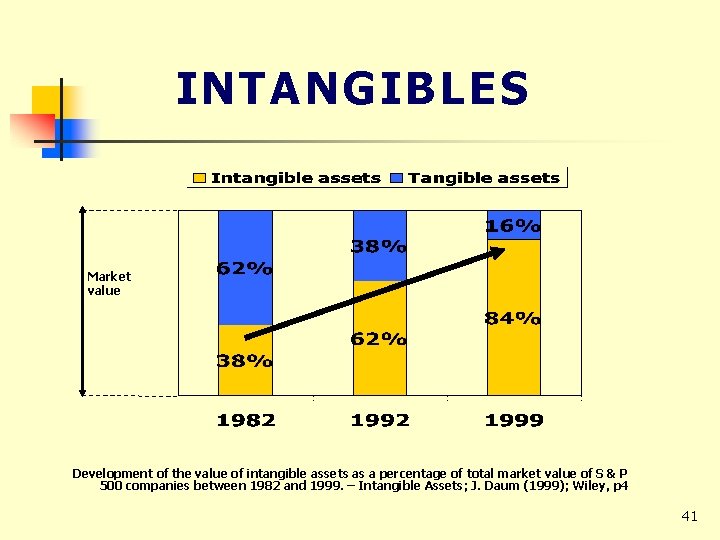
INTANGIBLES Market value Development of the value of intangible assets as a percentage of total market value of S & P 500 companies between 1982 and 1999. – Intangible Assets; J. Daum (1999); Wiley, p 4 41
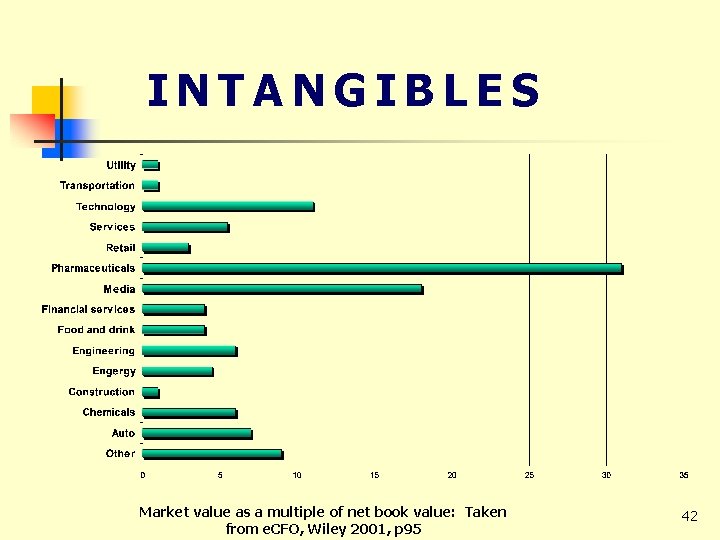
INTANGIBLES Market value as a multiple of net book value: Taken from e. CFO, Wiley 2001, p 95 42
INTANGIBLES AND ACCOUTNING n n Off the balance sheet Problems with global accounting do not properly allow the inclusion of internally generated assets, except those obtained by acquisition The issue of “goodwill” REPUTATION IS AN INTANGIBLE ASSET IN ITS OWN RIGHT 43
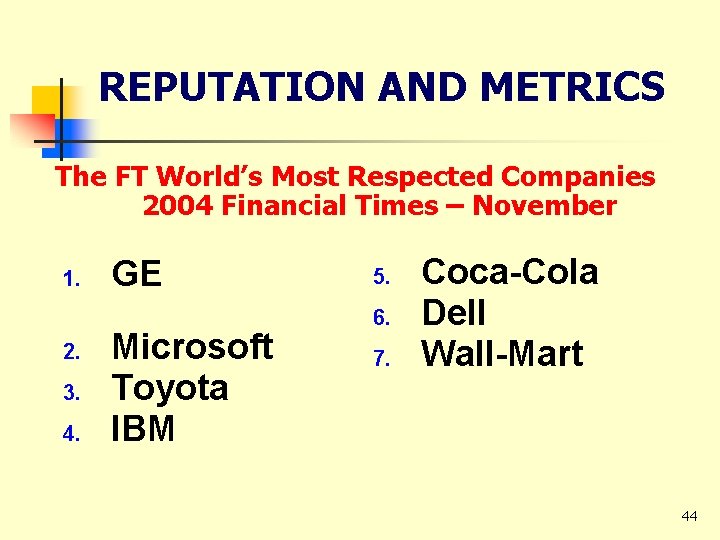
REPUTATION AND METRICS The FT World’s Most Respected Companies 2004 Financial Times – November 1. 2. 3. 4. GE Microsoft Toyota IBM 5. 6. 7. Coca-Cola Dell Wall-Mart 44
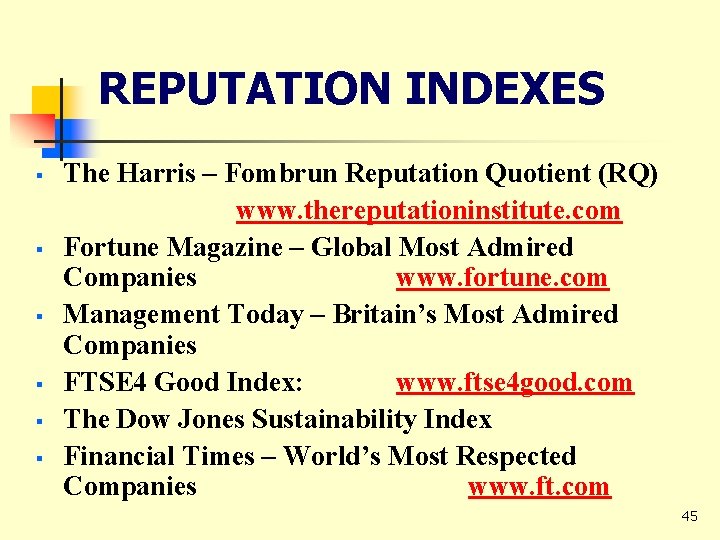
REPUTATION INDEXES § § § The Harris – Fombrun Reputation Quotient (RQ) www. thereputationinstitute. com Fortune Magazine – Global Most Admired Companies www. fortune. com Management Today – Britain’s Most Admired Companies FTSE 4 Good Index: www. ftse 4 good. com The Dow Jones Sustainability Index Financial Times – World’s Most Respected Companies www. ft. com 45
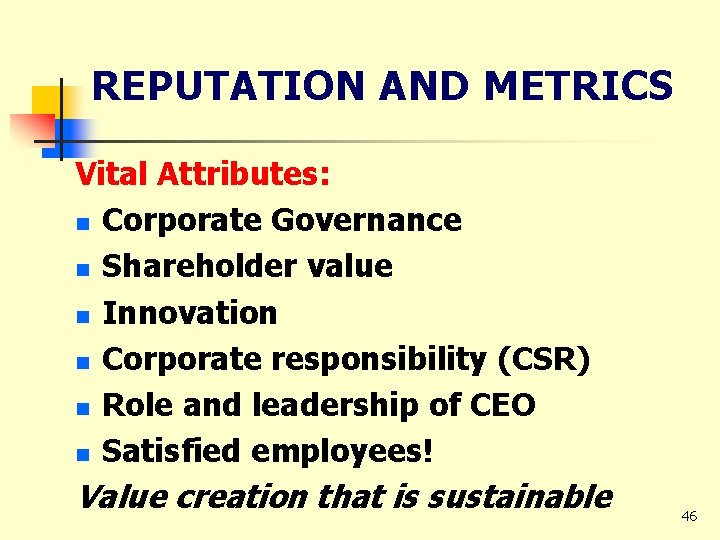
REPUTATION AND METRICS Vital Attributes: n Corporate Governance n Shareholder value n Innovation n Corporate responsibility (CSR) n Role and leadership of CEO n Satisfied employees! Value creation that is sustainable 46
DRIVERS OF CHANGE n n n Increased specialisation – outsourcing and disintermediation Relationship marketing – one-to-one customer relationship Business is increasingly customer-led rather than production driven Alliances and partnerships Vulnerability of brand equity Decline in trust – especially institutional 47
DRIVERS OF REPUTATION n n n n n Financial performance and shareholder value Corporate responsibility Corporate governance: compliance and regulation Technology – Internet and wireless Weblogs (blogs) over 5 m web journals Investor engagement (SRI) and NGOs Stakeholder convergence and managing stakeholders’ expectations Employee expectations Brand operational risk 48
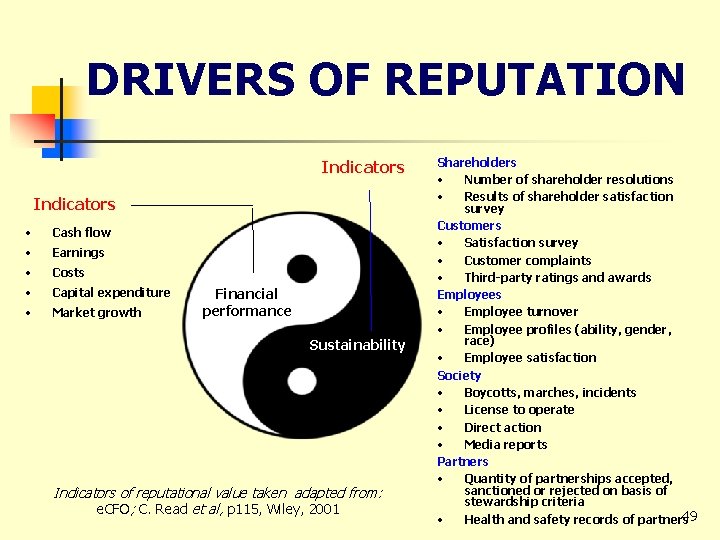
DRIVERS OF REPUTATION Indicators • Cash flow • Earnings • Costs • Capital expenditure • Market growth Financial performance Sustainability Indicators of reputational value taken adapted from: e. CFO; C. Read et al, p 115, Wiley, 2001 Shareholders • Number of shareholder resolutions • Results of shareholder satisfaction survey Customers • Satisfaction survey • Customer complaints • Third-party ratings and awards Employees • Employee turnover • Employee profiles (ability, gender, race) • Employee satisfaction Society • Boycotts, marches, incidents • License to operate • Direct action • Media reports Partners • Quantity of partnerships accepted, sanctioned or rejected on basis of stewardship criteria 49 • Health and safety records of partners
DRIVERS OF REPUTATION n n n n A more intrusive and sensational media – media amplification Need for transparency (disclosure) and accountability Companies as social institutions Globalization and the rise of corporate brands Notion that ethics counts Historical – Enron and World. Com Reputation as an asset in its own right - $ Victim culture – insurance claims 50
CORPORATE GOVERNANCE n n n Good corporate governance and compliance are seen by many as the primary force behind reputation management FSA in (UK) Basel II Sarbanes Oxley (USA) Role of compliance officers 51
REPUTATION: an enabler? n n n n Gain control and anticipate events Avoid long-term brand equity damage Avoid boycotts or sale losses Ensure compliance and shareholder value Better stakeholder relations – NGOs Better media relations and issue management Understand your risk exposure and allow easier entry into new markets and brand extensions Improved investor relations and profile 52
REPUTATION: an enabler? n n n Better employee output, retention and internal communications Better understanding of issues Preparation for crisis situation Alignment of strategy with key stakeholders’ expectations Sustainable wealth and value creation Development of alert systems and a “radar” 53
REPUTATION: an enabler? n n Positive influence on regulators when issuing licenses Local authorities may take it into account when considering planning applications In the financial markets more likely to raise capital Reduce the cost of entry into new markets, thereby securing a price advantage 54
MEDIA MANAGEMENT Good and diligent management of the media is central to reputation management: media profile n n n Learn which media are the most influential within your target group Supply the press with information that is accurate and useful Build relationship with journalists Look for triggers within issues – monitor the media and other users groups Use media intelligence agencies 55
MEIDA INTELLIGENCE n Romeike: www. romeike. com n Metrica: www. metrica. com n Echo: www. echo. Research. com n n Prnewswire: www. prenewswire. com Prweb: www. prweb. com 56
PR AND REPUTATION World of confusing terms n Public relations: a discipline in transition n Public affairs and lobbying n Corporate affairs n Corporate communications n Reputation management What’s the difference? 57
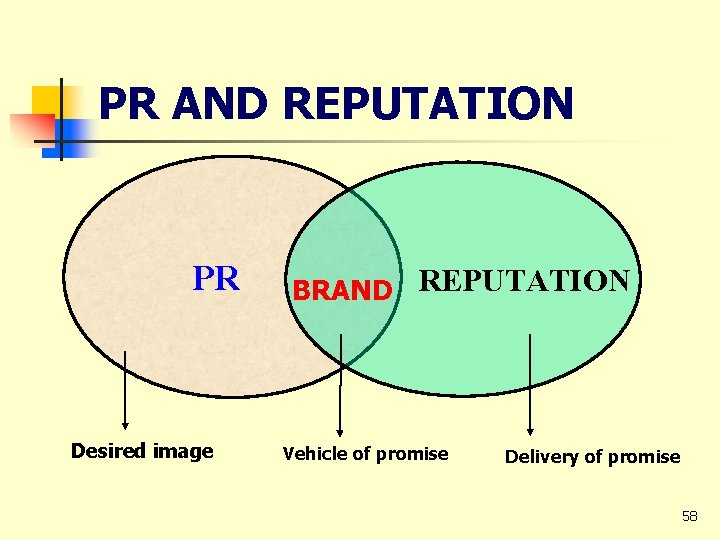
PR AND REPUTATION PR Desired image BRAND REPUTATION Vehicle of promise Delivery of promise 58
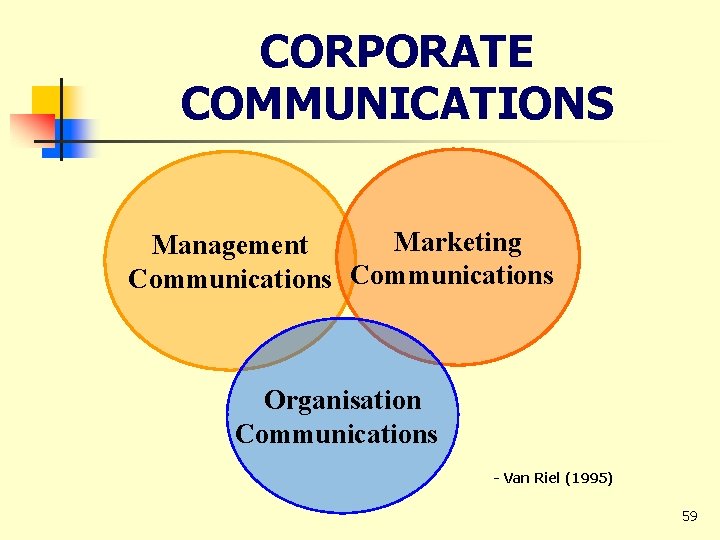
CORPORATE COMMUNICATIONS Marketing Management Communications Organisation Communications - Van Riel (1995) 59
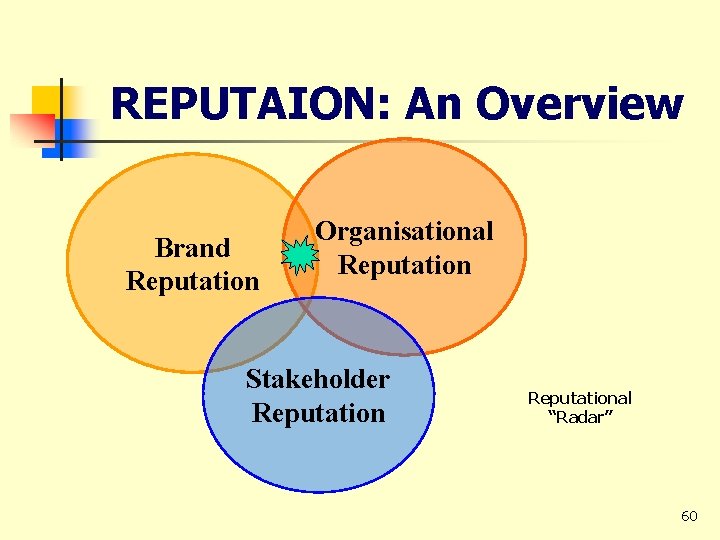
REPUTAION: An Overview Brand Reputation Organisational Reputation Stakeholder Reputational “Radar” 60
Relationship between PR and Reputation n Public relations and reputation are intricately linked: PR – more specific issues: media relations, public affairs, crisis management, event management and branding Reputation management is more holistic in its approach and involves all employees. 61
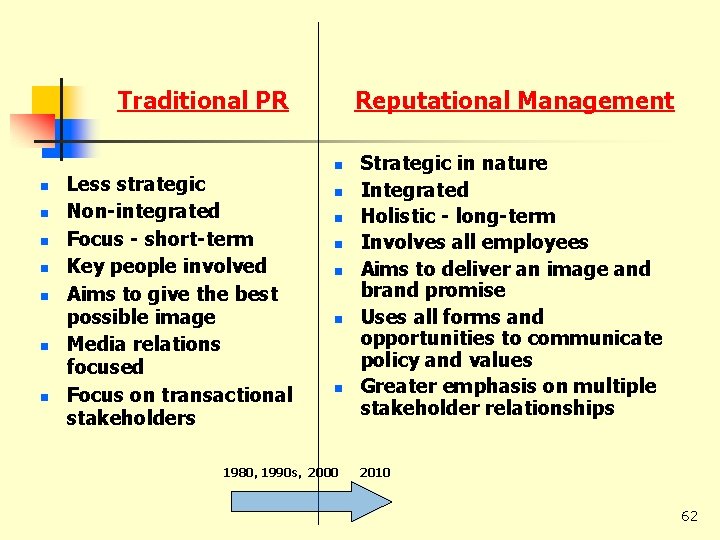
Traditional PR n n n n Less strategic Non-integrated Focus - short-term Key people involved Aims to give the best possible image Media relations focused Focus on transactional stakeholders Reputational Management n n n n 1980, 1990 s, 2000 Strategic in nature Integrated Holistic - long-term Involves all employees Aims to deliver an image and brand promise Uses all forms and opportunities to communicate policy and values Greater emphasis on multiple stakeholder relationships 2010 62
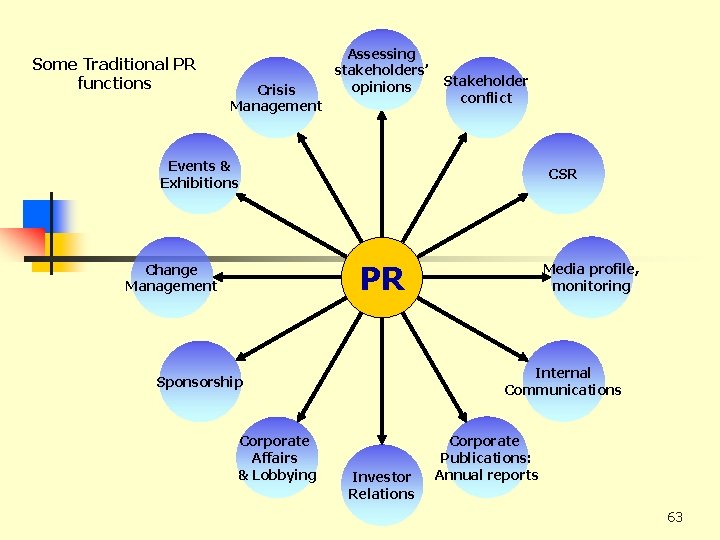
Some Traditional PR functions Crisis Management Assessing stakeholders’ opinions Stakeholder conflict Events & Exhibitions CSR PR Change Management Internal Communications Sponsorship Corporate Affairs & Lobbying Media profile, monitoring Investor Relations Corporate Publications: Annual reports 63
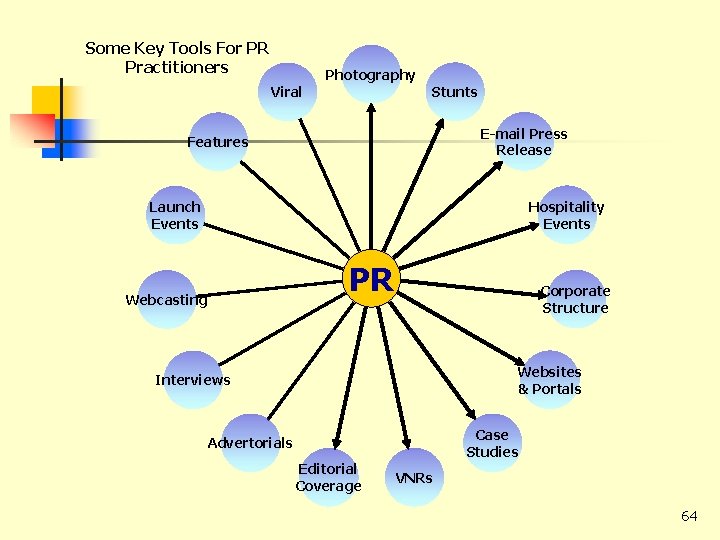
Some Key Tools For PR Practitioners Photography Stunts Viral E-mail Press Release Features Hospitality Events Launch Events PR Webcasting Corporate Structure Websites & Portals Interviews Case Studies Advertorials Editorial Coverage VNRs 64
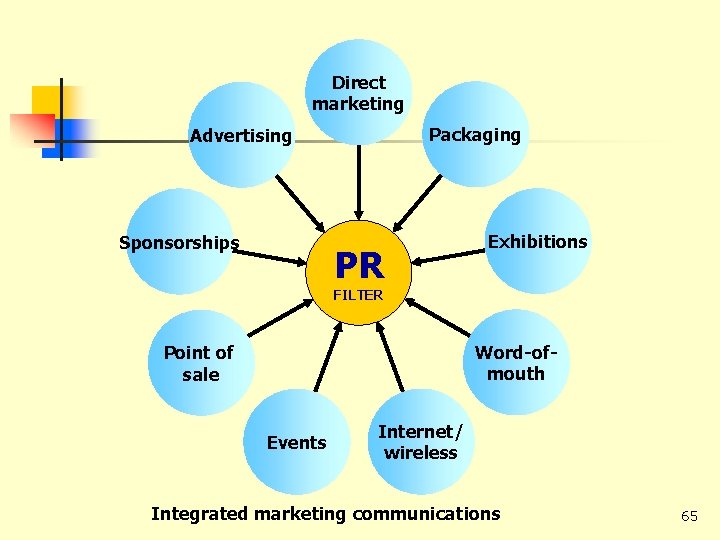
Direct marketing Packaging Advertising Sponsorships PR Exhibitions FILTER Word-ofmouth Point of sale Events Internet/ wireless Integrated marketing communications 65
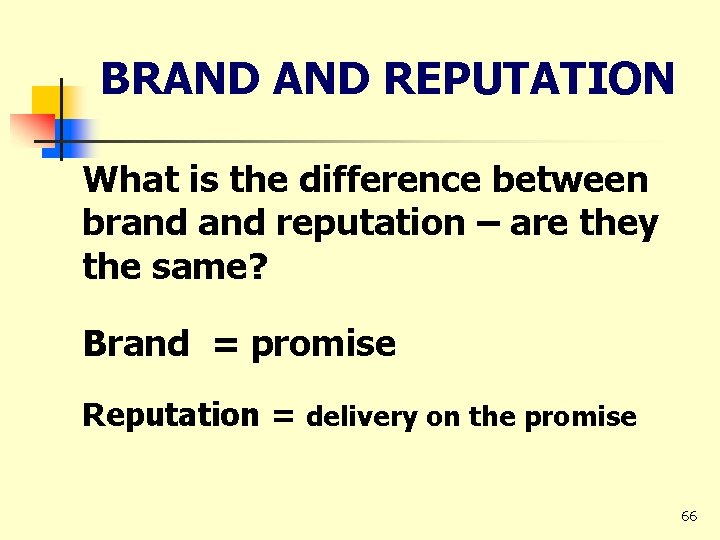
BRAND REPUTATION What is the difference between brand reputation – are they the same? Brand = promise Reputation = delivery on the promise 66
THE BUSINESS CASE FOR REPUTATION? n n Links between reputation and financial performance are not easy to generalize about – evidence to-date unclear and inconsistent Question – how do you measure and what? Mathematical co-relations do not necessarily demonstrate causality The question is complicated and multidimensional 67
BUSINESS CASE FOR REPUTATION n n n Does a good financial performance develop a perception of a good reputation? Good links do exist between corporate image and customer satisfaction Satisfied customers are not always loyal 68
REPUTATION AND FINANCIAL PERFORMANCE n Risk and reputation are linked n Traditional methods of assessing risk: n Value at risk Va. R – a measure of the riskiness of a portfolio, based on assessing the maximum amount that would be lost 19 out of 20 days, given typical levels in market prices 69
BUSINESS CASE FOR REPUTATION MANAGEMENT How do FTSE 100 companies currently measure performance? n n n n Growth in earnings per share (EPS) Total Shareholder Return (TSR) Earnings before Interest and Tax (EBIT) EBITA Economic Value Added (EVA) Return on Capital Employed (ROCE) Net Operating Profit After Tax (NOPAT) 70
BUSINESS CASE FOR REPUTATION MANAGEMENT How do FTSE 100 companies currently measure performance? n Cash flow n Cost of capital management n Market share n Strategic targets 71
BUSINESS CASE FOR REPUTATION Measuring Shareholder Value EVA = (rate of return - cost of capital) x capital employed Other ways of measuring shareholder value include: n Net Present Value (NPV) n Price/earnings ratio (P/E) n Capital asset pricing model (CAPM) n The Du Pont Equation n The Wealth Added Index (WAI) www. sternstewart. co. uk 72
REPUTATION AND CREDIBILITY FOREIGN FIRMS n IPO n London Stock Exchange n Alternative investment market (AIM) n OFEX Share price is now an indicator of a company’s “reputational capital” 73
FOREIGN FIRMS AND REPUTATION DEVELOPMENT n n n n Develop investor relations and financial communications Produce detailed Annual Reports Develop media profile Work towards best practice and compliance with corporate governance Establish a strong and transparent working board Integrate risk analysis in all areas of the business Develop strong and clear corporate responsibility polices Appoint risk and reputation officers 74
INVESTOR RELATIONS n n n n Educate key stakeholders: NGO Help shape and modify legislation Correct misconceptions Lobby on behalf of a trade body Lobby at the Diplomatic level Highlight unfair or restrictive practice Grassroots campaign development Develop high profile media campaigns 75
THE STAKEHOLDER I M P E R A T I V E n n n Classic discussion based on whether a company is solely responsible to just its shareholders or a wider range of interests Pure economic argument focuses on optimising or maximising shareholder return BUT: modern business operates in a volatile, hostel environment – a more pluralistic approach is required 76
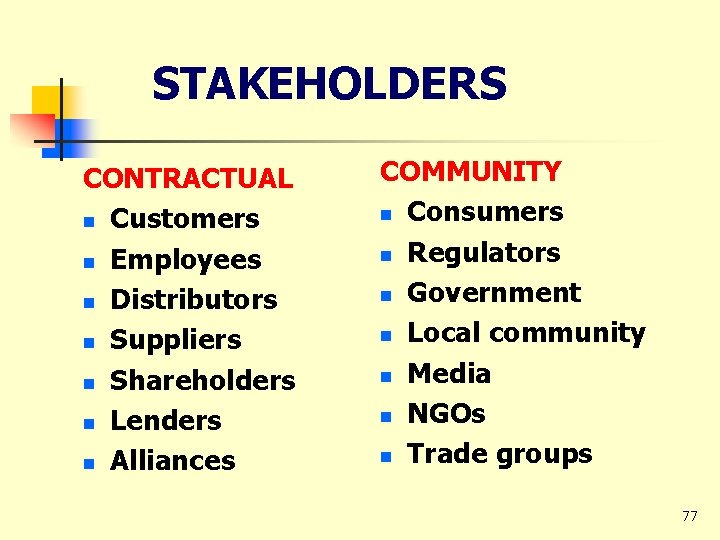
STAKEHOLDERS CONTRACTUAL n Customers n Employees n Distributors n Suppliers n Shareholders n Lenders n Alliances COMMUNITY n Consumers n Regulators n Government n Local community n Media n NGOs n Trade groups 77
STRATEGIC APPROACH TO REPUTATION Since 1980 s Three big ideas 1. TQM - Xerox and Motorola 2. Reengineering 3. Intellectual Capital (KM) – GE It is not the strategy itself sometimes, just the way it is executed. 78
STRATEGY AND REPUTATION n n An organisation’s strategy describes how it intents to create value for its shareholders and stakeholders What is the link between reputation and intangibles? Intangibles are hard for competitors to imitate, therefore they are a source of competitive advantage Co-creation of value 79
STRATEGY AND REPUTATION n n n Intangibles per se do not directly affect financial performance; instead they work more indirectly via a complex chain of cause and effect The impact of a new tangible asset tends to be more immediate Intangibles need to be generally combined with other assets – HR and IT 80
BALANCED SCORECARD Kaplan’s and Norton’s – Balanced Scorecard approach and strategic maps Four perspectives: n Financial n Customer n Process n Developmental n 81
CASE STUDY: Coca-Cola: problems n Poor executive reshuffle n Anti-Americanism: Mecca and Zam Cola n Problems in Belgium 1999 n Faltering financial performance n Crisis with “Dasani” drinking water UK 2004 n Obesity issues n Problems with NGOs in India n Trying to grow faster than the market n Deaths in Colombia 82
Coca-Cola: n n Solutions Continuous brand equity building within communities Citizenship initiatives Work with Greenpeace on reducing carbon dioxide emissions Open acknowledgement of the obesity issue within the US n Sustaining brand identity and Image n Re-evaluation of strategic growth 83
HOW TO DEVELOP A REPUTATION n n n Quality of products and services Passion for brand Customer relationship marketing Strong corporate governance and compliance Integrated risk and issue management Crisis planning Corporate responsibility (CR) Strong brand values, experience and communications Organisational culture and structure Contract fulfilment Business presentation and conferences Customer facing staff 84
HOW TO DEVELOP A REPUTATION n n n Innovation Vision and leadership by CEO Investor relations and public affairs Intelligence gathering Developing media profile Adaptive and ability to reinvent Community relations CEO’s reputation Core competencies Establishing networks and alliances Understand the market Develop brand experience: “moments of truth” 85
HOW TO DEVELOP A REPUTATION n n n n n Clear strategies and resources Learning from other’s mistakes Listening to customers’ opinions Audit and assurance Measuring and evalutation IP protection Stakeholder analysis, mapping and engagement Deliver on customer promise Think global, act local 86
HOW TO DEVELOP A REPUTATION: Organisational Structure n Who talks to who? n Final “gatekeeper” responsibilities n Question of internal communications n Vertical to global matrix to e-business network structures n The Case of ABB – Asea Brown Boveri 87
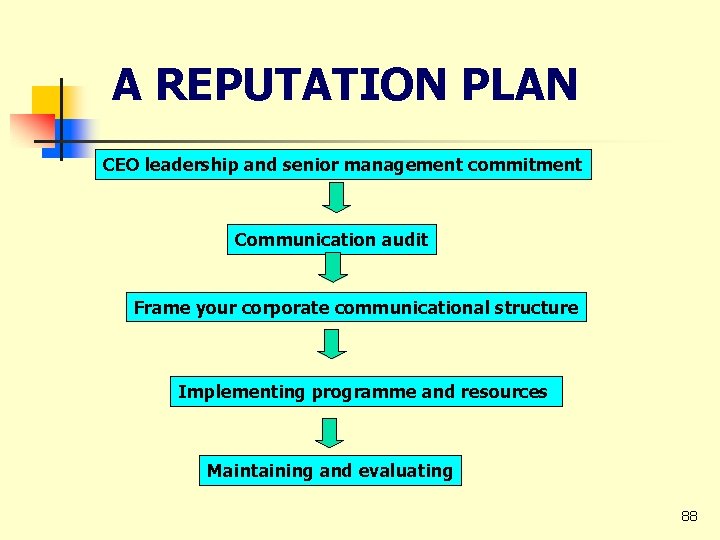
A REPUTATION PLAN CEO leadership and senior management commitment Communication audit Frame your corporate communicational structure Implementing programme and resources Maintaining and evaluating 88
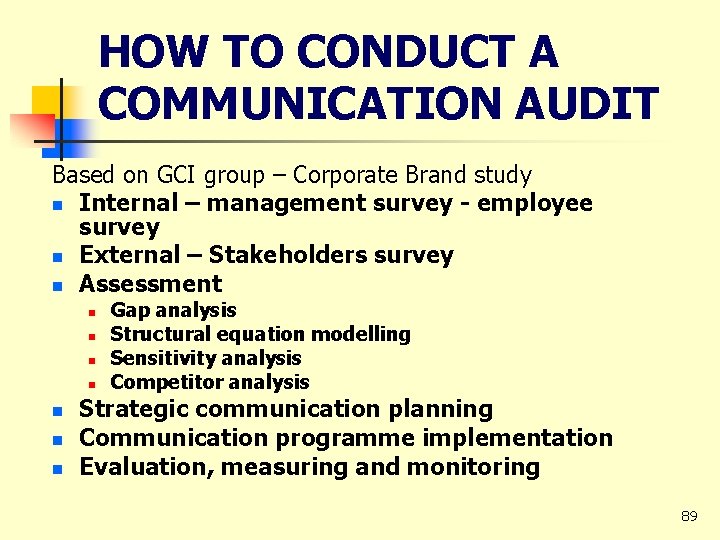
HOW TO CONDUCT A COMMUNICATION AUDIT Based on GCI group – Corporate Brand study n Internal – management survey - employee survey n External – Stakeholders survey n Assessment n n n n Gap analysis Structural equation modelling Sensitivity analysis Competitor analysis Strategic communication planning Communication programme implementation Evaluation, measuring and monitoring 89
CONCLUSION n n The early part of the 21 st Century is the era of reputation management and the management of intangibles The ruthless organisation cannot succeed Companies must adopt pluralistic approaches to managing risk and reputation- must adopt a socio-economic approach Emphasis must go on pro-active approaches, risk and issue management not just crisis management 90
CONCLUSION n n Reputation management must be strategic in nature, but must incorporate emergent properties and reporting: involve everyone, not just managers Getting organisational structure right and managing structural capital is critical 91
CONCLUSION n n Corporations must be innovative, passionate, and adaptive Reputation must be viewed as a strategic weapon, emergent and monitored Stakeholders’ views must be measured and evaluated: what is stakeholder reputation? Reputation management should not stop at senior management and customer facing staff: all employees should be involved 92
CONCLUSION n n Brands are the glue of reputation Develop brand equity internally and externally Ensure your employees understand your intangible assets Be proactive with the media 93
CONCLUSION n n Ensure your brand is not too easily copied or imitable: differentiate by behaviour View CSR as a way forward, not a defence mechanism Develop first rate corporate governance Ask the right questions, then integrate, and integrate 94
- Slides: 94