
2005 NACF Meeting AGC CCA CMIC September 2005
2005 NACF Meeting AGC – CCA - CMIC September, 2005. 1
Associations Overview 2
Associations Overview Mexican Chamber of the Construction Industry q It is a public interest, autonomous institution with its own legal personality and resources, which was created to represent the construction industry’s general interests and to comply with the Business Chambers and Confederations Law. q It has nation-wide jurisdiction. q It has 43 delegations, which confer its National characteristic. Delegations q Institutions whose legal personality and resources are conformed as one. q They represent the Chamber within a territorial distric, in which it exerts its action in state and municipal matters. q They are in charge of offering the services to affiliates. 3
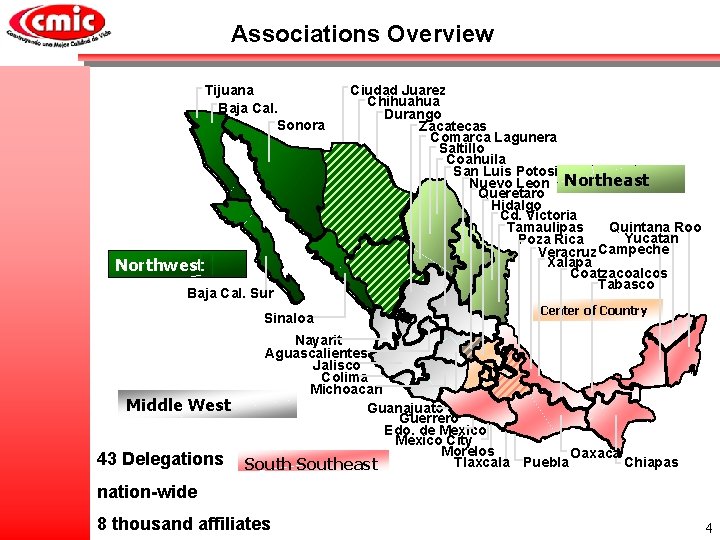
Associations Overview Tijuana Baja Cal. Sonora Noroeste - NO Northwest Baja Cal. Sur Sinaloa Middle West 43 Delegations Ciudad Juarez Chihuahua Durango Zacatecas Comarca Lagunera Saltillo Coahuila San Luis Potosi Nuevo Leon Northeast Queretaro Hidalgo Cd. Victoria Quintana Roo Tamaulipas Yucatan Poza Rica Campeche Veracruz Xalapa Coatzacoalcos Tabasco Center of Country Nayarit Aguascalientes Jalisco Colima Michoacan Guanajuato Guerrero Edo. de Mexico City Morelos Oaxaca Tlaxcala Puebla Chiapas Southeast nation-wide 8 thousand affiliates 4
Associations Overview Normativity Business Chambers and Confederations Law Bylaws Ethics Code Chamber Objectives To represent, protect and promote the general interests of the construction industrialists. To serve as a State’s advisory and collaborative body. To perform all the activities established in the Business Chambers Law. 5
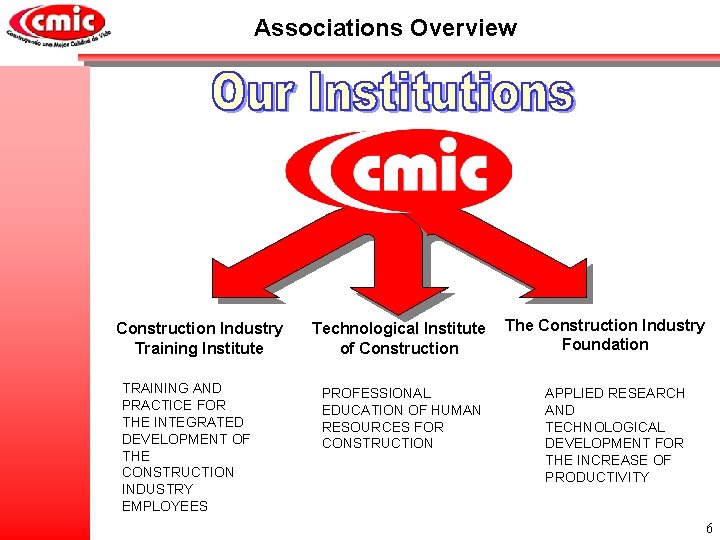
Associations Overview Construction Industry Training Institute TRAINING AND PRACTICE FOR THE INTEGRATED DEVELOPMENT OF THE CONSTRUCTION INDUSTRY EMPLOYEES Technological Institute of Construction PROFESSIONAL EDUCATION OF HUMAN RESOURCES FOR CONSTRUCTION The Construction Industry Foundation APPLIED RESEARCH AND TECHNOLOGICAL DEVELOPMENT FOR THE INCREASE OF PRODUCTIVITY 6
Associations Overview Governing Bodies q General Assembly q Board of Directors q Executive Commission q Chairman of the Board of Directors q Delegational Executive Committees q General Direction 7
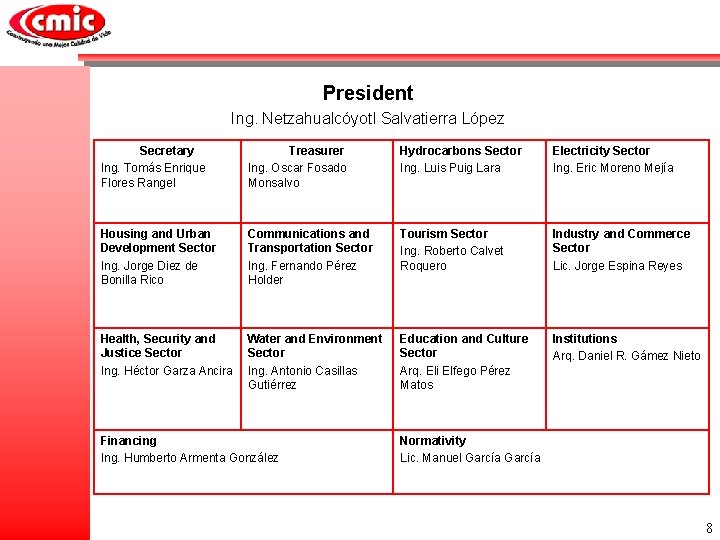
President Ing. Netzahualcóyotl Salvatierra López Secretary Ing. Tomás Enrique Flores Rangel Treasurer Ing. Oscar Fosado Monsalvo Hydrocarbons Sector Ing. Luis Puig Lara Electricity Sector Ing. Eric Moreno Mejía Housing and Urban Development Sector Ing. Jorge Diez de Bonilla Rico Communications and Transportation Sector Ing. Fernando Pérez Holder Tourism Sector Ing. Roberto Calvet Roquero Industry and Commerce Sector Lic. Jorge Espina Reyes Health, Security and Justice Sector Ing. Héctor Garza Ancira Water and Environment Sector Ing. Antonio Casillas Gutiérrez Education and Culture Sector Arq. Eli Elfego Pérez Matos Institutions Arq. Daniel R. Gámez Nieto Financing Ing. Humberto Armenta González Normativity Lic. Manuel García 8
Economic Background 9
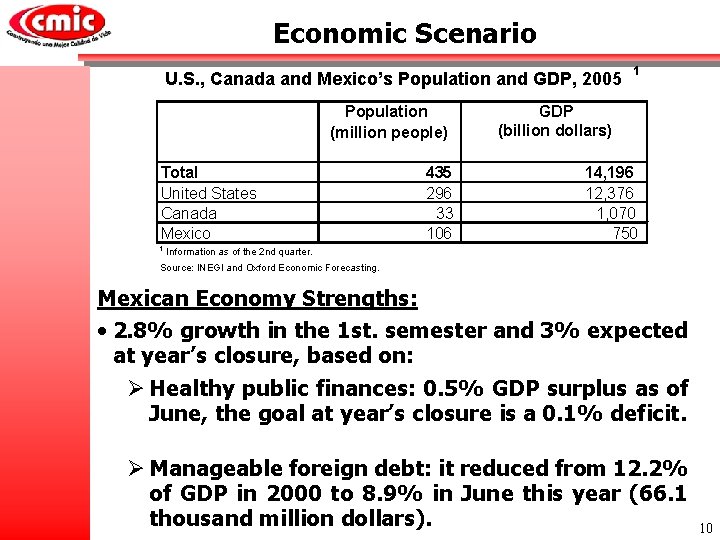
Economic Scenario U. S. , Canada and Mexico’s Population and GDP, 2005 Population (million people) Total United States Canada Mexico 1 435 296 33 106 1 GDP (billion dollars) 14, 196 12, 376 1, 070 750 Information as of the 2 nd quarter. Source: INEGI and Oxford Economic Forecasting. Mexican Economy Strengths: • 2. 8% growth in the 1 st. semester and 3% expected at year’s closure, based on: Ø Healthy public finances: 0. 5% GDP surplus as of June, the goal at year’s closure is a 0. 1% deficit. Ø Manageable foreign debt: it reduced from 12. 2% of GDP in 2000 to 8. 9% in June this year (66. 1 thousand million dollars). 10
Economic Scenario Ø The highest international reserves in history: 60 billion dollars in June. Ø Oil price higher than expected: 51 dls. /barrel in August vs 27 dls. projected. Part of the surplus is allocated to infrastructure works in the provinces. Ø The flow of family remittances continues: 9 billion dollars as of June, 2005, 18% more than in 2004. Ø Exchange rate estimation: 10. 83 pesos per dollar in August, at the end of 2004 it was 11. 15. Ø The Country’s risk has remained at low levels, below 200 points. 11
Economic Scenario The construction industry: • Has shown a progressive growth, from a 2. 1% growth in 2002 to 5. 3% in 2004. An increase of 4% is expected by the end of 2005. • 3% growth as of the first quarter, 2005. • It is one of the main drivers of the Mexican economy. • Housing is the leading sector: 640 thousand housing credits and subsidies will be granted this year, with a 13. 1 million dollar investment, 3. 9% more than in 2004. • Investments in hydrocarbons (11. 5 billion dollars), electricity (4. 6 billion dollars) and highways (2. 5 billion dollars) are also outstanding. • Greater public investment in the provinces due to the extraordinary oil revenues. 12
Economic Scenario • Public-private alliances are multiplying the infrastructure investment: ØHighway concessions: a) -In operation, the Matehuala bypass road (142 km and a 35 million dollar investment); -Under construction, the Mexicali bypass road (41 km and 60 million dollars) and the Tepic-Villa Union Highway (224 km and 221 million dollars); -To be initiated, the Amozoc-Perote (122. 5 km and 174 million dollars) and the Morelia. Salamanca (83 km and 81 million dollars) Highways; -Under bidding process, the Mexico City North bypass road (219 km and 522 million dollars) and the San Luis Rio Colorado International Bridge. b) 22 projects next to be opened for bidding for the concession of more than 700 km, with a total investment of 2. 5 billion dollars. 13
Economic Scenario Ø Projects for Service Rendering: ü Roads: forthcoming initiation of the Irapuato -La Piedad section (74 km and 83 million dollars). Additionally, there are 7 projects next to be opened for bidding for the operation of 438 km, with a total investment of 1. 4 billion dollars. ü The High Specialty Hospital of the Bajio Region [Hospital Regional de Alta Especialidad del Bajio], with 184 beds, is currently in bidding process. ü The bidding process for the San Luis Potosi Polytechnic University is currently under preparation. 14

Political Background 15
Political Background • The presidential candidates of each political party will be defined this year, in order to begin the political campaigns process. • On July 6 th, 2006, the presidential elections and the elections for Federal Deputies and Senators will take place. • The elected President December 1 st, 2006. will take office on 16
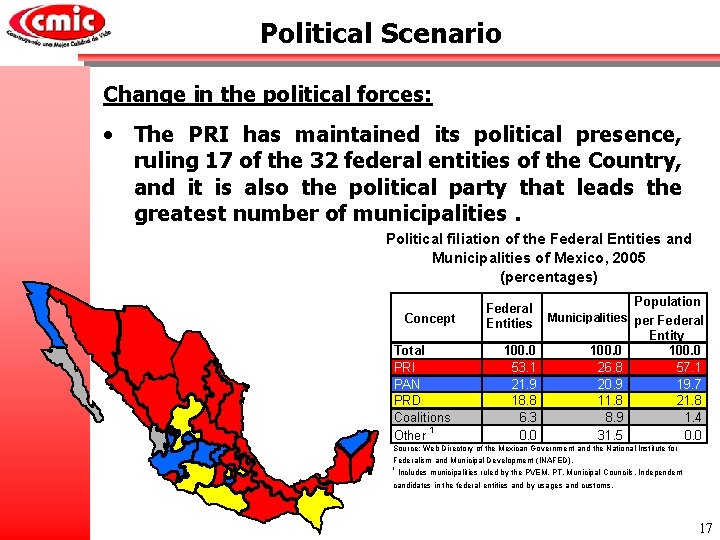
Political Scenario Change in the political forces: • The PRI has maintained its political presence, ruling 17 of the 32 federal entities of the Country, and it is also the political party that leads the greatest number of municipalities. Political filiation of the Federal Entities and Municipalities of Mexico, 2005 (percentages) Concept Total PRI PAN PRD Coalitions 1 Other Federal Entities 100. 0 53. 1 21. 9 18. 8 6. 3 0. 0 Municipalities 100. 0 26. 8 20. 9 11. 8 8. 9 31. 5 Population per Federal Entity 100. 0 57. 1 19. 7 21. 8 1. 4 0. 0 Source: Web Directory of the Mexican Government and the National Institute for Federalism and Municipal Development (INAFED). 1 Includes municipalities ruled by the PVEM, PT, Municipal Councils, Independent candidates in the federal entities and by usages and customs. 17
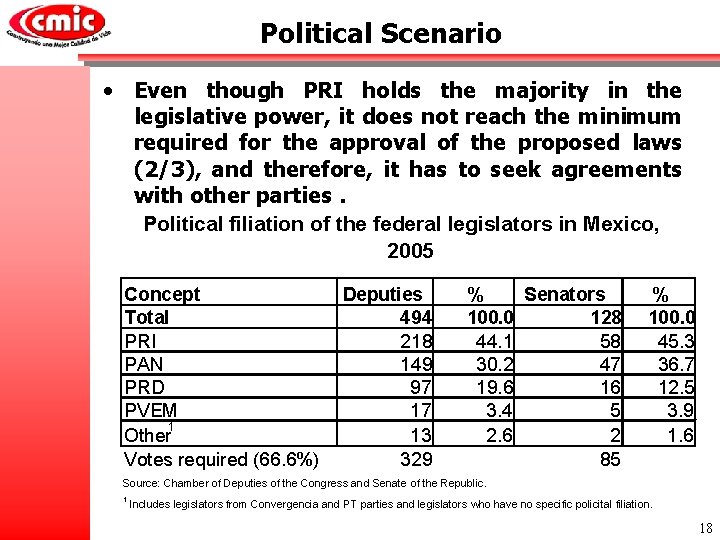
Political Scenario • Even though PRI holds the majority in the legislative power, it does not reach the minimum required for the approval of the proposed laws (2/3), and therefore, it has to seek agreements with other parties. Political filiation of the federal legislators in Mexico, 2005 Concept Total PRI PAN PRD PVEM 1 Other Votes required (66. 6%) Deputies 494 218 149 97 17 13 329 % Senators 100. 0 128 44. 1 58 30. 2 47 19. 6 16 3. 4 5 2. 6 2 85 % 100. 0 45. 3 36. 7 12. 5 3. 9 1. 6 Source: Chamber of Deputies of the Congress and Senate of the Republic. 1 Includes legislators from Convergencia and PT parties and legislators who have no specific policital filiation. 18
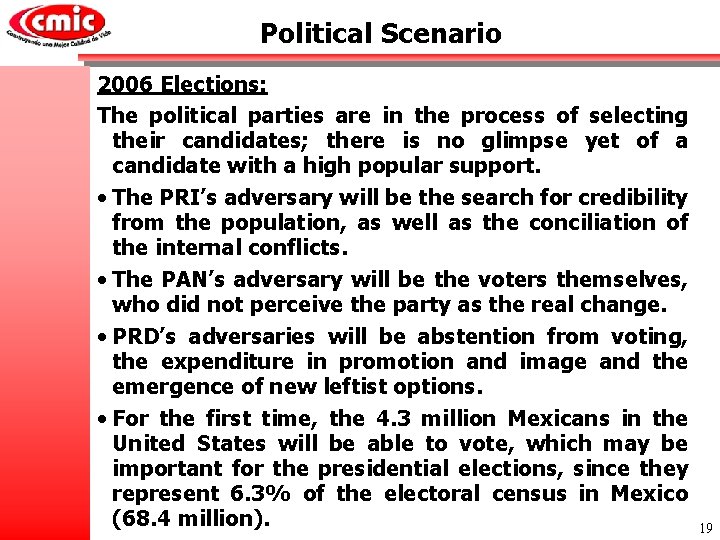
Political Scenario 2006 Elections: The political parties are in the process of selecting their candidates; there is no glimpse yet of a candidate with a high popular support. • The PRI’s adversary will be the search for credibility from the population, as well as the conciliation of the internal conflicts. • The PAN’s adversary will be the voters themselves, who did not perceive the party as the real change. • PRD’s adversaries will be abstention from voting, the expenditure in promotion and image and the emergence of new leftist options. • For the first time, the 4. 3 million Mexicans in the United States will be able to vote, which may be important for the presidential elections, since they represent 6. 3% of the electoral census in Mexico (68. 4 million). 19
Accomplishments and Priorities 20
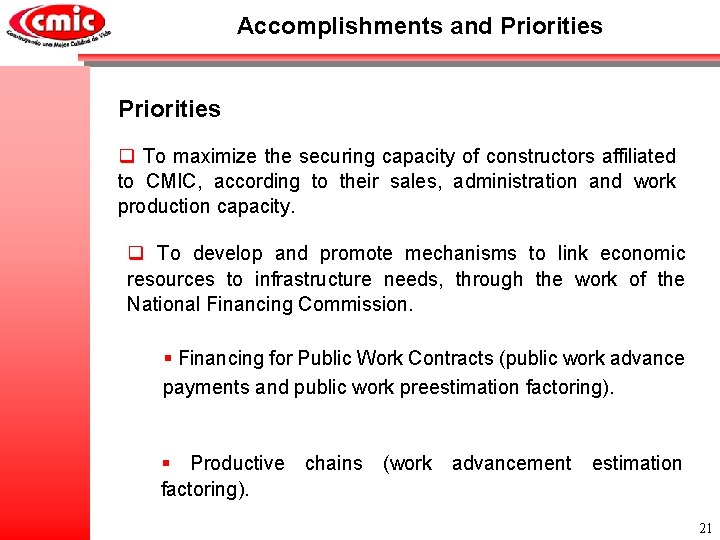
Accomplishments and Priorities q To maximize the securing capacity of constructors affiliated to CMIC, according to their sales, administration and work production capacity. q To develop and promote mechanisms to link economic resources to infrastructure needs, through the work of the National Financing Commission. § Financing for Public Work Contracts (public work advance payments and public work preestimation factoring). § Productive chains (work advancement estimation factoring). 21
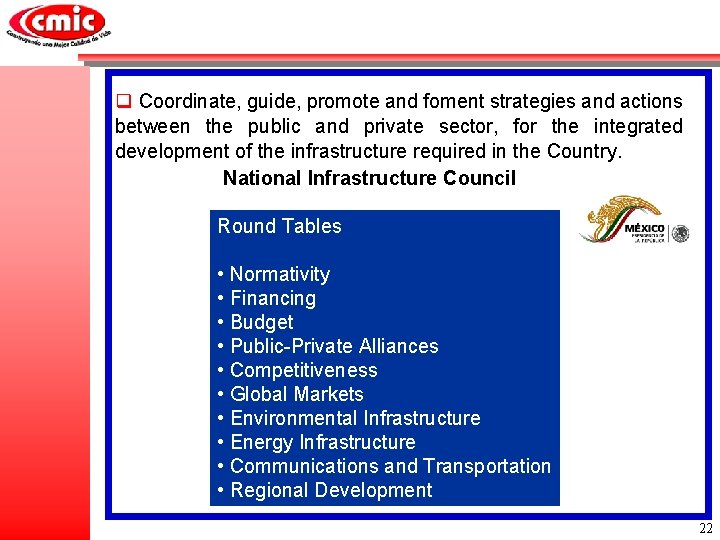
q Coordinate, guide, promote and foment strategies and actions between the public and private sector, for the integrated development of the infrastructure required in the Country. National Infrastructure Council Round Tables • Normativity • Financing • Budget • Public-Private Alliances • Competitiveness • Global Markets • Environmental Infrastructure • Energy Infrastructure • Communications and Transportation • Regional Development 22
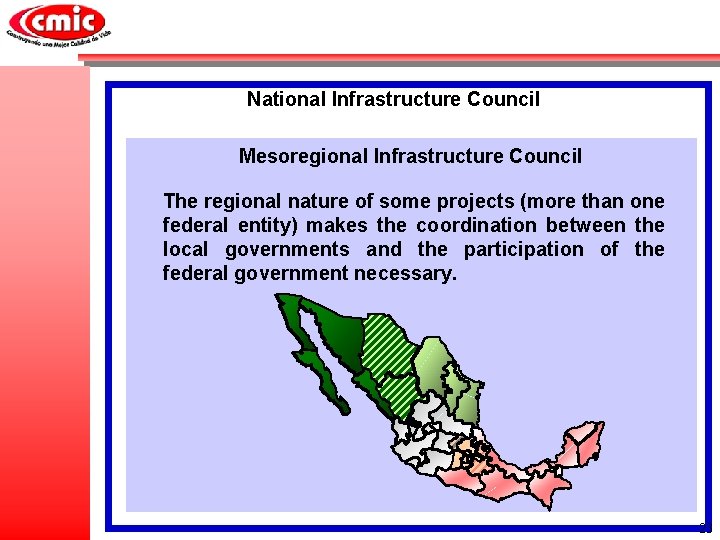
National Infrastructure Council Mesoregional Infrastructure Council The regional nature of some projects (more than one federal entity) makes the coordination between the local governments and the participation of the federal government necessary. 23
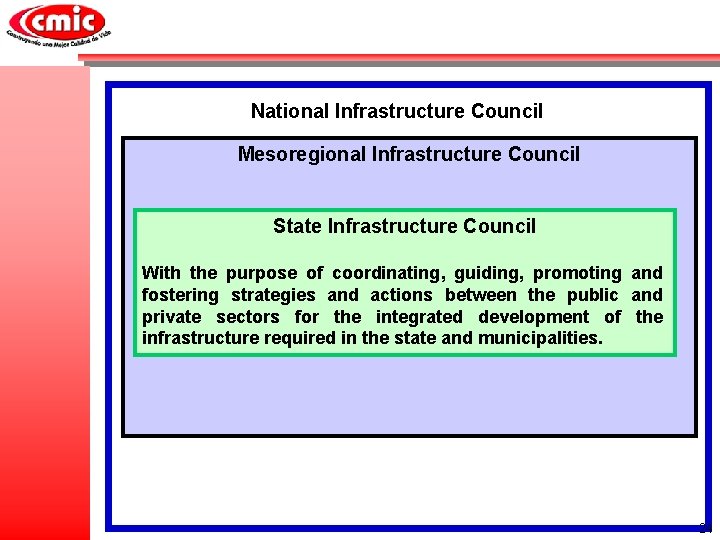
National Infrastructure Council Mesoregional Infrastructure Council State Infrastructure Council With the purpose of coordinating, guiding, promoting and fostering strategies and actions between the public and private sectors for the integrated development of the infrastructure required in the state and municipalities. 24
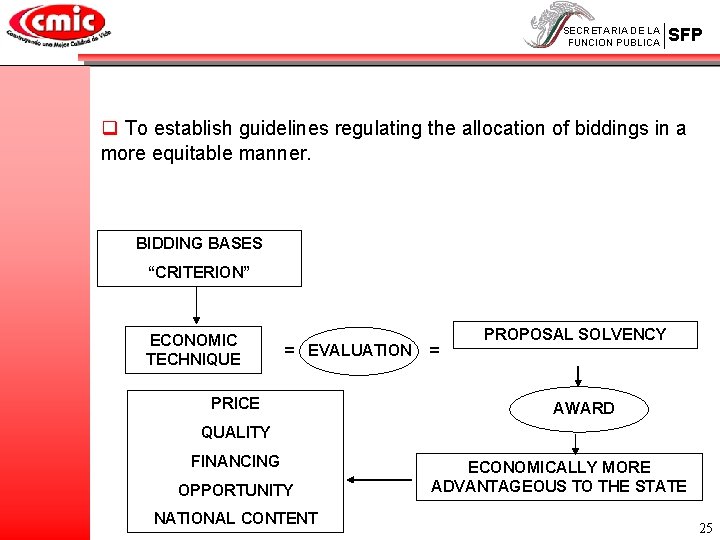
SECRETARIA DE LA FUNCION PUBLICA SFP q To establish guidelines regulating the allocation of biddings in a more equitable manner. BIDDING BASES “CRITERION” ECONOMIC TECHNIQUE = EVALUATION PRICE = PROPOSAL SOLVENCY AWARD QUALITY FINANCING OPPORTUNITY NATIONAL CONTENT ECONOMICALLY MORE ADVANTAGEOUS TO THE STATE 25
SECRETARIA DE LA FUNCION PUBLICA SFP q To assure the mechanisms and procedures allowing the completion of the infrastructure projects promoted by the federal government in terms of transparency, equity and legal certainty, so they are completed timely and in the due form. AGREEMENT BETWEEN CMIC AND THE PUBLIC FUNCTION DEPARTMENT FOR SAID PURPOSE The strategic entities that execute the most important governmental public works concur in the agreement. 26
SECRETARIA DE LA FUNCION PUBLICA SFP q To collaborate in the transparency and fight against corruption practices within contracting processes. AGREEMENT BETWEEN CMIC, THE PUBLIC FUNCTION DEPARTMENT AND THE FEDERAL ROADS AND BRIDGES AGENCY PARTICIPATION IN THE BIDDING BASES OF IMPORTANT PROJECTS PREPARED BY PEMEX q To promote training, validation and certification among companies in this sector. THERE ARE INTEGRAL PROGRAMS CONSIDERING TRAINING COURSES, DIPLOMA COURSES, VALIDATION AND CERTIFICATION OF COMPANIES BY SPECIALTY, CURRENTLY IN HOUSING AND TOURISM 27
Labor / Labour Topics 28
Migration and Labor Policy Mexicans in the United States: • The estimated number of Mexican-origin people living in the United States is 26. 6 million. ØThe number of people born in Mexico who live in the United States equals 9. 9 million. o 54% entered between 1990 and 2002. o Only 22% have the U. S. citizenship. o 69% are in working ages, i. e. , 6. 8 million people. o Construction and the primary sector draw 17% and 4. 4% of the working population, respectively. 29
Migration and Labor Policy Temporary migration: • Around 437 thousand mexicans in average cross the border each year as temporary immigrants who later go back to their communities of origin. Of these, 79% work without authorization. • The temporary immigrants flow decreased from 464 thousand during 1993 -1997 to 437 thousand in 2001 -2003. • Between 2001 -2003, the average stay of temporary immigrants in the U. S. increased to 12. 2 months, in contrast with 5. 5 months during 19931997. 30
Migration and Labor Policy The migration policy of the Mexican Government with the U. S. : • The Mexican Government seeks: o To allow the safe, suitable, legal and orderly displacement and residence of Mexicans. o A negotiation with the United States, considering migration as a shared responsibility. • The September 11, 2001 attacks have limited the advancement of the migration agreement. 31
Migration and Labor Policy • The U. S. migration agenda considers the following: o The migratory regularization of around 3. 5 million indocumented immigrants. o A temporary workers program allowing the authorized access of Mexicans to productive regions and sectors of the U. S. o The strengthening of border security aimed to prevent the death of immigrants and illegal people trade. 32

Job Safety 33
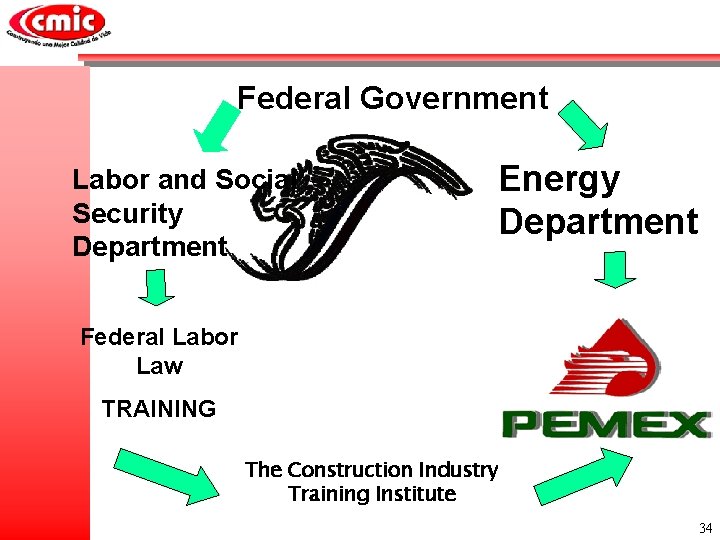
Federal Government Labor and Social Security Department Energy Department Federal Labor Law TRAINING The Construction Industry Training Institute 34
BACKGROUND Petroleos Mexicanos is one of the companies of greatest interest due to the continuous improvement of the productive processes of its organization and the respect for the communities and the ecological setting where it operates; in addition, one of its priorities is the Industrial Safety and Environmental Protection in its facilities and for the personnel working in them. 35
Consolidation of contracting companies workers safety through training Due to the fact that the contractors’ personnel in Pemex Gas represented 40% of the total population in 1998, Pemex Gas suggested as strategy the training in industrial safety and environmental protection through CMICICIC. On November 18 th, 1998, an Agreement was undersigned with CMICICIC for the training of the contractors’ personnel in industrial safety and THE GOAL IS O CER Incidents environmental protection. 36
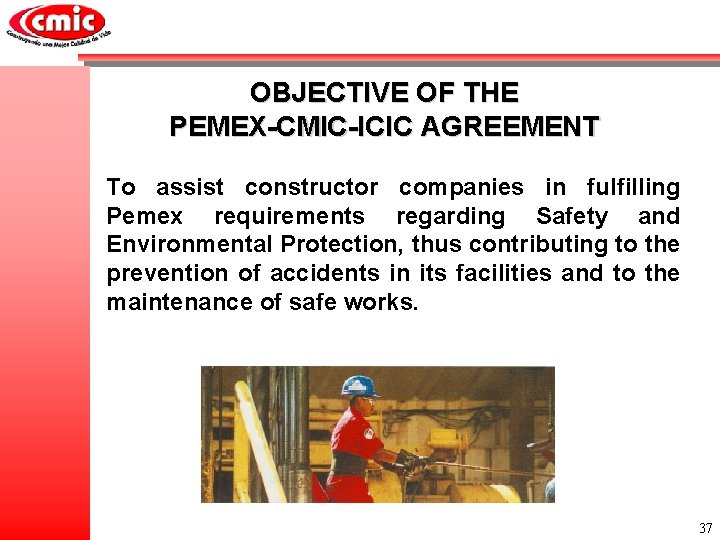
OBJECTIVE OF THE PEMEX-CMIC-ICIC AGREEMENT To assist constructor companies in fulfilling Pemex requirements regarding Safety and Environmental Protection, thus contributing to the prevention of accidents in its facilities and to the maintenance of safe works. 37
Operation Strategy To assure that the construction activities performed by Contracting Companies are executed according to PEMEX’s safety and environmental protection standards, and that their performance in this area equals that of world class companies in the construction sector. By means of: Training Incorporation of Industrial Safety and Environmental Protection requirements in contracts. 7 38
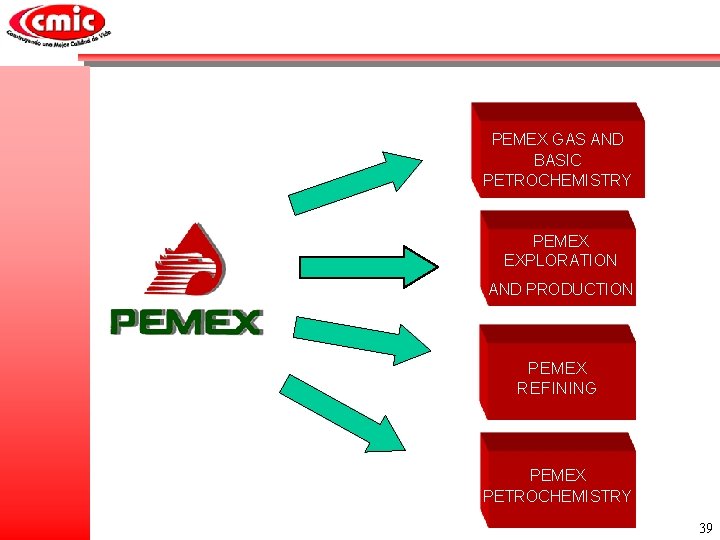
PEMEX GAS AND BASIC PETROCHEMISTRY PEMEX EXPLORATION AND PRODUCTION PEMEX REFINING PEMEX PETROCHEMISTRY 39
PEMEX-ICIC Training Strategy Development and implementation of training programs in Industrial Safety and Environmental Protection for medium level and operating personnel in companies that develop construction and maintenance projects in Petroleos Mexicanos subsidiaries. 40
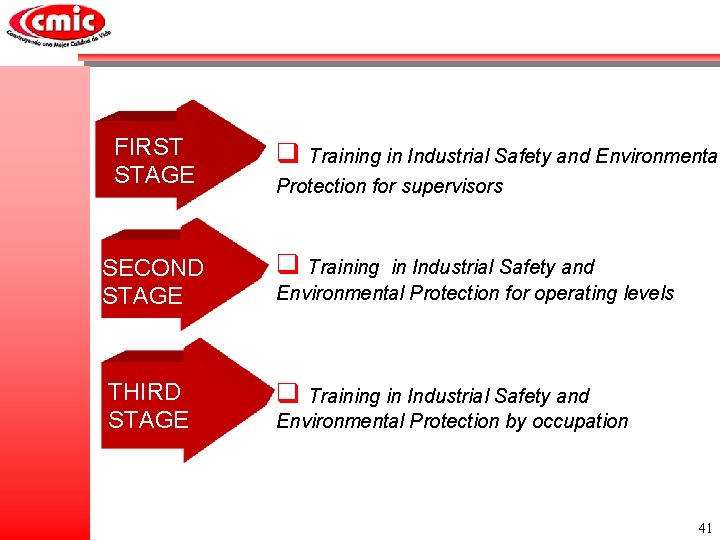
FIRST STAGE q Training in Industrial Safety and Environmental Protection for supervisors SECOND STAGE q Training THIRD STAGE q Training in Industrial Safety and Environmental Protection for operating levels Environmental Protection by occupation 41
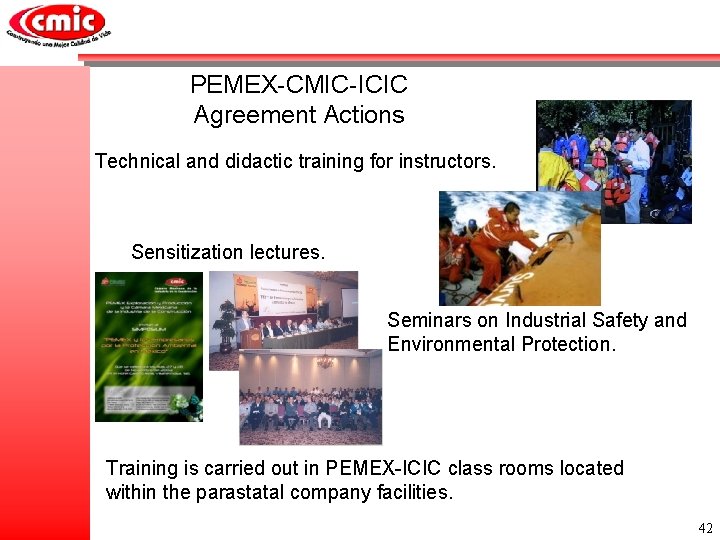
PEMEX-CMIC-ICIC Agreement Actions Technical and didactic training for instructors. Sensitization lectures. Seminars on Industrial Safety and Environmental Protection. Training is carried out in PEMEX-ICIC class rooms located within the parastatal company facilities. 42
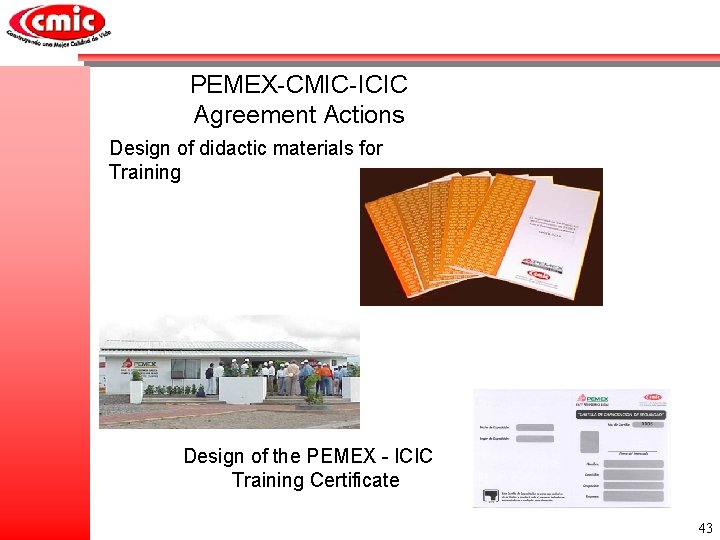
PEMEX-CMIC-ICIC Agreement Actions Design of didactic materials for Training Design of the PEMEX - ICIC Training Certificate 43
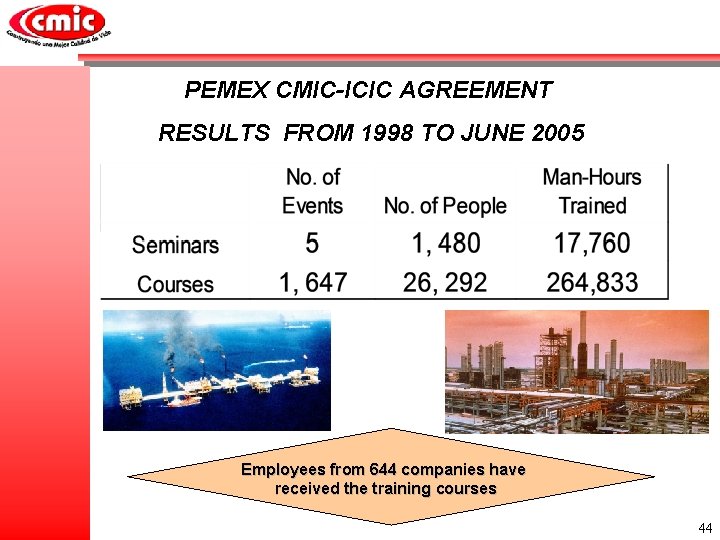
PEMEX CMIC-ICIC AGREEMENT RESULTS FROM 1998 TO JUNE 2005 Employees from 644 companies have received the training courses 44
Environmental Aspects RULING LAWS AND REGULATIONS FOR TOURISM DEVELOPMENTS 45
RULING LAWS AND REGULATIONS FOR TOURISM DEVELOPMENTS • In terms of environmental regulations, basic terms are defined in the Constitution of Mexico in it’s 4 th article: “Every person has the right for an appropiate environment in order to find prosperity. ” • Articlr 27 underlines that “The property of land water inside the national territory belongs to the nation, having by that the right to regulate the use of the natural resources, assure it’s conservation, preserve and restore the ecological equilibrium, in order to achieve an equilibrate development of the country. ” • There is also the General Law of Ecological Equilibrium and the Protection of the Environment (LGEEPA) as well as the Official Mexican Rulings (NOM’S). Their goal si to preserve and restore the ecological equilibrium. 46
• In order to obtain authorization to develop a tourism resort, an evaluation of the environmental impact needs to be done, as it is defined in article 28 of the General Law of Ecological Equilibrium and Environment Protection : “The Environmental Impact Evaluation is the procedure through wich the Ministry of Environment and Natural Resources (SEMARNAT) establishes the conditions for construction and activities that might cause unstable ecosystems or avoid the limits and conditions establish in the appropiate laws to protect the environment and preserve the ecosystems, in order to reduce to the minimum the negative effects on the environment. . ” § Project should be developed according to local urban plans and the federal ecological ruling, declarations of indangered species and other laws that might apply. 47
§ The official laws that have more impact on Tourism developments are: Ø NOM-022 -SEMARNAT-2003, Establishes the specifications to preserve and watch the ustaintability of the coast zones with mangrove. Ø NOM-059 -SEMARNAT-2001, Protects the native mexican species of silvester flora and fauna at risk. Ø PROY-NOM-140 -SEMARNAT-2005, Establishes the general environmental requirements to develop golf courses and resorts that include them. 48
§ Tourism is an activity that can increase the value of local ecosystems, and integrates the people to the town, city or municipality development, wich is more important during the transition from rural municipalities to urban developments. § It’s an economic activity that might sustain the environmental conditions and who’s responsability belongs to the nation. § Environmental legislation in a major component in any tourism develpment in Mexico, essencial to prevent future damages, and to prepare how to deal with problems. 49
CONSTRUCTION INPUTS AVAILABILITY AND PRICES 50
Creation of Employments in Construction The construction industry generates directly more than 4 million remunerated occupations, which represents 12% of the total national occupied personnel amounting to more than 33 million, besides of generating more than 1. 5 million direct employments in sectors related to this industry, which represent 5% of the national total. Iron and steel, Cement, Transportation, oil and oil derivatives, financial services, structural metallic products, professional services, wood and cork products, glass and glass products, machinery and electric devices, plastic products, basic chemistry, restaurants and hotels are among the main sectors in which indirect employments are generated. 51
Import and Export of Construction Materials According to the Foreign Trade Bank (BANCOMEXT), from January to November, 2004, the construction materials and ironwork imports amounted to 4. 6 billion dollars (including the manufacturing [maquila] of products made with raw materials from the country of origin, for example, tools and machinery). Imports The 3 main concepts imported were hand tools, various valves and their parts, as well as screws, nuts and iron or steel bolts. Regarding the origin of imports, more than 72% come from the United States, 3. 8% from Germany, 3. 4% from China, 3. 2% from Spain and 3. 0% from Japan. 52
According to BANCOMEXT, from January to November, 2004, the construction materials and ironwork exports amounted to 5. 9 billion dollars (including maquila), a figure 24. 5% higher than that in 2003. Exports The three main concepts exported were wrench valves and common metal, iron or manufactured steel parts in various forms, as well as marble and cut stones. The destination of exports was as follows: more than 90% to the United States, around 2% to Canada and around 1% to Guatemala and 0. 5% to Germany. Commercial Balance This yields a positive balance for Mexico in construction materials, of 1. 3 billion dollars during 2004. 53
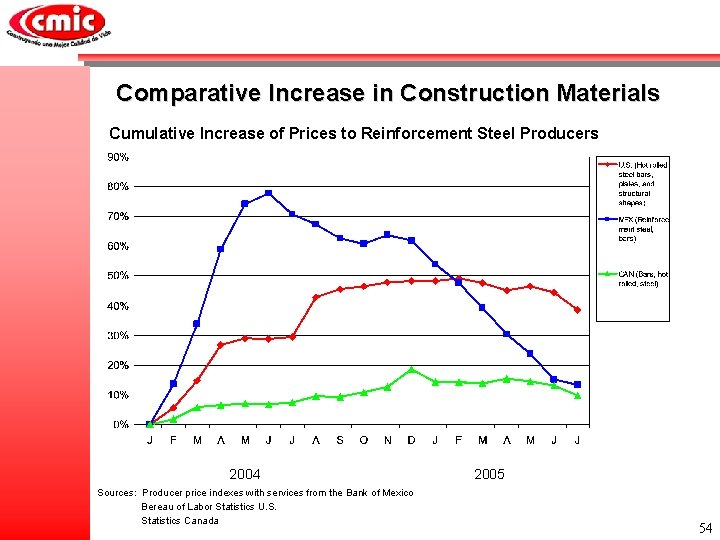
Comparative Increase in Construction Materials Cumulative Increase of Prices to Reinforcement Steel Producers 2004 Sources: Producer price indexes with services from the Bank of Mexico Bereau of Labor Statistics U. S. Statistics Canada 2005 54
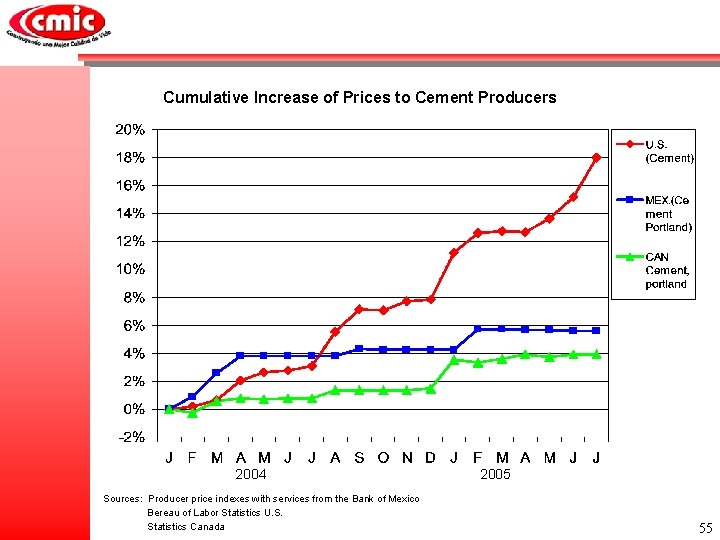
Cumulative Increase of Prices to Cement Producers 2004 Sources: Producer price indexes with services from the Bank of Mexico Bereau of Labor Statistics U. S. Statistics Canada 2005 55
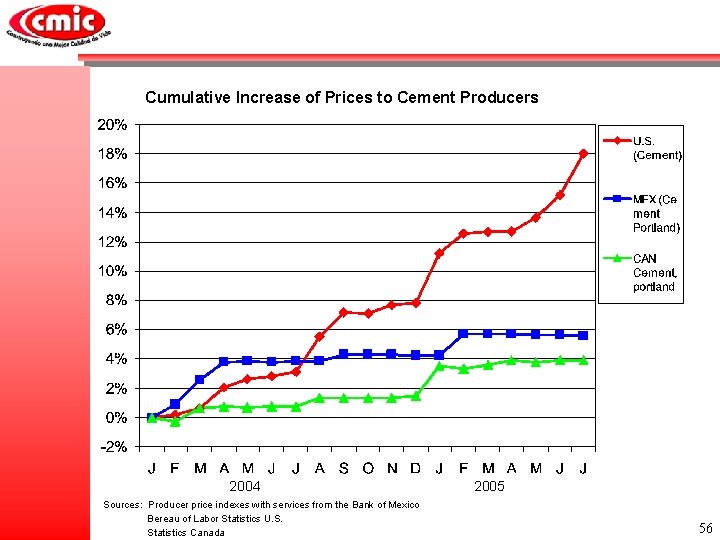
Cumulative Increase of Prices to Cement Producers 2004 Sources: Producer price indexes with services from the Bank of Mexico Bereau of Labor Statistics U. S. Statistics Canada 2005 56
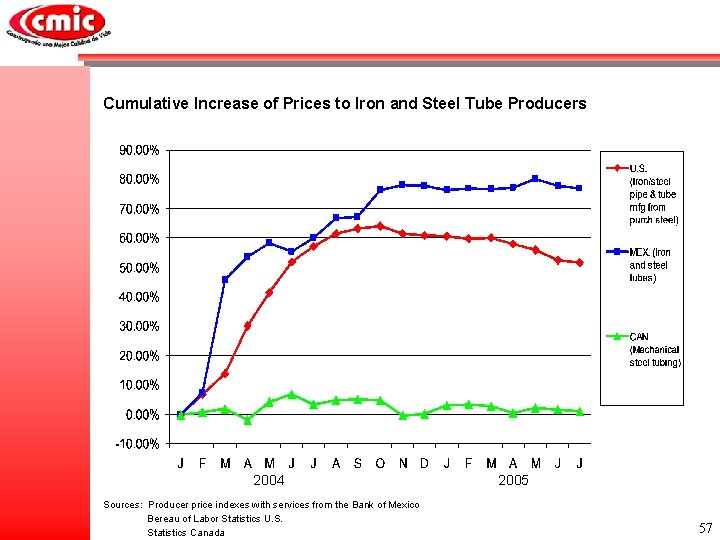
Cumulative Increase of Prices to Iron and Steel Tube Producers 2004 Sources: Producer price indexes with services from the Bank of Mexico Bereau of Labor Statistics U. S. Statistics Canada 2005 57
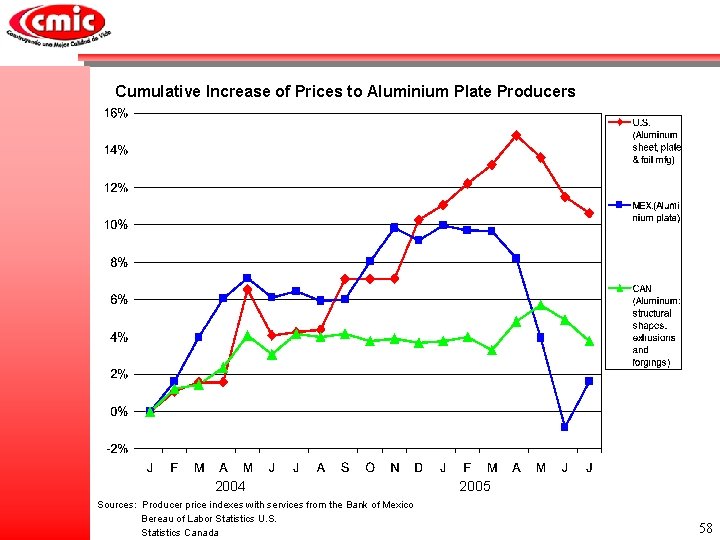
Cumulative Increase of Prices to Aluminium Plate Producers 2004 Sources: Producer price indexes with services from the Bank of Mexico Bereau of Labor Statistics U. S. Statistics Canada 2005 58
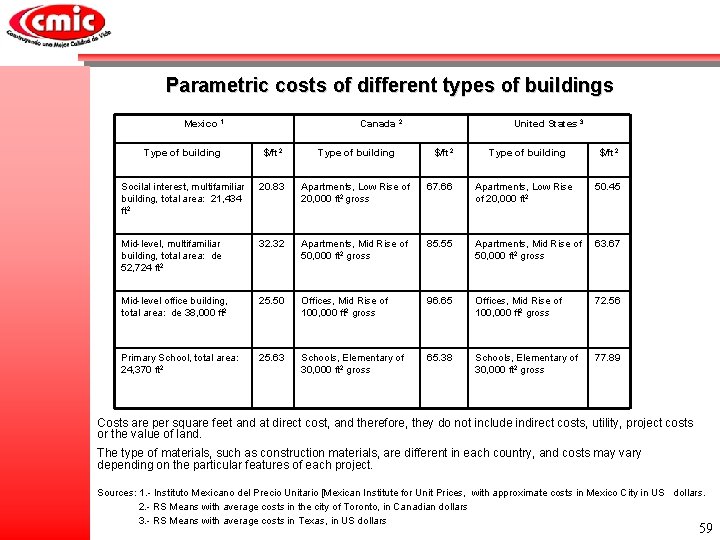
Parametric costs of different types of buildings Mexico 1 Canada 2 United States 3 Type of building $/ft 2 Socilal interest, multifamiliar building, total area: 21, 434 ft 2 20. 83 Apartments, Low Rise of 20, 000 ft 2 gross 67. 66 Apartments, Low Rise of 20, 000 ft 2 50. 45 Mid-level, multifamiliar building, total area: de 52, 724 ft 2 32. 32 Apartments, Mid Rise of 50, 000 ft 2 gross 85. 55 Apartments, Mid Rise of 50, 000 ft 2 gross 63. 67 Mid-level office building, total area: de 38, 000 ft 2 25. 50 Offices, Mid Rise of 100, 000 ft 2 gross 96. 65 Offices, Mid Rise of 100, 000 ft 2 gross 72. 56 Primary School, total area: 24, 370 ft 2 25. 63 Schools, Elementary of 30, 000 ft 2 gross 65. 38 Schools, Elementary of 30, 000 ft 2 gross 77. 89 Costs are per square feet and at direct cost, and therefore, they do not include indirect costs, utility, project costs or the value of land. The type of materials, such as construction materials, are different in each country, and costs may vary depending on the particular features of each project. Sources: 1. - Instituto Mexicano del Precio Unitario [Mexican Institute for Unit Prices, with approximate costs in Mexico City in US dollars. 2. - RS Means with average costs in the city of Toronto, in Canadian dollars 3. - RS Means with average costs in Texas, in US dollars 59
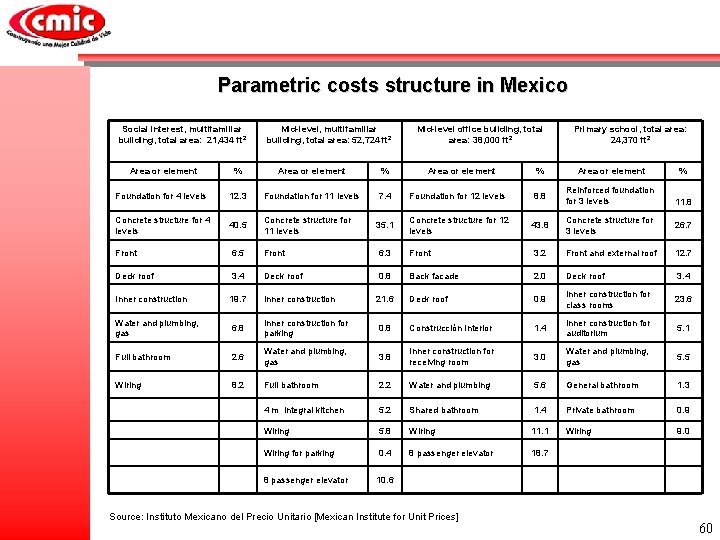
Parametric costs structure in Mexico Social interest, multifamiliar building, total area: 21, 434 ft 2 Area or element Mid-level, multifamiliar building, total area: 52, 724 ft 2 % Area or element % Foundation for 4 levels 12. 3 Foundation for 11 levels 7. 4 Concrete structure for 4 levels 40. 5 Concrete structure for 11 levels Front 6. 5 Deck roof Mid-level office building, total area: 38, 000 ft 2 Area or element Primary school, total area: 24, 370 ft 2 % Area or element % Foundation for 12 levels 8. 8 Reinforced foundation for 3 levels 11. 8 35. 1 Concrete structure for 12 levels 43. 8 Concrete structure for 3 levels 26. 7 Front 6. 3 Front 3. 2 Front and external roof 12. 7 3. 4 Deck roof 0. 8 Back facade 2. 0 Deck roof 3. 4 Inner construction 19. 7 Inner construction 21. 6 Deck roof 0. 9 Inner construction for class rooms 23. 6 Water and plumbing, gas 6. 8 Inner construction for parking 0. 8 Construcción Interior 1. 4 Inner construction for auditorium 5. 1 Full bathroom 2. 6 Water and plumbing, gas 3. 8 Inner construction for receiving room 3. 0 Water and plumbing, gas 5. 5 Wiring 8. 2 Full bathroom 2. 2 Water and plumbing 5. 6 General bathroom 1. 3 4 m integral kitchen 5. 2 Shared bathroom 1. 4 Private bathroom 0. 9 Wiring 5. 8 Wiring 11. 1 Wiring 9. 0 Wiring for parking 0. 4 8 passenger elevator 18. 7 8 passenger elevator 10. 6 Source: Instituto Mexicano del Precio Unitario [Mexican Institute for Unit Prices] 60
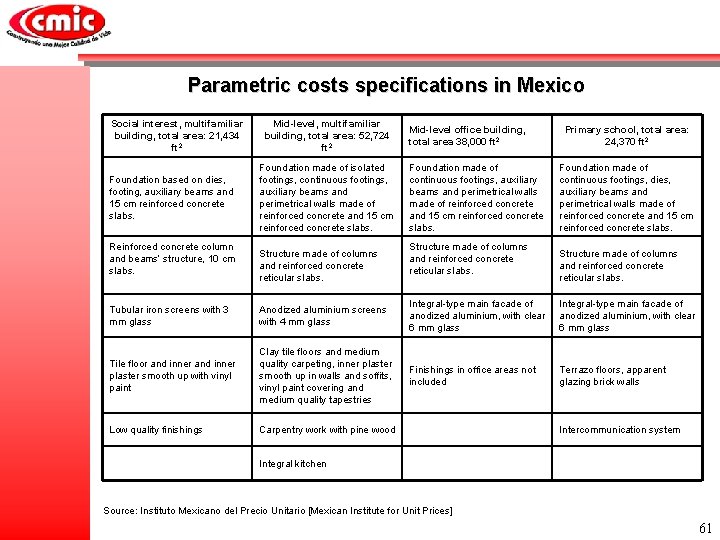
Parametric costs specifications in Mexico Social interest, multifamiliar building, total area: 21, 434 ft 2 Foundation based on dies, footing, auxiliary beams and 15 cm reinforced concrete slabs. Reinforced concrete column and beams’ structure, 10 cm slabs. Mid-level, multifamiliar building, total area: 52, 724 ft 2 Foundation made of isolated footings, continuous footings, auxiliary beams and perimetrical walls made of reinforced concrete and 15 cm reinforced concrete slabs. Structure made of columns and reinforced concrete reticular slabs. Mid-level office building, total area 38, 000 ft 2 Foundation made of continuous footings, auxiliary beams and perimetrical walls made of reinforced concrete and 15 cm reinforced concrete slabs. Structure made of columns and reinforced concrete reticular slabs. Primary school, total area: 24, 370 ft 2 Foundation made of continuous footings, dies, auxiliary beams and perimetrical walls made of reinforced concrete and 15 cm reinforced concrete slabs. Structure made of columns and reinforced concrete reticular slabs. Tubular iron screens with 3 mm glass Anodized aluminium screens with 4 mm glass Integral-type main facade of anodized aluminium, with clear 6 mm glass Tile floor and inner plaster smooth up with vinyl paint Clay tile floors and medium quality carpeting, inner plaster smooth up in walls and soffits, vinyl paint covering and medium quality tapestries Finishings in office areas not included Terrazo floors, apparent glazing brick walls Low quality finishings Carpentry work with pine wood Intercommunication system Integral kitchen Source: Instituto Mexicano del Precio Unitario [Mexican Institute for Unit Prices] 61

Research and Innovation 62
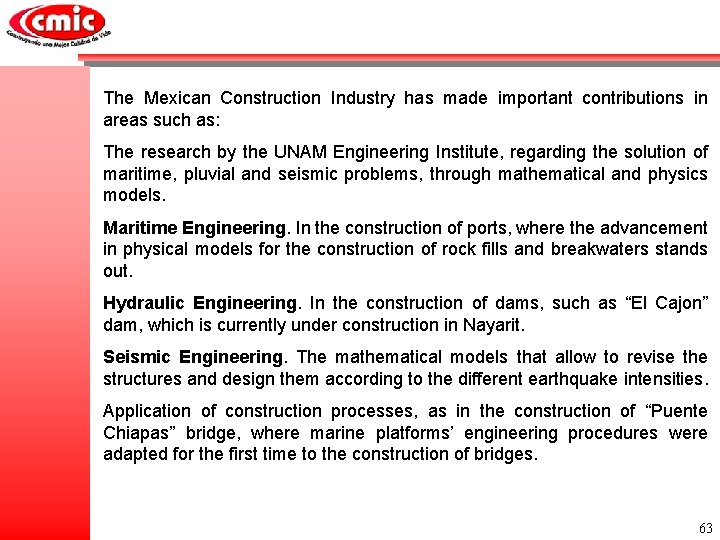
The Mexican Construction Industry has made important contributions in areas such as: The research by the UNAM Engineering Institute, regarding the solution of maritime, pluvial and seismic problems, through mathematical and physics models. Maritime Engineering. In the construction of ports, where the advancement in physical models for the construction of rock fills and breakwaters stands out. Hydraulic Engineering. In the construction of dams, such as “El Cajon” dam, which is currently under construction in Nayarit. Seismic Engineering. The mathematical models that allow to revise the structures and design them according to the different earthquake intensities. Application of construction processes, as in the construction of “Puente Chiapas” bridge, where marine platforms’ engineering procedures were adapted for the first time to the construction of bridges. 63
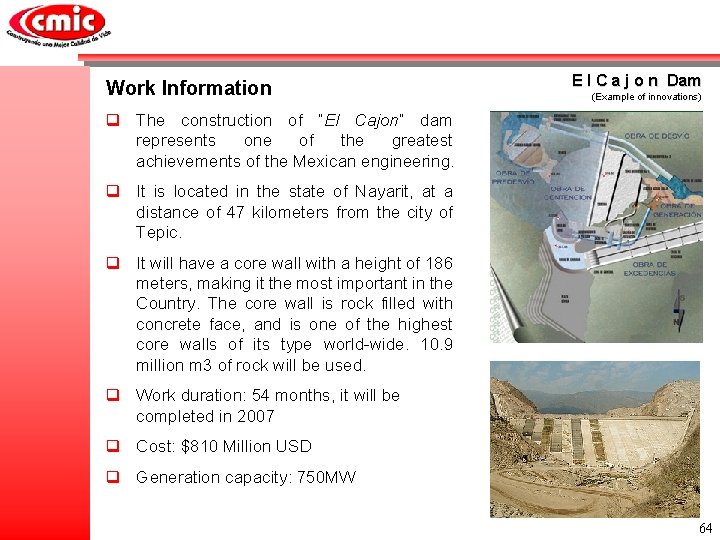
Work Information E l C a j o n Dam (Example of innovations) q The construction of “El Cajon” dam represents one of the greatest achievements of the Mexican engineering. q It is located in the state of Nayarit, at a distance of 47 kilometers from the city of Tepic. q It will have a core wall with a height of 186 meters, making it the most important in the Country. The core wall is rock filled with concrete face, and is one of the highest core walls of its type world-wide. 10. 9 million m 3 of rock will be used. q Work duration: 54 months, it will be completed in 2007 q Cost: $810 Million USD q Generation capacity: 750 MW 64
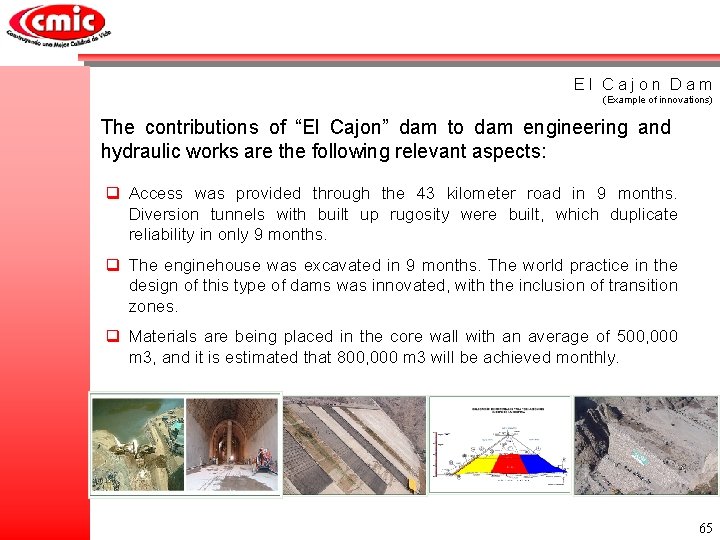
El Cajon Dam (Example of innovations) The contributions of “El Cajon” dam to dam engineering and hydraulic works are the following relevant aspects: q Access was provided through the 43 kilometer road in 9 months. Diversion tunnels with built up rugosity were built, which duplicate reliability in only 9 months. q The enginehouse was excavated in 9 months. The world practice in the design of this type of dams was innovated, with the inclusion of transition zones. q Materials are being placed in the core wall with an average of 500, 000 m 3, and it is estimated that 800, 000 m 3 will be achieved monthly. 65
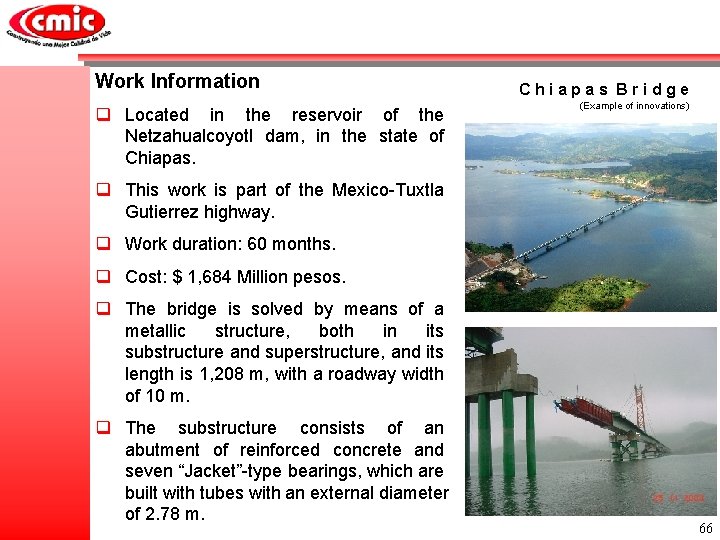
Work Information q Located in the reservoir of the Netzahualcoyotl dam, in the state of Chiapas Bridge (Example of innovations) q This work is part of the Mexico-Tuxtla Gutierrez highway. q Work duration: 60 months. q Cost: $ 1, 684 Million pesos. q The bridge is solved by means of a metallic structure, both in its substructure and superstructure, and its length is 1, 208 m, with a roadway width of 10 m. q The substructure consists of an abutment of reinforced concrete and seven “Jacket”-type bearings, which are built with tubes with an external diameter of 2. 78 m. 66
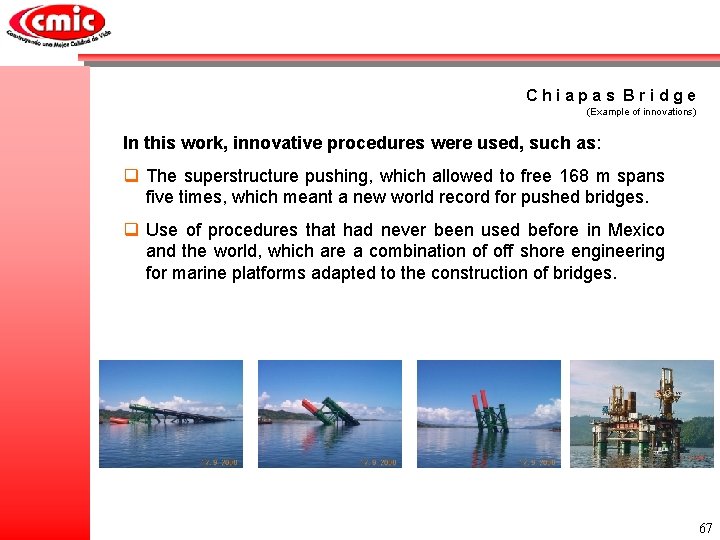
Chiapas Bridge (Example of innovations) In this work, innovative procedures were used, such as: q The superstructure pushing, which allowed to free 168 m spans five times, which meant a new world record for pushed bridges. q Use of procedures that had never been used before in Mexico and the world, which are a combination of off shore engineering for marine platforms adapted to the construction of bridges. 67
- Slides: 67