
2000 PrenticeHall Inc Statistics for Business and Economics
© 2000 Prentice-Hall, Inc. Statistics for Business and Economics Probability Chapter 3 3 -1
Learning Objectives © 2000 Prentice-Hall, Inc. 1. Define Experiment, Outcome, Event, Sample Space, & Probability 2. Explain How to Assign Probabilities 3. Use a Contingency Table, Venn Diagram, or Tree to Find Probabilities 4. Describe & Use Probability Rules 3 -2
Thinking Challenge © 2000 Prentice-Hall, Inc. What’s the probability of getting a head on the toss of a single fair coin? Use a scale from 0 (no way) to 1 (sure thing). So toss a coin twice. Do it! Did you get one head & one tail? What’s it all mean? 3 -3
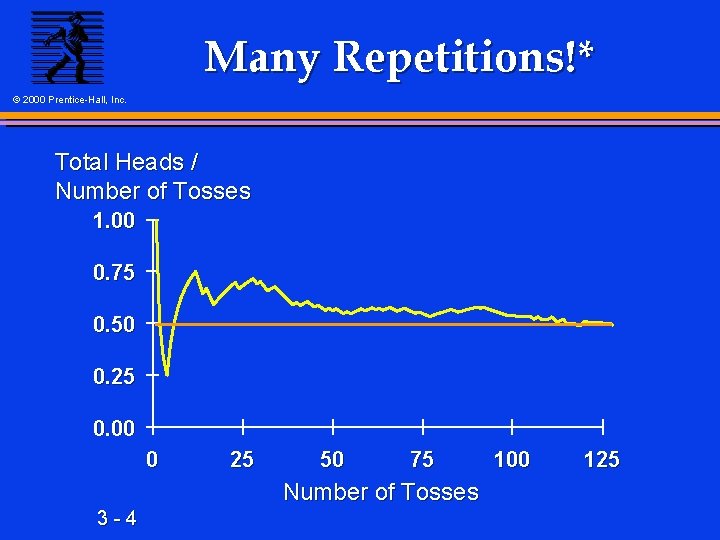
Many Repetitions!* © 2000 Prentice-Hall, Inc. Total Heads / Number of Tosses 1. 00 0. 75 0. 50 0. 25 0. 00 0 25 50 75 Number of Tosses 3 -4 100 125
© 2000 Prentice-Hall, Inc. Experiments, Outcomes, & Events 3 -5
Experiments & Outcomes © 2000 Prentice-Hall, Inc. 1. Experiment n Process of Obtaining an Observation, Outcome or Simple Event 2. Sample Point n Most Basic Outcome of an Experiment Sample Space Depends on Experimenter! 3. Sample Space (S) n Collection of All Possible Outcomes 3 -6
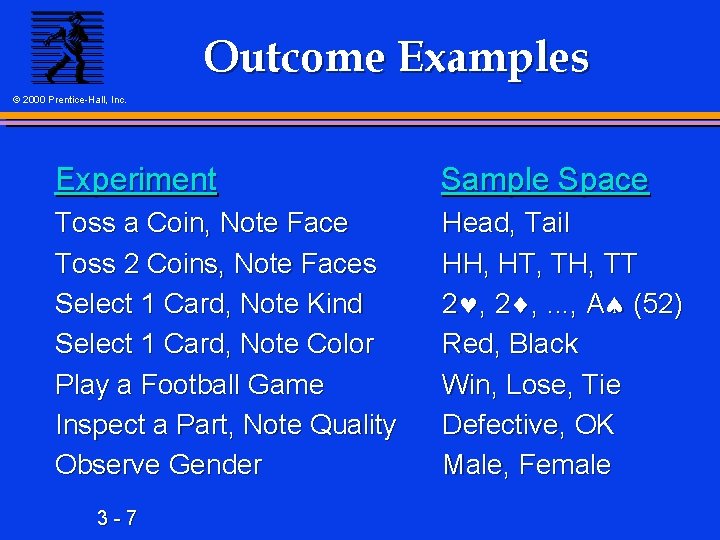
Outcome Examples © 2000 Prentice-Hall, Inc. Experiment Sample Space Toss a Coin, Note Face Toss 2 Coins, Note Faces Select 1 Card, Note Kind Select 1 Card, Note Color Play a Football Game Inspect a Part, Note Quality Observe Gender Head, Tail HH, HT, TH, TT 2 , . . . , A (52) Red, Black Win, Lose, Tie Defective, OK Male, Female 3 -7
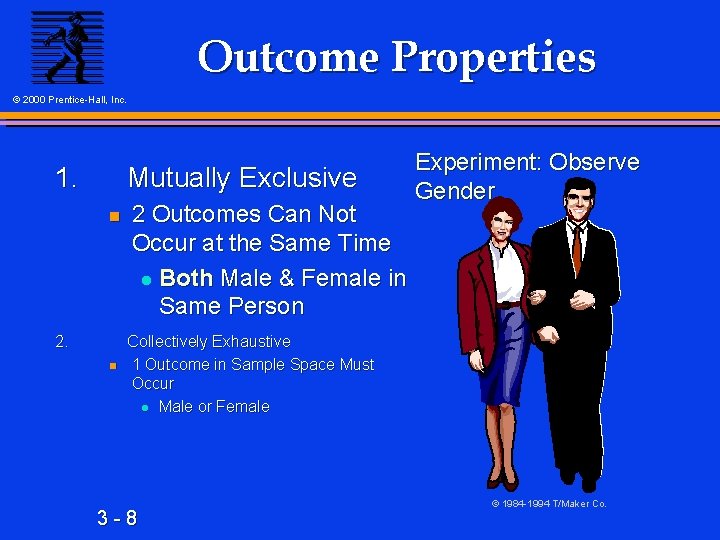
Outcome Properties © 2000 Prentice-Hall, Inc. 1. Mutually Exclusive n 2 Outcomes Can Not Occur at the Same Time l Both Male & Female in Same Person Experiment: Observe Gender Collectively Exhaustive 1 Outcome in Sample Space Must Occur l Male or Female 3 -8 © 1984 -1994 T/Maker Co.
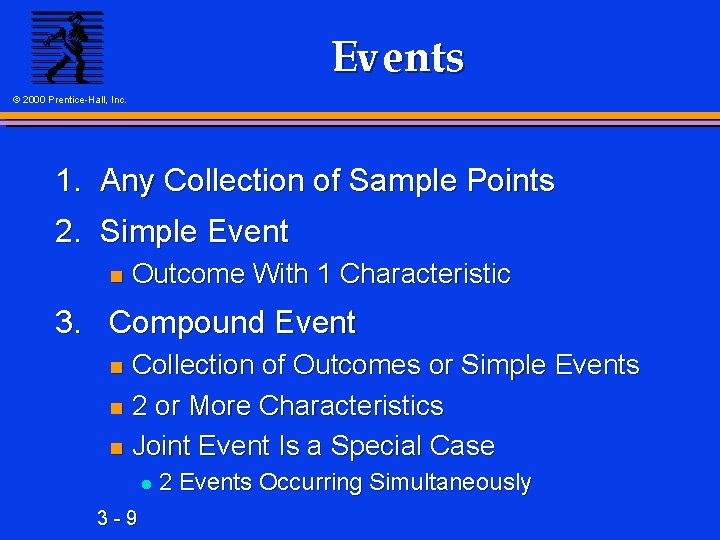
Events © 2000 Prentice-Hall, Inc. 1. Any Collection of Sample Points 2. Simple Event n Outcome With 1 Characteristic 3. Compound Event Collection of Outcomes or Simple Events n 2 or More Characteristics n Joint Event Is a Special Case n l 3 -9 2 Events Occurring Simultaneously
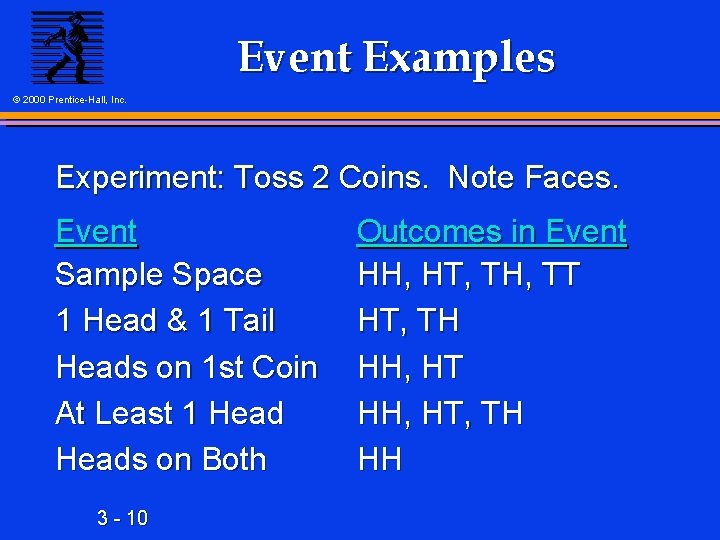
Event Examples © 2000 Prentice-Hall, Inc. Experiment: Toss 2 Coins. Note Faces. Event Sample Space 1 Head & 1 Tail Heads on 1 st Coin At Least 1 Heads on Both 3 - 10 Outcomes in Event HH, HT, TH, TT HT, TH HH, HT, TH HH
© 2000 Prentice-Hall, Inc. Sample Space 3 - 11
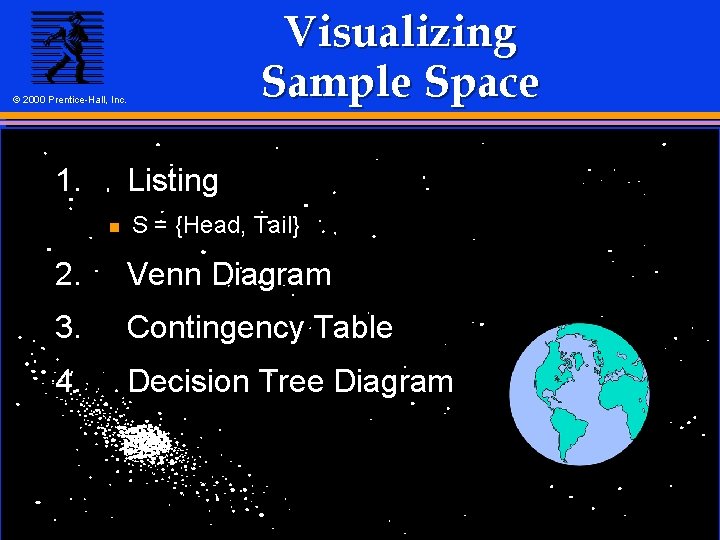
Visualizing Sample Space © 2000 Prentice-Hall, Inc. 1. Listing n S = {Head, Tail} 2. Venn Diagram 3. Contingency Table 4. Decision Tree Diagram 3 - 12
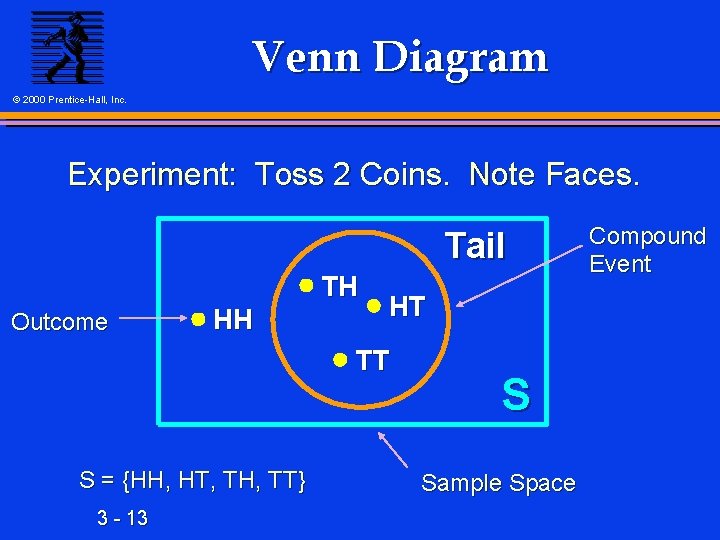
Venn Diagram © 2000 Prentice-Hall, Inc. Experiment: Toss 2 Coins. Note Faces. Tail TH Outcome HH HT TT S = {HH, HT, TH, TT} 3 - 13 S Sample Space Compound Event
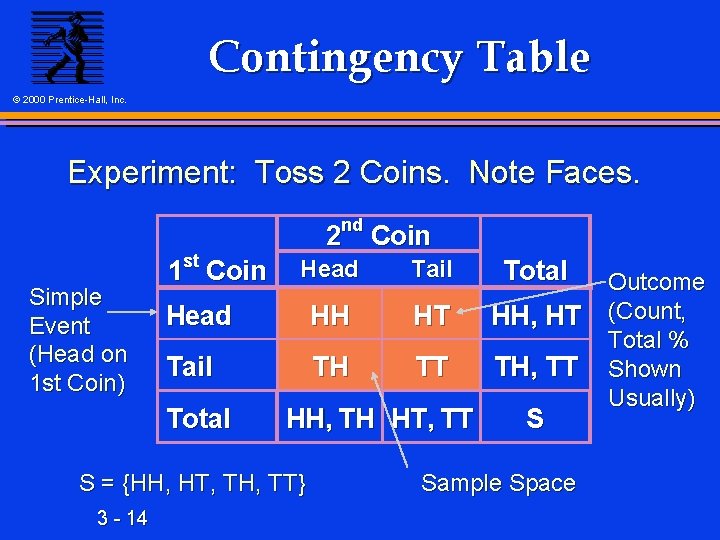
Contingency Table © 2000 Prentice-Hall, Inc. Experiment: Toss 2 Coins. Note Faces. nd st Simple Event (Head on 1 st Coin) 2 Head Tail Total Head HH HT HH, HT Tail TH TT TH, TT 1 Coin Total HH, TH HT, TT S = {HH, HT, TH, TT} 3 - 14 Coin S Sample Space Outcome (Count, Total % Shown Usually)
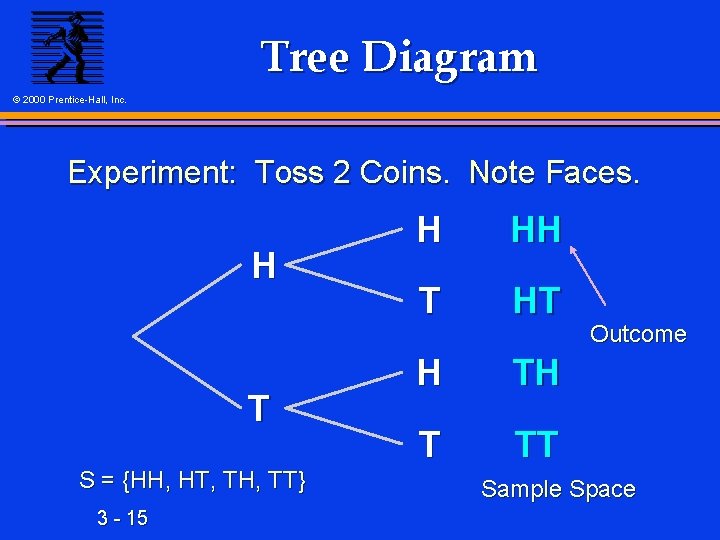
Tree Diagram © 2000 Prentice-Hall, Inc. Experiment: Toss 2 Coins. Note Faces. H T S = {HH, HT, TH, TT} 3 - 15 H HH T HT H TH T TT Outcome Sample Space
© 2000 Prentice-Hall, Inc. Compound Events 3 - 16
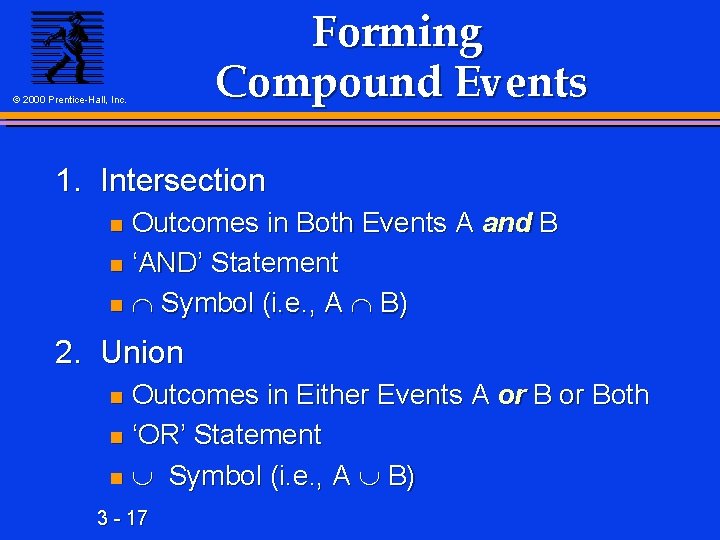
© 2000 Prentice-Hall, Inc. Forming Compound Events 1. Intersection Outcomes in Both Events A and B n ‘AND’ Statement n Symbol (i. e. , A B) n 2. Union Outcomes in Either Events A or Both n ‘OR’ Statement n Symbol (i. e. , A B) n 3 - 17
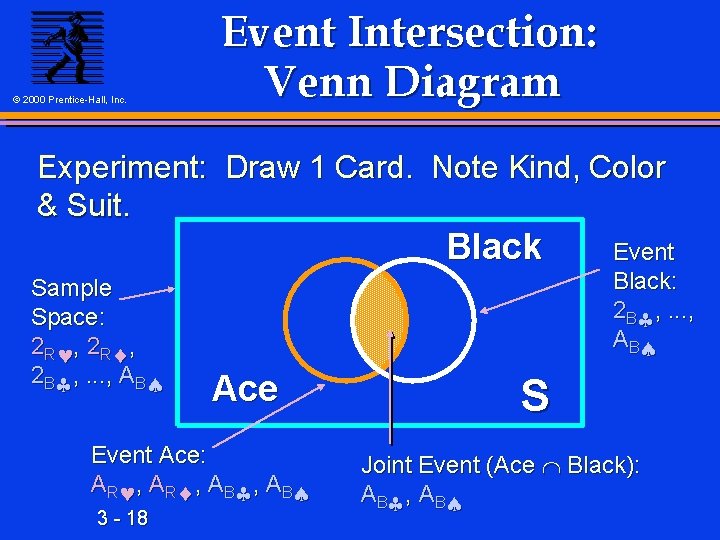
© 2000 Prentice-Hall, Inc. Event Intersection: Venn Diagram Experiment: Draw 1 Card. Note Kind, Color & Suit. Black Sample Space: 2 R , 2 B , . . . , AB Ace Event Ace: A R , A B 3 - 18 Event Black: 2 B , . . . , A B S Joint Event (Ace Black): A B , A B
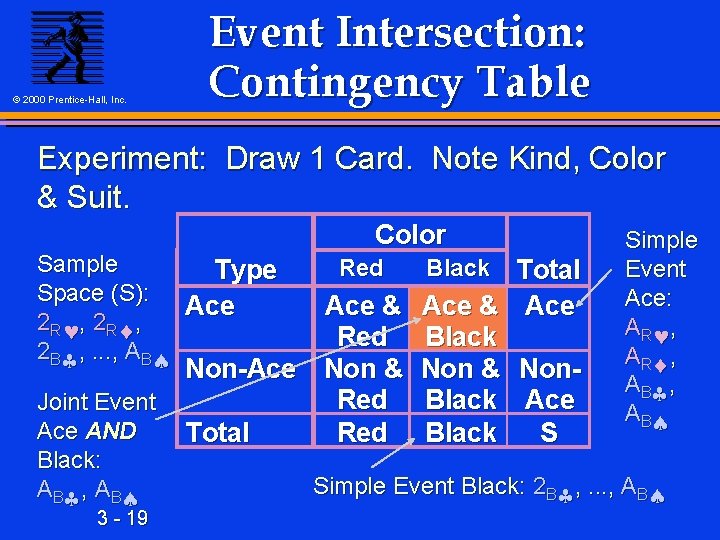
© 2000 Prentice-Hall, Inc. Event Intersection: Contingency Table Experiment: Draw 1 Card. Note Kind, Color & Suit. Color Sample Type Space (S): Ace 2 R , 2 B , . . . , AB Joint Event Ace AND Black: A B , A B 3 - 19 Red Black Total Ace & Ace Red Black Non-Ace Non & Non. Red Black Ace Total Red Black S Simple Event Ace: A R , A B Simple Event Black: 2 B , . . . , AB
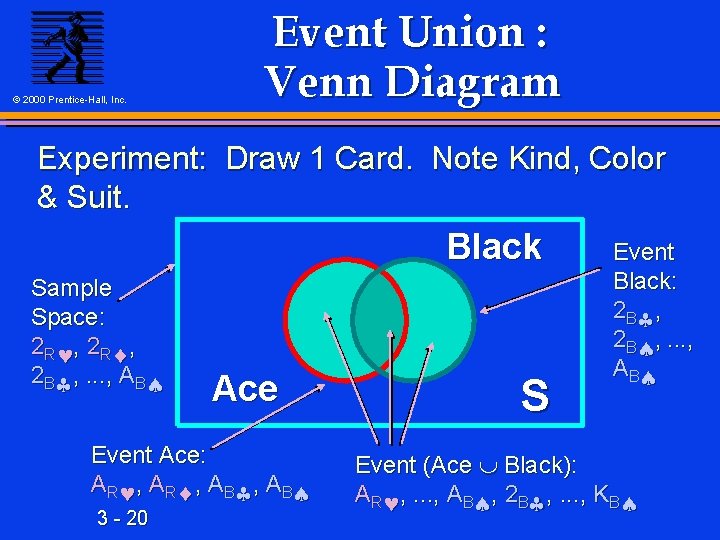
© 2000 Prentice-Hall, Inc. Event Union : Venn Diagram Experiment: Draw 1 Card. Note Kind, Color & Suit. Black Sample Space: 2 R , 2 B , . . . , AB Ace Event Ace: A R , A B 3 - 20 S Event Black: 2 B , 2 B , . . . , A B Event (Ace Black): AR , . . . , AB , 2 B , . . . , KB
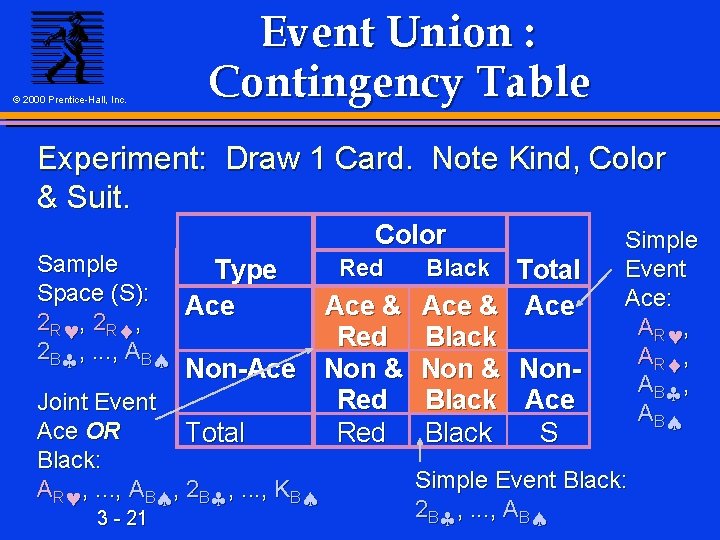
© 2000 Prentice-Hall, Inc. Event Union : Contingency Table Experiment: Draw 1 Card. Note Kind, Color & Suit. Color Sample Type Space (S): Ace 2 R , 2 B , . . . , AB Red Black Total Ace & Ace Red Black Non-Ace Non & Non. Red Black Ace Total Red Black S Joint Event Ace OR Black: AR , . . . , AB , 2 B , . . . , KB 3 - 21 Simple Event Ace: A R , A B Simple Event Black: 2 B , . . . , AB
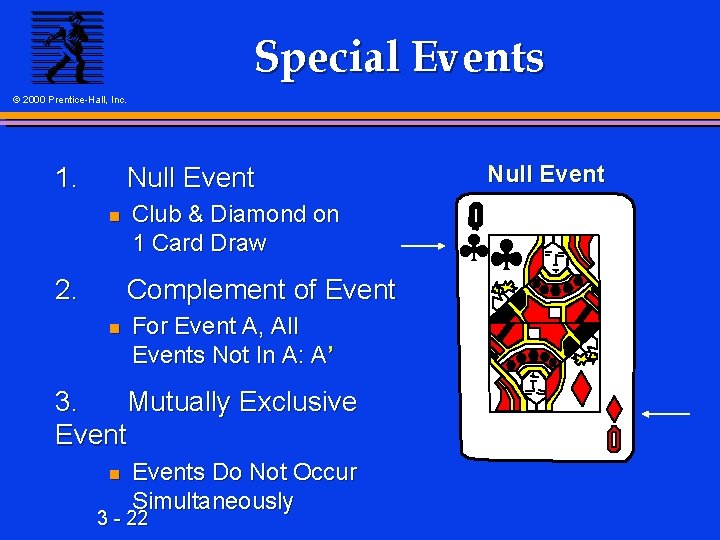
Special Events © 2000 Prentice-Hall, Inc. 1. Null Event n 2. Club & Diamond on 1 Card Draw Complement of Event n For Event A, All Events Not In A: A’ 3. Mutually Exclusive Event n Events Do Not Occur Simultaneously 3 - 22 Null Event
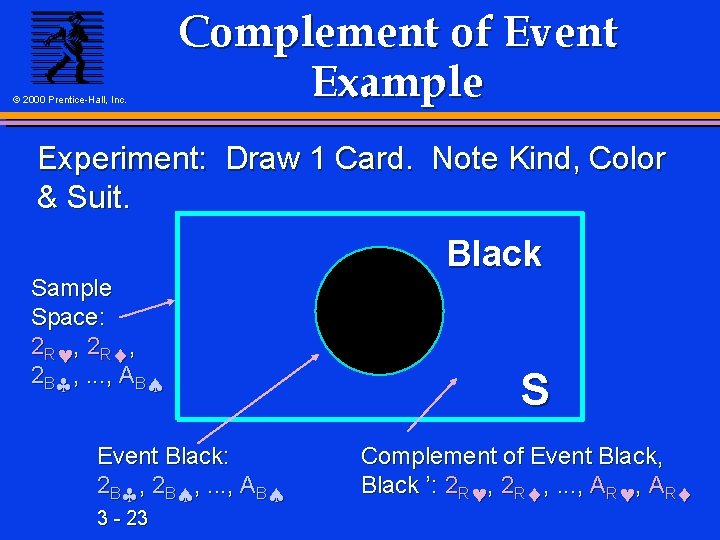
© 2000 Prentice-Hall, Inc. Complement of Event Example Experiment: Draw 1 Card. Note Kind, Color & Suit. Sample Space: 2 R , 2 B , . . . , AB Event Black: 2 B , . . . , AB 3 - 23 Black S Complement of Event Black, Black ’: 2 R , . . . , AR
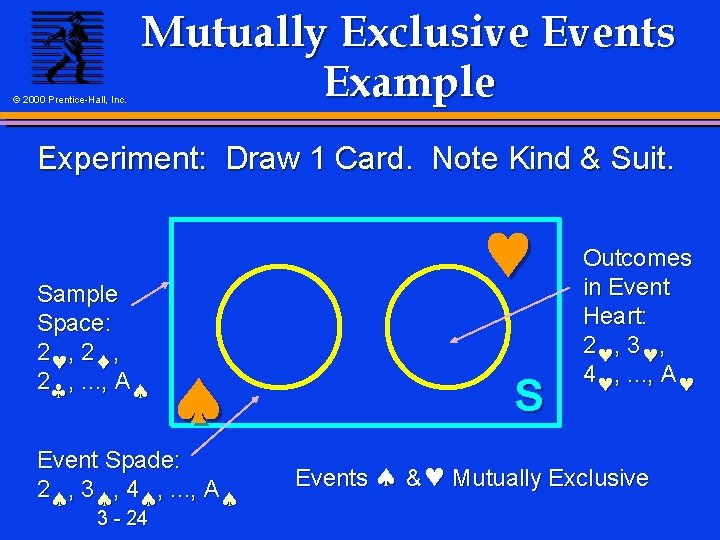
© 2000 Prentice-Hall, Inc. Mutually Exclusive Events Example Experiment: Draw 1 Card. Note Kind & Suit. Sample Space: 2 , 2 , . . . , A Event Spade: 2 , 3 , 4 , . . . , A 3 - 24 S Outcomes in Event Heart: 2 , 3 , 4 , . . . , A Events & Mutually Exclusive
© 2000 Prentice-Hall, Inc. Probabilities 3 - 25
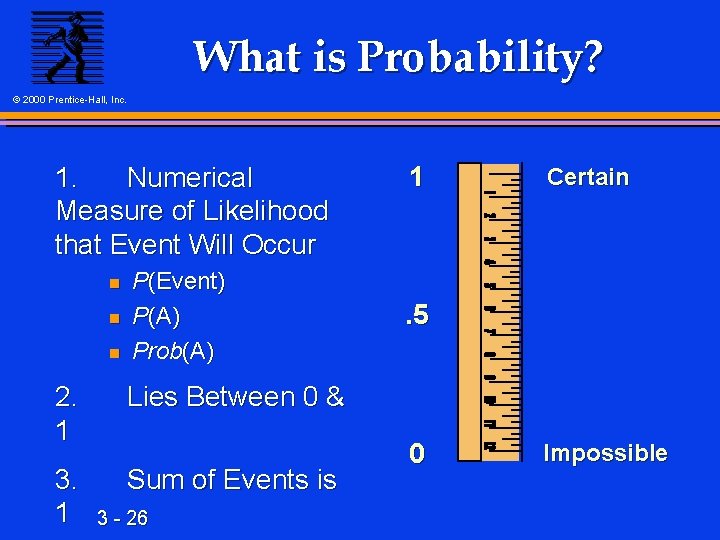
What is Probability? © 2000 Prentice-Hall, Inc. 1. Numerical Measure of Likelihood that Event Will Occur n n n P(Event) P(A) Prob(A) 2. 1 Lies Between 0 & 3. 1 Sum of Events is 3 - 26 1 Certain . 5 0 Impossible
© 2000 Prentice-Hall, Inc. Assigning Event Probabilities 1. a priori Classical Method 2. Empirical Classical Method 3. Subjective Method 3 - 27 What’s the probability?
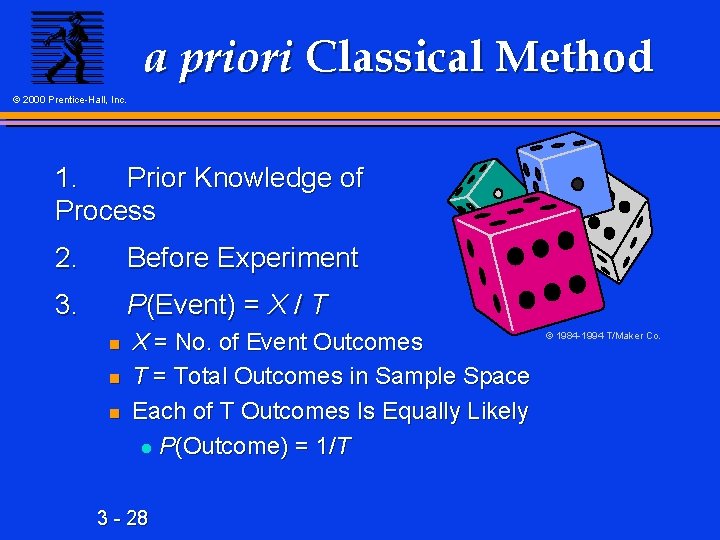
a priori Classical Method © 2000 Prentice-Hall, Inc. 1. Prior Knowledge of Process 2. Before Experiment 3. P(Event) = X / T n n n X = No. of Event Outcomes T = Total Outcomes in Sample Space Each of T Outcomes Is Equally Likely l P(Outcome) = 1/T 3 - 28 © 1984 -1994 T/Maker Co.
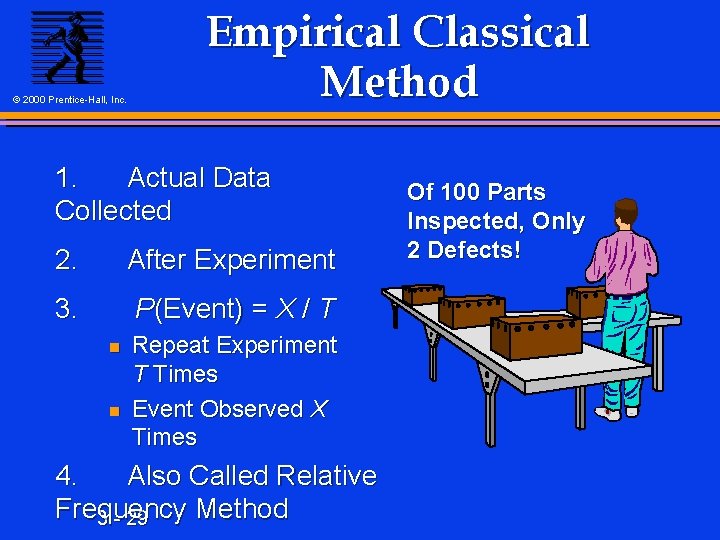
© 2000 Prentice-Hall, Inc. Empirical Classical Method 1. Actual Data Collected 2. After Experiment 3. P(Event) = X / T n n Repeat Experiment T Times Event Observed X Times 4. Also Called Relative Frequency Method 3 - 29 Of 100 Parts Inspected, Only 2 Defects!
Subjective Method © 2000 Prentice-Hall, Inc. 1. Individual Knowledge of Situation 2. Before Experiment 3. Unique Process n Not Repeatable 4. Different Probabilities from Different People 3 - 30 © 1984 -1994 T/Maker Co.
Thinking Challenge © 2000 Prentice-Hall, Inc. Which Method Should Be Used to Find the Probability. . . 1. That a Box of 24 Bolts Will Be Defective? 2. That a Toss of a Coin Will Be a Tail? 3. That Tom Will Default on His PLUS Loan? 4. That a Student Will Earn an A in This Class? 5. That a New Store on Rte. 1 Will Succeed? 3 - 31
Compound Event Probability © 2000 Prentice-Hall, Inc. 1. Numerical Measure of Likelihood that Compound Event Will Occur 2. Can Often Use Contingency Table n 2 Variables Only 3. Formula Methods n n n Additive Rule Conditional Probability Formula Multiplicative Rule 3 - 32
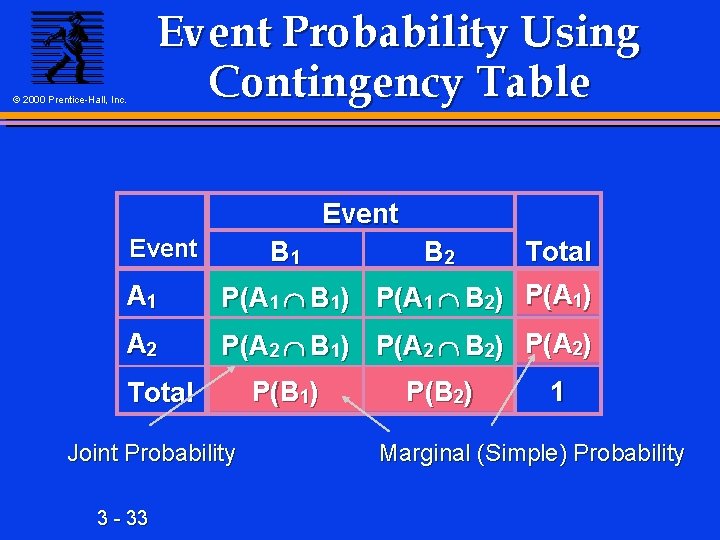
Event Probability Using Contingency Table © 2000 Prentice-Hall, Inc. Event B 1 B 2 Total A 1 P(A 1 B 1) P(A 1 B 2) P(A 1) A 2 P(A 2 B 1) P(A 2 B 2) P(A 2) Total Joint Probability 3 - 33 P(B 1) P(B 2) 1 Marginal (Simple) Probability
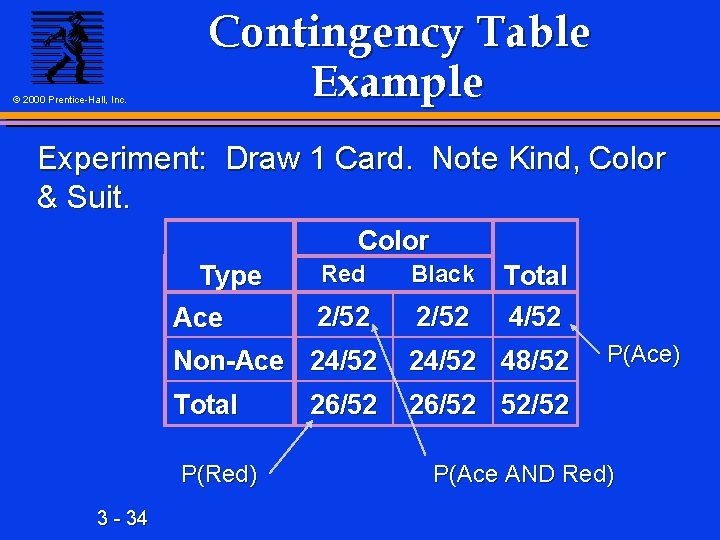
© 2000 Prentice-Hall, Inc. Contingency Table Example Experiment: Draw 1 Card. Note Kind, Color & Suit. Color Type Ace Black 2/52 Total 4/52 Non-Ace 24/52 48/52 26/52 52/52 Total P(Red) 3 - 34 Red P(Ace) P(Ace AND Red)
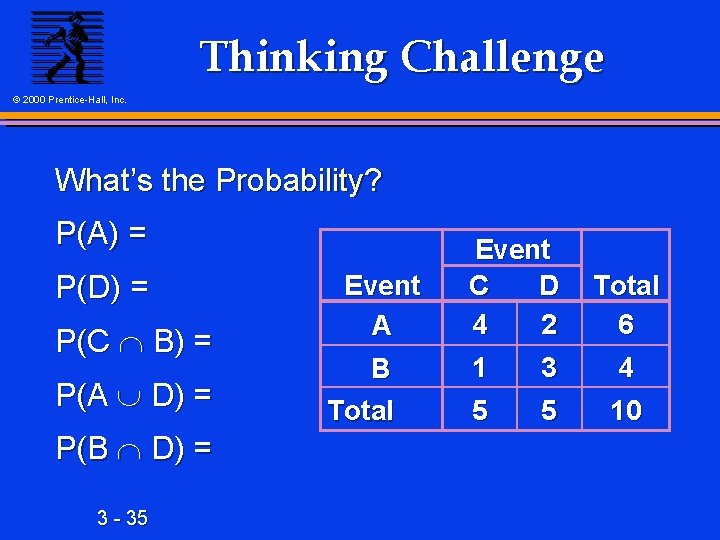
Thinking Challenge © 2000 Prentice-Hall, Inc. What’s the Probability? P(A) = P(D) = P(C B) = P(A D) = P(B D) = 3 - 35 Event A B Total Event C D 4 2 1 3 5 5 Total 6 4 10
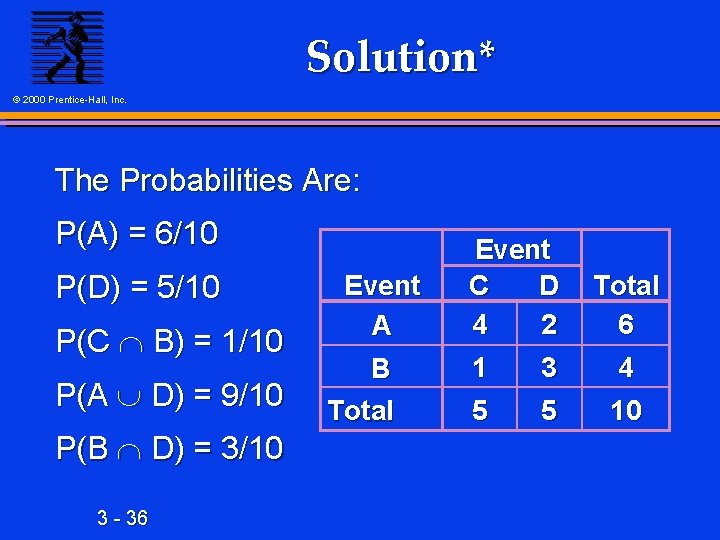
Solution* © 2000 Prentice-Hall, Inc. The Probabilities Are: P(A) = 6/10 P(D) = 5/10 P(C B) = 1/10 P(A D) = 9/10 P(B D) = 3/10 3 - 36 Event A B Total Event C D 4 2 1 3 5 5 Total 6 4 10
© 2000 Prentice-Hall, Inc. Additive Rule 3 - 37
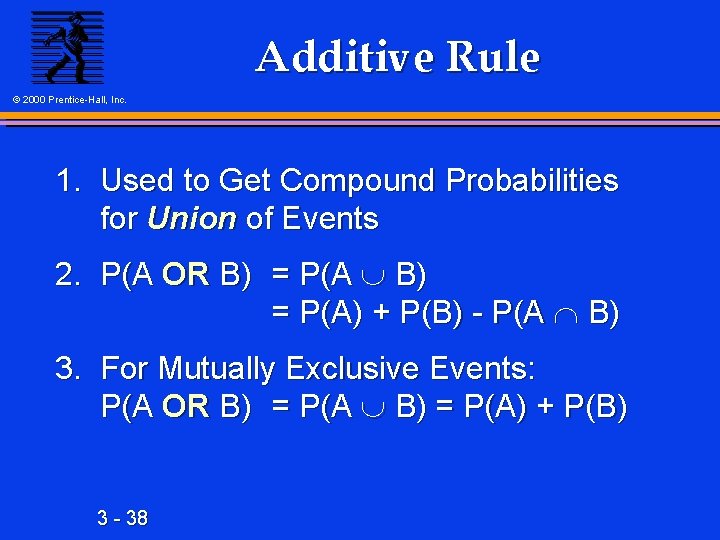
Additive Rule © 2000 Prentice-Hall, Inc. 1. Used to Get Compound Probabilities for Union of Events 2. P(A OR B) = P(A) + P(B) - P(A B) 3. For Mutually Exclusive Events: P(A OR B) = P(A) + P(B) 3 - 38
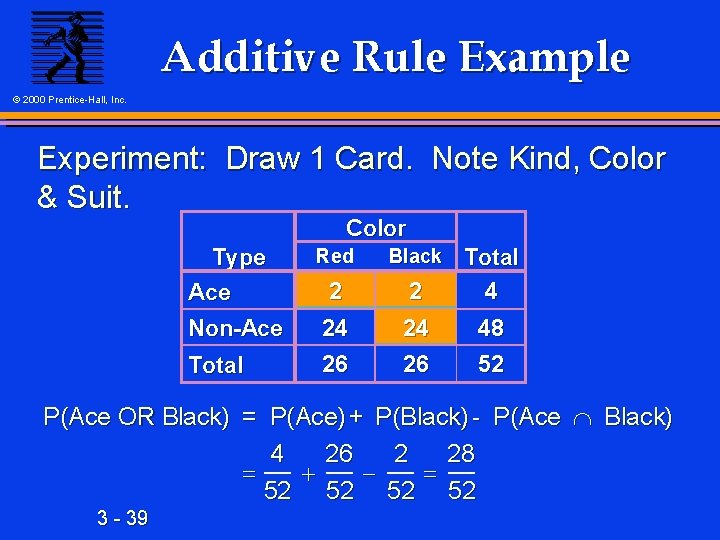
Additive Rule Example © 2000 Prentice-Hall, Inc. Experiment: Draw 1 Card. Note Kind, Color & Suit. Color Type Ace Red Black 2 2 Total 4 Non-Ace 24 24 48 Total 26 26 52 P(Ace OR Black) = P(Ace) + P(Black) - P(Ace Black) 4 26 2 28 52 52 3 - 39
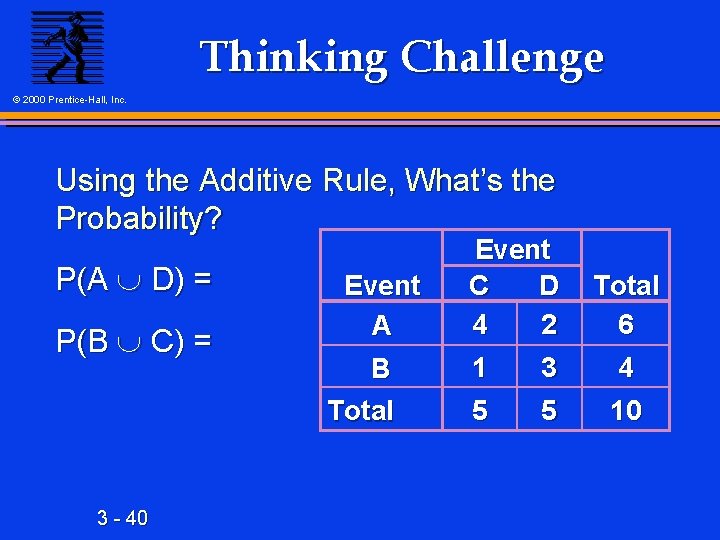
Thinking Challenge © 2000 Prentice-Hall, Inc. Using the Additive Rule, What’s the Probability? P(A D) = P(B C) = Event A B Total 3 - 40 Event C D 4 2 1 3 5 5 Total 6 4 10
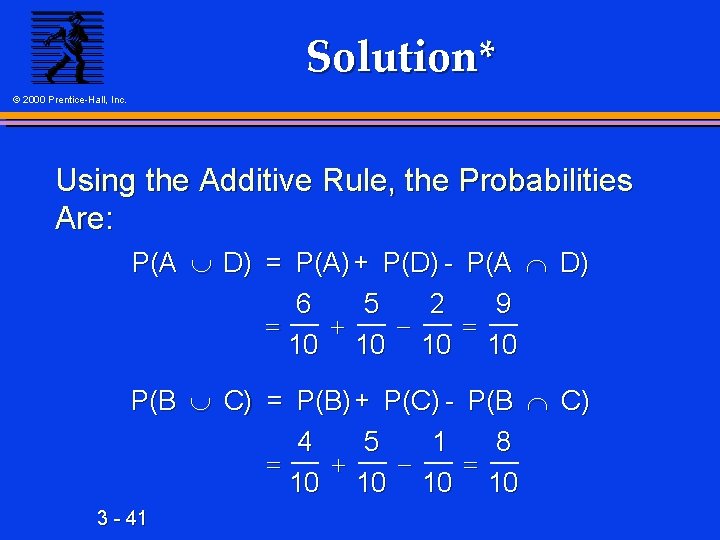
Solution* © 2000 Prentice-Hall, Inc. Using the Additive Rule, the Probabilities Are: P(A D) = P(A) + P(D) - P(A D) 6 5 2 9 10 10 P(B C) = P(B) + P(C) - P(B C) 4 5 1 8 10 10 3 - 41
© 2000 Prentice-Hall, Inc. Conditional Probability 3 - 42
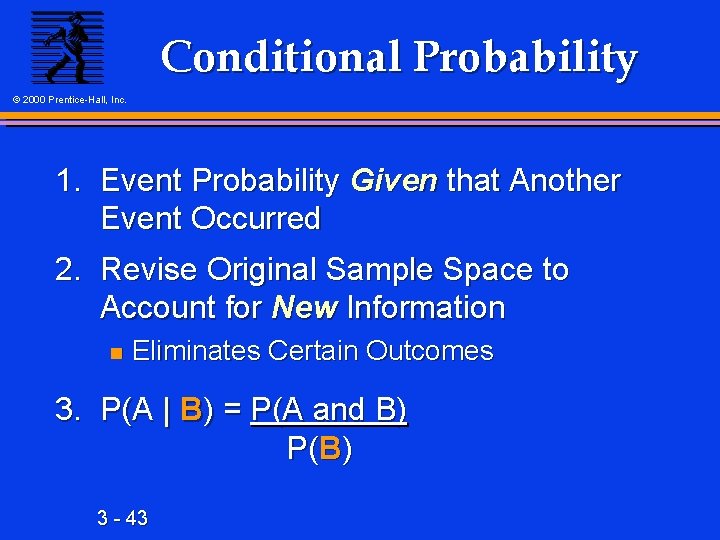
Conditional Probability © 2000 Prentice-Hall, Inc. 1. Event Probability Given that Another Event Occurred 2. Revise Original Sample Space to Account for New Information n Eliminates Certain Outcomes 3. P(A | B) = P(A and B) P(B) 3 - 43
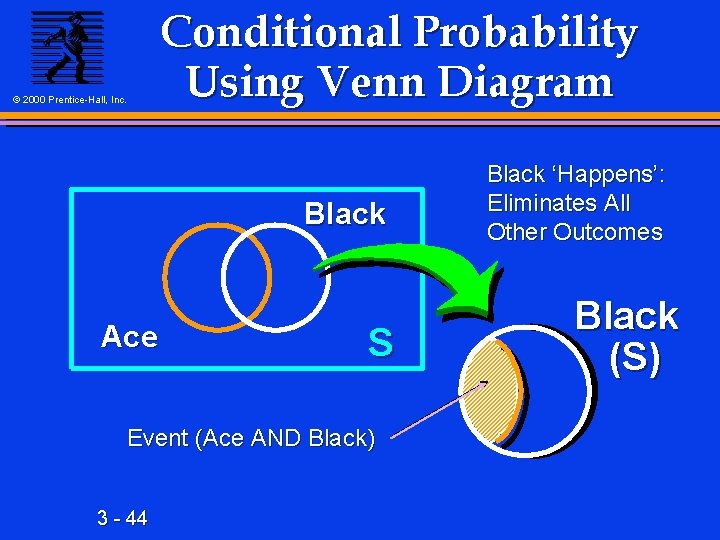
© 2000 Prentice-Hall, Inc. Conditional Probability Using Venn Diagram Black Ace S Event (Ace AND Black) 3 - 44 Black ‘Happens’: Eliminates All Other Outcomes Black (S)
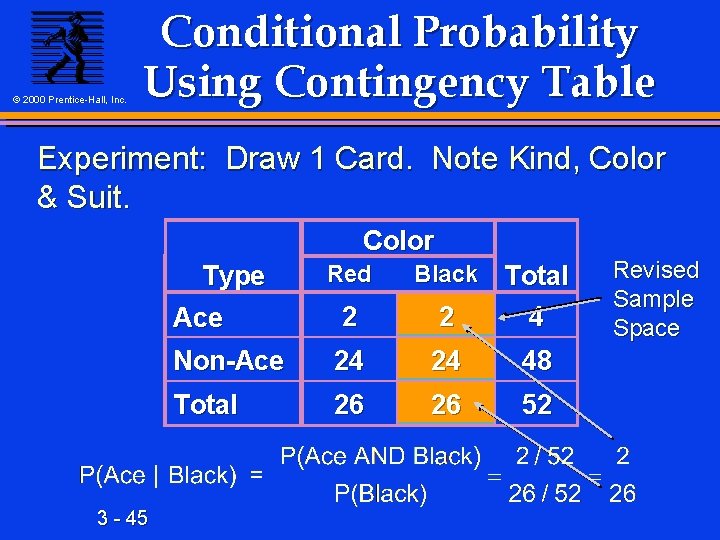
© 2000 Prentice-Hall, Inc. Conditional Probability Using Contingency Table Experiment: Draw 1 Card. Note Kind, Color & Suit. Color Red Black 2 2 Total 4 Non-Ace 24 24 48 Total 26 26 52 Type Ace 3 - 45 Revised Sample Space
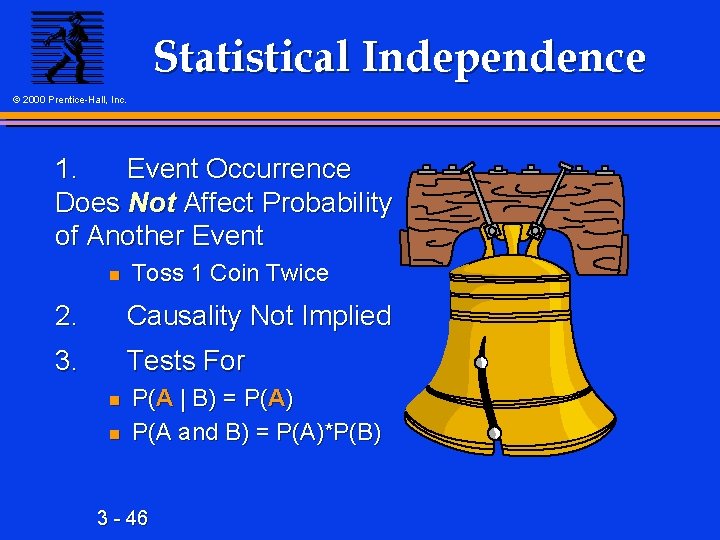
Statistical Independence © 2000 Prentice-Hall, Inc. 1. Event Occurrence Does Not Affect Probability of Another Event n Toss 1 Coin Twice 2. Causality Not Implied 3. Tests For n n P(A | B) = P(A) P(A and B) = P(A)*P(B) 3 - 46
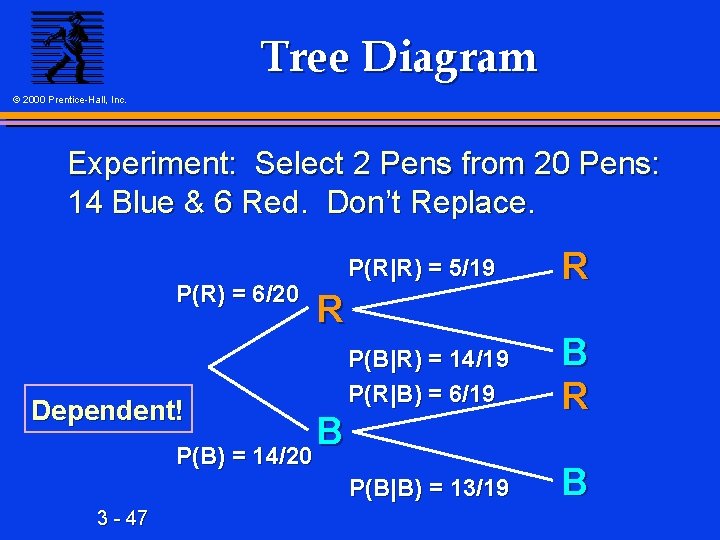
Tree Diagram © 2000 Prentice-Hall, Inc. Experiment: Select 2 Pens from 20 Pens: 14 Blue & 6 Red. Don’t Replace. P(R) = 6/20 Dependent! P(R|R) = 5/19 R P(B|R) = 14/19 P(R|B) = 6/19 B R P(B|B) = 13/19 B R B P(B) = 14/20 3 - 47
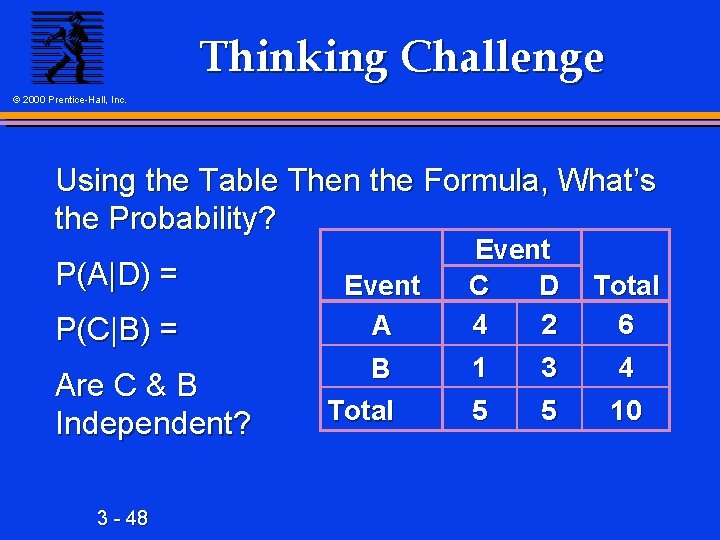
Thinking Challenge © 2000 Prentice-Hall, Inc. Using the Table Then the Formula, What’s the Probability? P(A|D) = P(C|B) = Are C & B Independent? 3 - 48 Event A B Total Event C D 4 2 1 3 5 5 Total 6 4 10
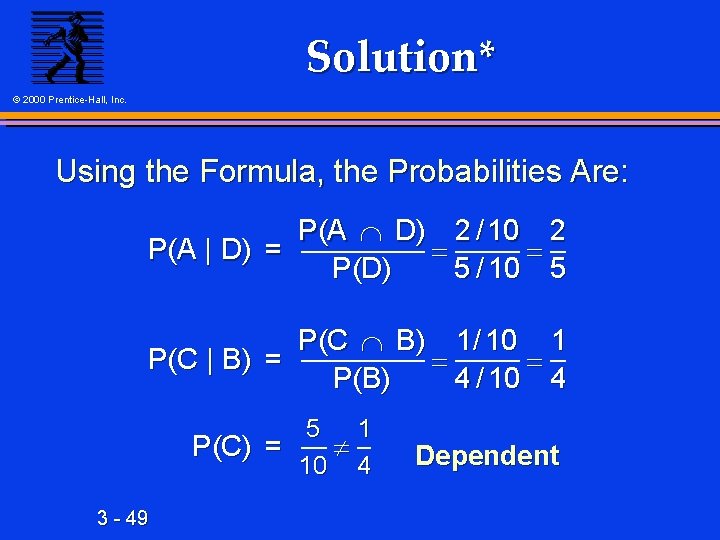
Solution* © 2000 Prentice-Hall, Inc. Using the Formula, the Probabilities Are: P(A D) 2 / 10 2 P(A | D) = P(D) 5 / 10 5 P(C B) 1 / 10 1 P(C | B) = P(B) 4 / 10 4 5 1 P(C) = 10 4 3 - 49 Dependent
© 2000 Prentice-Hall, Inc. Multiplicative Rule 3 - 50
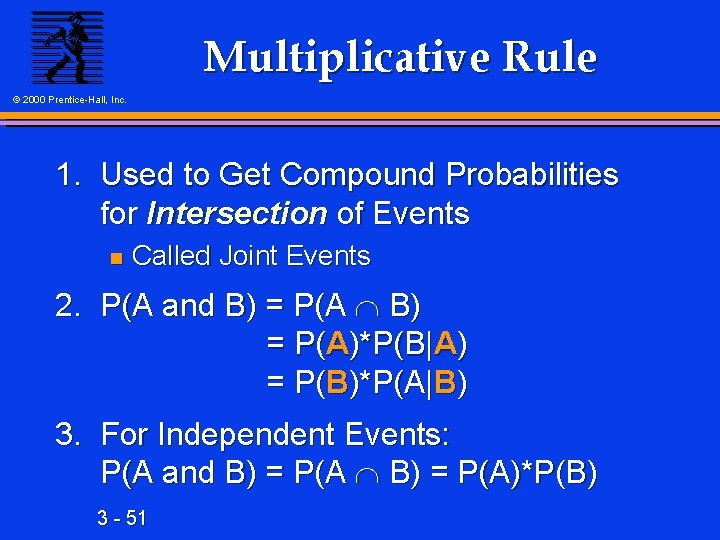
Multiplicative Rule © 2000 Prentice-Hall, Inc. 1. Used to Get Compound Probabilities for Intersection of Events n Called Joint Events 2. P(A and B) = P(A)*P(B|A) = P(B)*P(A|B) 3. For Independent Events: P(A and B) = P(A)*P(B) 3 - 51
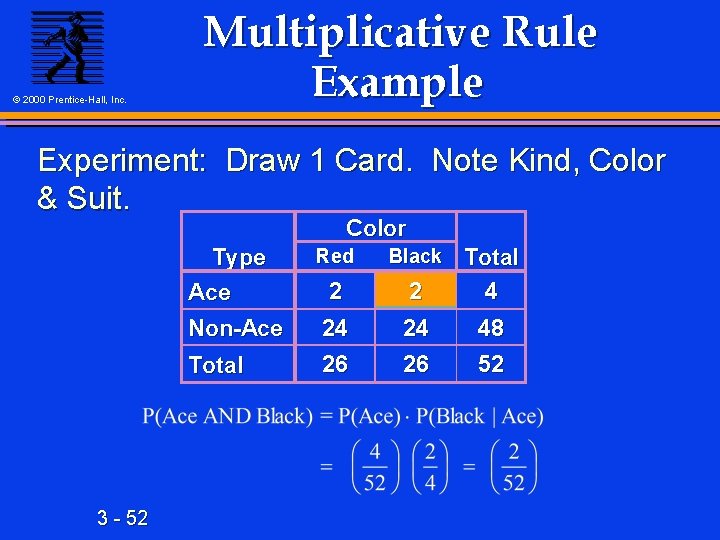
© 2000 Prentice-Hall, Inc. Multiplicative Rule Example Experiment: Draw 1 Card. Note Kind, Color & Suit. Color Type Ace 3 - 52 Red Black 2 2 Total 4 Non-Ace 24 24 48 Total 26 26 52
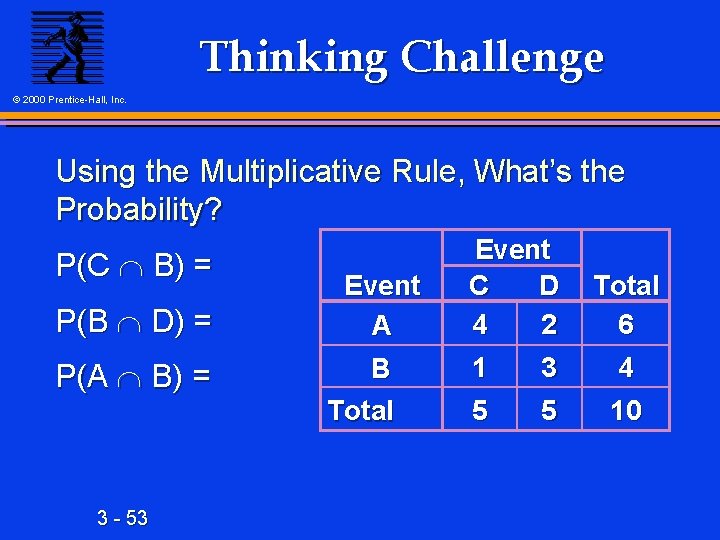
Thinking Challenge © 2000 Prentice-Hall, Inc. Using the Multiplicative Rule, What’s the Probability? P(C B) = P(B D) = P(A B) = 3 - 53 Event A B Total Event C D 4 2 1 3 5 5 Total 6 4 10
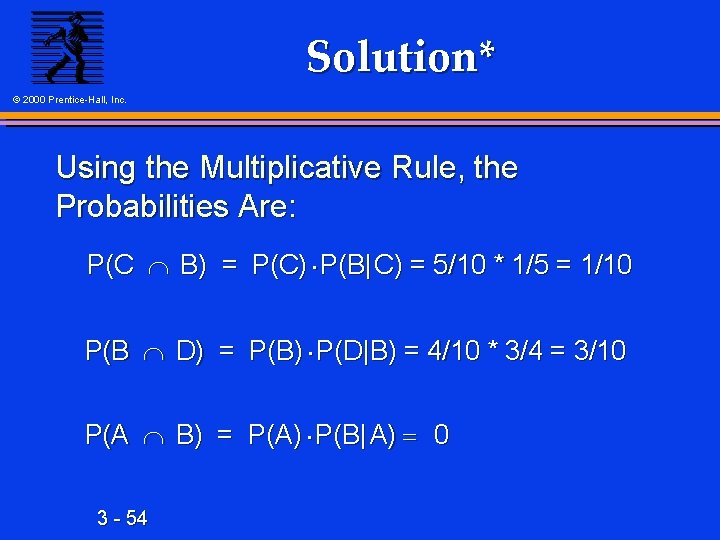
Solution* © 2000 Prentice-Hall, Inc. Using the Multiplicative Rule, the Probabilities Are: P(C B) = P(C) P(B| C) = 5/10 * 1/5 = 1/10 P(B D) = P(B) P(D|B) = 4/10 * 3/4 = 3/10 P(A B) = P(A) P(B| A) 0 3 - 54
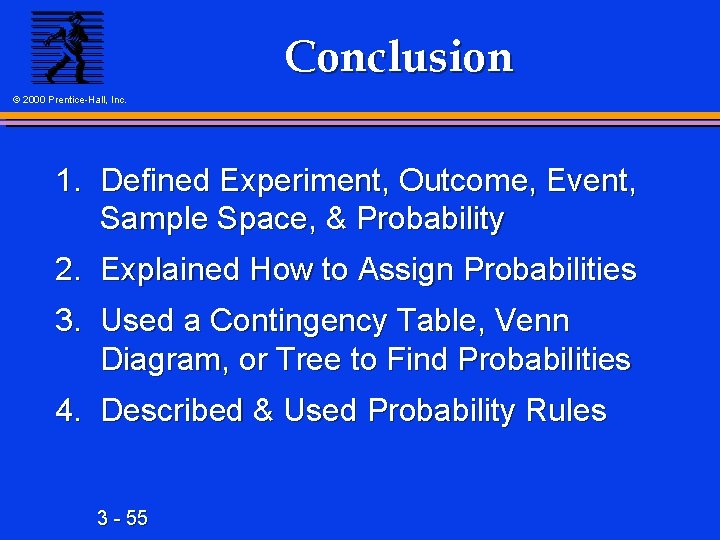
Conclusion © 2000 Prentice-Hall, Inc. 1. Defined Experiment, Outcome, Event, Sample Space, & Probability 2. Explained How to Assign Probabilities 3. Used a Contingency Table, Venn Diagram, or Tree to Find Probabilities 4. Described & Used Probability Rules 3 - 55

End of Chapter Any blank slides that follow are blank intentionally.
- Slides: 56