
2000 BC The first Maya people emerged Mayan
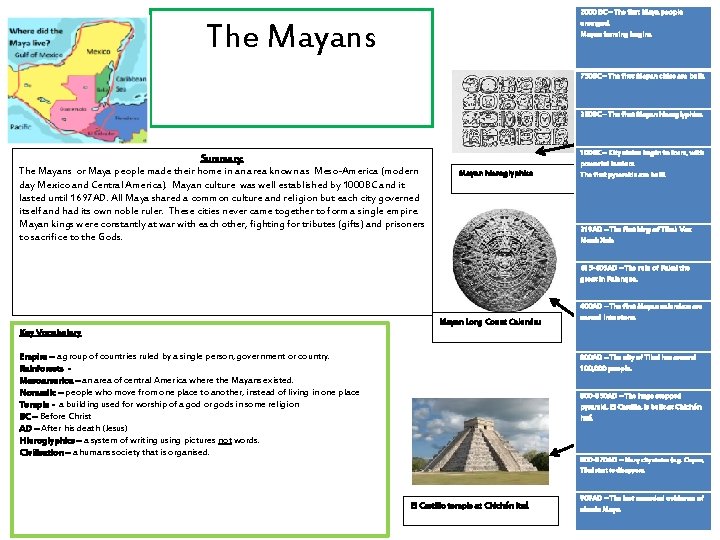
2000 BC – The first Maya people emerged. Mayan farming begins. The Mayans 750 BC – The first Mayan cities are built. 250 BC – The first Mayan hieroglyphics. Summary: The Mayans or Maya people made their home in an area known as Meso-America (modern day Mexico and Central America). Mayan culture was well established by 1000 BC and it lasted until 1697 AD. All Maya shared a common culture and religion but each city governed itself and had its own noble ruler. These cities never came together to form a single empire. Mayan kings were constantly at war with each other, fighting for tributes (gifts) and prisoners to sacrifice to the Gods. Mayan hieroglyphics 100 BC – City states begin to form, with powerful leaders. The first pyramids are built. 219 AD – The first king of Tikal: Vax Moch Xob. 615 -603 AD – The rule of Pakal the great in Palenque. Key Vocabulary Mayan Long Count Calendar Empire – a group of countries ruled by a single person, government or country. Rainforests Mesoamerica – an area of central America where the Mayans existed. Nomadic – people who move from one place to another, instead of living in one place Temple - a building used for worship of a god or gods in some religion BC – Before Christ AD – After his death (Jesus) Hieroglyphics – a system of writing using pictures not words. Civilisation – a humans society that is organised. 400 AD – The first Mayan calendars are carved into stone. 800 AD – The city of Tikal has around 100, 000 people. 800 -850 AD – The huge stepped pyramid, El Castilla, is built at Chichén Itzá 800 -870 AD – Many city states (e. g. Copan, Tikal start to disappear. El Castillo temple at Chichén Itzá 909 AD – The last recorded evidence of classic Maya.
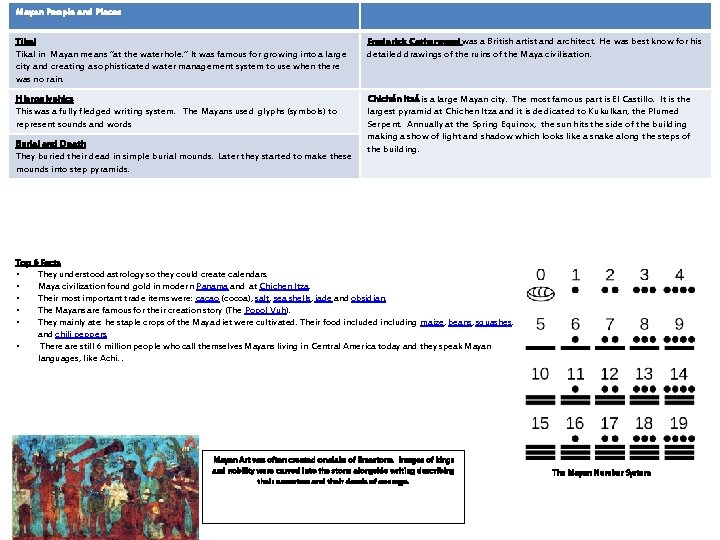
Mayan People and Places Tikal in Mayan means “at the waterhole. ” It was famous for growing into a large city and creating a sophisticated water management system to use when there was no rain. Frederick Catherwood was a British artist and architect. He was best know for his detailed drawings of the ruins of the Maya civilisation. Hieroglyphics This was a fully fledged writing system. The Mayans used glyphs (symbols) to represent sounds and words Chichén Itzá is a large Mayan city. The most famous part is El Castillo. It is the largest pyramid at Chichen Itza and it is dedicated to Kukulkan, the Plumed Serpent. Annually at the Spring Equinox, the sun hits the side of the building making a show of light and shadow which looks like a snake along the steps of the building. Burial and Death They buried their dead in simple burial mounds. Later they started to make these mounds into step pyramids. Top 6 Facts • They understood astrology so they could create calendars. • Maya civilization found gold in modern Panama and at Chichen Itza. • Their most important trade items were: cacao (cocoa), salt, sea shells, jade and obsidian. • The Mayans are famous for their creation story (The Popol Vuh). • They mainly ate: he staple crops of the Maya diet were cultivated. Their food included including maize, beans, squashes, and chili peppers. • There are still 6 million people who call themselves Mayans living in Central America today and they speak Mayan languages, like Achi. . Mayan Art was often created on slabs of limestone. Images of kings and nobility were carved into the stone alongside writing describing their ancestors and their deeds of courage. The Mayan Number System
- Slides: 2