
20 th Century Chinese character simplification and Cantonese
![Cantonese Characters • To write the second syllable of Cantonese [mɐt⁵tʃʰøn⁵⁵] ‘what the hell’,](https://slidetodoc.com/presentation_image_h/09f54cb0540b4efe662bdc5301f80518/image-36.jpg "Cantonese Characters • To write the second syllable of Cantonese [mɐt⁵tʃʰøn⁵⁵] ‘what the hell’,")
- Slides: 39
20 th Century Chinese character simplification (and Cantonese writing) CHIN 342/442 Autumn 2019
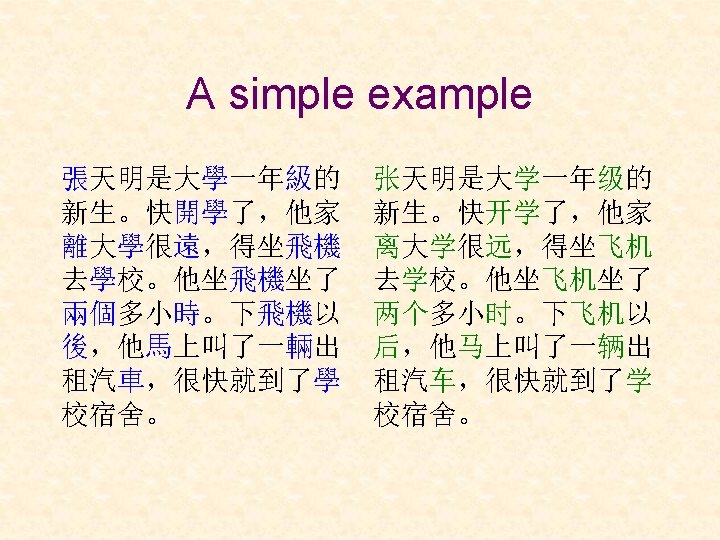
Traditional and Simplified Characters • There are two scripts in use today to write Modern Standard Mandarin • They are closely related • “Traditional Characters” are used today in Taiwan, Hong Kong, and some overseas communities • Example: China Daily News (中華日報) Online)
Traditional and Simplified Characters • “Simplified Characters” are used today in mainland China, Singapore, and many overseas communities • Example: Guangming Daily (光明日报) Online • Simplified characters are the first major change to the official Chinese writing system in nearly 2, 000 years
Why? • What led to the first official change in the Chinese writing system in nearly 2, 000 years? • What were the goals of simplification? • What were the specific mechanisms by which characters were “simplified”? • How effective was the policy?
Motives for Character Simplification • Part of the same late 19 th-c. / early 20 th-c. language reform movement that led to Guóyǔ/Pǔtōnghuà, Báihuà, and pīnyīn • When the Communists came to power in 1949, their stated goal was elimination of characters and their replacement by an alphabet; “simplification” was temporary
Goals of Simplification • The goal of character elimination was eventually abandoned • What were the aims of character simplification? – Reduce number of characters to learn – Reduce number of strokes per character – Reduce schooling time to literacy – Increase overall literacy rates (20% in 1920 s)
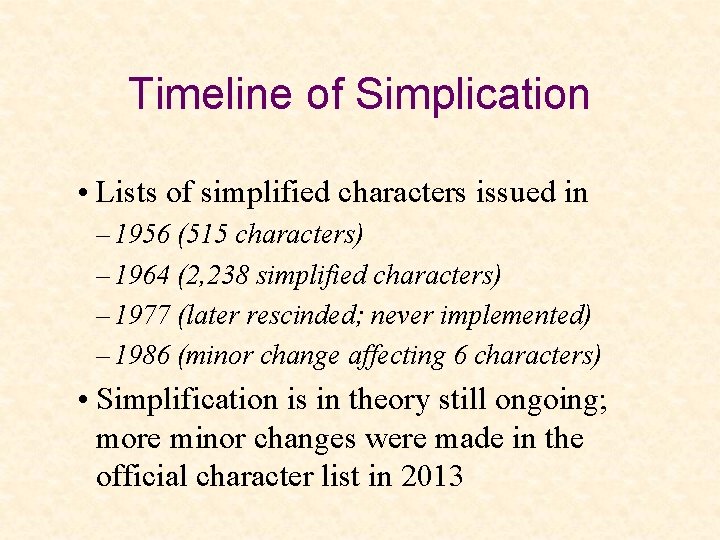
Timeline of Simplication • Lists of simplified characters issued in – 1956 (515 characters) – 1964 (2, 238 simplified characters) – 1977 (later rescinded; never implemented) – 1986 (minor change affecting 6 characters) • Simplification is in theory still ongoing; more minor changes were made in the official character list in 2013
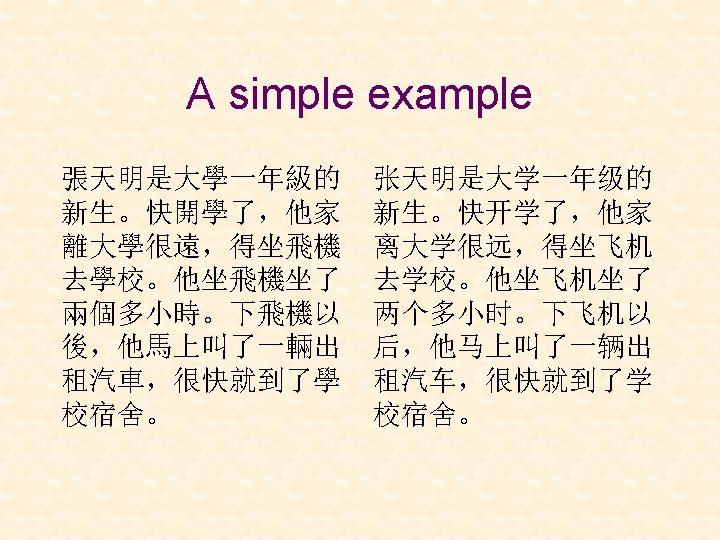
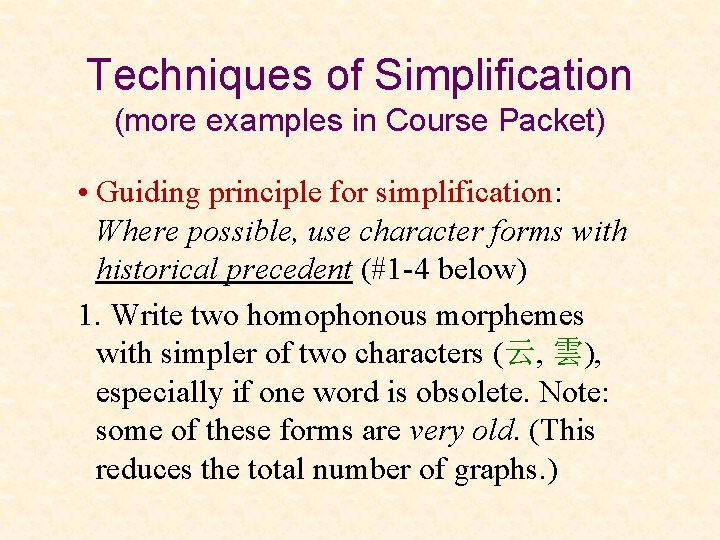
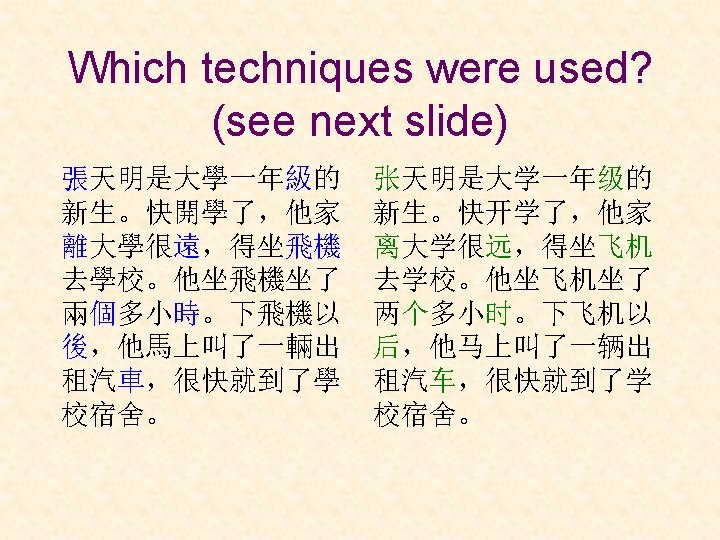
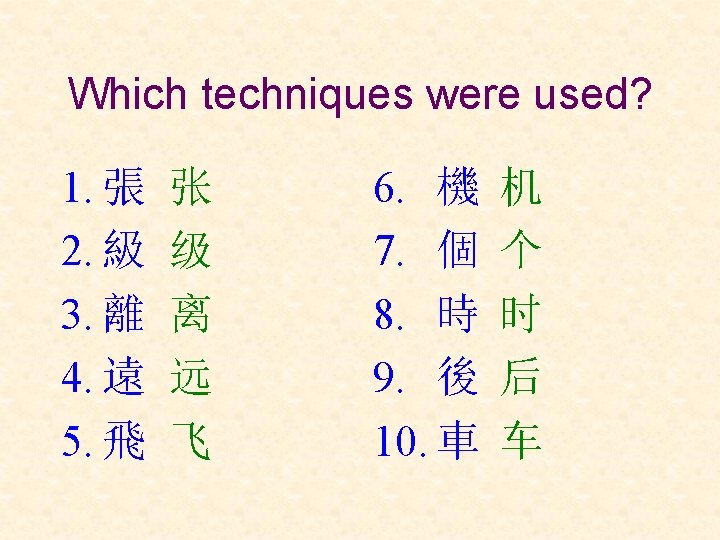
Techniques of Simplification (more examples in Course Packet) • Guiding principle for simplification: Where possible, use character forms with historical precedent (#1 -4 below) 1. Write two homophonous morphemes with simpler of two characters (云, 雲), especially if one word is obsolete. Note: some of these forms are very old. (This reduces the total number of graphs. )
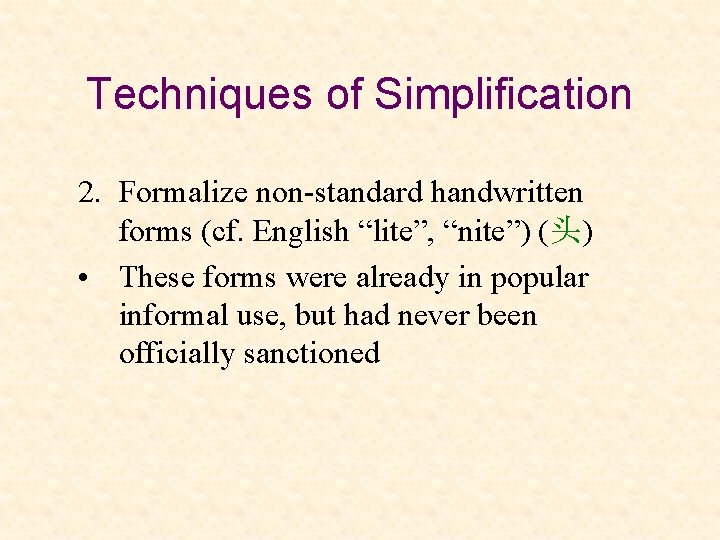
Techniques of Simplification 2. Formalize non-standard handwritten forms (cf. English “lite”, “nite”) (头) • These forms were already in popular informal use, but had never been officially sanctioned
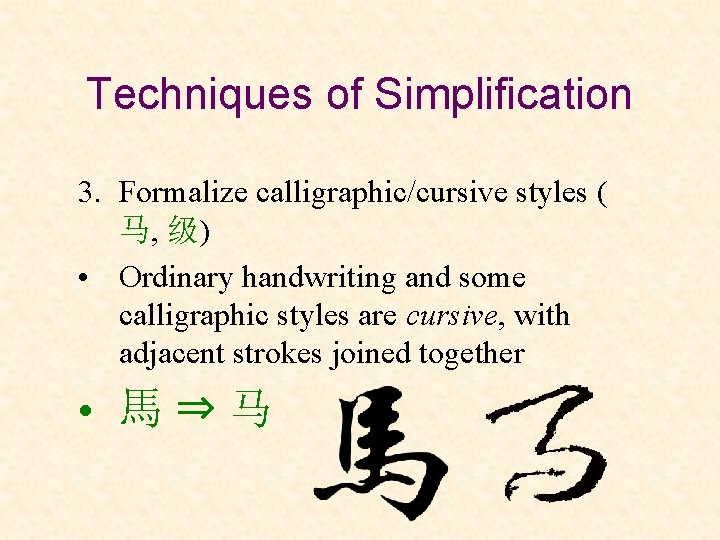
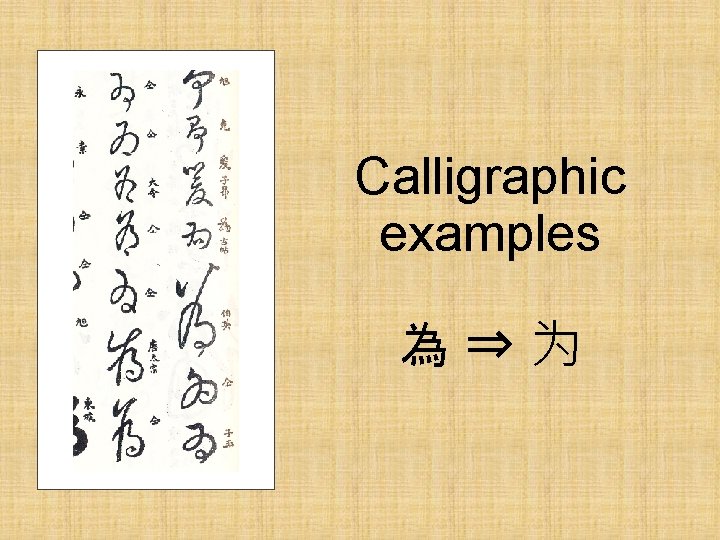
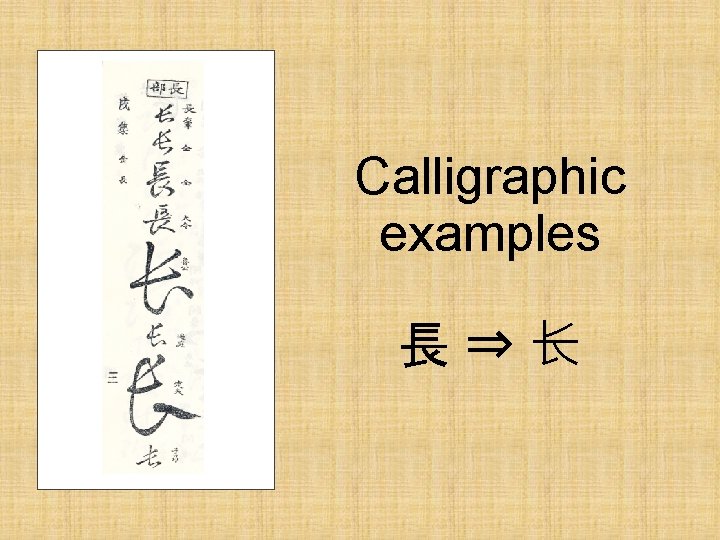
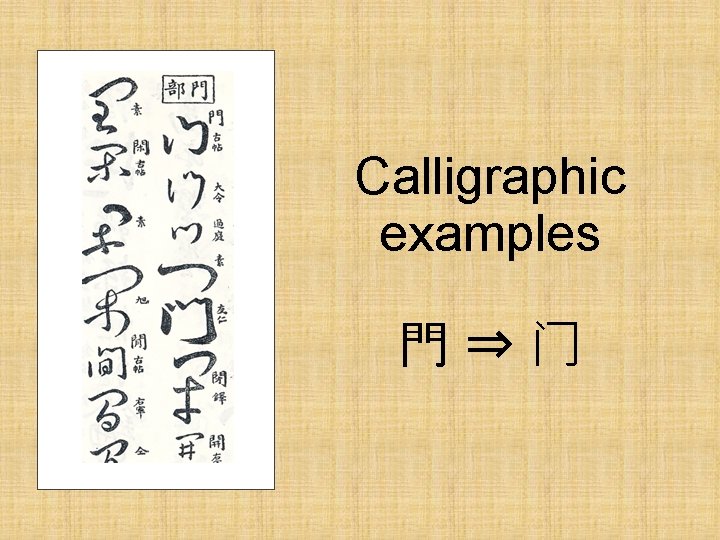
Techniques of Simplification 3. Formalize calligraphic/cursive styles ( 马, 级) • Ordinary handwriting and some calligraphic styles are cursive, with adjacent strokes joined together • 馬⇒马
Calligraphic examples 為⇒为
Calligraphic examples 長⇒长
Calligraphic examples 門⇒门
Techniques of Simplification 4. Use simpler archaic forms (从) • These are forms attested in early texts and dictionaries; Shuōwén Jiězì always uses 从, never “traditional” form 從. • Some simplified characters are older than traditional characters! 5. Invent new simplified forms (analogy with historically-attested techniques):
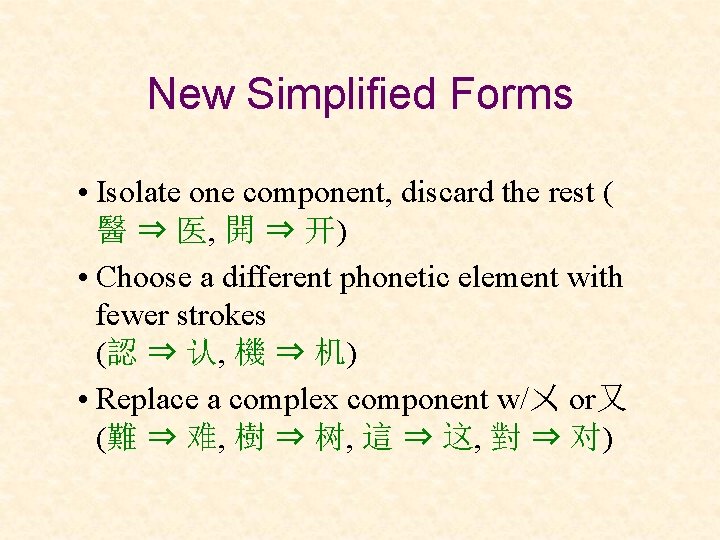
New Simplified Forms • Isolate one component, discard the rest ( 醫 ⇒ 医, 開 ⇒ 开) • Choose a different phonetic element with fewer strokes (認 ⇒ 认, 機 ⇒ 机) • Replace a complex component w/㐅 or又 (難 ⇒ 难, 樹 ⇒ 树, 這 ⇒ 这, 對 ⇒ 对)
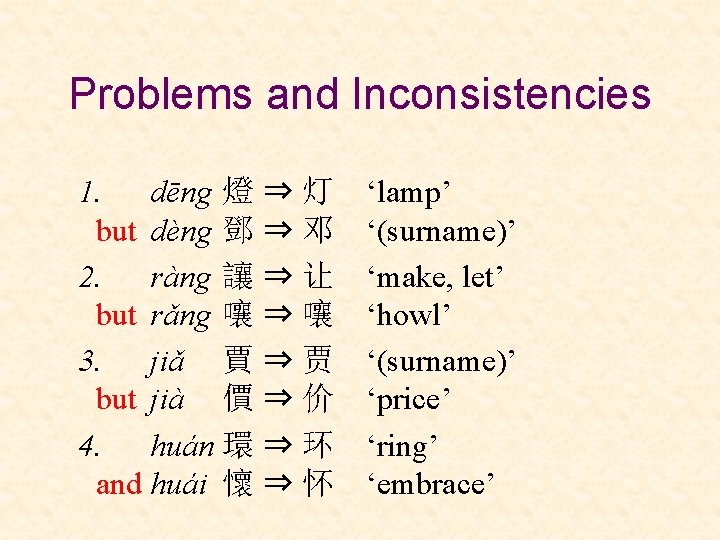
Problems and Inconsistencies 1. dēng 燈 ⇒ 灯 but dèng 鄧 ⇒ 邓 2. ràng 讓 ⇒ 让 but rǎng 嚷 ⇒ 嚷 3. jiǎ 賈 ⇒ 贾 but jià 價 ⇒ 价 4. huán 環 ⇒ 环 and huái 懷 ⇒ 怀 ‘lamp’ ‘(surname)’ ‘make, let’ ‘howl’ ‘(surname)’ ‘price’ ‘ring’ ‘embrace’
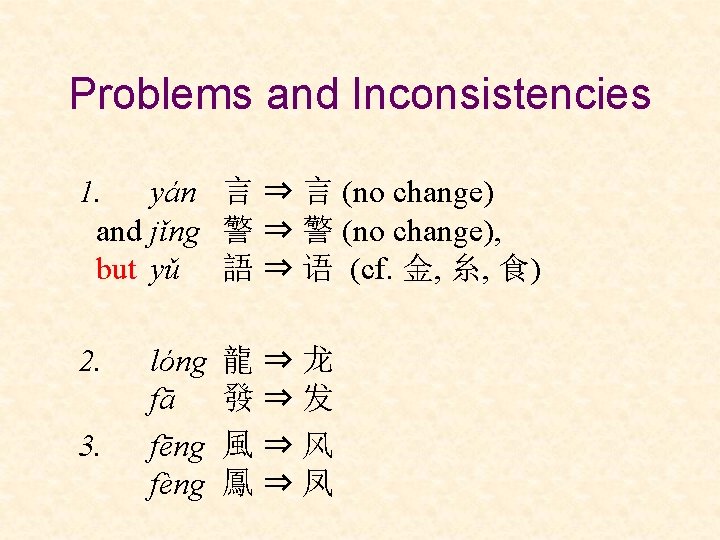
Problems and Inconsistencies 1. yán 言 ⇒ 言 (no change) and jǐng 警 ⇒ 警 (no change), but yǔ 語 ⇒ 语 (cf. 金, 糸, 食) 2. 3. lóng fā fēng fèng 龍⇒龙 發⇒发 風⇒风 鳳⇒凤
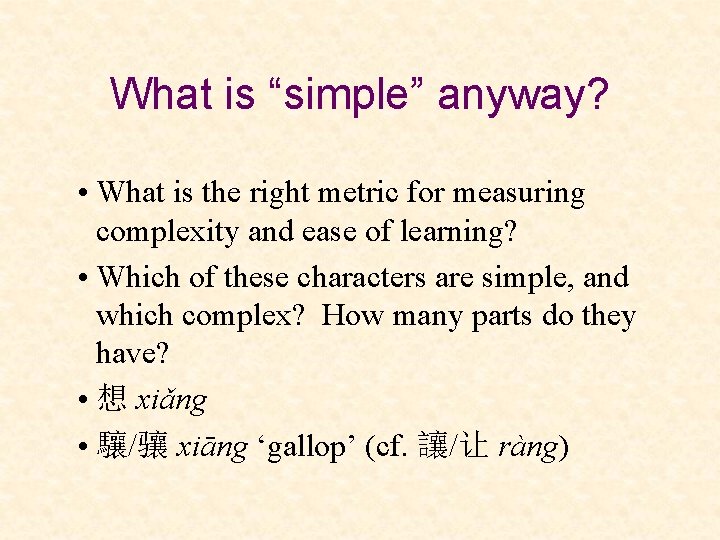
What is “simple” anyway? • What is the right metric for measuring complexity and ease of learning? • Which of these characters are simple, and which complex? How many parts do they have? • 想 xiǎng • 驤/骧 xiāng ‘gallop’ (cf. 讓/让 ràng)
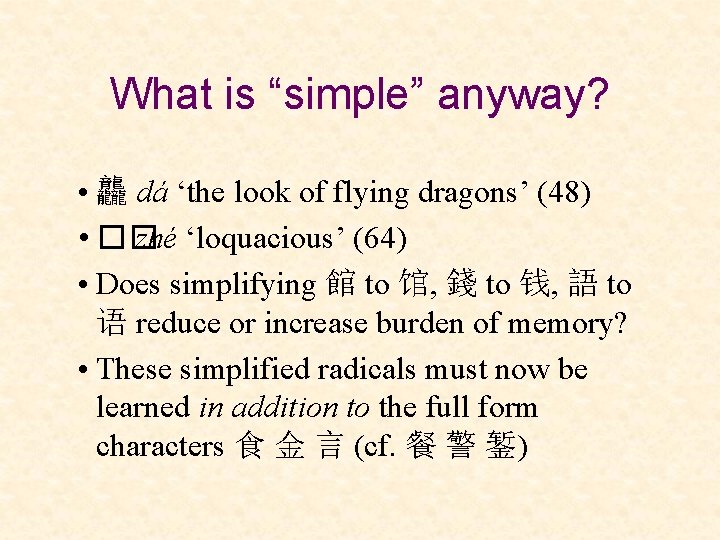
What is “simple” anyway? • 龘 dá ‘the look of flying dragons’ (48) • �� zhé ‘loquacious’ (64) • Does simplifying 館 to 馆, 錢 to 钱, 語 to 语 reduce or increase burden of memory? • These simplified radicals must now be learned in addition to the full form characters 食 金 言 (cf. 餐 警 錾)
What is “simple” anyway? • Recent psycholinguistic studies have begun to provide some objective means for measuring cognitive processing in learning and reading Chinese characters • It’s hard to draw definitive conclusions, but it seems that simplified characters may have comparatively very slight drawbacks for learning and reading
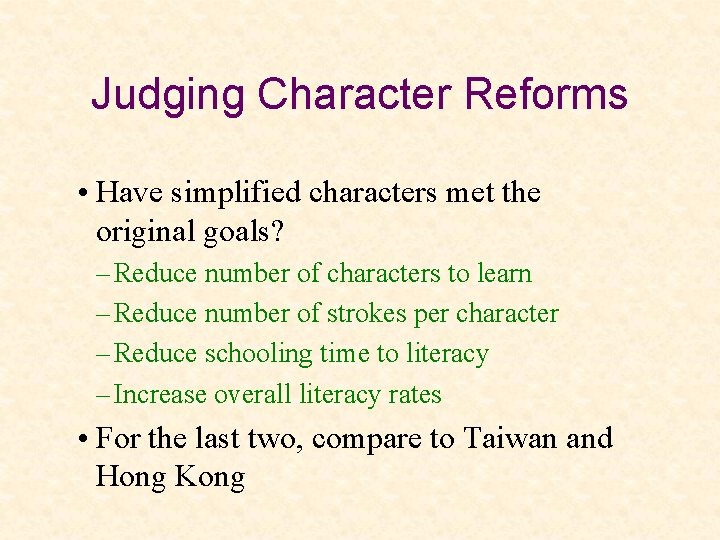
Judging Character Reforms • Have simplified characters met the original goals? – Reduce number of characters to learn – Reduce number of strokes per character – Reduce schooling time to literacy – Increase overall literacy rates • For the last two, compare to Taiwan and Hong Kong
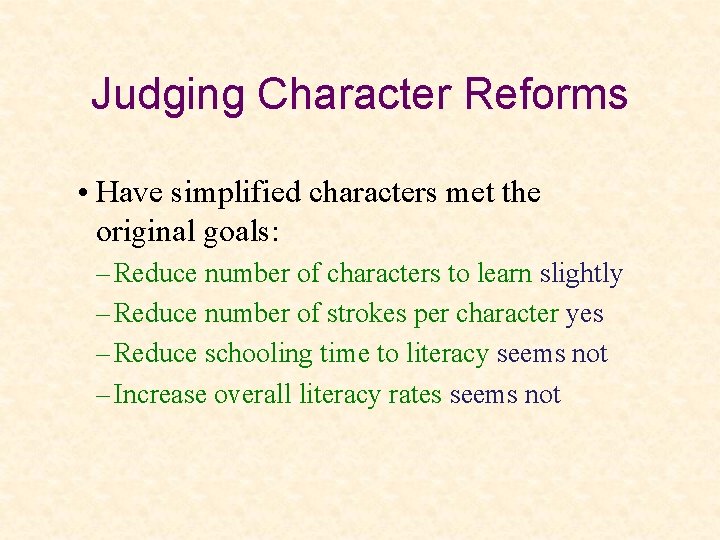
Judging Character Reforms • Have simplified characters met the original goals: – Reduce number of characters to learn slightly – Reduce number of strokes per character yes – Reduce schooling time to literacy seems not – Increase overall literacy rates seems not
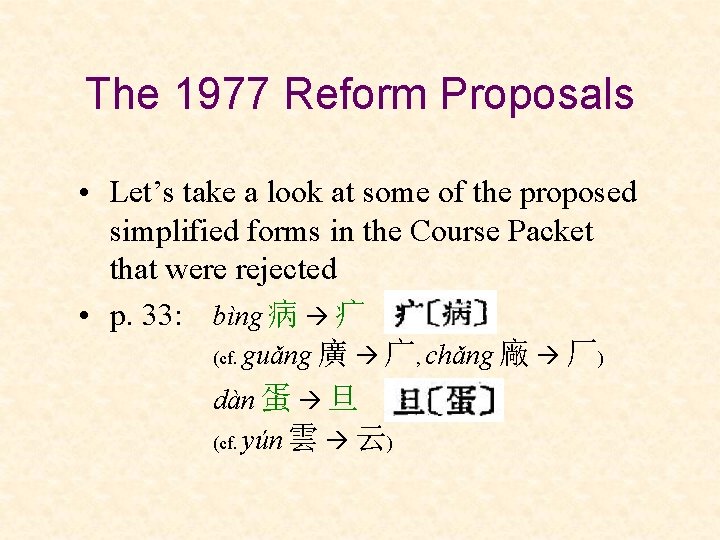
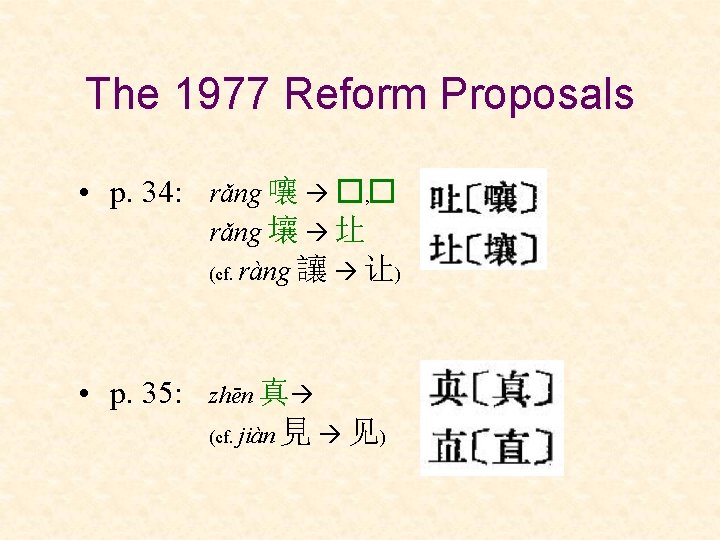
The 1977 Reform Proposals • Let’s take a look at some of the proposed simplified forms in the Course Packet that were rejected • p. 33: bìng 病 疒 (cf. guǎng 廣 广, chǎng 廠 厂) dàn 蛋 旦 (cf. yún 雲 云)
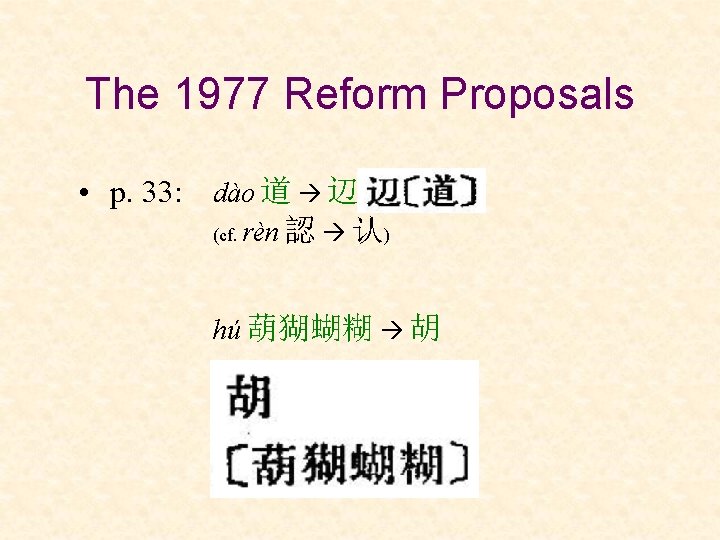
The 1977 Reform Proposals • p. 33: dào 道 辺 (cf. rèn 認 认) hú 葫猢蝴糊 胡
The 1977 Reform Proposals • p. 34: rǎng 嚷 �� , rǎng 壤 圵 (cf. ràng 讓 让) • p. 35: zhēn 真 (cf. jiàn 見 见)
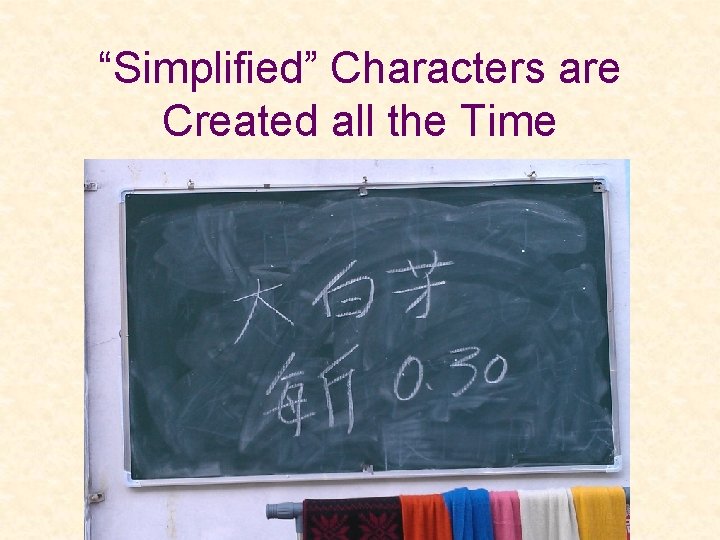
“Simplified” Characters are Created all the Time
The future • What is the future of traditional characters in Hong Kong and Taiwan? • What is the future of Chinese characters in general? • How will political changes and technological changes affect the use and structure of Chinese characters as a functioning script?
Cantonese Writing • In Hong Kong and Guǎngzhōu, formal written Chinese is Standard Written Chinese (a written form of Mandarin). • As a result, newspapers and other formal writing in Hong Kong can be read and understood by any educated Chinese speaker • But …
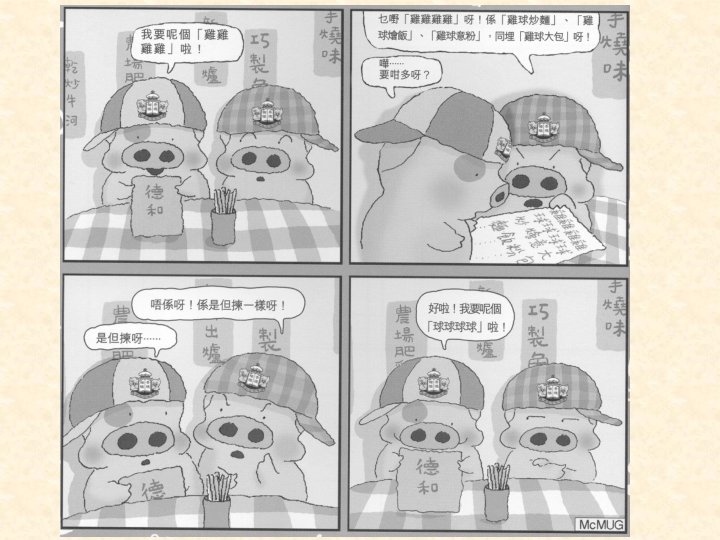
Cantonese Writing • Cantonese is distinct: it is the only non. Mandarin variety of Chinese having a fully developed, widely used written form • Seen in – notes – advertisements – comics – etc.
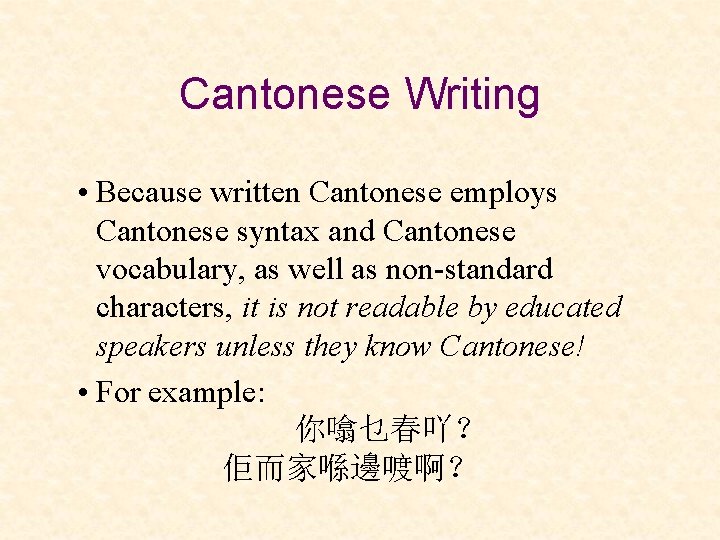
Cantonese Writing • Because written Cantonese employs Cantonese syntax and Cantonese vocabulary, as well as non-standard characters, it is not readable by educated speakers unless they know Cantonese! • For example: 你噏乜春吖? 佢而家喺邊喥啊?
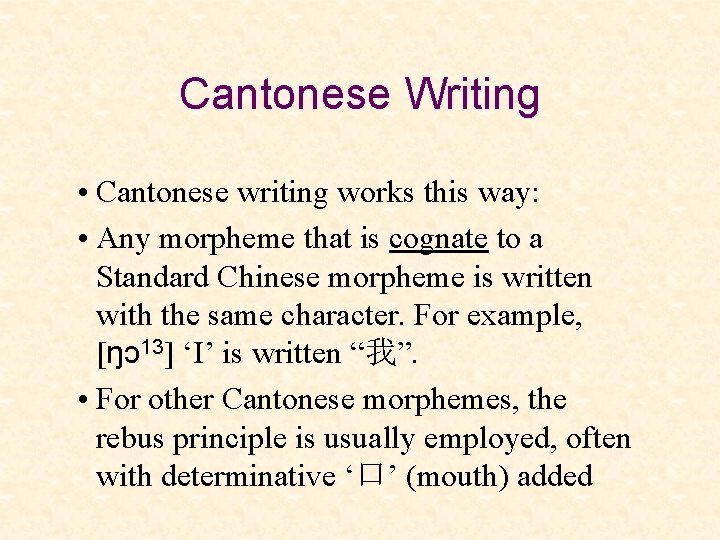
Cantonese Writing • Cantonese writing works this way: • Any morpheme that is cognate to a Standard Chinese morpheme is written with the same character. For example, [ŋɔ 13] ‘I’ is written “我”. • For other Cantonese morphemes, the rebus principle is usually employed, often with determinative ‘口’ (mouth) added
Cantonese Characters • To write the second syllable of Cantonese [mɐt⁵tʃʰøn⁵⁵] ‘what the hell’, the character 春 is employed as a rebus. • To write the Cantonese negative [m 21] ‘not’, the character 吾 (Mand. wú) is employed as a rebus, with ‘mouth’ added as semantic determinative: 唔 • Other examples in Course Packet
Next Time • Writing Chinese without Chinese characters: Romanizations and Transcriptions • Lexicographic ordering: Dictionary organization and character look-up methods
End • Look over the various examples in the course packet on what we’ve covered today.