
20 th Century Analysis of Child Development Theories

- Slides: 42
20 th Century Analysis of Child Development Theories and Methods
Anthropology. • • When we move into the 20 th century we begin to see the division between the various disciplines. • Anthropologists-Make their contribution by studying various cultures. •
Malinoski (1921) • Looked at primitive cultures such as natives of the Trobriand Islands. • • Looks at how children are education into basic manual skills and techniques and development into a moral culture. •
Margaret Mead, • . Coming of Age in Samoa broke down categories of socialization -looked at maternal care, obligations to siblings, rights and responsibilities. •
Benedict(1934) • Patterns of Culture- showed how socialization is a mediation process between the personality and culture. Individual of a particular society learns certain cultural configurations
Modern anthropologists Continue to look at simpler cultures to understand: • a. institutional arrangements • b. alternative arrangements and the plasticity of human nature • c. relatedness between cultural change and personality • d. correlations between specific cultural arrangements (religion, magic, art) and personality. •
Sociology • One of the most significant sociologists was Charles Cooley and his notion of the "looking glass self" • • -The self is ultimately social- the self becomes self by interacting with others. •
Dewey • It was who modified this line of thought by arguing that organism is not a fixed thing but is constantly changing and developing through interaction with its environment
George Herbert Mead (1934) • Mind, Self, Society • - then went a step further • -The self is in constant interaction with the self and the environment;
Mead on `the self’ • -The self is self reflective; sees itself as subject and object. • -The self is concerned with- meaning of objects • -courses of actions • -choice -pros and cons
C. H Cooley • The Looking Glass Self • For Cooley the self becomes social through role taking -the ability to look upon oneself from an outsider's perspective. • •
• At the same time in sociology we see a number of studies in the Chicago school tradition in the mid 1930's that incorporate theories into their empirical research.
Social Constructionism • A third sociologist Blumer (1969) attempted to make modification to earlier sociological theories of child.
• He argues that the human is an active and reactive agent -humans are involved in a constant process of appraisal, reapprasal and interpretation. • -
Blumer (1969) • the individual considers situational contingencies to derive maximum profit (exchange model)
Chicago School Studies • Middletown (1929) devoted five chapters to child rearing practices • • Methods of Discipline, division of chores, parental authority, kitchen table conversations, the school and the family, church and the family. •
Saint Dennis • Horace Miner's Saint Dennis is an example of a Canadian study of this type that looks a French Canada. • A parish town teaches French Canadian values: fatalism, communalism, obedience • Values of `la survivance’
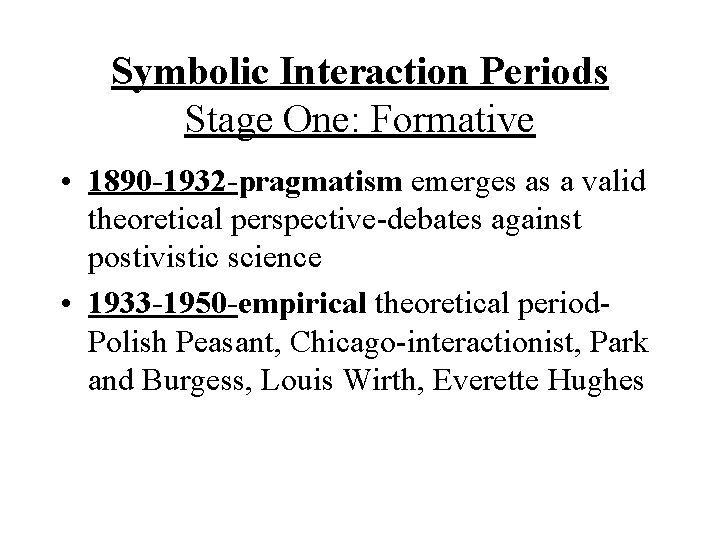
Symbolic Interaction Periods Stage One: Formative • 1890 -1932 -pragmatism emerges as a valid theoretical perspective-debates against postivistic science • 1933 -1950 -empirical theoretical period. Polish Peasant, Chicago-interactionist, Park and Burgess, Louis Wirth, Everette Hughes
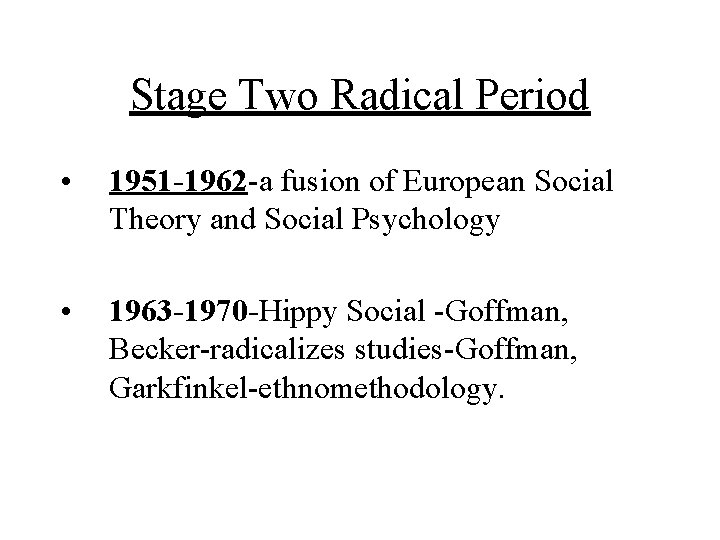
Stage Two Radical Period • 1951 -1962 -a fusion of European Social Theory and Social Psychology • 1963 -1970 -Hippy Social -Goffman, Becker-radicalizes studies-Goffman, Garkfinkel-ethnomethodology.
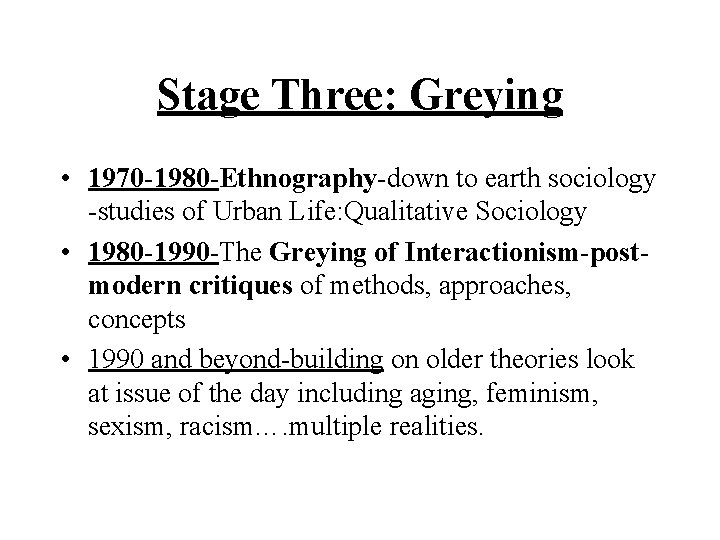
Stage Three: Greying • 1970 -1980 -Ethnography-down to earth sociology -studies of Urban Life: Qualitative Sociology • 1980 -1990 -The Greying of Interactionism-postmodern critiques of methods, approaches, concepts • 1990 and beyond-building on older theories look at issue of the day including aging, feminism, sexism, racism…. multiple realities.
Psychology • Psychologists in the twentieth century held that an individuals mental content rooted in biology is shaped by interaction with other.
• Classic psychologist emphasized personality theories based on physiological change while various other theories diverge somewhat from a biological base along a continuum.
Psychology and Cognition • Another theme in psychology is to look at language, cognition and child development. • • Lastly, psychologist throughout the twentieth century have become heavily involved in experimental research using sophistication analysis. • •
Information processing, • They are looking into things like information processing, • They are looking into questions such as Does a child's ability to search for information change with age? • To what extent does a child's current knowledge help him to learn more? •
Ethology • Looks at adaptation -Do children adapt to the world in restrictive time periods? • They look at whether child who have been deprived of food or physical and social stimulation are deprived. • ? •
• Borstein (1969) for example, developed the concept, sensitive period to refer to the time optimal for certain capacities for speech, development of motor skills etc.
Ethological Theory • Ethological theory borrows a great deal from Darwin’s theory of Natural Selection. • It holds that certain patterns of social behaviour are the product of evolution. •
Ethological example • Consider for example, the bond between mother and child. For the ethologist this bond exists because it helps the species survive-certain aspects of behaviour are said to be the result of natural instincts.
• Human beings are biologically wired to emit responses…. ie babies are wired to keep them close to mother (the cry) mother is wired to love and look after infants. •
Aggression Ethological • One of the most controversial theories of the ethologist is regarding aggression. • According to this school of thought aggression has an instinctual basis.
Innate Aggression • Aggression is an innate drive that may be aroused when an individual encounters frustration or threat. • The individual is automatically directed towards the goal of injuring or destroying the source of irritation. Furthermore, when the aggressive drive is aroused energy is
Ecological Systems Theory • • -Developed by Urie Bronfrenbenner, is a classical psycholical model emphasizing how certain biological dispositions combine with environmental forces to mould development. •
Systems micro meso, exo • His theory looks at the micro system, mesosystem, and mesosystem. • • The microsystem-refers to the child's immediate environment •
• The mesosystem -encompasses broader agents of socialization such as home, neighbourhood, daycare center. • • The exosystem- involves social settings beyond the childs environment that effect the child in some way. These might include work schedules, maternity leaves, sick pay etc. •
Trait Theory • Trait theorists conceptualize personality in terms of how much an individual possesses each of several behavioural predispositions or traits such as intelligence, aggressiveness, conscientiousness, achievement motivation.
n-dimensional space • Each person have an n-dimensional space, with n referring to the number of independent personality traits that each theorist considers important for variability in social behaviour.
Personality profiles • Trait theorists use statistical analysis to chart personality profiles which may then be compared with others. • For example, a person’s inventory might be “above average on extraversion, average on dependency.
psychometric movement • Trait theory is associated with the psychometric movement which favours statistical analysis. By establishing group norms, traits are seen as relatively stable and enduring predispositions that are fairly generalizable. . •
Criticisms of trait theory • Criticism of trait theory are as follows: • • a. They pay little attention to how children develop greater or lesser amount of various traits. • b. Trait theorists are only interested in internal qualities (not a great amount of focus on external stimuli)
Trait theorists • c. Trait theorists expect cross situational consistency -ie. A boy who is aggressive at school will be aggressive towards parents, peers, teachers etc. .
• Research has not supported this. Hawthorne and May (1929) found little evidence of a consistent moral pattern across situations
• d. People are variable on most behavioural dimensions thus behaviour cannot be predicted on the basis of generalized traits.