
20 Keys Benchmarking and Mobilisation When all employees
20 Keys Benchmarking and Mobilisation When all employees are aware of the company’s position in relation to world best practices, a true feeling of competition is developed on every level and everyone becomes aligned in their efforts to improve. Prof Iwao Kobayashi 1

20 Keys Relations Diagram Key 1: Cleaning & Organising Key 2: Rationalising the System / Goal Alignment Key 3: Small Group Activities Key 4: Reducing Work-in-Process Key 5: Quick Changeover Technology Key 6: Kaizen of Operations Key 7: Zero Monitor Manufacturing /Production Key 8: Coupled Manufacturing /Production Key 9: Maintaining Machines & Equipment Key 10: Workplace Discipline Key 11: Quality Assurance Key 12: Developing Your Suppliers Key 13: Eliminating Waste Key 14: Empowering Employees to Make Improvements Key 15: Skill Versatility and Cross Training Key 16: Production Scheduling Key 17: Efficiency Control Key 18: Using Information Systems Key 19: Conserving Energy & Materials Key 20: Using Technology for Strategic Advantage 2

20 Keys Goal Configuration Goal Energise Workplace Quality Improvement Cost Reduction (Productivity Improvement) Process Flow Improvement / WIP Reduction / Faster Delivery Technology Development 20 Keys 1 Cleaning and Organising 2 Rationalising the System / Goal Alignment 3 Small Group Activities 10 Workplace Discipline 7 Zero Monitor Production 9 Maintaining Machines and Equipment 11 Quality Assurance 12 Developing Suppliers 15 Skill Versatility and Cross-Training 13 Eliminating Waste 14 Empowering Employees to Make Improvements 6 Kaizen of Operations 17 Efficiency Control 19 Conserving Energy and Materials 5 Quick Changeover Technology 4 Reducing Inventory 16 Production Scheduling 8 Coupled Production 18 Using Microprocessors 20 Using Technology for Strategic Advantage 3
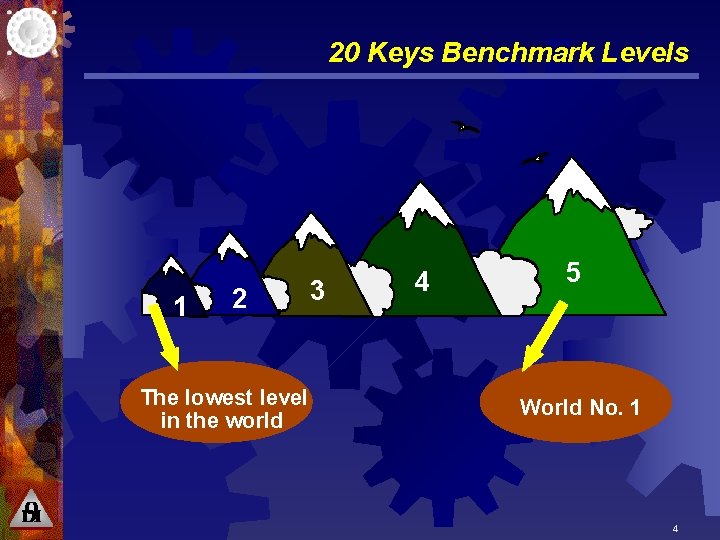
20 Keys Benchmark Levels 1 2 The lowest level in the world 3 4 5 World No. 1 4
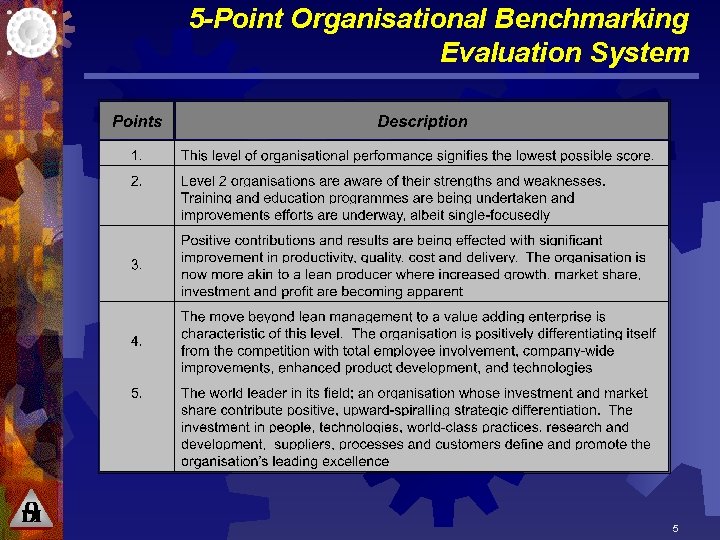
5 -Point Organisational Benchmarking Evaluation System 5
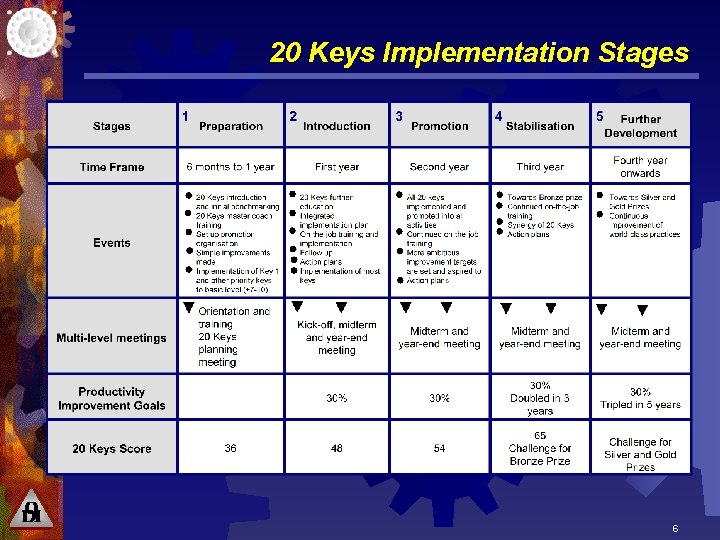
20 Keys Implementation Stages 6

Stages of Implementation Stage 5 Growth and Expansion Stage 4 Institutionalization & Stabilisation Stage 3 Promotion & Wider Application Stage 2 Integrated Implementation Stage 1 Preparation & Introduction 7
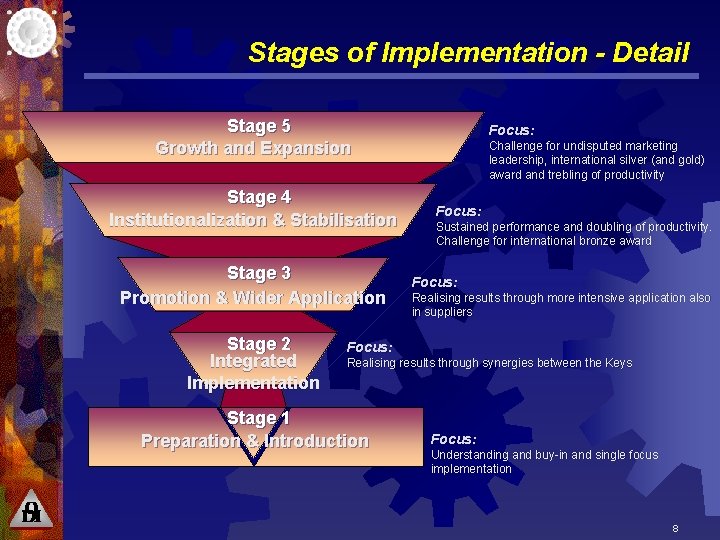
Stages of Implementation - Detail Stage 5 Growth and Expansion Stage 4 Institutionalization & Stabilisation Stage 3 Promotion & Wider Application Stage 2 Integrated Implementation Focus: Challenge for undisputed marketing leadership, international silver (and gold) award and trebling of productivity Focus: Sustained performance and doubling of productivity. Challenge for international bronze award Focus: Realising results through more intensive application also in suppliers Focus: Realising results through synergies between the Keys Stage 1 Preparation & Introduction Focus: Understanding and buy-in and single focus implementation 8
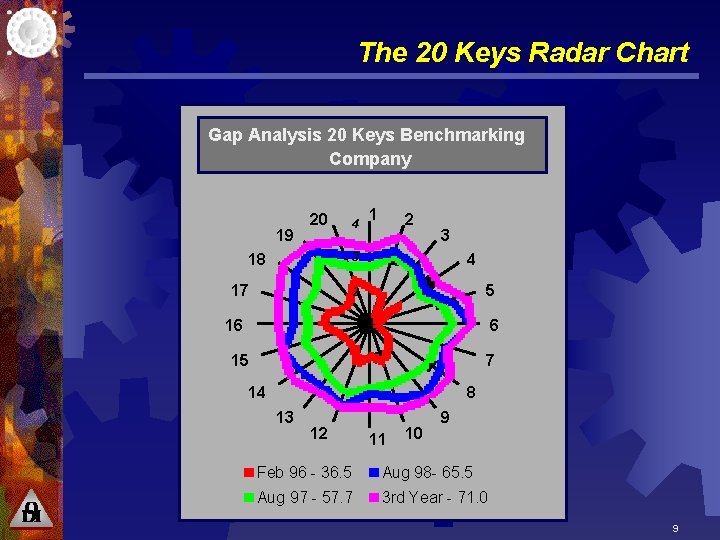
The 20 Keys Radar Chart Gap Analysis 20 Keys Benchmarking Company 19 20 4 1 2 3 3 18 17 4 5 2 16 6 15 7 14 8 13 12 11 10 9 Feb 96 - 36. 5 Aug 98 - 65. 5 Aug 97 - 57. 7 3 rd Year - 71. 0 9
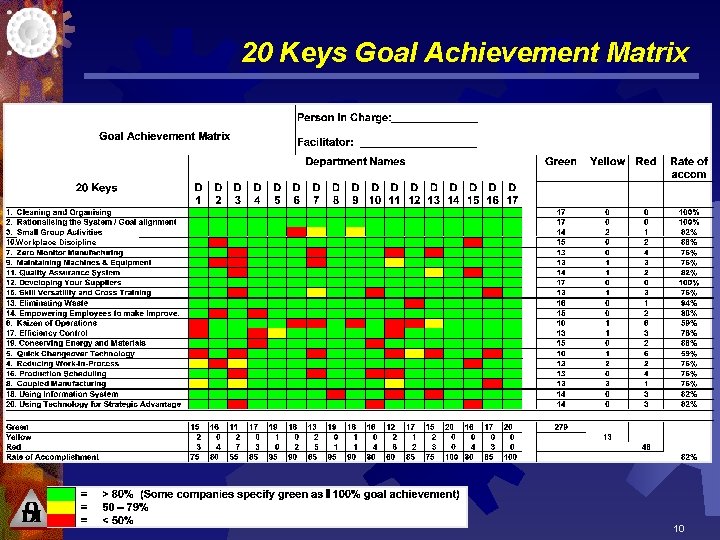
20 Keys Goal Achievement Matrix Workplace Discipline 10
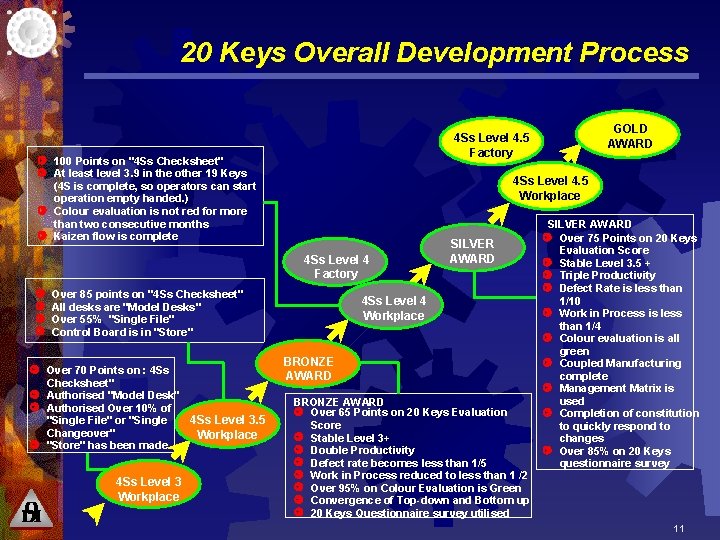
20 Keys Overall Development Process ) 100 Points on "4 Ss Checksheet" ) At least level 3. 9 in the other 19 Keys (4 S is complete, so operators can start operation empty handed. ) ) Colour evaluation is not red for more than two consecutive months ) Kaizen flow is complete 4 Ss Level 4. 5 Workplace 4 Ss Level 4 Factory ) ) Over 85 points on "4 Ss Checksheet" All desks are "Model Desks" Over 55% "Single File" Control Board is in "Store" ) Over 70 Points on : 4 Ss Checksheet" ) Authorised "Model Desk" ) Authorised Over 10% of 4 Ss Level 3. 5 "Single File" or "Single Changeover" Workplace ) "Store" has been made 4 Ss Level 3 Workplace GOLD AWARD 4 Ss Level 4. 5 Factory SILVER AWARD 4 Ss Level 4 Workplace BRONZE AWARD ) Over 65 Points on 20 Keys Evaluation Score ) Stable Level 3+ ) Double Productivity ) Defect rate becomes less than 1/5 ) Work in Process reduced to less than 1 /2 ) Over 95% on Colour Evaluation is Green ) Convergence of Top-down and Bottom up ) 20 Keys Questionnaire survey utilised SILVER AWARD ) Over 75 Points on 20 Keys Evaluation Score ) Stable Level 3. 5 + ) Triple Productivity ) Defect Rate is less than 1/10 ) Work in Process is less than 1/4 ) Colour evaluation is all green ) Coupled Manufacturing complete ) Management Matrix is used ) Completion of constitution to quickly respond to changes ) Over 85% on 20 Keys questionnaire survey 11
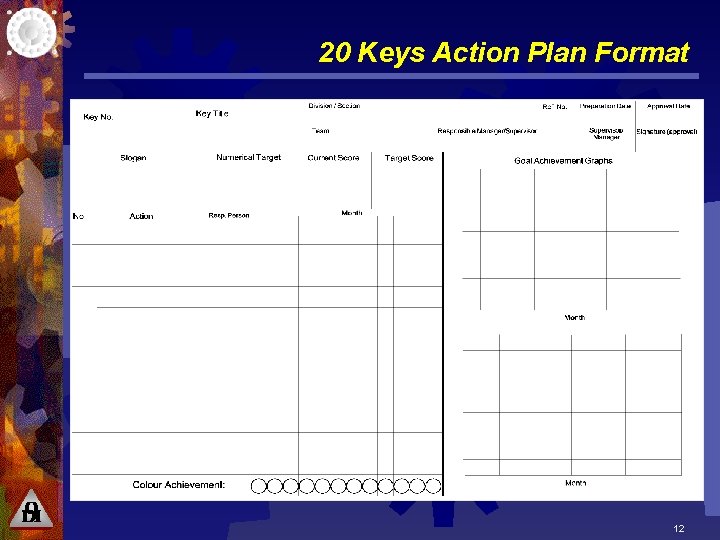
20 Keys Action Plan Format 12
“The only sustainable competitive advantage comes from learning faster than your competitors” John Keane (Financial Times Survey of Knowledge Management 28 th April 1999) 13
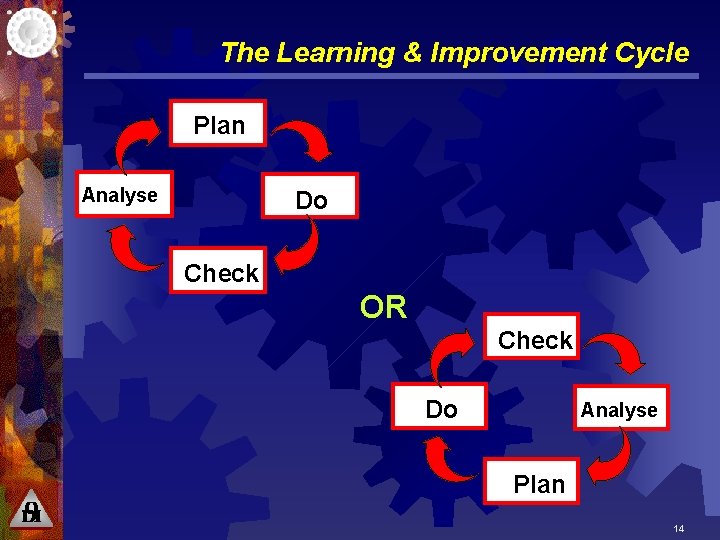
The Learning & Improvement Cycle Plan Analyse Do Check OR Check Do Analyse Plan 14
Says Jack Welch, Chairman & CEO of General Electric “The companies that find a way to engage every mind - harness every volt of passionate energy, bring excitement to the lives of the people, motivate people to come to work in search of a better way - every day - will be the companies that will win. ” 15
Says Gianni Ravazotti, Chairman of Ceramic Industries “As managers we must encourage & challenge all our people to constantly develop & improve. Then we shall see energised, productive, competitive & profitable companies that just keep on growing!” 16
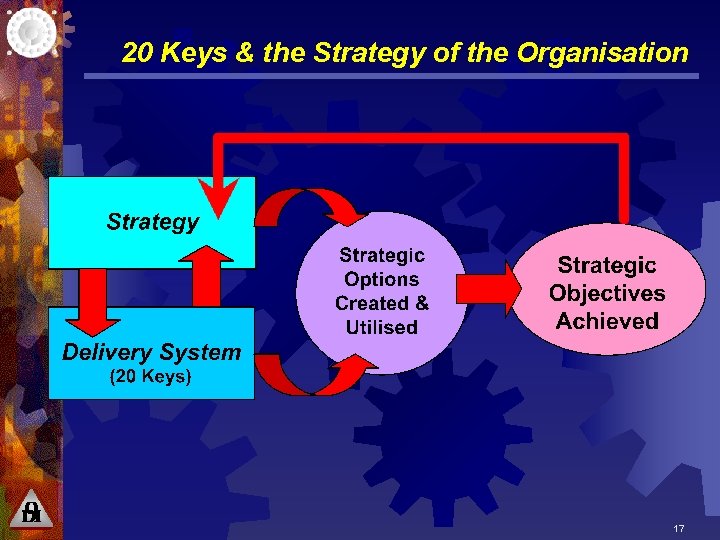
20 Keys & the Strategy of the Organisation 17
20 Keys - Aims & Objectives Created to: ü Achieve the strategic goals of the business ü Improve the speed of learning and innovation of the business and improve the productivity and flexibility of the organisation to adapt more readily to changing market requirements ü Eliminate all forms of waste (non value adding activities) to improve customer satisfaction and market share by making products and services better, faster and cheaper ü Energise and motivate employees to work towards achievement of the goals of the business ü Improve competitiveness, profitability and long term sustainable business success 18
The 20 Keys Programme ã ã Comprises 20 very practical and synergistically integrated key methods required to strengthen the organisation's delivery system focussing on making products and services better, faster and cheaper Utilises visual descriptions (and checksheets) to: Benchmark the organisation against best practices in the world 4 Compare units within a group Recognises and respects what the organisation has achieved to date Develops stretch goals by creating an image throughout the organisation of what can be achieved Builds the skills of everyone to participate in the improvement process Involves all employees in the accomplishment of the superordinate goal – achieving an international bronze award and improving the 20 Keys score by at least 20 points in four years to: 4 Double productivity 4 Reduce defects by 80% 4 Reduce work in process by 50% Successful in many cultures across the world 4 ã ã ã 19
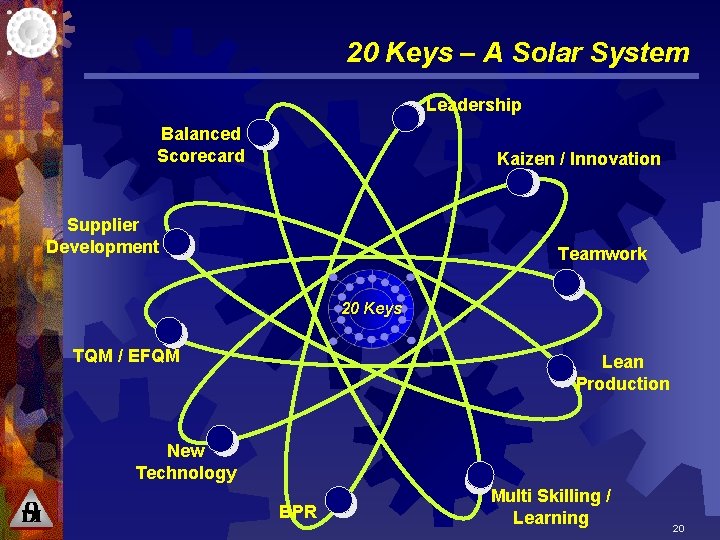
20 Keys – A Solar System Leadership Balanced Scorecard Kaizen / Innovation Supplier Development Teamwork 20 Keys TQM / EFQM Lean Production New Technology BPR Multi Skilling / Learning 20
Understanding & Conviction • • • Understanding alone is not enough to get people moving - understanding by itself will never get things put into practical operation Understanding is a function of reason, whereas conviction is an emotion Only understanding and conviction will ensure success Shigeo Shingo 21
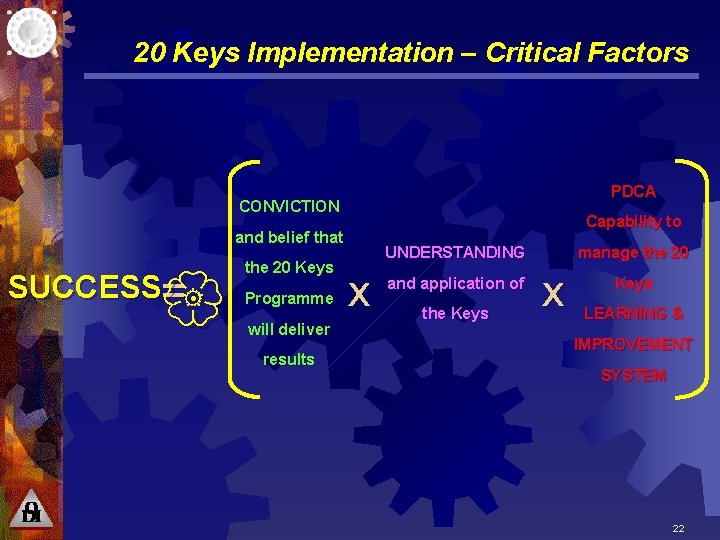
20 Keys Implementation – Critical Factors PDCA CONVICTION Capability to and belief that SUCCESS= the 20 Keys Programme will deliver results UNDERSTANDING x and application of the Keys manage the 20 x Keys LEARNING & IMPROVEMENT SYSTEM 22
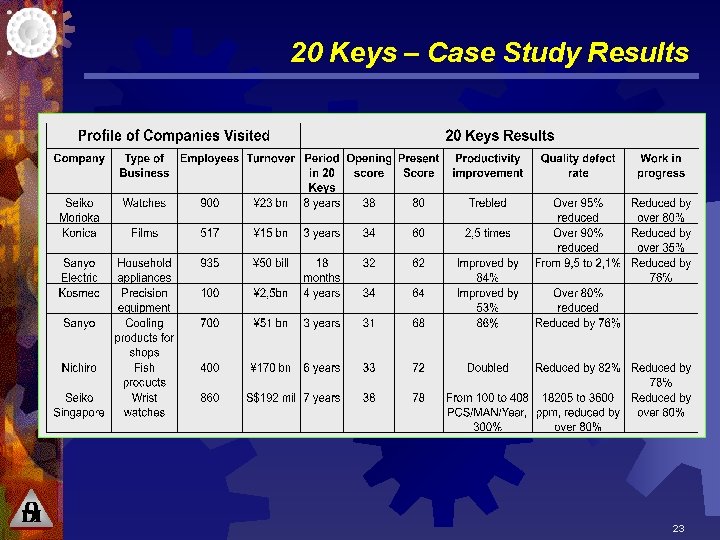
20 Keys – Case Study Results 23
Nichero Foods Implementation Case Study 24
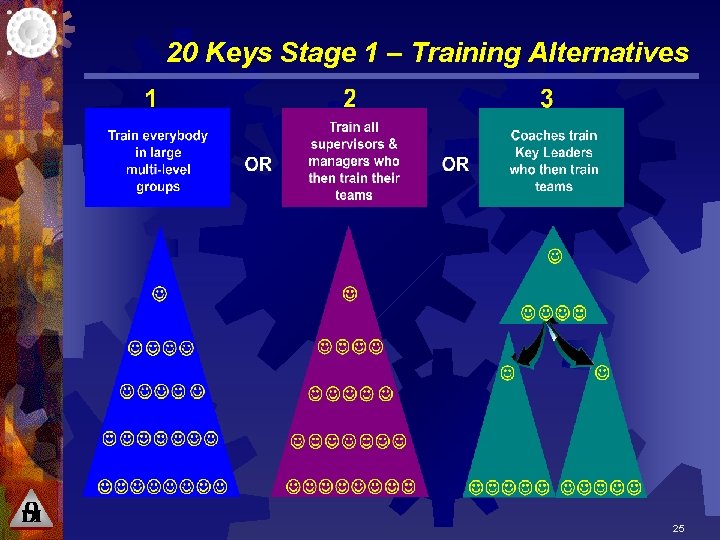
20 Keys Stage 1 – Training Alternatives 25
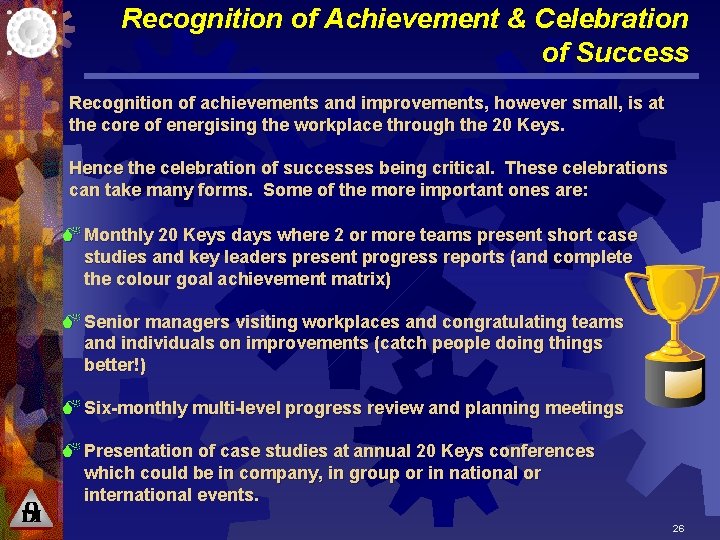
Recognition of Achievement & Celebration of Success Recognition of achievements and improvements, however small, is at the core of energising the workplace through the 20 Keys. Hence the celebration of successes being critical. These celebrations can take many forms. Some of the more important ones are: M Monthly 20 Keys days where 2 or more teams present short case studies and key leaders present progress reports (and complete the colour goal achievement matrix) M Senior managers visiting workplaces and congratulating teams and individuals on improvements (catch people doing things better!) M Six-monthly multi-level progress review and planning meetings M Presentation of case studies at annual 20 Keys conferences which could be in company, in group or in national or international events. 26
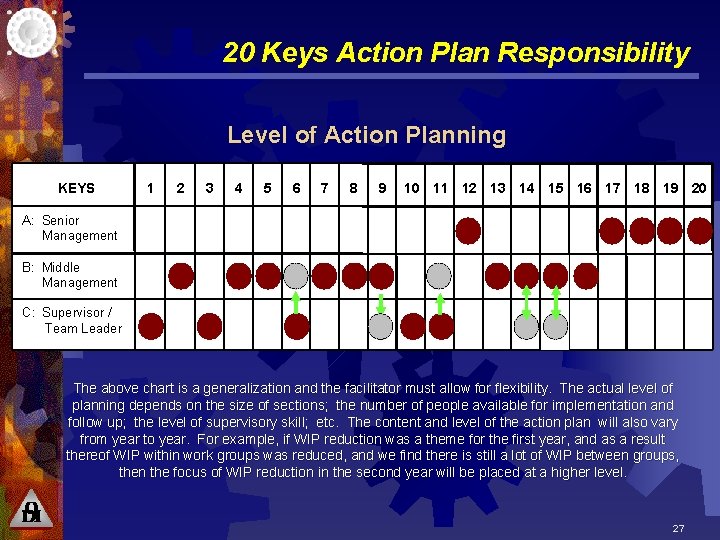
20 Keys Action Plan Responsibility Level of Action Planning KEYS 1 2 3 4 5 6 7 8 9 10 11 12 13 14 15 16 17 18 19 20 A: Senior Management B: Middle Management C: Supervisor / Team Leader The above chart is a generalization and the facilitator must allow for flexibility. The actual level of planning depends on the size of sections; the number of people available for implementation and follow up; the level of supervisory skill; etc. The content and level of the action plan will also vary from year to year. For example, if WIP reduction was a theme for the first year, and as a result thereof WIP within work groups was reduced, and we find there is still a lot of WIP between groups, then the focus of WIP reduction in the second year will be placed at a higher level. 27
The Purpose of Multi-Level Meetings They are used to : · · · Energise the organisation Visualise and strengthen the leadership of the organisation Open up communication channels between levels and departments Facilitate and speed up training in the 20 Keys and other strategic priorities Plan implementation of the 20 Keys and other strategic priorities Ensure proper follow-up and replanning. 28

29
The are Totally in Tune with the Requirements of Globalization It is a transparent system that connects, involves and energizes everybody in the business to produce and provide products and services flexibly according to market requirements: • • • Better Faster Cheaper 30
The 20 Keys Programme was created to: Achieve the strategic goals of the Improve businessthe speed of learning and innovation of the organisation – the organisation constitution Improve customer satisfaction and market share through better, faster and cheaper services and products Energise and motivate employees Improve competition, profitability and sustainable business success 31
- Slides: 31