
20 Ionic Equilibria III The Solubility Product Principle
20 Ionic Equilibria III: The Solubility Product Principle

Chapter Goals • Solubility Product Constants溶解度積常數 • Determination of Solubility Product Constants 決 定溶解度積常數 • Uses of Solubility Product Constants • Fractional Precipitation分級沉澱 • Simultaneous Equilibria Involving Slightly Soluble Compounds • Dissolving Precipitates 2

Aqueous Solutions: An Introduction Insoluble 3

Solubility Product Constants • Silver chloride, Ag. Cl, is rather insoluble in water. • Careful experiments show that if solid Ag. Cl is placed in pure water and vigorously stirred, a small amount of the Ag. Cl dissolves in the+water. + Ag Cl Ag (aq) + Cl (aq) • The equilibrium constant expression for this dissolution is called a solubility product constant 溶解度積常數. – Ksp = solubility product constant Ksp = [Ag+][Cl-] = 1. 8 x 10 -10 Appendix H 當溶液解離達平衡後,反應物以及生成物離子的濃度皆不改 變,此離子濃度會達成一個固定的比例即稱溶解度積常數 4

Solubility Product Constants • Consider the dissolution of silver sulfide in water. H 2 O Ag 2 S(aq) 100% 2 Ag+ + S 2 - • The solubility product expression for Ag 2 S is: K = [Ag+]2[S 2 -] = 1. 0 x 10 -49 sp Ksp的數值愈大,表示溶液中離子的濃度也愈大;也就是水 溶解化合物時,化合物在水中分解成離子的數量也就愈多。 5

Solubility Product Constants • The dissolution of solid calcium phosphate in water is represented as: Ca 22+(PO 43 -)2(s) H 2 O 100% 2 Ca 2+ + 2 PO 43 - The solubility product constant expression is: Ksp = [Ca 2+]3[PO 43 -]2 = 1. 0 x 10 -25 n 6

Solubility Product Constants • In general, the dissolution of a slightly soluble compound and its solubility product expression are represented as: Mr. Ys(s) H 2 O 100% r. Ms+ + s. Yr- Ksp = [Ms+]r[Yr-]s 溶解度的另一表示方法: • The solubility of a compound molar solubility莫耳溶解 度 The number of moles that dissolve to one liter of 7 saturated solution (M) 每公升飽和水溶液中所含溶質的莫耳

Solubility Product Constants • The same rules apply for compounds that have more than two kinds of ions. • One example of a compound that has more than two kinds of ions is calcium ammonium phosphate. Ca. NH 4 PO 4(s) H 2 O 100% Ca 2+(aq) + NH 4+(aq)+PO 43 -(aq) Ksp = [Ca 2+][NH 4+][PO 43 -] 8

Determination of Solubility Product Constants Example 20 -1: One liter of saturated silver chloride solution contains 0. 00192 g of dissolved Ag. Cl at 25 o. C. Calculate the molar solubility of, and Ksp for, Ag. Cl. The molar solubility can be easily calculated from the data: ? M Ag. Cl= 0. 00192 g Ag. Cl 143 g Ag. Cl 1. 0 L Ag. Cl(s) Ag+ + 1. 34 x 10 -5 M = 1. 34 x 10 -5 M Cl- 1. 34 x 10 -5 M Ksp = [Ag+][Cl-= ] (1. 34 x 10 -5) x (1. 34 x 10 -5) = 1. 8 x 10 -10 M 9

Determination of Solubility Product Constants Example 20 -2: One liter of saturated calcium fluoride solution contains 0. 0167 gram of Ca. F 2 at 25 o. C. Calculate the molar solubility of, and Ksp for, Ca. F 2. ? M Ca. F 2= 0. 0167 g Ca. F 2 78. 1 g 1. 0 L Ca. F 2 Ca 2+ + 2. 14 x 10 -4 M = 2. 14 x 10 -4 M 2 F- 2. 14 x 10 -4 2 x(2. 14 x 10 -4) Ksp = [Ca 2+][F-]2= (2. 14 x 10 -4) x (4. 28 x 10 -4)2 = 3. 92 x 10 -11 mol/L 10

Uses of Solubility Product Constants Example 20 -3: Calculate the molar solubility of barium sulfate, Ba. SO 4, in pure water and the concentration of barium and sulfate ions in saturated barium sulfate at 25 o. C. For barium sulfate, Ksp= 1. 1 x 10 -10. Ba. SO 4 Ba 2+ + x. M SO 42 - x. M Ksp = [Ba 2+][SO 42 -=] 1. 1 x 10 -10 (x)(x) = 1. 1 x 10 -10 x= 1. 0 x 10 -5 M [Ba 2+]=[SO 42 -]= 1. 0 x 10 -5 M 1. 0 x 10 -5 mol ? g Ba. SO 4= 1. 0 x 10 -5 M x 1 L = = 1. 0 x 10 -5 x 234 = 2. 34 x 10 -3 g in 1 L 11

Uses of Solubility Product Constants Example 20 -4: The solubility product constant for magnesium hydroxide, Mg(OH)2, is 1. 5 x 10 -11. Calculate the molar solubility of magnesium hydroxide and the p. H of a saturated magnesium hydroxide solution at 25 o. C. Mg(OH)2 Mg 2+ + 2 OHx. M 2 x M 2 1. 5 x 10 -11 Ksp = [Mg 2+][OH-]= (x)(2 x)2 = 1. 5 x 10 -11 4 x 3= 1. 5 x 10 -11 M x 3= 3. 75 x 10 -12 M x= 1. 6 x 10 -4 M [OH-]= 2 x (1. 6 x 10 -4) =3. 2 x 10 -4 M p. OH=3. 49, p. H =10. 51 12

The Common Ion Effect in Solubility Calculations Example 20 -5: Calculate the molar solubility of barium sulfate, Ba. SO 4, in 0. 010 M sodium sulfate, Na 2 SO 4, solution at 25 o. C. Compare this to the solubility of Ba. SO 4 in pure water. (Example 20 -3). (What is the common ion? How was a common ion problem solved in Chapter 19? ) Na 2 SO 4 2 Na+ + SO 42 - Soluble ionic salt 0. 010 M 2 x(0. 010)M Ba. SO 4 Ba 2+ + x. M 完全解離 0. 010 M SO 42 -Slightly Soluble salt x. M 溶解度很低 Ksp = [Ba 2+][SO 42 -]= 1. 1 x 10 -10 = (x)(0. 01+x) 0. 01+x 0. 01 (0. 01)x = 1. 1 x 10 -10 x = 1. 1 x 10 -8 Molar solubility of Ba. SO 4 13

The Common Ion Effect in Solubility Calculations • The molar solubility of Ba. SO 4 in 0. 010 M Na 2 SO 4 solution is 1. 1 x 10 -8 M. • The molar solubility of Ba. SO 4 in pure water is 1. 0 x 10 -5 M. – Ba. SO 4 is 900 times more soluble in pure water than in 0. 010 M sodium sulfate! – Adding sodium sulfate to a solution is a fantastic method to remove Ba 2+ ions from solution! • If your drinking water were suspected to have lead ions in it, suggest a method to prove or disprove this suspicion. 14

The Reaction Quotient in Precipitation Reactions The reaction quotient, Q, and the Ksp of a compound are used to calculate the concentration of ions in a solution and whether or not a precipitate will form. If Qsp< Ksp Forward process is favored (反應向右) No precipitation occurs; if solid is present, more solid can dissolve (不會產生沉澱) If Qsp= Ksp Solution is just saturated (正好飽和) Solid and solution are in equilibrium; neither forward nor reverse process is favored If Qsp> Ksp Reverse process is favored (反應向左) precipitation occurs to form more solid (產 生沉澱) 15
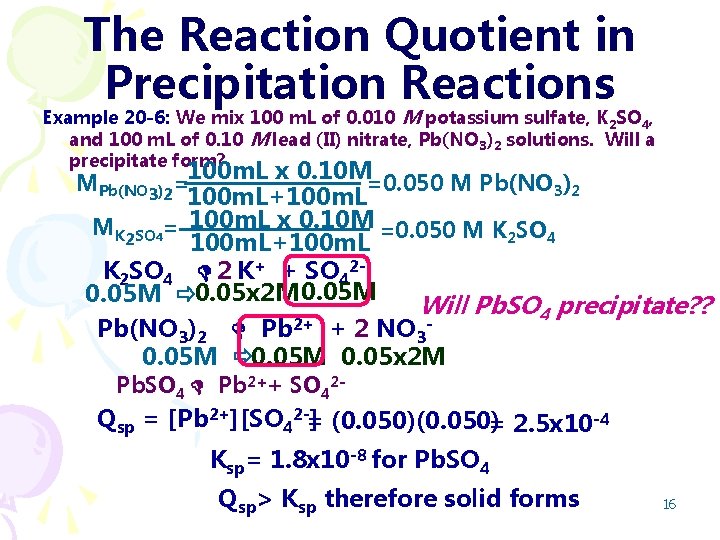
The Reaction Quotient in Precipitation Reactions Example 20 -6: We mix 100 m. L of 0. 010 M potassium sulfate, K 2 SO 4, and 100 m. L of 0. 10 M lead (II) nitrate, Pb(NO 3)2 solutions. Will a precipitate form? 100 m. L x 0. 10 M=0. 050 M Pb(NO ) 3 2 100 m. L+100 m. L MK 2 SO 4= 100 m. L x 0. 10 M =0. 050 M K 2 SO 4 100 m. L+100 m. L K 2 SO 4 2 K+ + SO 420. 05 M 0. 05 x 2 M 0. 05 M MPb(NO 3)2= Will Pb. SO 4 precipitate? ? Pb(NO 3)2 Pb 2+ + 2 NO 30. 05 M 0. 05 x 2 M Pb. SO 4 Pb 2++ SO 42 - Qsp = [Pb 2+][SO 42 -= ] (0. 050) = 2. 5 x 10 -4 Ksp= 1. 8 x 10 -8 for Pb. SO 4 Qsp> Ksp therefore solid forms 16

The Reaction Quotient in Precipitation Reactions Example 20 -7: Suppose we wish to remove mercury from an aqueous solution that contains a soluble mercury compound such as Hg(NO 3)2. We can do this by precipitating mercury (II) ions as the insoluble compound Hg. S. What concentration of sulfide ions, from a soluble compound such as Na 2 S, is required to reduce the Hg 2+ concentration to 1. 0 x 10 -8 M? For Hg. S, Ksp=3. 0 x 10 -53. Hg. S Hg 2++ S 2 Ksp = [Hg 2+][S 2 -= ] 3. 0 x 10 -53= [S 2 -]x(1. 0 x 10 -8) [S 2 -] = 3. 0 x 10 -45 If enough S 2 -, in th form of Na 2 S, is added to just slightly exceed 3. 0 x 10 -45 M the mercury will precipitate 17

The Reaction Quotient in Precipitation Reactions Example 20 -8: Refer to example 20 -7. What volume of the solution (1. 0 x 10 -8 M Hg 2+ ) contains 1. 0 g of mercury? ? L =1. 0 g Hg 2+ 2+ 1 mol Hg 1. 0 L x x 201 g Hg 2+ 1. 0 x 10 -8 mol Hg 2+ ? L =5. 0 x 105 L 18
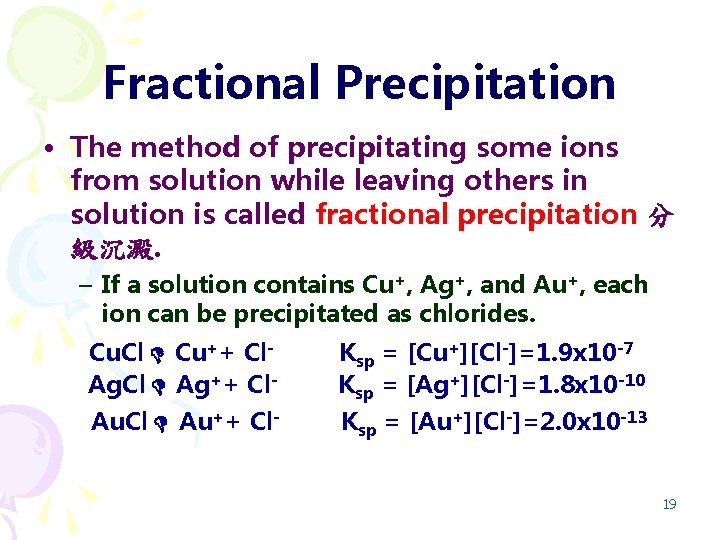
Fractional Precipitation • The method of precipitating some ions from solution while leaving others in solution is called fractional precipitation 分 級沉澱. – If a solution contains Cu+, Ag+, and Au+, each ion can be precipitated as chlorides. Cu. Cl Cu++ Cl. Ag. Cl Ag++ Cl- Ksp = [Cu+][Cl-]=1. 9 x 10 -7 Ksp = [Ag+][Cl-]=1. 8 x 10 -10 Au. Cl Au++ Cl- Ksp = [Au+][Cl-]=2. 0 x 10 -13 19

Example 20 -9: If solid sodium chloride is slowly added to a solution that is 0. 010 M each in Cu+, Ag+, and Au+ ions, which compound precipitates first? Calculate the concentration of Cl- required to initiate precipitation of each of these metal chlorides. Au. Cl has the small Ksp, so it precipitates first By the same reasoning, Cu. Cl will precipitate last • Calculate the concentration of Cl- required to precipate Au. Cl Ksp = [Au+][Cl-]=2. 0 x 10 -13 = (0. 010)x[Cl-]=2. 0 x 10 -11 • Repeat the calculation for silver chloride. Ksp = [Ag+][Cl-]=1. 8 x 10 -10 = (0. 010)x[Cl-]=1. 8 x 10 -8 • Finally, for copper (I) chloride to precipitate. Ksp = [Cu+][Cl-]=1. 9 x 10 -7= (0. 010)x[Cl-]=1. 9 x 10 -5 20
![Fractional Precipitation • These three calculations give the [Cl-] required to – precipitate Au.](http://slidetodoc.com/presentation_image_h/7fab892d405e2e54c4f2fd9a992707d0/image-21.jpg "Fractional Precipitation • These three calculations give the [Cl-] required to – precipitate Au.")
Fractional Precipitation • These three calculations give the [Cl-] required to – precipitate Au. Cl ([Cl-] >2. 0 x 10 -11 M), – precipitate Ag. Cl ([Cl-] >1. 8 x 10 -8 M), – precipitate Cu. Cl ([Cl-] >1. 9 x 10 -5 M). • It is also possible to calculate the amount of Au+ precipitated before the Ag+ begins to precipitate, as well as the amounts of Au+ and Ag+ precipitated before the Cu+ begins to precipitate. 21

Example 20 -10: Calculate the percentage of Au+ ions that precipitate before Ag. Cl begins to precipitate. – Use the [Cl-] from Example 20 -9 to determine the [Au+] remaining in solution just before Ag. Cl begins to precipitate. Ksp = [Au+][Cl-]=2. 0 x 10 -13 [Au+]x(1. 8 x 10 -8)=2. 0 x 10 -13 [Au+]=1. 1 x 10 -5 unprecipitated • The percent of Au+ ions unprecipitated just before Au. Cl precipitates is: +] [Au unprecipitated % Au+unprecipitated= x 100% [Au+]original 1. 1 x 10 -5 = 0. 01 x 100% =0. 1% unprecipitated • Therefore, 99. 9% of the Au+ ions precipitates before Ag. Cl begins to precipitate. 22
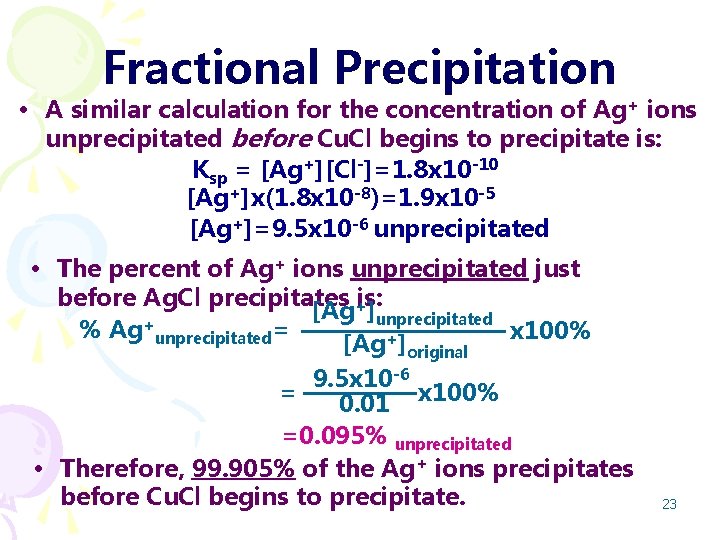
Fractional Precipitation • A similar calculation for the concentration of Ag + ions unprecipitated before Cu. Cl begins to precipitate is: Ksp = [Ag+][Cl-]=1. 8 x 10 -10 [Ag+]x(1. 8 x 10 -8)=1. 9 x 10 -5 [Ag+]=9. 5 x 10 -6 unprecipitated • The percent of Ag+ ions unprecipitated just before Ag. Cl precipitates +is: [Ag ]unprecipitated + % Ag unprecipitated= x 100% + [Ag ]original 9. 5 x 10 -6 = 0. 01 x 100% =0. 095% unprecipitated • Therefore, 99. 905% of the Ag+ ions precipitates before Cu. Cl begins to precipitate. 23
Simultaneous Equilibria Involving Slightly Soluble Compounds • Many weak acids and bases react with many metal ions to form insoluble compounds. 許多弱酸和弱鹼可以和金屬反應形 成不可溶的化合物 – The weak acid or weak base equilibrium as well as the solubility equilibrium • Equlibria that simultaneously involve two or more different equilibrium constant expressions are simultaneous equilibria. 24

Simultaneous Equilibria Involving Slightly Soluble Compounds Example 20 -12: If 0. 10 mole of ammonia and 0. 010 mole of magnesium nitrate, Mg(NO 3)2, are added to enough water to make one liter of solution, will magnesium hydroxide precipitate from the solution? – For Mg(OH)2, Ksp = 1. 5 x 10 -11. Kb for NH 3 = 1. 8 x 10 -5. Calculate Qsp for Mg(OH)2 and compare it to Ksp. – Mg(NO 3)2 is a soluble ionic compound so [Mg 2+] = 0. 010 M. – Aqueous ammonia is a weak base that we can calculate [OH -]. NH 3 + H 2 O NH 4++ OH- 0. 1 M -x +x +x [NH 4+] [OH-] (x)(x) -5 K b= = 1. 8 x 10 = [NH 3] (0. 10 -x) x 2=1. 8 x 10 -6 x=1. 3 x 10 -3 =[OH-] Mg(NO 3) 2 Mg 2++ 2 NO可溶性鹽類 3 0. 01 M +0. 01 M+0. 01 x 2 M 2 Qsp = [Mg 2+][OH-]=2 (0. 010)(1. 3 x 10 -3)= 1. 7 x 10 -8 Qsp> Ksp thus Mg(OH)2 will precipitate 25

Example 20 -13: How many moles of solid ammonium chloride, NH 4 Cl, must be used to prevent precipitation of Mg(OH)2 in one liter of solution that is 0. 10 M in aqueous ammonia and 0. 010 M in magnesium nitrate, Mg(NO 3)2 ? (Note the similarity between this problem and Example 20 -12. ) Calculate the maximum [OH-] that can exist in a solution that is 0. 010 M in Mg 2+. Ksp = [Mg 2+][OH-]2=1. 5 x 10 -11 [OH-]2 x(0. 010)=1. 5 x 10 -11 [OH-]2=1. 5 x 10 -9 [OH-] 3. 9 x 10 -5 M Using the maximum [OH-] that can exist in solution, determine the number of moles of NH 4 Cl required to buffer 0. 10 M aqueous ammonia so that the [OH-] does not exceed 3. 9 x 10 -5 M. NH 4 Cl → NH 4++ Cl- x. M NH 3 + H 2 O NH 4 ++ OH- Buffer solution (0. 1 M) (3. 9 x 10 -5) [OH-]=Kb x [base] =1. 8 x 10 -5 x (x) [salt] (0. 10) Because there is 1. 0 L of solution 26 x= 0. 046 =[NH 4 Cl]There are 0. 046 mol NH 4 Cl

Simultaneous Equilibria Involving Slightly Soluble Compounds • Check these values by calculating Qsp for Mg(OH)2. 2 Qsp = [Mg 2+][OH-]= (0. 010)(3. 9 x 10 -5)2= 1. 5 x 10 -11 Qsp = Ksp Thus this system is at equilibrium • Use the ion product for water to calculate the [H+] and the p. H of the solution. [H+][OH-] =1. 0 x 10 -14 [H+]x(3. 9 x 10 -5)=1. 0 x 10 -14 [H+] =2. 6 x 10 -10 p. H=9. 59 27

Dissolving Precipitates • For an insoluble solid, if the ion concentrations (of either the cation or anion) are decreased, a solid precipitate can be dissolved. (在不可溶固體 中, 若任一離子濃度降低, 則此沉澱的固體會被再溶解) – The trick is to make Qsp < Ksp. • One method is to convert the ions into weak electrolytes. 採用的方法乃將離子轉成弱 電解質 – Make these ions more water soluble. 讓此離子更水 溶 28

Dissolving Precipitates • If insoluble metal hydroxides are dissolved in strong acids, they form soluble salts and water. (不可溶金屬氫氧化合物可溶於強酸而形成可 溶性鹽類及水) • For example, look at the dissolution of Mg(OH)2 in HCl. Mg(OH)2(s) + 2 HCl(aq) Mg. Cl 2(aq) + 2 H 2 O(l) or Mg(OH)2(s) + 2 H+(aq) Mg 2+(aq) + 2 H 2 O(l) Notice that the insoluble Mg(OH)2 is converted to the more soluble Mg. Cl 2 29
Dissolving Precipitates • A second method is to dissolve insoluble metal carbonates in strong acids. (另一方法 是將不可溶金屬碳酸化合物溶於強酸中) – The carbonates will form soluble salts, carbon dioxide, and water. Ca. CO 3(s) + 2 HCl(aq) Ca. Cl 2(aq) + CO 2(g) + 2 H 2 O(l) or Ca. CO 3(s) + 2 H+(aq) Ca 2+(aq) + CO 2(g) + 2 H 2 O(l) Notice that the formation of carbon dioxide removes ions and makes the carbonate dissolve 30

Dissolving Precipitates • A third method is to convert an ion to another species by an oxidation-reduction reaction. (第三 種方法乃利用氧化還原反應改變離子態) • For example, the dissolution of insoluble metal sulfides in hot nitric acid causes the sulfide ions to be oxidized to elemental sulfur. 3 Pb. S(s) + 8 H+ + 2 NO 3 - 3 Pb 2+ + 3 S 0(s) +2 NO(g) + 4 H 2 O(l) [Pb 2+][S 2 -]=8. 4 x 10 -28=Ksp The NO 3 - oxidizes S 2 - to S 0 making the Qsp<Ksp 31

Dissolving Precipitates • A fourth method is complex ion formation. (第四 種方法是形成錯離子) • The cations in many slightly soluble compounds will form complex ions. – This is the method used to dissolve unreacted Ag. Br and Ag. Cl on photographic film. • Photographic “hypo” is Na 2 S 2 O 3. h 2 Ag. Br(s) 2 Ag(s) + Br 2(l) In the unexposed portion of the film Ag. Br(s) is left Ag. Br(s) + 2 Na 2 S 3 O 2(aq) Na 3 Ag(S 2 O 3)2 (aq) + Na. Br(aq) Ag. Br(s) + 2 Na 2 S 32 - [Ag(S 2 O 3)2]3 -(aq) + Br-(aq) 32
Dissolving Precipitates • Copper(II) hydroxide, which is light blue colored, dissolves in aqueous ammonia to form dark blue, [Cu(NH 3)4]2+. Cu(OH)2(s) + 4 NH 3(aq) [Cu(NH 3)4]2+(aq) + 2 OHCu(OH)2(s) Cu 2+(aq) + 2 OH-(aq) Cu 2+(aq) + 4 NH 3 [Cu(NH 3)4]2+(aq) 33

Complex Ion Equilibria • A metal ion coordinated to several neutral molecules or anions forms compounds called complex ions. • Familiar examples of complex ions include: [Ag(NH 3)2]+ [Cu(NH 3)4]2+ Co(NH 3)2 Cl 2 [Pt(NH 3)2]+ 34

Complex Ion Equilibria • The dissociation of complex ions can be represented similarly to equilibria. • For example: [Cu(NH 3)4]2+ Cu 2+ + 4 NH 3 [Cu 2+] [NH 3]4 K d= [[Cu(NH 3)4]2+] [Ag(NH 3)2]+ Ag+ + 2 NH 3 [Ag+] [NH 3]2 K d= [[Ag(NH 3)2]+] Complex ion equilibrium constants are called dissociation constants Kd. 35

Complex Ion Equilibria Example 20 -14: Calculate the concentration of silver ions in a solution that is 0. 010 M in [Ag(NH 3)2]+. Kd = 6. 3 x 10 -8 Write the dissociation reaction and equilibrium concentrations. [Ag(NH 3)2]+ Ag+ + 2 NH 3 (0. 01 -x)M (2 x)M Substitute the algebraic quantities into the dissociation expression. 2 [Ag+] [NH 3]2 (x)(2 x) K d= = 6. 3 x 10 -8 = + [[Ag(NH 3)2] ] (0. 010 -x) 4 x 3= 6. 3 x 10 -10 x 3= 1. 6 x 10 -10 x= 5. 4 x 10 -4 M 36
Example 20 -15: How many moles of ammonia must be added to 2. 00 L of water so that it will just dissolve 0. 010 mole of silver chloride, Ag. Cl? ? M Ag. Cl = 0. 01 mol/2. 0 L = 5 x 10 -3 M Ag. Cl(s) + 2 NH 3 [Ag(NH 3)2]++ Cl 5 x 10 -3 M 2(5 x 10 -3) M 5 x 10 -3 M Ag. Cl Ag+ + Cl. Ksp=[Ag+][ Cl-] =1. 8 x 10 -10 [Ag+] [NH 3]2 + + -10 [Ag(NH 3)2] Ag + 2 NH 3 Kd= =6. 3 x 10 [[Ag(NH 3)2]+] The [Ag+] in the solution must satisfy both equilibrium constant expressions. Because the [Cl-] is known, the equilibrium concentration of Ag+ can be calculated from Ksp for Ag. Cl. Ksp=[Ag+][ Cl-] =1. 8 x 10 -10=[Ag+](5 x 10 -3) +] possible Which is the maximum [Ag + -8 [Ag ] =3. 6 x 10 -8)[NH ]2 (3. 6 x 10 [Ag+] [NH 3]2 3 -10 = =6. 3 x 10 K d= (5 x 10 -3) [[Ag(NH 3)2]+] [NH 3]= 0. 094 M [NH 3]2= 8. 75 x 10 -3 [NH 3]total= 0. 094 M + 2 x(5. 0 x 10 -3) =0. 104 M 37 ? mol NH 3= 2. 0 L x 0. 104 M = 0. 21
- Slides: 37