
20 A 20 B Rate of Change 20
20 A, 20 B Rate of Change, 20 C The Derivative Function, 20 D Rules of Differentiation Unit 5: Introduction to Differential Calculus 1 20 A, 20 B, 20 C
Rate a comparison between two quantities of different kinds Paxon’s schedule allows for 90 minutes per class period Math Studies students turn in three late project rough drafts per day speed: rate of distance traveled per unit of time common units: km/h m/sec kmh-1 20 A, 20 B, 20 C Cop y msec-1
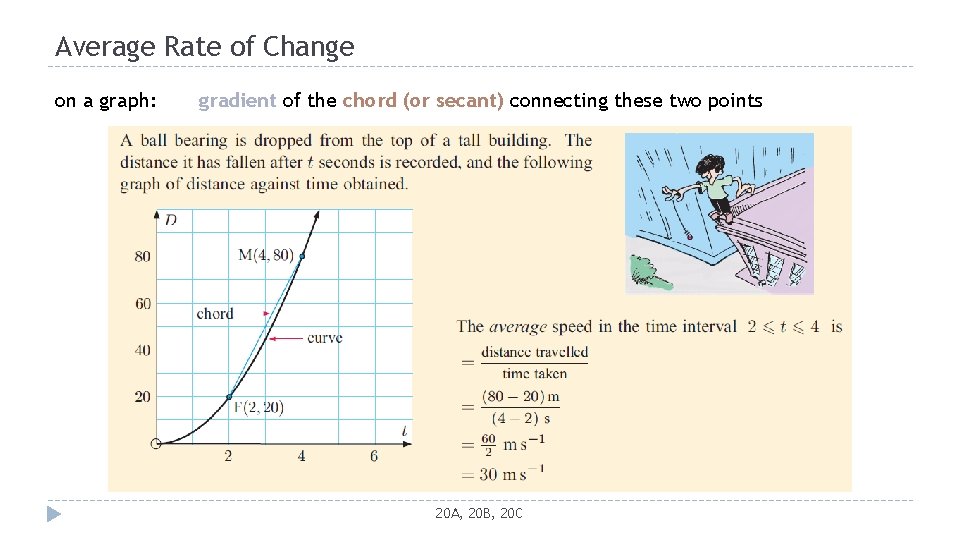
Average Rate of Change on a graph: gradient of the chord (or secant) connecting these two points 20 A, 20 B, 20 C
Instantaneous Rate of Change gradient of the tangent to the graph at that point on a graph: Cop y using a straight-edge, graph the tangent to the curve and determine its gradient by choosing two of its points Investigation p. 565: 1(a)(b) 20 A, 20 B, 20 C
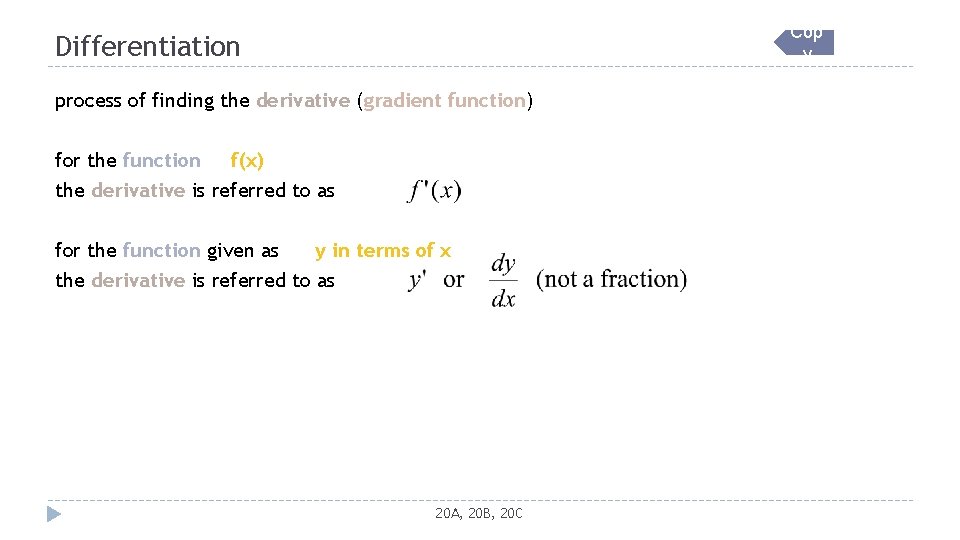
Cop y Differentiation process of finding the derivative (gradient function) for the function f(x) the derivative is referred to as for the function given as y in terms of x the derivative is referred to as 20 A, 20 B, 20 C

Simple Rules of Differentiation constant function sum rule general rule 20 A, 20 B, 20 C Cop y
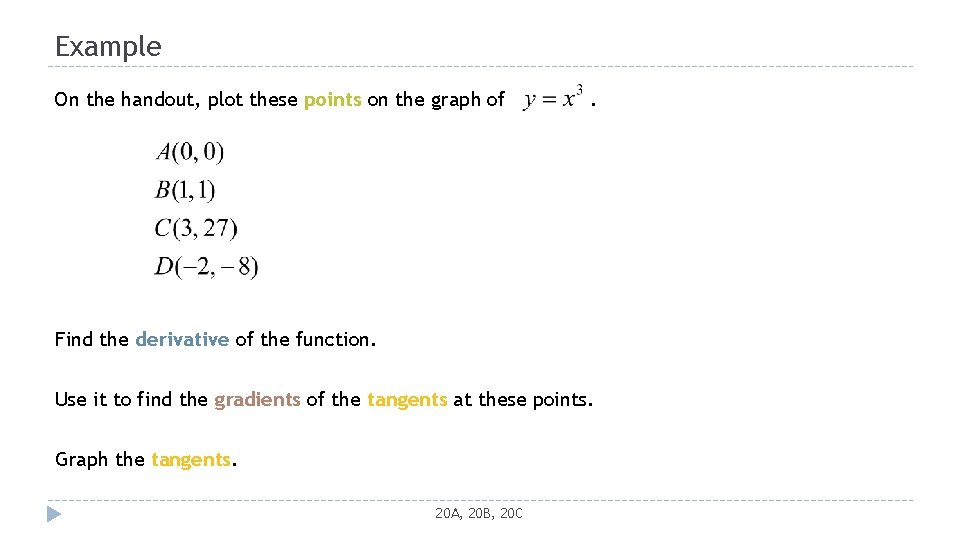
Example On the handout, plot these points on the graph of . Find the derivative of the function. Use it to find the gradients of the tangents at these points. Graph the tangents. 20 A, 20 B, 20 C
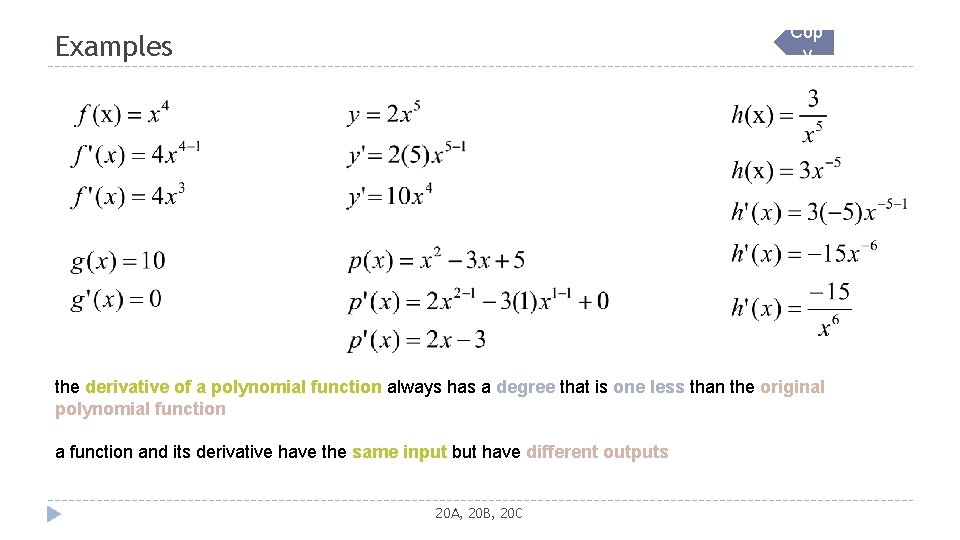
Cop y Examples the derivative of a polynomial function always has a degree that is one less than the original polynomial function and its derivative have the same input but have different outputs 20 A, 20 B, 20 C
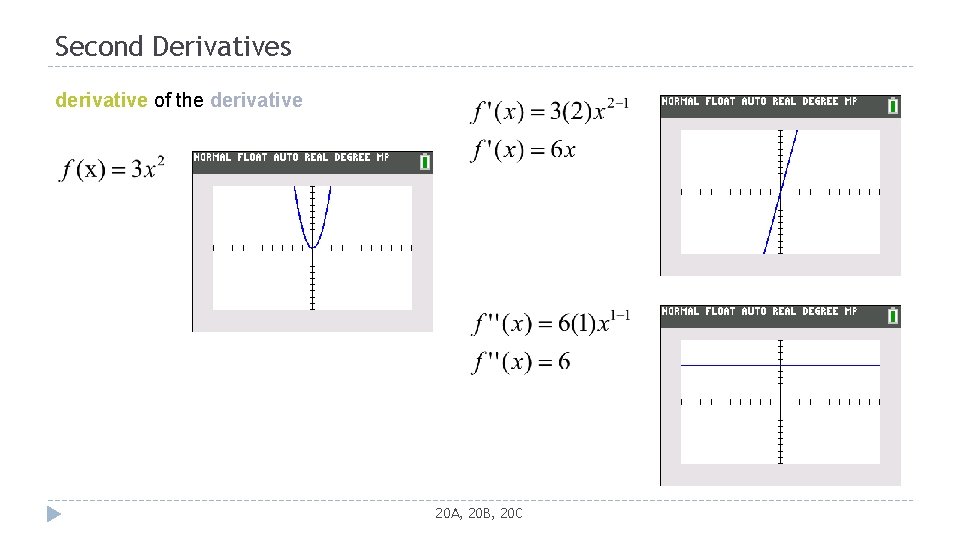
Second Derivatives derivative of the derivative 20 A, 20 B, 20 C
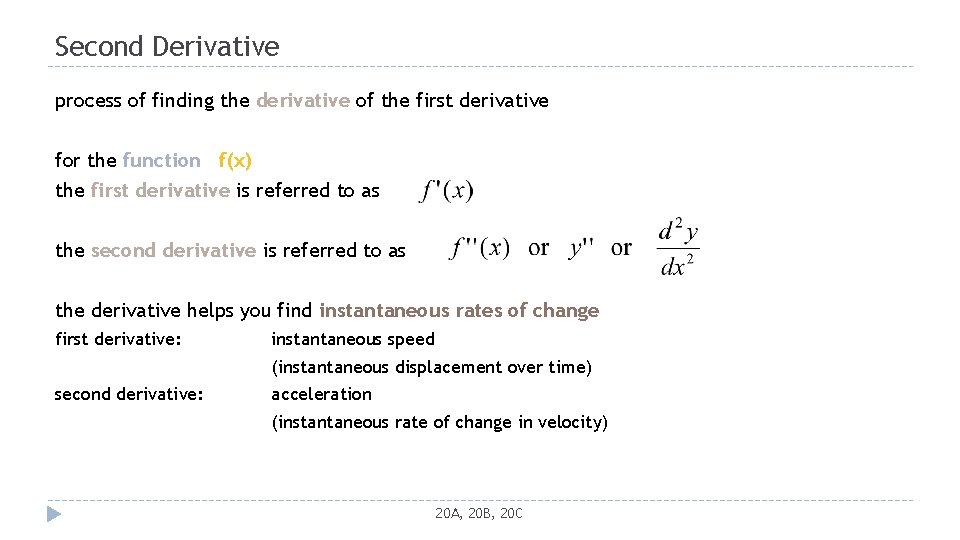
Second Derivative process of finding the derivative of the first derivative for the function f(x) the first derivative is referred to as the second derivative is referred to as the derivative helps you find instantaneous rates of change first derivative: instantaneous speed (instantaneous displacement over time) second derivative: acceleration (instantaneous rate of change in velocity) 20 A, 20 B, 20 C
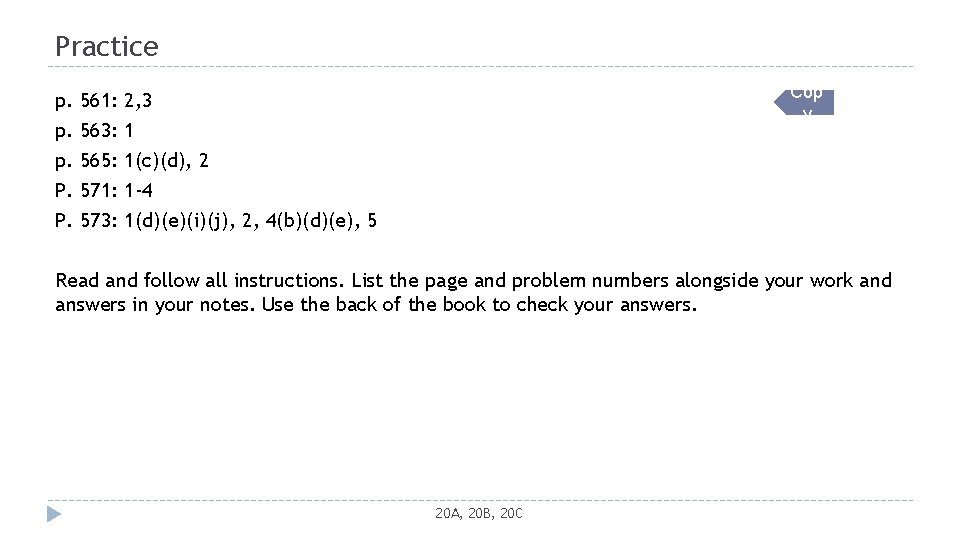
Practice Cop y p. 561: 2, 3 p. 563: 1 p. 565: 1(c)(d), 2 P. 571: 1 -4 P. 573: 1(d)(e)(i)(j), 2, 4(b)(d)(e), 5 Read and follow all instructions. List the page and problem numbers alongside your work and answers in your notes. Use the back of the book to check your answers. 20 A, 20 B, 20 C
- Slides: 11