
20 21 Assessing the variability of rainfall temperature
20 21 Assessing the variability of rainfall, temperature, and river flow in Sipi catchment on Mt. Elgon, Uganda J. KILAMA LUWA 1, J. G. MWANJALOLO MAJALIWA 2, Y. BAMUTAZE 2, I. KABENGE 2, G. ORYANGI 1, P. PILESJO 3 1 Faculty 2 College of Science, Gulu University, P. O. Box 166, Gulu, Uganda of Agriculture and Environmental Sciences, Makerere University, P. O. Box 576, Kampala, Uganda 3 Centre for Geographic Information Systems, Lund University, P. O. Box 117, 221 00 LUND, Sweden Corresponding author: kilamaluwa@gmail. com 12/15/2021 1
20 21 Background/Problem/Rationale • The variability in climate at a catchment scale affects water and food security and ecosystem health (Langat et al. , 2017) • Climate research has evolved over time but with less emphasis on small catchment (Poortinga et al. , 2017). • Research on climate variability in small catchments can find practical applications in multiple sectors (Marques et al. , 2015; Langat et al. , 2017; Alamirew et al. , 2016; Onyutha, 2016). • The variability and trends in rainfall, temperature, and river flow, and the frequencies of extreme events in Sipi catchment is still poorly 12/15/2021 2
20 21 Objectives • To determine the variability and trends in rainfall, temperature, and river flow, and occurrences of extreme events in Sipi catchment. 1. How has rainfall, temperature, and river flow varied in Sipi? 2. What is the trend of rainfall, temperature, and river flow in Sipi? 3. How many extreme events have occurred in Sipi catchment pre and post-2000? 12/15/2021 3
20 21 Methods/Approach 12/15/2021 4
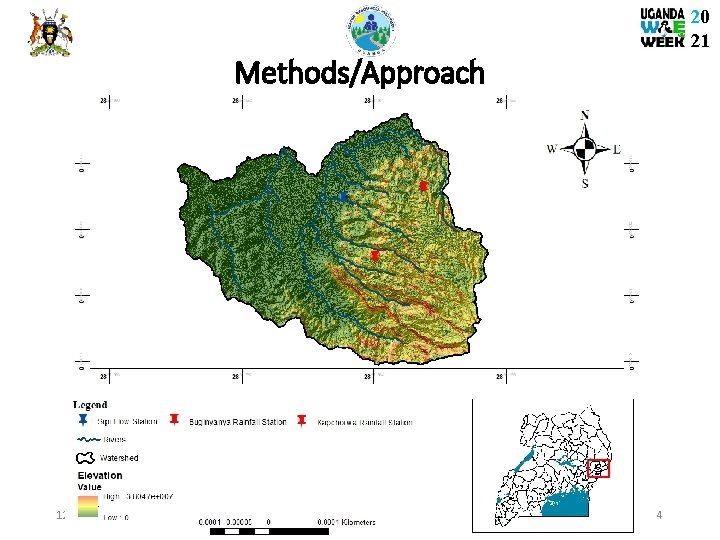
20 21 Methods/Approach • Rainfall and temperature data (1981 -2015) • Weather stations Buginyanya and Kapchorwa • Source: Uganda National Meteorological Authority (UNMA). • Flow data of Sipi (1998 -2015) • Source: Ministry of Water and Environment. • Analysis: Descriptive statistics, trend tests, and the Standardized Precipitation Index (SPI) • Scales: Annual and seasonal. 12/15/2021 5
20 21 Results/Findings • High variations in SON seasonal rainfall (CV > 30) • Annual rainfall varied moderately (20 ˂ CV ˂ 30). • SON minimum and mean temperatures have increased over the entire catchment at α = 0. 001 and α = 0. 05 levels of significance respectively • Both MAM and annual river flow increased at an α = 0. 05 level of significance. • Extreme events in the catchment post-2000 = (13) 12/15/2021 • Extreme events in the catchment pre-2000 = (5) 6
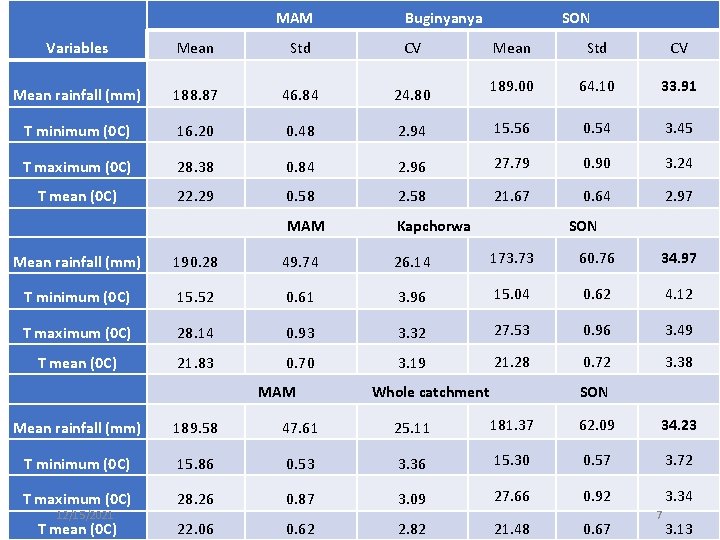
MAM Buginyanya 20 CV 21 SON Mean Std 189. 00 64. 10 33. 91 2. 94 15. 56 0. 54 3. 45 0. 84 2. 96 27. 79 0. 90 3. 24 0. 58 21. 67 0. 64 2. 97 MAM Kapchorwa Variables Mean Std CV Mean rainfall (mm) 188. 87 46. 84 24. 80 T minimum (0 C) 16. 20 0. 48 T maximum (0 C) 28. 38 T mean (0 C) 22. 29 SON Mean rainfall (mm) 190. 28 49. 74 26. 14 173. 73 60. 76 34. 97 T minimum (0 C) 15. 52 0. 61 3. 96 15. 04 0. 62 4. 12 T maximum (0 C) 28. 14 0. 93 3. 32 27. 53 0. 96 3. 49 T mean (0 C) 21. 83 0. 70 3. 19 21. 28 0. 72 3. 38 MAM Whole catchment SON Mean rainfall (mm) 189. 58 47. 61 25. 11 181. 37 62. 09 34. 23 T minimum (0 C) 15. 86 0. 53 3. 36 15. 30 0. 57 3. 72 T maximum (0 C) 28. 26 0. 87 3. 09 27. 66 0. 92 3. 34 T mean (0 C) 22. 06 0. 62 2. 82 21. 48 12/15/2021 0. 67 7 3. 13
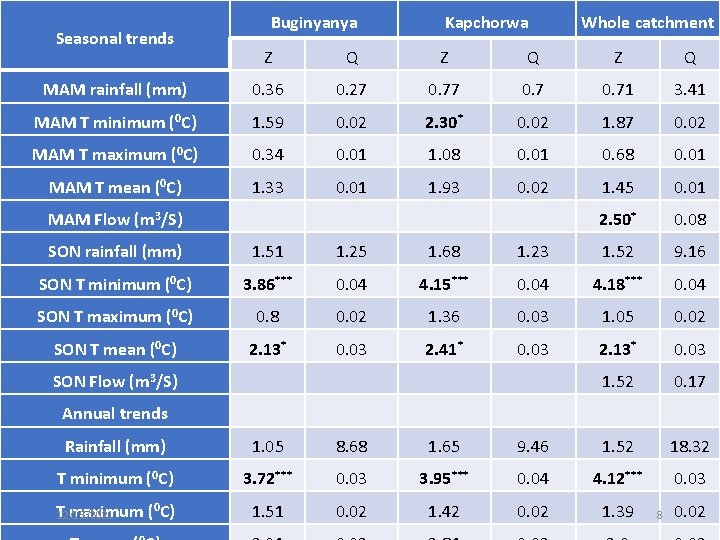
Seasonal trends Buginyanya Kapchorwa 20 Whole catchment 21 Z Q Z Q MAM rainfall (mm) 0. 36 0. 27 0. 71 3. 41 MAM T minimum (0 C) 1. 59 0. 02 2. 30* 0. 02 1. 87 0. 02 MAM T maximum (0 C) 0. 34 0. 01 1. 08 0. 01 0. 68 0. 01 MAM T mean (0 C) 1. 33 0. 01 1. 93 0. 02 1. 45 0. 01 2. 50* 0. 08 MAM Flow (m 3/S) SON rainfall (mm) 1. 51 1. 25 1. 68 1. 23 1. 52 9. 16 SON T minimum (0 C) 3. 86*** 0. 04 4. 15*** 0. 04 4. 18*** 0. 04 SON T maximum (0 C) 0. 8 0. 02 1. 36 0. 03 1. 05 0. 02 SON T mean (0 C) 2. 13* 0. 03 2. 41* 0. 03 2. 13* 0. 03 1. 52 0. 17 SON Flow (m 3/S) Annual trends Rainfall (mm) 1. 05 8. 68 1. 65 9. 46 1. 52 18. 32 T minimum (0 C) 3. 72*** 0. 03 3. 95*** 0. 04 4. 12*** 0. 03 T 12/15/2021 maximum (0 C) 1. 51 0. 02 1. 42 0. 02 1. 39 8 0. 02
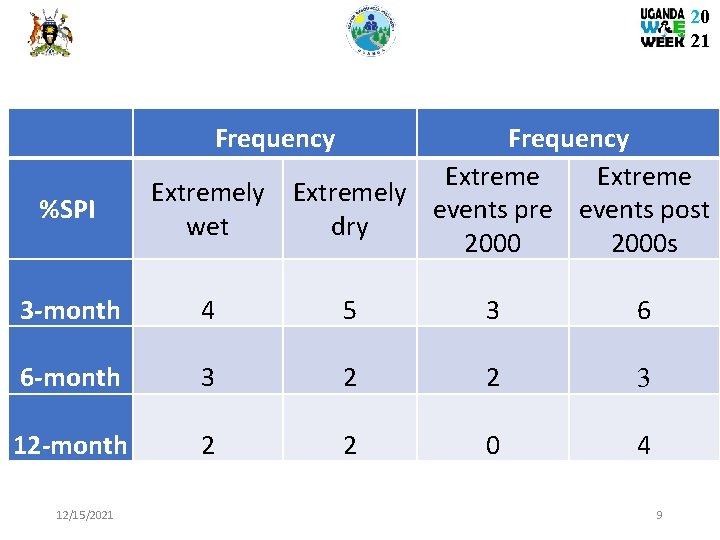
20 21 Frequency %SPI Frequency Extremely events pre events post wet dry 2000 s 3 -month 4 5 3 6 6 -month 3 2 2 3 12 -month 2 2 0 4 12/15/2021 9
20 21 Conclusions • SON rainfall in Sipi catchment is highly variable (CV > 30) • Sipi catchment has become more prone to extreme climate events in the recent decades than before. • The significant increased trend of river flow visa-vi the insignificant increased trend in rainfall could be attributed to the impacts of climate and land use changes. 12/15/2021 10
20 21 Recommendations • Water investment projects should take into account the high variability in SON rainfall, the trends if rainfall, temperature, and river flow, and the increased frequencies of extremely wet/dry events in the catchment • There is urgent need to quantify the impacts of future climate and land use changes on water resources in the catchment. 12/15/2021 11
20 21 Acknowledgements • Thanks to the Swedish International Development Agency (SIDA) for the financial support for this research. • We are equally thankful to the UNMA (for the rainfall and temperature data) and MWE (for Sipi flow data) 12/15/2021 12
- Slides: 12