
2 Use the context to guess the meaning

- Slides: 18
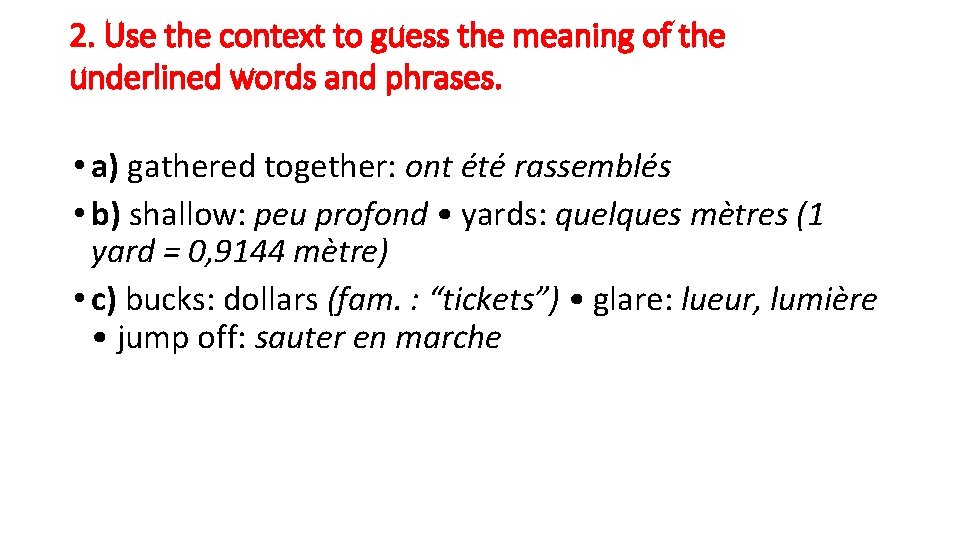
2. Use the context to guess the meaning of the underlined words and phrases. • a) gathered together: ont été rassemblés • b) shallow: peu profond • yards: quelques mètres (1 yard = 0, 9144 mètre) • c) bucks: dollars (fam. : “tickets”) • glare: lueur, lumière • jump off: sauter en marche
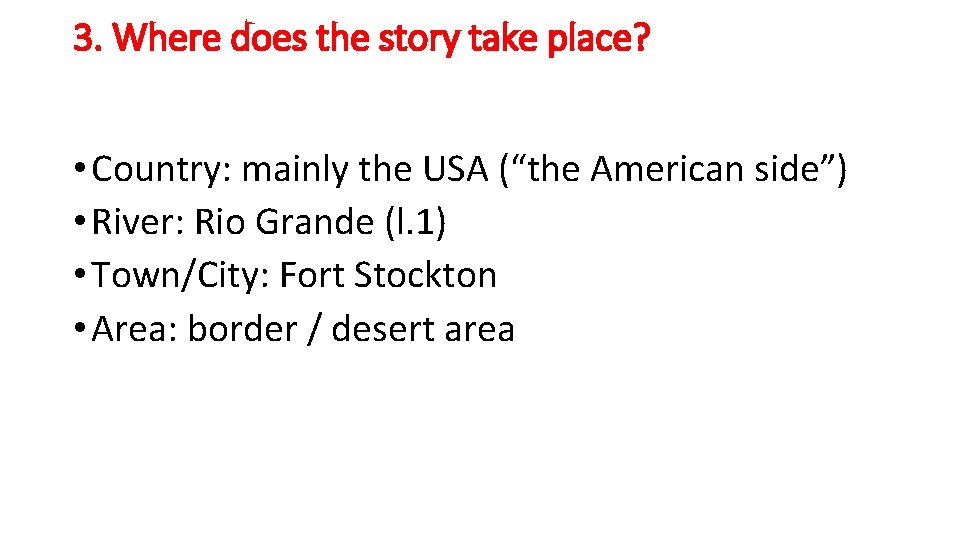
3. Where does the story take place? • Country: mainly the USA (“the American side”) • River: Rio Grande (l. 1) • Town/City: Fort Stockton • Area: border / desert area
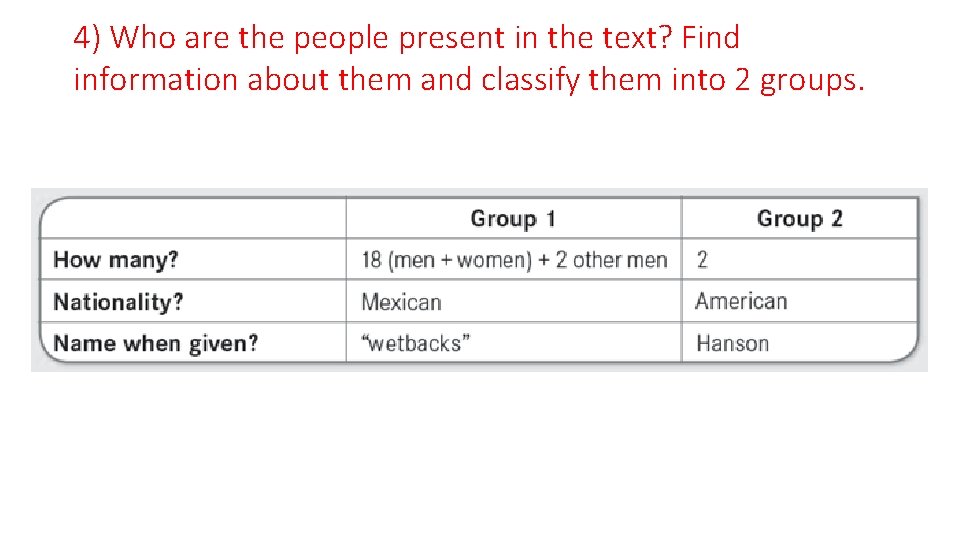
4) Who are the people present in the text? Find information about them and classify them into 2 groups.
5. Rephrase what you understood from the first paragraph and say what happens. The Mexicans had to go across the Rio Grande River but did not need to swim (only partly for the last part of the journey) as/since the water level was very low, due to the drought. So, that part of the journey was not the harshest / hardest. Moreover, two other Mexicans were there (on the other side) to help them, and in particular, the women.
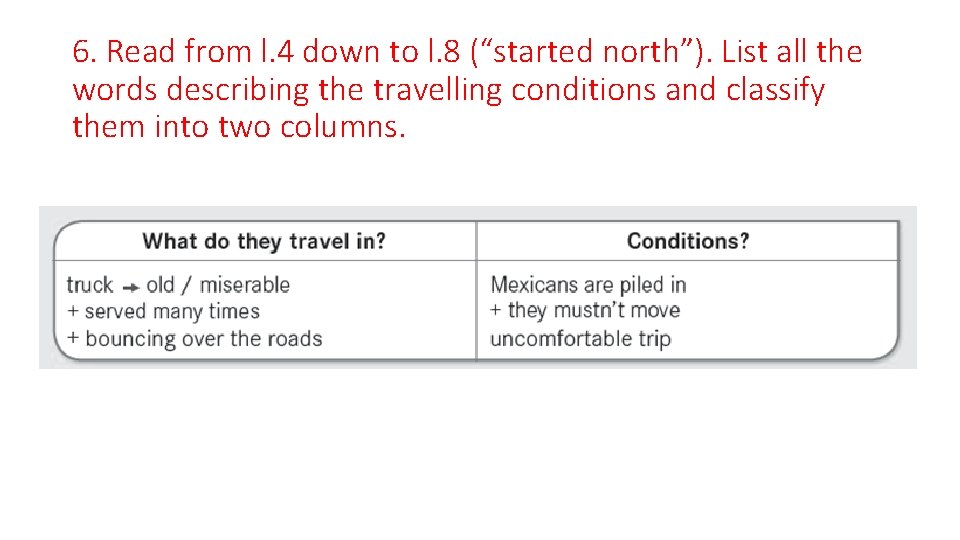
6. Read from l. 4 down to l. 8 (“started north”). List all the words describing the travelling conditions and classify them into two columns.
7. • a) Find words related to money: “ 15 bucks” (l. 6), “verifying the payments” (l. 7). • b) Who gets the money? c) What for? Hanson gets the money from each single candidate for illegal immigration in order to drive them to Fort Stockton and leave them on a safe road. (“and I put you on a back road to Fort Stockton”, l. 6)
8. a) What do the underlined words have in common? “… a man named Hanson growled: […] as he drove, a cohort rode atop the cab of the truck, keeping a shotgun aimed at the passengers. ‘Don’t no one try to jump off, ’ he warned. ” (l. 5 -10) They are all verbs showing the Americans’ attitude towards the Mexicans: they reveal they are aggressive, threatening, even violent. They want to scare them in order to control them better.
b) What can we guess about the passengers’ feelings then? Why? • They must have had second thoughts, doubts about their guides although they did not have any choice and had to rely on them to get to the US. They must have felt ill-at-ease, worried, even scared because of the way they were treated by Hanson and his accomplices.
9. Use the context to guess the meaning of the underlined words: • fix: réparer • Anglos: Américains, Blancs • stranded: laissés en plan
10. a) Pick out two verbs showing that the truck has a problem. • cough (l. 23) + conk out (l. 24) b) “… the engine began to sputter, caught, and then purred nicely. ” (l. 15). What does the word “nicely” indicate about what is going on? The problem has been solved.
c) In this context, can you guess the meaning of the word “delight” (l. 15): • Pour leur plus grande joie d) Say in your own words what has just been done. Hanson pretends he has just finished repairing the truck and makes them hear the sound of the engine starting. So they think that the problem has just been solved.
11. a) Say what the underlined word refer to: • he (l. 24) refers to Hanson + this (l. 24) refers to the problem / the breakdown. • their (l. 26) refers to the Mexicans. b) Tick the correct answer. The incident was: ❐ a trap c) Sum up the incident in your own words. First, Hanson pretended the truck had a problem / some trouble / that there was a breakdown. So he asked the Mexicans to get off the truck. He made the Mexicans think that he was repairing the truck. But it turned out to be a trap.
d) How did the passengers feel at that moment? • When hearing the sound of the engine again, the Mexicans were hopeful and thought that they would be able to get back on the truck and move on. But, finally, the American guide betrayed the Mexicans and left them stranded in the middle of nowhere, in the desert. They were far from the river, helpless, defenceless, powerless. They were panic-stricken / horror-stricken.
12. Pick out at least three sentences related to the climate. • “the sun was blazing high” (l. 29 -30); • “the sky was an arch of blue” (l. 34); • “in that dreadful heat” (l. 36)
• 13. a) What did they need most? Quote key words only. food / water / a guide / cacti • b) What are the consequences? Several Mexicans have already died of thirst. • c) Find the opposite of the word heaven (paradise). hell
• 14. a) Who are the Guzmans (full names)? How are they related to each other? Cándido Guzman and Manuela Guzman. They are brother and sister. (“stared madly at her brother”, l. 37). • b) What happened to them? They tried to walk out of the deadly desert and to find help, but with the other Mexicans, they endured the terrible pain of a scorching sun. / they endured excruciating pains. Most of them slowly died of thirst. They had nothing to quench their thirst and no glimmer of hope. Manuela dies in her brother’s arms. We do not know at the end of the text what will happen to Cándido.