
2 Unicellular Eukaryotes Protozoan Groups Characteristics of Unicellular
- Slides: 11
• 2 -Unicellular Eukaryotes /Protozoan Groups Characteristics of Unicellular (Eukaryotes) 1. Unicellular; some colonial, and some with multicellular stages in their life cycles. Coloniality occurs when cells divide, but remain together. The cells may specialize on particular functions, but all cells are capable of reproduction. Multicellularity requires the conditions of coloniality plus the additional criterion that only some cells are capable of reproduction. 2. Mostly microscopic, although some are large enough to be seen with the unaided eye 3. All symmetries represented in the group; shape variable or constant (oval, spherical, or other) 4. No germ layer present 5. No organs or tissues, but specialized organelles are found nucleus single or multiple
6. Free-living, mutualism, commensalism, parasitism all represented in the groups 7. Locomotion by pseudopodia, flagella, cilia, and direct cell movements; some sessile 8. Some provided with a simple endoskeleton or exoskeleton, but most are naked 9. Nutrition of all types: autotrophic (manufacturing own nutrients by photosynthesis), heterotrophic (depending on other plants or animals for food), saprozoic (using nutrients dissolved in the surrounding medium) 10. Aquatic or terrestrial habitat; free-living or symbiotic mode of life 11. Reproduction asexually by fission, budding, and cysts and sexually by conjugation or by syngamy (union of male and female gametes to form a zygote)
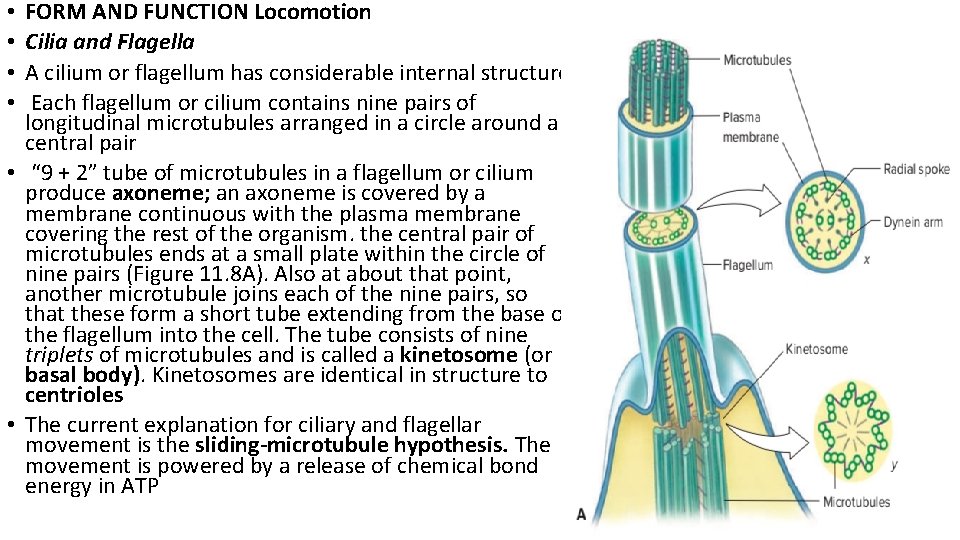
FORM AND FUNCTION Locomotion Cilia and Flagella A cilium or flagellum has considerable internal structure. Each flagellum or cilium contains nine pairs of longitudinal microtubules arranged in a circle around a central pair • “ 9 + 2” tube of microtubules in a flagellum or cilium produce axoneme; an axoneme is covered by a membrane continuous with the plasma membrane covering the rest of the organism. the central pair of microtubules ends at a small plate within the circle of nine pairs (Figure 11. 8 A). Also at about that point, another microtubule joins each of the nine pairs, so that these form a short tube extending from the base of the flagellum into the cell. The tube consists of nine triplets of microtubules and is called a kinetosome (or basal body). Kinetosomes are identical in structure to centrioles • The current explanation for ciliary and flagellar movement is the sliding-microtubule hypothesis. The movement is powered by a release of chemical bond energy in ATP • •
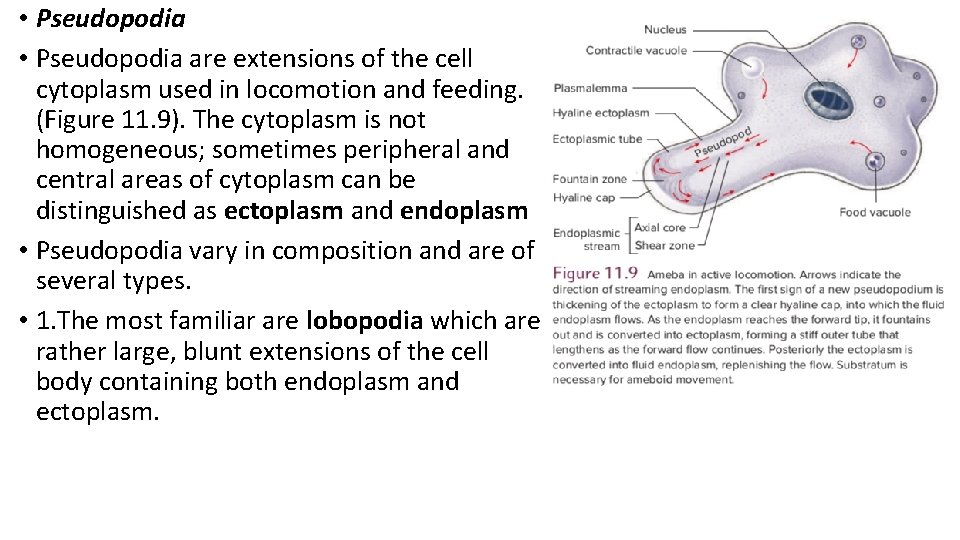
• Pseudopodia are extensions of the cell cytoplasm used in locomotion and feeding. (Figure 11. 9). The cytoplasm is not homogeneous; sometimes peripheral and central areas of cytoplasm can be distinguished as ectoplasm and endoplasm • Pseudopodia vary in composition and are of several types. • 1. The most familiar are lobopodia which are rather large, blunt extensions of the cell body containing both endoplasm and ectoplasm.
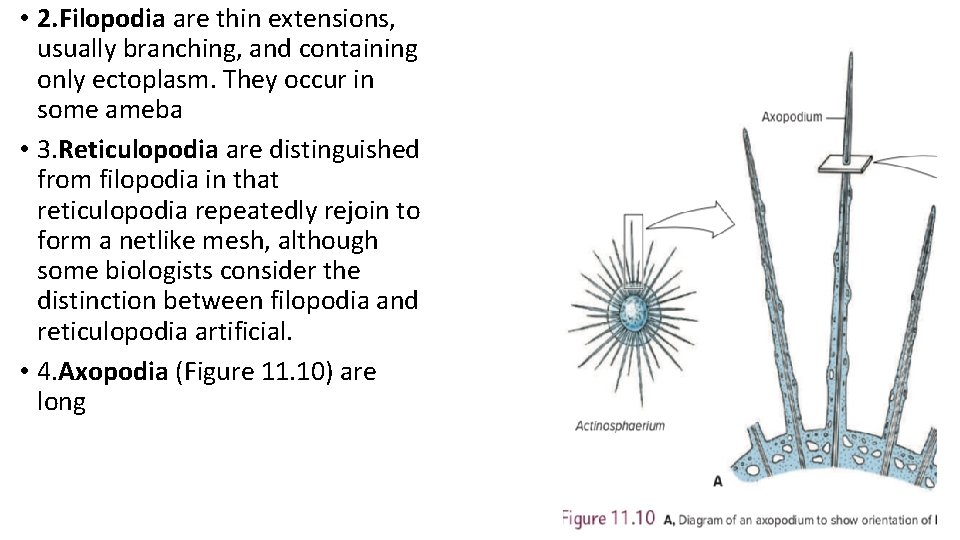
• 2. Filopodia are thin extensions, usually branching, and containing only ectoplasm. They occur in some ameba • 3. Reticulopodia are distinguished from filopodia in that reticulopodia repeatedly rejoin to form a netlike mesh, although some biologists consider the distinction between filopodia and reticulopodia artificial. • 4. Axopodia (Figure 11. 10) are long
• Nutrition • In holozoic nutrition, food particles are brought into a cell by phagocytosis. • where extension or invagination of the plasma membrane surrounds a food particle. As the invagination extends farther into the cell, it is pinched off at the surface The food particle thus is contained in an intracellular, membrane-bound vesicle, a food vacuole or phagosome. Lysosomes, small vesicles containing digestive enzymes, fuse with the phagosome and pour their contents into it, where digestion begins
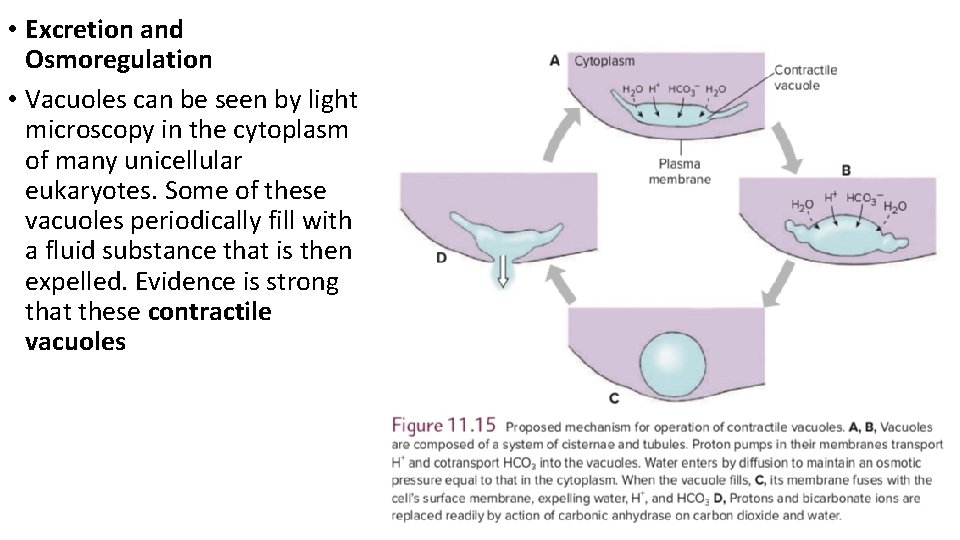
• Excretion and Osmoregulation • Vacuoles can be seen by light microscopy in the cytoplasm of many unicellular eukaryotes. Some of these vacuoles periodically fill with a fluid substance that is then expelled. Evidence is strong that these contractile vacuoles
• Reproduction • Sexual reproduction does occur in most unicellular eukaryotes. Diploid cells undergo reduction division (meiosis) to make haploid gametes or simply haploid gamete nuclei • Fission • The cell multiplication process that produces more individuals in unicellular eukaryotes is called fission. The most common type of fission is binary, in which two essentially identical individuals result When a progeny cell is considerably smaller than the parent and then grows to adult size, the process is called budding. Budding occurs in some ciliates. In multiple fission, division of the cytoplasm (cytokinesis) is preceded by several nuclear divisions, so that a number of individuals are produced almost simultaneously Multiple fission, or schizogony, is common among the Apicomplexa and some amebas. If the multiple fission is preceded by or associated with union of gametes, it is called sporogony. • Sexual Processes • Gamete nuclei, or pronuclei, which fuse in fertilization to restore the diploid number of chromosomes, are usually borne in special gametic cells. When gametes all look alike, they are called isogametes, but most species have two dissimilar types, or anisogametes.
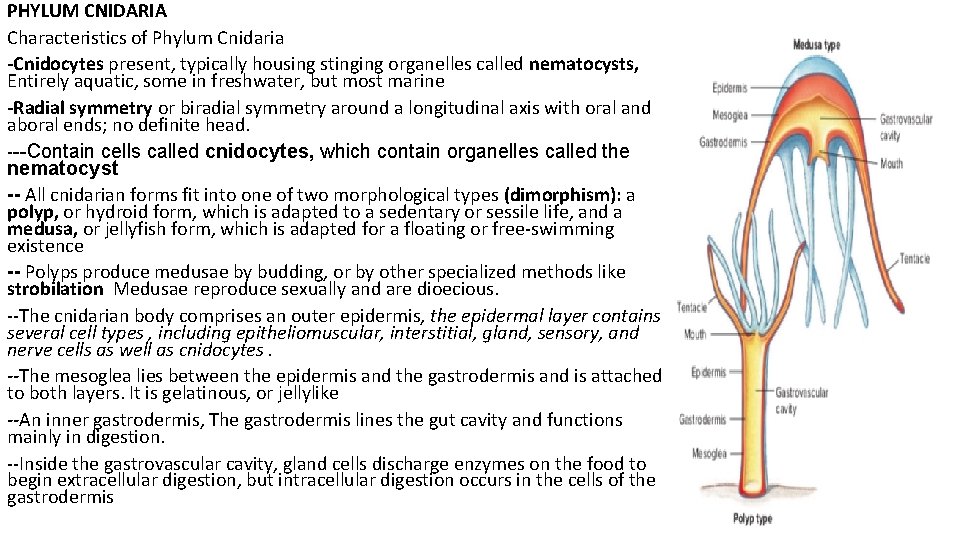
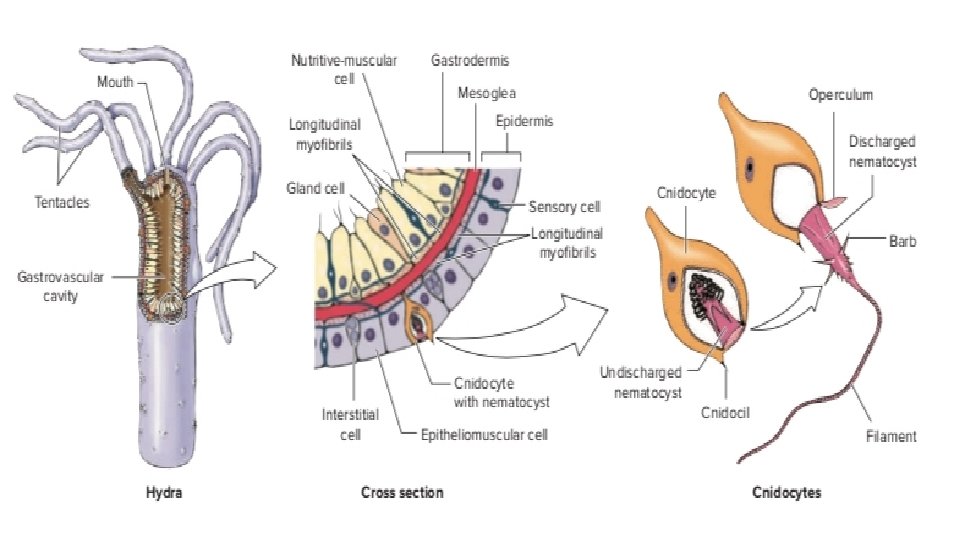
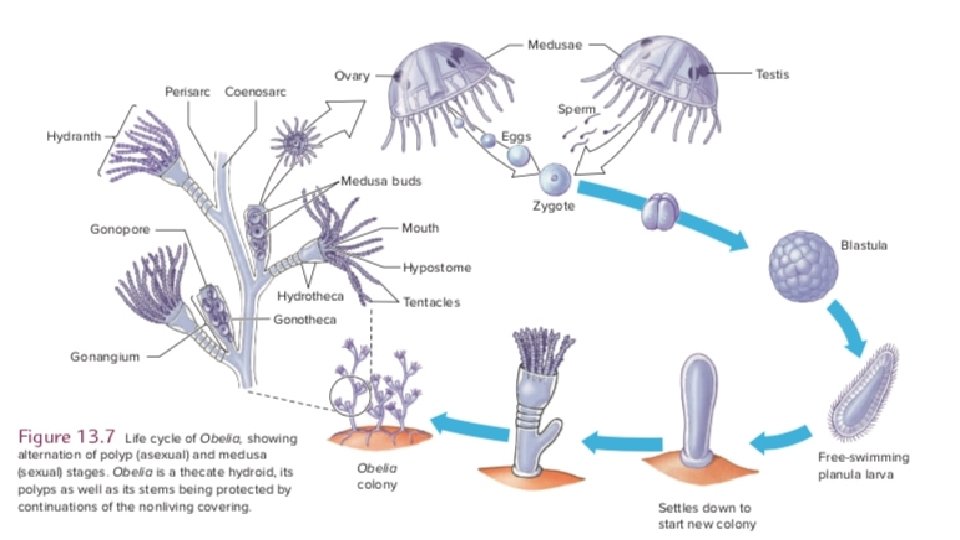
PHYLUM CNIDARIA Characteristics of Phylum Cnidaria -Cnidocytes present, typically housing stinging organelles called nematocysts, Entirely aquatic, some in freshwater, but most marine -Radial symmetry or biradial symmetry around a longitudinal axis with oral and aboral ends; no definite head. ---Contain cells called cnidocytes, which contain organelles called the nematocyst -- All cnidarian forms fit into one of two morphological types (dimorphism): a polyp, or hydroid form, which is adapted to a sedentary or sessile life, and a medusa, or jellyfish form, which is adapted for a floating or free-swimming existence -- Polyps produce medusae by budding, or by other specialized methods like strobilation Medusae reproduce sexually and are dioecious. --The cnidarian body comprises an outer epidermis, the epidermal layer contains several cell types , including epitheliomuscular, interstitial, gland, sensory, and nerve cells as well as cnidocytes. --The mesoglea lies between the epidermis and the gastrodermis and is attached to both layers. It is gelatinous, or jellylike --An inner gastrodermis, The gastrodermis lines the gut cavity and functions mainly in digestion. --Inside the gastrovascular cavity, gland cells discharge enzymes on the food to begin extracellular digestion, but intracellular digestion occurs in the cells of the gastrodermis