
2 Stubborn structures an explanation of the development
2 Stubborn structures: an explanation of the development of postcommunist regimes
Are § § Stubborn structures Ø the lack of proper separation of the three spheres of social action (political, market, communal) (Claus Offe) Ø collusion of power&ownership (Rusztem Nureev, Andrey Ryabov) Ø patrimonialization: private appropriation of the public authority (Max Weber, Oleksandr Fisun) Ø patron-client relations (Henry Hale) Ø informality / discretionality (Alena Ledeneva) Ø centralized and monopolized forms of corruption system defining features of these regimes , or just unpleasant side-effects?
Thesis A: Regime Type Depends on the Separation of Spheres of Social Action Thesis A: • the level of separation of spheres of social action makes certain regime types feasible, while others, unfeasible in a country • the separation of spheres manifests as the norms of the actors who populate the regime • those regimes are feasible which presume the same level of separation as its actors / those regimes are unfeasible which presume a different level of separation than its actors • should an unfeasible regime be established, it will (a) either be weak and prone to degenerate into a more feasible type or (b) have to institute specific (effective) mechanisms to avoid degeneration.
Thesis B: The Separation of Spheres Followed Civilizational Boundaries Thesis B: • in pre-communist times, the separation of spheres of social action followed civilizational boundaries • countries that belonged to Western Christianity featured most separation, followed by less separation in the Eastern Orthodox and the least separation in the Islamic and Sinic civilizations • the lack of separation was represented by a series of interrelated phenomena, which were present with different strength in different civilizations.
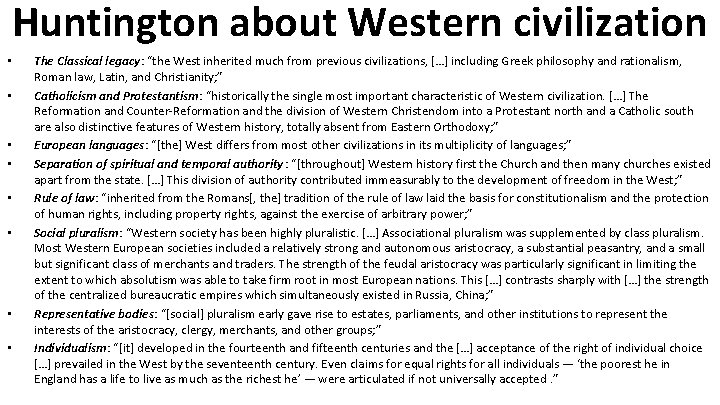
Huntington about Western civilization • • The Classical legacy: “the West inherited much from previous civilizations, […] including Greek philosophy and rationalism, Roman law, Latin, and Christianity; ” Catholicism and Protestantism: “historically the single most important characteristic of Western civilization. […] The Reformation and Counter-Reformation and the division of Western Christendom into a Protestant north and a Catholic south are also distinctive features of Western history, totally absent from Eastern Orthodoxy; ” European languages: “[the] West differs from most other civilizations in its multiplicity of languages; ” Separation of spiritual and temporal authority : “[throughout] Western history first the Church and then many churches existed apart from the state. […] This division of authority contributed immeasurably to the development of freedom in the West; ” Rule of law: “inherited from the Romans[, the] tradition of the rule of law laid the basis for constitutionalism and the protection of human rights, including property rights, against the exercise of arbitrary power; ” Social pluralism: “Western society has been highly pluralistic. […] Associational pluralism was supplemented by class pluralism. Most Western European societies included a relatively strong and autonomous aristocracy, a substantial peasantry, and a small but significant class of merchants and traders. The strength of the feudal aristocracy was particularly significant in limiting the extent to which absolutism was able to take firm root in most European nations. This […] contrasts sharply with […] the strength of the centralized bureaucratic empires which simultaneously existed in Russia, China; ” Representative bodies: “[social] pluralism early gave rise to estates, parliaments, and other institutions to represent the interests of the aristocracy, clergy, merchants, and other groups; ” Individualism: “[it] developed in the fourteenth and fifteenth centuries and the […] acceptance of the right of individual choice […] prevailed in the West by the seventeenth century. Even claims for equal rights for all individuals — ‘the poorest he in England has a life to live as much as the richest he’ — were articulated if not universally accepted. ”
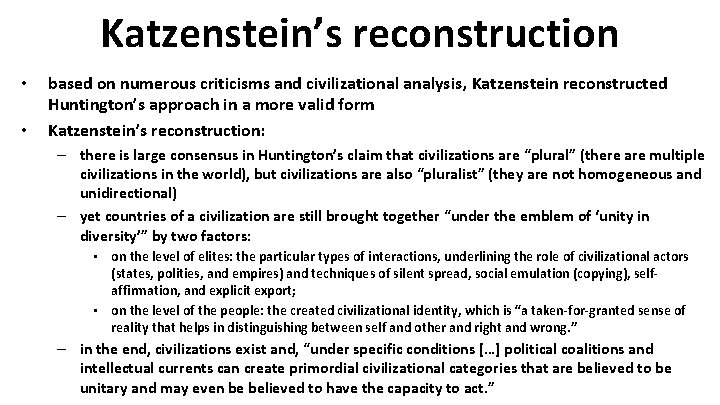
Katzenstein’s reconstruction • • based on numerous criticisms and civilizational analysis, Katzenstein reconstructed Huntington’s approach in a more valid form Katzenstein’s reconstruction: – there is large consensus in Huntington’s claim that civilizations are “plural” (there are multiple civilizations in the world), but civilizations are also “pluralist” (they are not homogeneous and unidirectional) – yet countries of a civilization are still brought together “under the emblem of ‘unity in diversity’” by two factors: • on the level of elites: the particular types of interactions, underlining the role of civilizational actors (states, polities, and empires) and techniques of silent spread, social emulation (copying), selfaffirmation, and explicit export; • on the level of the people: the created civilizational identity, which is “a taken-for-granted sense of reality that helps in distinguishing between self and other and right and wrong. ” – in the end, civilizations exist and, “under specific conditions […] political coalitions and intellectual currents can create primordial civilizational categories that are believed to be unitary and may even be believed to have the capacity to act. ”
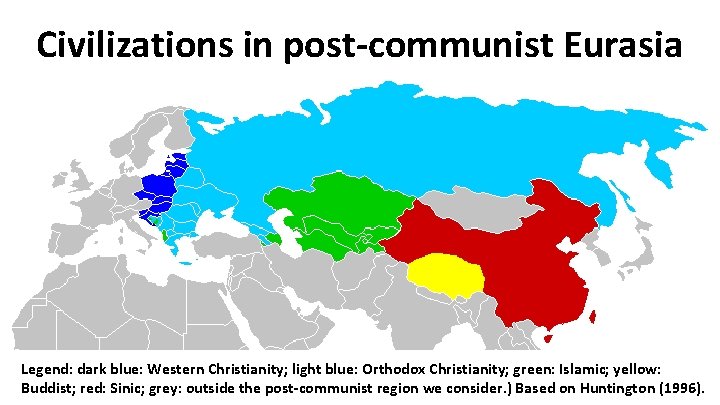
Civilizations in post-communist Eurasia Legend: dark blue: Western Christianity; light blue: Orthodox Christianity; green: Islamic; yellow: Buddist; red: Sinic; grey: outside the post-communist region we consider. ) Based on Huntington (1996).
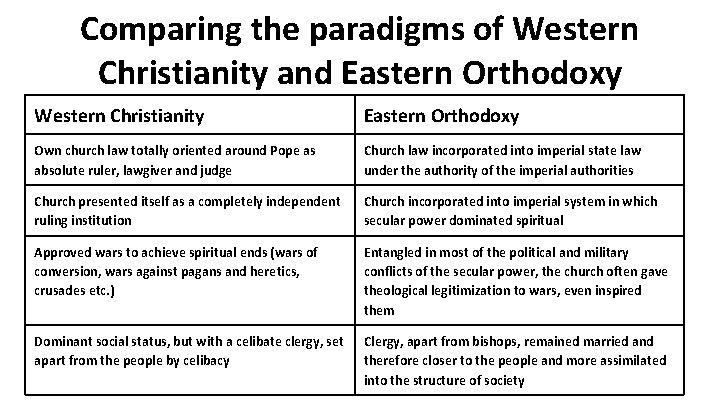
Comparing the paradigms of Western Christianity and Eastern Orthodoxy Western Christianity Eastern Orthodoxy Own church law totally oriented around Pope as absolute ruler, lawgiver and judge Church law incorporated into imperial state law under the authority of the imperial authorities Church presented itself as a completely independent ruling institution Church incorporated into imperial system in which secular power dominated spiritual Approved wars to achieve spiritual ends (wars of conversion, wars against pagans and heretics, crusades etc. ) Entangled in most of the political and military conflicts of the secular power, the church often gave theological legitimization to wars, even inspired them Dominant social status, but with a celibate clergy, set apart from the people by celibacy Clergy, apart from bishops, remained married and therefore closer to the people and more assimilated into the structure of society
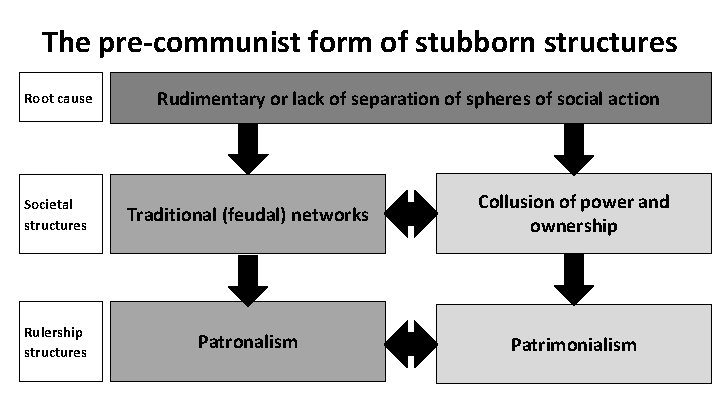
The pre-communist form of stubborn structures Root cause Rudimentary or lack of separation of spheres of social action Societal structures Traditional (feudal) networks Collusion of power and ownership Rulership structures Patronalism Patrimonialism
Thesis C: Communist Dictatorships Arrested and Reversed the Separation of Spheres Thesis C: • in communist times, countries of different civilizations were put under the unifying “political lid” of dictatorship • this arrested the social development that the countries had been undergoing • the communist system brought an own series of interrelated phenomena that represented a merger of spheres of social action, reinforcing the preexisting patterns of (lack of) separation • while different kinds of communism could develop in different civilizations, the one-party system and the monopoly of state property induced similar social phenomena and did unify the countries to some degree.
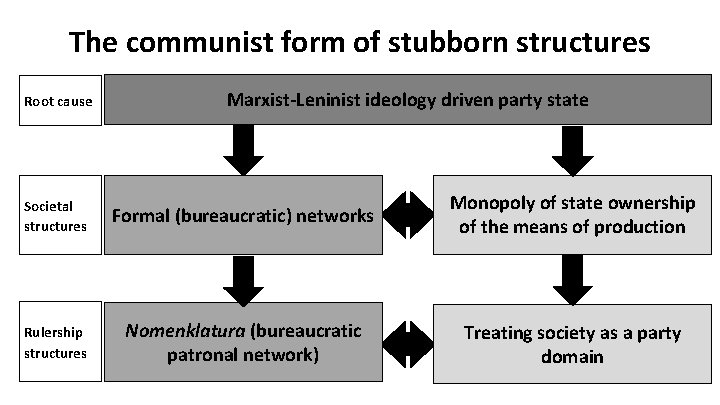
The communist form of stubborn structures Root cause Marxist-Leninist ideology driven party state Societal structures Formal (bureaucratic) networks Monopoly of state ownership of the means of production Rulership structures Nomenklatura (bureaucratic patronal network) Treating society as a party domain
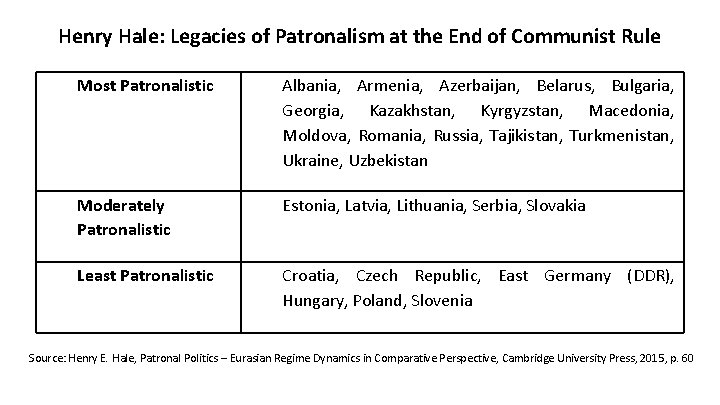
Henry Hale: Legacies of Patronalism at the End of Communist Rule Most Patronalistic Albania, Armenia, Azerbaijan, Belarus, Bulgaria, Georgia, Kazakhstan, Kyrgyzstan, Macedonia, Moldova, Romania, Russia, Tajikistan, Turkmenistan, Ukraine, Uzbekistan Moderately Patronalistic Estonia, Latvia, Lithuania, Serbia, Slovakia Least Patronalistic Croatia, Czech Republic, East Germany (DDR), Hungary, Poland, Slovenia Source: Henry E. Hale, Patronal Politics – Eurasian Regime Dynamics in Comparative Perspective, Cambridge University Press, 2015, p. 60
Thesis D: Democratization Did Not Change the Separation of Spheres Thesis D: • in post-communist times, regime changes involved the change of the formal institutional setting but not of the actors’ informal understanding of the separation of spheres of social action • liberal democracy was feasible only in countries where the actors’ informal understanding was to separate the spheres of social action (Thesis A) • the more unseparated spheres were produced by civilizational belonging (Thesis B) and the influence of the communist regime (Thesis C) on the level of actors, the more patronal regimes came into being • whether the regimes became democratic/multi-pyramid or autocratic/singlepyramid depended mainly on two factors: (1) the presence or lack of presidentialism and proportionate electoral system and (2) Western linkage and leverage.
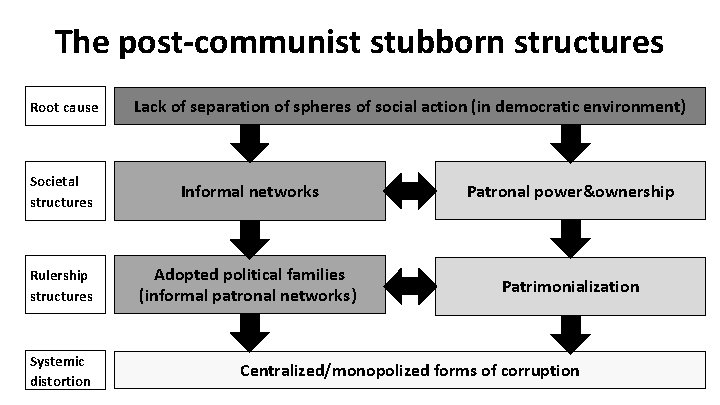
The post-communist stubborn structures Root cause Lack of separation of spheres of social action (in democratic environment) Societal structures Informal networks Patronal power&ownership Rulership structures Adopted political families (informal patronal networks) Patrimonialization Systemic distortion Centralized/monopolized forms of corruption
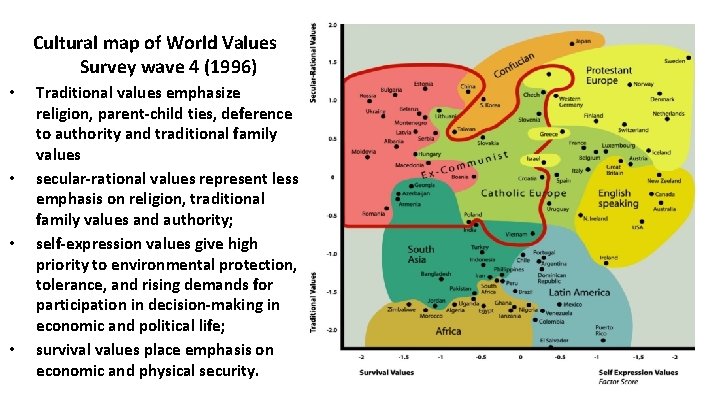
Cultural map of World Values Survey wave 4 (1996) • • Traditional values emphasize religion, parent-child ties, deference to authority and traditional family values secular-rational values represent less emphasis on religion, traditional family values and authority; self-expression values give high priority to environmental protection, tolerance, and rising demands for participation in decision-making in economic and political life; survival values place emphasis on economic and physical security.
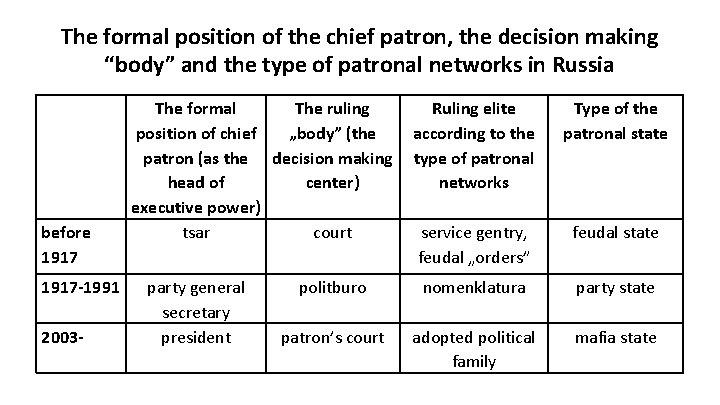
The formal position of the chief patron, the decision making “body” and the type of patronal networks in Russia before 1917 -1991 2003 - The formal The ruling position of chief „body” (the patron (as the decision making head of center) executive power) tsar court party general secretary president Ruling elite according to the type of patronal networks Type of the patronal state service gentry, feudal „orders” feudal state politburo nomenklatura party state patron’s court adopted political family mafia state
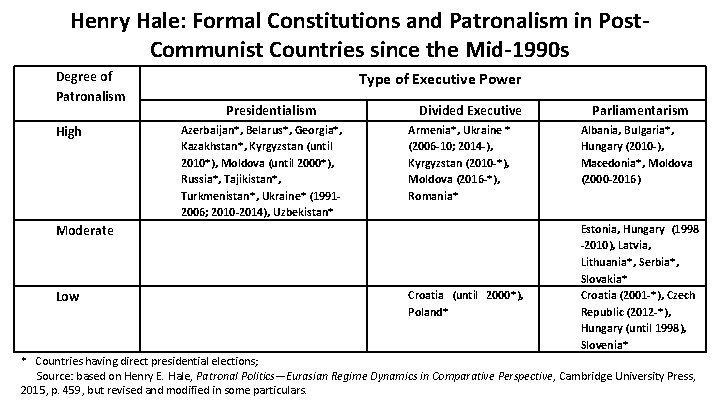
Henry Hale: Formal Constitutions and Patronalism in Post. Communist Countries since the Mid-1990 s Degree of Patronalism High Type of Executive Power Presidentialism Azerbaijan*, Belarus*, Georgia*, Kazakhstan*, Kyrgyzstan (until 2010*), Moldova (until 2000*), Russia*, Tajikistan*, Turkmenistan*, Ukraine* (19912006; 2010 -2014), Uzbekistan* Divided Executive Armenia*, Ukraine * (2006 -10; 2014 -), Kyrgyzstan (2010 -*), Moldova (2016 -*), Romania* Moderate Low Croatia (until 2000*), Poland* Parliamentarism Albania, Bulgaria*, Hungary (2010 -), Macedonia*, Moldova (2000 -2016) Estonia, Hungary (1998 -2010), Latvia, Lithuania*, Serbia*, Slovakia* Croatia (2001 -*), Czech Republic (2012 -*), Hungary (until 1998), Slovenia* * Countries having direct presidential elections; Source: based on Henry E. Hale, Patronal Politics—Eurasian Regime Dynamics in Comparative Perspective, Cambridge University Press, 2015, p. 459, but revised and modified in some particulars.
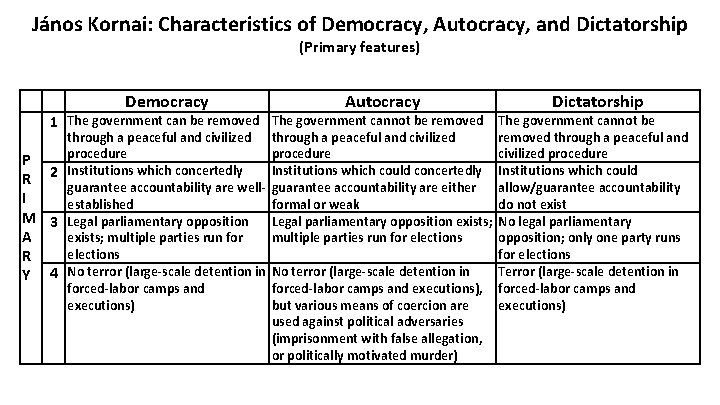
János Kornai: Characteristics of Democracy, Autocracy, and Dictatorship (Primary features) Democracy Autocracy Dictatorship 1 The government can be removed The government cannot be through a peaceful and civilized procedure P Institutions which concertedly R 2 guarantee accountability are well. I established M 3 Legal parliamentary opposition A exists; multiple parties run for elections R Y 4 No terror (large-scale detention in forced-labor camps and executions) through a peaceful and civilized procedure Institutions which could concertedly guarantee accountability are either formal or weak Legal parliamentary opposition exists; multiple parties run for elections No terror (large-scale detention in forced-labor camps and executions), but various means of coercion are used against political adversaries (imprisonment with false allegation, or politically motivated murder) removed through a peaceful and civilized procedure Institutions which could allow/guarantee accountability do not exist No legal parliamentary opposition; only one party runs for elections Terror (large-scale detention in forced-labor camps and executions)
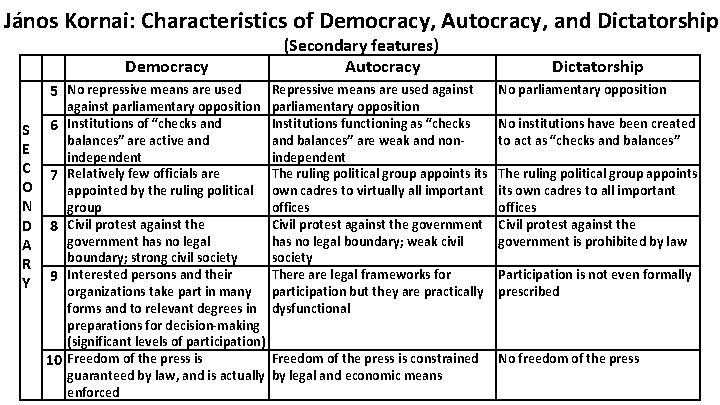
János Kornai: Characteristics of Democracy, Autocracy, and Dictatorship Democracy 5 No repressive means are used S E C O N D A R Y (Secondary features) Autocracy Repressive means are used against parliamentary opposition Institutions functioning as “checks 6 Institutions of “checks and balances” are active and balances” are weak and nonindependent The ruling political group appoints its 7 Relatively few officials are appointed by the ruling political own cadres to virtually all important group offices Civil protest against the government 8 Civil protest against the government has no legal boundary; weak civil boundary; strong civil society There are legal frameworks for 9 Interested persons and their organizations take part in many participation but they are practically forms and to relevant degrees in dysfunctional preparations for decision-making (significant levels of participation) Freedom of the press is constrained 10 Freedom of the press is guaranteed by law, and is actually by legal and economic means enforced Dictatorship No parliamentary opposition No institutions have been created to act as “checks and balances” The ruling political group appoints its own cadres to all important offices Civil protest against the government is prohibited by law Participation is not even formally prescribed No freedom of the press
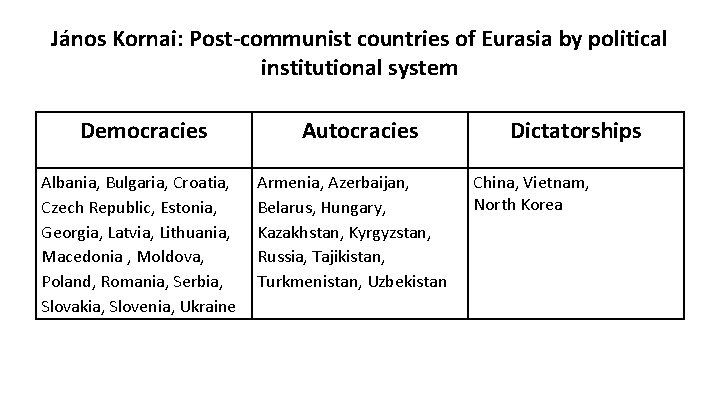
János Kornai: Post-communist countries of Eurasia by political institutional system Democracies Albania, Bulgaria, Croatia, Czech Republic, Estonia, Georgia, Latvia, Lithuania, Macedonia , Moldova, Poland, Romania, Serbia, Slovakia, Slovenia, Ukraine Autocracies Armenia, Azerbaijan, Belarus, Hungary, Kazakhstan, Kyrgyzstan, Russia, Tajikistan, Turkmenistan, Uzbekistan Dictatorships China, Vietnam, North Korea
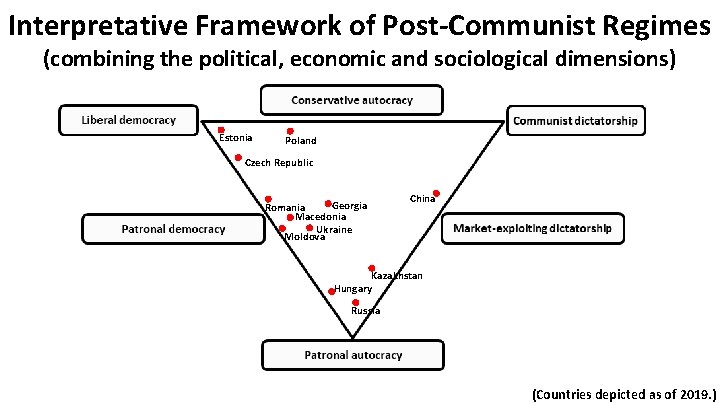
Interpretative Framework of Post-Communist Regimes (combining the political, economic and sociological dimensions) Estonia Poland Czech Republic Georgia Romania Macedonia Ukraine Moldova China Kazakhstan Hungary Russia (Countries depicted as of 2019. )
- Slides: 21