
2 Strain CHAPTER OBJECTIVES Define concept of normal
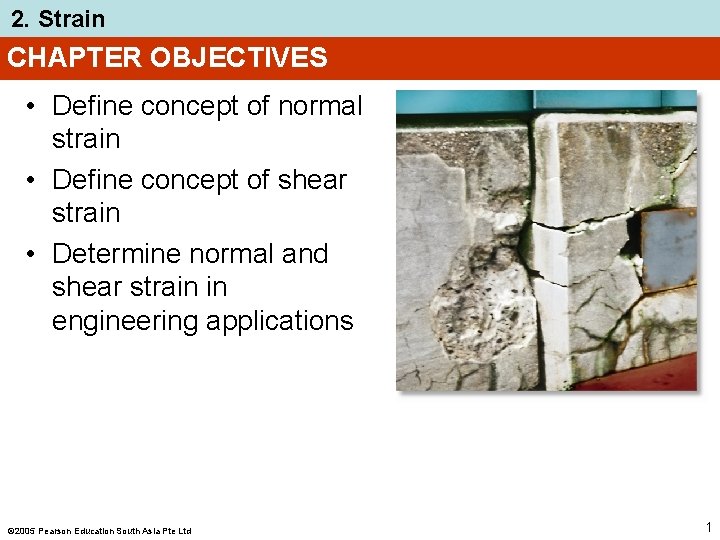
2. Strain CHAPTER OBJECTIVES • Define concept of normal strain • Define concept of shear strain • Determine normal and shear strain in engineering applications 2005 Pearson Education South Asia Pte Ltd 1
2. Strain CHAPTER OUTLINE 1. Deformation 2. Strain 2005 Pearson Education South Asia Pte Ltd 2
2. Strain 2. 1 DEFORMATION Deformation • Occurs when a force is applied to a body • Can be highly visible or practically unnoticeable • Can also occur when temperature of a body is changed • Is not uniform throughout a body’s volume, thus change in geometry of any line segment within body may vary along its length 2005 Pearson Education South Asia Pte Ltd 3
2. Strain 2. 1 DEFORMATION To simplify study of deformation • Assume lines to be very short and located in neighborhood of a point, and • Take into account the orientation of the line segment at the point 2005 Pearson Education South Asia Pte Ltd 4
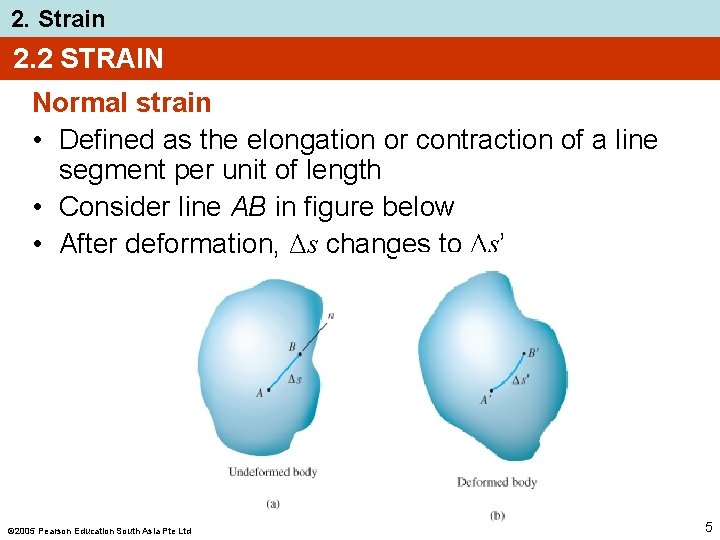
2. Strain 2. 2 STRAIN Normal strain • Defined as the elongation or contraction of a line segment per unit of length • Consider line AB in figure below • After deformation, Δs changes to Δs’ 2005 Pearson Education South Asia Pte Ltd 5
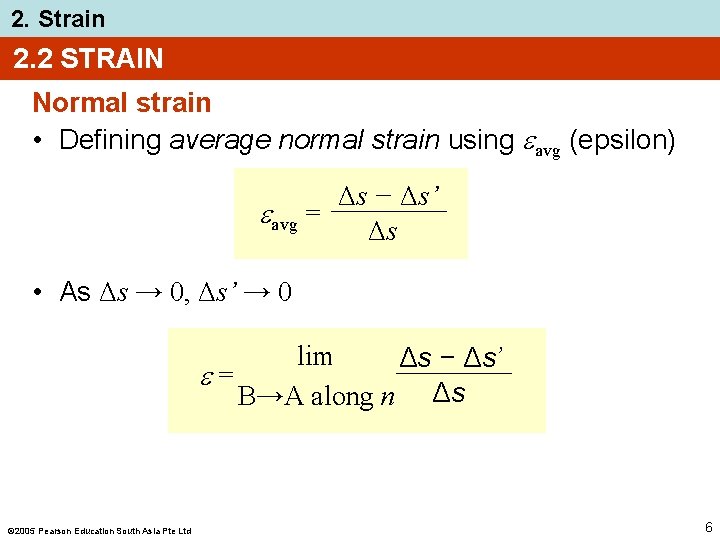
2. Strain 2. 2 STRAIN Normal strain • Defining average normal strain using avg (epsilon) Δs − Δs’ avg = Δs • As Δs → 0, Δs’ → 0 lim Δs − Δs’ = B→A along n Δs 2005 Pearson Education South Asia Pte Ltd 6
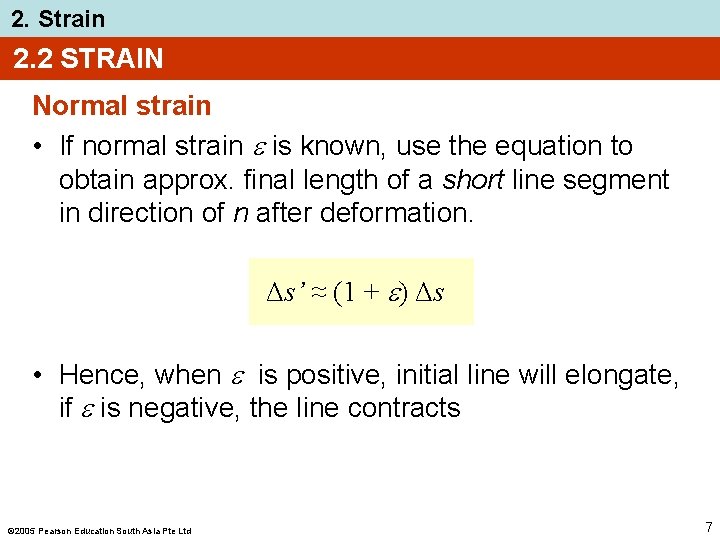
2. Strain 2. 2 STRAIN Normal strain • If normal strain is known, use the equation to obtain approx. final length of a short line segment in direction of n after deformation. Δs’ ≈ (1 + ) Δs • Hence, when is positive, initial line will elongate, if is negative, the line contracts 2005 Pearson Education South Asia Pte Ltd 7
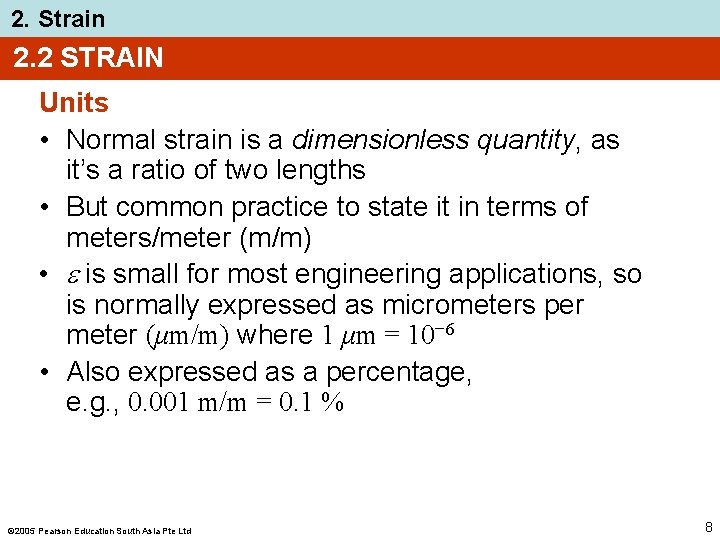
2. Strain 2. 2 STRAIN Units • Normal strain is a dimensionless quantity, as it’s a ratio of two lengths • But common practice to state it in terms of meters/meter (m/m) • is small for most engineering applications, so is normally expressed as micrometers per meter (μm/m) where 1 μm = 10− 6 • Also expressed as a percentage, e. g. , 0. 001 m/m = 0. 1 % 2005 Pearson Education South Asia Pte Ltd 8
2. Strain 2. 2 STRAIN Shear strain • Defined as the change in angle that occurs between two line segments that were originally perpendicular to one another • This angle is denoted by γ (gamma) and measured in radians (rad). 2005 Pearson Education South Asia Pte Ltd 9
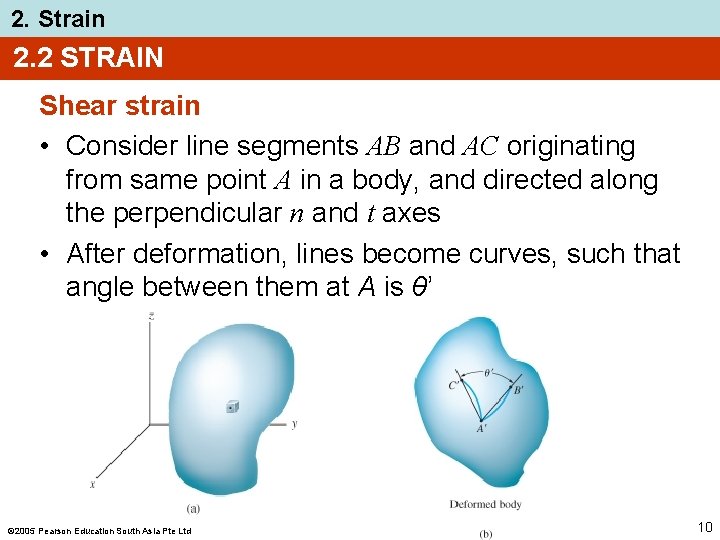
2. Strain 2. 2 STRAIN Shear strain • Consider line segments AB and AC originating from same point A in a body, and directed along the perpendicular n and t axes • After deformation, lines become curves, such that angle between them at A is θ’ 2005 Pearson Education South Asia Pte Ltd 10
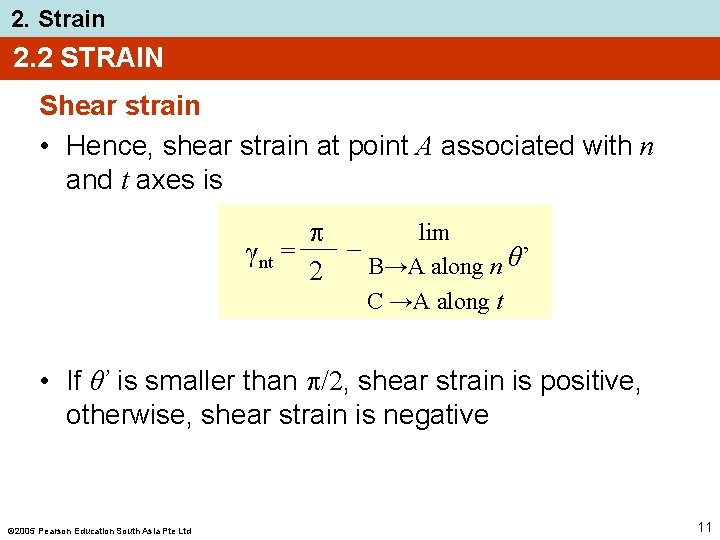
2. Strain 2. 2 STRAIN Shear strain • Hence, shear strain at point A associated with n and t axes is lim − γnt = θ’ B→A along n 2 C →A along t • If θ’ is smaller than /2, shear strain is positive, otherwise, shear strain is negative 2005 Pearson Education South Asia Pte Ltd 11
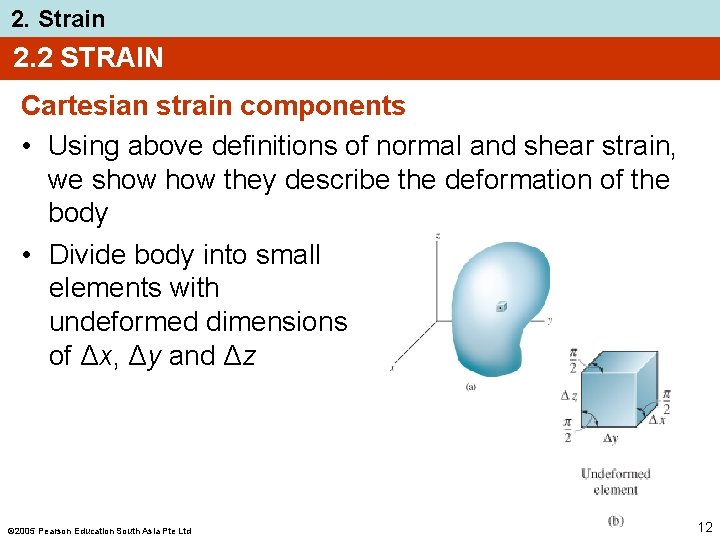
2. Strain 2. 2 STRAIN Cartesian strain components • Using above definitions of normal and shear strain, we show they describe the deformation of the body • Divide body into small elements with undeformed dimensions of Δx, Δy and Δz 2005 Pearson Education South Asia Pte Ltd 12
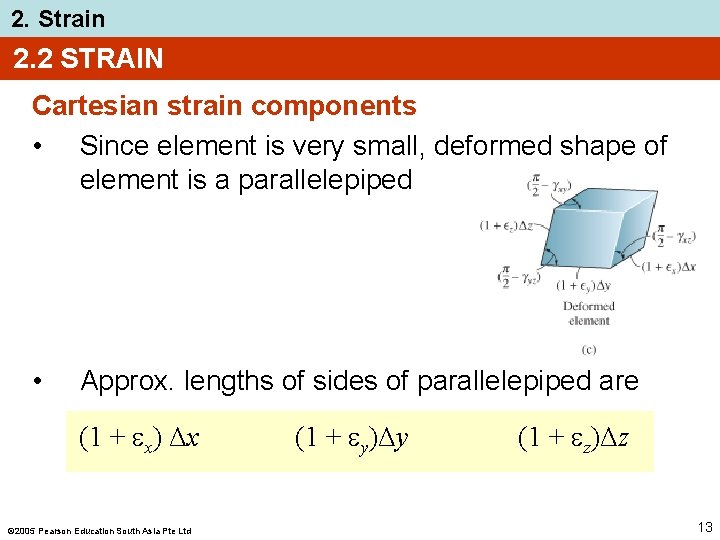
2. Strain 2. 2 STRAIN Cartesian strain components • Since element is very small, deformed shape of element is a parallelepiped • Approx. lengths of sides of parallelepiped are (1 + x) Δx 2005 Pearson Education South Asia Pte Ltd (1 + y)Δy (1 + z)Δz 13
2. Strain 2. 2 STRAIN Cartesian strain components • Approx. angles between the sides are − γxy − γyz − γxz 2 2 2 • • • Normal strains cause a change in its volume Shear strains cause a change in its shape To summarize, state of strain at a point requires specifying 3 normal strains; x, y, z and 3 shear strains of γxy, γyz, γxz 2005 Pearson Education South Asia Pte Ltd 14
2. Strain 2. 2 STRAIN Small strain analysis • Most engineering design involves applications for which only small deformations are allowed • We’ll assume that deformations that take place within a body are almost infinitesimal, so normal strains occurring within material are very small compared to 1, i. e. , << 1. 2005 Pearson Education South Asia Pte Ltd 15
2. Strain 2. 2 STRAIN Small strain analysis • This assumption is widely applied in practical engineering problems, and is referred to as small strain analysis • E. g. , it can be used to approximate sin θ = θ, cos θ = θ and tan θ = θ, provided θ is small 2005 Pearson Education South Asia Pte Ltd 16
- Slides: 16