
2 Static Games with Complete Information 2 4

- Slides: 15
2. Static Games with Complete Information 2. 4 SMGs with Mixed Strategies – Non-zero sum games ã ã ã In section 2. 3, we studied the zero-sum games that has no NE with pure strategies but found a NE under mixed strategies. In this section, we study the Nonzero-sum games (NZSG) with multiple NEs under mixed strategies. With multiple NEs, we can narrow down what would happen using the focal point. In NZSG, there is no reason to make other player guessing what strategies I will take. Thus, we will consider several issues associated with this. 1/15
2. Static Games with Complete Information 2. 4 SMGs with Mixed Strategies – Non-zero sum games 2. 4. 1 Mixing Sustained by Uncertain Beliefs Mixing strategies occurs because when a player chooses a strategy, she is unsure about what the other is choosing. This uncertainty makes her unsure about her own choice. ã Ex)The meeting game of JD and JP ã However, we will learn that when each player has correct beliefs on the other’s uncertain action, the game may have an equilibrium. ã 2/15
2. Static Games with Complete Information 2. 4 SMGs with Mixed Strategies – Non-zero sum games 2. 4. 1 Mixing Sustained by Uncertain Beliefs A. Will JP Meet JD? ã The meeting game (Both have friends in CE, thus they prefer to meet at CALES) is an example of the assurance game. If JD is certain that JP goes to CE, she has to stay at CE. If she is certain that JP stays CALES, she has to go to CALES. (click for NE) ã However, she is NOT certain (go to CE or CALES? ). What to do? Thus, we need to think deeper about JD’s uncertainty (on where to go). This kind of uncertainty is called ‘subjective uncertainty. ’ Jan-Dee June-Pyo CE CALES CE 1, 1 0, 0 CALES 0, 0 2, 2 3/15
2. Static Games with Complete Information 2. 4 SMGs with Mixed Strategies – Non-zero sum games 2. 4. 1 Mixing Sustained by Uncertain Beliefs A. Will JP Meet JD? (cont’d) ã From JD’s subjective judgment, she thinks that the probability of JP going to CE (in JD’s mind; subjective) is p. Or she thinks that the prob. of JP going to CALES is (1 - p). JD thinks JP uses p-mix. ã The prob. of JD staying at CE (in JP’s mind) is q. In this case, the payoffs are as follows. BR? q JP p 1 - p JD 1 - q q-mix CE CALES CE 1, 1 0, 0 1*q+0*(1 -q), 1*q+0*(1 -q) CALES 0, 0 2, 2 0*q+2*(1 -q), 0*q+2*(1 -q) p-mix 1*p+0*(1 -p), 1*p+0*(1 -p) 0*p+2*(1 -p), 0*p+2*(1 -p) p*q+(1 -p)*2*(1 -q), p*q+(1 -p)*2*(1 -q) 4/15
2. Static Games with Complete Information 2. 4 SMGs with Mixed Strategies – Non-zero sum games 2. 4. 1 Mixing Sustained by Uncertain Beliefs A. Will JP Meet JD? (cont’d) ã ã JD’s BRs? (Click) Upper envelope. Cross point? p=2(1 -p) p=2/3; JD goes to CALES if p <2/3, to CE if p > 2/3. JD goes to CALES if the prob. JP goes to CE is smaller than 2/3. JD’s Payoff 2 *JP가 CE로 갈 확률이 2/3보다 크면 JD는 CE 머문다 JD stays at CE q=1 1 JD’s payoff against JP’s p-mix when JD goes to CALES =0*p+2*(1 -p)=2 -2 p 1 JD’s q-mix JD goes to CALES JD goes to CE JD’s payoff against JP’s p-mix when JD goes to CE =1*p+0*(1 -p)=p 0 JP’s p-mix JD goes to CALES q(prob. JD stays at CE)=0 2/3 1 0 2/3 JP’s p-mix 1 5/15
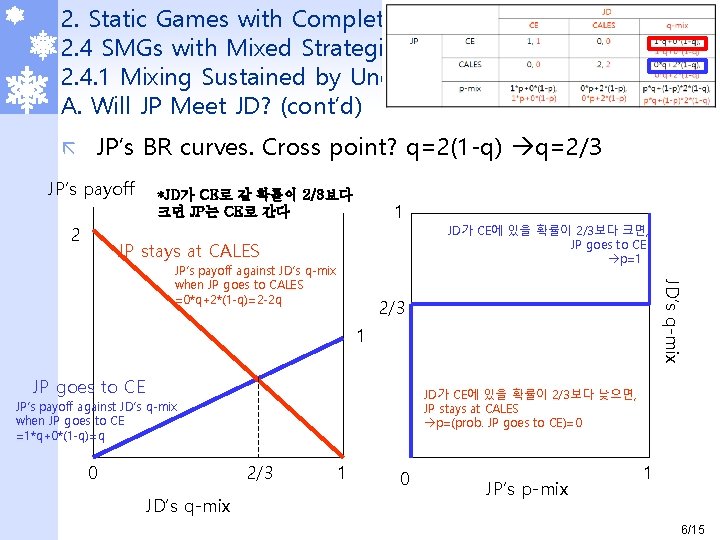
2. Static Games with Complete Information 2. 4 SMGs with Mixed Strategies – Non-zero sum games 2. 4. 1 Mixing Sustained by Uncertain Beliefs A. Will JP Meet JD? (cont’d) ã JP’s BR curves. Cross point? q=2(1 -q) q=2/3 JP’s payoff 2 *JD가 CE로 갈 확률이 2/3보다 크면 JP는 CE로 간다 1 JP stays at CALES JD’s q-mix JP’s payoff against JD’s q-mix when JP goes to CALES =0*q+2*(1 -q)=2 -2 q JD가 CE에 있을 확률이 2/3보다 크면, JP goes to CE p=1 2/3 1 JP goes to CE JD가 CE에 있을 확률이 2/3보다 낮으면, JP stays at CALES p=(prob. JP goes to CE)=0 JP’s payoff against JD’s q-mix when JP goes to CE =1*q+0*(1 -q)=q 0 2/3 JD’s q-mix 1 0 JP’s p-mix 1 6/15
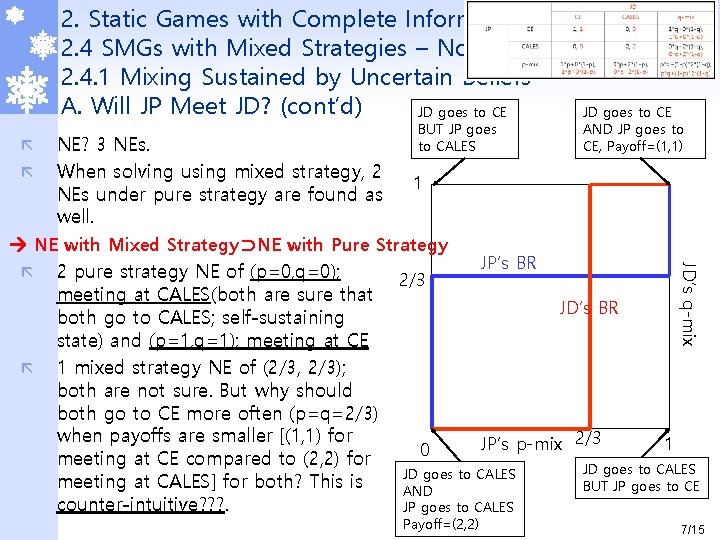
2. Static Games with Complete Information 2. 4 SMGs with Mixed Strategies – Non-zero sum games 2. 4. 1 Mixing Sustained by Uncertain Beliefs A. Will JP Meet JD? (cont’d) JD goes to CE ã ã NE? 3 NEs. When solving using mixed strategy, 2 NEs under pure strategy are found as well. BUT JP goes to CALES 1 NE with Mixed Strategy⊃NE with Pure Strategy ã 2 pure strategy NE of (p=0, q=0); meeting at CALES(both are sure that both go to CALES; self-sustaining state) and (p=1, q=1); meeting at CE 1 mixed strategy NE of (2/3, 2/3); both are not sure. But why should both go to CE more often (p=q=2/3) when payoffs are smaller [(1, 1) for meeting at CE compared to (2, 2) for meeting at CALES] for both? This is counter-intuitive? ? ? . 2/3 JP’s BR JD’s q-mix ã AND JP goes to CE, Payoff=(1, 1) JD’s BR 0 JP’s p-mix 2/3 JD goes to CALES AND JP goes to CALES Payoff=(2, 2) 1 JD goes to CALES BUT JP goes to CE 7/15
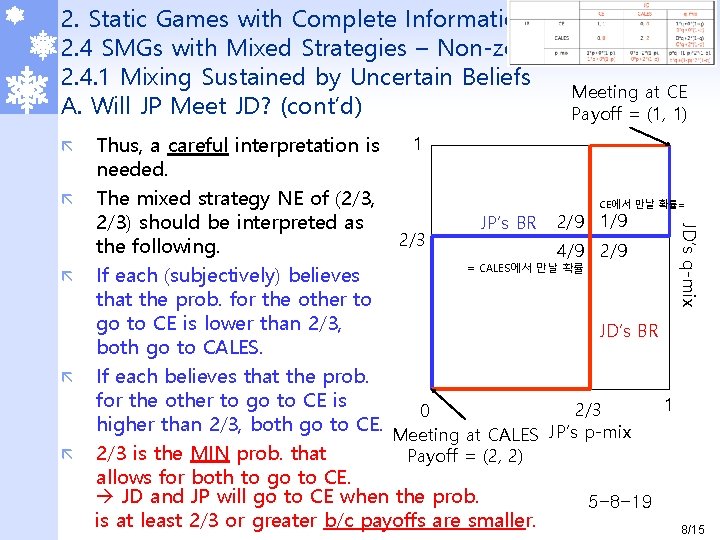
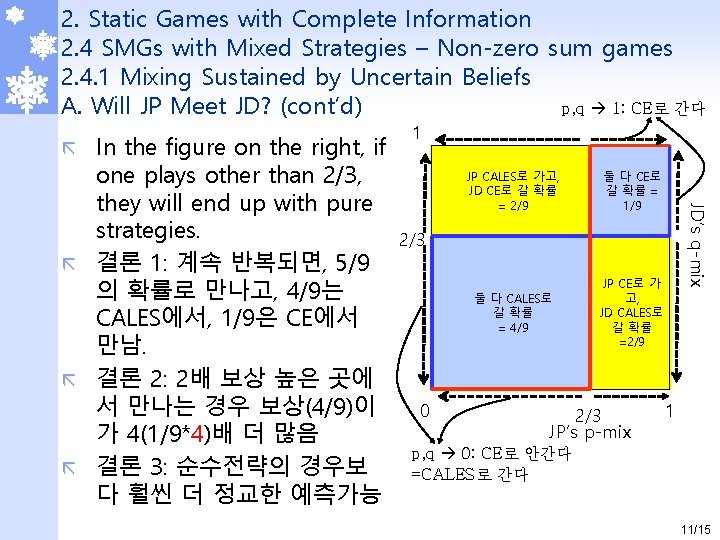
2. Static Games with Complete Information 2. 4 SMGs with Mixed Strategies – Non-zero sum games 2. 4. 1 Mixing Sustained by Uncertain Beliefs Meeting at CE A. Will JP Meet JD? (cont’d) Payoff = (1, 1) ã ã JD’s q-mix ã 1 Thus, a careful interpretation is needed. The mixed strategy NE of (2/3, CE에서 만날 확률= JP’s BR 2/9 1/9 2/3) should be interpreted as 2/3 the following. 4/9 2/9 = CALES에서 만날 확률 If each (subjectively) believes that the prob. for the other to go to CE is lower than 2/3, JD’s BR both go to CALES. If each believes that the prob. for the other to go to CE is 1 2/3 0 higher than 2/3, both go to CE. Meeting at CALES JP’s p-mix 2/3 is the MIN prob. that Payoff = (2, 2) allows for both to go to CE. JD and JP will go to CE when the prob. 5 -8 -19 is at least 2/3 or greater b/c payoffs are smaller. 8/15
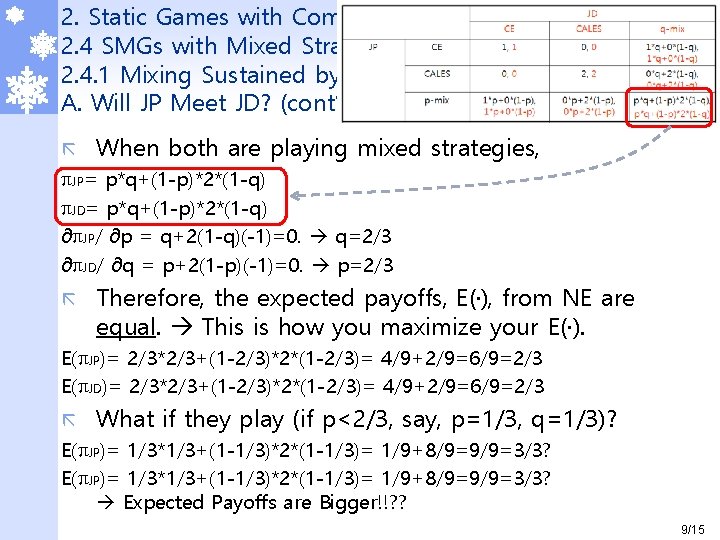
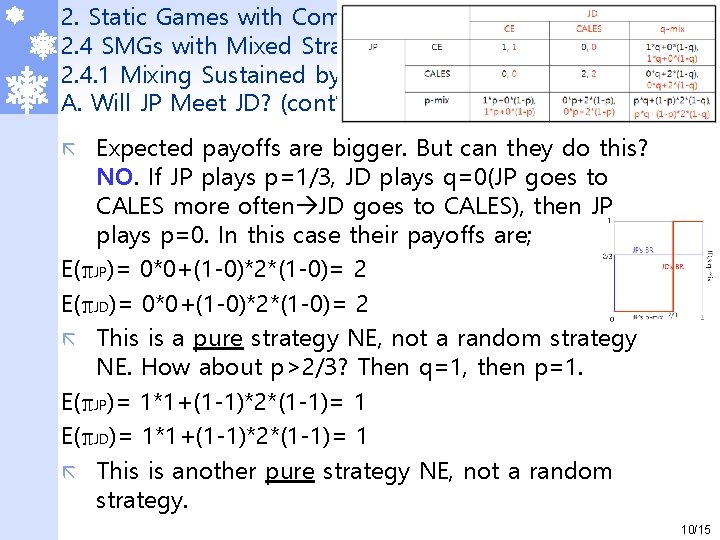
2. Static Games with Complete Information 2. 4 SMGs with Mixed Strategies – Non-zero sum games 2. 4. 1 Mixing Sustained by Uncertain Beliefs A. Will JP Meet JD? (cont’d) ã When both are playing mixed strategies, πJP= p*q+(1 -p)*2*(1 -q) πJD= p*q+(1 -p)*2*(1 -q) ∂πJP/ ∂p = q+2(1 -q)(-1)=0. q=2/3 ∂πJD/ ∂q = p+2(1 -p)(-1)=0. p=2/3 ã Therefore, the expected payoffs, E(·), from NE are equal. This is how you maximize your E(·). E(πJP)= 2/3*2/3+(1 -2/3)*2*(1 -2/3)= 4/9+2/9=6/9=2/3 E(πJD)= 2/3*2/3+(1 -2/3)*2*(1 -2/3)= 4/9+2/9=6/9=2/3 ã What if they play (if p<2/3, say, p=1/3, q=1/3)? E(πJP)= 1/3*1/3+(1 -1/3)*2*(1 -1/3)= 1/9+8/9=9/9=3/3? Expected Payoffs are Bigger!!? ? 9/15
2. Static Games with Complete Information 2. 4 SMGs with Mixed Strategies – Non-zero sum games 2. 4. 1 Mixing Sustained by Uncertain Beliefs A. Will JP Meet JD? (cont’d) Expected payoffs are bigger. But can they do this? NO. If JP plays p=1/3, JD plays q=0(JP goes to CALES more often JD goes to CALES), then JP plays p=0. In this case their payoffs are; E(πJP)= 0*0+(1 -0)*2*(1 -0)= 2 E(πJD)= 0*0+(1 -0)*2*(1 -0)= 2 ã This is a pure strategy NE, not a random strategy NE. How about p>2/3? Then q=1, then p=1. E(πJP)= 1*1+(1 -1)*2*(1 -1)= 1 E(πJD)= 1*1+(1 -1)*2*(1 -1)= 1 ã This is another pure strategy NE, not a random strategy. ã 10/15
2. Static Games with Complete Information 2. 4 SMGs with Mixed Strategies – Non-zero sum games 2. 4. 1 Mixing Sustained by Uncertain Beliefs A. Will JP Meet JD? (cont’d) p, q 1: CE로 간다 JP CALES로 가고, JD CE로 갈 확률 = 2/9 둘 다 CE로 갈 확률 = 1/9 둘 다 CALES로 갈 확률 = 4/9 JP CE로 가 고, JD CALES로 갈 확률 =2/9 JD’s q-mix In the figure on the right, if one plays other than 2/3, they will end up with pure strategies. ã 결론 1: 계속 반복되면, 5/9 의 확률로 만나고, 4/9는 CALES에서, 1/9은 CE에서 만남. ã 결론 2: 2배 보상 높은 곳에 서 만나는 경우 보상(4/9)이 가 4(1/9*4)배 더 많음 ã 결론 3: 순수전략의 경우보 다 훨씬 더 정교한 예측가능 ã 1 2/3 0 2/3 JP’s p-mix 1 p, q 0: CE로 안간다 =CALES로 간다 11/15
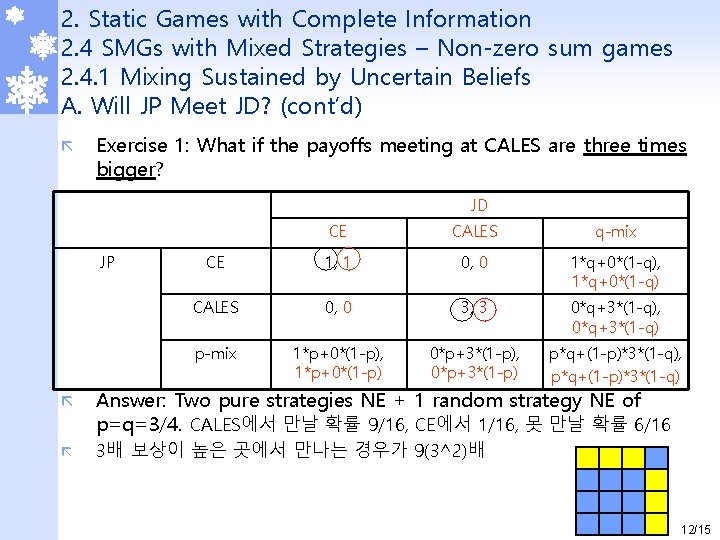
2. Static Games with Complete Information 2. 4 SMGs with Mixed Strategies – Non-zero sum games 2. 4. 1 Mixing Sustained by Uncertain Beliefs A. Will JP Meet JD? (cont’d) ã Exercise 1: What if the payoffs meeting at CALES are three times bigger? JD JP CE CALES q-mix CE 1, 1 0, 0 1*q+0*(1 -q), 1*q+0*(1 -q) CALES 0, 0 3, 3 0*q+3*(1 -q), 0*q+3*(1 -q) p-mix 1*p+0*(1 -p), 1*p+0*(1 -p) 0*p+3*(1 -p), 0*p+3*(1 -p) p*q+(1 -p)*3*(1 -q), p*q+(1 -p)*3*(1 -q) ã Answer: Two pure strategies NE + 1 random strategy NE of p=q=3/4. CALES에서 만날 확률 9/16, CE에서 1/16, 못 만날 확률 6/16 ã 3배 보상이 높은 곳에서 만나는 경우가 9(3^2)배 12/15
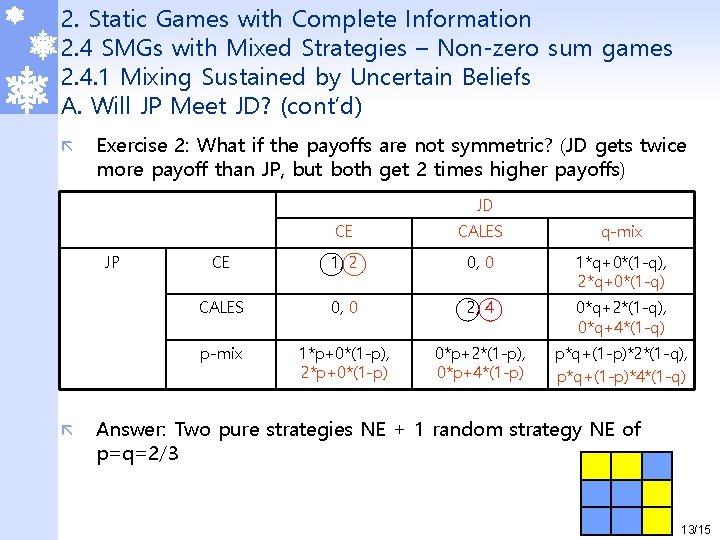
2. Static Games with Complete Information 2. 4 SMGs with Mixed Strategies – Non-zero sum games 2. 4. 1 Mixing Sustained by Uncertain Beliefs A. Will JP Meet JD? (cont’d) ã Exercise 2: What if the payoffs are not symmetric? (JD gets twice more payoff than JP, but both get 2 times higher payoffs) JD JP ã CE CALES q-mix CE 1, 2 0, 0 1*q+0*(1 -q), 2*q+0*(1 -q) CALES 0, 0 2, 4 0*q+2*(1 -q), 0*q+4*(1 -q) p-mix 1*p+0*(1 -p), 2*p+0*(1 -p) 0*p+2*(1 -p), 0*p+4*(1 -p) p*q+(1 -p)*2*(1 -q), p*q+(1 -p)*4*(1 -q) Answer: Two pure strategies NE + 1 random strategy NE of p=q=2/3 13/15
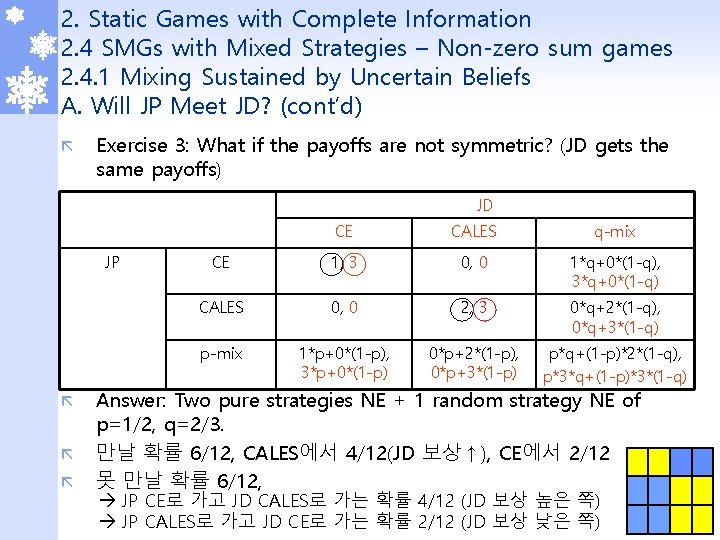
2. Static Games with Complete Information 2. 4 SMGs with Mixed Strategies – Non-zero sum games 2. 4. 1 Mixing Sustained by Uncertain Beliefs A. Will JP Meet JD? (cont’d) ã Exercise 3: What if the payoffs are not symmetric? (JD gets the same payoffs) JD JP ã ã ã CE CALES q-mix CE 1, 3 0, 0 1*q+0*(1 -q), 3*q+0*(1 -q) CALES 0, 0 2, 3 0*q+2*(1 -q), 0*q+3*(1 -q) p-mix 1*p+0*(1 -p), 3*p+0*(1 -p) 0*p+2*(1 -p), 0*p+3*(1 -p) p*q+(1 -p)*2*(1 -q), p*3*q+(1 -p)*3*(1 -q) Answer: Two pure strategies NE + 1 random strategy NE of p=1/2, q=2/3. 만날 확률 6/12, CALES에서 4/12(JD 보상↑), CE에서 2/12 못 만날 확률 6/12, JP CE로 가고 JD CALES로 가는 확률 4/12 (JD 보상 높은 쪽) JP CALES로 가고 JD CE로 가는 확률 2/12 (JD 보상 낮은 쪽) 14/15
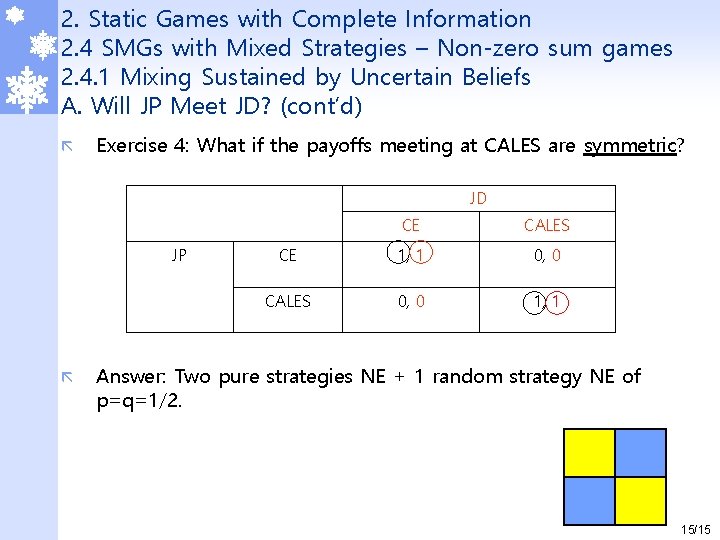
2. Static Games with Complete Information 2. 4 SMGs with Mixed Strategies – Non-zero sum games 2. 4. 1 Mixing Sustained by Uncertain Beliefs A. Will JP Meet JD? (cont’d) ã Exercise 4: What if the payoffs meeting at CALES are symmetric? JD JP ã CE CALES CE 1, 1 0, 0 CALES 0, 0 1, 1 Answer: Two pure strategies NE + 1 random strategy NE of p=q=1/2. 15/15