
2 Speciation Types of Isolation Notes What is


- Slides: 24
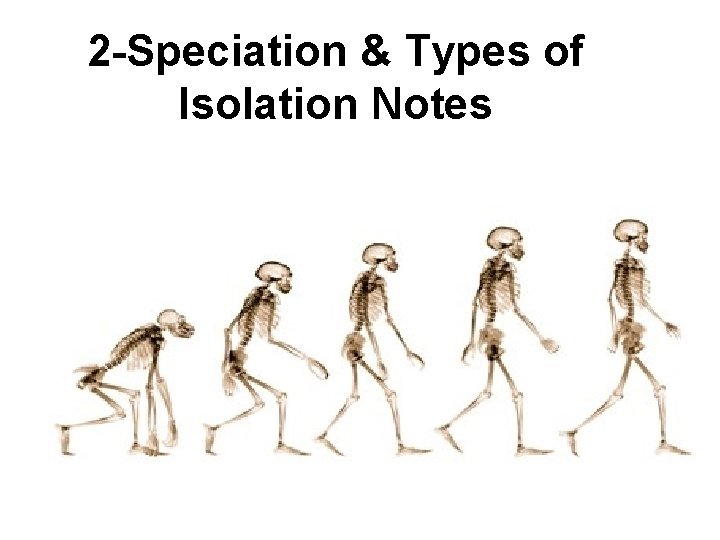
2 -Speciation & Types of Isolation Notes
What is a species? The Biological Species Concept A species = a group of organisms that can interbreed and produce fertile offspring. Speciation: Formation of a new species.
How do new species evolve? Reproductive Isolation: occurs when two populations can no longer interbreed (separate gene pools). Reproductive isolation can occur in a variety of ways, including geographically, behaviorally, temporally.
1. Geographic Isolation (ecological): when two populations are separated by geographic barriers such as mountain ranges, canyons, rivers, oceans, etc.
1. Geographic Isolation (ecological): Example: formation of Colorado River split squirrel groups
2. Behavioral Isolation: when two populations are capable of interbreeding, but have differences in courtship & other behaviors prevent breeding Example: Bird mating calls, frog vocalizations
2. Behavioral Isolation: when two populations are capable of interbreeding, but have differences in courtship & other behaviors prevent breeding What the heck is that? !?
3. Temporal Isolation: when two populations live in the same environment, but breed at different times. ←Late May Mid-June Example: orchid pollen release
3. Temporal Isolation: when two populations live in the same environment, but breed at different times.
Dog-day (17 year) Periodical (12 year)
4. Mechanical Isolation: When two populations live in the same environment, but can’t mate or pollinate because of physical differences These monkeyflowers don’t cross pollinate because they are pollinated by different animals.
5. Gametic Isolation: Sperm and eggs from different individuals are incompatible, so no fertilization occurs.
Identify the types of reproductive isolation on the following slides.
What type of reproductive isolation? Rana aurora (northern red-legged frog) breeds January - March Rana boylii (foothill yellow-legged frog) breeds late March - May
What type of reproductive isolation? Different species of bowerbird construct elaborate bowers and decorate them with different colors in order to woo females. The Satin bowerbird (left) builds a channel between upright sticks, and decorates with bright blue objects, while the Mac. Gregor’s Bowerbird (right) builds a tall tower of sticks and decorates with bits of charcoal. Evolutionary changes in mating rituals, such as bower construction, can contribute to speciation.
What type of reproductive isolation? Spotted owl subspecies living in different locations show some genetic and morphological differences.
What type of reproductive isolation? Each bird of paradise species has specialized feathers and dances that are attractive to females of their species. Birds of Paradise Video Link
"Are Humans Getting Better? What is Really Going On
Speciation in Darwin’s finches: Here we will devise a hypothetical scenario for the evolution of all 13 species of Galapagos finches from a single group of founding birds. 1. The founders arrive: (called the founder effect) A few finches travel from South America to one of the islands. There, they survive and reproduce.
2. Birds become separated: Some birds from species A cross to a second island. Type of isolation? Geographic isolation
3. Changes in the gene pool: The second island has a different type of food (larger seeds) that favors a bird with a larger, stronger beak. The population on the second island evolves into a population, B, with larger beaks.
4. Birds are reproductively isolated: If some of the population B birds cross back to the first island, they will not mate with the birds of population A. • A and B are now separate species
5. Ecological competition: As species A and B compete for seeds on the first island, they continue to evolve. • A third species may evolve.
6. Continued evolution: • The process continues until the formation of all 13 finch species from one common ancestor. • This type of evolution is also known as adaptive radiation