
2 Software life span models Stages through which
- Slides: 20
2 Software life span models • Stages through which software goes, from conception to death • Stages may be very different • Software = product – stages are similar to the stages in the life span of other products © 2012 Václav Rajlich Software Engineering: The Current Practice Ch. 2 1
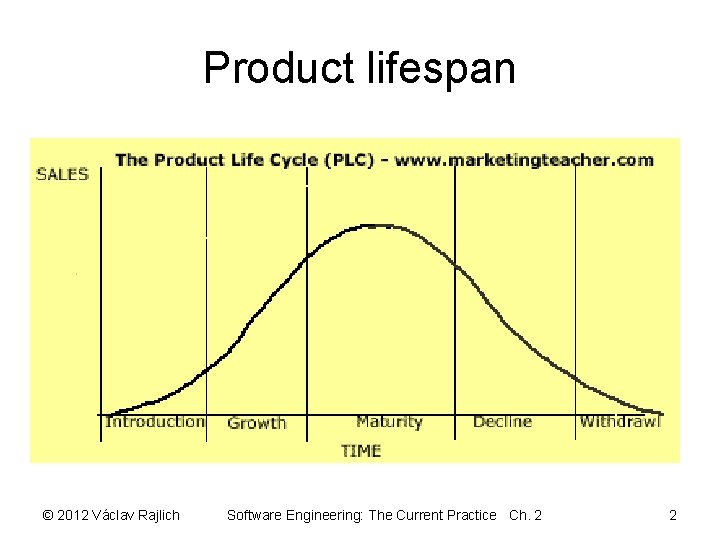
Product lifespan © 2012 Václav Rajlich Software Engineering: The Current Practice Ch. 2 2
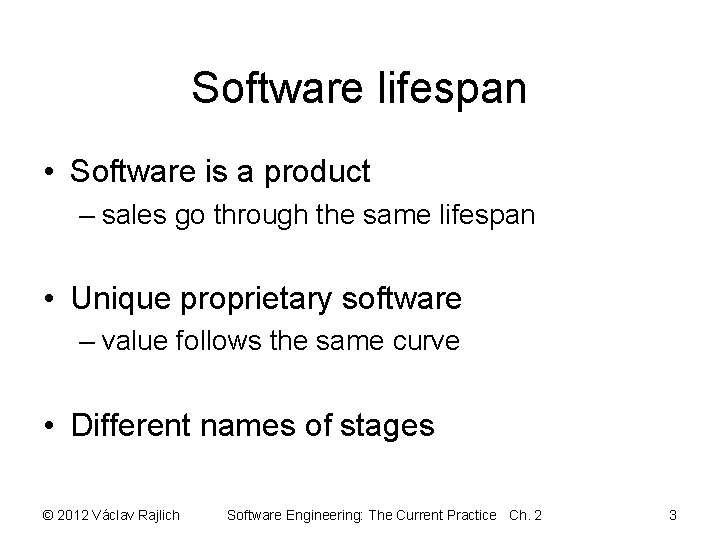
Software lifespan • Software is a product – sales go through the same lifespan • Unique proprietary software – value follows the same curve • Different names of stages © 2012 Václav Rajlich Software Engineering: The Current Practice Ch. 2 3
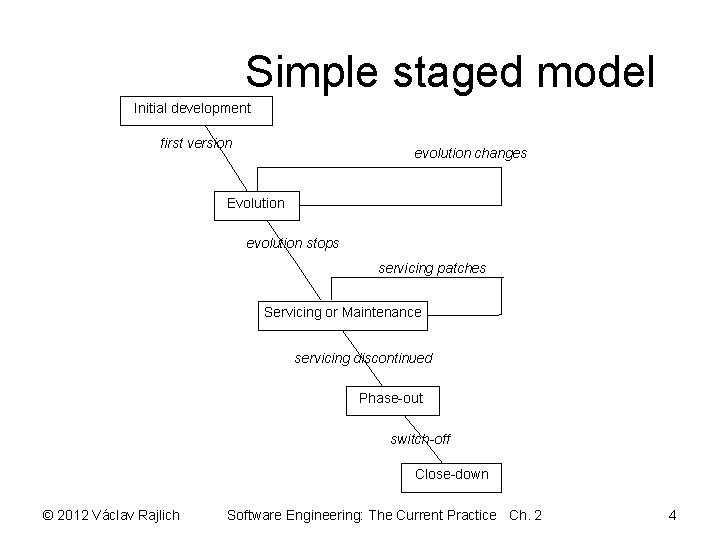
Simple staged model Initial development first version evolution changes Evolution evolution stops servicing patches Servicing or Maintenance servicing discontinued Phase-out switch-off Close-down © 2012 Václav Rajlich Software Engineering: The Current Practice Ch. 2 4
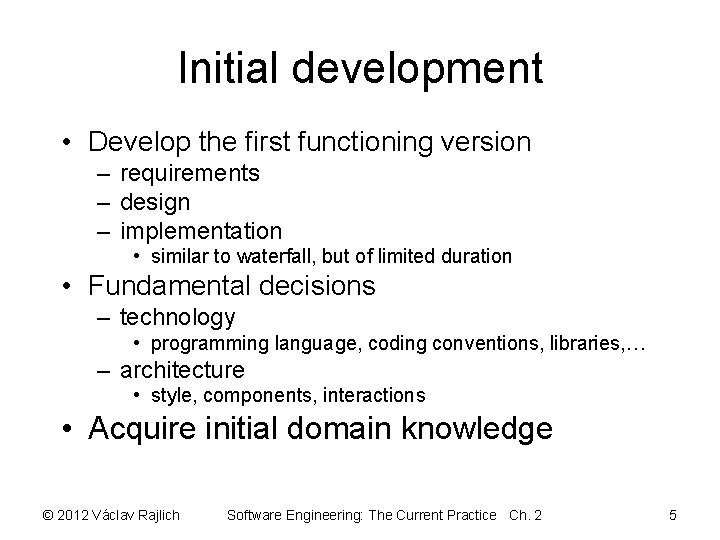
Initial development • Develop the first functioning version – requirements – design – implementation • similar to waterfall, but of limited duration • Fundamental decisions – technology • programming language, coding conventions, libraries, … – architecture • style, components, interactions • Acquire initial domain knowledge © 2012 Václav Rajlich Software Engineering: The Current Practice Ch. 2 5
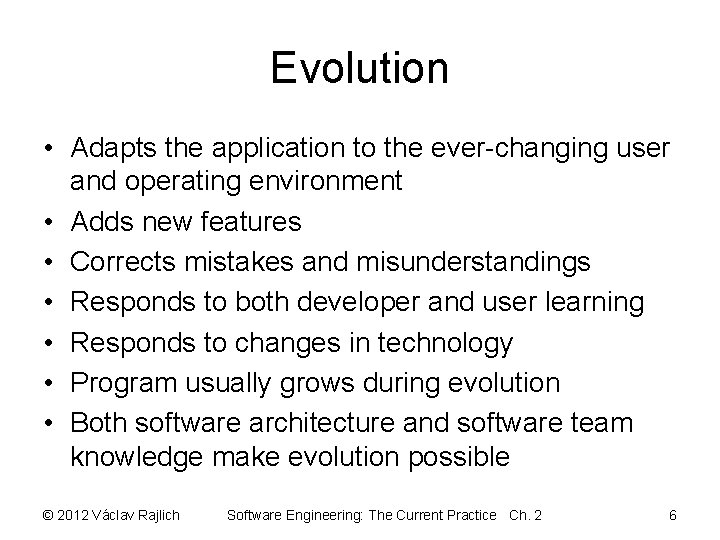
Evolution • Adapts the application to the ever-changing user and operating environment • Adds new features • Corrects mistakes and misunderstandings • Responds to both developer and user learning • Responds to changes in technology • Program usually grows during evolution • Both software architecture and software team knowledge make evolution possible © 2012 Václav Rajlich Software Engineering: The Current Practice Ch. 2 6
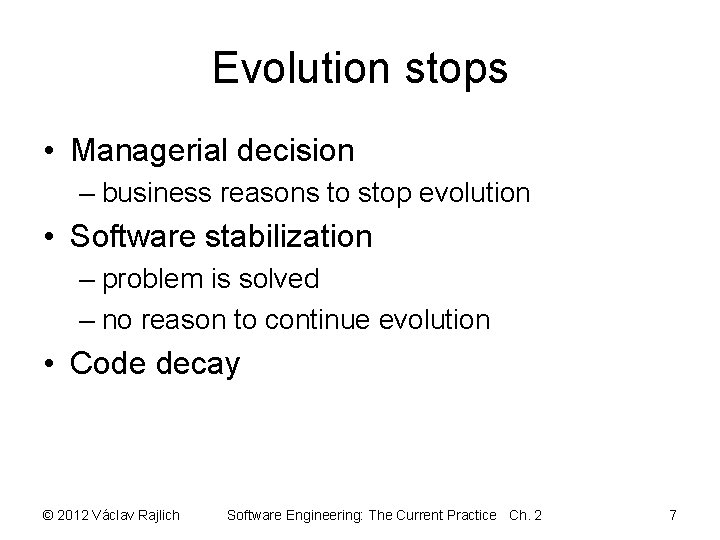
Evolution stops • Managerial decision – business reasons to stop evolution • Software stabilization – problem is solved – no reason to continue evolution • Code decay © 2012 Václav Rajlich Software Engineering: The Current Practice Ch. 2 7
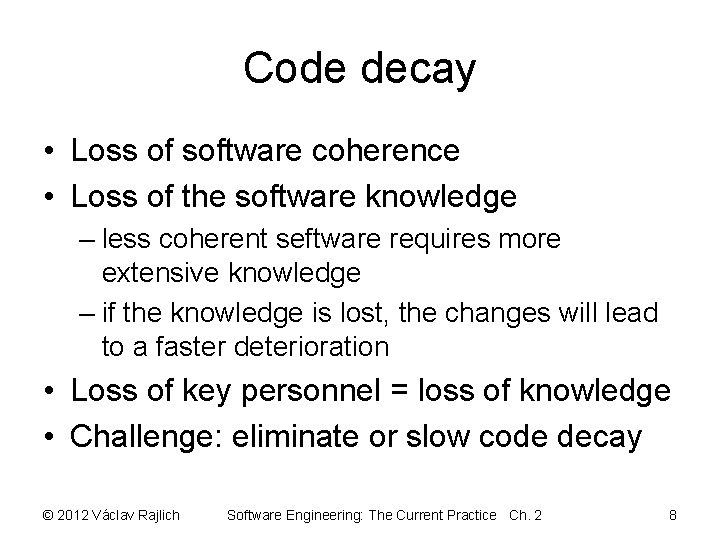
Code decay • Loss of software coherence • Loss of the software knowledge – less coherent seftware requires more extensive knowledge – if the knowledge is lost, the changes will lead to a faster deterioration • Loss of key personnel = loss of knowledge • Challenge: eliminate or slow code decay © 2012 Václav Rajlich Software Engineering: The Current Practice Ch. 2 8
Servicing = Maintenance • No additions of new functionality • Changes are limited to patches and wrappers – less costly, but they cause further deterioration • Process is different from evolution – no need for senior engineers – the process is predictable • well suited to process measurement and management © 2012 Václav Rajlich Software Engineering: The Current Practice Ch. 2 9
Reversal from servicing to evolution • Expensive, rare • Not simply a technical problem – the knowledge of the software team must also be recovered © 2012 Václav Rajlich Software Engineering: The Current Practice Ch. 2 10
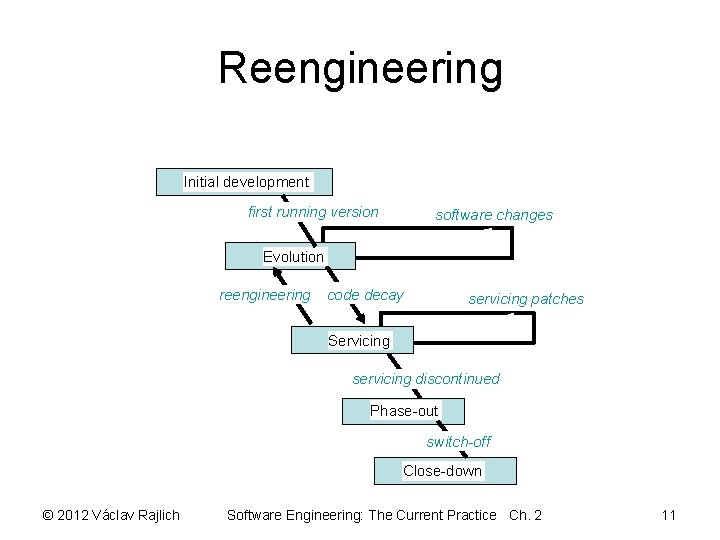
Reengineering Initial development first running version software changes Evolution reengineering code decay servicing patches Servicing servicing discontinued Phase-out switch-off Close-down © 2012 Václav Rajlich Software Engineering: The Current Practice Ch. 2 11
Phase-out • No more servicing is being undertaken – but the system still may be in production • Users must work around known deficiencies © 2012 Václav Rajlich Software Engineering: The Current Practice Ch. 2 12
Close-down • Software use is disconnected – current life of successful software: – about 10 to 20 years • Users are directed towards a replacement • An ‘exit strategy’ is needed. – changing to another system requires retraining – what to do with long-lived data? © 2012 Václav Rajlich Software Engineering: The Current Practice Ch. 2 13
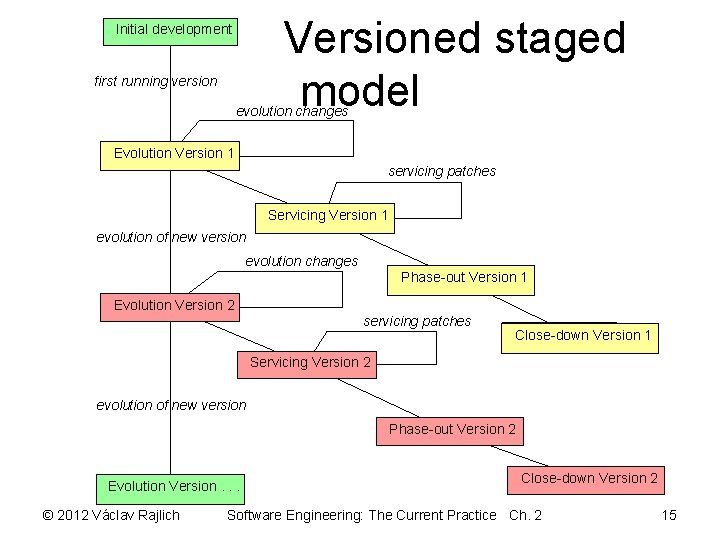
Versioned staged model • Used by software with many users • Evolution is the backbone of the process – evolution produces versions – versions are serviced, phased-out, closed down © 2012 Václav Rajlich Software Engineering: The Current Practice Ch. 2 14
Versioned staged model Initial development first running version evolution changes Evolution Version 1 servicing patches Servicing Version 1 evolution of new version evolution changes Phase-out Version 1 Evolution Version 2 servicing patches Close-down Version 1 Servicing Version 2 evolution of new version Phase-out Version 2 Evolution Version. . . © 2012 Václav Rajlich Close-down Version 2 Software Engineering: The Current Practice Ch. 2 15
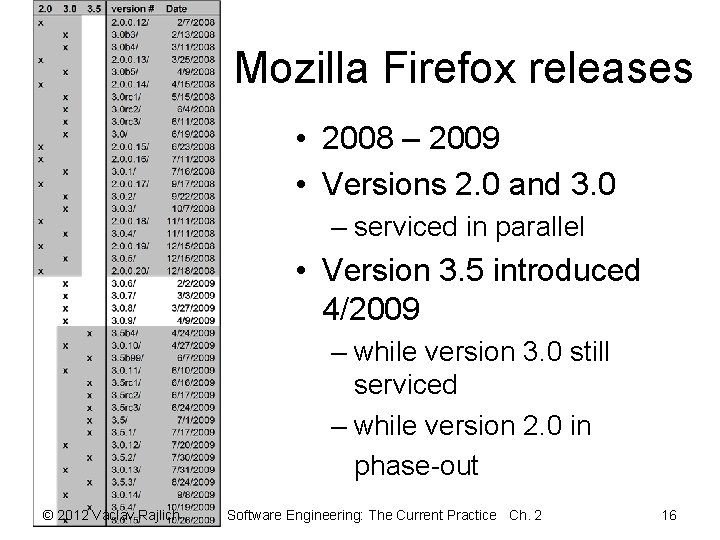
Mozilla Firefox releases • 2008 – 2009 • Versions 2. 0 and 3. 0 – serviced in parallel • Version 3. 5 introduced 4/2009 – while version 3. 0 still serviced – while version 2. 0 in phase-out © 2012 Václav Rajlich Software Engineering: The Current Practice Ch. 2 16
Incomplete lifespans • Discontinued projects – stopped during initial development • Stable domain – no need for evolution • Development starts with evolution – a related old software is evolved into new one © 2012 Václav Rajlich Software Engineering: The Current Practice Ch. 2 17
Lifecycle vs. lifespan model • Lifecycle – common terminology – incorrect: There is no cycle • some software discontinued without a replacement • Lifespan model – better terminology – less commonly used © 2012 Václav Rajlich Software Engineering: The Current Practice Ch. 2 18
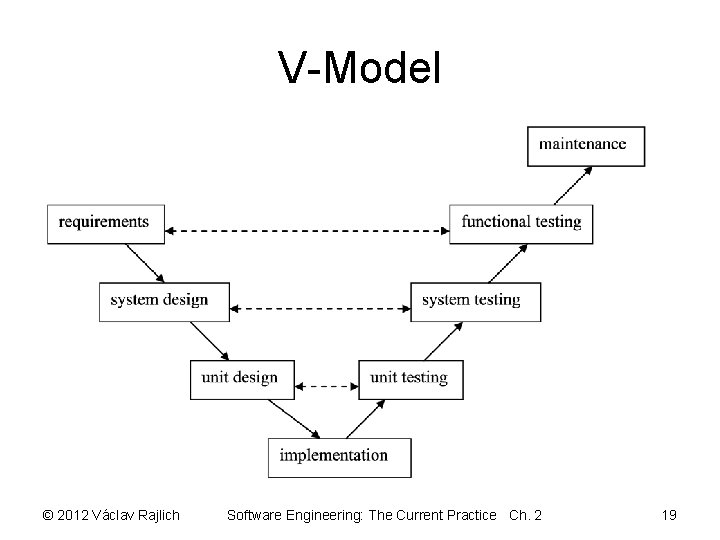
V-Model © 2012 Václav Rajlich Software Engineering: The Current Practice Ch. 2 19
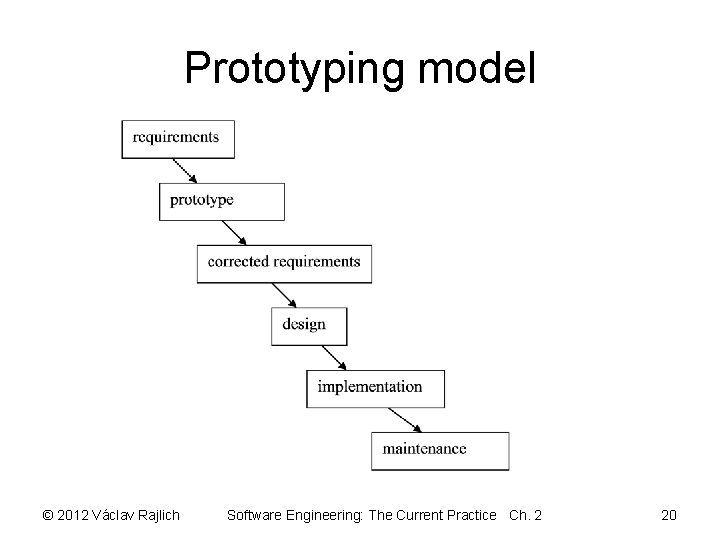
Prototyping model © 2012 Václav Rajlich Software Engineering: The Current Practice Ch. 2 20