
2 Set Theory Using Mathematics to Classify Objects
2 Set Theory Using Mathematics to Classify Objects © 2010 Pearson Education, Inc. All rights reserved.
2. 4 Survey Problems • Label sets in Venn diagrams with various names • Use Venn diagrams to solve survey problems • Understand how to handle contradictory information in survey problems © 2010 Pearson Education, Inc. All rights reserved. Section 2. 4, Slide 2
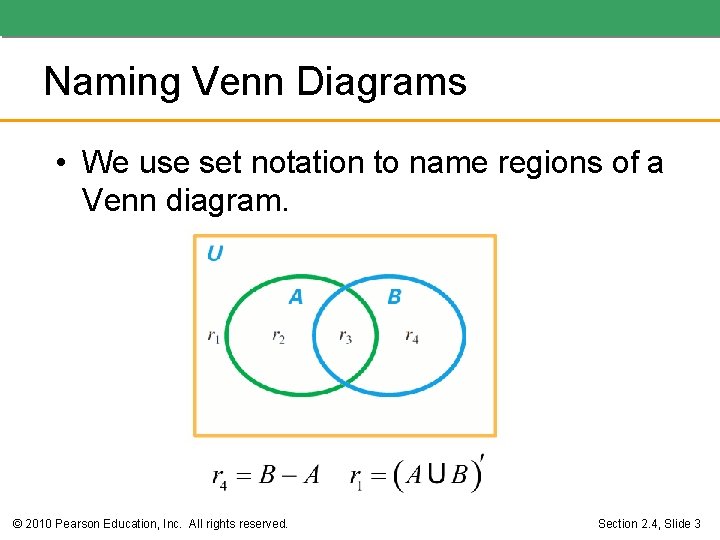
Naming Venn Diagrams • We use set notation to name regions of a Venn diagram. © 2010 Pearson Education, Inc. All rights reserved. Section 2. 4, Slide 3
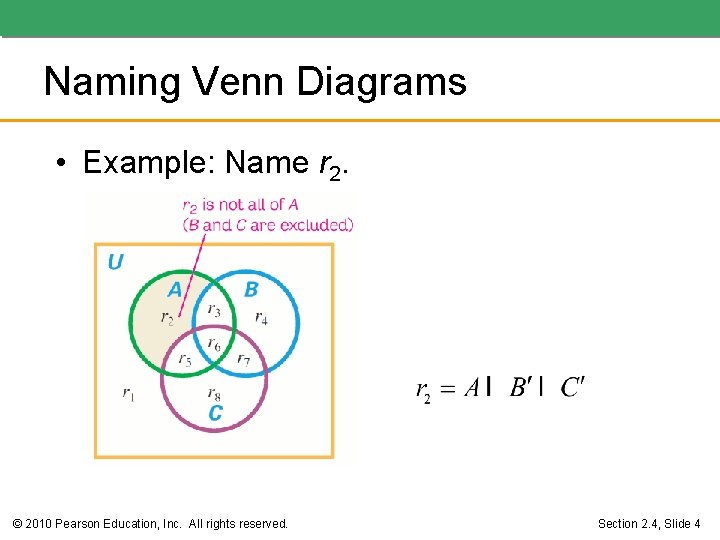
Naming Venn Diagrams • Example: Name r 2. © 2010 Pearson Education, Inc. All rights reserved. Section 2. 4, Slide 4
Survey Problems • When we collect and organize data into sets, we usually want to analyze the information. • These types of problems are called survey problems. © 2010 Pearson Education, Inc. All rights reserved. Section 2. 4, Slide 5
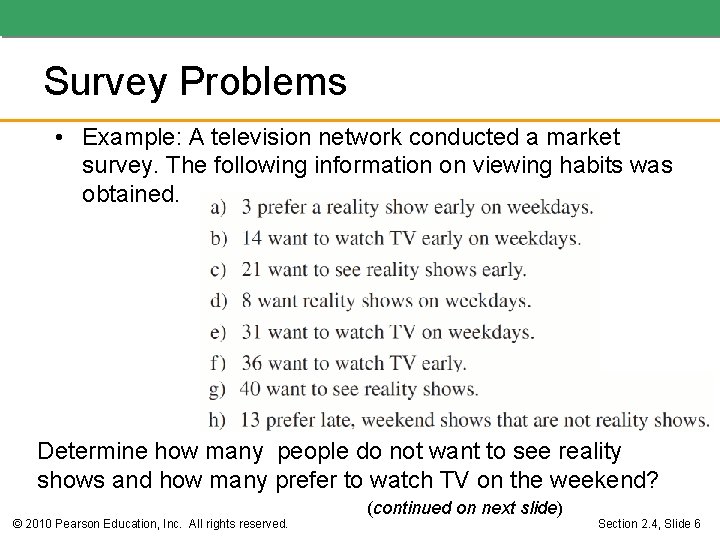
Survey Problems • Example: A television network conducted a market survey. The following information on viewing habits was obtained. Determine how many people do not want to see reality shows and how many prefer to watch TV on the weekend? © 2010 Pearson Education, Inc. All rights reserved. (continued on next slide) Section 2. 4, Slide 6
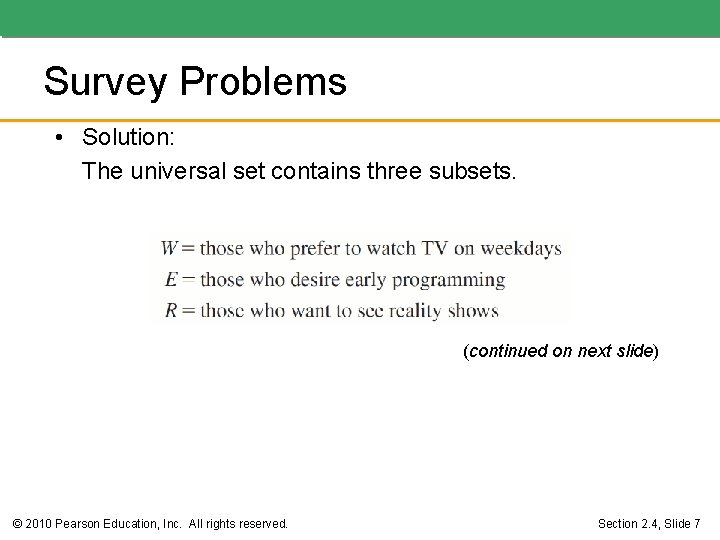
Survey Problems • Solution: The universal set contains three subsets. (continued on next slide) © 2010 Pearson Education, Inc. All rights reserved. Section 2. 4, Slide 7
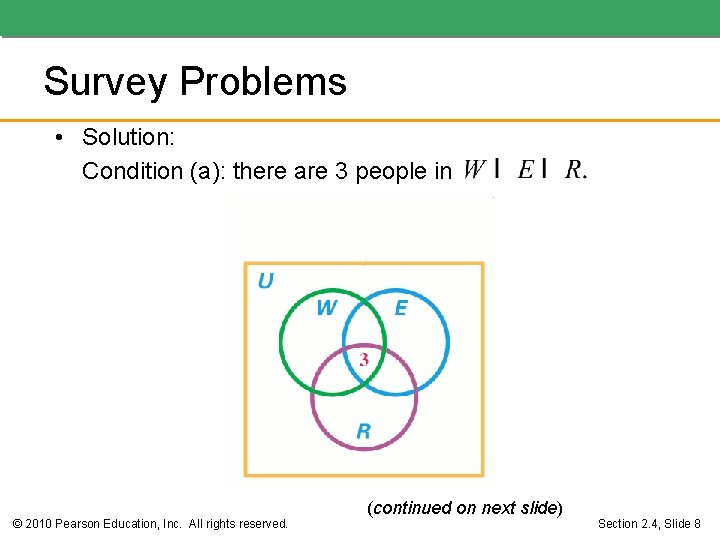
Survey Problems • Solution: Condition (a): there are 3 people in © 2010 Pearson Education, Inc. All rights reserved. (continued on next slide) Section 2. 4, Slide 8
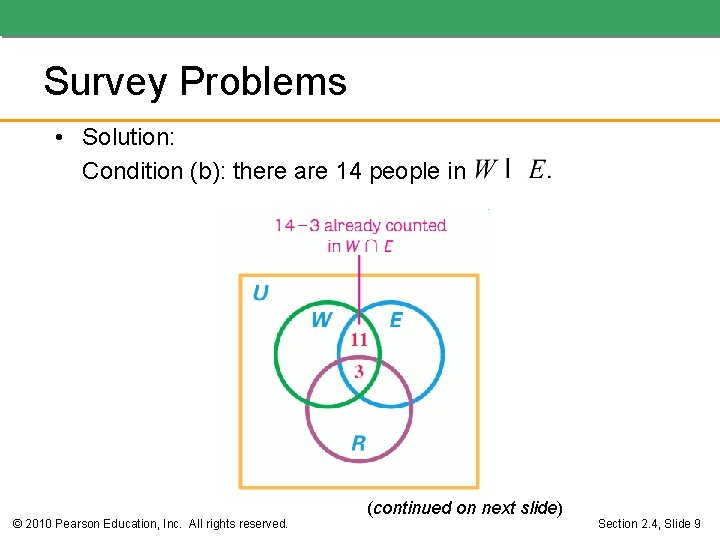
Survey Problems • Solution: Condition (b): there are 14 people in © 2010 Pearson Education, Inc. All rights reserved. (continued on next slide) Section 2. 4, Slide 9
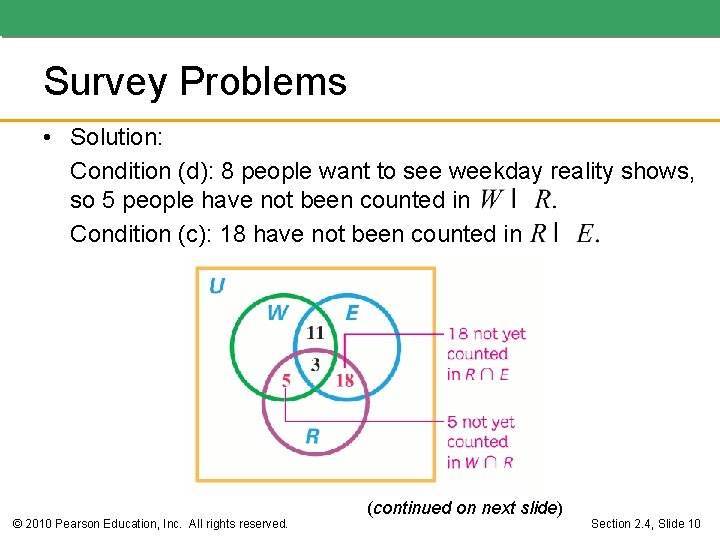
Survey Problems • Solution: Condition (d): 8 people want to see weekday reality shows, so 5 people have not been counted in Condition (c): 18 have not been counted in © 2010 Pearson Education, Inc. All rights reserved. (continued on next slide) Section 2. 4, Slide 10
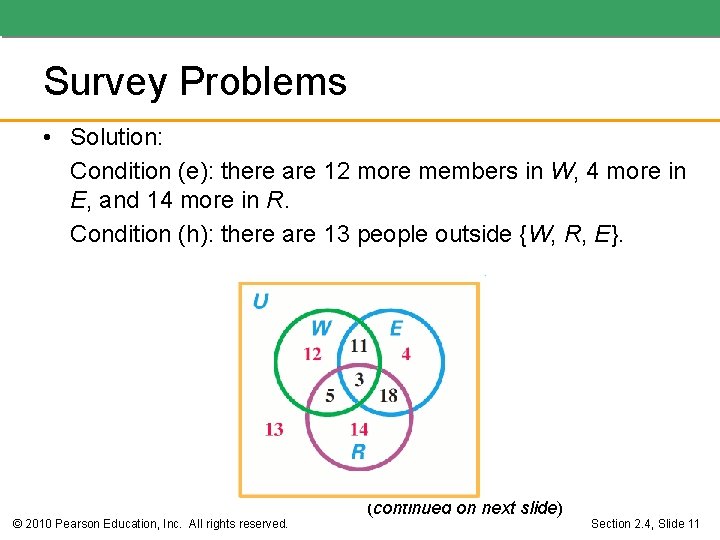
Survey Problems • Solution: Condition (e): there are 12 more members in W, 4 more in E, and 14 more in R. Condition (h): there are 13 people outside {W, R, E}. © 2010 Pearson Education, Inc. All rights reserved. (continued on next slide) Section 2. 4, Slide 11
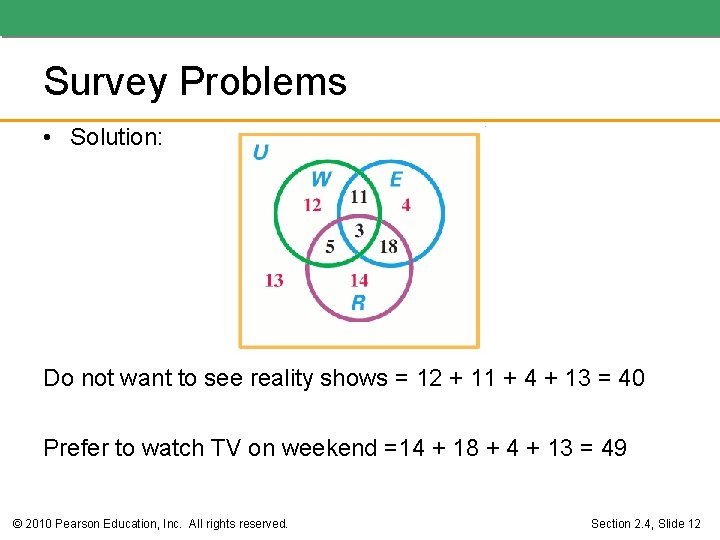
Survey Problems • Solution: Do not want to see reality shows = 12 + 11 + 4 + 13 = 40 Prefer to watch TV on weekend =14 + 18 + 4 + 13 = 49 © 2010 Pearson Education, Inc. All rights reserved. Section 2. 4, Slide 12
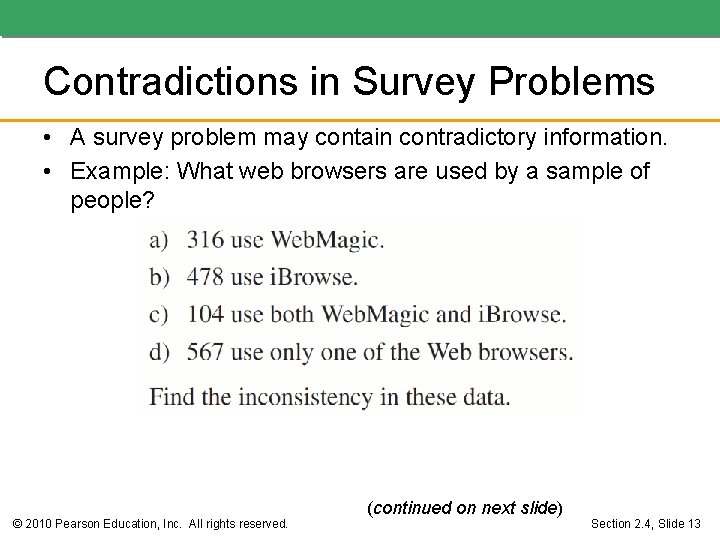
Contradictions in Survey Problems • A survey problem may contain contradictory information. • Example: What web browsers are used by a sample of people? © 2010 Pearson Education, Inc. All rights reserved. (continued on next slide) Section 2. 4, Slide 13
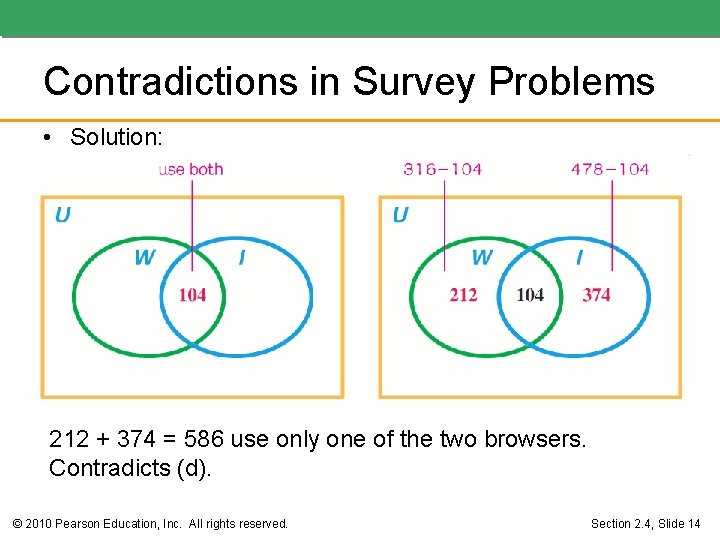
Contradictions in Survey Problems • Solution: 212 + 374 = 586 use only one of the two browsers. Contradicts (d). © 2010 Pearson Education, Inc. All rights reserved. Section 2. 4, Slide 14
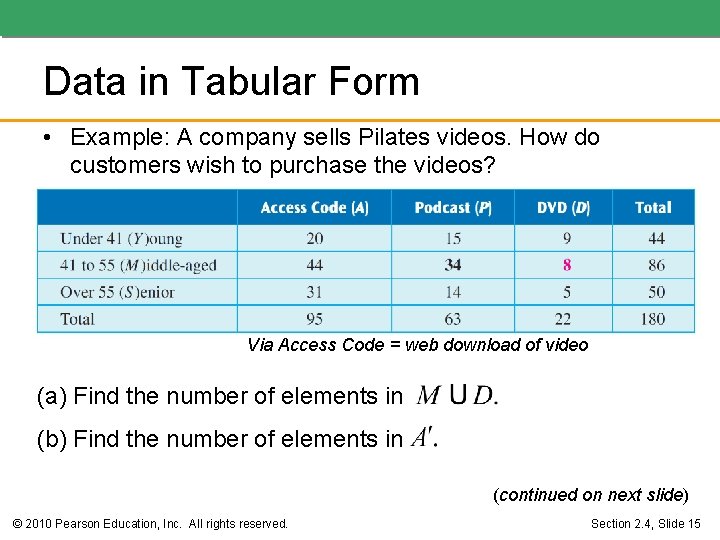
Data in Tabular Form • Example: A company sells Pilates videos. How do customers wish to purchase the videos? Via Access Code = web download of video (a) Find the number of elements in (b) Find the number of elements in (continued on next slide) © 2010 Pearson Education, Inc. All rights reserved. Section 2. 4, Slide 15
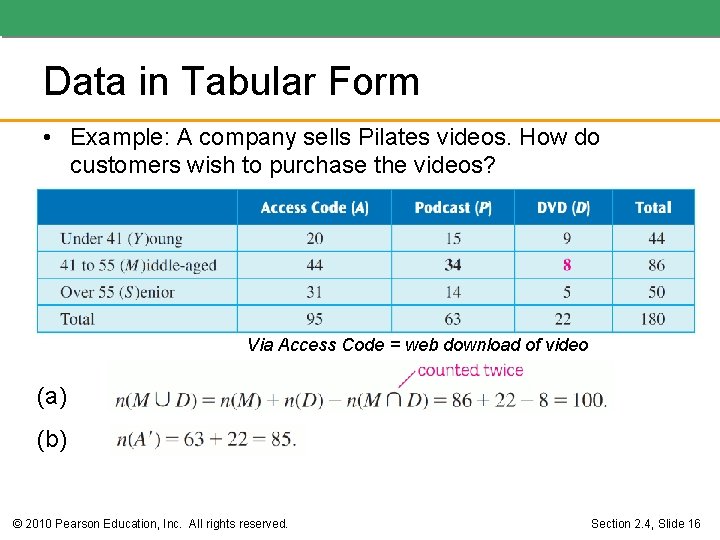
Data in Tabular Form • Example: A company sells Pilates videos. How do customers wish to purchase the videos? Via Access Code = web download of video (a) (b) © 2010 Pearson Education, Inc. All rights reserved. Section 2. 4, Slide 16
- Slides: 16