
2 Set Theory Using Mathematics to Classify Objects
2 Set Theory Using Mathematics to Classify Objects © 2010 Pearson Education, Inc. All rights reserved.
2. 1 The Language of Sets • Specify sets using both listing and set-builder notation • Understand when sets are welldefined • Use the element symbol property (continued on next slide) © 2010 Pearson Education, Inc. All rights reserved. Section 2. 1, Slide 2

2. 1 The Language of Sets • Find the cardinal number of sets © 2010 Pearson Education, Inc. All rights reserved. Section 2. 1, Slide 3
Representing Sets • Set – collection of objects • Element – a member of a set © 2010 Pearson Education, Inc. All rights reserved. Section 2. 1, Slide 4
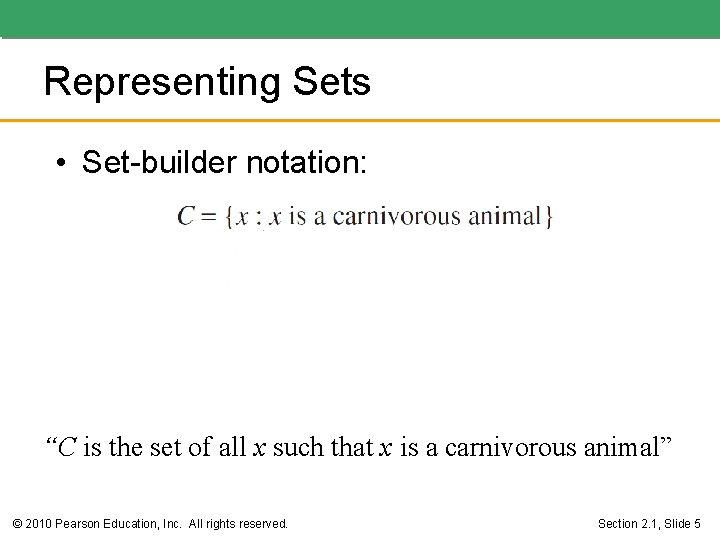
Representing Sets • Set-builder notation: “C is the set of all x such that x is a carnivorous animal” © 2010 Pearson Education, Inc. All rights reserved. Section 2. 1, Slide 5
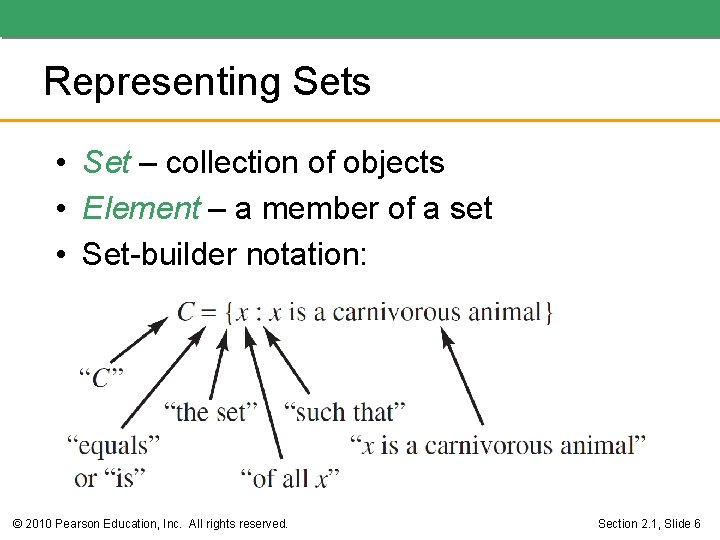
Representing Sets • Set – collection of objects • Element – a member of a set • Set-builder notation: © 2010 Pearson Education, Inc. All rights reserved. Section 2. 1, Slide 6
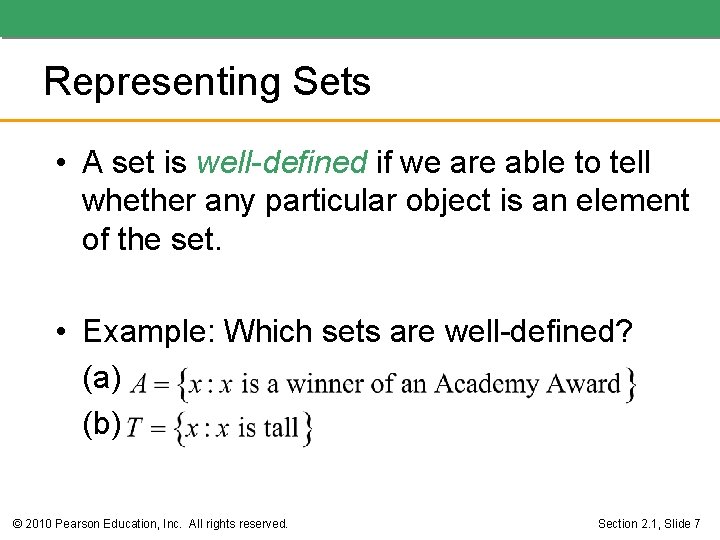
Representing Sets • A set is well-defined if we are able to tell whether any particular object is an element of the set. • Example: Which sets are well-defined? (a) (b) © 2010 Pearson Education, Inc. All rights reserved. Section 2. 1, Slide 7
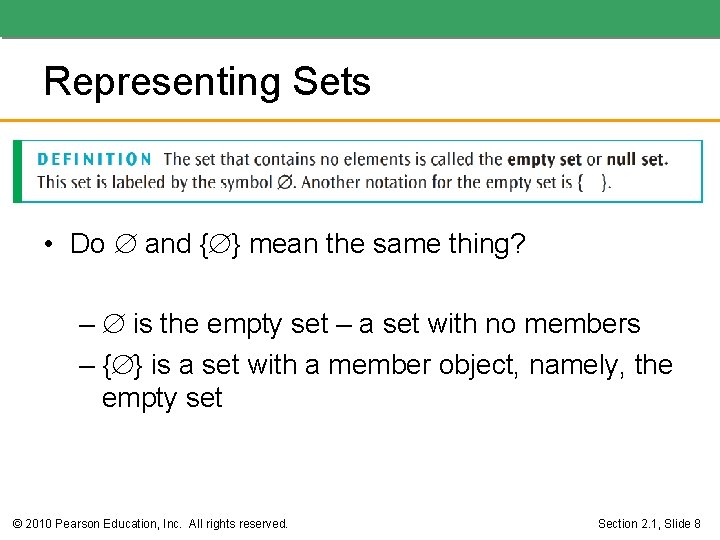
Representing Sets • Do and { } mean the same thing? – is the empty set – a set with no members – { } is a set with a member object, namely, the empty set © 2010 Pearson Education, Inc. All rights reserved. Section 2. 1, Slide 8
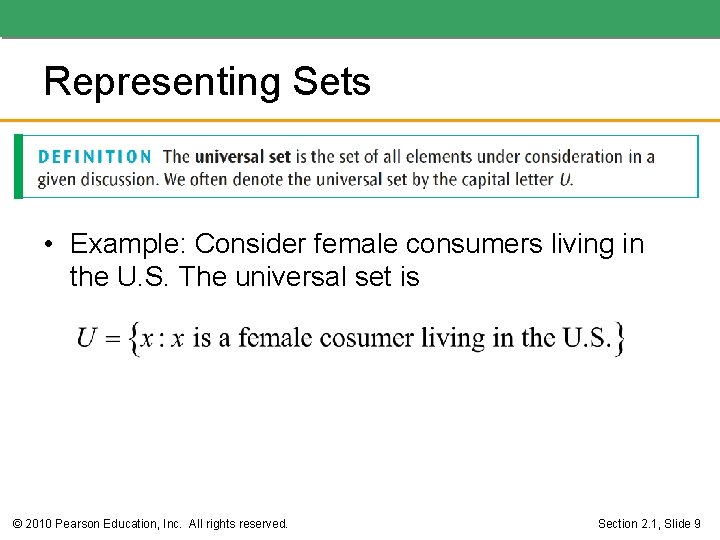
Representing Sets • Example: Consider female consumers living in the U. S. The universal set is © 2010 Pearson Education, Inc. All rights reserved. Section 2. 1, Slide 9
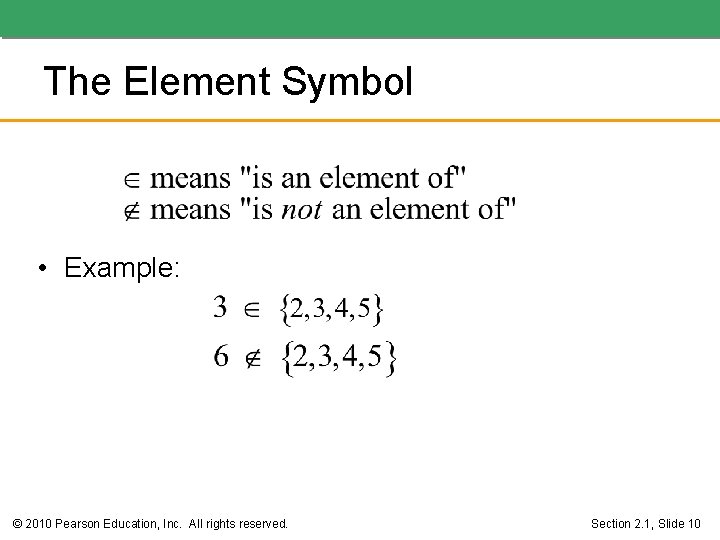
The Element Symbol • Example: © 2010 Pearson Education, Inc. All rights reserved. Section 2. 1, Slide 10
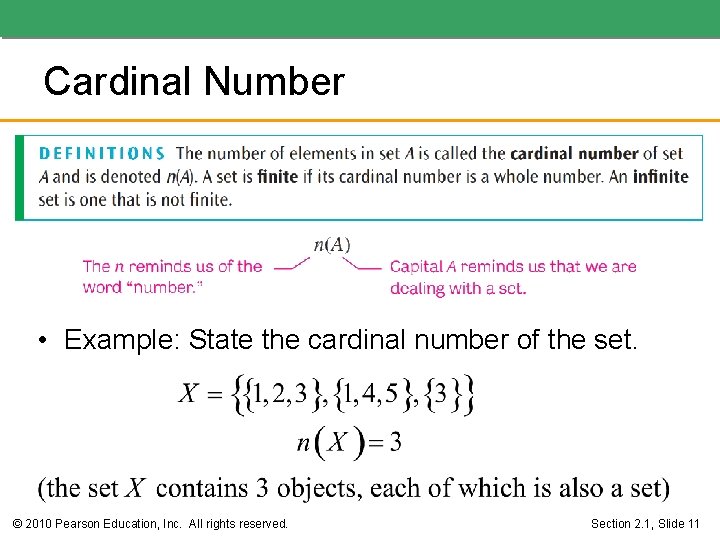
Cardinal Number • Example: State the cardinal number of the set. © 2010 Pearson Education, Inc. All rights reserved. Section 2. 1, Slide 11
- Slides: 11