
2 RADIO TRANSMITTERS AND RECEIVERS OF RADIO TV

- Slides: 17
ТЕМА 2: RADIO TRANSMITTERS AND RECEIVERS OF RADIO & TV SYSTEMS LECTURE 3. RADIO TRANSMITTERS 1. Basic functional units of the transmitters 2. Technical parameters of radio transmitters 3. Features of power amplifiers of the radio transmitters 4. Oscillators 5. Frequency stabilizing. Crystal oscillators
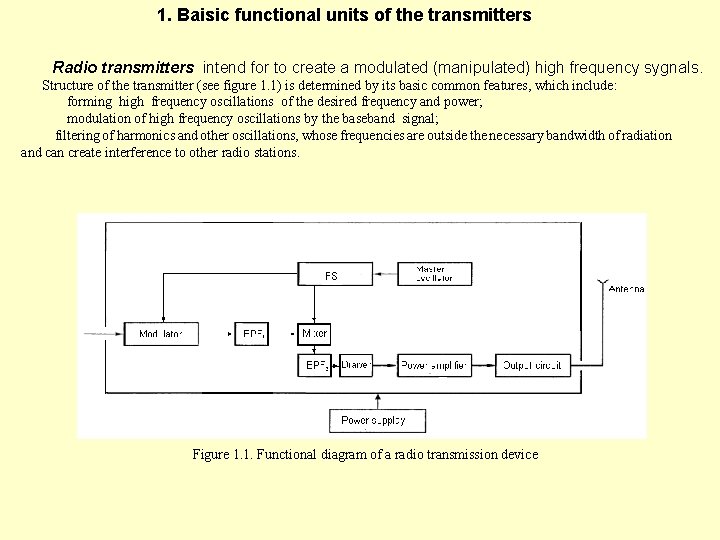
1. Baisic functional units of the transmitters Radio transmitters intend for to create a modulated (manipulated) high frequency sygnals. Structure of the transmitter (see figure 1. 1) is determined by its basic common features, which include: forming high frequency oscillations of the desired frequency and power; modulation of high frequency oscillations by the baseband signal; filtering of harmonics and other oscillations, whose frequencies are outside the necessary bandwidth of radiation and can create interference to other radio stations. Figure 1. 1. Functional diagram of a radio transmission device
Synthesizer converts the frequency oscillation of the reference generator, which is usually constant, in any other frequency, which is currently required for radio communication or TV broadcasting. Frequency stability under this transformation should not significantly deteriorate. In some cases, frequency synthesizer is not needed, for example, if the generator directly creates oscillations of the desired frequency. However, with the synthesizer it is easier to provide the required accuracy and stability of the frequency. In addition, modern synthesizers are suited for remote or automatic control of the synthesized frequency, which facilitates the overall automatic control transmitter parameters. Modulator is used for modulation of high frequency oscillations by input information signal. Power amplifier and draiver (sometimes called as a generators with external excitation) increases the power of the signal to a level determined by the requirements of the radio system. Power supply provides currents and voltages to all units of transmitter for the normal operation of transistors, radio valves and other electronic elements as well as automatic control systems, emergency protection devices and other auxiliary circuits. The power supply system includes rectifiers, electrical generators with internal combustion engines, batteries, inverters (converters) of low DC voltage into the high one or vice versa, transformers, switching equipment, backup power supplies and devices for automatic switching from the primary source to a backup in case of malfunction, etc.
Технические показатели радиопередатчиков Band of waves. Distinguish the transmitters of kilometre, hectometer, decametre and other waves. To this distinction the proper features of constructions are related, because the constructions of oscillatory circuits and types of amplifying elements are different in different ranges. A transmitter can work on one or a few fixed waves, or it can tune in to any wave-length in the continuous range of waves. Maximal Power of transmitter is usually determined as maximal power of highfrequency oscillations, entering to antenna in silent mode (without modulation at a continuous radiation). Middle power of transmitter it is everage power during continuous work in modulation mode. Frequency stability. By international standards the deviation from the nominal frequency of broadcast LW and MW transmitters should not 0, 005% (<10 Hz). At HF permissible frequency stability of transmitters with power more than 0, 5 k. W is 1. 5 ∙ 10 -6, which corresponds in range from 4 to 30 MHz absolute instability from 6 to 45 Hz. Spurious emissions are called radiation at radio frequencies outside the band, which is transmitted by radio signal. Spurious emissions include emission at the harmonics and harmful products of mutual modulation.
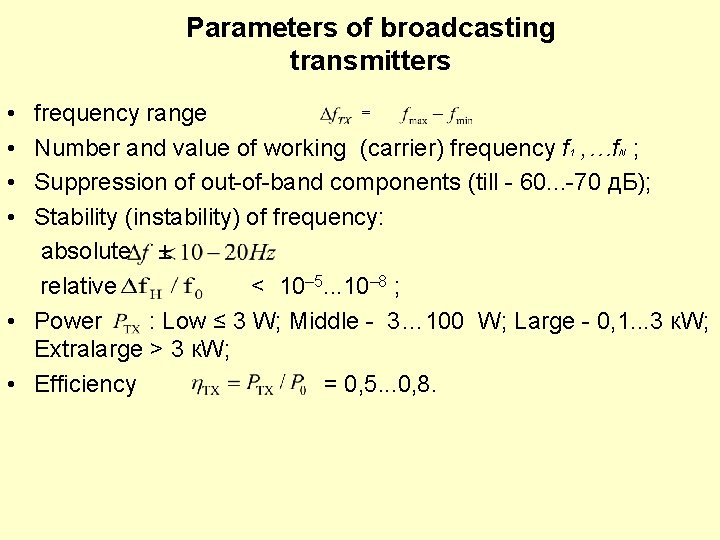
Parameters of broadcasting transmitters • • = frequency range Number and value of working (carrier) frequency f 1 , …f. N ; Suppression of out-of-band components (till - 60. . . -70 д. Б); Stability (instability) of frequency: absolute ± relative < 10– 5. . . 10– 8 ; • Power : Low ≤ 3 W; Middle - 3… 100 W; Large - 0, 1. . . 3 к. W; Extralarge > 3 к. W; • Efficiency = 0, 5. . . 0, 8.
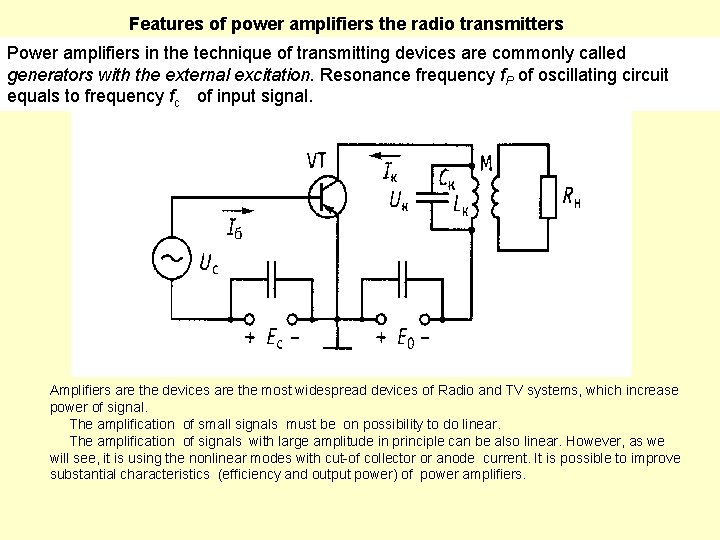
Features of power amplifiers the radio transmitters Power amplifiers in the technique of transmitting devices are commonly called generators with the external excitation. Resonance frequency f. P of oscillating circuit equals to frequency fc of input signal. Amplifiers are the devices are the most widespread devices of Radio and TV systems, which increase power of signal. The amplification of small signals must be on possibility to do linear. The amplification of signals with large amplitude in principle can be also linear. However, as we will see, it is using the nonlinear modes with cut-of collector or anode current. It is possible to improve substantial characteristics (efficiency and output power) of power amplifiers.
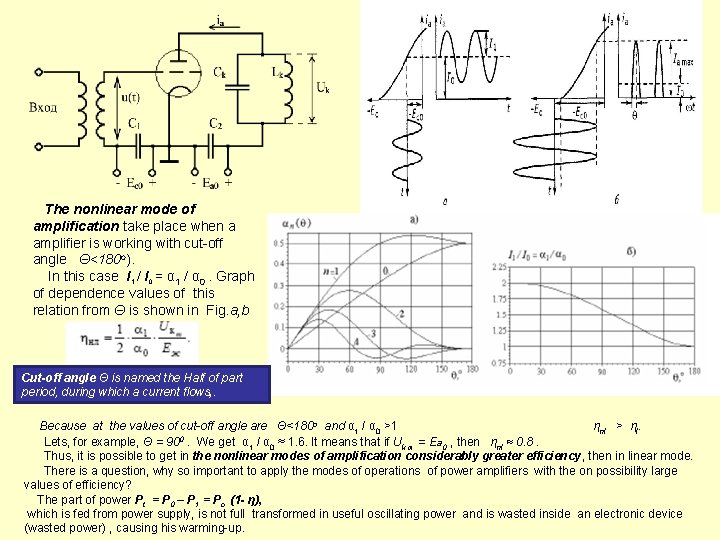
The nonlinear mode of amplification take place when a amplifier is working with cut-off angle Θ<180 o). In this case I 1 / I 0 = α 1 / α 0. Graph of dependence values of this relation from Θ is shown in Fig. a, b Cut-off angle Θ is named the Half of part period, during which a current flows, . Because at the values of cut-off angle are Θ<180 o and α 1 / α 0 >1 ηnl > ηl. 0 Lets, for example, Θ = 90. We get α 1 / α 0 ≈ 1. 6. It means that if Uk m = Ea 0 , then ηnl ≈ 0. 8. Thus, it is possible to get in the nonlinear modes of amplification considerably greater efficiency, then in linear mode. There is a question, why so important to apply the modes of operations of power amplifiers with the on possibility large values of efficiency? The part of power Pt = P 0 – P 1 = Po (1 - η), which is fed from power supply, is not full transformed in useful oscillating power and is wasted inside an electronic device (wasted power) , causing his warming-up.
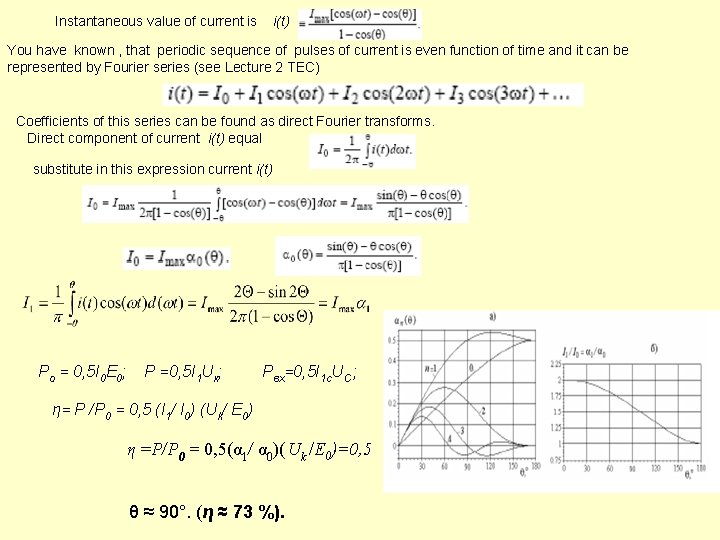
Instantaneous value of current is i(t) You have known , that periodic sequence of pulses of current is even function of time and it can be represented by Fourier series (see Lecture 2 TEC) Coefficients of this series can be found as direct Fourier transforms. Direct component of current i(t) equal substitute in this expression current i(t) Ро = 0, 5 I 0 Е 0; Р =0, 5 I 1 Uк; Pвх=0, 5 I 1 c. UC ; η= Р /P 0 = 0, 5 (I 1/ I 0) (Uk/ E 0) η =P/P 0 = 0, 5(α 1/ α 0)( Uk /E 0)=0, 5 θ ≈ 90°. (η ≈ 73 %).
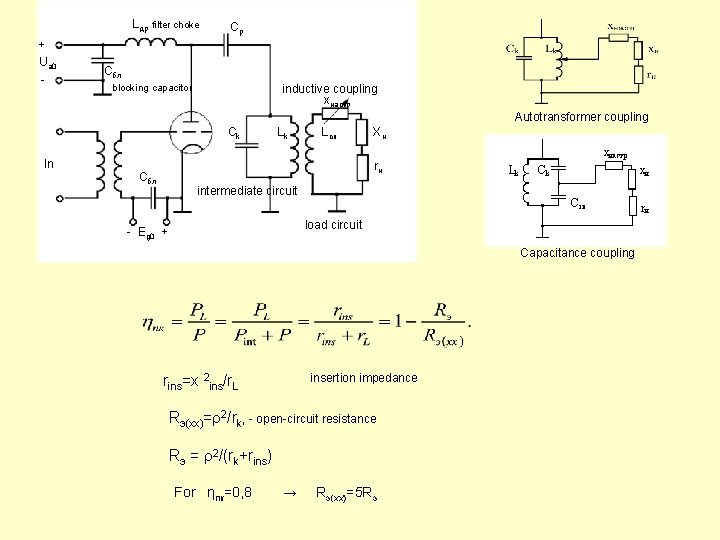
Lдр filter choke + Ua 0 - Cр Cбл blocking capacitor inductive coupling хнастр Autotransformer coupling Ck Lk L св In Хн rн Cбл intermediate circuit хнастр Lk Ck xн Cзв load circuit - Еg 0 + Capacitance coupling. insertion impedance rins=x 2 ins/r. L Rэ(хх)= 2/rk, - open-circuit resistance Rэ = 2/(rk+rins) For ηпк=0, 8 → Rэ(хх)=5 Rэ rн
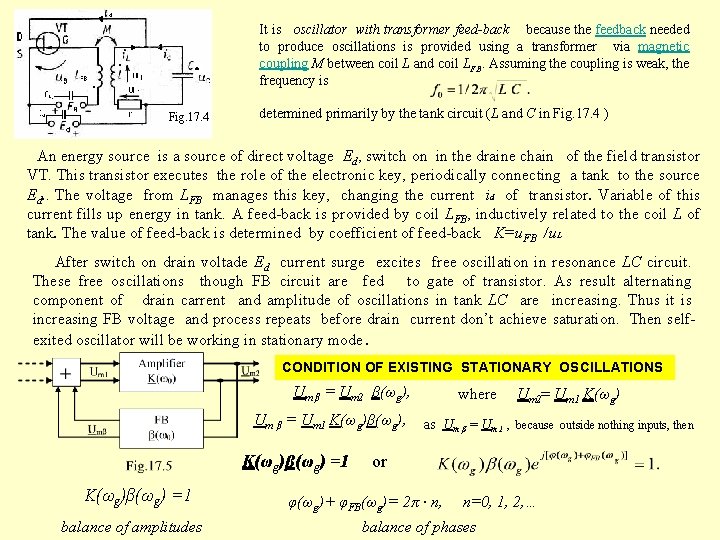
It is oscillator with transformer feed-back because the feedback needed to produce oscillations is provided using a transformer via magnetic coupling M between coil L and coil LFB. Assuming the coupling is weak, the frequency is Fig. 17. 4 determined primarily by the tank circuit (L and C in Fig. 17. 4 ) An energy source is a source of direct voltage Ed, switch on in the draine chain of the field transistor VT. This transistor executes the role of the electronic key, periodically connecting a tank to the source Ed. . The voltage from LFB manages this key, changing the current id of transistor. Variable of this current fills up energy in tank. A feed-back is provided by coil LFB, inductively related to the coil L of tank. The value of feed-back is determined by coefficient of feed-back K=u. FB /u. L After switch on drain voltade Ed current surge excites free oscillation in resonance LC circuit. These free oscillations though FB circuit are fed to gate of transistor. As result alternating component of drain carrent and amplitude of oscillations in tank LC are increasing. Thus it is increasing FB voltage and process repeats before drain current don’t achieve saturation. Then selfexited oscillator will be working in stationary mode. CONDITION OF EXISTING STATIONARY OSCILLATIONS Um β = Um 2 β(ωg), Um β = Um 1 K(ωg)β(ωg), K(ωg)β(ωg) =1 balance of amplitudes where Um 2= Um 1 K(ωg) as Um β = Um 1 , because outside nothing inputs, then or φ(ωg)+ φFB(ωg)= 2π ∙ n, n=0, 1, 2, … balance of phases
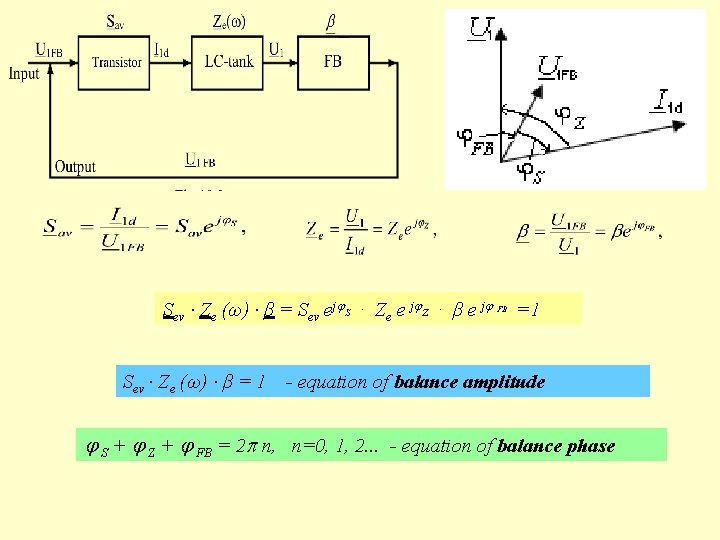
Sev ∙ Ze (ω) ∙ β = Sev ej S ∙ Ze e j Z ∙ β e j Sev ∙ Ze (ω) ∙ β = 1 FB =1 - equation of balance amplitude S + Z + FB = 2 n, n=0, 1, 2. . . - equation of balance phase
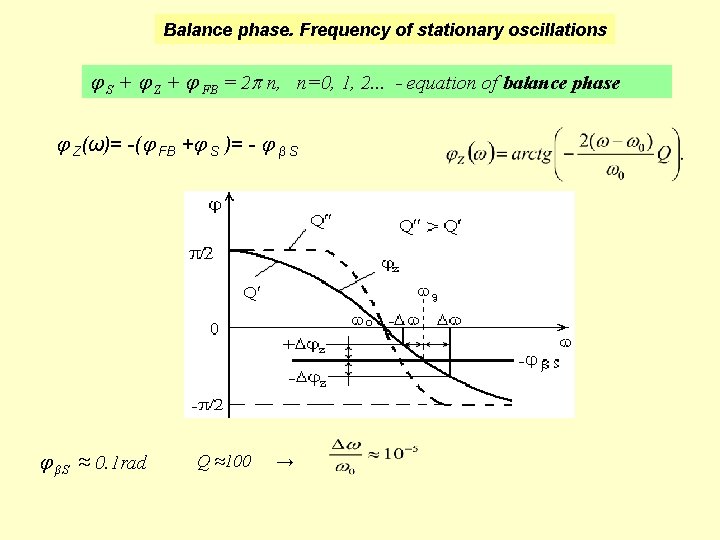
Balance phase. Frequency of stationary oscillations S + Z + FB = 2 n, n=0, 1, 2. . . - equation of balance phase Z(ω)= -( FB + S )= - β S βS ≈ 0. 1 rad Q ≈100 →
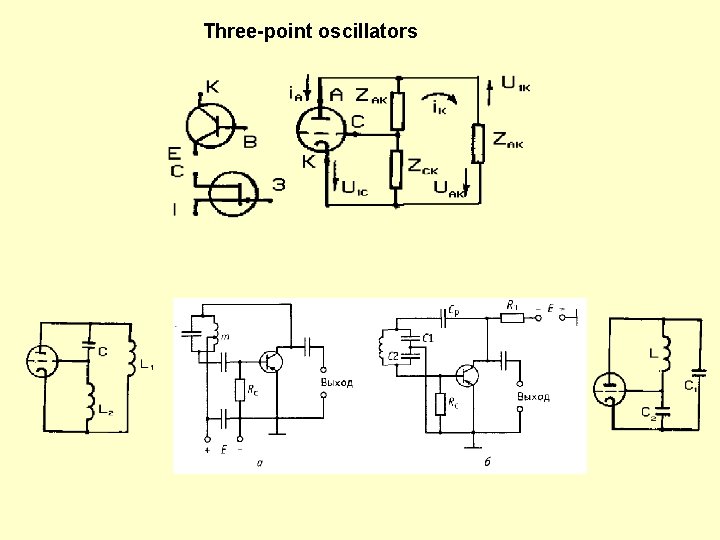
Three-point oscillators
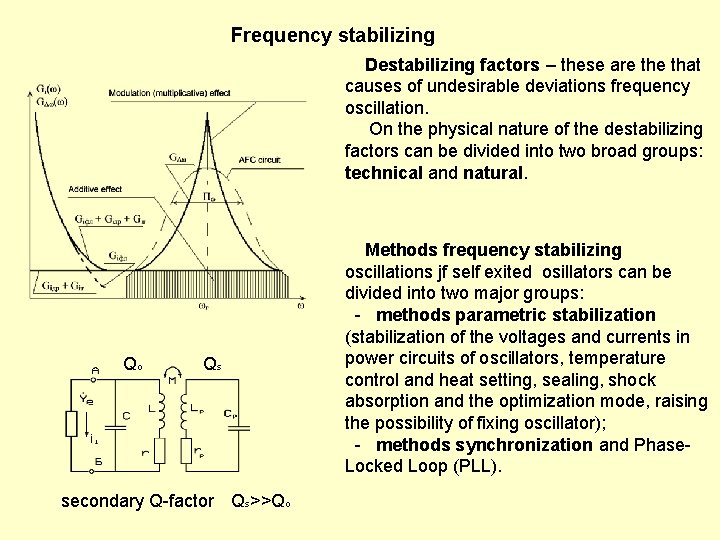
Frequency stabilizing Destabilizing factors – these are that causes of undesirable deviations frequency oscillation. On the physical nature of the destabilizing factors can be divided into two broad groups: technical and natural. Qo Qs secondary Q-factor Qs>>Qo Methods frequency stabilizing oscillations jf self exited osillators can be divided into two major groups: - methods parametric stabilization (stabilization of the voltages and currents in power circuits of oscillators, temperature control and heat setting, sealing, shock absorption and the optimization mode, raising the possibility of fixing oscillator); - methods synchronization and Phase. Locked Loop (PLL).
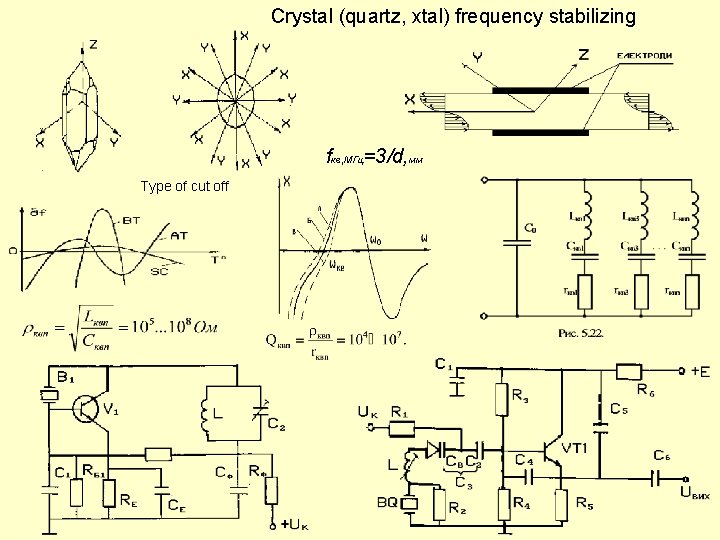
Crystal (quartz, xtal) frequency stabilizing fкв, MГц=3/d, мм Type of cut off
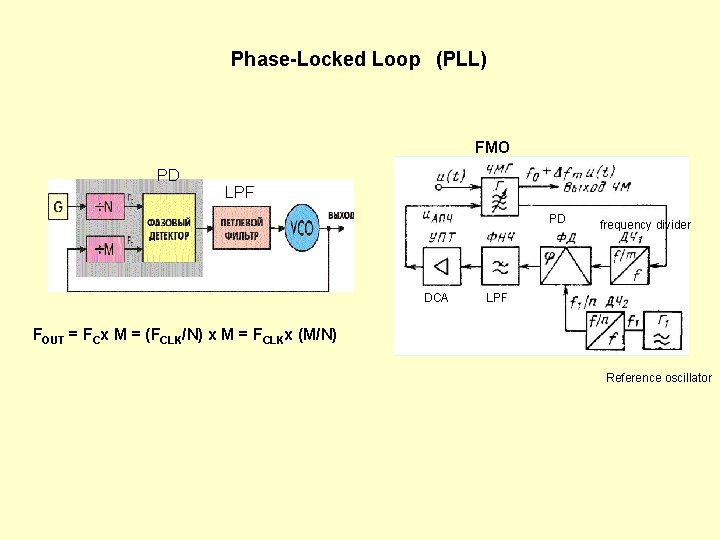
Phase-Locked Loop (PLL) FMO PD LPF PD DCA frequency divider LPF FOUT = FCx M = (FCLK/N) x M = FCLKx (M/N) Reference oscillator
Thank you for attention