
2 PETER Sources 1 Carson D A Moo





- Slides: 42
2 PETER
Sources: 1. Carson, D. A. & Moo, Douglas J. , An Introduction to the New Testament, 2 d Edition, (Zondervan, Grand Rapids 1992, 2005) 2. Gangel, Kenneth, 2 Peter, Bible Knowledge Commentary, Victor Books, 1983. 3. Guthrie, Donald, New Testament Introduction. 4 th Ed. , Leister, England: Apollos: Downers Grove, Ill. , Inter. Varsity Press, 1990. 4. Witherington, Ben. , Letters and Homilies for Hellenized Christians, Vol. 2: Inter. Varsity Press,
THEME: BEWARE OF FALSE TEACHERS
ANY STUDY OF 2 PETER MUST DEAL WITH THE FACT THAT ITS AUTHENTICITY IS GENERALLY DENIED BY MODERN SCHOLARSHIP
PETER TESTIFIED THAT HE WROTE IT (1: 1) HE REFERENCED THE TRANSFIGURATION (1: 17 -18) SECOND LETTER (3: 1) BUT…
KASEMANN: 2 PETER IS FROM BEGINNING TO END A DOCUMENT EXPRESSING AN EARLY CATHOLIC VIEWPOINT AND IS PERHAPS THE MOST DUBIOUS WRITING IN THE CANON
KUMMEL: THIS LETTER CANNOT HAVE BEEN WRITTEN BY PETER
2 PETER I. AUTHOR: PETER CHALLENGES: STYLISTIC 1. The Greek in 2 Peter is too different from 1 Peter to be the same author
2 PETER I. AUTHOR: PETER CHALLENGES: STYLISTIC • There are 100 words common to both epistles. There are 599 words in 2 Peter that don’t appear in 1 Peter. • The grammar in 2 Peter is quite different from 1 Peter.
2 PETER I. AUTHOR: PETER ANSWER: 1. Peter could have written 2 Peter personally but used Silas as his secretary (amanuensis) to write 1 Peter. That would explain all stylistic
2 PETER I. AUTHOR: PETER ANSWER: 1. OR, Perhaps the different occasion for the letter led to different styles and vocabulary.
2 PETER I. AUTHOR: PETER CHALLENGE: HISTORICAL 2. The false teaching combated in 2 Peter is 2 d century Gnosticism.
2 PETER I. AUTHOR: PETER ANSWER: 2. 2 Peter dos not identify the specific heresy taught, so there’s no proof that Gnosticism is the heresy being combated in 2 Peter
2 PETER I. AUTHOR: PETER CHALLENGE: HISTORICAL 3. 2 Peter 3: 15 -16 calls Paul’s letters ‘scripture’. Since Paul’s letters weren’t considered canonical until much later, Peter could not have written this letter.
2 PETER I. AUTHOR: PETER ANSWER: 3. We don’t know when Paul’s letters were first considered canonical. Some may have been considered canonical during Peter and Paul’s lifetime. But we do know that the authors themselves considered their words to be equal with scripture sometimes. (e. g. 1 Cor. 5: 3; 2 Cor: 10: 11). They considered their words inspired (1 Pet. 1: 10 -12); They expected their letters to be read in churches (Col. 4: 16)
2 PETER I. AUTHOR: PETER CHALLENGE: HISTORICAL 4. Reference to the death of “our fathers”, the importance of apostolic tradition (3: 2, 3: 16) and the thought the second coming would be delayed for a long time (3: 8) betray a late writing, past the time of
2 PETER I. AUTHOR: PETER ANSWER: 4. ”Our fathers” could and probably does, refer to the ancestors of the Jewish nation, i. e. , the patriarchs, not the apostles. Peter’s reference to ‘Parousia’ is in sync with the rest of the NT that says that we don’t know when it will be, but we must be ready.
2 PETER I. AUTHOR: PETER CHALLENGE: EXTERNAL EVIDENCE 5. 2 Peter is not strongly attested in the early church a. No church father before Origen (3 d C) quotes it. b. Eusebius (4 th C) expressed doubts about authenticity c. It is missing from the Muratorian Canon, (the oldest known list of most of the books of the NT. ) (180 -200 AD)
2 PETER I. AUTHOR: PETER ANSWER: 5. 2 Peter is not strongly attested in the early church. a. Several 2 d century writers seem to be influenced by the letter. b. It may not be mentioned in the Muratorian canon because we have only a fragment of it. The Muratorian Canon also excludes 1 Peter, James and Hebrews and includes The Apocalypse of Peter. c. Eusebius noted that he and others had doubts about the letter, but he listed it among the books he had doubts about, rather than the list of books that he deemed to be non-canonical, such as known Petrine forgeries. Because of the many Petrine forgeries in existence at the time, the church was being careful about citing 2 Peter
2 PETER I. AUTHOR: PETER • Methodius of Olympus, martyred in the Diocletian persecution, (3 d C) quoted 2 Peter 3: 8 to support his argument in De Resurrectione. He definitely referred to the Apostle Peter as the author. • Firmilian, a bishop of Caesarea in Cappadocia (3 d C) , referred to the Apostle Peter’s denunciation of false teachers. First Peter does not refer to false teachers, but 2 Peter devotes an entire chapter to the subject. Thus Firmilian may have been ascribing Petrine authorship to 2 Peter. • Finally, Origen, though pointing out doubt of others, seems from the content and frequent references in his other writings to have accepted 2 Peter as authoritative.
2 PETER I. AUTHOR: PETER The fact that 2 Peter was eventually accepted and that the Apocalypse of Peter, the Gospel of Peter, and the Acts of Peter were rejected as pseudonymous books clearly indicates that pseudonymity was not tolerated. • From Kenneth Gangel, Bible Knowledge Commentary, 2 Peter
2 PETER I. AUTHOR: PETER CHALLENGE: HISTORICAL 6. The reference to Peter’s imminent death (1: 12 -15) shows that the letter is a testament to him, rather than written by him.
2 PETER I. AUTHOR: PETER ANSWER: 6. The fact that the letter was accepted into the canon proves that the early Christians were convinced that Peter wrote it.
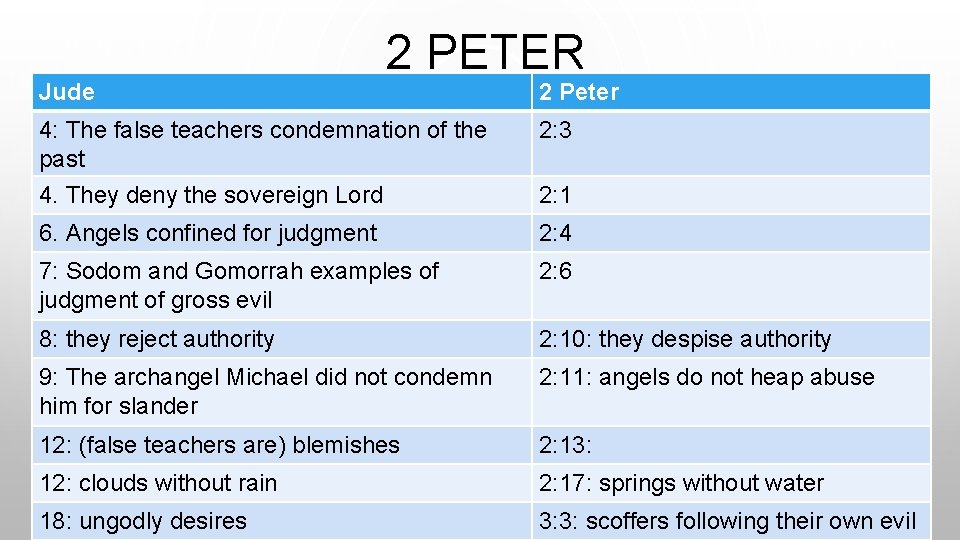
2 PETER I. AUTHOR: PETER CHALLENGE: RELATIONSHIP TO JUDE 7. 2 Peter relied on Jude which was written after Peter’s death.
Jude 2 PETER 2 Peter 4: The false teachers condemnation of the past 4. They deny the sovereign Lord 2: 3 6. Angels confined for judgment 2: 4 7: Sodom and Gomorrah examples of judgment of gross evil 2: 6 8: they reject authority 2: 10: they despise authority 9: The archangel Michael did not condemn him for slander 2: 11: angels do not heap abuse 12: (false teachers are) blemishes 2: 13: 12: clouds without rain 2: 17: springs without water 18: ungodly desires 3: 3: scoffers following their own evil 2: 1
2 PETER I. AUTHOR: PETER ANSWER: 7. It is not certain that Peter relied on Jude (although it is probable). It is also not certain that Jude wrote after Peter’s death. A good case can be made that Jude wrote before Peter’s death.
2 PETER I. AUTHOR: PETER ANSWER: 7. Why would a pseudepigraphist borrow from a lesser known source? That would be unparalleled among pseudepigraphies of the 1 st C. If Peter did borrow from Jude, that would be evidence of authenticity rather than
2 PETER I. AUTHOR: PETER Guthrie: No advocate of a pseudonymous origin for 2 Peter has been able to give a wholly satisfactory account for the motive behind it. This would weigh in favor of Peter’s authorship. The main problem is why there was such a delay in its reception as canonical. This may be explained by the fact that the letter had been sent to a local audience, which may explain why the letter was not circulated among more
2 PETER I. AUTHOR: PETER Guthrie: The main difficulties with the hypothesis the Peter did not write the letter are the lack of adequate motives of a forger, and that it was ultimately accepted. That it ultimately became accepted universally must have been because its claim to apostolic authorship and
2 PETER I. AUTHOR: PETER Gangel: Though 2 Peter is the least attested book in the New Testament, its external support far surpasses that of any excluded book. The absence of early church tradition supporting 2 Peter certainly could have been due to the letter’s brevity and the lack of communication among Christians during times of heavy persecution. Consequently the silence of the second century and the caution of the third century posed no insurmountable problems for the careful scholarship of the canonical councils of the fourth
2 PETER DATE: If Peter wrote the letter, it had to have been about 65 -67 A. D. , soon before his death at the hand of Nero. Peter said, “The time of my departure was near” (1: 13 -14). Nero died in 68 A. D.
2 PETER PROVENANCE: ROME If Peter wrote shortly before his death, he must have been in the place where he was killed, which was Rome. (cf. “Babylon” 1 Peter 5: 12)
2 PETER DESTINATION AND AUDIENCE 1: 1: “To those through the righteousness of our God and savior Jesus Christ have received a faith as precious as ours. ” 3: 1 “This is now my second letter to you. ” If Peter wrote both 1 and 2 Peter, then the audience is the same as his first letter: mainly gentiles, but some Jews, in the north central part of Asia Minor. (aliens residing in Pontus, Galatia, Cappadocia, Asia and
2 PETER PURPOSE: 1. To warn about false teachers 2. To ground believers in the truth 3. To teach about end times
2 PETER FALSE TEACHINGS 1. Peter’s mention that “no prophecy of Scripture is a matter of one’s by private interpretation” (1: 20 -21) suggest that he was addressing
2 PETER FALSE TEACHINGS 2. They (mockers) “deliberately ignore this fact, that by the word of God the heavens existed long ago. ” (3: 5)
2 PETER FALSE TEACHINGS 3. A denial of the Parousia (coming) and a mockery of those who looked forward to it. (3: 3 ff)
2 PETER’S UNIQUE CONTRIBUTION TO THE NT 1. 2 Peter teaches us of the seriousness of deviating from faith in either theology or morals
2 PETER’S UNIQUE CONTRIBUTION TO THE NT 2. 2 Peter helps us understand biblical eschatology by expanding on the “Day of the Lord”. The world will be destroyed by fire and to be replaced by a new heaven and
2 PETER’S UNIQUE CONTRIBUTION TO THE NT 3. 2 Peter reminds us of the importance of remembering true teaching so that we can combat false teaching.
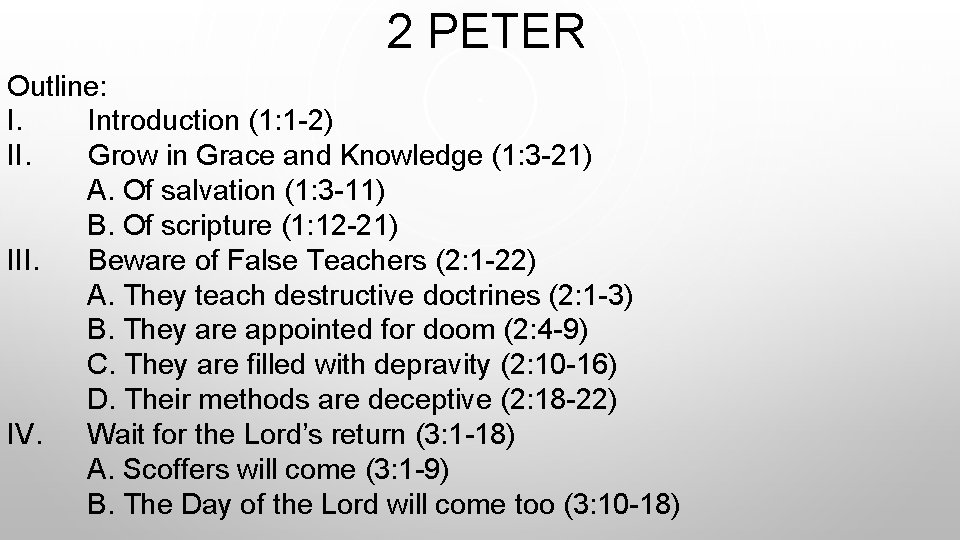
2 PETER Outline: I. Introduction (1: 1 -2) II. Grow in Grace and Knowledge (1: 3 -21) A. Of salvation (1: 3 -11) B. Of scripture (1: 12 -21) III. Beware of False Teachers (2: 1 -22) A. They teach destructive doctrines (2: 1 -3) B. They are appointed for doom (2: 4 -9) C. They are filled with depravity (2: 10 -16) D. Their methods are deceptive (2: 18 -22) IV. Wait for the Lord’s return (3: 1 -18) A. Scoffers will come (3: 1 -9) B. The Day of the Lord will come too (3: 10 -18)
2 PETER MAIN LESSON OF THE BOOK: The way to combat false teaching is by knowing the truth. Knowledge of right doctrine is the best defense against heresy.