
2 November 28 2020 HOW TO DEVELOP INTERNSHIPS
2 November 28, 2020 HOW TO DEVELOP INTERNSHIPS AND PAID WORK EXPERIENCE (PWE) OPPORTUNITIES Presented By: H-1 B Ready to Work Grants EMPLOYMENT AND TRAINING ADMINISTRATION UNITED STATES DEPARTMENT OF LABOR
3 Enter your location in the Chat window!
4 Polling Question # 1 • Let’s get to know who is on the call today. Using the poll, select the role that you play in your H-1 B RTW grant. • For this grant initiative I am the: q q q Authorized Representative Program Director/Manager IT/Data Manager or staff Training Partner Employer Partner Service Provider
5 Workforce Analyst ETA Division of Strategic Investments Washington DC
6 RTW Technical Assistance Coach TAD Grants Subject Matter Expert High Impact Partners, Inc.
7 ü An introduction to, and overview of paid work experience and internships as a learning vehicle ü Explain the planning process for establishing an internship opportunity for a student ü Choosing and recruiting employer internship partners and managing the relationship
8 Ø Introduction to Work-Based Learning Ø Critical Values of Internships Ø Internship Program Design Model Ø Choosing Recruiting, Managing Employer Partners ØQ & A
9 Ø Learning while working may be oldest form skill-based education Ø Began in the U. S. in the early 1900 s at the University of Cincinnati (COOP) Ø Overall term for this type of learning is work-based learning (WBL) though many types of work-based learning are used Ø Confusing? Yes.
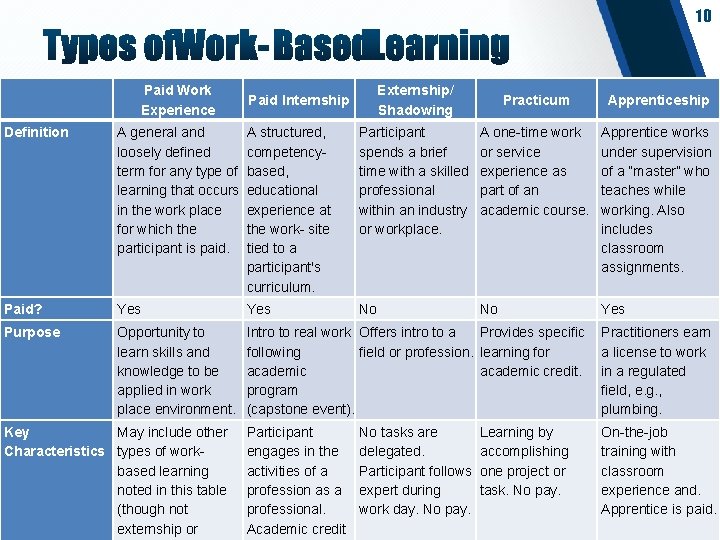
10 Paid Work Experience Externship/ Shadowing Paid Internship Practicum Apprenticeship Definition A general and loosely defined term for any type of learning that occurs in the work place for which the participant is paid. A structured, competencybased, educational experience at the work- site tied to a participant's curriculum. Participant spends a brief time with a skilled professional within an industry or workplace. A one-time work or service experience as part of an academic course. Apprentice works under supervision of a “master” who teaches while working. Also includes classroom assignments. Paid? Yes No No Yes Purpose Opportunity to learn skills and knowledge to be applied in work place environment. Intro to real work Offers intro to a Provides specific following field or profession. learning for academic credit. program (capstone event). Practitioners earn a license to work in a regulated field, e. g. , plumbing. Participant engages in the activities of a profession as a professional. Academic credit On-the-job training with classroom experience and. Apprentice is paid. Key May include other Characteristics types of workbased learning noted in this table (though not externship or No tasks are delegated. Participant follows expert during work day. No pay. Learning by accomplishing one project or task. No pay.
11 Ø Internship: oversight and monitoring is expected; thorough learning plan and; occurs with more intensity with an internship. Ø Paid work experience: may well occur with little or no “learning” oversight and simply be experience in a work environment as more of an “enlightening” event rather than structured learning.
12 Ø H-1 B Ready to Work Grants Guidelines for Paid Work Experience and Internships • There is wide flexibility on the structure and composition of individual internship experiences, and grantees should ensure their activities align with the Funding Restrictions identified in the RTW SGA and their individual Statement of Work (SOW).
13 Ø RTW SGA does not define the details or structure of internship but notes that each should: • Have learning goals and should reflect on what was/is included in the grant funded learning experience • Be for a defined period of time generally limited in duration • Be flexible to support work-place and classroom learning • Prepare the individual for employment opportunities • Be a paid experience
14 VALUE TO STUDENTS VALUE TO EMPLOYER PARTNERS VALUE TO RTW PROGRAM
15 Ø The internship is considered the “bridge” between training and the beginning of a profession Ø Enable participants to experience the realities of various careers Ø Provide a prime opportunity to secure a job. Sixty-one percent of participants who had internships have job offers by the end of their senior year. Ø Are a good opportunity to earn money
16 Ø Enhance participant resumes and subsequent interviewing opportunities Ø Gain confidence in their skills and preparation Ø Develop the soft skills Ø Earn college credit while being treated like a real employee
17 Ø Access to a pool of skilled job candidates who possess the specific skills, certificates, and credentials required Ø Input on designing training that specifically meets the employer’s needs Ø Ability to assure that the right credentials and certifications are included in the program to meet their industry standards
18 Ø Understand the reality of work, changing work expectations, and curriculum design (relevancy) Ø Connect to a powerful partner group to support the program Ø Represent and speak for the value and success of your program (PR) Ø Strongly enhance student employment placements
19 Ø The objective is to prepare: • The training organization; • The targeted employer(s), and; • The student. Ø Full understanding by each partner of all expectations, goals, timetable
20 Ø Let’s switch gears and see who is familiar with the Internship Program Design Model. Ø Do you have any previous experience with the Internship Program Design Model? q Yes q No q Somewhat

21
22 Ø Requires a staff professional Ø Manage all the internship activities: planning and arrangements, participant preparation, employer preparation and communications among all parties Ø Has a grasp of the legalities of internships, of curriculum design and approval and knows his/her way around the school’s processes
23 Ø Choose individuals that are serious about success and want to fit into an employer’s system Ø A combination of selection processes including instructor recommendations; application process to learn why the participant seeks an internship, and interviews (both school personnel and a representative of the employer)
24 Ø A structured and planned learning experience that: assures employer involvement/engagement for a monitored or supervised work or service experience Ø Fits comfortably and safely within the employer’s business model, processes and procedures Ø Does not necessarily incur costs or disruptions of normal business Ø Focuses on developing and completing an individual’s career education
25 Ø Schedule Ø Prepare employer: supervision, legalities, and expectations Ø Plan training curriculum and learning experiences with employer
26 Ø Academic plan: both a calendar and schedule and lesson plans as a guide for the experience • it includes the learning objectives, and; • description of the academic, occupational, and employability skills with evaluation Ø Introduction to the internship process and the work environment
27 Ø Learn if the participant is a good fit for the job or if adjustments need to quickly be made Ø If the “fit” is not happening, then the coordinator, employee staff and the participant should meet to discuss the challenges and make changes
28 Ø Should be evaluated and documented regularly not only at the end Ø Employ a standardized evaluation form Ø Employer supervisor, in cooperation with the appropriate school faculty or staff member, should write a final evaluation Ø Should be no surprises
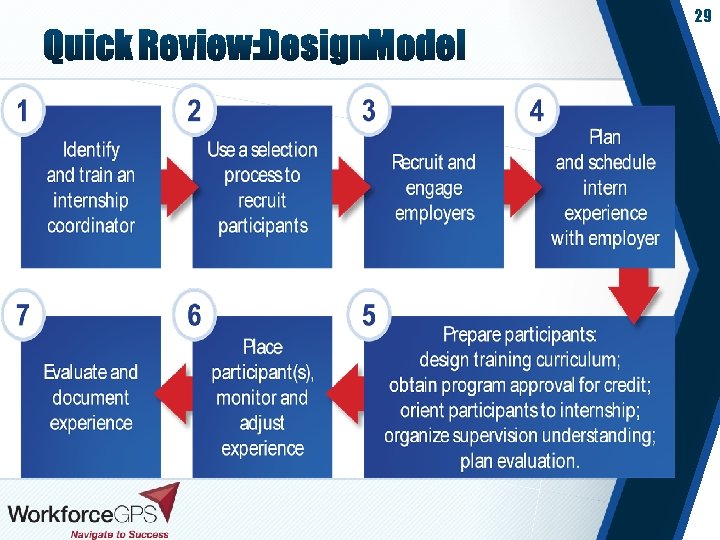
29
30 Ø Defined and described work-based learning Ø Reviewed the value of internships to all partners Ø Investigated a common internship program design model Ø Let’s chat about employers…
31 Ø The key of a successful internship lies with a well-integrated relationship between the employer’s staff who oversee the intern and the educational institution’s professionals.
32 Ø The key: • Employers always appear more comfortable making a commitment if they know specifically what is expected from them. It is important for them to clearly understand how their roles or contributions impact the overall success of the program.
33 Ø Understanding employers as partners: • Highest priority for each employer is meeting its own business’s immediate demands. Hosting an intern will always be subject to actions taken to meet those needs; • Business environments move more quickly than educational organizations and decision -making in business is faster with little time lost. You will need to step up the pace.

34 Ø Understanding employers as partners, continued. • Patience and communication • Involve employers early: will smooth the planning and the placement • Expect changes and adapt • Know about the employer’s work environment, and training processes
35 Ø Recruiting employers: • The requirement: “train and place individuals into jobs within occupations and industries for which employers are using H-1 B visas to hire foreign workers because no American workers can meet the skills required…”
36 Ø Recruiting employers: • Review team’s general knowledge • Use labor market information (real-time) • Interview executives from local business organizations • Recruiting employers: – The requirement: “train and place individuals into jobs within occupations and industries for which employers are using H-1 B visas to hire foreign workers because no American workers can meet the skills required…”
37 Ø Beginning the relationship: • Arrange and prepare for first meeting • Manage the meeting toward a successful outcome (see agenda in handbook) • Get a commitment over time • Create a written agreement (again, see handbook for models)
38 Ø Manage the relationship: 1. Early engagement! Identify and engage your employers early in planning an internship placement. That early connection makes certain your training programs align with business needs and makes the employer feel valued.
39 Ø Manage the relationship 2. “Hardwire” employers to your program by involving them in program decisions; work side-by-side with them; visit their firms; respond to their ideas. Be inclusive! 3. Meet individually with each employer and determine what each hopes to accomplish as an intern team member. Also, share and discuss program management and outcomes.
40 Ø Manage the relationship 4. Time management is especially critical. Schedule meetings far in advance and maintain a reliable and consistent calendar. Send an agenda. Remember that changes in meeting times, places or dates on short notice will assure that employers will miss; 5. Be sure to meet deadlines and complete actions that are expected by employer partners – and are important to them. Be predictable and reliable! Keep your promises
41 Ø Manage the relationship 6. Build a routine and reliable communication system that involves more than a single vehicle; always send communications on roughly the same dates and be sure that the communications are clear 7. On a routine basis, have the chair of your career pathway team phone each employer partner to chat, provide updates, complements, and to seek opinions; Return all phone calls and email inquiries. Listen, listen, and listen!
42 Ø Manage the relationship 8. Provide multiple thank you messages to each employer partner. Note their individual contributions and the importance that it had on a specific outcome. 9. Invite employers to regular celebrations 10. On a routine basis, use the team’s outreach communication system (bulletins, news releases, blogs, etc. ) to highlight the contributions of employer

43 Enter your location in the Chat window!
44 Creating and Conducting Successful Work-based Learning Experiences for Participants in H-1 B RTW Partnership Grant Programs Download Now! https: //h 1 breadytoworkforcegps. or g/resources/2016/04/12/14/51/RTW_Int ernship_and_PWE_Toolkit
45 Workforce. GPS site for Ready to Work Ø https: //h 1 breadytoworkforcegps. org/ Have you joined our Linked. In page yet? Ø https: //www. linkedin. com/groups/H 1 B-Ready-Work-RTW-7018078/about Ø Small Group Coaching: Social Media and Internet Marketing: Tools and Strategies for Employer and Participant Recruitment Ø Peer to Peer: Participant Outreach and Recruitment Strategies: Best Practices from the Field. Ø LTU SME Webinar Series: Employer Engagement for IT Industries
46
47 Thank you for participating in the H-1 B RTW: How to Develop Paid Internship and Work Experience (PWE) Opportunities Webinar! • Please take a minute to complete this brief feedback tool regarding the Webinar on today May 9, 2016. • The input you provide will help us better the delivery of future webinars and create technical assistance meaningful for your work.

48
- Slides: 47