
2 nd week thethe 2 nd week formation

- Slides: 12
2 nd week thethe 2 nd week
formation the of the bilaminar 2 nd week germ disc
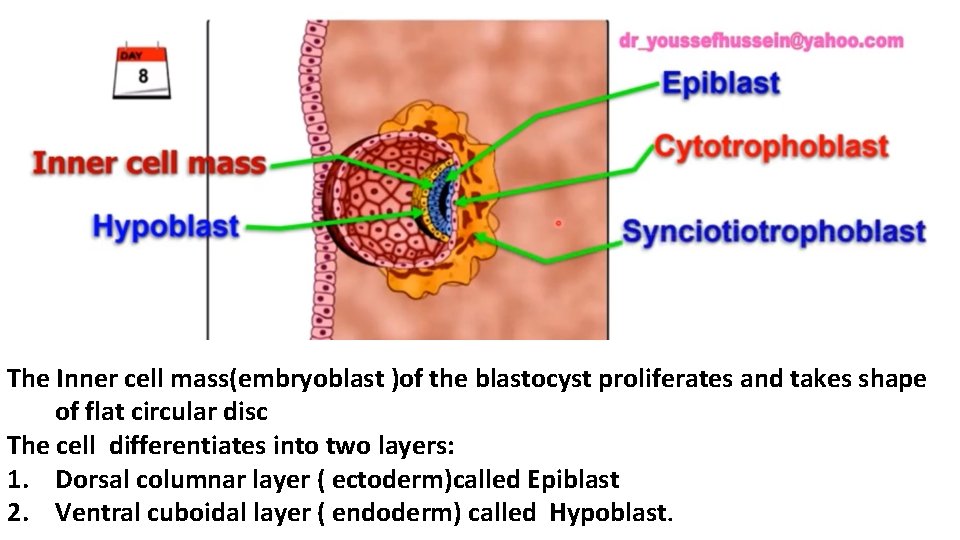
The Inner cell mass(embryoblast )of the blastocyst proliferates and takes shape of flat circular disc The cell differentiates into two layers: 1. Dorsal columnar layer ( ectoderm)called Epiblast 2. Ventral cuboidal layer ( endoderm) called Hypoblast.
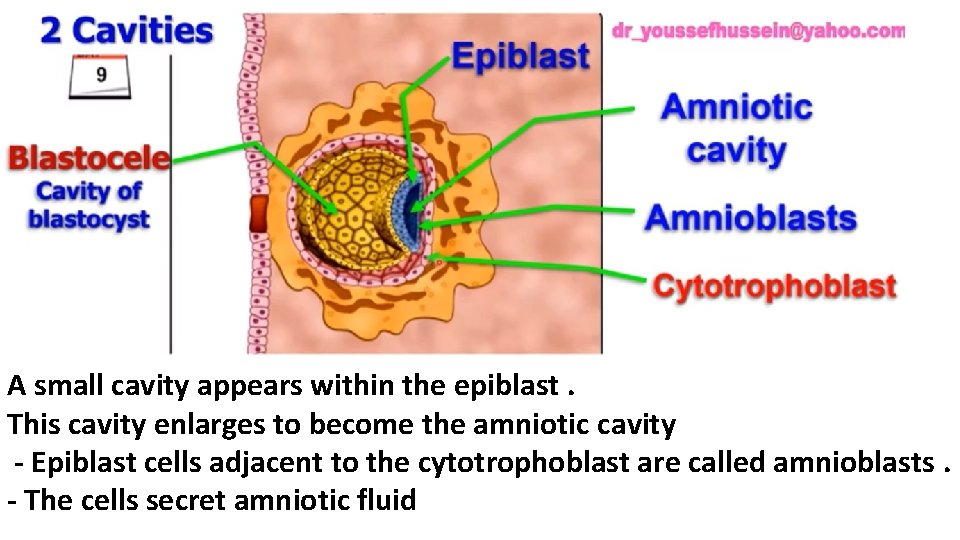
A small cavity appears within the epiblast. This cavity enlarges to become the amniotic cavity - Epiblast cells adjacent to the cytotrophoblast are called amnioblasts. - The cells secret amniotic fluid
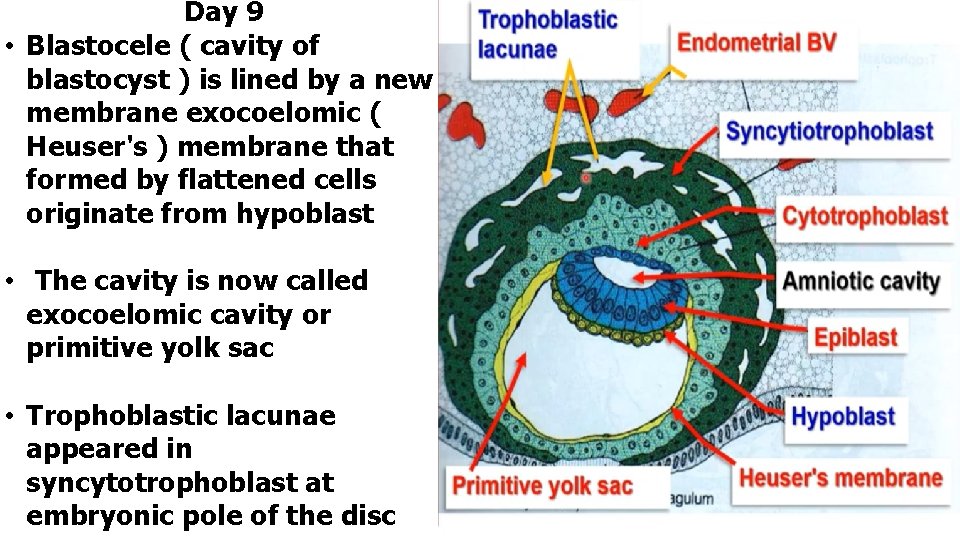
Day 9 • Blastocele ( cavity of blastocyst ) is lined by a new membrane exocoelomic ( Heuser's ) membrane that formed by flattened cells originate from hypoblast • The cavity is now called exocoelomic cavity or primitive yolk sac • Trophoblastic lacunae appeared in syncytotrophoblast at embryonic pole of the disc
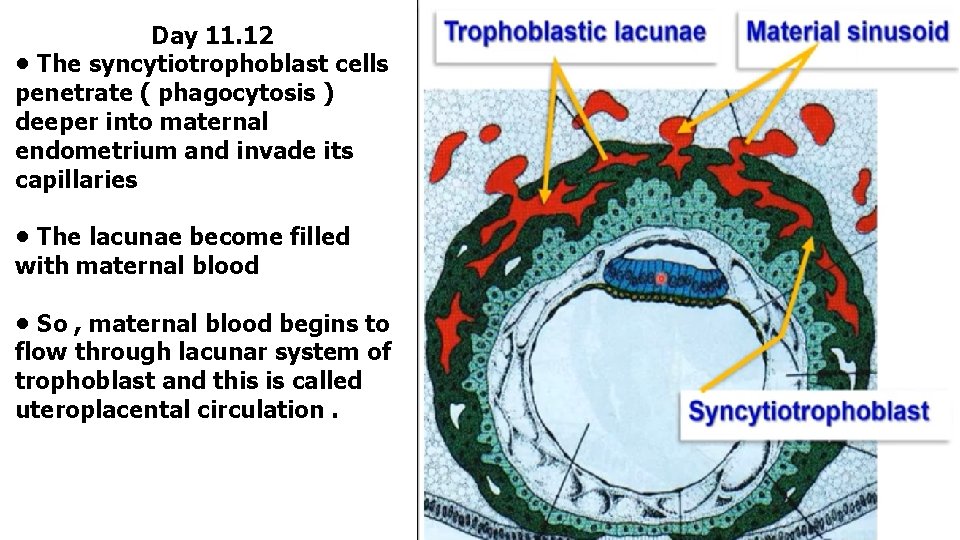
Day 11. 12 • The syncytiotrophoblast cells penetrate ( phagocytosis ) deeper into maternal endometrium and invade its capillaries • The lacunae become filled with maternal blood • So , maternal blood begins to flow through lacunar system of trophoblast and this is called uteroplacental circulation.
formationthe of 2 nd the chorionic vesicle week
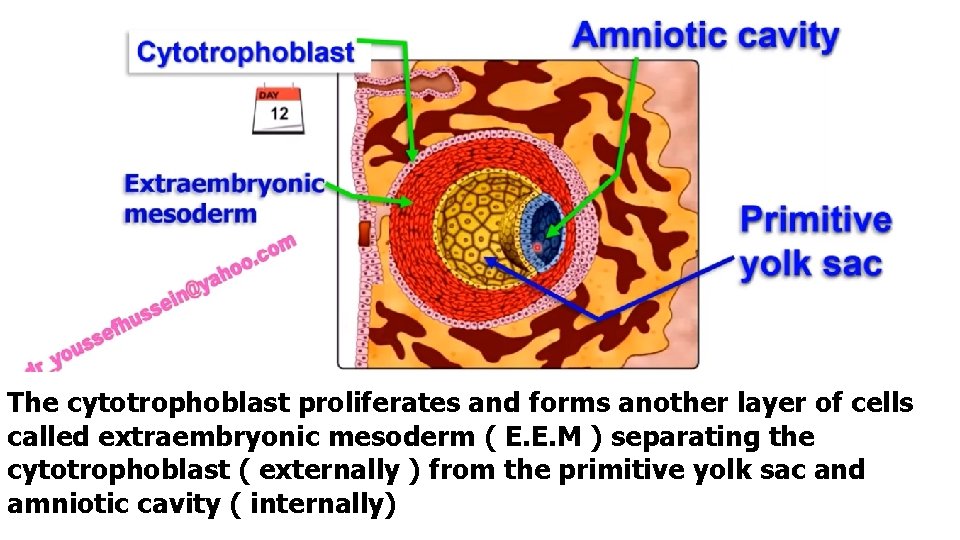
The cytotrophoblast proliferates and forms another layer of cells called extraembryonic mesoderm ( E. E. M ) separating the cytotrophoblast ( externally ) from the primitive yolk sac and amniotic cavity ( internally)
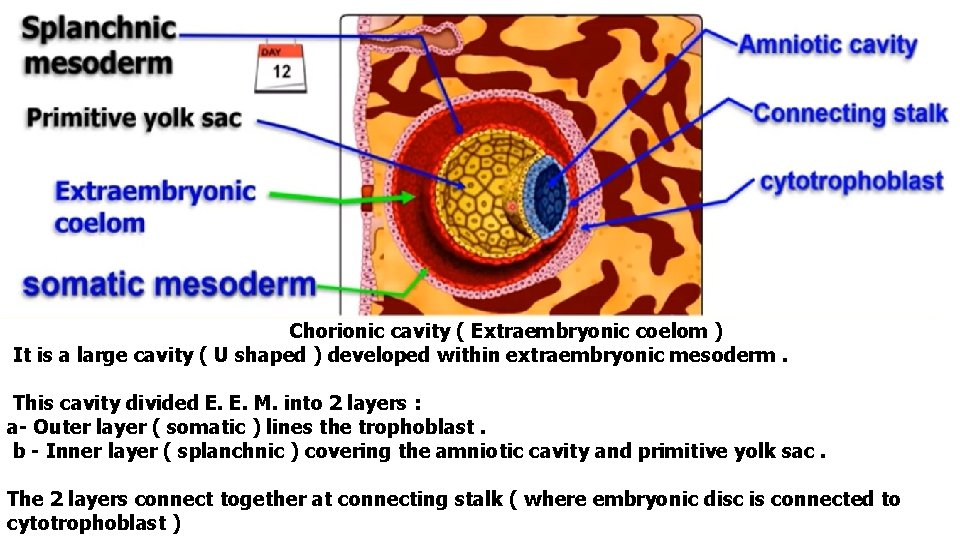
Chorionic cavity ( Extraembryonic coelom ) It is a large cavity ( U shaped ) developed within extraembryonic mesoderm. This cavity divided E. E. M. into 2 layers : a- Outer layer ( somatic ) lines the trophoblast. b - Inner layer ( splanchnic ) covering the amniotic cavity and primitive yolk sac. The 2 layers connect together at connecting stalk ( where embryonic disc is connected to cytotrophoblast )
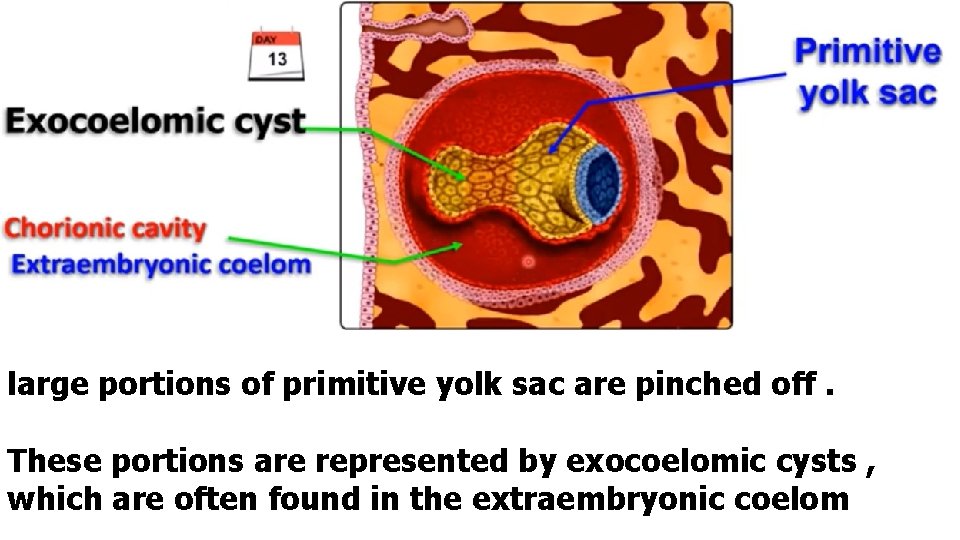
large portions of primitive yolk sac are pinched off. These portions are represented by exocoelomic cysts , which are often found in the extraembryonic coelom
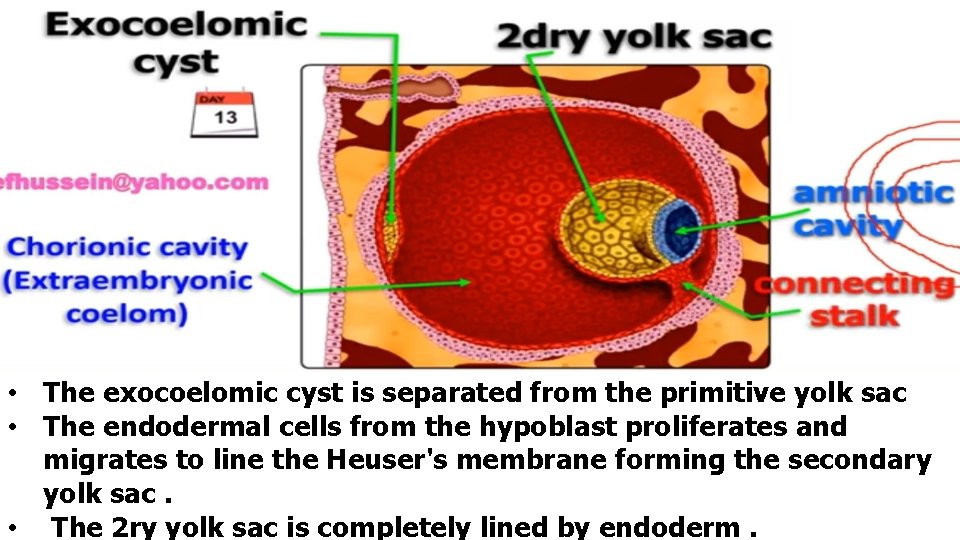
• The exocoelomic cyst is separated from the primitive yolk sac • The endodermal cells from the hypoblast proliferates and migrates to line the Heuser's membrane forming the secondary yolk sac. • The 2 ry yolk sac is completely lined by endoderm.
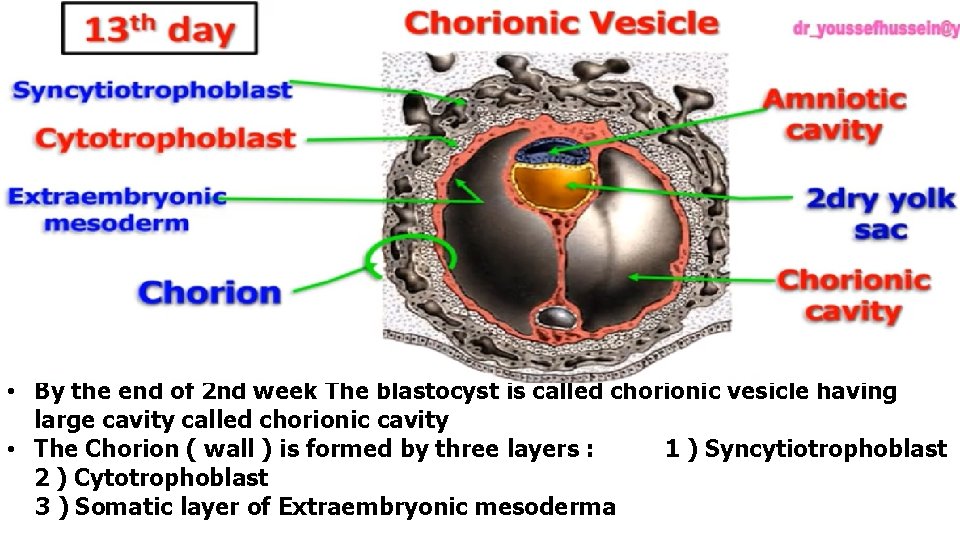
• By the end of 2 nd week The blastocyst is called chorionic vesicle having large cavity called chorionic cavity • The Chorion ( wall ) is formed by three layers : 1 ) Syncytiotrophoblast 2 ) Cytotrophoblast 3 ) Somatic layer of Extraembryonic mesoderma