
2 nd Nose You can use either hand





- Slides: 70
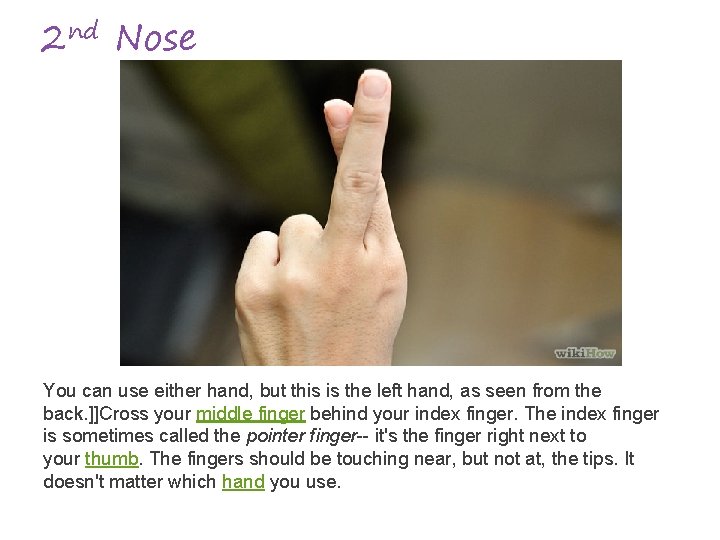
2 nd Nose You can use either hand, but this is the left hand, as seen from the back. ]]Cross your middle finger behind your index finger. The index finger is sometimes called the pointer finger-- it's the finger right next to your thumb. The fingers should be touching near, but not at, the tips. It doesn't matter which hand you use.
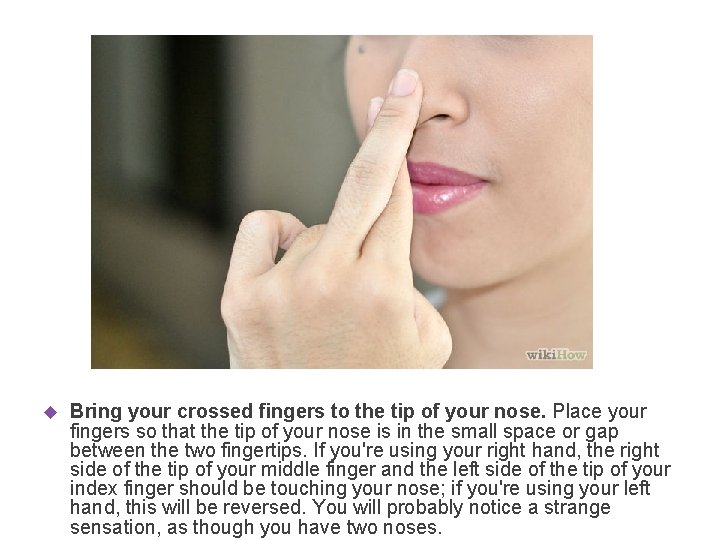
Bring your crossed fingers to the tip of your nose. Place your fingers so that the tip of your nose is in the small space or gap between the two fingertips. If you're using your right hand, the right side of the tip of your middle finger and the left side of the tip of your index finger should be touching your nose; if you're using your left hand, this will be reversed. You will probably notice a strange sensation, as though you have two noses.
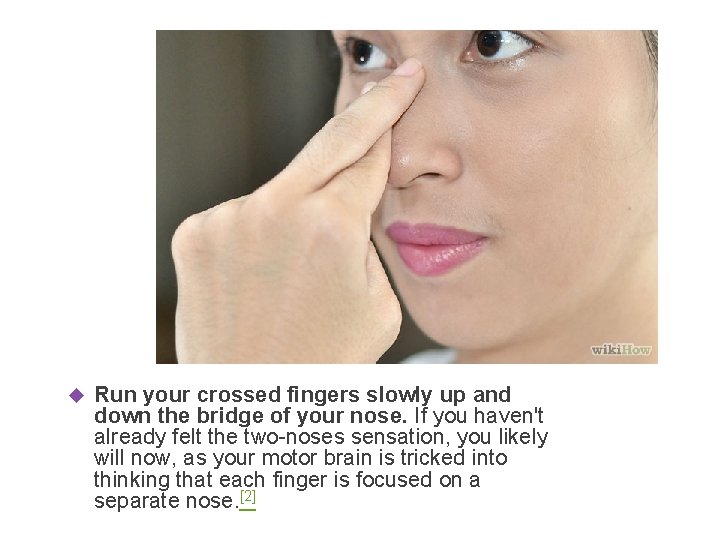
Run your crossed fingers slowly up and down the bridge of your nose. If you haven't already felt the two-noses sensation, you likely will now, as your motor brain is tricked into thinking that each finger is focused on a separate nose. [2]
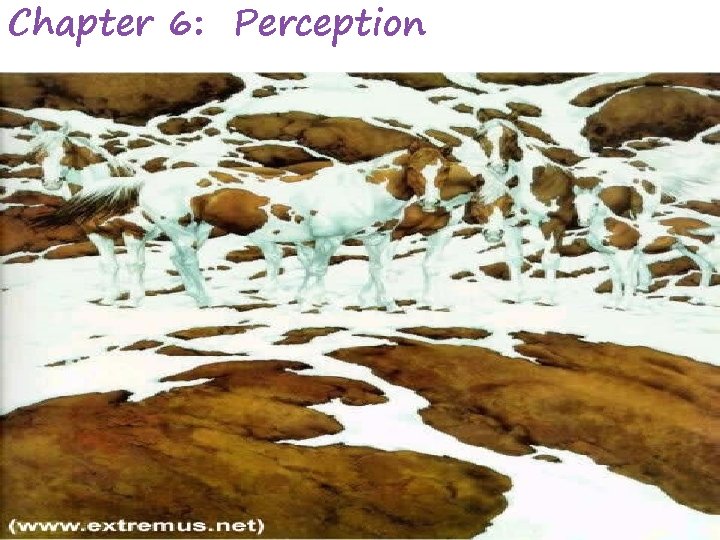
Chapter 6: Perception
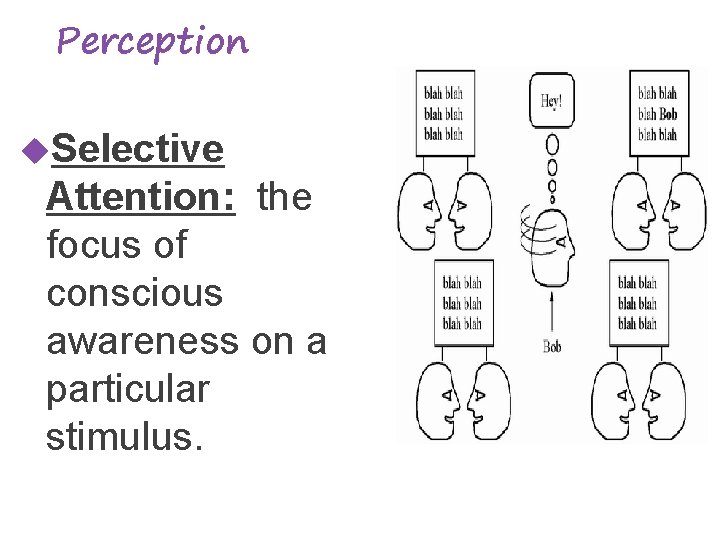
Perception Selective Attention: the focus of conscious awareness on a particular stimulus.
Selective Attention The most famous example to illustrate selective attention is known as the “cocktail party effect. ” http: //www. huffingtonpost. com/2012/06/20/silent-gorilla-studyconcentration-deaf_n_1612843. html? utm_hp_ref=science&icid=mainggrid 7%7 Cmain 5%7 Cdl 5%7 Csec 1_lnk 3%26 p. Lid%3 D 171994
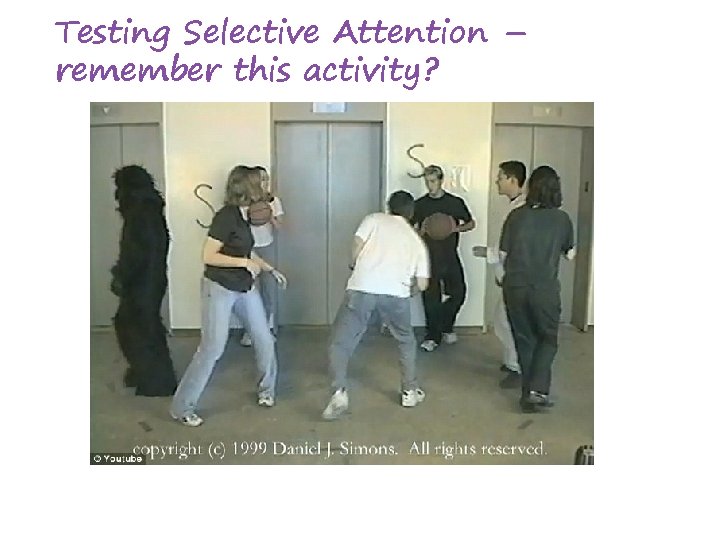
Testing Selective Attention – remember this activity?
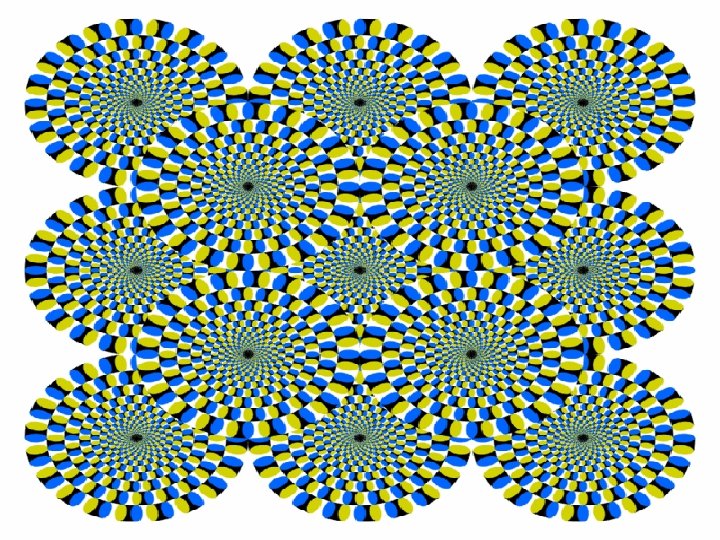
http: //www. echalk. co. uk/amusements/Optical. Illusions/mot ion. Blindness/motion. Blindness. html Haircut http: //www. youtube. com/watch? v=ve. D-Bz. Cy. HJc Brain Games color http: //www. youtube. com/watch? v=Jwdgj. I 4 Dxng
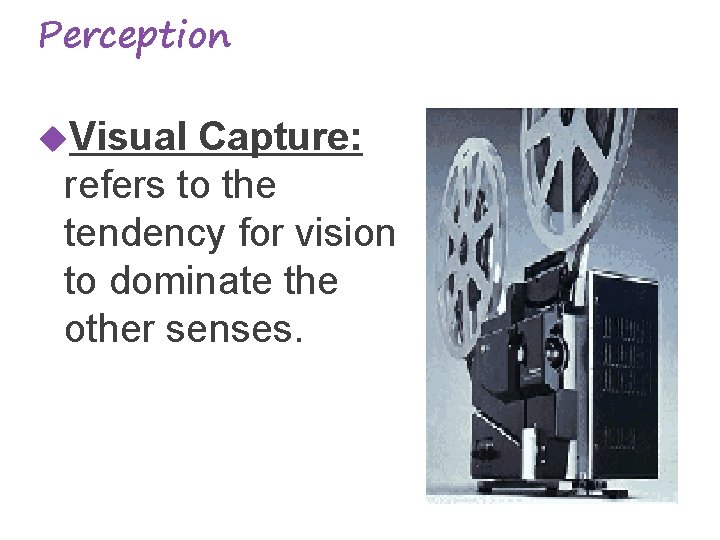
Perception Visual Capture: refers to the tendency for vision to dominate the other senses.
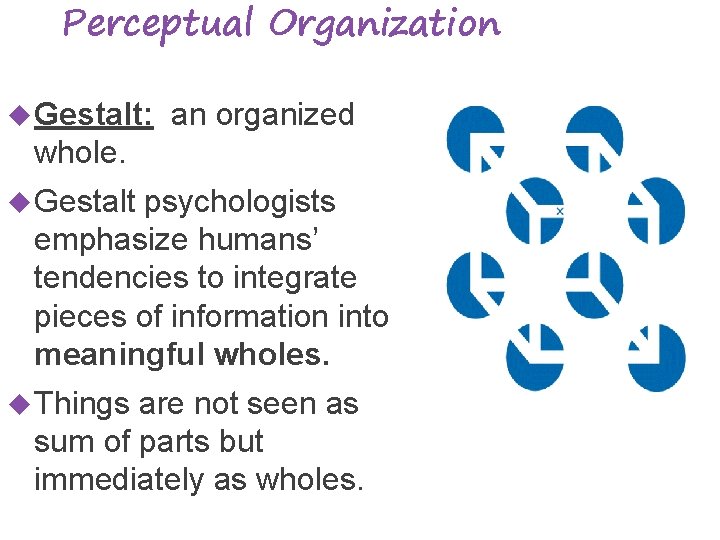
Perceptual Organization Gestalt: an organized whole. Gestalt psychologists emphasize humans’ tendencies to integrate pieces of information into meaningful wholes. Things are not seen as sum of parts but immediately as wholes.
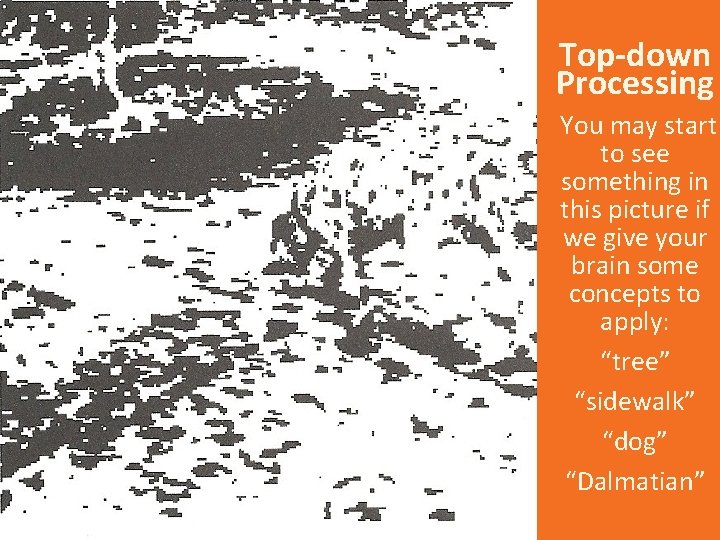
Top-down Processing You may start to see something in this picture if we give your brain some concepts to apply: “tree” “sidewalk” “dog” “Dalmatian”
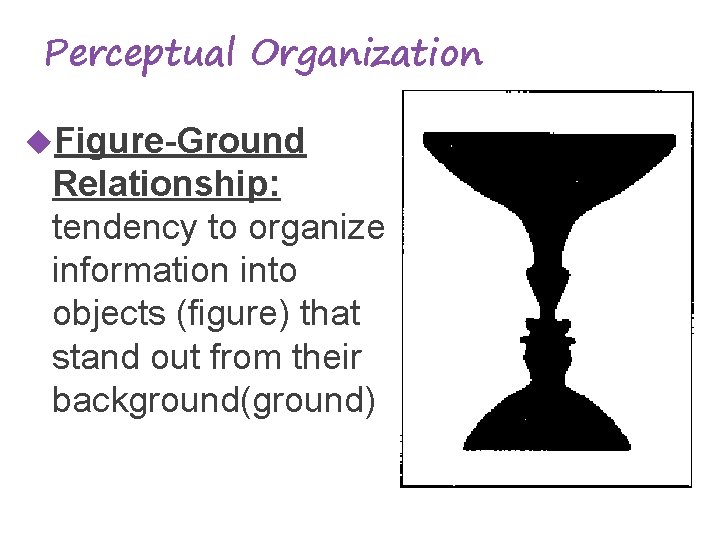
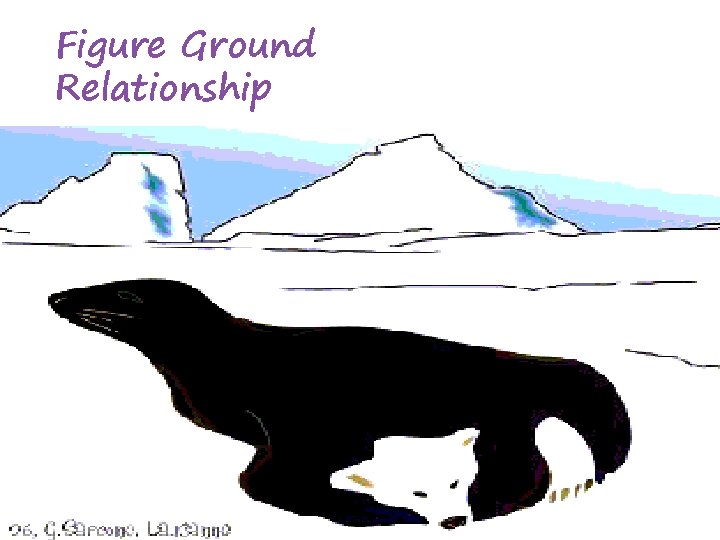
Perceptual Organization Figure-Ground Relationship: tendency to organize information into objects (figure) that stand out from their background(ground)
Figure Ground Relationship
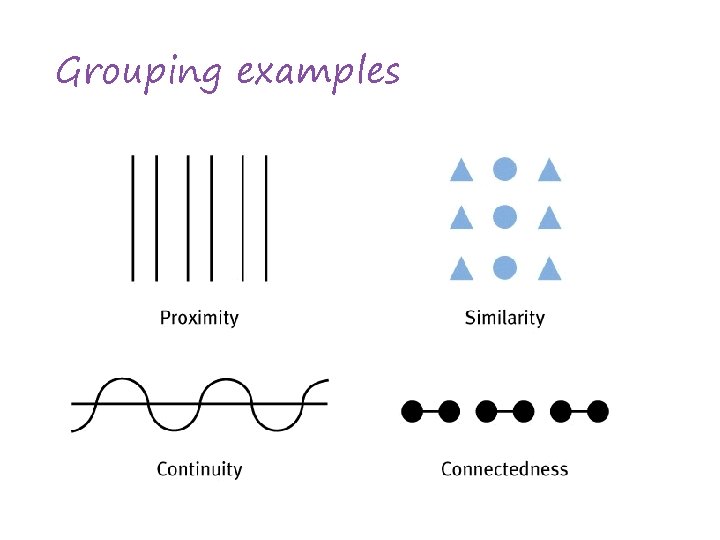
Gestalt Psychology Grouping: the perceptual tendency to organize stimuli into coherent groups Grouping Principles: Proximity Similarity Continuity Closure Connectedness
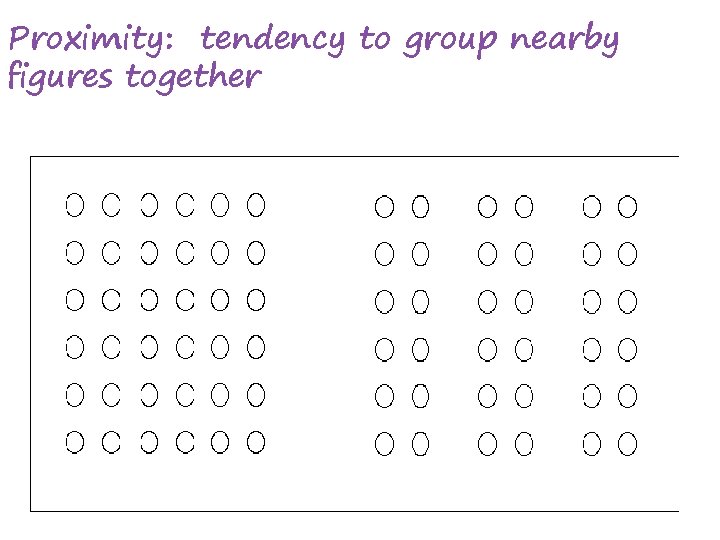
Proximity: tendency to group nearby figures together
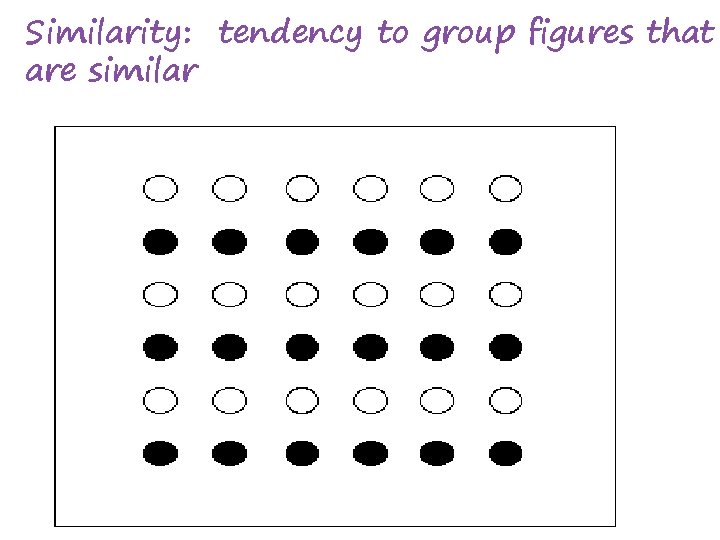
Similarity: tendency to group figures that are similar
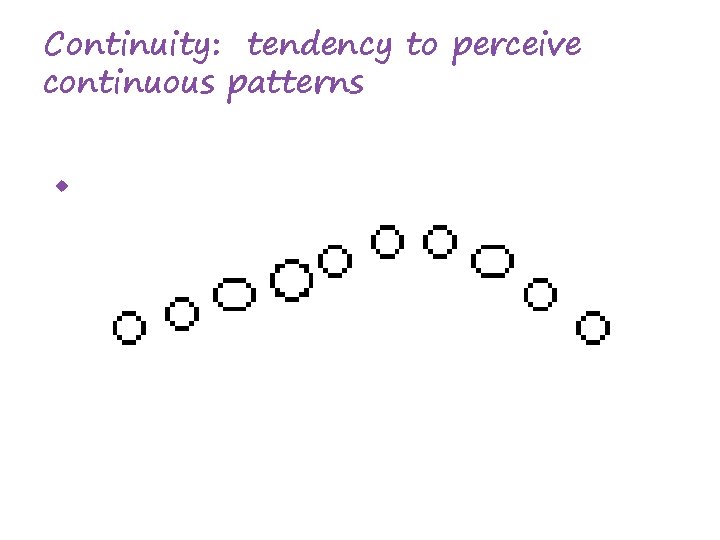
Continuity: tendency to perceive continuous patterns
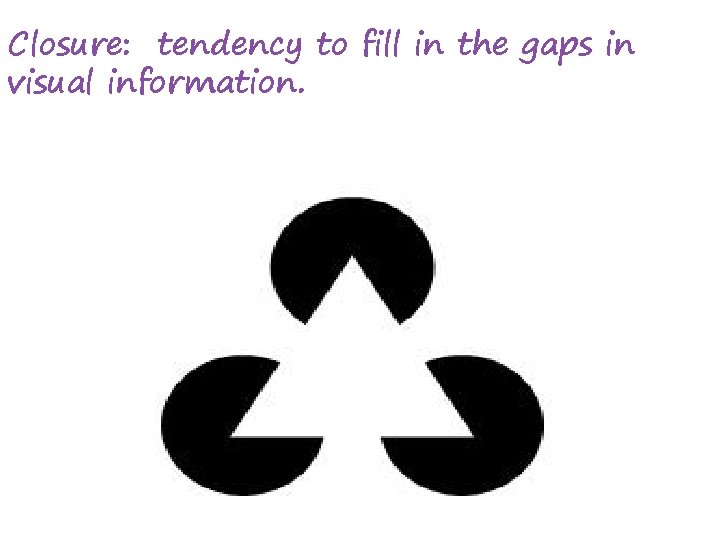
Closure: tendency to fill in the gaps in visual information.
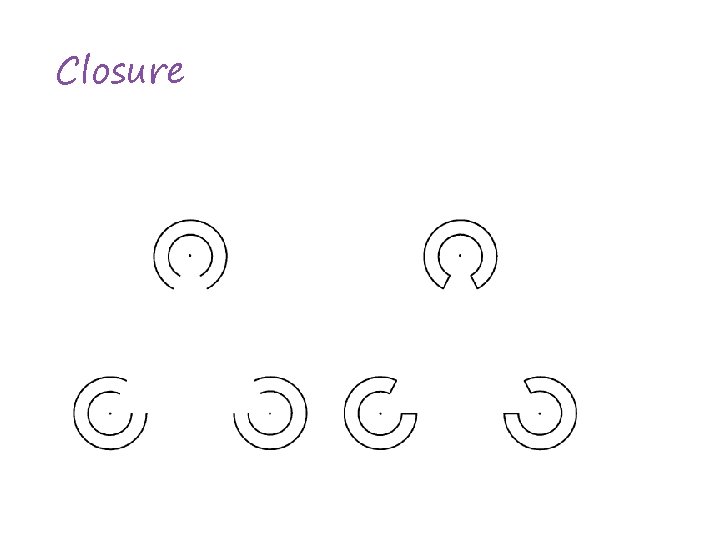
Closure
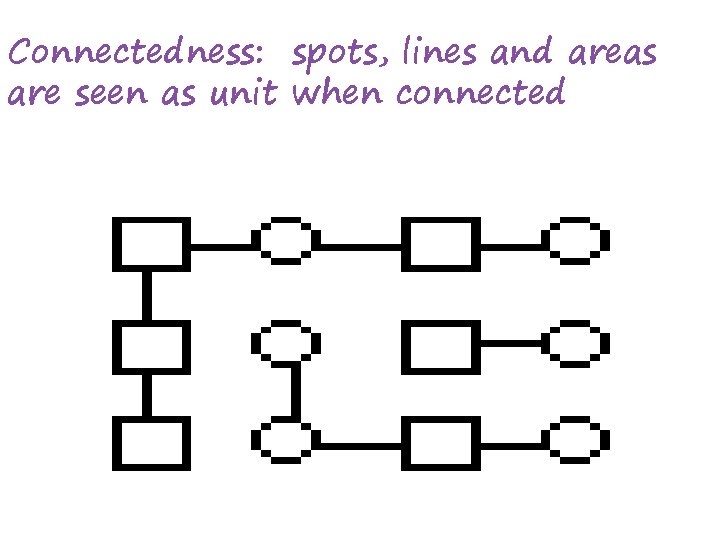
Connectedness: spots, lines and areas are seen as unit when connected
Grouping examples
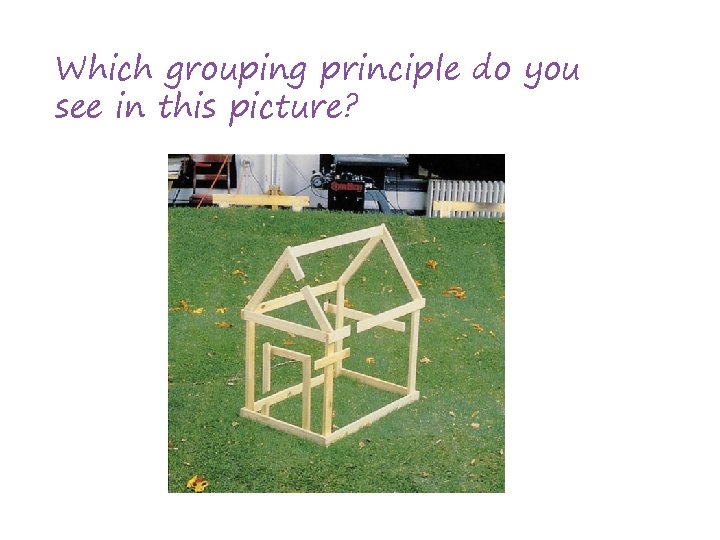
Which grouping principle do you see in this picture?
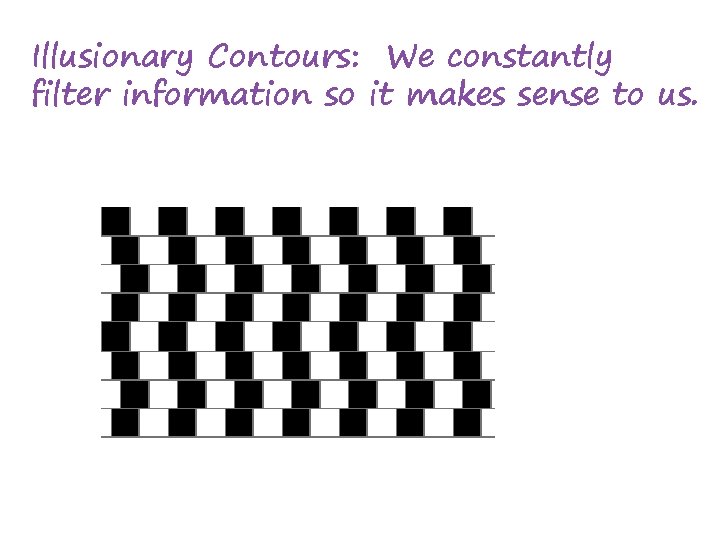
Illusionary Contours: We constantly filter information so it makes sense to us.
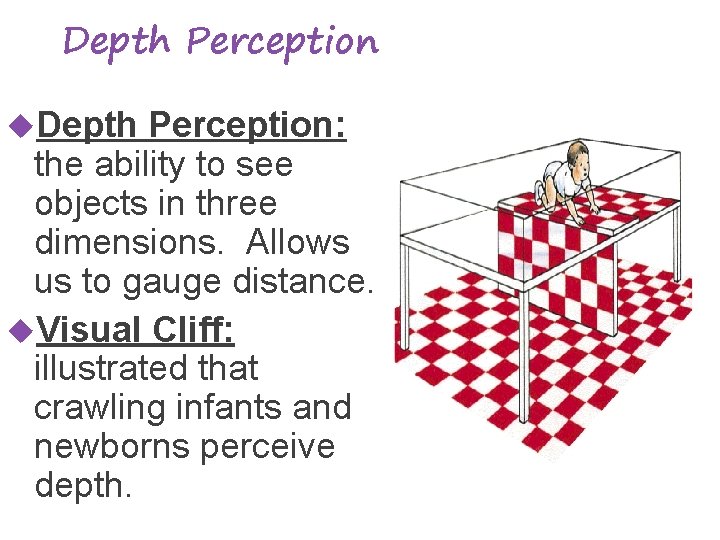
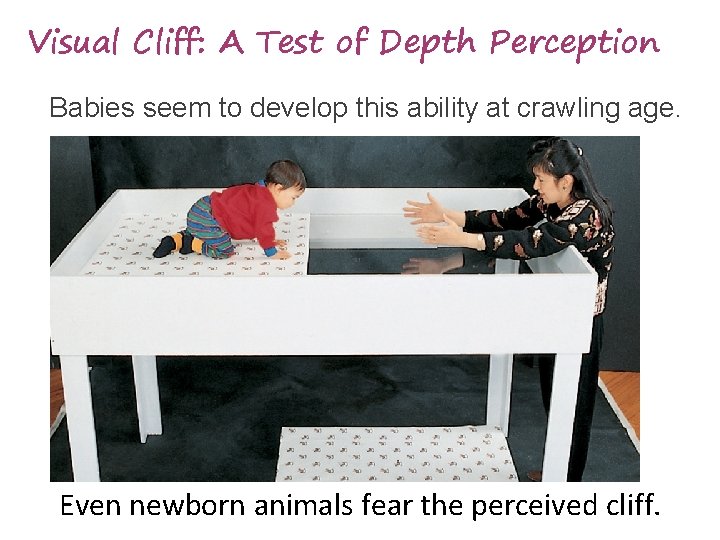
Depth Perception: the ability to see objects in three dimensions. Allows us to gauge distance. Visual Cliff: illustrated that crawling infants and newborns perceive depth.
Visual Cliff: A Test of Depth Perception Babies seem to develop this ability at crawling age. Even newborn animals fear the perceived cliff.
Types of Depth Perception Binocular Cues: depth cues that rely on the use of two eyes. Examples of Binocular Cues: Retinal Disparity: idea that images of an object from the two eyes differ. The closer the object, the larger the difference (disparity. ) Convergence: extent to which the eyes converge inward when looking at an object that brain keeps track of to measure distance.
Types of Depth Perception Monocular Cues: distance cues that are available to either eye alone. Often used in art.
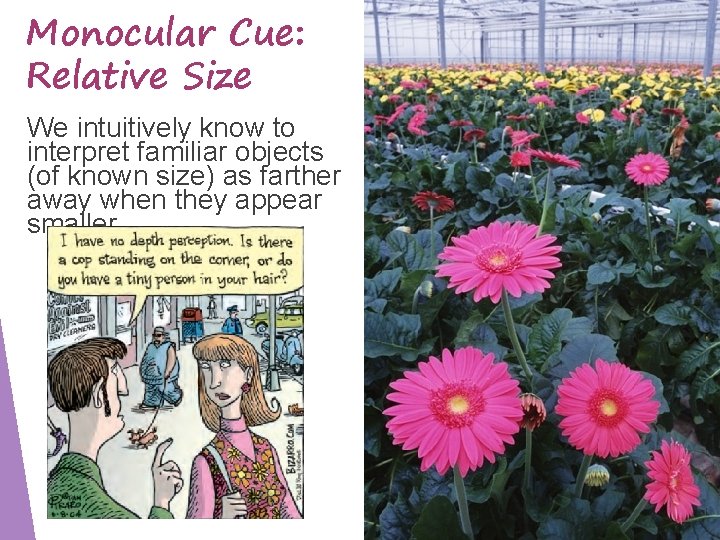
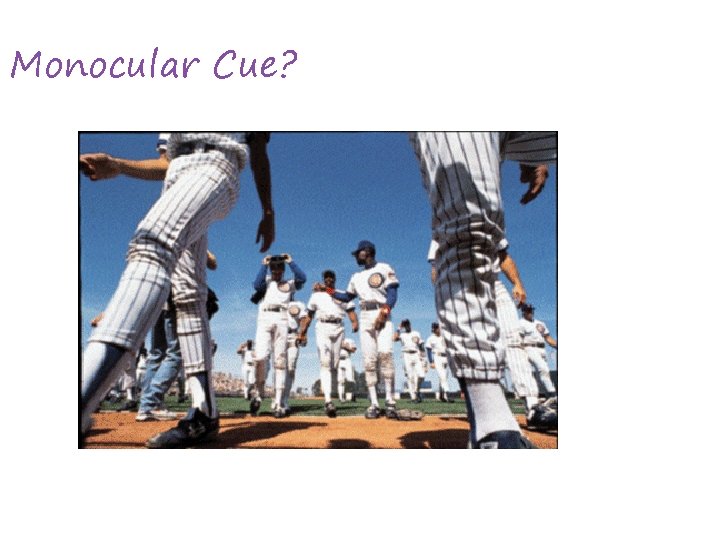
Monocular Cue: Relative Size We intuitively know to interpret familiar objects (of known size) as farther away when they appear smaller.
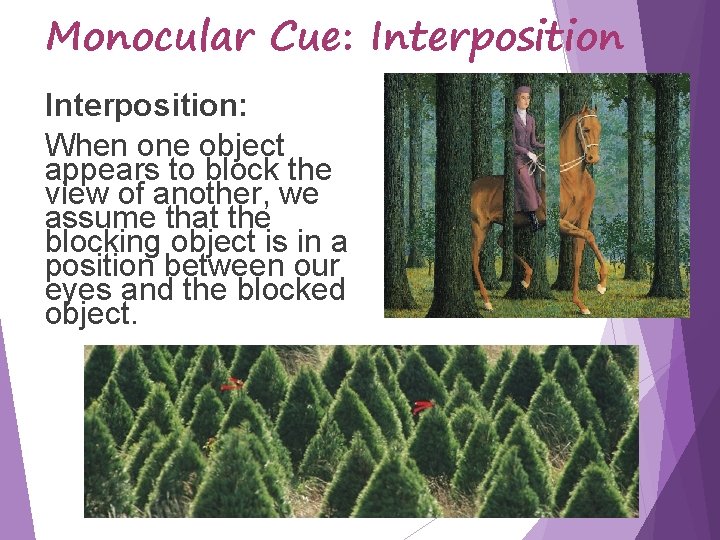
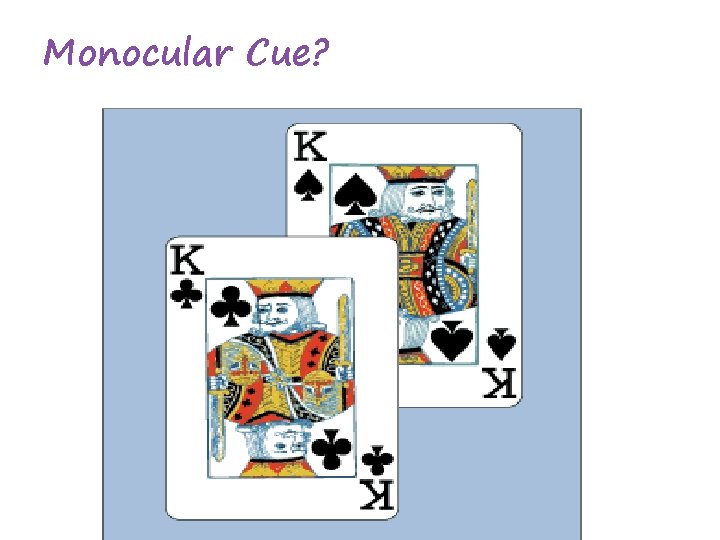
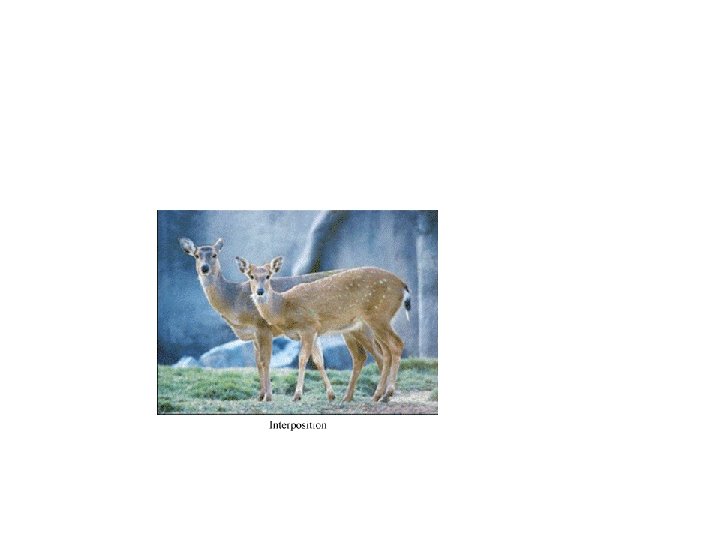
Monocular Cue: Interposition: When one object appears to block the view of another, we assume that the blocking object is in a position between our eyes and the blocked object.
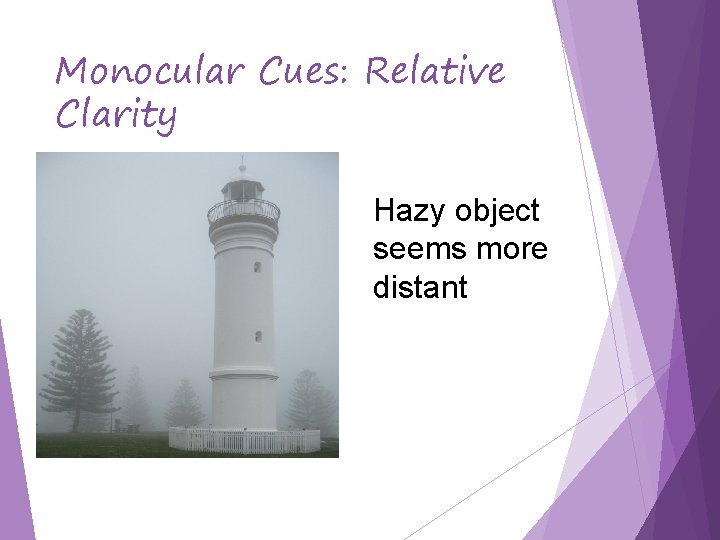
Monocular Cues: Relative Clarity Hazy object seems more distant
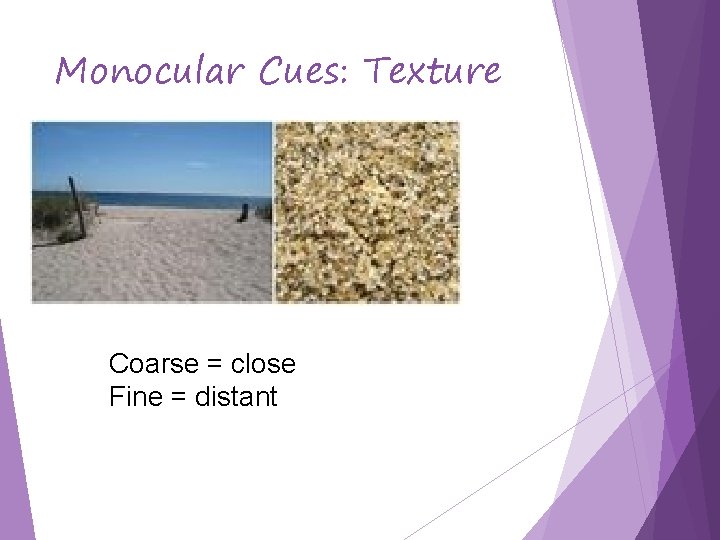
Monocular Cues: Texture Coarse = close Fine = distant
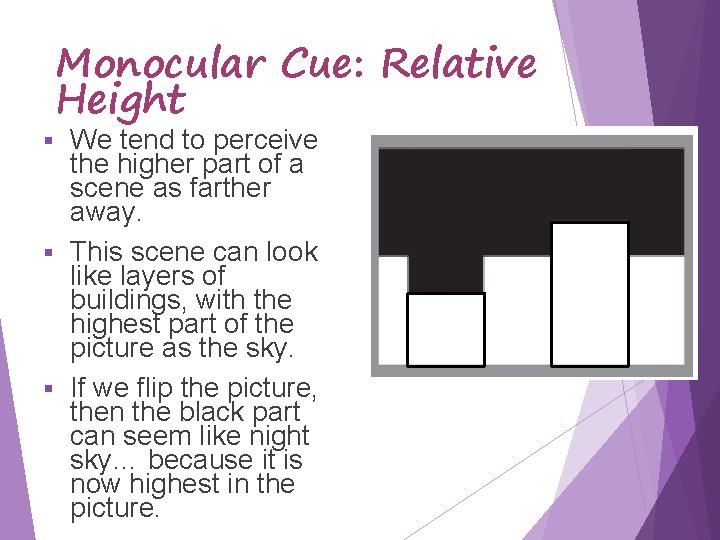
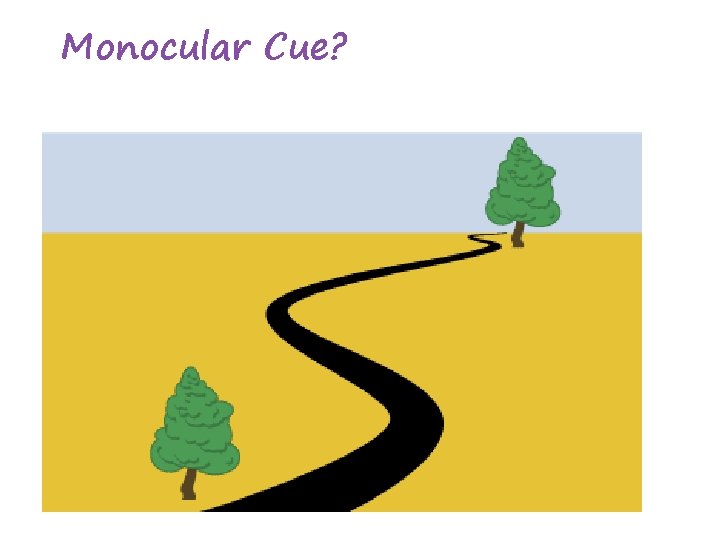
Monocular Cue: Relative Height We tend to perceive the higher part of a scene as farther away. § This scene can look like layers of buildings, with the highest part of the picture as the sky. § If we flip the picture, then the black part can seem like night sky… because it is now highest in the picture. §
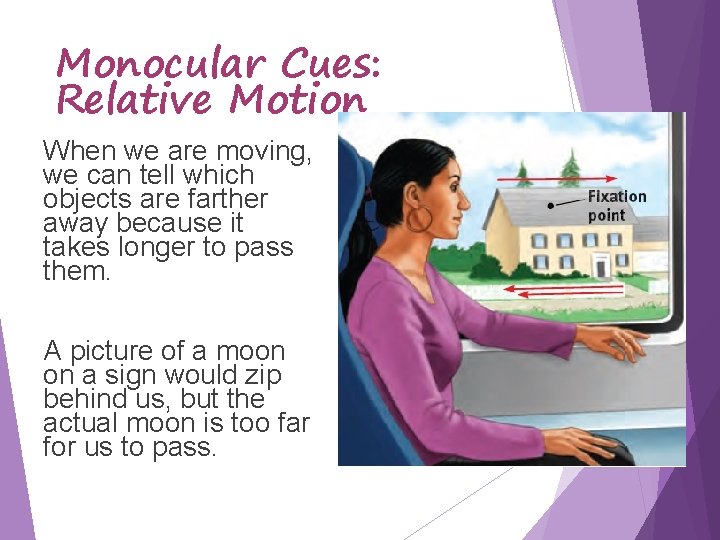
Monocular Cues: Relative Motion When we are moving, we can tell which objects are farther away because it takes longer to pass them. A picture of a moon on a sign would zip behind us, but the actual moon is too far for us to pass.
Motion Perception We perceive motion in many ways. Objects moving toward us We perceive this motion by watching the changing apparent size of an object. § Objects moving to one side We perceive relative motion, although we often judge huge objects inaccurately. In what way? Why? § Objects traveling in a more complex path, such as in an arc through the air coming toward us Baseball players, and even dogs, can run right to where a fly ball is going to land by keeping the ball in a constant apparent position in the sky. §
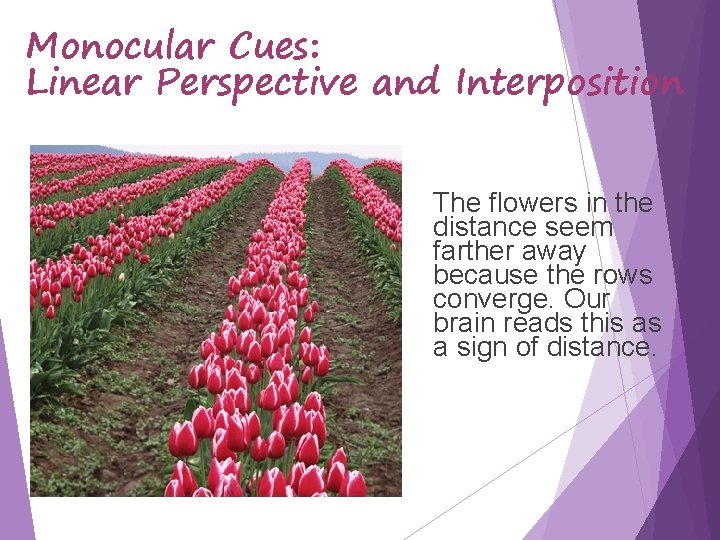
Monocular Cues: Linear Perspective and Interposition The flowers in the distance seem farther away because the rows converge. Our brain reads this as a sign of distance.
Tricks Using Linear Perspective These two red lines meet the retina as being the same size § However, our perception of distance affects our perception of length. §
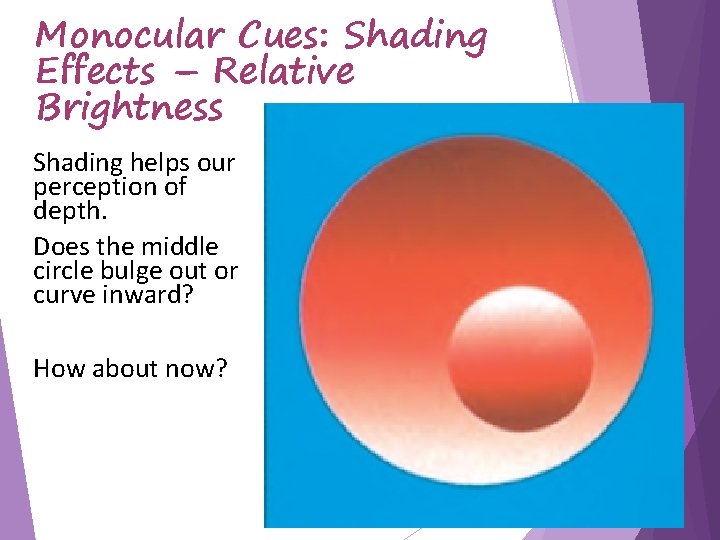
Monocular Cues: Shading Effects – Relative Brightness Shading helps our perception of depth. Does the middle circle bulge out or curve inward? How about now?
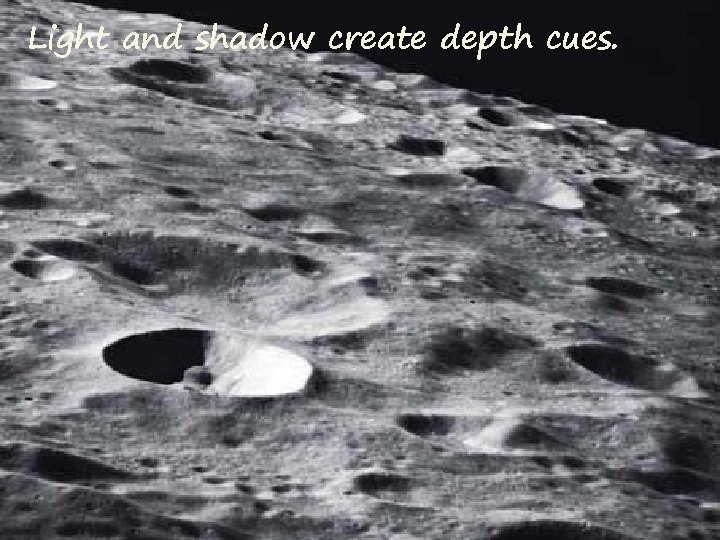
Light and shadow create depth cues.
Monocular Cue?
Monocular Cue?
Monocular Cue?
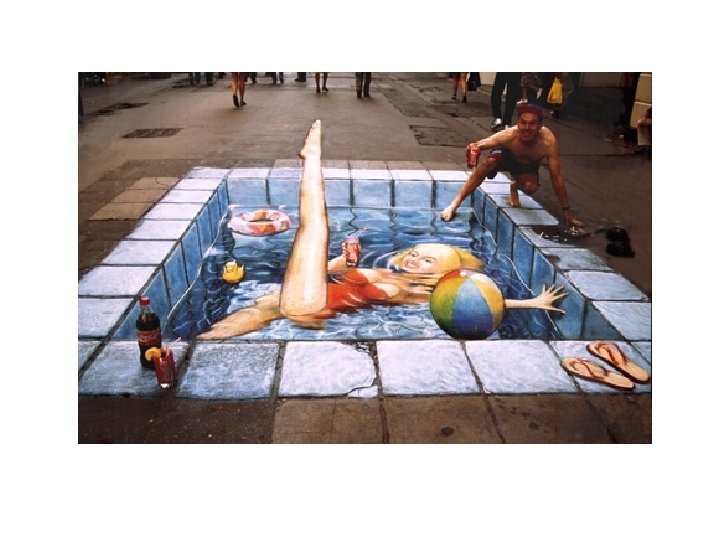
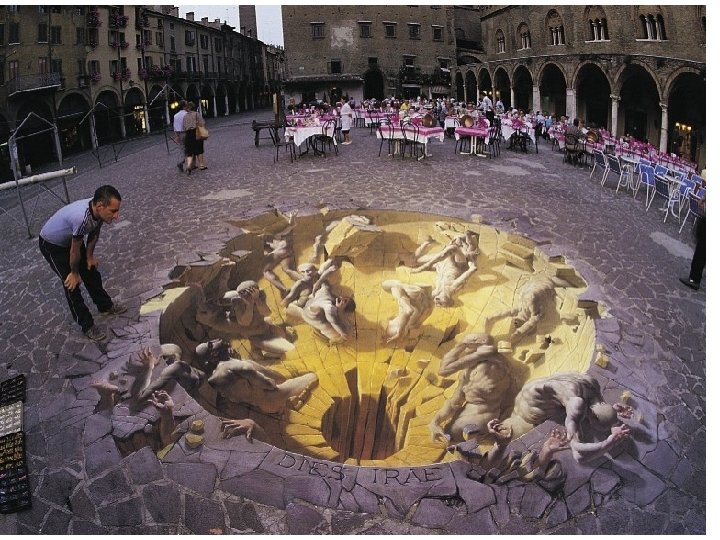
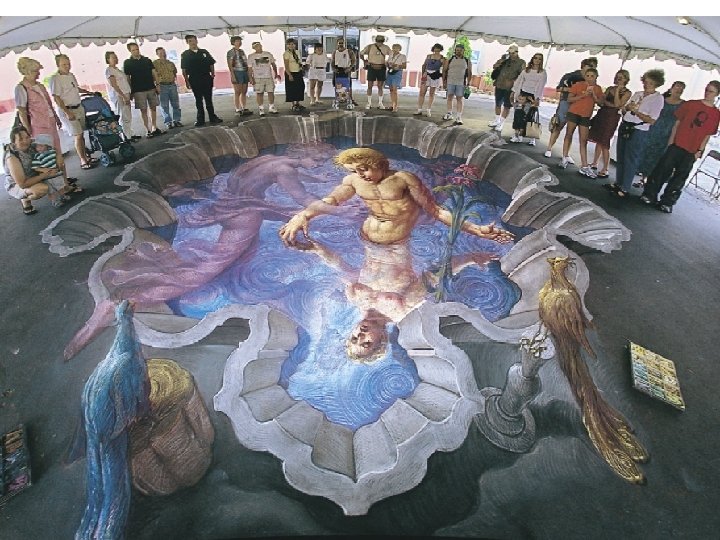
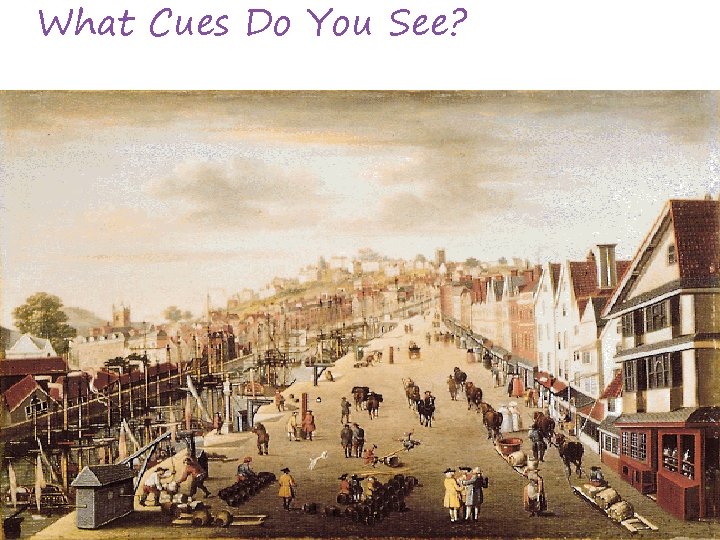
What Cues Do You See?
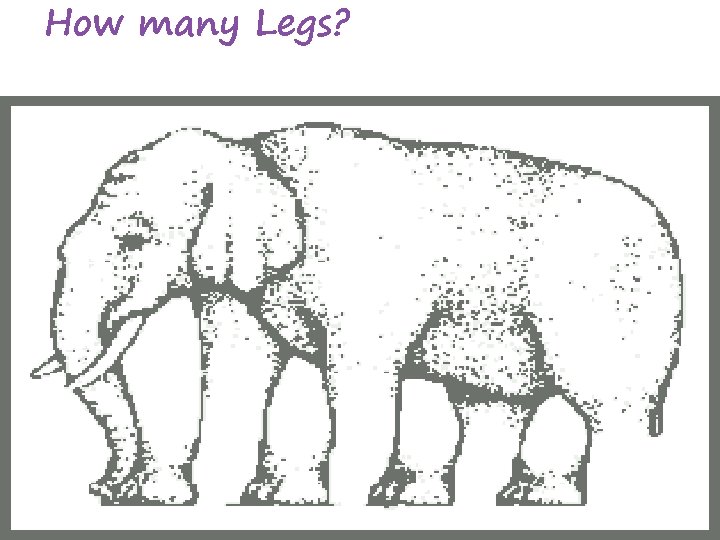
How many Legs?
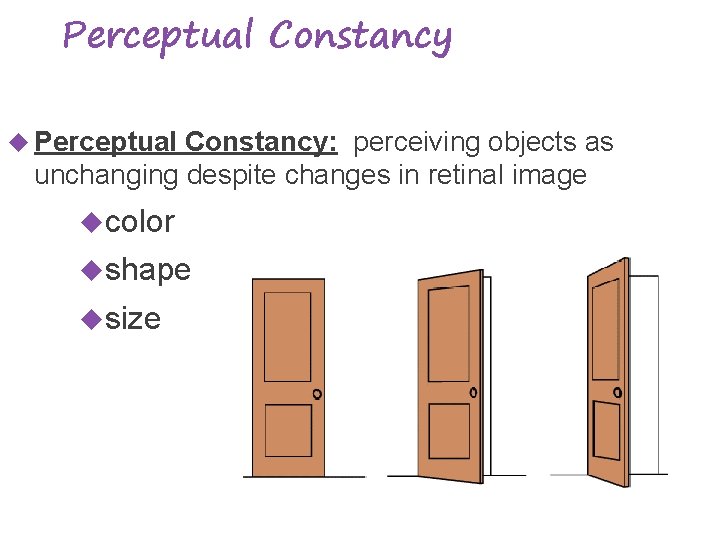
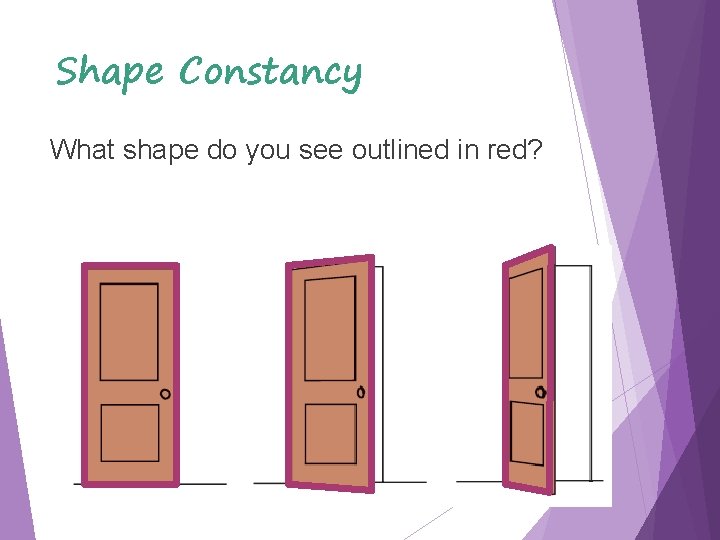
Perceptual Constancy Perceptual Constancy: perceiving objects as unchanging despite changes in retinal image color shape size
Shape Constancy What shape do you see outlined in red?
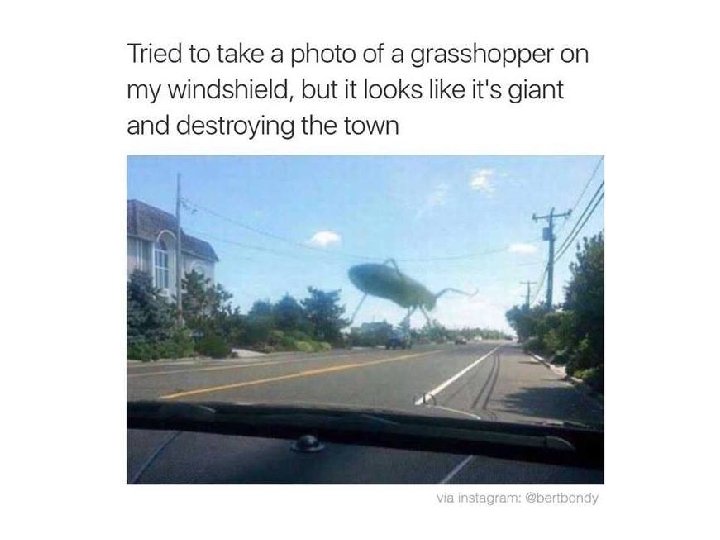
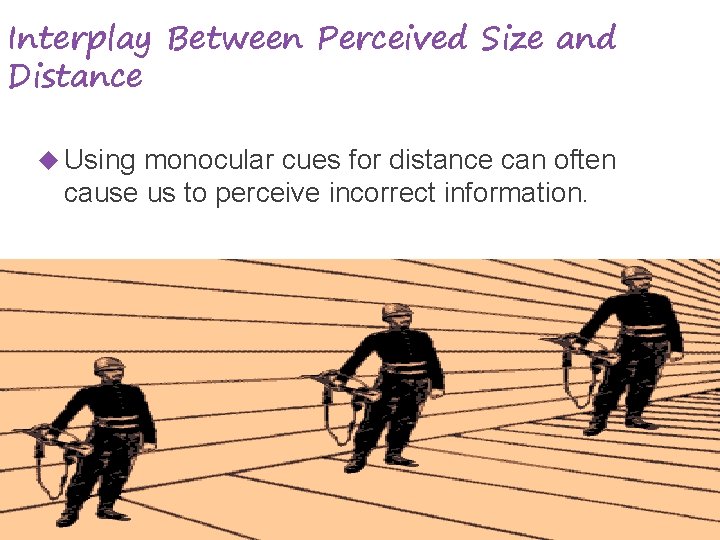
Interplay Between Perceived Size and Distance Using monocular cues for distance can often cause us to perceive incorrect information.
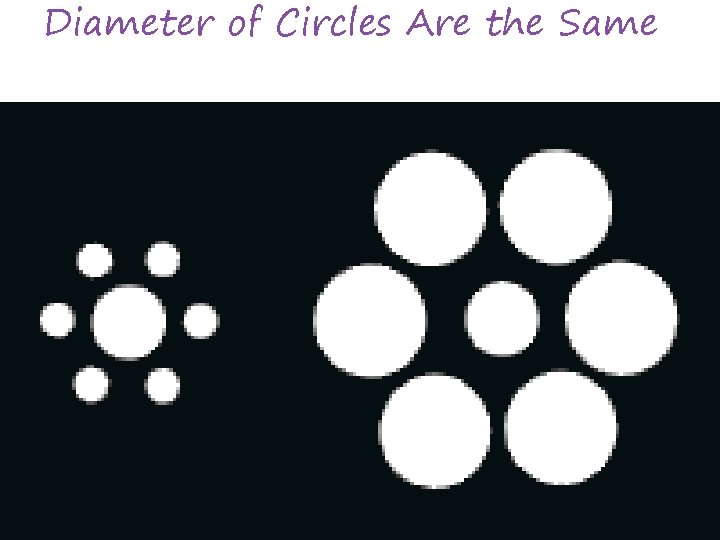
Diameter of Circles Are the Same
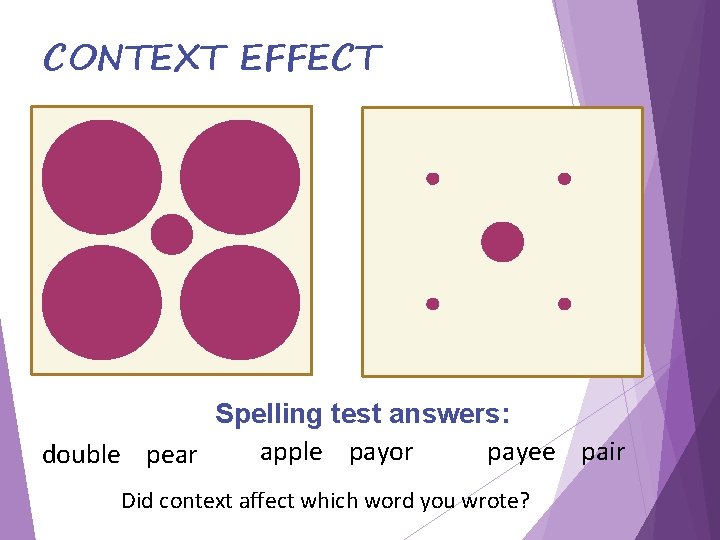
CONTEXT EFFECT Spelling test answers: apple payor payee pair double pear Did context affect which word you wrote?
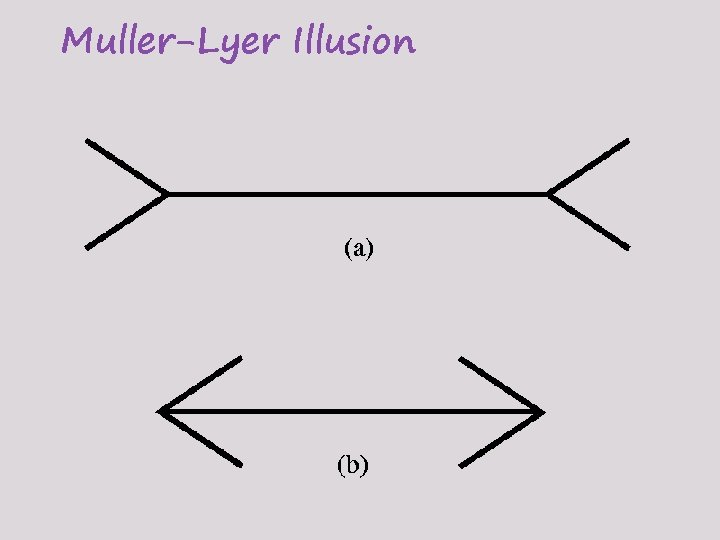
Muller-Lyer Illusion
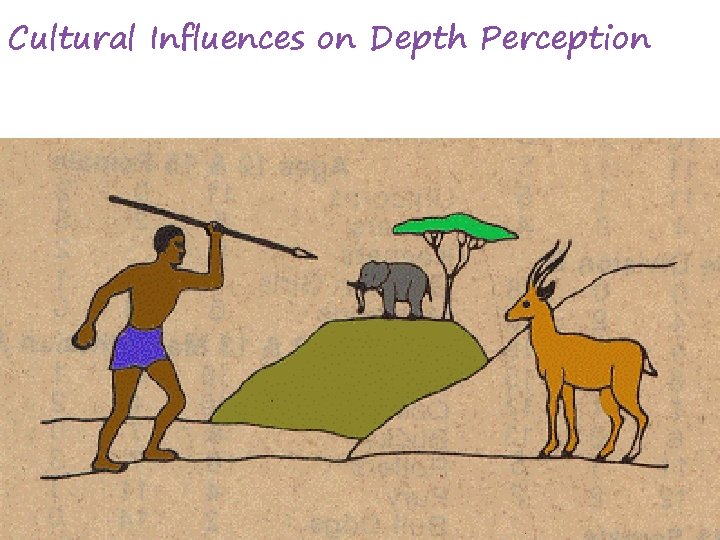
Cultural Influences on Depth Perception
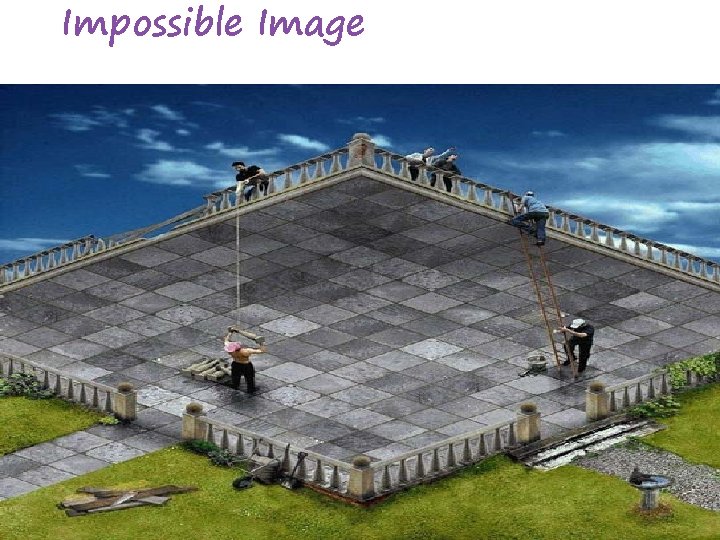
Impossible Image
Impossible Staircase
Warm Up http: //www. youtube. com/watch? v=KApie. SGly. Bk
Sensory Deprivation and Perception Blind Person Example Some aspects of perception might be innate Others involve experiences Critical period for development of sensation and perception
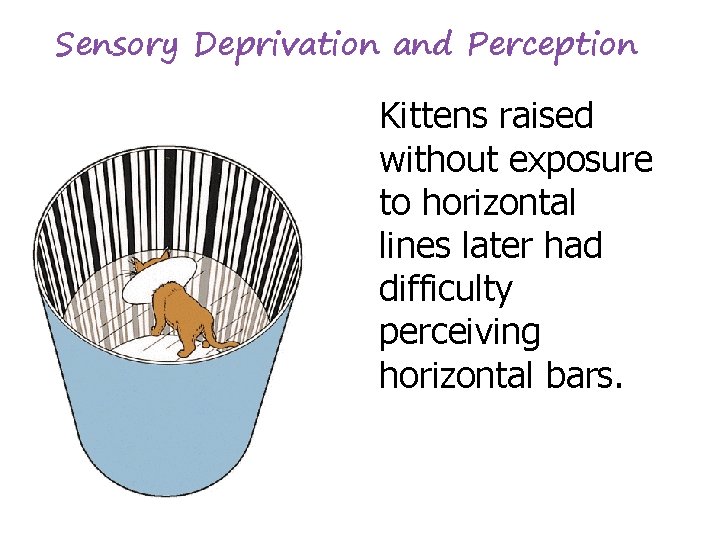
Sensory Deprivation and Perception Kittens raised without exposure to horizontal lines later had difficulty perceiving horizontal bars.
Perceptual Adaptation (vision) ability to adjust to an artificially displaced visual field prism glasses
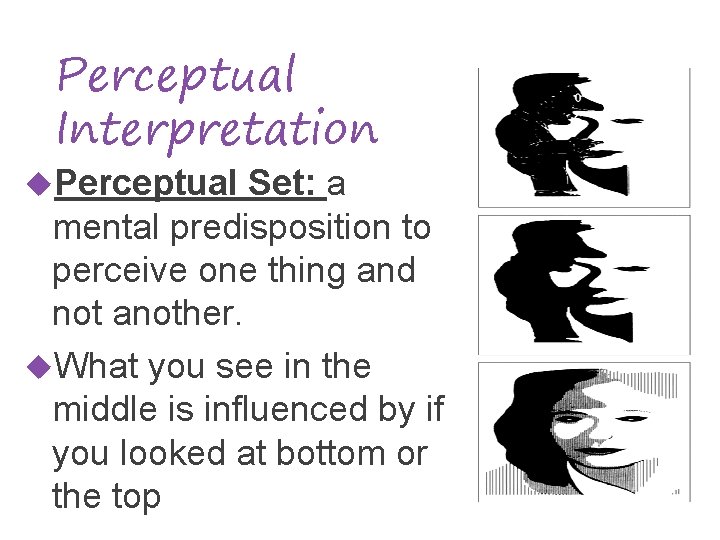
Perceptual Interpretation Perceptual Set: a mental predisposition to perceive one thing and not another. What you see in the middle is influenced by if you looked at bottom or the top
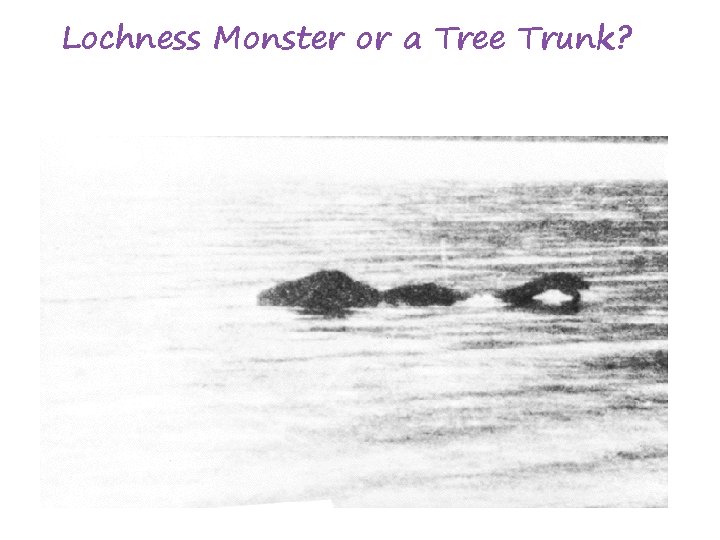
Lochness Monster or a Tree Trunk?
Perceptual Set Affects Other Senses Perceptual Set also affects other senses like audition. Ex: eel is on the wagon vs. eel is on the orange. CONTEXT MATTERS! Rat Man Lyrics
Perception and the Human Factors Psychologists- explore how people and machines interact and how machines and environments can be adapted to human behaviors
Is there Extrasensory Perception? Extrasensory Perception: claim that perception can occur apart from sensory input. Astrological predictions, psychic healing, communication with the dead Telepathy- mind to mind Clairvoyance- perceiving remote events Precognition- perceiving future events Psychokinesis- mind over matter Example- light as a feather stiff as a board
Is there Extrasensory Perception? Parapsychology: study of paranormal phenomenon, including ESP and psycho kinesis. Research Psychics not accurate More predictions- police work Vague predictions Lottery No experiment has EVER produced a convincible demonstration of ESP
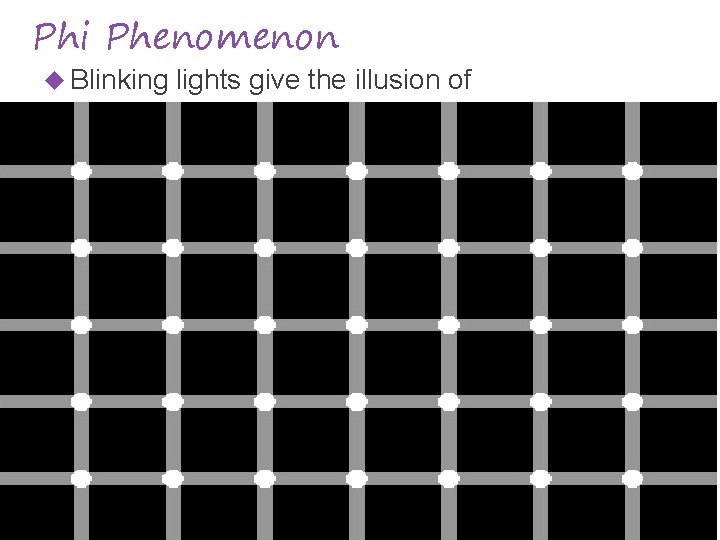
Phi Phenomenon Blinking lights give the illusion of motion