
2 nd Class Business Cases Value Proposition Agile
2 nd Class -Business Cases – Value Proposition -Agile vs. Waterfall Development Process Bus 100: Building Software Products: From Strategy to Sales John Gibbon
References Hal Louchheim
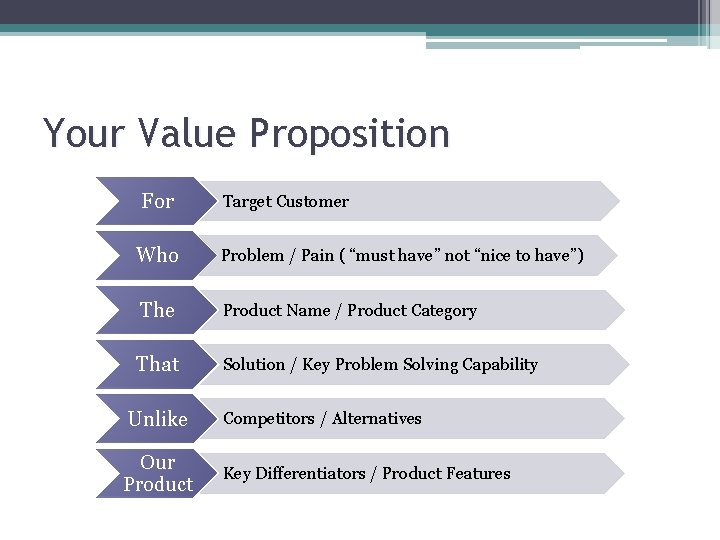
Your Value Proposition For Target Customer Who Problem / Pain ( “must have” not “nice to have”) The Product Name / Product Category That Solution / Key Problem Solving Capability Unlike Competitors / Alternatives Our Product Key Differentiators / Product Features
Success Metrics -Revenue -Market Share -New Users -Increase Usage -Increased Customer Satisfaction: NPS -Other?
Market and Competitive Analysis -Clients -Industry Experts -Internet Employ Porter’s Forces, Blue Ocean, Other Frameworks
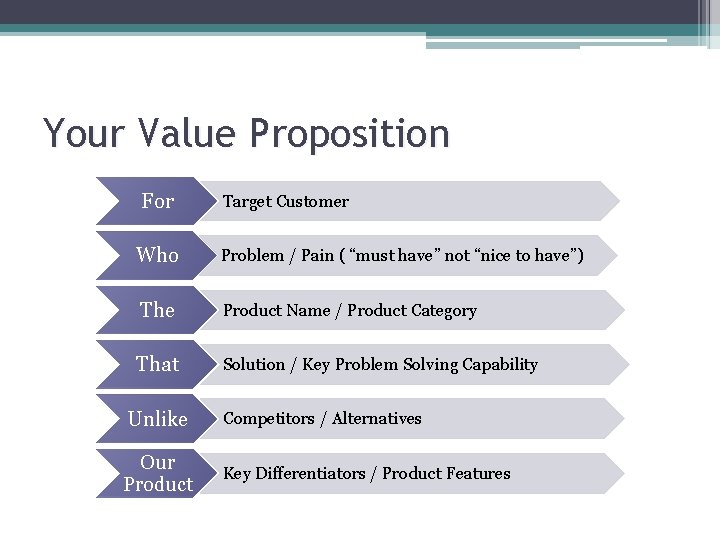
Your Value Proposition For Target Customer Who Problem / Pain ( “must have” not “nice to have”) The Product Name / Product Category That Solution / Key Problem Solving Capability Unlike Competitors / Alternatives Our Product Key Differentiators / Product Features
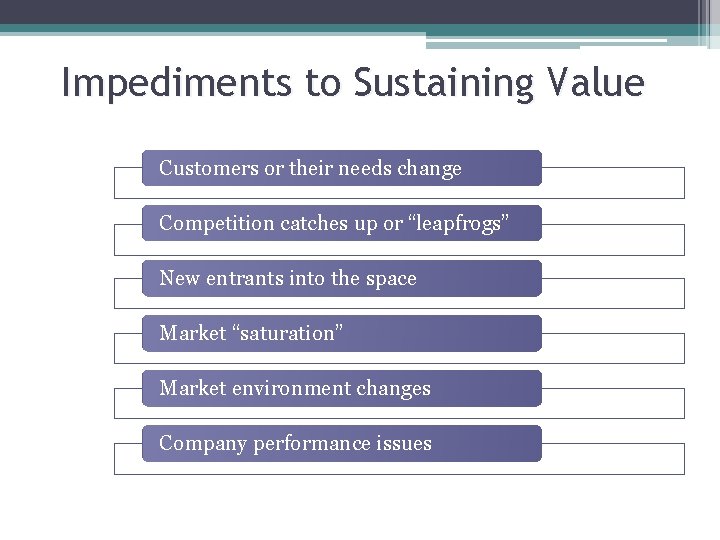
Impediments to Sustaining Value Customers or their needs change Competition catches up or “leapfrogs” New entrants into the space Market “saturation” Market environment changes Company performance issues
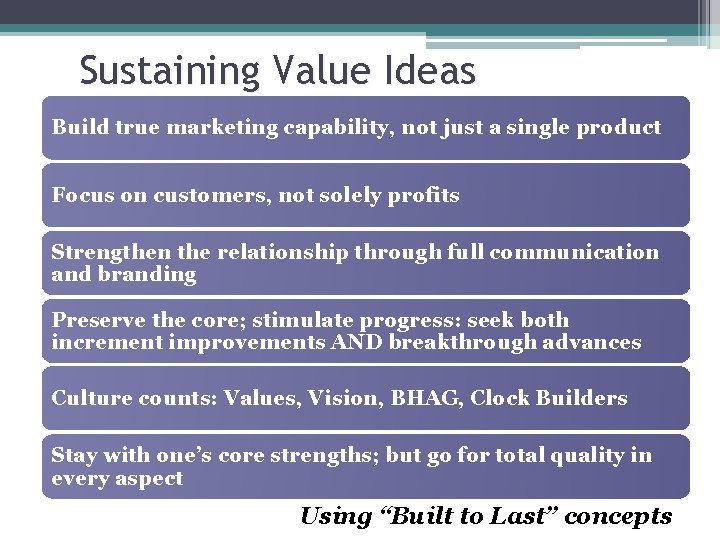
Sustaining Value Ideas Build true marketing capability, not just a single product Focus on customers, not solely profits Strengthen the relationship through full communication and branding Preserve the core; stimulate progress: seek both increment improvements AND breakthrough advances Culture counts: Values, Vision, BHAG, Clock Builders Stay with one’s core strengths; but go for total quality in every aspect Using “Built to Last” concepts
Agile vs. Waterfall Development Process Bus 100: Building Software Products: From Strategy to Sales John Gibbon
Manifesto for Agile Software Development We are uncovering better ways of developing software by doing it and helping others do it. Through this work we have come to value: Individuals and interactions over processes and tools Working software over comprehensive documentation Customer collaboration over contract negotiation Responding to change over following a plan That is, while there is value in the items on the right, we value the items on the left more. Agile. Manifesto. org (2001)
(Usually) Agile Methodology Iterative and Incremental Development 1. Short, Iterative Cycles (2 -5 weeks) with Demonstrable Deliverables 1. Plan, Requirements Analysis, Design, Code, Test, Document 2. At End, Should Have Releasable Software 3. Re-evaluate Priorities at End of Each Iteration 1. Stories or Use-Case Based Development 2. Time Driven, Not Feature Driven Development -Burn Down and Backlogs 3. Scrums – daily face-to-face meetings -Pigs and Chickens 4. Test Driven Development
Posted in Scrum Meeting Room What Report During Scrum? Project Principles • Accomplishments since last Scrum • • Accomplishments before next Scrum • Future roadblocks and risks • Decided/learned anything new should share with team • Discussion outside Scrum required? • Changes required in task schedule? Customer Focused Continuous Improvement Best Practices Based on Agile/Scrum • Time boxed, “Sprints”, simplicity, communication, support/empower team and individual • Agile Manifesto: -Individuals and interactions over processes and tools -Working software over comprehensive documentation
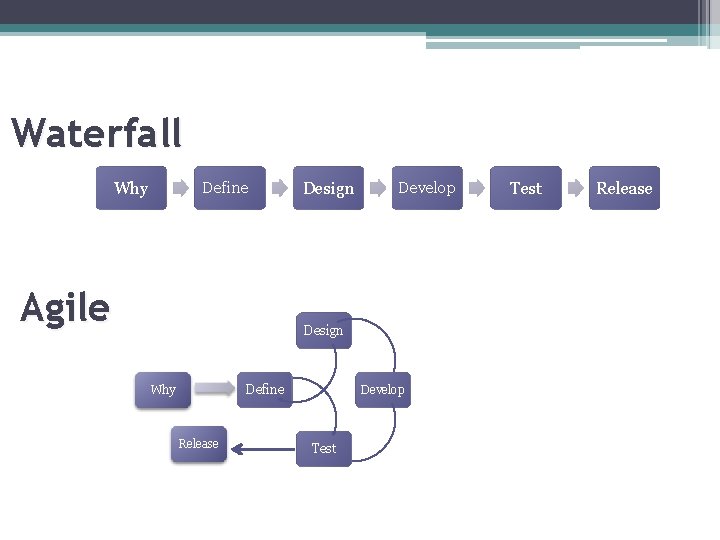
Waterfall Why Define Agile Design Develop Design Define Why Release Develop Test Release
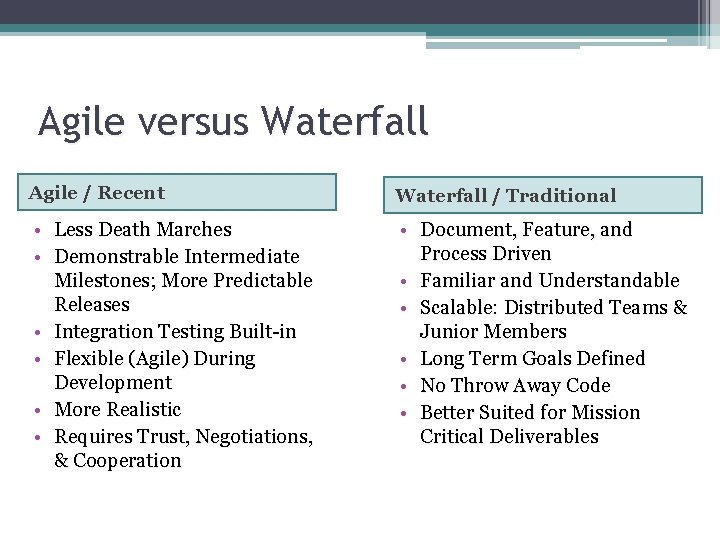
Agile versus Waterfall Agile / Recent Waterfall / Traditional • Less Death Marches • Demonstrable Intermediate Milestones; More Predictable Releases • Integration Testing Built-in • Flexible (Agile) During Development • More Realistic • Requires Trust, Negotiations, & Cooperation • Document, Feature, and Process Driven • Familiar and Understandable • Scalable: Distributed Teams & Junior Members • Long Term Goals Defined • No Throw Away Code • Better Suited for Mission Critical Deliverables
- Slides: 14