
2 MS 3 Moscow Moons of Planets October
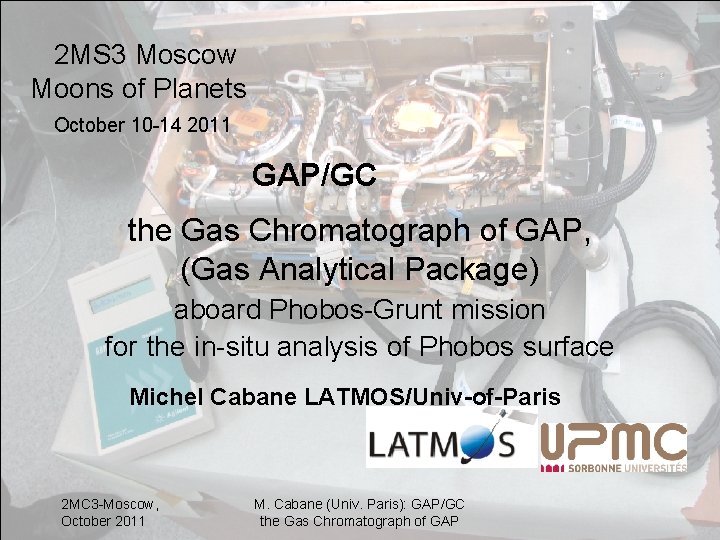
2 MS 3 Moscow Moons of Planets October 10 -14 2011 GAP/GC the Gas Chromatograph of GAP, (Gas Analytical Package) aboard Phobos-Grunt mission for the in-situ analysis of Phobos surface Michel Cabane LATMOS/Univ-of-Paris 2 MC 3 -Moscow, October 2011 M. Cabane (Univ. Paris): GAP/GC the Gas Chromatograph of GAP
The GAP/GC team : France Russia M. Cabane D. Coscia C. Szopa P. Coll J. P. Goutail J. J. Correia A. Galic P. Zapf C. Montaron C. Philippon LATMOS Paris LATMOS LISA LATMOS BTS LISA LATMOS LISA A. Gaboriaud CNES 2 MC 3 -Moscow, October 2011 M. V. Gerasimov A. V. Kaluzhnyy Y. V. Lebedev A. V. Stepanov A. V. Titov A. G. Sapgir M. Cabane (Univ. Paris): GAP/GC the Gas Chromatograph of GAP and many others
Other GC developed at LATMOS (previously SA) / LISA : for COSAC (ROSETTA-ESA) SAM (MSL 2011 -NASA) for MOMA (Exomars-ESA) 2 MC 3 -Moscow, October 2011 M. Cabane (Univ. Paris): GAP/GC the Gas Chromatograph of GAP with MPS (Germany) with GSFC (USA)
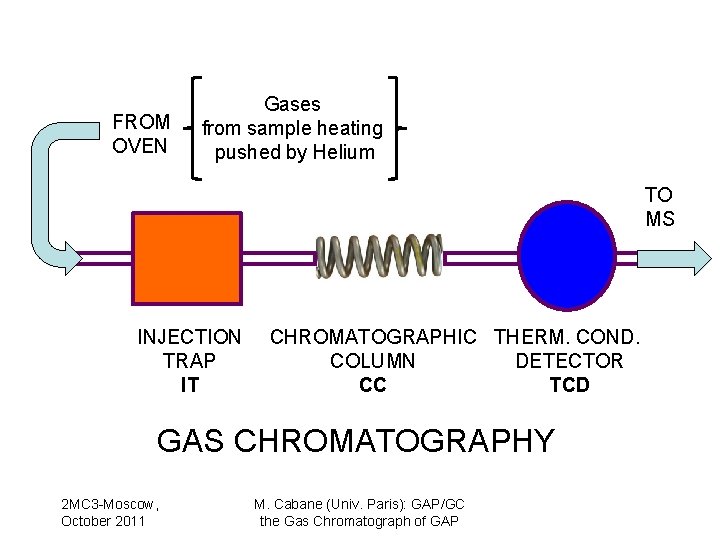
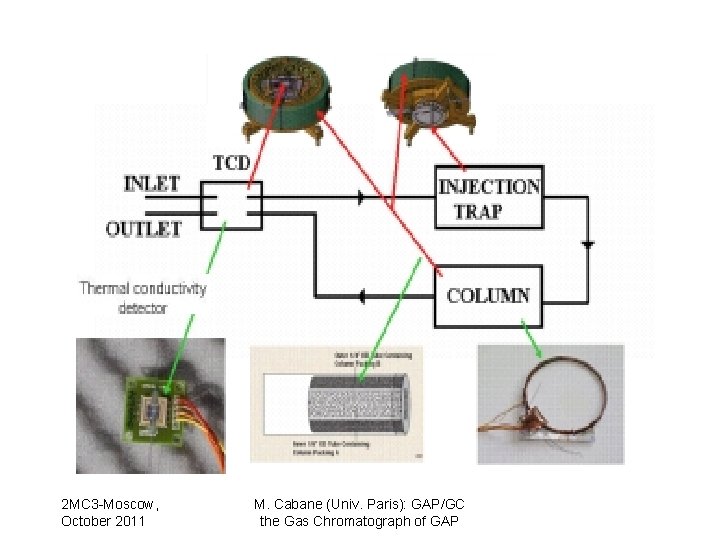
FROM OVEN Gases from sample heating pushed by Helium TO MS INJECTION TRAP IT CHROMATOGRAPHIC THERM. COND. COLUMN DETECTOR CC TCD GAS CHROMATOGRAPHY 2 MC 3 -Moscow, October 2011 M. Cabane (Univ. Paris): GAP/GC the Gas Chromatograph of GAP
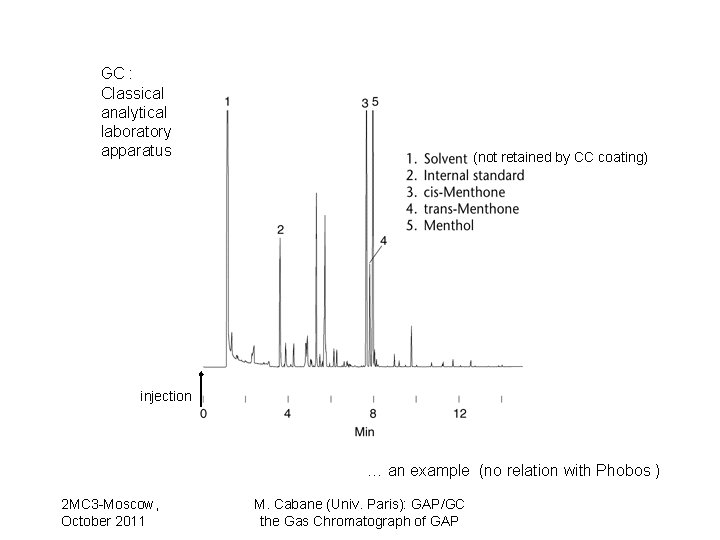
GC : Classical analytical laboratory apparatus (not retained by CC coating) injection … an example (no relation with Phobos ) 2 MC 3 -Moscow, October 2011 M. Cabane (Univ. Paris): GAP/GC the Gas Chromatograph of GAP
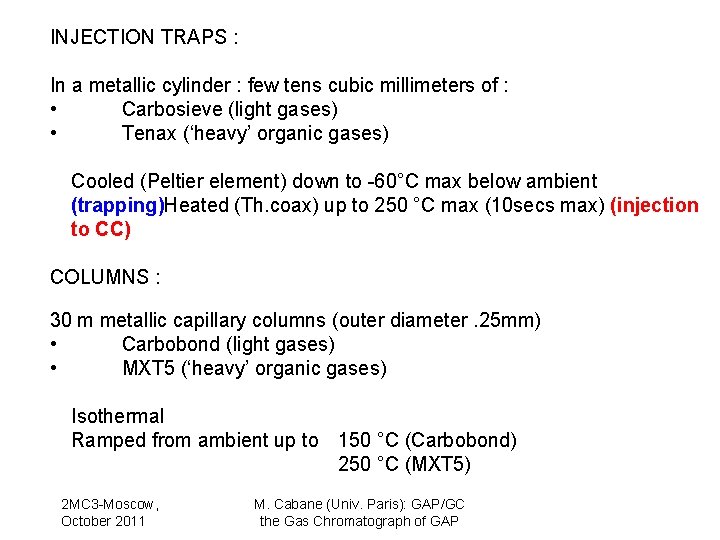
INJECTION TRAPS : In a metallic cylinder : few tens cubic millimeters of : • Carbosieve (light gases) • Tenax (‘heavy’ organic gases) Cooled (Peltier element) down to -60°C max below ambient (trapping)Heated (Th. coax) up to 250 °C max (10 secs max) (injection to CC) COLUMNS : 30 m metallic capillary columns (outer diameter. 25 mm) • Carbobond (light gases) • MXT 5 (‘heavy’ organic gases) Isothermal Ramped from ambient up to 150 °C (Carbobond) 250 °C (MXT 5) 2 MC 3 -Moscow, October 2011 M. Cabane (Univ. Paris): GAP/GC the Gas Chromatograph of GAP
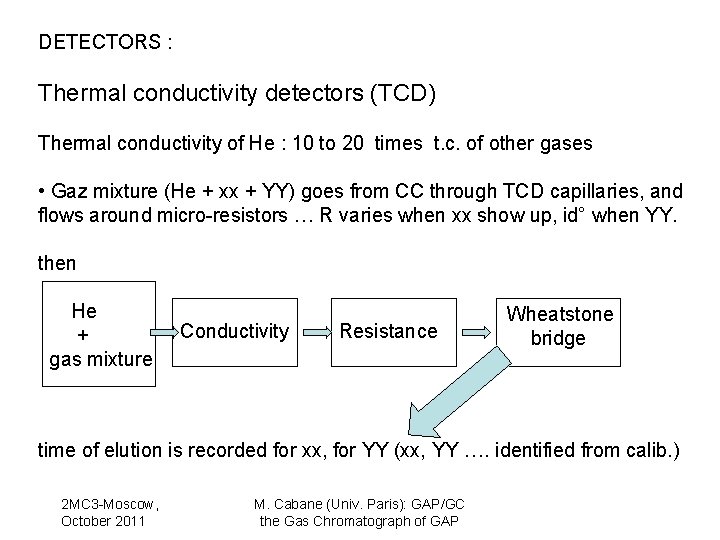
DETECTORS : Thermal conductivity detectors (TCD) Thermal conductivity of He : 10 to 20 times t. c. of other gases • Gaz mixture (He + xx + YY) goes from CC through TCD capillaries, and flows around micro-resistors … R varies when xx show up, id° when YY. then He + gas mixture Conductivity Resistance Wheatstone bridge time of elution is recorded for xx, for YY (xx, YY …. identified from calib. ) 2 MC 3 -Moscow, October 2011 M. Cabane (Univ. Paris): GAP/GC the Gas Chromatograph of GAP
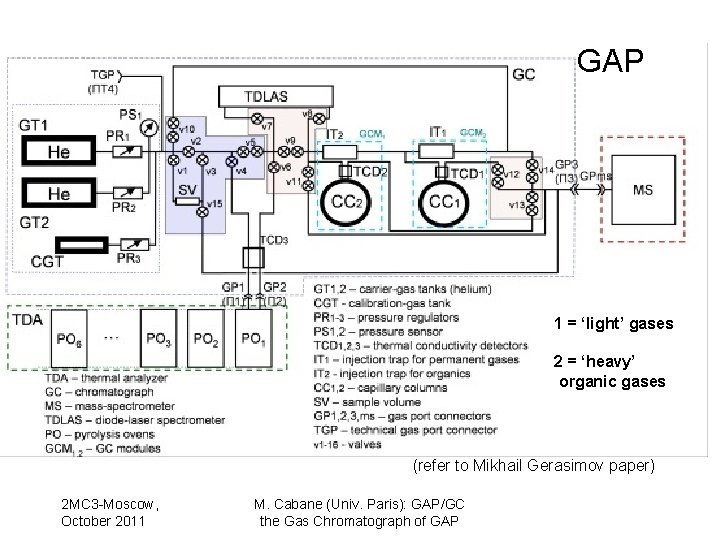
GAP 1 = ‘light’ gases 2 = ‘heavy’ organic gases (refer to Mikhail Gerasimov paper) 2 MC 3 -Moscow, October 2011 M. Cabane (Univ. Paris): GAP/GC the Gas Chromatograph of GAP
2 MC 3 -Moscow, October 2011 M. Cabane (Univ. Paris): GAP/GC the Gas Chromatograph of GAP
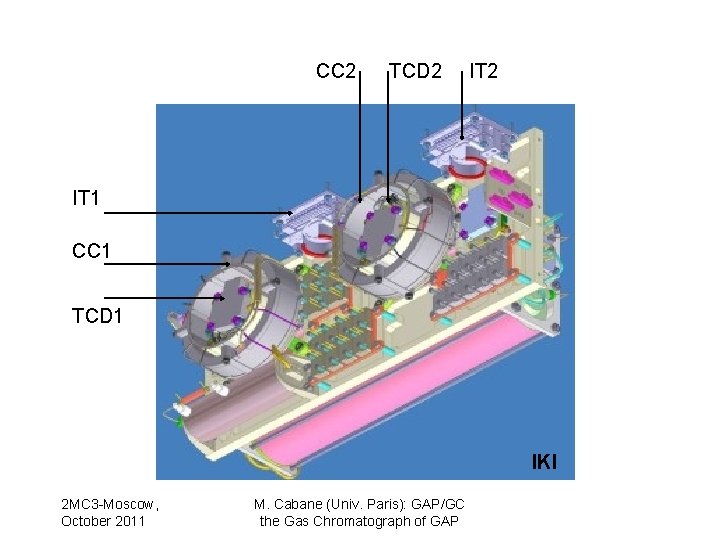
CC 2 TCD 2 IT 1 CC 1 TCD 1 IKI 2 MC 3 -Moscow, October 2011 M. Cabane (Univ. Paris): GAP/GC the Gas Chromatograph of GAP
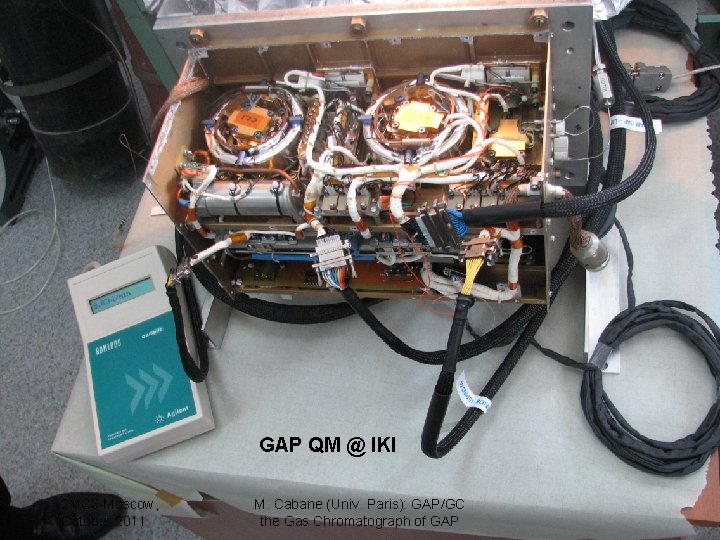
GAP QM @ IKI 2 MC 3 -Moscow, October 2011 M. Cabane (Univ. Paris): GAP/GC the Gas Chromatograph of GAP
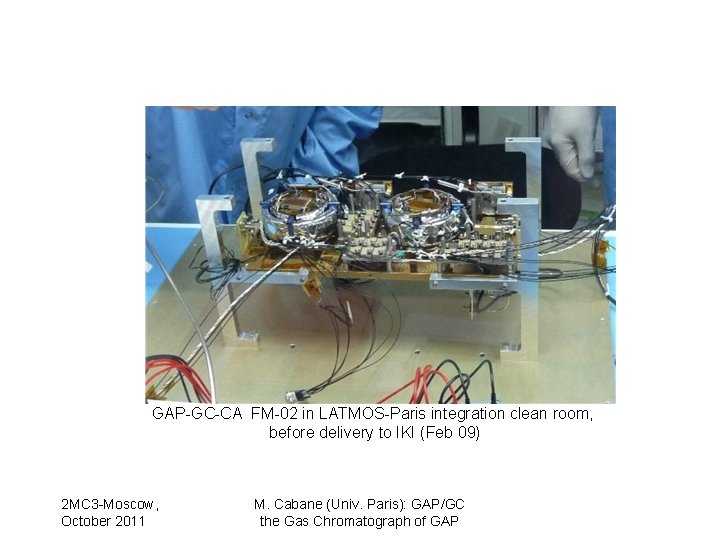
GAP-GC-CA FM-02 in LATMOS-Paris integration clean room, before delivery to IKI (Feb 09) 2 MC 3 -Moscow, October 2011 M. Cabane (Univ. Paris): GAP/GC the Gas Chromatograph of GAP
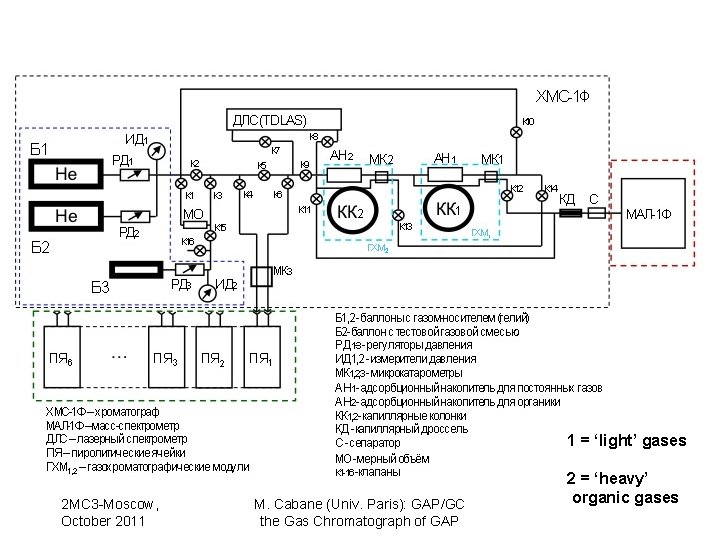
1 = ‘light’ gases 2 MC 3 -Moscow, October 2011 M. Cabane (Univ. Paris): GAP/GC the Gas Chromatograph of GAP 2 = ‘heavy’ organic gases
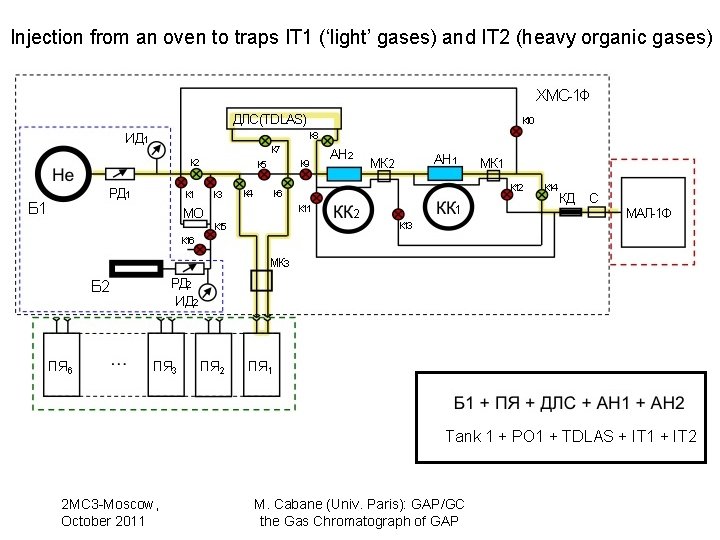
Injection from an oven to traps IT 1 (‘light’ gases) and IT 2 (heavy organic gases) Mode 1 : Tank 1 + PO 1 + TDLAS + IT 1 + IT 2 2 MC 3 -Moscow, October 2011 M. Cabane (Univ. Paris): GAP/GC the Gas Chromatograph of GAP
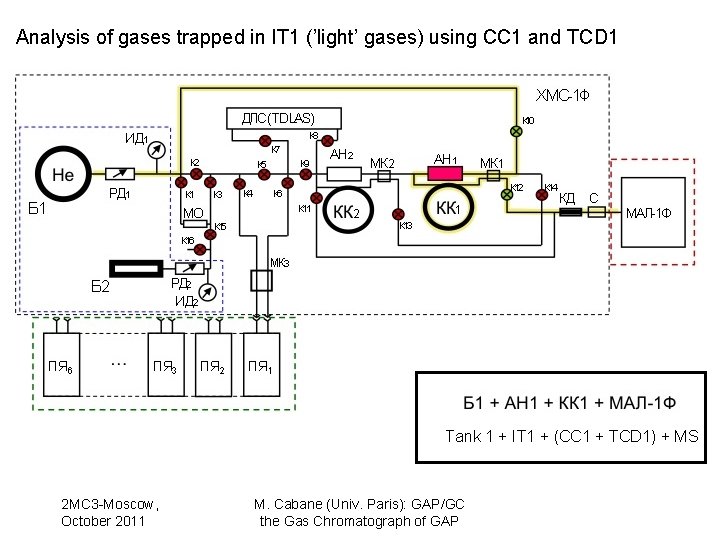
Analysis of gases trapped in IT 1 (’light’ gases) using CC 1 and TCD 1 Mode 2 : Tank 1 + IT 1 + (CC 1 + TCD 1) + MS 2 MC 3 -Moscow, October 2011 M. Cabane (Univ. Paris): GAP/GC the Gas Chromatograph of GAP
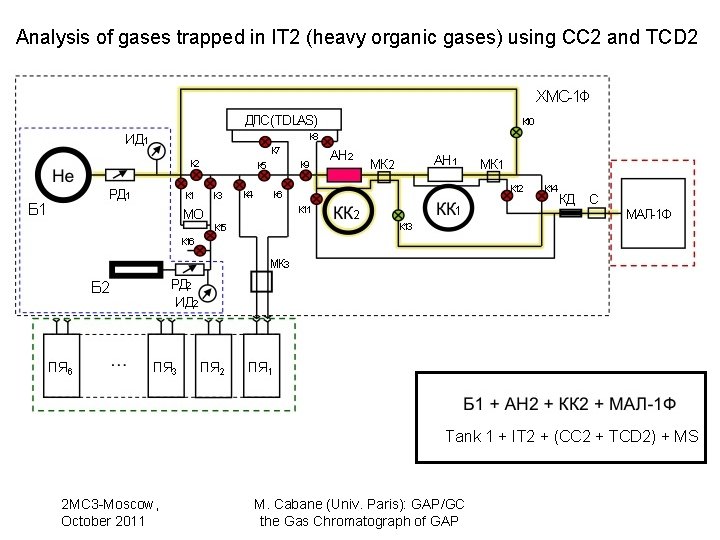
Analysis of gases trapped in IT 2 (heavy organic gases) using CC 2 and TCD 2 Mode 3 : Tank 1 + IT 2 + (CC 2 + TCD 2) + MS 2 MC 3 -Moscow, October 2011 M. Cabane (Univ. Paris): GAP/GC the Gas Chromatograph of GAP
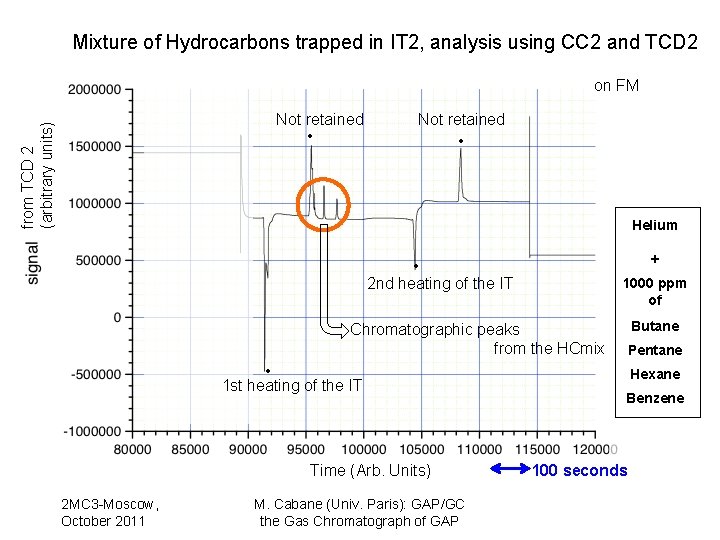
Mixture of Hydrocarbons trapped in IT 2, analysis using CC 2 and TCD 2 on FM from TCD 2 (arbitrary units) Not retained • Helium + • 2 nd heating of the IT 1000 ppm of Butane Chromatographic peaks from the HCmix • 1 st heating of the IT Time (Arb. Units) 2 MC 3 -Moscow, October 2011 M. Cabane (Univ. Paris): GAP/GC the Gas Chromatograph of GAP Pentane Hexane Benzene 100 seconds
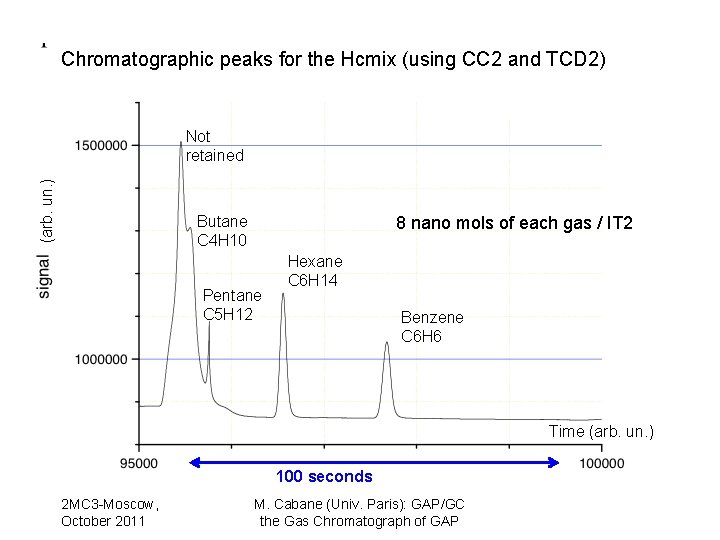
Chromatographic peaks for the Hcmix (using CC 2 and TCD 2) (arb. un. ) Not retained Butane C 4 H 10 8 nano mols of each gas / IT 2 Pentane C 5 H 12 Hexane C 6 H 14 Benzene C 6 H 6 Time (arb. un. ) 100 seconds 2 MC 3 -Moscow, October 2011 M. Cabane (Univ. Paris): GAP/GC the Gas Chromatograph of GAP
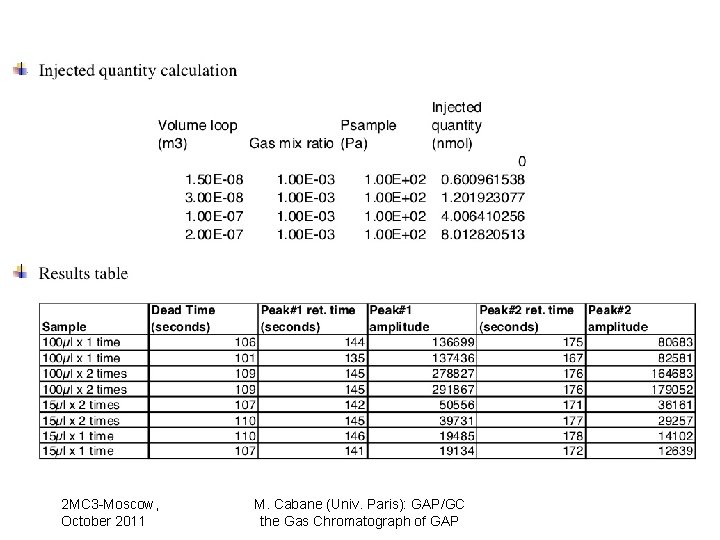
2 MC 3 -Moscow, October 2011 M. Cabane (Univ. Paris): GAP/GC the Gas Chromatograph of GAP
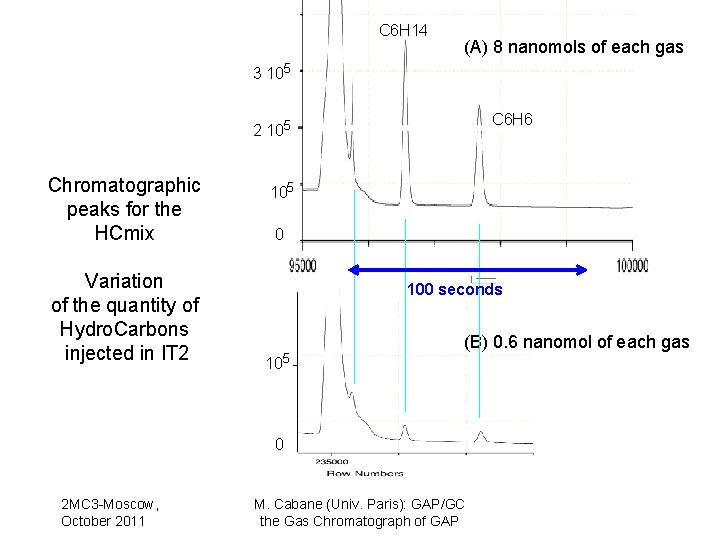
C 6 H 14 (A) 8 nanomols of each gas 3 105 C 6 H 6 2 105 Chromatographic peaks for the HCmix Variation of the quantity of Hydro. Carbons injected in IT 2 105 0 100 seconds 105 - (B) 0. 6 nanomol of each gas 0 2 MC 3 -Moscow, October 2011 M. Cabane (Univ. Paris): GAP/GC the Gas Chromatograph of GAP
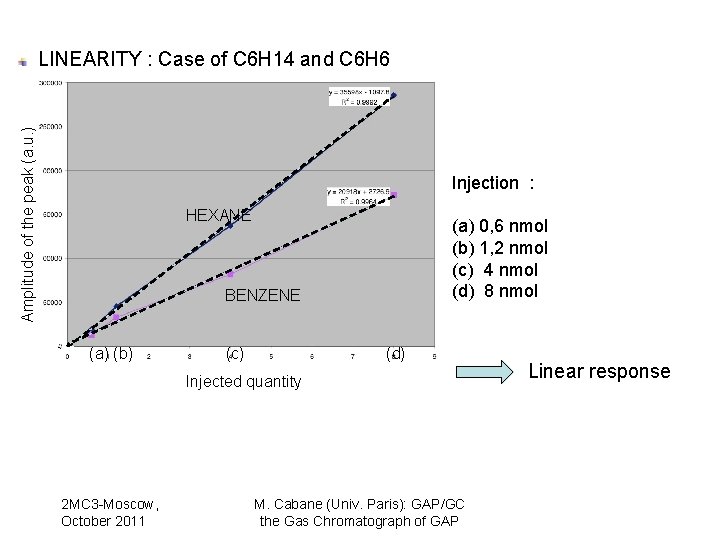
Amplitude of the peak (a. u. ) LINEARITY : Case of C 6 H 14 and C 6 H 6 Injection : HEXANE (a) 0, 6 nmol (b) 1, 2 nmol (c) 4 nmol (d) 8 nmol BENZENE (a) (b) (c) (d) Injected quantity 2 MC 3 -Moscow, October 2011 M. Cabane (Univ. Paris): GAP/GC the Gas Chromatograph of GAP Linear response
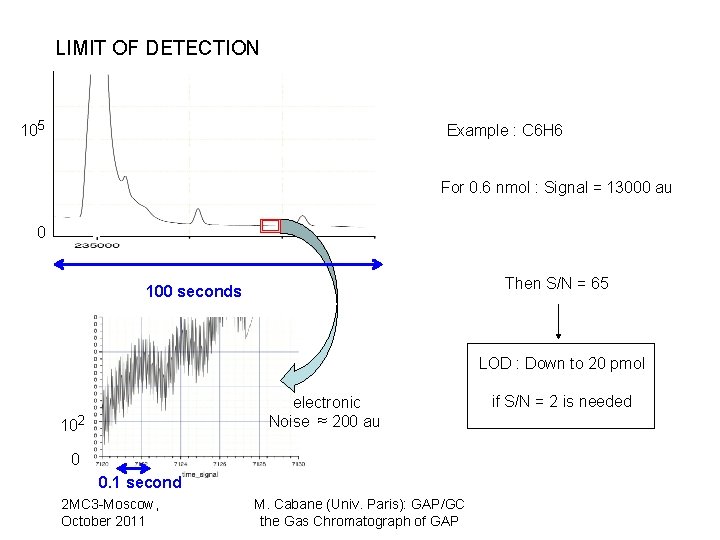
LIMIT OF DETECTION 105 Example : C 6 H 6 105 For 0. 6 nmol : Signal = 13000 au 0 0 Then S/N = 65 100 seconds Noise LOD : Down to 20 pmol electronic Noise ≈ 200 au 102 0 0. 1 second 2 MC 3 -Moscow, October 2011 M. Cabane (Univ. Paris): GAP/GC the Gas Chromatograph of GAP if S/N = 2 is needed
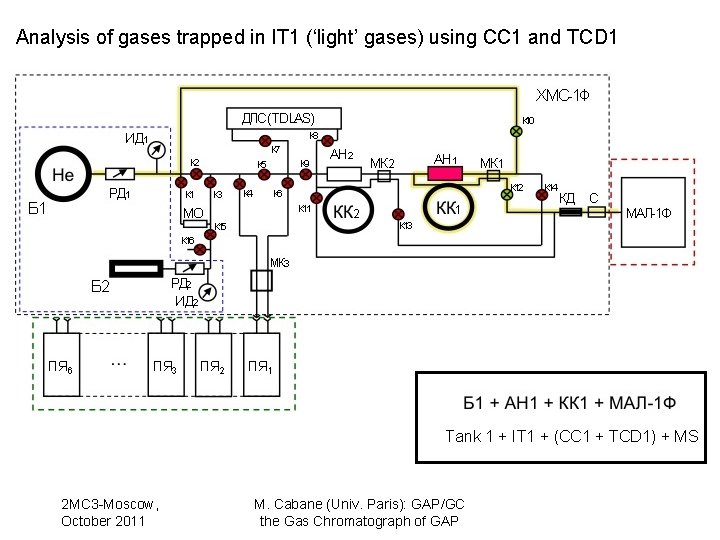
Analysis of gases trapped in IT 1 (‘light’ gases) using CC 1 and TCD 1 Mode 2 : Tank 1 + IT 1 + (CC 1 + TCD 1) + MS 2 MC 3 -Moscow, October 2011 M. Cabane (Univ. Paris): GAP/GC the Gas Chromatograph of GAP
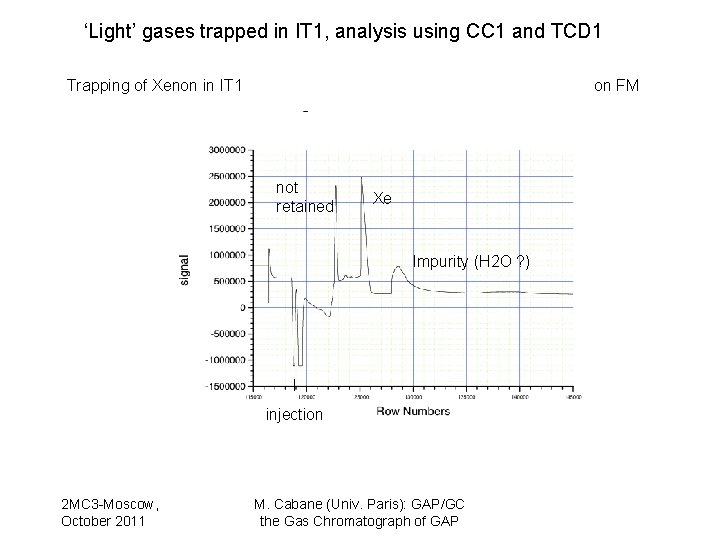
‘Light’ gases trapped in IT 1, analysis using CC 1 and TCD 1 Trapping of Xenon in IT 1 on FM not retained Xe Impurity (H 2 O ? ) I injection 2 MC 3 -Moscow, October 2011 M. Cabane (Univ. Paris): GAP/GC the Gas Chromatograph of GAP
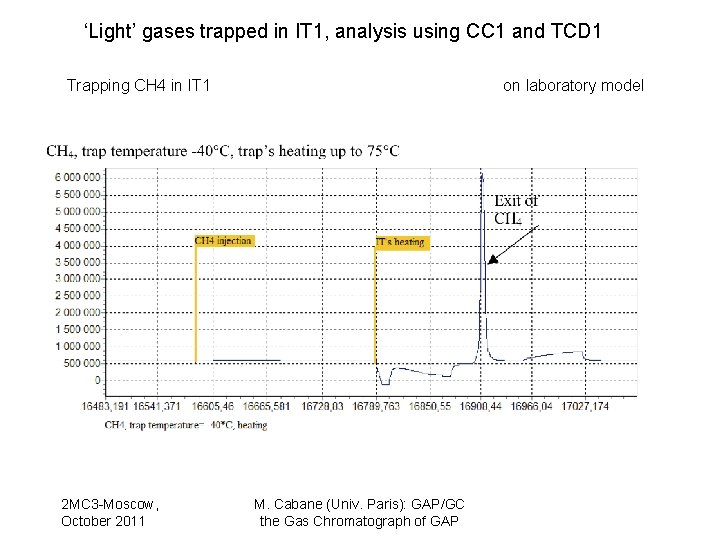
‘Light’ gases trapped in IT 1, analysis using CC 1 and TCD 1 Trapping CH 4 in IT 1 2 MC 3 -Moscow, October 2011 on laboratory model M. Cabane (Univ. Paris): GAP/GC the Gas Chromatograph of GAP
To conclude : The Gas Chromatograph has been tested by elements (IT, CC, TCD) integrated into GAP tested into GAP models Its capabilities are fully compatible with what we want to do on Phobos with GAP It remains to continue calibrations at IKI ( on GAP test bed) and in France, at LATMOS-LISA (CC, TCD, IT) 2 MC 3 -Moscow, October 2011 M. Cabane (Univ. Paris): GAP/GC the Gas Chromatograph of GAP
Thanks for your attention 2 MC 3 -Moscow, October 2011 M. Cabane (Univ. Paris): GAP/GC the Gas Chromatograph of GAP
Recents results and ongoing calibrations : Mixture : Kr CO 2 CH 4 C 2 H 2 C 4 H 10 C 5 H 12 C 6 H 14 CH 4 Kr C 2 H 2 Sulfur compounds etc. Add H 2 O 2 MC 3 -Moscow, October 2011 M. Cabane (Univ. Paris): GAP/GC the Gas Chromatograph of GAP
- Slides: 28