
2 Monte Carlo SimulationMCS is a mathematical technique
- Slides: 1
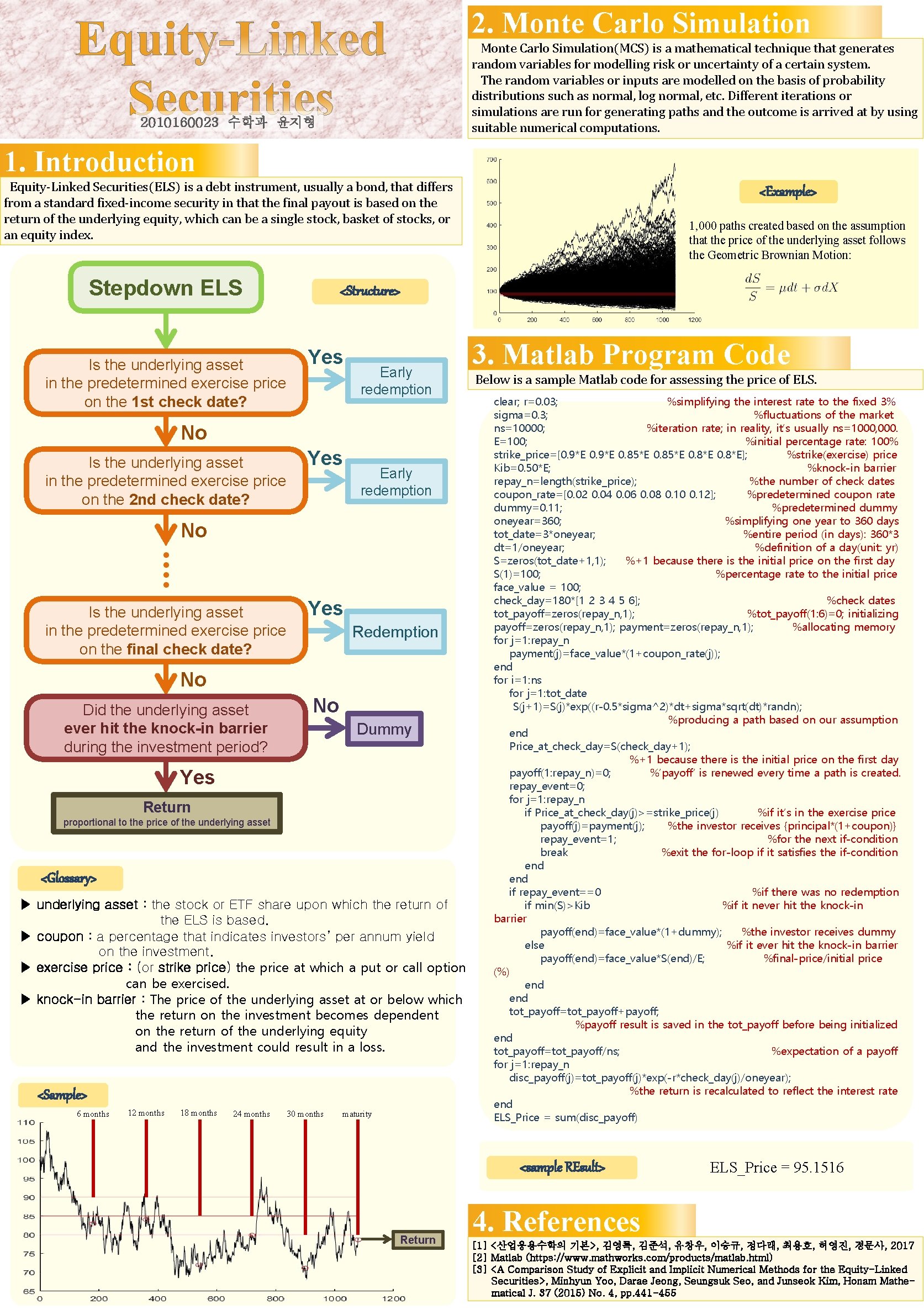
2. Monte Carlo Simulation(MCS) is a mathematical technique that generates random variables for modelling risk or uncertainty of a certain system. The random variables or inputs are modelled on the basis of probability distributions such as normal, log normal, etc. Different iterations or simulations are run for generating paths and the outcome is arrived at by using suitable numerical computations. 2010160023 수학과 윤지형 1. Introduction Equity-Linked Securities(ELS) is a debt instrument, usually a bond, that differs from a standard fixed-income security in that the final payout is based on the return of the underlying equity, which can be a single stock, basket of stocks, or an equity index. Stepdown ELS Is the underlying asset in the predetermined exercise price on the 1 st check date? Yes Early redemption No Is the underlying asset in the predetermined exercise price on the final check date? Yes Redemption No Did the underlying asset ever hit the knock-in barrier during the investment period? No Dummy Yes Return proportional to the price of the underlying asset <Glossary> ▶ underlying asset : the stock or ETF share upon which the return of the ELS is based. ▶ coupon : a percentage that indicates investors’ per annum yield on the investment. ▶ exercise price : (or strike price) the price at which a put or call option can be exercised. ▶ knock-in barrier : The price of the underlying asset at or below which the return on the investment becomes dependent on the return of the underlying equity and the investment could result in a loss. <Sample> 6 months 12 months 18 months 24 months 1, 000 paths created based on the assumption that the price of the underlying asset follows the Geometric Brownian Motion: <Structure> No Is the underlying asset in the predetermined exercise price on the 2 nd check date? <Example> 30 months maturity 3. Matlab Program Code Below is a sample Matlab code for assessing the price of ELS. clear; r=0. 03; %simplifying the interest rate to the fixed 3% sigma=0. 3; %fluctuations of the market ns=10000; %iteration rate; in reality, it’s usually ns=1000, 000. E=100; %initial percentage rate: 100% strike_price=[0. 9*E 0. 85*E 0. 8*E]; %strike(exercise) price Kib=0. 50*E; %knock-in barrier repay_n=length(strike_price); %the number of check dates coupon_rate=[0. 02 0. 04 0. 06 0. 08 0. 10 0. 12]; %predetermined coupon rate dummy=0. 11; %predetermined dummy oneyear=360; %simplifying one year to 360 days tot_date=3*oneyear; %entire period (in days): 360*3 dt=1/oneyear; %definition of a day(unit: yr) S=zeros(tot_date+1, 1); %+1 because there is the initial price on the first day S(1)=100; %percentage rate to the initial price face_value = 100; check_day=180*[1 2 3 4 5 6]; %check dates tot_payoff=zeros(repay_n, 1); %tot_payoff(1: 6)=0; initializing payoff=zeros(repay_n, 1); payment=zeros(repay_n, 1); %allocating memory for j=1: repay_n payment(j)=face_value*(1+coupon_rate(j)); end for i=1: ns for j=1: tot_date S(j+1)=S(j)*exp((r-0. 5*sigma^2)*dt+sigma*sqrt(dt)*randn); %producing a path based on our assumption end Price_at_check_day=S(check_day+1); %+1 because there is the initial price on the first day payoff(1: repay_n)=0; %’payoff’ is renewed every time a path is created. repay_event=0; for j=1: repay_n if Price_at_check_day(j)>=strike_price(j) %if it’s in the exercise price payoff(j)=payment(j); %the investor receives {principal*(1+coupon)} repay_event=1; %for the next if-condition break %exit the for-loop if it satisfies the if-condition end if repay_event==0 %if there was no redemption if min(S)>Kib %if it never hit the knock-in barrier payoff(end)=face_value*(1+dummy); %the investor receives dummy else %if it ever hit the knock-in barrier payoff(end)=face_value*S(end)/E; %final-price/initial price (%) end tot_payoff=tot_payoff+payoff; %payoff result is saved in the tot_payoff before being initialized end tot_payoff=tot_payoff/ns; %expectation of a payoff for j=1: repay_n disc_payoff(j)=tot_payoff(j)*exp(-r*check_day(j)/oneyear); %the return is recalculated to reflect the interest rate end ELS_Price = sum(disc_payoff) <sample REsult> Return ELS_Price = 95. 1516 4. References [1] <산업응용수학의 기본>, 김영록, 김준석, 유창우, 이승규, 정다래, 최용호, 허영진, 경문사, 2017 [2] Matlab (https: //www. mathworks. com/products/matlab. html) [3] <A Comparison Study of Explicit and Implicit Numerical Methods for the Equity-Linked Securities>, Minhyun Yoo, Darae Jeong, Seungsuk Seo, and Junseok Kim, Honam Mathematical J. 37 (2015) No. 4, pp. 441 -455