
2 Model Building and Gains from Trade Previously
2 Model Building and Gains from Trade
Previously • Economics is the study of how people allocate their limited resources to satisfy their nearly unlimited wants. • “Scarcity” refers to the limited nature of society’s resources. • Incentives are factors that motivate a person to act or exert effort.
Big Questions 1. How do economists study the economy? 2. What is a production possibilities frontier? 3. What are the benefits of specialization and trade? 4. What is the trade-off between having more now and having more later?
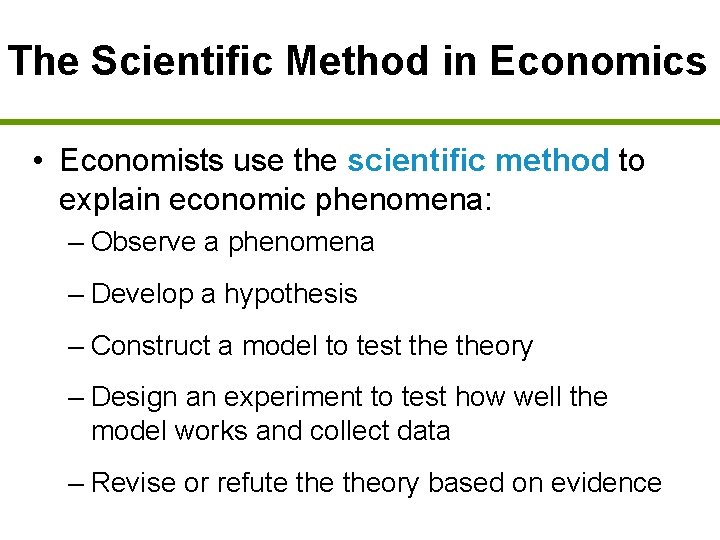
The Scientific Method in Economics • Economists use the scientific method to explain economic phenomena: – Observe a phenomena – Develop a hypothesis – Construct a model to test theory – Design an experiment to test how well the model works and collect data – Revise or refute theory based on evidence

Positive and Normative Analysis • Positive statement – Can be tested and validated – Describes “what is” • Normative statement – An opinion that cannot be tested or validated – Describes “what ought to be” • Economists are concerned with positive analysis.
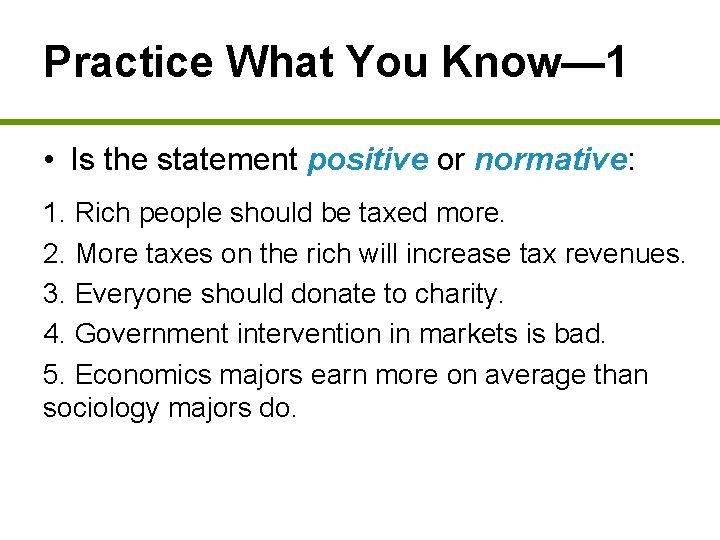
Practice What You Know— 1 • Is the statement positive or normative: 1. Rich people should be taxed more. 2. More taxes on the rich will increase tax revenues. 3. Everyone should donate to charity. 4. Government intervention in markets is bad. 5. Economics majors earn more on average than sociology majors do.
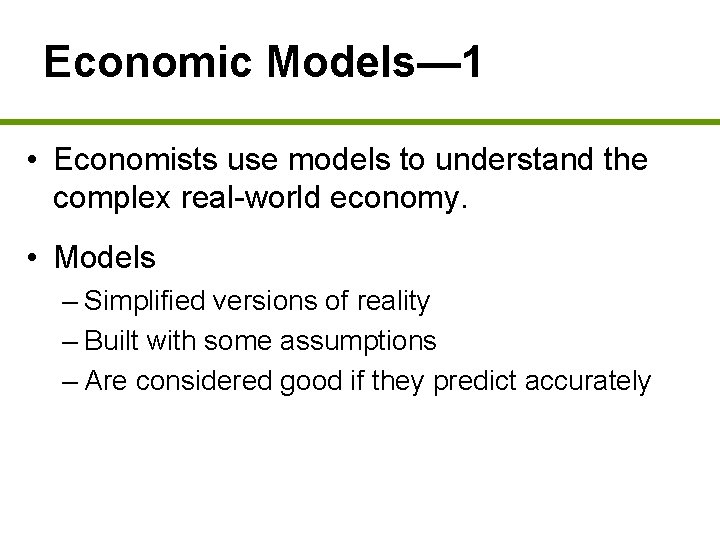
Economic Models— 1 • Economists use models to understand the complex real-world economy. • Models – Simplified versions of reality – Built with some assumptions – Are considered good if they predict accurately
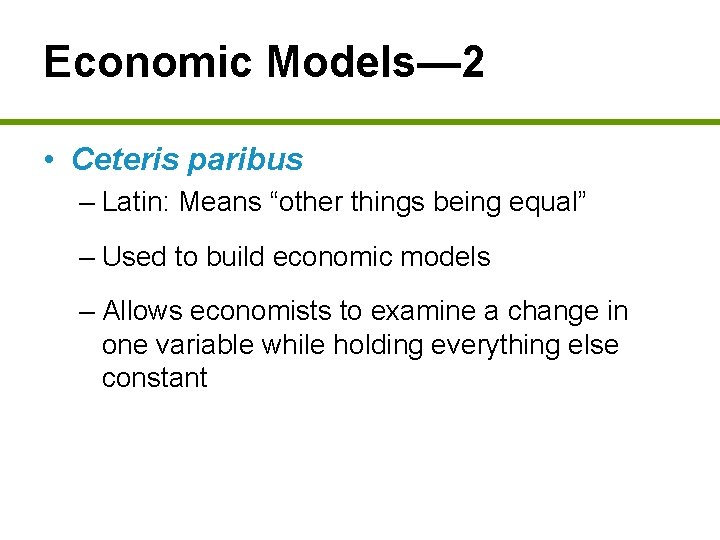
Economic Models— 2 • Ceteris paribus – Latin: Means “other things being equal” – Used to build economic models – Allows economists to examine a change in one variable while holding everything else constant
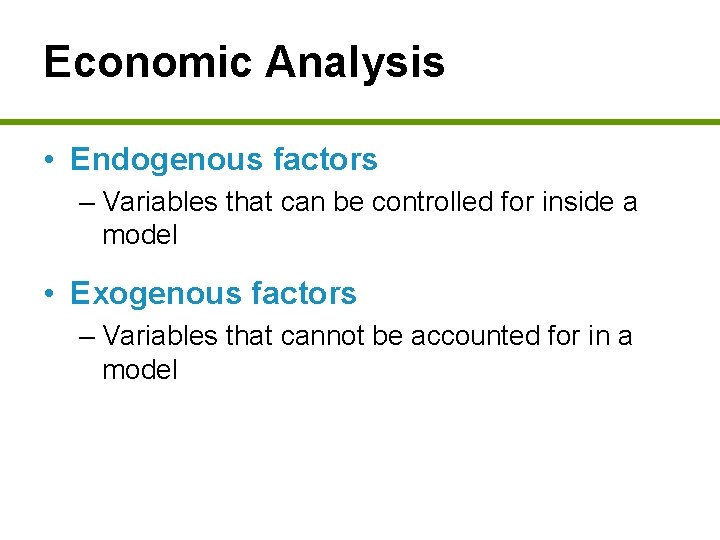
Economic Analysis • Endogenous factors – Variables that can be controlled for inside a model • Exogenous factors – Variables that cannot be accounted for in a model
Danger of Faulty Assumptions • When building a model, you must decide: – What variables to include – What variables to exclude • These aren’t known with certainty. • Model assumptions are also important for the model’s success in predicting outcomes. – It is necessary to often examine and reevaluate the assumptions in models.
Practice What You Know— 2 • What is a possible problem with using faulty assumptions when building an economic model? A. The model could become too popular. B. It could lead to poor economic decisions. C. It means we never have to rebuild the model. D. It could cause too much wealth.
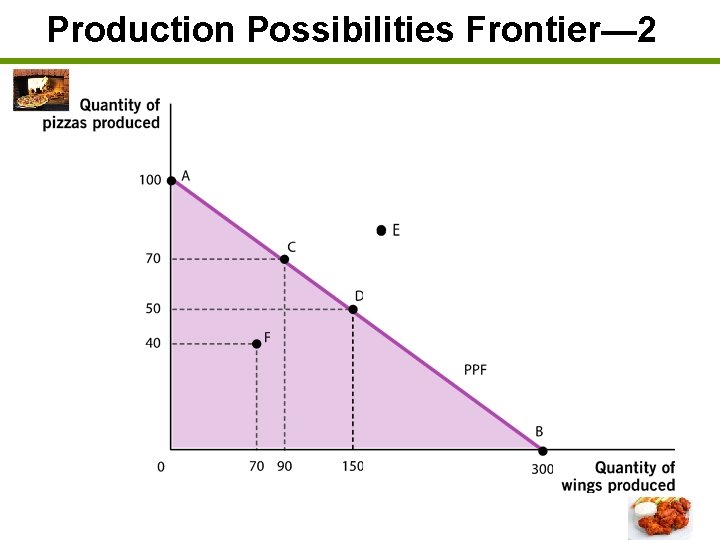
Production Possibilities Frontier — 1 • Production possibilities frontier – Illustrates the combinations of outputs that a society can produce if all of its resources are being used efficiently • Assumptions (ceteris paribus): – Technology fixed – Quantity of resources fixed – Society produces only two goods: • Pizza and wings
Production Possibilities Frontier— 2
Practice What You Know— 3 • With regard to the PPF, an efficient point is a point that is A. impossible to reach. B. inside the PPF. C. outside the PPF. D. on the PPF.
PPF and Opportunity Cost— 1 • Why is the PPF downward-sloping? – Must give up one good to increase production of another • Recall opportunity cost – Highest-valued alternative given up to pursue an action
Practice What You Know— 4 • If we move down and to the right along a PPF, the opportunity cost of this movement can be measured in terms of A. how much of the x-axis good we gain. B. how much of the y-axis good we gain. C. how much of the x-axis good we give up. D. how much of the y-axis good we give up.
PPF and Opportunity Cost— 2 • Not all resources are perfectly adaptable for producing both goods – The PPF will not have a constant slope. – The opportunity cost of producing a good will rise as we produce more of it. • The slope will get steeper as we move from left to right.
PPF and Opportunity Cost— 3 • Law of increasing opportunity cost – The opportunity cost of producing a good rises as society produces more of it. – The PPF will not have a constant slope. • The slope will rise (in absolute value) as we move from left to right.
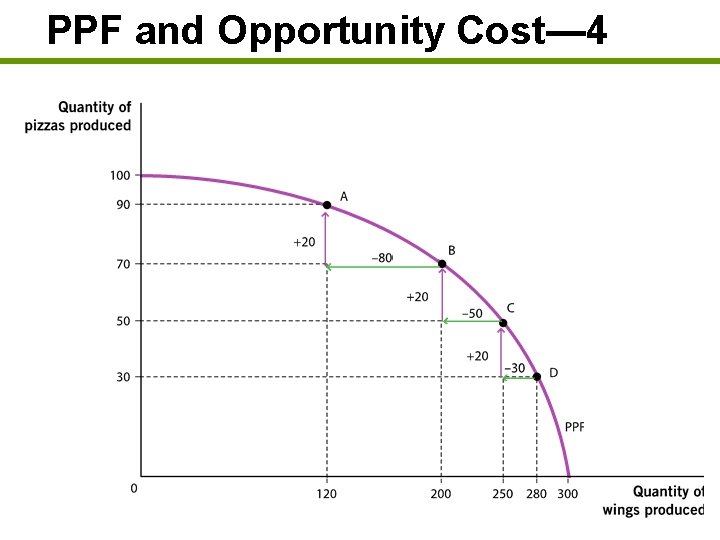
PPF and Opportunity Cost— 4
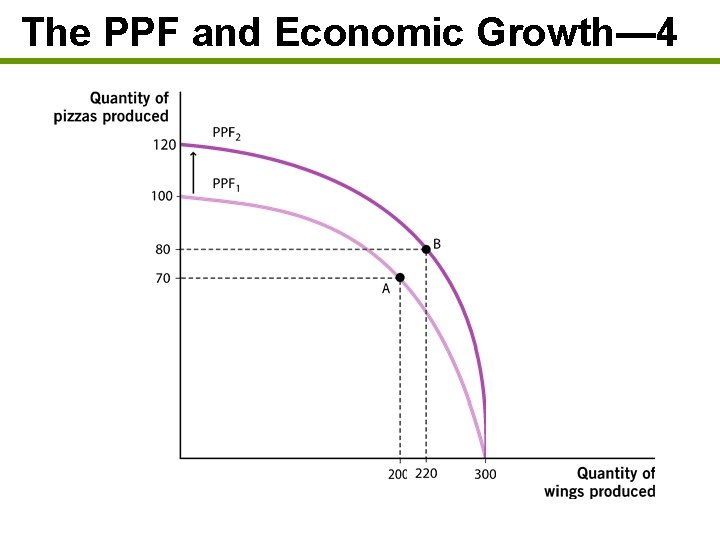
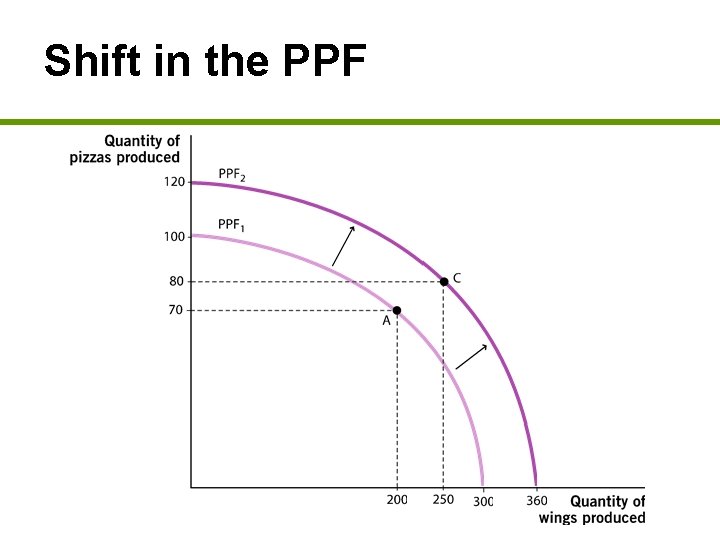
The PPF and Economic Growth — 1 • Economic growth – The process that enables a society to produce more output in the future – Can be shown by a shift outward of the PPF • Some previously unattainable good combinations would now be possible to produce
The PPF and Economic Growth — 2 • The PPF could shift graphically in two ways. – New resources or technology could be introduced that either • affect the production of one good, or • affect the production of both goods.
The PPF and Economic Growth — 3 • The PPF could shift out because of – New technology – New (or better) resources available • These changes in technology or resources could affect the production of – Only one good – Both goods
The PPF and Economic Growth— 4
Shift in the PPF
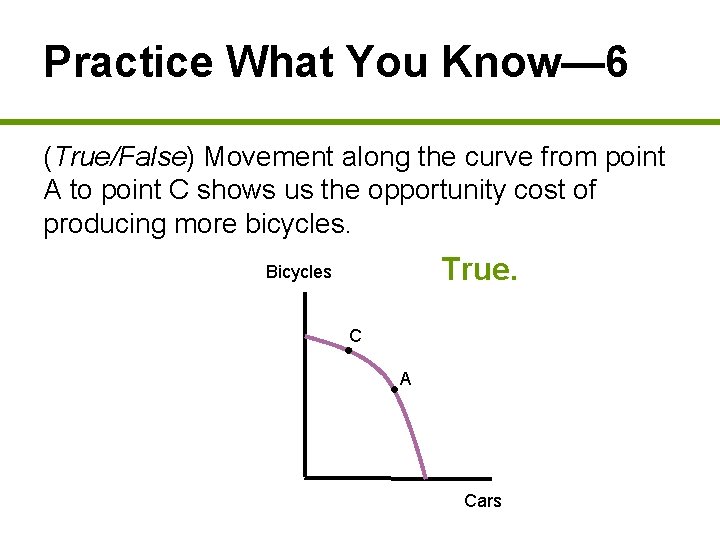
Practice What You Know— 6 (True/False) Movement along the curve from point A to point C shows us the opportunity cost of producing more bicycles. True. Bicycles C A Cars
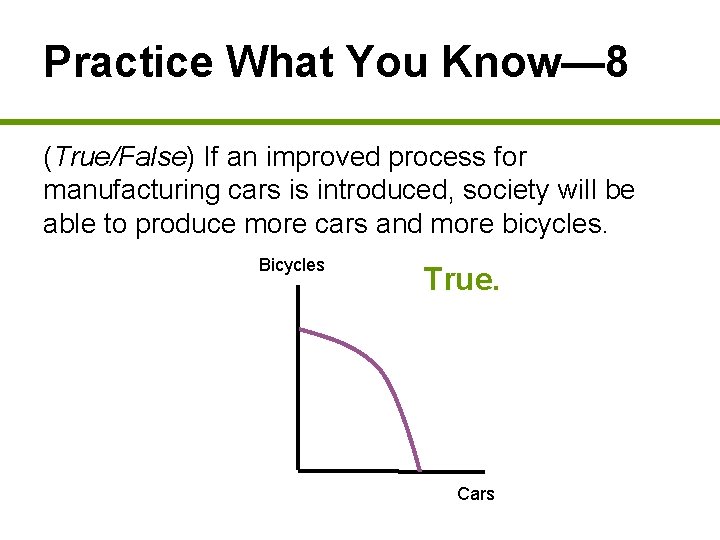
Practice What You Know— 8 (True/False) If an improved process for manufacturing cars is introduced, society will be able to produce more cars and more bicycles. Bicycles True. Cars
Practice What You Know— 9 • Suppose there is high unemployment. With respect to the PPF, what will happen? A. The PPF will shift inward. B. The PPF will shift outward. C. We will produce at a point inside the PPF. D. We will produce at a point outside the PPF.
Specialization and Trade— 1 • Improvements in technology and resources can make an economy more productive. • Specialization and trade can also create gains for society. • Specialization – The limiting of one’s work to a particular area
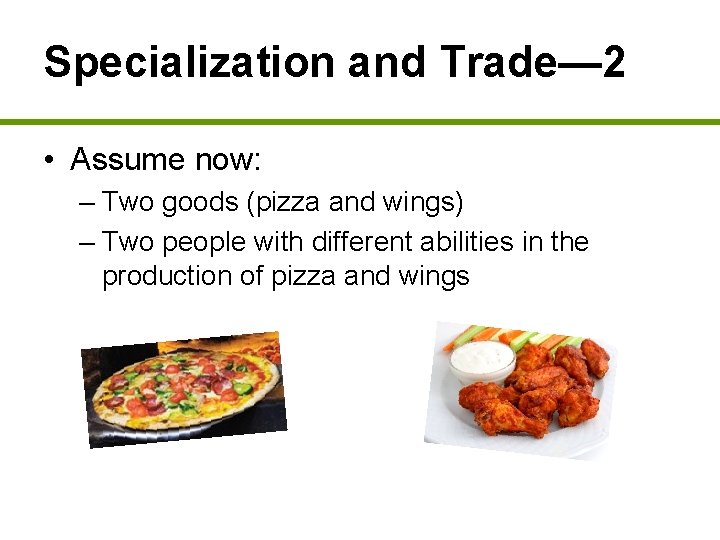
Specialization and Trade— 2 • Assume now: – Two goods (pizza and wings) – Two people with different abilities in the production of pizza and wings
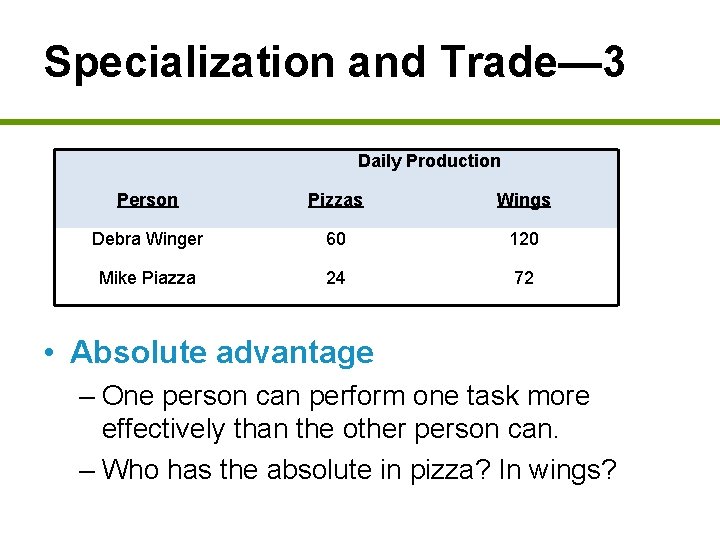
Specialization and Trade— 3 Daily Production Person Pizzas Wings Debra Winger 60 120 Mike Piazza 24 72 • Absolute advantage – One person can perform one task more effectively than the other person can. – Who has the absolute in pizza? In wings?

Specialization and Trade— 4
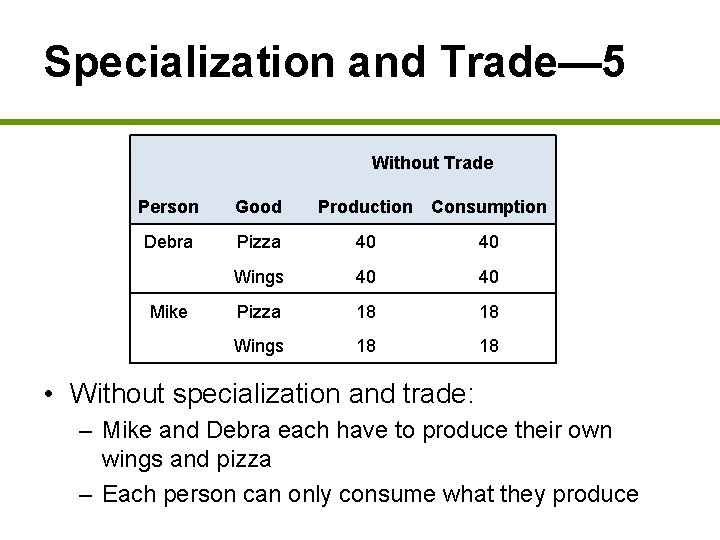
Specialization and Trade— 5 Without Trade Person Good Debra Pizza 40 40 Wings 40 40 Pizza 18 18 Wings 18 18 Mike Production Consumption • Without specialization and trade: – Mike and Debra each have to produce their own wings and pizza – Each person can only consume what they produce
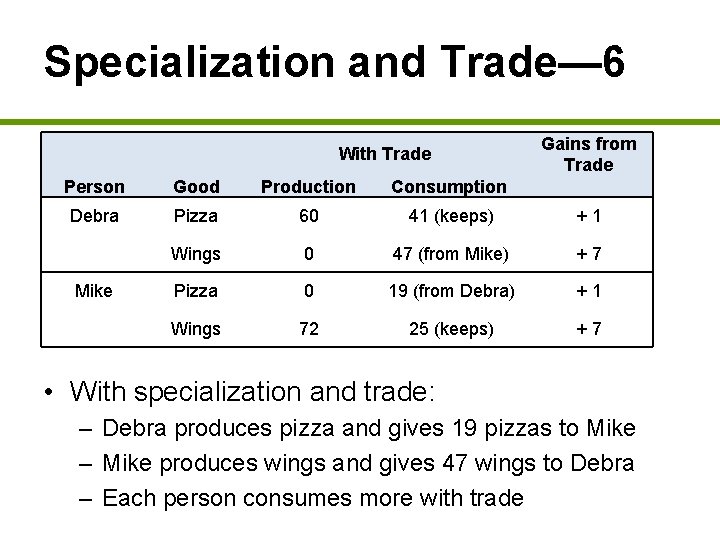
Specialization and Trade— 6 With Trade Gains from Trade Person Good Production Consumption Debra Pizza 60 41 (keeps) +1 Wings 0 47 (from Mike) +7 Pizza 0 19 (from Debra) +1 Wings 72 25 (keeps) +7 Mike • With specialization and trade: – Debra produces pizza and gives 19 pizzas to Mike – Mike produces wings and gives 47 wings to Debra – Each person consumes more with trade
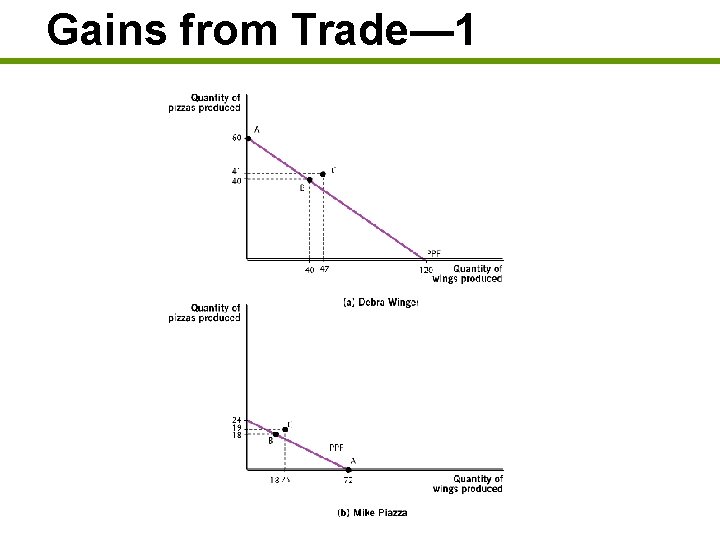
Gains from Trade— 1
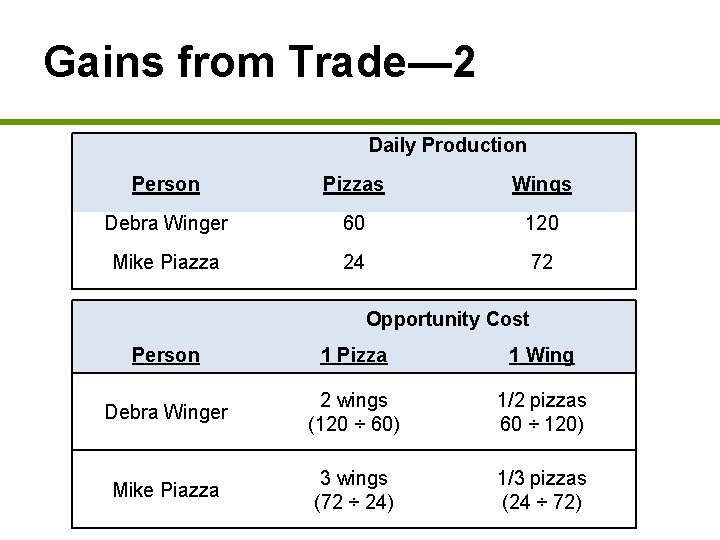
Gains from Trade— 2 Daily Production Person Pizzas Wings Debra Winger 60 120 Mike Piazza 24 72 Opportunity Cost Person 1 Pizza 1 Wing Debra Winger 2 wings (120 ÷ 60) 1/2 pizzas 60 ÷ 120) Mike Piazza 3 wings (72 ÷ 24) 1/3 pizzas (24 ÷ 72)
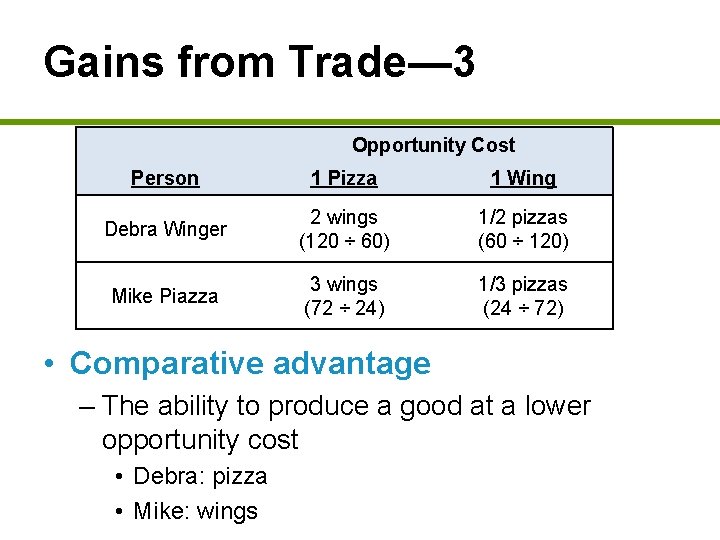
Gains from Trade— 3 Opportunity Cost Person 1 Pizza 1 Wing Debra Winger 2 wings (120 ÷ 60) 1/2 pizzas (60 ÷ 120) Mike Piazza 3 wings (72 ÷ 24) 1/3 pizzas (24 ÷ 72) • Comparative advantage – The ability to produce a good at a lower opportunity cost • Debra: pizza • Mike: wings
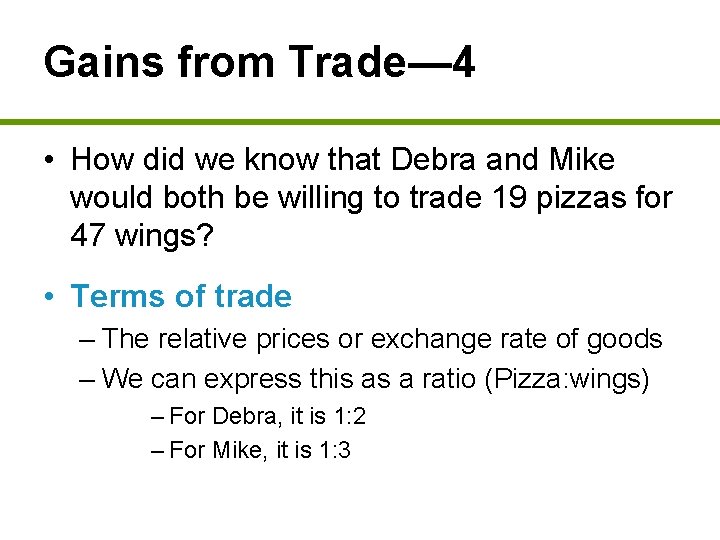
Gains from Trade— 4 • How did we know that Debra and Mike would both be willing to trade 19 pizzas for 47 wings? • Terms of trade – The relative prices or exchange rate of goods – We can express this as a ratio (Pizza: wings) – For Debra, it is 1: 2 – For Mike, it is 1: 3
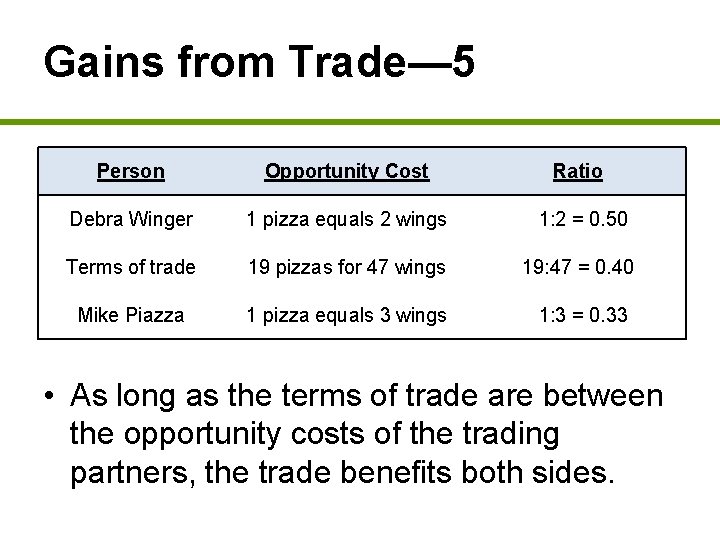
Gains from Trade— 5 Person Opportunity Cost Ratio Debra Winger 1 pizza equals 2 wings 1: 2 = 0. 50 Terms of trade 19 pizzas for 47 wings 19: 47 = 0. 40 Mike Piazza 1 pizza equals 3 wings 1: 3 = 0. 33 • As long as the terms of trade are between the opportunity costs of the trading partners, the trade benefits both sides.
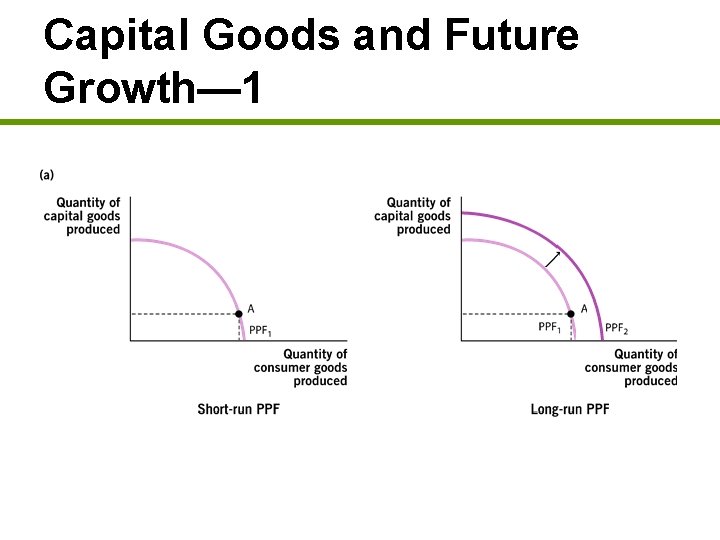
Capital Goods and Future Growth— 1
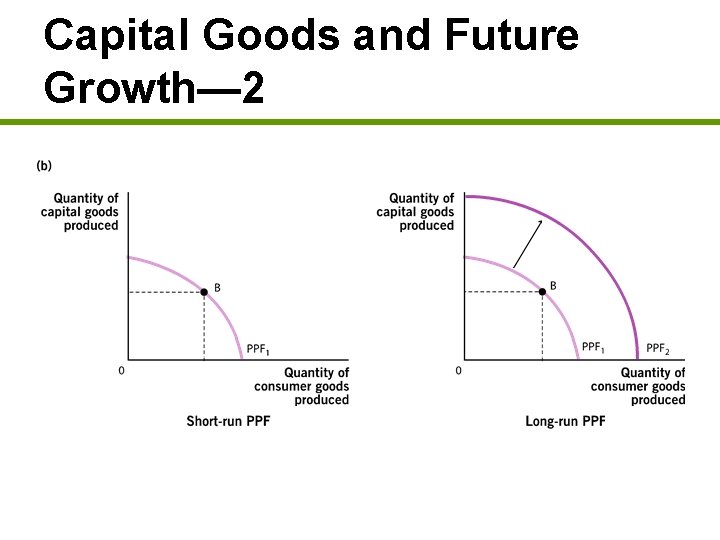
Capital Goods and Future Growth— 2
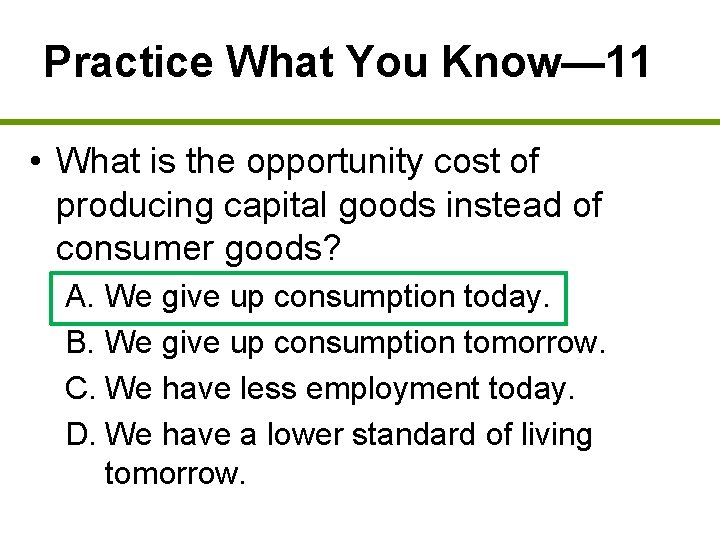
Practice What You Know— 11 • What is the opportunity cost of producing capital goods instead of consumer goods? A. We give up consumption today. B. We give up consumption tomorrow. C. We have less employment today. D. We have a lower standard of living tomorrow.
Conclusion • Economists use simplified models to understand how the economy works. • The production possibilities frontier (PPF) illustrates the benefits of trade and allows us to describe ways to grow the economy. • When producers specialize, they focus their efforts on those goods and services for which they have the lowest opportunity cost and trade with others who are good at making something else.
- Slides: 42