
2 Memory learning Functions of specific cortical areas
- Slides: 64
2 Memory & learning
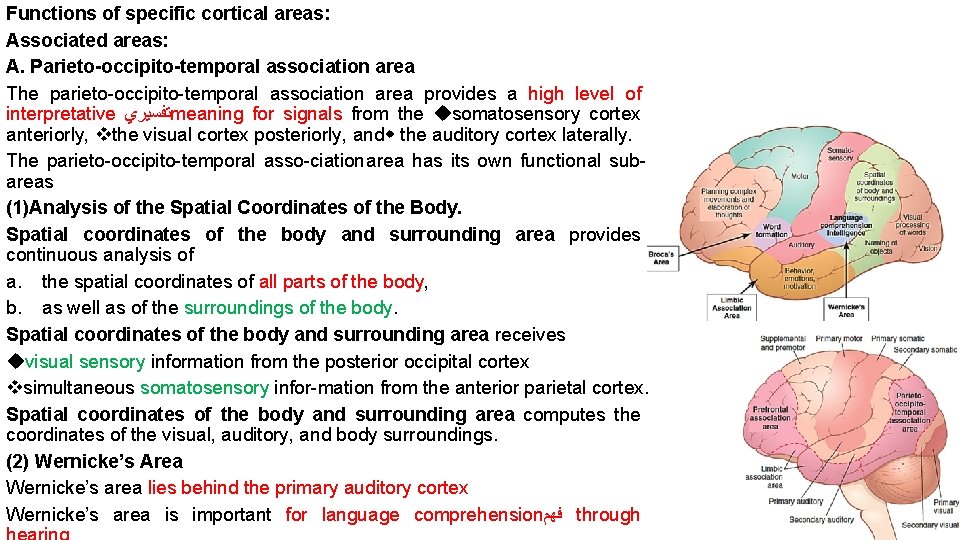
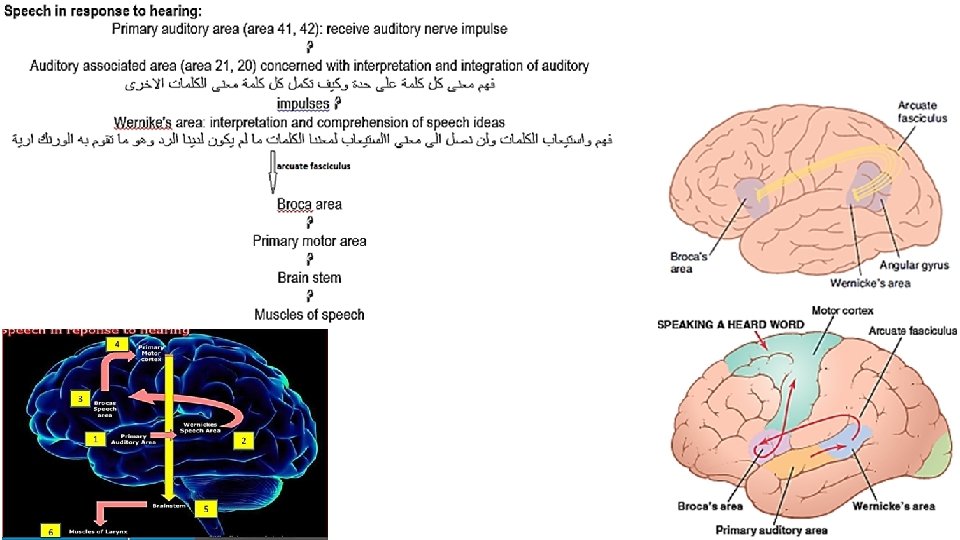
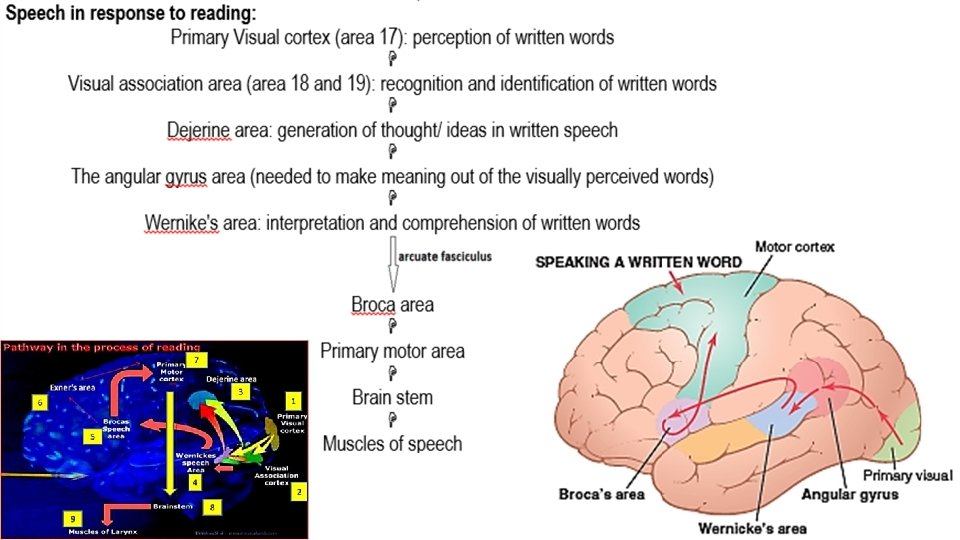
Functions of specific cortical areas: Associated areas: A. Parieto-occipito-temporal association area The parieto occipito temporal association area provides a high level of interpretative ﺗﻔﺴﻴﺮﻱ meaning for signals from the somatosensory cortex anteriorly, the visual cortex posteriorly, and the auditory cortex laterally. The parieto occipito temporal asso ciation area has its own functional sub areas (1)Analysis of the Spatial Coordinates of the Body. Spatial coordinates of the body and surrounding area provides continuous analysis of a. the spatial coordinates of all parts of the body, b. as well as of the surroundings of the body. Spatial coordinates of the body and surrounding area receives visual sensory information from the posterior occipital cortex simultaneous somatosensory infor mation from the anterior parietal cortex. Spatial coordinates of the body and surrounding area computes the coordinates of the visual, auditory, and body surroundings. (2) Wernicke’s Area Wernicke’s area lies behind the primary auditory cortex Wernicke’s area is important for language comprehension ﻓﻬﻢ through
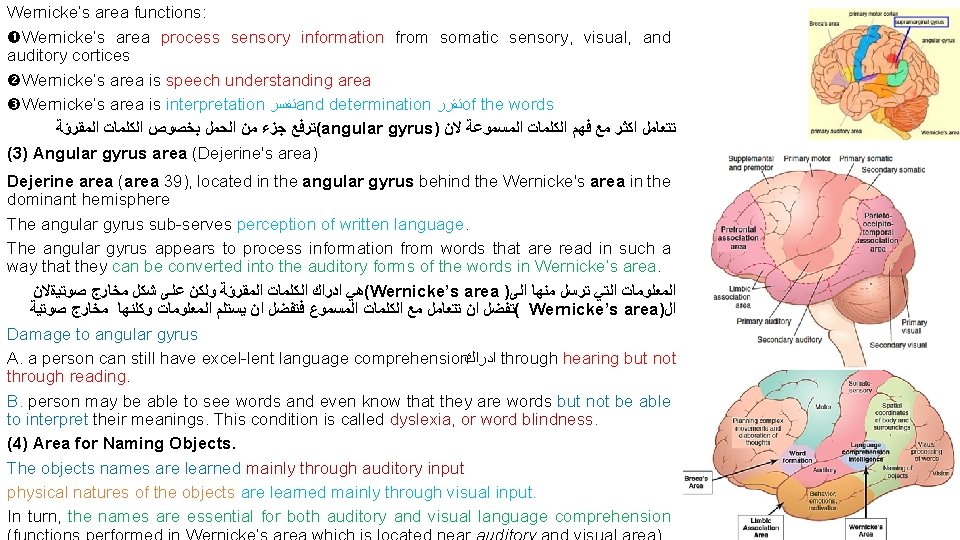
Wernicke’s area functions: Wernicke’s area process sensory information from somatic sensory, visual, and auditory cortices Wernicke’s area is speech understanding area Wernicke’s area is interpretation ﺗﻔﺴﺮ and determination ﺗﻘﺮﺭ of the words (ﺗﺮﻓﻊ ﺟﺰﺀ ﻣﻦ ﺍﻟﺤﻤﻞ ﺑﺨﺼﻮﺹ ﺍﻟﻜﻠﻤﺎﺕ ﺍﻟﻤﻘﺮﺅﺔ angular gyrus) ﺗﺘﻌﺎﻣﻞ ﺍﻛﺜﺮ ﻣﻊ ﻓﻬﻢ ﺍﻟﻜﻠﻤﺎﺕ ﺍﻟﻤﺴﻤﻮﻋﺔ ﻻﻥ (3) Angular gyrus area (Dejerine's area) Dejerine area (area 39), located in the angular gyrus behind the Wernicke's area in the dominant hemisphere The angular gyrus sub serves perception of written language. The angular gyrus appears to process information from words that are read in such a way that they can be converted into the auditory forms of the words in Wernicke’s area. (ﻫﻲ ﺍﺩﺭﺍﻙ ﺍﻟﻜﻠﻤﺎﺕ ﺍﻟﻤﻘﺮﺅﺔ ﻭﻟﻜﻦ ﻋﻠﻰ ﺷﻜﻞ ﻣﺨﺎﺭﺝ ﺻﻮﺗﻴةﻻﻥ Wernicke’s area ) ﺍﻟﻤﻌﻠﻮﻣﺎﺕ ﺍﻟﺘﻲ ﺗﺮﺳﻞ ﻣﻨﻬﺎ ﺍﻟﻰ (ﺗﻔﻀﻞ ﺍﻥ ﺗﺘﻌﺎﻣﻞ ﻣﻊ ﺍﻟﻜﻠﻤﺎﺕ ﺍﻟﻤﺴﻤﻮﻉ ﻓﺘﻔﻀﻞ ﺍﻥ ﻳﺴﺘﻠﻢ ﺍﻟﻤﻌﻠﻮﻣﺎﺕ ﻭﻛﻠﺌﻬﺎ ﻣﺨﺎﺭﺝ ﺻﻮﺗﻴﺔ Wernicke’s area) ﺍﻝ Damage to angular gyrus A. a person can still have excel lent language comprehension ﺍﺩﺭﺍﻙ through hearing but not through reading. B. person may be able to see words and even know that they are words but not be able to interpret their meanings. This condition is called dyslexia, or word blindness. (4) Area for Naming Objects. The objects names are learned mainly through auditory input physical natures of the objects are learned mainly through visual input. In turn, the names are essential for both auditory and visual language comprehension
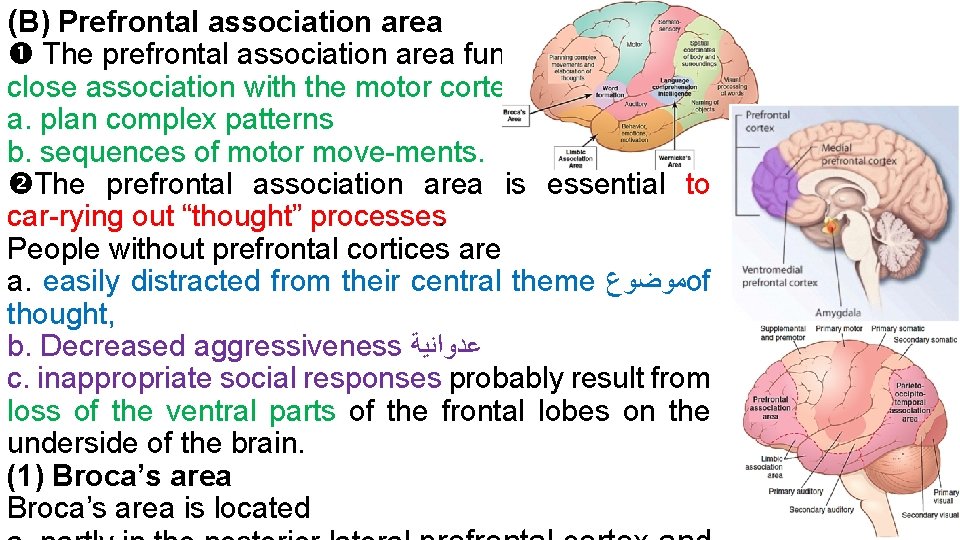
(B) Prefrontal association area The prefrontal association area functions in close association with the motor cortex to a. plan complex patterns b. sequences of motor move ments. The prefrontal association area is essential to car rying out “thought” processes. People without prefrontal cortices are a. easily distracted from their central theme ﻣﻮﺿﻮﻉ of thought, b. Decreased aggressiveness ﻋﺪﻭﺍﻧﻴﺔ c. inappropriate social responses probably result from loss of the ventral parts of the frontal lobes on the underside of the brain. (1) Broca’s area is located
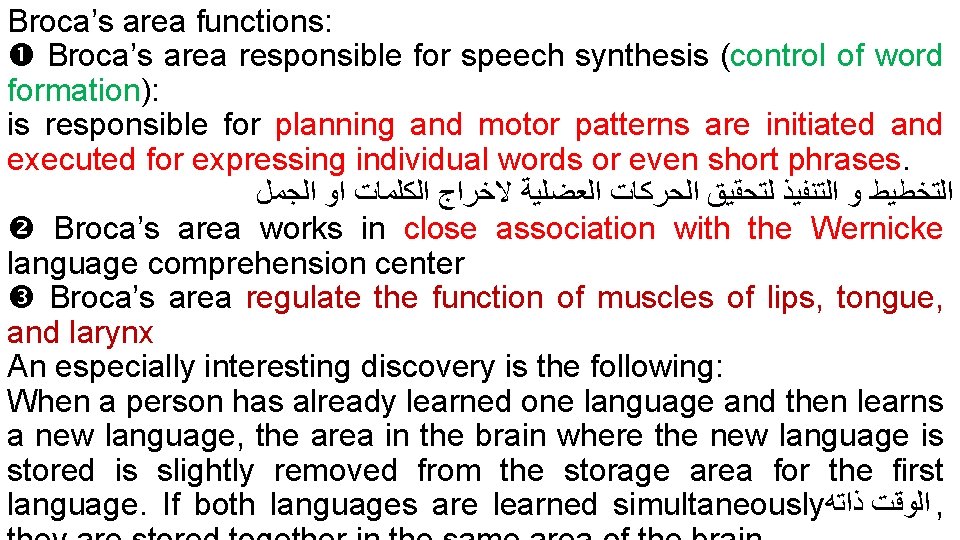
Broca’s area functions: Broca’s area responsible for speech synthesis (control of word formation): is responsible for planning and motor patterns are initiated and executed for expressing individual words or even short phrases. ﺍﻟﺘﺨﻄﻴﻂ ﻭ ﺍﻟﺘﻨﻔﻴﺬ ﻟﺘﺤﻘﻴﻖ ﺍﻟﺤﺮﻛﺎﺕ ﺍﻟﻌﻀﻠﻴﺔ ﻻﺧﺮﺍﺝ ﺍﻟﻜﻠﻤﺎﺕ ﺍﻭ ﺍﻟﺠﻤﻞ Broca’s area works in close association with the Wernicke language comprehension center Broca’s area regulate the function of muscles of lips, tongue, and larynx An especially interesting discovery is the following: When a person has already learned one language and then learns a new language, the area in the brain where the new language is stored is slightly removed from the storage area for the first language. If both languages are learned simultaneously ﺍﻟﻮﻗﺖ ﺫﺍﺗﻪ ,
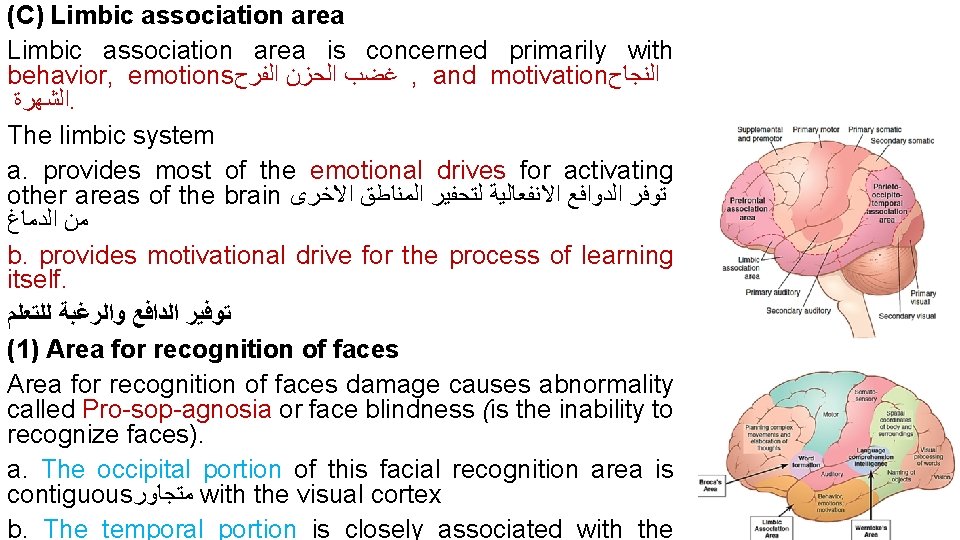
(C) Limbic association area is concerned primarily with behavior, emotions ﻏﻀﺐ ﺍﻟﺤﺰﻥ ﺍﻟﻔﺮﺡ , and motivation ﺍﻟﻨﺠﺎﺡ ﺍﻟﺸﻬﺮﺓ. The limbic system a. provides most of the emotional drives for activating other areas of the brain ﺗﻮﻓﺮ ﺍﻟﺪﻭﺍﻓﻊ ﺍﻻﻧﻔﻌﺎﻟﻴﺔ ﻟﺘﺤﻔﻴﺮ ﺍﻟﻤﻨﺎﻃﻖ ﺍﻻﺧﺮﻯ ﻣﻦ ﺍﻟﺪﻣﺎﻍ b. provides motivational drive for the process of learning itself. ﺗﻮﻓﻴﺮ ﺍﻟﺪﺍﻓﻊ ﻭﺍﻟﺮﻏﺒﺔ ﻟﻠﺘﻌﻠﻢ (1) Area for recognition of faces damage causes abnormality called Pro sop agnosia or face blindness (is the inability to recognize faces). a. The occipital portion of this facial recognition area is contiguous ﻣﺘﺠﺎﻭﺭ with the visual cortex b. The temporal portion is closely associated with the
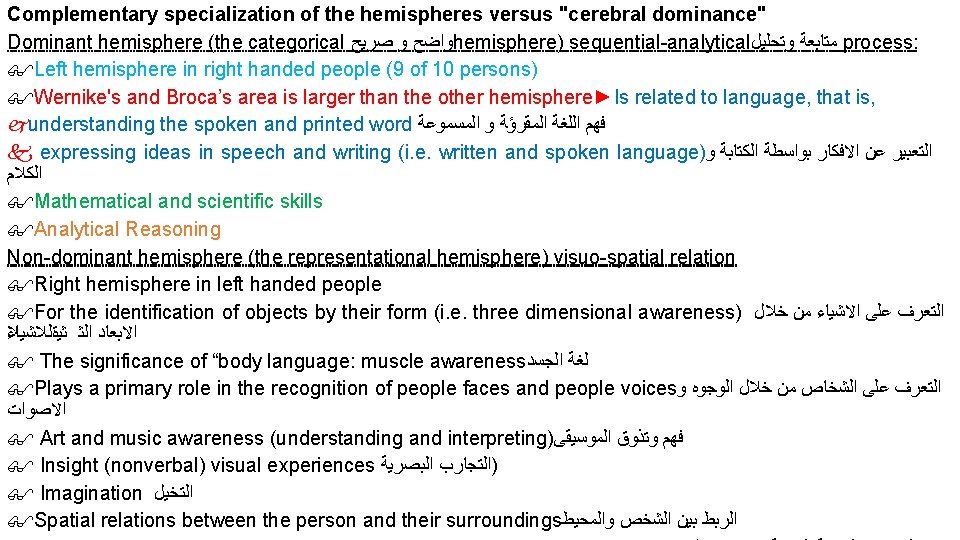
Complementary specialization of the hemispheres versus "cerebral dominance" Dominant hemisphere (the categorical ﻭﺍﺿﺢ ﻭ ﺻﺮﻳﺢ hemisphere) sequential analytical ﻣﺘﺎﺑﻌﺔ ﻭﺗﺤﻠﻴﻞ process: Left hemisphere in right handed people (9 of 10 persons) Wernike's and Broca’s area is larger than the other hemisphere►Is related to language, that is, understanding the spoken and printed word ﻓﻬﻢ ﺍﻟﻠﻐﺔ ﺍﻟﻤﻘﺮﺅﺔ ﻭ ﺍﻟﻤﺴﻤﻮﻋﺔ expressing ideas in speech and writing (i. e. written and spoken language) ﺍﻟﺘﻌﺒﻴﺮ ﻋﻦ ﺍﻻﻓﻜﺎﺭ ﺑﻮﺍﺳﻄﺔ ﺍﻟﻜﺘﺎﺑﺔ ﻭ ﺍﻟﻜﻼﻡ Mathematical and scientific skills Analytical Reasoning Non dominant hemisphere (the representational hemisphere) visuo spatial relation Right hemisphere in left handed people For the identification of objects by their form (i. e. three dimensional awareness) ﺍﻟﺘﻌﺮﻑ ﻋﻠﻰ ﺍﻻﺷﻴﺎﺀ ﻣﻦ ﺧﻼﻝ ﻼ ﺛﻴﺓﻠﻼﺷﻴﺎﺀ ﺍﻻﺑﻌﺎﺩ ﺍﻟﺜ The significance of “body language: muscle awareness ﻟﻐﺔ ﺍﻟﺠﺴﺪ Plays a primary role in the recognition of people faces and people voices ﺍﻟﺘﻌﺮﻑ ﻋﻠﻰ ﺍﻟﺸﺨﺎﺹ ﻣﻦ ﺧﻼﻝ ﺍﻟﻮﺟﻮﻩ ﻭ ﺍﻻﺻﻮﺍﺕ Art and music awareness (understanding and interpreting) ﻓﻬﻢ ﻭﺗﺬﻭﻕ ﺍﻟﻤﻮﺳﻴﻘﻰ Insight (nonverbal) visual experiences )ﺍﻟﺘﺠﺎﺭﺏ ﺍﻟﺒﺼﺮﻳﺔ Imagination ﺍﻟﺘﺨﻴﻞ Spatial relations between the person and their surroundings ﺍﻟﺮﺑﻂ ﺑﻴﻦ ﺍﻟﺸﺨﺺ ﻭﺍﻟﻤﺤﻴﻂ
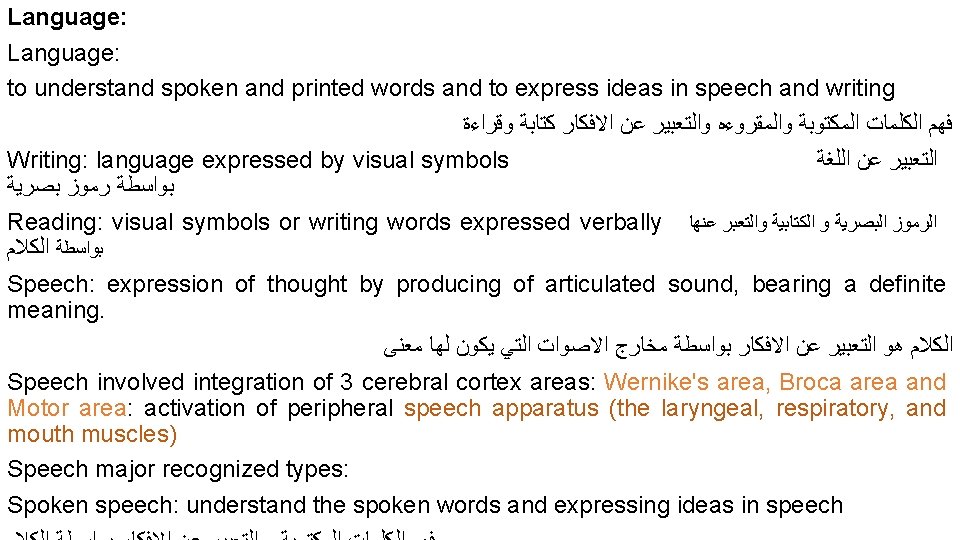
Language: to understand spoken and printed words and to express ideas in speech and writing ﻓﻬﻢ ﺍﻟﻜﻠﻤﺎﺕ ﺍﻟﻤﻜﺘﻮﺑﺔ ﻭﺍﻟﻤﻘﺮﻭﺀﻩ ﻭﺍﻟﺘﻌﺒﻴﺮ ﻋﻦ ﺍﻻﻓﻜﺎﺭ ﻛﺘﺎﺑﺔ ﻭﻗﺮﺍﺀﺓ Writing: language expressed by visual symbols ﺍﻟﺘﻌﺒﻴﺮ ﻋﻦ ﺍﻟﻠﻐﺔ ﺑﻮﺍﺳﻄﺔ ﺭﻣﻮﺯ ﺑﺼﺮﻳﺔ Reading: visual symbols or writing words expressed verbally ﺍﻟﺮﻣﻮﺯ ﺍﻟﺒﺼﺮﻳﺔ ﻭ ﺍﻟﻜﺘﺎﺑﻴﺔ ﻭﺍﻟﺘﻌﺒﺮ ﻋﻨﻬﺎ ﺑﻮﺍﺳﻄﺔ ﺍﻟﻜﻼﻡ Speech: expression of thought by producing of articulated sound, bearing a definite meaning. ﺍﻟﻜﻼﻡ ﻫﻮ ﺍﻟﺘﻌﺒﻴﺮ ﻋﻦ ﺍﻻﻓﻜﺎﺭ ﺑﻮﺍﺳﻄﺔ ﻣﺨﺎﺭﺝ ﺍﻻﺻﻮﺍﺕ ﺍﻟﺘﻲ ﻳﻜﻮﻥ ﻟﻬﺎ ﻣﻌﻨﻰ Speech involved integration of 3 cerebral cortex areas: Wernike's area, Broca area and Motor area: activation of peripheral speech apparatus (the laryngeal, respiratory, and mouth muscles) Speech major recognized types: Spoken speech: understand the spoken words and expressing ideas in speech
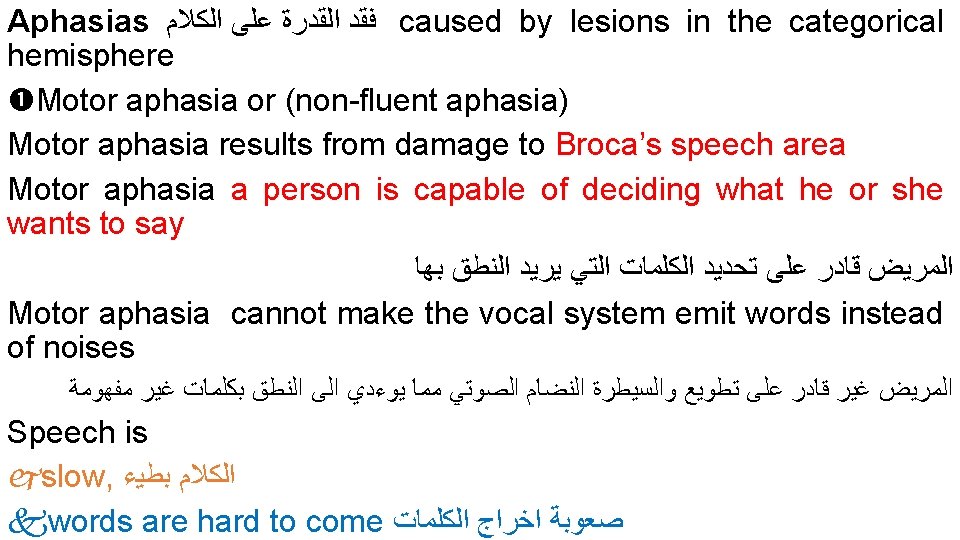
Aphasias ﻓﻘﺪ ﺍﻟﻘﺪﺭﺓ ﻋﻠﻰ ﺍﻟﻜﻼﻡ caused by lesions in the categorical hemisphere Motor aphasia or (non fluent aphasia) Motor aphasia results from damage to Broca’s speech area Motor aphasia a person is capable of deciding what he or she wants to say ﺍﻟﻤﺮﻳﺾ ﻗﺎﺩﺭ ﻋﻠﻰ ﺗﺤﺪﻳﺪ ﺍﻟﻜﻠﻤﺎﺕ ﺍﻟﺘﻲ ﻳﺮﻳﺪ ﺍﻟﻨﻄﻖ ﺑﻬﺎ Motor aphasia cannot make the vocal system emit words instead of noises ﺍﻟﻤﺮﻳﺾ ﻏﻴﺮ ﻗﺎﺩﺭ ﻋﻠﻰ ﺗﻄﻮﻳﻊ ﻭﺍﻟﺴﻴﻄﺮﺓ ﺍﻟﻨﻀﺎﻡ ﺍﻟﺼﻮﺗﻲ ﻣﻤﺎ ﻳﻮﺀﺩﻱ ﺍﻟﻰ ﺍﻟﻨﻄﻖ ﺑﻜﻠﻤﺎﺕ ﻏﻴﺮ ﻣﻔﻬﻮﻣﺔ Speech is slow, ﺍﻟﻜﻼﻡ ﺑﻄﻴﺀ words are hard to come ﺻﻌﻮﺑﺔ ﺍﺧﺮﺍﺝ ﺍﻟﻜﻠﻤﺎﺕ
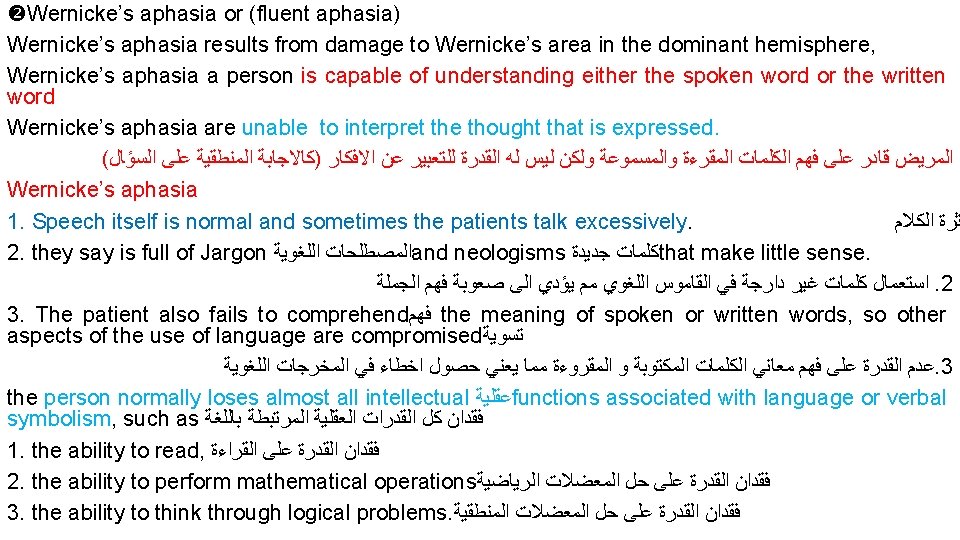
Wernicke’s aphasia or (fluent aphasia) Wernicke’s aphasia results from damage to Wernicke’s area in the dominant hemisphere, Wernicke’s aphasia a person is capable of understanding either the spoken word or the written word Wernicke’s aphasia are unable to interpret the thought that is expressed. ( ﺍﻟﻤﺮﻳﺾ ﻗﺎﺩﺭ ﻋﻠﻰ ﻓﻬﻢ ﺍﻟﻜﻠﻤﺎﺕ ﺍﻟﻤﻘﺮﺀﺓ ﻭﺍﻟﻤﺴﻤﻮﻋﺔ ﻭﻟﻜﻦ ﻟﻴﺲ ﻟﻪ ﺍﻟﻘﺪﺭﺓ ﻟﻠﺘﻌﺒﻴﺮ ﻋﻦ ﺍﻻﻓﻜﺎﺭ )ﻛﺎﻻﺟﺎﺑﺔ ﺍﻟﻤﻨﻄﻘﻴﺔ ﻋﻠﻰ ﺍﻟﺴﺆﺎﻝ Wernicke’s aphasia 1. Speech itself is normal and sometimes the patients talk excessively. ﺜﺮﺓ ﺍﻟﻜﻼﻡ 2. they say is full of Jargon ﺍﻟﻤﺼﻄﻠﺤﺎﺕ ﺍﻟﻠﻐﻮﻳﺔ and neologisms ﻛﻠﻤﺎﺕ ﺟﺪﻳﺪﺓ that make little sense. ﺍﺳﺘﻌﻤﺎﻝ ﻛﻠﻤﺎﺕ ﻏﻴﺮ ﺩﺍﺭﺟﺔ ﻓﻲ ﺍﻟﻘﺎﻣﻮﺱ ﺍﻟﻠﻐﻮﻱ ﻣﻢ ﻳﺆﺪﻱ ﺍﻟﻰ ﺻﻌﻮﺑﺔ ﻓﻬﻢ ﺍﻟﺠﻤﻠﺔ. 2 3. The patient also fails to comprehend ﻓﻬﻢ the meaning of spoken or written words, so other aspects of the use of language are compromised ﺗﺴﻮﻳﺔ ﻋﺪﻡ ﺍﻟﻘﺪﺭﺓ ﻋﻠﻰ ﻓﻬﻢ ﻣﻌﺎﻧﻲ ﺍﻟﻜﻠﻤﺎﺕ ﺍﻟﻤﻜﺘﻮﺑﺔ ﻭ ﺍﻟﻤﻘﺮﻭﺀﺓ ﻣﻤﺎ ﻳﻌﻨﻲ ﺣﺼﻮﻝ ﺍﺧﻄﺎﺀ ﻓﻲ ﺍﻟﻤﺨﺮﺟﺎﺕ ﺍﻟﻠﻐﻮﻳﺔ. 3 the person normally loses almost all intellectual ﻋﻘﻠﻴﺔ functions associated with language or verbal symbolism, such as ﻓﻘﺪﺍﻥ ﻛﻞ ﺍﻟﻘﺪﺭﺍﺕ ﺍﻟﻌﻘﻠﻴﺔ ﺍﻟﻤﺮﺗﺒﻄﺔ ﺑﺎﻟﻠﻐﺔ 1. the ability to read, ﻓﻘﺪﺍﻥ ﺍﻟﻘﺪﺭﺓ ﻋﻠﻰ ﺍﻟﻘﺮﺍﺀﺓ 2. the ability to perform mathematical operations ﻓﻘﺪﺍﻥ ﺍﻟﻘﺪﺭﺓ ﻋﻠﻰ ﺣﻞ ﺍﻟﻤﻌﻀﻼﺕ ﺍﻟﺮﻳﺎﺿﻴﺔ 3. the ability to think through logical problems. ﻓﻘﺪﺍﻥ ﺍﻟﻘﺪﺭﺓ ﻋﻠﻰ ﺣﻞ ﺍﻟﻤﻌﻀﻼﺕ ﺍﻟﻤﻨﻄﻘﻴﺔ
Anomic aphasia: When a lesion damages the angular gyrus in the categorical hemisphere without affecting Wernicke’s or Broca’s areas. There is no difficulty with speech or the understanding of auditory information; There is trouble understanding written language or pictures, because visual information is not processed and transmitted to Wernicke’s area. Learning ﺍﺳﺘﺤﺪﺍﺙ ﺍﻟﻤﻌﻠﻮﻣﺔ Learning is acquisition ﺍﺳﺘﺤﺪﺍﺙ of the information that makes ability to alter behavior on the basis of experience possible. ﺍﺳﺘﺤﺪﺍﺙ ﺍﻟﻤﻌﻠﻮﻣﺔ ﺍﻟﺘﻲ ﺗﺴﻤﺢ ﺑﺒﺘﻐﻴﺮ ﺍﻟﺴﻠﻮﻙ ﺑﻨﺎﺀ ﻋﻠﻰ ﺍﻟﺘﺠﺮﺑﺔ Learning is a process that will modify a subsequent behavior ﺍﻟﺘﻌﻠﻢ ﻫﻲ ﻭﺳﻴﻠﺔ ﻟﺘﻄﻮﻳﺮ ﺍﻟﻤﻬﺎﺭﺍﺕ Memory ﺍﺳﺘړڃﺎﻉ ﺍﻟﻤﻌﻠﻮﻣﺔ ﻭ ﺧﺰﻥ : Memory is the ability to store, retain and recall ﺗﺬﻛﺮ personal experiences, information, and various skills and habits. ﺍﻟﻘﺪﺭﺓ ﻋﻠﻰ ﺧﺰﻥ ﺍﺳﺘﺮﺟﺎﻉ ﻭﺗﺬﻛﺮ ﺍﻟﺘﺠﺎﺭﺏ ﺍﻟﺸﺨﺼﻴﺔ ﻭﺍﻟﻤﻌﻠﻮﻣﺎﺕ ﻭﺍﻟﻤﻬﺎﺭﺍﺕ ﻭﺍﻟﻌﺎﺩﺍﺕ Memory is an active system that store, organizes, alters and recovers (retrieves )ﺍﺳﺘﺮﺟﺎﻉ information Memory process Just like computer Encoding: Converting information into a useable form Storage: Holding this information in memory
Neuronal basis of memory: Memories are stored in the brain by changing the basic sensitivity of synaptic transmission between neurons as a result of previous neural activity. We cannot store all memories Some memories are erased; or ignore. This capability results from inhibition of the syn aptic pathways for this type of information; the resulting effect is called habituation, which is a type of negative memory. Some memories are enhanced or stored. This capability results from facilitation of the synaptic pathways, and the process is called memory sensitization, which is a type of positive memory.
Multi-store model memory: Is a model of memory proposed that human memory has three separate components: sensory, short term (or working), and long term. typically from 10 to 15 seconds, or sometimes up to a minute Most of information is forgotten someway along the way. Information that you pay attention to and process will move to next store of memory
(1)Sensory memory is the shortest term element of memory. Sensory memory is the ability to retain impressions ﺍﻧﻄﺒﺎﻋﺎﺕ of sensory information after the original stimuli have ended. ﺍﻟﻘﺪﺭﺓ ﻋﻠﻰ ﺍﺳﺘﺮﺟﺎﻉ ﺍﻻﻳﻌﺎﺯ ﺍﻟﺤﺴﻲ ﺣﺘﻰ ﺑﻌﺪ ﺯﻭﺍﻝ ﺗﺄﺜﻴﺮ ﺍﻟﻠﻤﺆﺜﺮ ﺍﻟﺤﺴﻲ Sensory memory acts as a kind of buffer for stimuli received through the five senses of sight, hearing, smell, taste and touch, which are retained accurately, but very briefly. For example, the ability to look at something and remember what it looked like with just a second of observation is an example of sensory memory. ﻫﻮ ﺧﺰﺍﻥ ﻣﺆﻘﺖ ﻟﻸﻴﻌﺎﺯﺍﺕ ﺍﻟﺤﺴﻴﺔ ﺍﻟﺘﻲ ﻳﻤﻜﻦ ﺍﺳﺘﺮﺟﺎﻋﻬﺎ ﻭﻟﻜﻦ ﻟﻔﺘﺮﻩ ﻗﺼﻴﺮﺓ ﺟﺪﺍ ﻣﺜﻞ ﺗﺬﻛﺮ ﺍﺳﻢ ﻣﺎﺭﻛﺖ ﺍﻟﺸﺎﻱ ﺑﻌﺪ ﻧﻀﺮﺓ ﺳﺮﻳﻌﺔ ﻋﻠﻰ ﺍﻟﺮﻑ ﺍﻟﺬﻱ ﻳﺤﺘﻮﻱ ﻋﻠﻰ ﺍﻟﻌﺪﻳﺪ ﻣﻦ ﺍﻻﺻﻨﺎﻑ Sensory memory unlike other types of memory, cannot be prolonged via rehearsal. Sensory memory is an ultra short term memory and decays or degrades
Sensory memory often considered part of the process of perception Sensory memory represents an essential step for storing information in short term memory. Sensory memory is usually unlimited capacity Sensory memory is usually considered to be totally outside of conscious control. The brain is designed to only process information that will be useful at a later date, and to allow the rest to pass by unnoted. ﺍﻟﺪﻣﺎﻍ ﻣﻬﻴﺎ ﻟﺘﺬﻛﺮ ﺍﻟﻤﻔﻴﺪ ﻭﻧﺴﻴﺎﻥ ﺍﻟﺒﺎﻗﻲ The stimuli detected by our senses can be either a. deliberately ignored, in which case they disappear almost instantaneously, or b. Perceived ﻣﺤﺴﻮﺱ ﻭ ﻣﻠﺤﻮﺽ , in which case they enter our sensory
(2) Short-term memory Short term memory can be thought of as A. the ability to remember B. process ﻣﻌﺎﻟﺠﺔ information at the same time. Short term memory is very fragile and information can be lost with distraction or passage of time. Short term memory has three key aspects: 1. Limited capacity (only about 7 items can be stored at a time) 2. Limited duration short term memory, which lasts seconds to hours, during which processing in the hippocampus and elsewhere lays down long term changes in synaptic strength. 3. Encoding (primarily acoustic ﺻﻮﺗﻲ , even translating visual information into sounds). 4. Conscious process of information
However, this information will quickly disappear forever unless we make a conscious effort to retain it. Short term memory is a necessary step toward the next stage of retention, long term memory. The transfer of information to long term memory for more permanent storage can be facilitated or improved via The process of attention (i. e. selectivity of information) and a first step of learning is attention ﺍﻟﺘﺮﻛﻴﺰ ﻭﺍﻻﻧﺘﺒﺎﻩ ﻋﻠﻰ ﺍﻟﻤﻌﻠﻮﻣﺔ ﺍﻟﻤﻄﻠﻮﺑﺔ Mental repetition of the information or, even more effectively, by giving it meaning and associating it with other previously acquired knowledge. ﺍﻟﺘﻜﺮﺍﺭ ﻭﺭﺑﻄﻬﺎ ﺑﻤﻌﻠﻮﻣﺔ ﺳﺎﺑﻘﺔ Motivation is also a consideration, in that information relating to a subject of strong interest to a person, is more likely to be retained in long term memory. ﺍﻟﺪﺍﻓﻊ ﻭﺍﻟﺴﺒﺐ
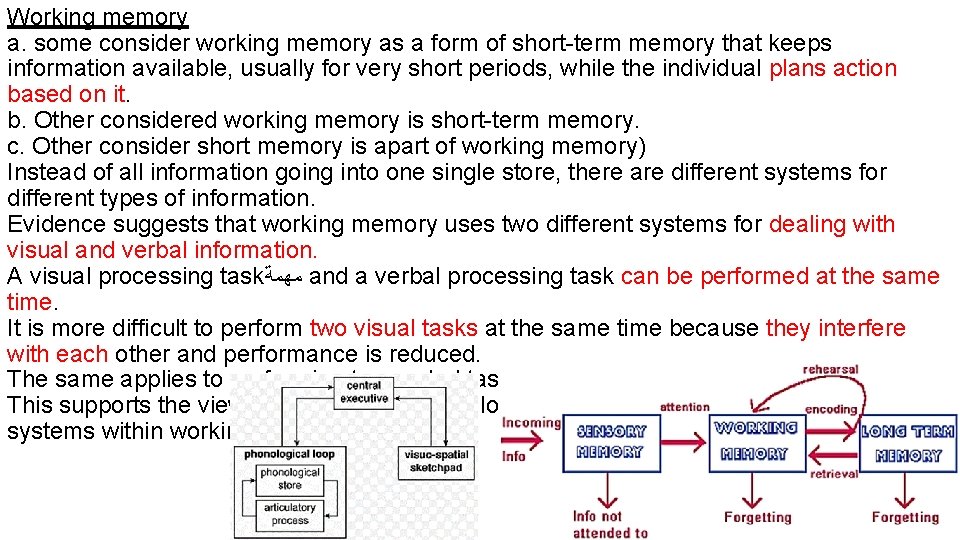
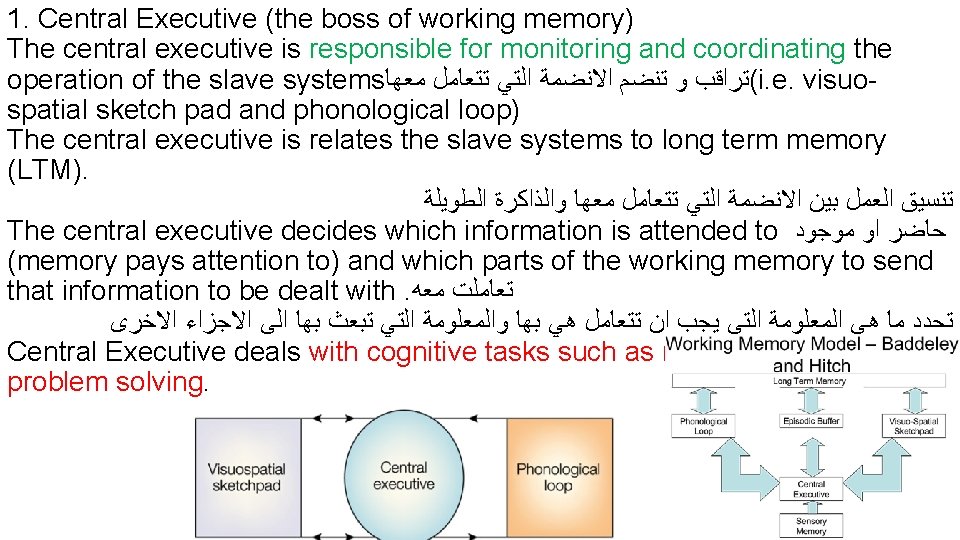
Working memory a. some consider working memory as a form of short term memory that keeps information available, usually for very short periods, while the individual plans action based on it. b. Other considered working memory is short term memory. c. Other consider short memory is apart of working memory) Instead of all information going into one single store, there are different systems for different types of information. Evidence suggests that working memory uses two different systems for dealing with visual and verbal information. A visual processing task ﻣﻬﻤﺔ and a verbal processing task can be performed at the same time. It is more difficult to perform two visual tasks at the same time because they interfere with each other and performance is reduced. The same applies to performing two verbal tasks at the same time. This supports the view that the phonological loop and the sketchpad ﺩﻓﺘﺮ ﺭﺳﻢ are separate systems within working memory.
1. Central Executive (the boss of working memory) The central executive is responsible for monitoring and coordinating the operation of the slave systems (ﺗﺮﺍﻗﺐ ﻭ ﺗﻨﻀﻢ ﺍﻻﻧﻀﻤﺔ ﺍﻟﺘﻲ ﺗﺘﻌﺎﻣﻞ ﻣﻌﻬﺎ i. e. visuo spatial sketch pad and phonological loop) The central executive is relates the slave systems to long term memory (LTM). ﺗﻨﺴﻴﻖ ﺍﻟﻌﻤﻞ ﺑﻴﻦ ﺍﻻﻧﻀﻤﺔ ﺍﻟﺘﻲ ﺗﺘﻌﺎﻣﻞ ﻣﻌﻬﺎ ﻭﺍﻟﺬﺍﻛﺮﺓ ﺍﻟﻄﻮﻳﻠﺔ The central executive decides which information is attended to ﺣﺎﺿﺮ ﺍﻭ ﻣﻮﺟﻮﺩ (memory pays attention to) and which parts of the working memory to send that information to be dealt with. ﺗﻌﺎﻣﻠﺖ ﻣﻌﻪ ﺗﺤﺪﺩ ﻣﺎ ﻫﻲ ﺍﻟﻤﻌﻠﻮﻣﺔ ﺍﻟﺘﻲ ﻳﺠﺐ ﺍﻥ ﺗﺘﻌﺎﻣﻞ ﻫﻲ ﺑﻬﺎ ﻭﺍﻟﻤﻌﻠﻮﻣﺔ ﺍﻟﺘﻲ ﺗﺒﻌﺚ ﺑﻬﺎ ﺍﻟﻰ ﺍﻻﺟﺰﺍﺀ ﺍﻻﺧﺮﻯ Central Executive deals with cognitive tasks such as mental arithmetic and problem solving.
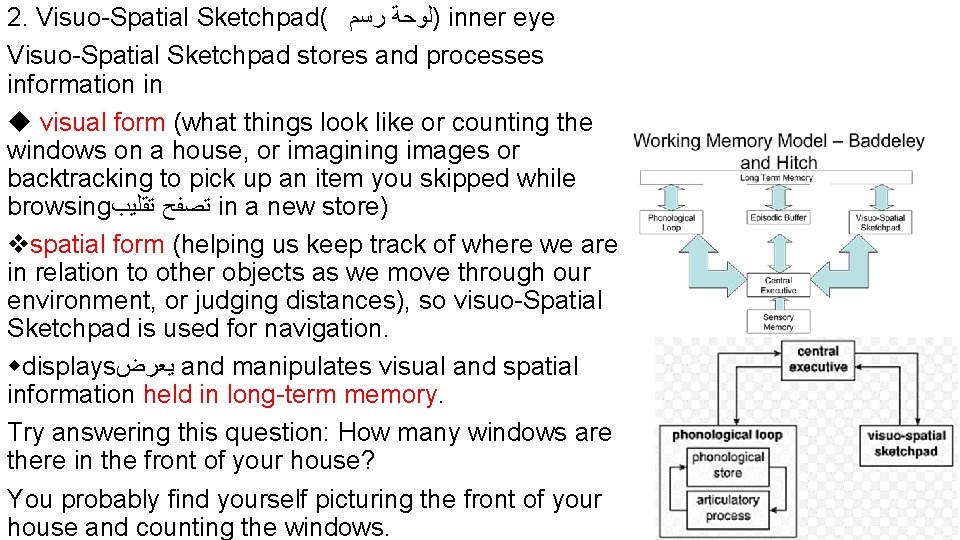
2. Visuo Spatial Sketchpad( )ﻟﻮﺣﺔ ﺭﺳﻢ inner eye Visuo Spatial Sketchpad stores and processes information in visual form (what things look like or counting the windows on a house, or imagining images or backtracking to pick up an item you skipped while browsing ﺗﺼﻔﺢ ﺗﻘﻠﻴﺐ in a new store) spatial form (helping us keep track of where we are in relation to other objects as we move through our environment, or judging distances), so visuo Spatial Sketchpad is used for navigation. displays ﻳﻌﺮﺽ and manipulates visual and spatial information held in long term memory. Try answering this question: How many windows are there in the front of your house? You probably find yourself picturing the front of your house and counting the windows.
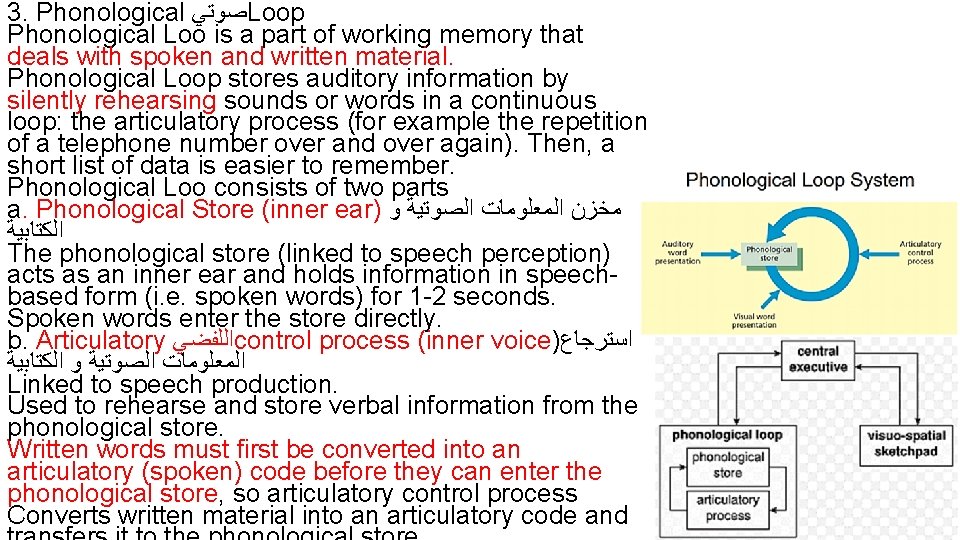
3. Phonological ﺻﻮﺗﻲ Loop Phonological Loo is a part of working memory that deals with spoken and written material. Phonological Loop stores auditory information by silently rehearsing sounds or words in a continuous loop: the articulatory process (for example the repetition of a telephone number over and over again). Then, a short list of data is easier to remember. Phonological Loo consists of two parts a. Phonological Store (inner ear) ﻣﺨﺰﻥ ﺍﻟﻤﻌﻠﻮﻣﺎﺕ ﺍﻟﺼﻮﺗﻴﺔ ﻭ ﺍﻟﻜﺘﺎﺑﻴﺔ The phonological store (linked to speech perception) acts as an inner ear and holds information in speech based form (i. e. spoken words) for 1 2 seconds. Spoken words enter the store directly. b. Articulatory ﺍﻟﻠﻔﻀﻲ control process (inner voice) ﺍﺳﺘﺮﺟﺎﻉ ﺍﻟﻤﻌﻠﻮﻣﺎﺕ ﺍﻟﺼﻮﺗﻴﺔ ﻭ ﺍﻟﻜﺘﺎﺑﻴﺔ Linked to speech production. Used to rehearse and store verbal information from the phonological store. Written words must first be converted into an articulatory (spoken) code before they can enter the phonological store, so articulatory control process Converts written material into an articulatory code and
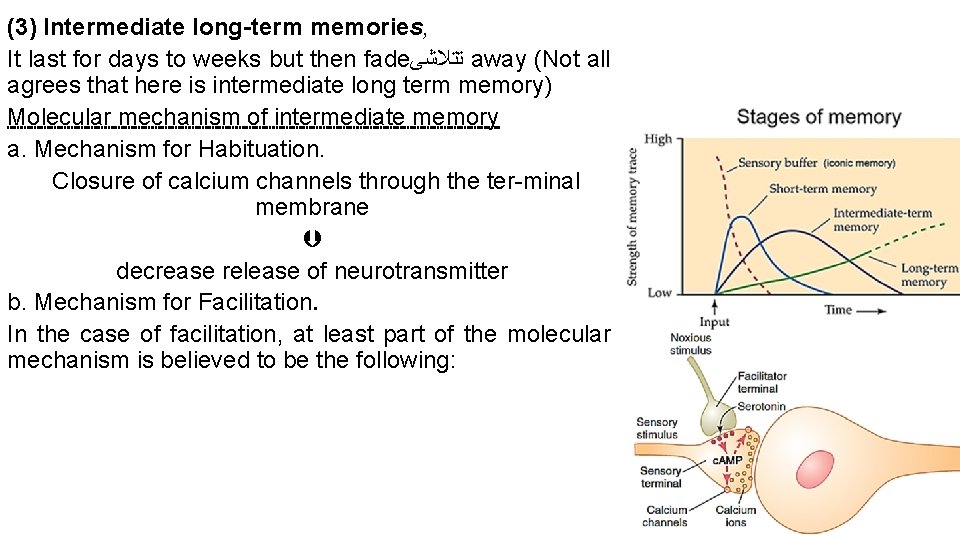
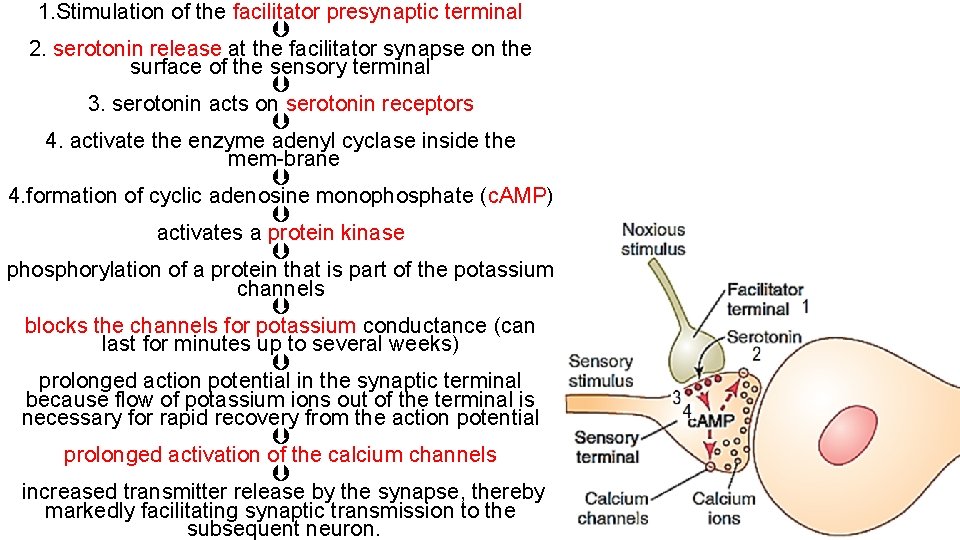
(3) Intermediate long-term memories, It last for days to weeks but then fade ﺗﺘﻼﺷﻰ away (Not all agrees that here is intermediate long term memory) Molecular mechanism of intermediate memory a. Mechanism for Habituation. Closure of calcium channels through the ter minal membrane decrease release of neurotransmitter b. Mechanism for Facilitation. In the case of facilitation, at least part of the molecular mechanism is believed to be the following:
1. Stimulation of the facilitator presynaptic terminal 2. serotonin release at the facilitator synapse on the surface of the sensory terminal 3. serotonin acts on serotonin receptors 4. activate the enzyme adenyl cyclase inside the mem brane 4. formation of cyclic adenosine monophosphate (c. AMP) activates a protein kinase phosphorylation of a protein that is part of the potassium channels blocks the channels for potassium conductance (can last for minutes up to several weeks) prolonged action potential in the synaptic terminal because flow of potassium ions out of the terminal is necessary for rapid recovery from the action potential prolonged activation of the calcium channels increased transmitter release by the synapse, thereby markedly facilitating synaptic transmission to the subsequent neuron.
(4)Long-term memory Long term memory, Place where data is stored for a long time once stored, can be recalled up to years or even a lifetime late Long term memory characterizes by: Unlimited capacity, semantically ﺍﻟﻤﻌﺎﻧﻲ encoded ﻓﻚ ﺗﺸﻔﻴﺮ Storage presumed permanent, Information highly organized robust ﻗﻮﻱ ﺍﻭ ﻣﺘﻴﻦ Storage: Holding this information in memory Retrieval: Taking memory out of storage Encoding: Converting information into a useable form Encoding types: Semantic encoding: encoding of meaning like meaning of word ﻓﻚ ﺗﺸﻔﻴﺮ ﺍﻟﻤﻌﺎﻧﻲ Acoustic encoding: encoding of sound like sound of word ﻓﻚ ﺗﺸﻔﻴﺮ ﺍﻟﺼﻮﺍﺕ Visual encoding: encoding of picture like picture of word ﻓﻚ ﺗﺸﻔﻴﺮ ﺭﺳﻢ ﺍﻟﻜﻠﻤﺎﺕ Tactile encoding: is the encoding of how something feels, normally through the sense of touch ﻓﻚ ﺗﺸﻔﻴﺮ ﺍﻟﻤﺤﻔﺰ ﺍﻟﻠﻤﺴﻲ During short term memory, the memory traces are subject to disruption by trauma and various drugs, whereas long term memory traces are remarkably resistant to disruption.
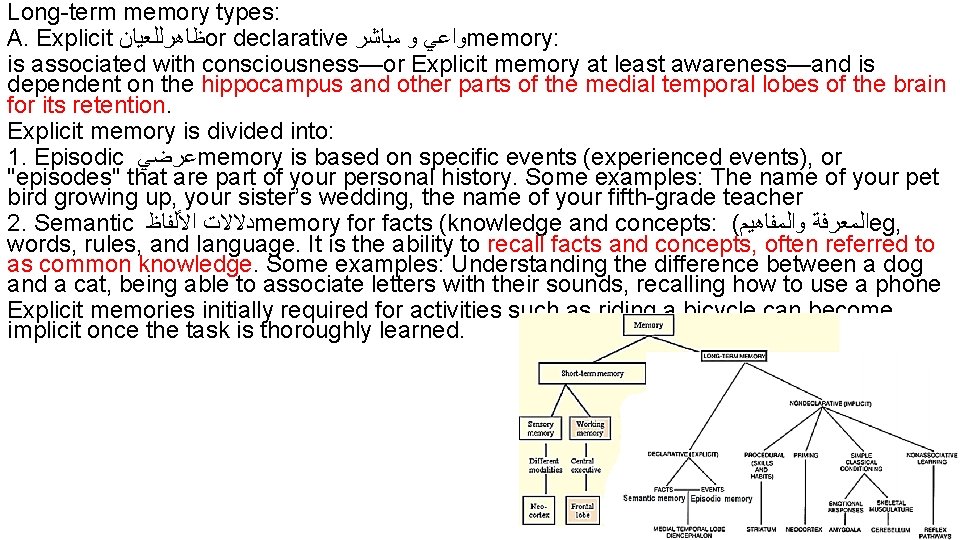
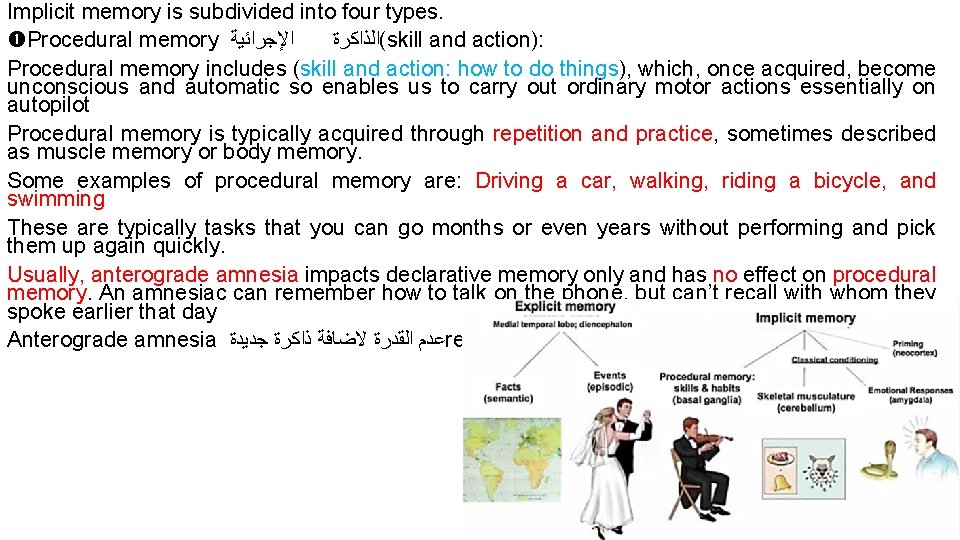
Long term memory types: A. Explicit ﻇﺎﻫﺮﻟﻠﻌﻴﺎﻥ or declarative ﻭﺍﻋﻲ ﻭ ﻣﺒﺎﺷﺮ memory: is associated with consciousness—or Explicit memory at least awareness—and is dependent on the hippocampus and other parts of the medial temporal lobes of the brain for its retention. Explicit memory is divided into: 1. Episodic ﻋﺮﺿﻲ memory is based on specific events (experienced events), or "episodes" that are part of your personal history. Some examples: The name of your pet bird growing up, your sister’s wedding, the name of your fifth grade teacher 2. Semantic ﺩﻻﻻﺕ ﺍﻷﻠﻔﺎﻅ memory for facts (knowledge and concepts: ( ﺍﻟﻤﻌﺮﻓﺔ ﻭﺍﻟﻤﻔﺎﻫﻴﻢ eg, words, rules, and language. It is the ability to recall facts and concepts, often referred to as common knowledge. Some examples: Understanding the difference between a dog and a cat, being able to associate letters with their sounds, recalling how to use a phone Explicit memories initially required for activities such as riding a bicycle can become implicit once the task is thoroughly learned.
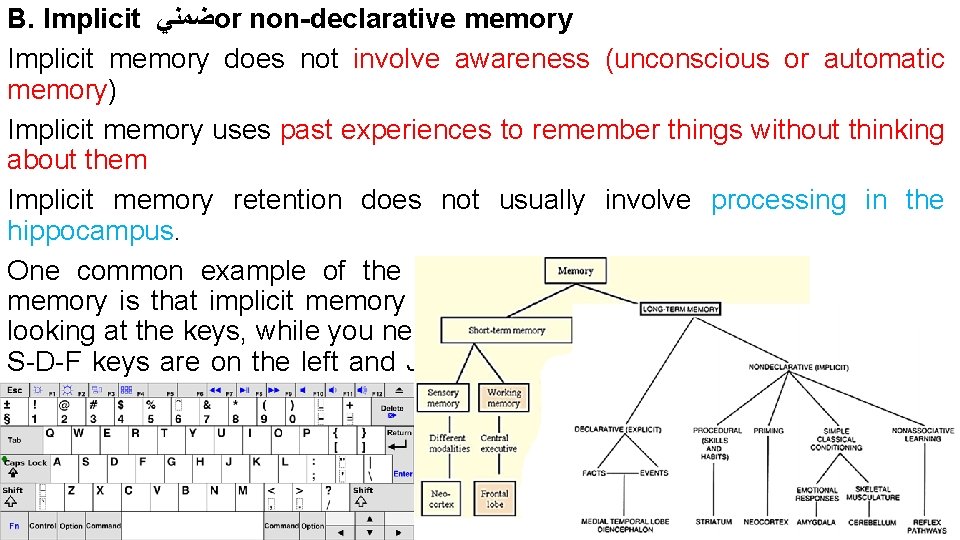
B. Implicit ﺿﻤﻨﻲ or non-declarative memory Implicit memory does not involve awareness (unconscious or automatic memory) Implicit memory uses past experiences to remember things without thinking about them Implicit memory retention does not usually involve processing in the hippocampus. One common example of the differences between implicit and explicit memory is that implicit memory allows you to type on a keyboard without looking at the keys, while you need explicit memory to remember that the A S D F keys are on the left and J K L ; keys are on the right in the "home" row.
Implicit memory is subdivided into four types. Procedural memory ﺍﻹﺟﺮﺍﺋﻴﺔ (ﺍﻟﺬﺍﻛﺮﺓ skill and action): Procedural memory includes (skill and action: how to do things), which, once acquired, become unconscious and automatic so enables us to carry out ordinary motor actions essentially on autopilot Procedural memory is typically acquired through repetition and practice, sometimes described as muscle memory or body memory. Some examples of procedural memory are: Driving a car, walking, riding a bicycle, and swimming These are typically tasks that you can go months or even years without performing and pick them up again quickly. Usually, anterograde amnesia impacts declarative memory only and has no effect on procedural memory. An amnesiac can remember how to talk on the phone, but can’t recall with whom they spoke earlier that day Anterograde amnesia ﻋﺪﻡ ﺍﻟﻘﺪﺭﺓ ﻻﺿﺎﻓﺔ ﺫﺍﻛﺮﺓ ﺟﺪﻳﺪﺓ retrograde amnesia ﻋﺪﻡ ﺍﻟﻘﺪﺭﺓ ﻻﺳﺘﺮﺟﺎﻉ ﺫﺍﻛﺮﺓ ﻗﺪﻳﻤﺔ
Priming: ﻋﺎﺩﺓ ﻋﻦ ﻃﺮﻳﻖ ﺗﺰﻭﻳﺪﻫﻢ ﺑﺎﻟﻤﻌﻠﻮﻣﺎﺕ ﺫﺍﺕ ﺍﻟﺼﻠﺔ ، ﺇﻋﺪﺍﺩ )ﺷﺨﺺ ﻣﺎ( ﻟﺤﺎﻟﺔ ﺃﻮ ﻣﻬﻤﺔ. Priming is facilitation of recognition of words or objects by prior exposure to them. Priming involves using pictures, words or other stimuli to help someone recognize another word or phrase in the future. Examples include using green to remember grass and red to remember apple, improved recall of a word when presented with the first few letters of it. Priming is an effect in which exposure to one stimuli influence the response to another stimulus due to prior experience. Example if some lets you to give a name of animal begins with "D" everybody says” Dog" not" Deer" or " Dolphin" because we are seen and familiar with dog more ; people elsewhere says "Deer" Non associative learning, the organism learns about a single stimulus. A signal stimulus is given repeatedly and nervous system learn about the characteristics of the stimulus: a. habituation: decrease response to stimuli e. g. exercise to treat dizziness in patients
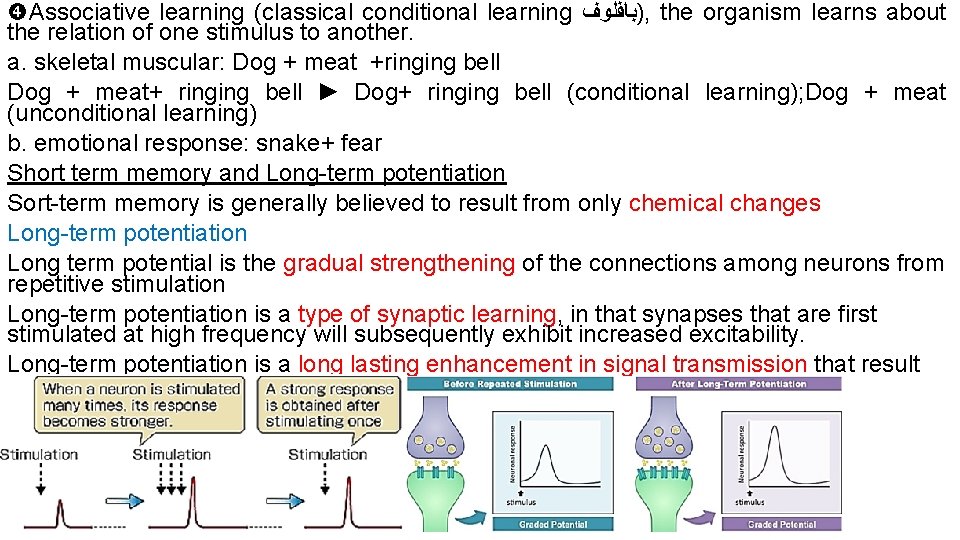
Associative learning (classical conditional learning )ﺑﺎﻔﻠﻮﻑ , the organism learns about the relation of one stimulus to another. a. skeletal muscular: Dog + meat +ringing bell Dog + meat+ ringing bell ► Dog+ ringing bell (conditional learning); Dog + meat (unconditional learning) b. emotional response: snake+ fear Short term memory and Long term potentiation Sort term memory is generally believed to result from only chemical changes Long term potentiation Long term potential is the gradual strengthening of the connections among neurons from repetitive stimulation Long term potentiation is a type of synaptic learning, in that synapses that are first stimulated at high frequency will subsequently exhibit increased excitability. Long term potentiation is a long lasting enhancement in signal transmission that result from stimulating them synchronously
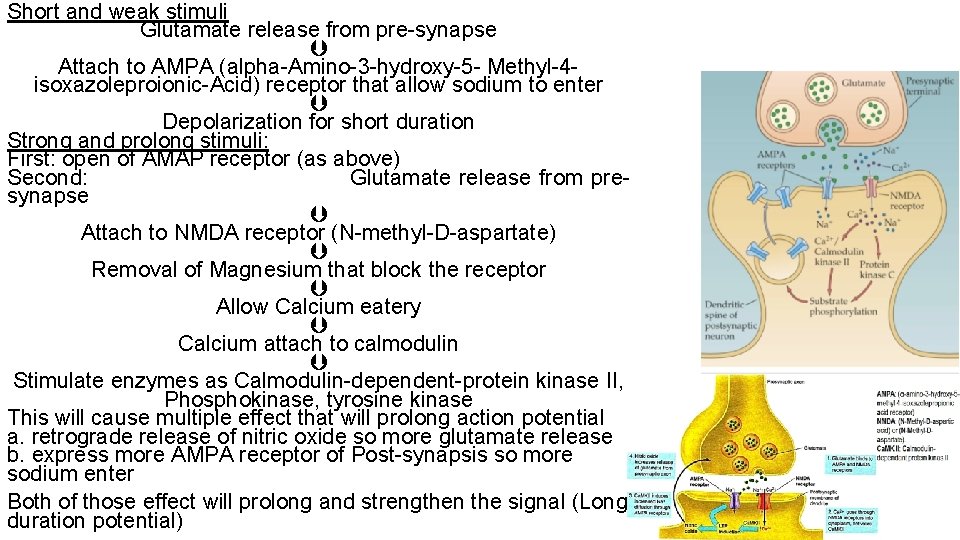
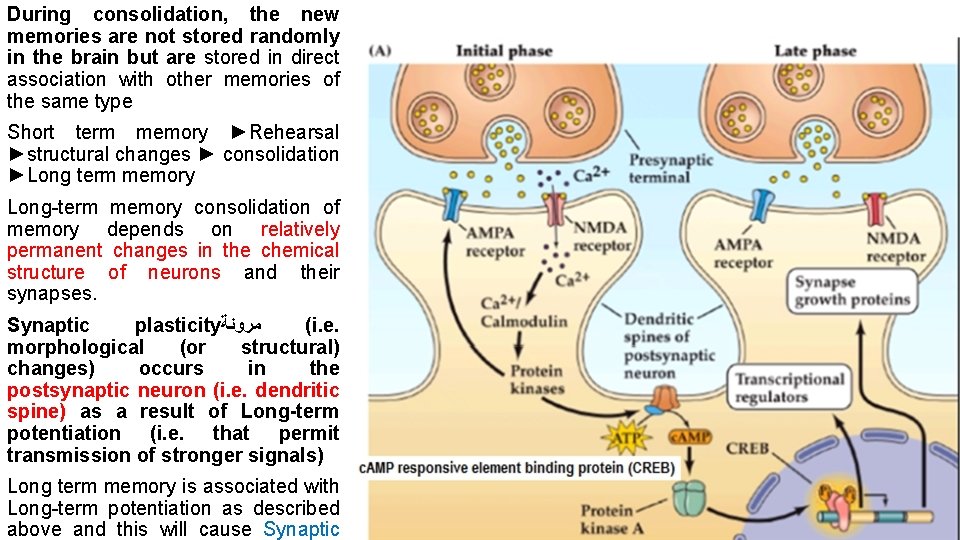
Short and weak stimuli Glutamate release from pre synapse Attach to AMPA (alpha Amino 3 hydroxy 5 Methyl 4 isoxazoleproionic Acid) receptor that allow sodium to enter Depolarization for short duration Strong and prolong stimuli: First: open of AMAP receptor (as above) Second: Glutamate release from pre synapse Attach to NMDA receptor (N methyl D aspartate) Removal of Magnesium that block the receptor Allow Calcium eatery Calcium attach to calmodulin Stimulate enzymes as Calmodulin dependent protein kinase II, Phosphokinase, tyrosine kinase This will cause multiple effect that will prolong action potential a. retrograde release of nitric oxide so more glutamate release b. express more AMPA receptor of Post synapsis so more sodium enter Both of those effect will prolong and strengthen the signal (Long duration potential)
Number of neurons and their connectivity often change significantly during learning During the first few weeks, months, and perhaps even year or so of life, many parts of the brain produce a great excess of neurons, and the neurons send out numerous axon branches to make connections with other neurons. If the new axons fail to connect with appropriate neurons, muscle cells, or gland cells, the new axons will dissolute within a few weeks. The number of neuronal connections is determined by specific nerve growth factors released retrograde from the stimulated cells. Furthermore, when insufficient connectivity occurs, the entire neuron that is sending out the axon branches might eventually disappear. Consolidation of memory: For short term memory to be converted into long term memory that can be recalled weeks or years later, it must become “consolidated. ” That is, the short term memory, if activated repeatedly, will initiate chemical, physical, and anatomical changes in the synapses that are responsible for the long term type of memory. This process requires 5 to 10 minutes for minimal consolidation and 1 hour or more for strong consolidation.
During consolidation, the new memories are not stored randomly in the brain but are stored in direct association with other memories of the same type Short term memory ►Rehearsal ►structural changes ► consolidation ►Long term memory consolidation of memory depends on relatively permanent changes in the chemical structure of neurons and their synapses. Synaptic plasticity ﻣﺮﻭﻧﺔ (i. e. morphological (or structural) changes) occurs in the postsynaptic neuron (i. e. dendritic spine) as a result of Long-term potentiation (i. e. that permit transmission of stronger signals) Long term memory is associated with Long term potentiation as described above and this will cause Synaptic
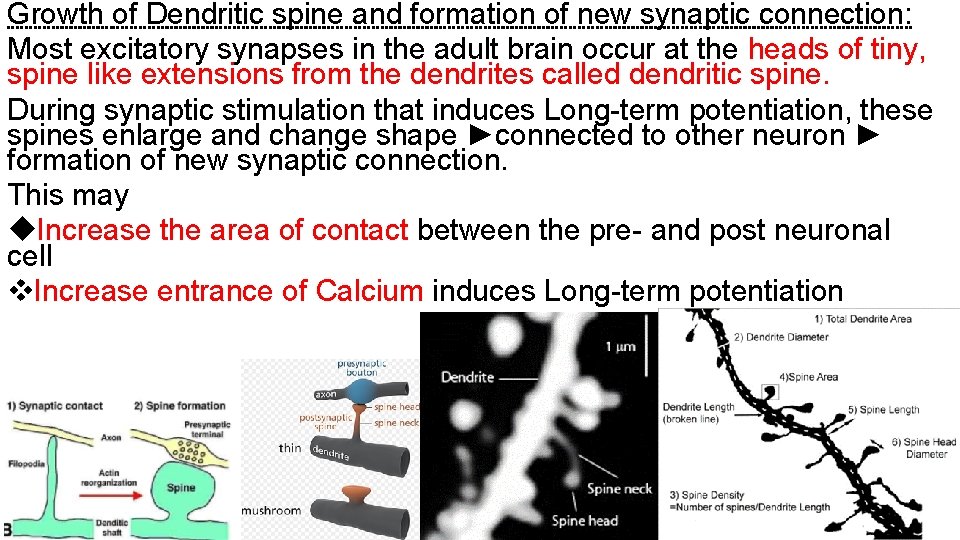
Growth of Dendritic spine and formation of new synaptic connection: Most excitatory synapses in the adult brain occur at the heads of tiny, spine like extensions from the dendrites called dendritic spine. During synaptic stimulation that induces Long term potentiation, these spines enlarge and change shape ►connected to other neuron ► formation of new synaptic connection. This may Increase the area of contact between the pre and post neuronal cell Increase entrance of Calcium induces Long term potentiation
3. Neural Stem Cells in Learning and Memory Neuronal stem cell produce new neural cell by (neurogenesis) and is involved in learning and memory. Neuronal stem cell and neurogenesis is related to hippocampus. Therefore, soon after birth, the principle of “use it or lose it” governs the final number of neurons and their connectivities in respective parts of the human nervous system. This is a type of learning. For example, if one eye of a newborn animal is covered for many weeks after birth, neurons in alternate stripes of the cerebral visual cortex—neurons normally connected to the covered eye—will degenerate, and the covered eye will remain either partially or totally blind for the remainder of life. Role of different areas in brain in relation to memory: The hippocampus is important for maintain recent memories, it is no longer needed once the memory has become consolidated into a more stable. Working memory areas are connected to hippocampus and the adjacent portion of the medial temporal cortex.
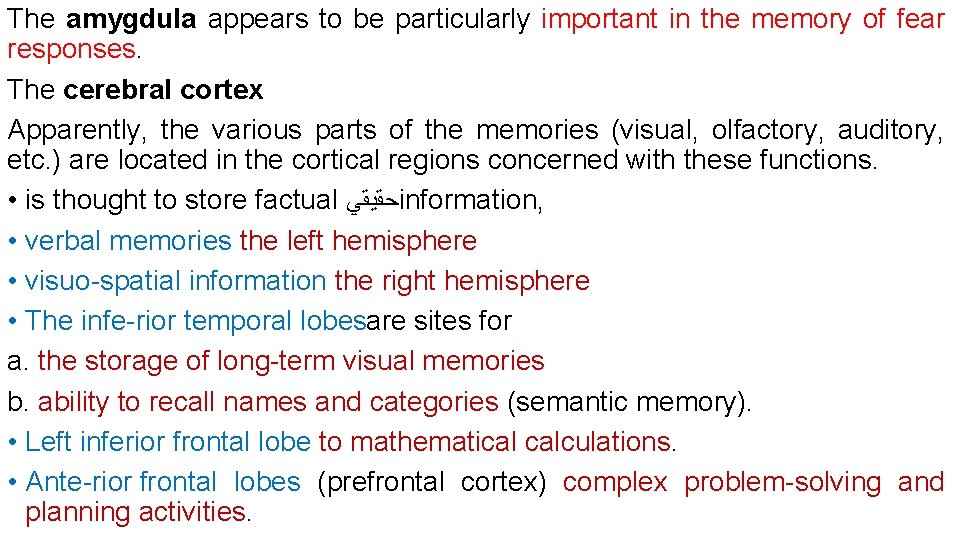
The amygdula appears to be particularly important in the memory of fear responses. The cerebral cortex Apparently, the various parts of the memories (visual, olfactory, auditory, etc. ) are located in the cortical regions concerned with these functions. • is thought to store factual ﺣﻘﻴﻘﻲ information, • verbal memories the left hemisphere • visuo spatial information the right hemisphere • The infe rior temporal lobesare sites for a. the storage of long term visual memories b. ability to recall names and categories (semantic memory). • Left inferior frontal lobe to mathematical calculations. • Ante rior frontal lobes (prefrontal cortex) complex problem solving and planning activities.
Pre frontal Cortex relation to memory: The pre frontal cortex is involved in: higher cognitive ﺍﺩﺭﺍﻙ functions (gathering information: attention, memory, language, perception ﺍﻟﺒﺼﻴﺮﺓ , ﺍﻟﻤﻌﺮﻓﺔ , and use them properly: problem solving, planning , and decision making) normal motivation ﺍﻟﺪﻭﺍﻓﻊ ﺍﻟﻄﺒﻴﻌﻴﺔ interpersonal skills ﺍﻟﻤﻬﺎﺭﺍﺕ ﺍﻟﺸﺨﺼﺒﺔ sexual desire ﺍﻟﺮﻏﺒﺔ ﺍﻟﺠﻨﺴﻴﺔ Lesions of the prefrontal cortex interfere with memory in a less dramatic way than lesions of the medial temporal lobe. When subjects recall words, there is increased activity in the frontal lobe and their left para hippocampal cortex When subjects recall pictures or scenes, there is activity in their right frontal lobe and the para hippocampal cortex on both sides.
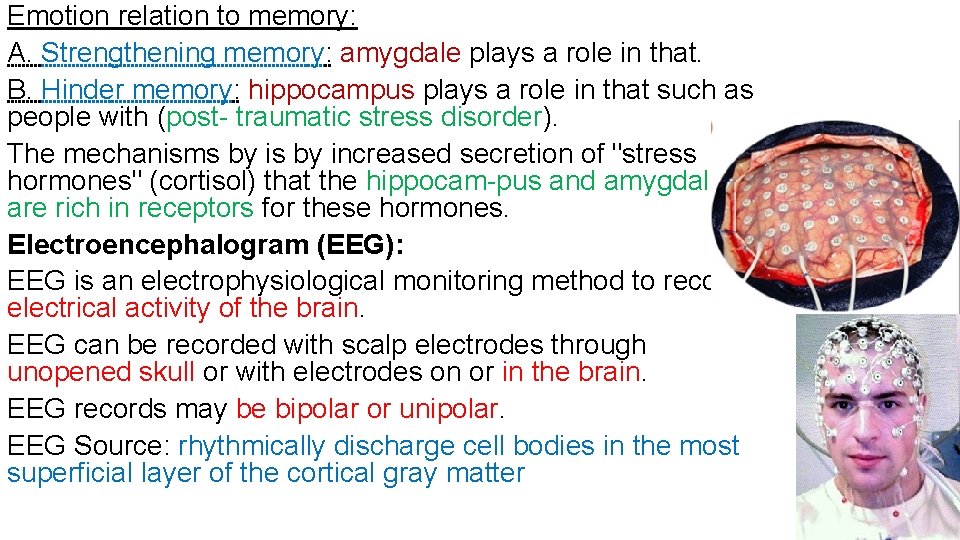
Emotion relation to memory: A. Strengthening memory: amygdale plays a role in that. B. Hinder memory: hippocampus plays a role in that such as people with (post traumatic stress disorder). The mechanisms by increased secretion of "stress hormones" (cortisol) that the hippocam pus and amygdala are rich in receptors for these hormones. Electroencephalogram (EEG): EEG is an electrophysiological monitoring method to record electrical activity of the brain. EEG can be recorded with scalp electrodes through unopened skull or with electrodes on or in the brain. EEG records may be bipolar or unipolar. EEG Source: rhythmically discharge cell bodies in the most superficial layer of the cortical gray matter
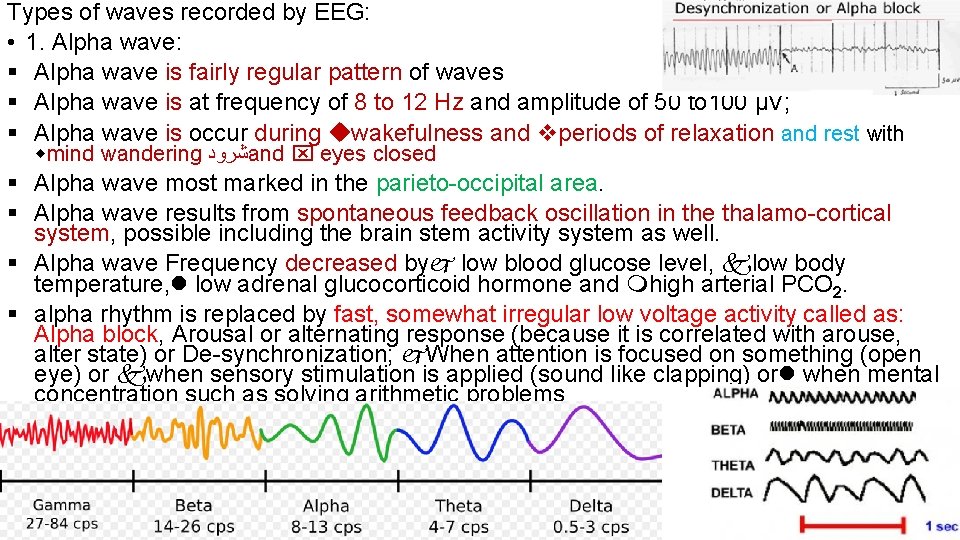
Types of waves recorded by EEG: • 1. Alpha wave: Alpha wave is fairly regular pattern of waves Alpha wave is at frequency of 8 to 12 Hz and amplitude of 50 to 100 μV; Alpha wave is occur during wakefulness and periods of relaxation and rest with mind wandering ﺷﺮﻭﺩ and eyes closed Alpha wave most marked in the parieto occipital area. Alpha wave results from spontaneous feedback oscillation in the thalamo cortical system, possible including the brain stem activity system as well. Alpha wave Frequency decreased by low blood glucose level, low body temperature, low adrenal glucocorticoid hormone and high arterial PCO 2. alpha rhythm is replaced by fast, somewhat irregular low voltage activity called as: Alpha block, Arousal or alternating response (because it is correlated with arouse, alter state) or De synchronization; When attention is focused on something (open eye) or when sensory stimulation is applied (sound like clapping) or when mental concentration such as solving arithmetic problems
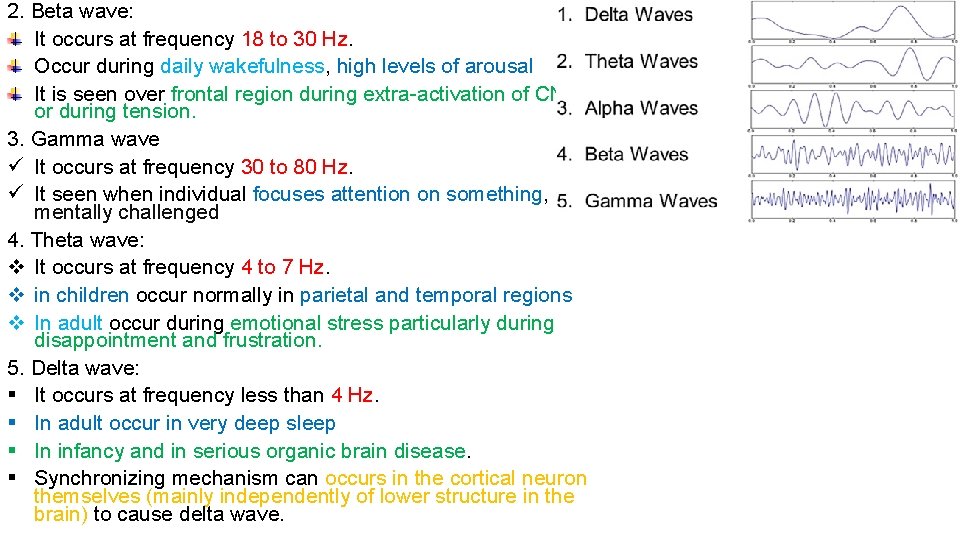
2. Beta wave: It occurs at frequency 18 to 30 Hz. Occur during daily wakefulness, high levels of arousal It is seen over frontal region during extra activation of CNS or during tension. 3. Gamma wave It occurs at frequency 30 to 80 Hz. It seen when individual focuses attention on something, mentally challenged 4. Theta wave: It occurs at frequency 4 to 7 Hz. in children occur normally in parietal and temporal regions In adult occur during emotional stress particularly during disappointment and frustration. 5. Delta wave: It occurs at frequency less than 4 Hz. In adult occur in very deep sleep In infancy and in serious organic brain disease. Synchronizing mechanism can occurs in the cortical neuron themselves (mainly independently of lower structure in the brain) to cause delta wave.
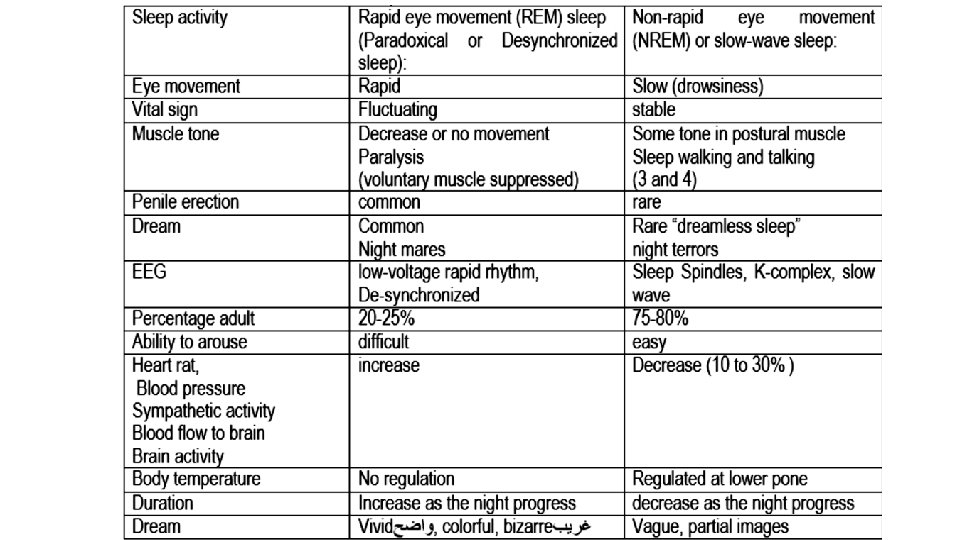
Sleep is a reversible behavioral state of perceptual disengagement ﻓﻚ ﺍﻻﺭﺗﺒﺎﻁ ﺍﻻﺩﺭﺍﻛﻲ from environment and unresponsive to the environment ﺣﺎﻟﺔ ﻳﻤﻜﻦ ﺍﻥ ﺗﺘﻐﻴﺮ ﻭﻫﻲ ﻓﻚ ﺍﺭﺗﺒﺎﻁ ﺍﻟﺸﺨﺺ ﺍﻟﺪﺭﺍﻛﻲ)ﻋﺪﻡ ﻣﻌﺮﻓﺔ ﻣﺎ ﻳﺪﻭﺭ ﺣﻮﻟﻪ( ﻭﻋﺪﻡ ﺍﺳﺘﺠﺎﺑﺔ ﻟﻠﻤﺤﻴﻂ ﺍﻟﺨﺎﺭﺟﻲ Sleep is a person can be aroused while unconsciousness or coma a ﺍﻥ person cannot be aroused Sleep Patterns: A. Rapid eye movement (REM) sleep (Paradoxical or Desynchronized sleep): REM sleep the eyes undergo rapid movements despite the fact that the person is still asleep. REM sleep is also called Paradoxical sleep because it is a paradox ﻣﺘﻨﺎﻗﺾ that a person can still be asleep despite marked activity in the brain. REM sleep occurs in episodes lasting 5 to 30 minutes usually appear on average every 90 minutes in young adults REM sleep is generated by cholinergic mediated REM on neurons at the junction of the pons and midbrain (in the upper brain stem reticular formation) begins to discharge before the onset of this phase of sleep.
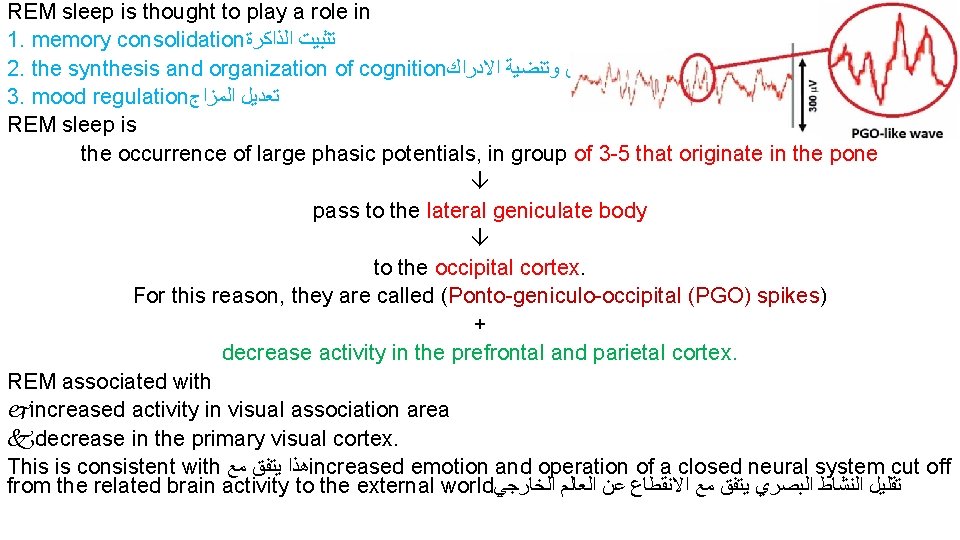
REM sleep is thought to play a role in 1. memory consolidation ﺗﺜﺒﻴﺖ ﺍﻟﺬﺍﻛﺮﺓ 2. the synthesis and organization of cognition ﺧﻠﻖ ﻭﺗﻨﻀﻴﺔ ﺍﻻﺩﺭﺍﻙ 3. mood regulation ﺗﻌﺪﻳﻞ ﺍﻟﻤﺰﺍﺝ REM sleep is the occurrence of large phasic potentials, in group of 3 5 that originate in the pone pass to the lateral geniculate body to the occipital cortex. For this reason, they are called (Ponto geniculo occipital (PGO) spikes) + decrease activity in the prefrontal and parietal cortex. REM associated with increased activity in visual association area decrease in the primary visual cortex. This is consistent with ﻫﺬﺍ ﻳﺘﻔﻖ ﻣﻊ increased emotion and operation of a closed neural system cut off from the related brain activity to the external world ﺗﻘﻠﻴﻞ ﺍﻟﻨﺸﺎﻁ ﺍﻟﺒﺼﺮﻱ ﻳﺘﻔﻖ ﻣﻊ ﺍﻻﻧﻘﻄﺎﻉ ﻋﻦ ﺍﻟﻌﺎﻟﻢ ﺍﻟﺨﺎﺭﺟﻲ
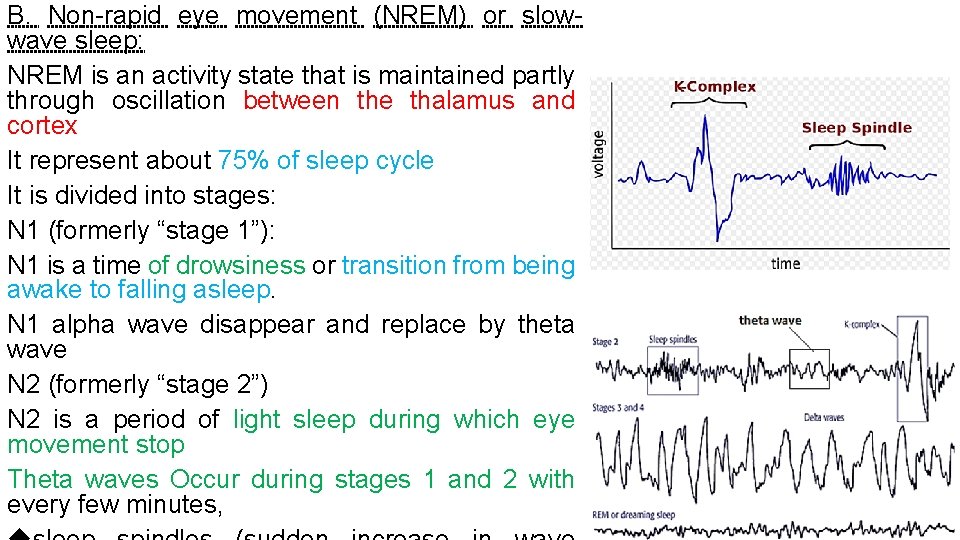
B. Non rapid eye movement (NREM) or slow wave sleep: NREM is an activity state that is maintained partly through oscillation between the thalamus and cortex It represent about 75% of sleep cycle It is divided into stages: N 1 (formerly “stage 1”): N 1 is a time of drowsiness or transition from being awake to falling asleep. N 1 alpha wave disappear and replace by theta wave N 2 (formerly “stage 2”) N 2 is a period of light sleep during which eye movement stop Theta waves Occur during stages 1 and 2 with every few minutes,
N 3 (formerly “stages 3 and 4”) is called “slow wave sleep” (SWS) N 3 is characterized by the presence of slow brain waves called “delta waves” interspersed ﻳﺨﻠﻠﻬﺎ with smaller, faster waves. The amount of slow wave sleep a person gets is directly related to accumulated sleep need — the longer a person has been awake, the more slow wave sleep he or she gets when sleep occurs. The difference between the dreams that occur in slow wave sleep (N 3 or stage 3 and 4)and those that occur in REM sleep is 1. REM sleep dream are associated with more bodily muscle activity 2. slow wave sleep dreams are usually not remembered because consolidation of the dreams in memory does not occur. The main difference between REM sleep and wakefulness dreams is that Dream consciousness is characterized by bizarre imagery ﺻﻮﺭ ﻏﺮﻳﺒﺔ illogical thoughts ﺍﻓﻜﺎﺭ ﻏﻴﺮ ﻣﻨﻄﻘﻴﺔ dreams are generally not stored in memory ﺍﻻﺣﻼﻡ ﻻ ﺗﺨﺰﻥ ﻭﺑﺎﻟﺘﺎﻟﻰ ﻻﻳﻤﻜﻦ ﺗﺬﻛﺮﻫﺎ The reason for this difference is unknown The tooth grinding ( ﺍﻟﺼﺮ ﻋﻠﻰ ﺍﻻﺳﻨﺎﻥ bruxism) that occurs in some individuals is also associated with dreaming.
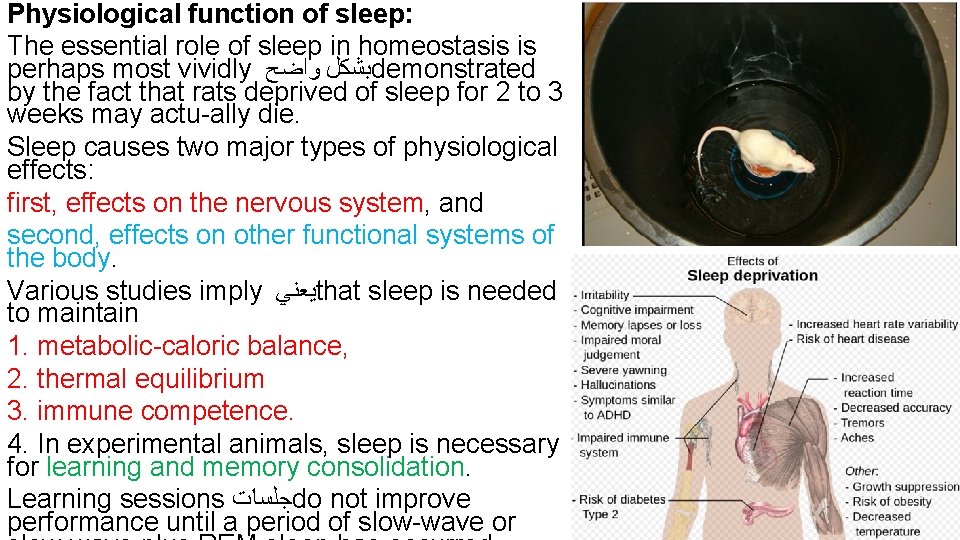
Physiological function of sleep: The essential role of sleep in homeostasis is perhaps most vividly ﺑﺸﻜﻞ ﻭﺍﺿﺢ demonstrated by the fact that rats deprived of sleep for 2 to 3 weeks may actu ally die. Sleep causes two major types of physiological effects: first, effects on the nervous system, and second, effects on other functional systems of the body. Various studies imply ﻳﻌﻨﻲ that sleep is needed to maintain 1. metabolic caloric balance, 2. thermal equilibrium 3. immune competence. 4. In experimental animals, sleep is necessary for learning and memory consolidation. Learning sessions ﺟﻠﺴﺎﺕ do not improve performance until a period of slow wave or
Sleep has been postulated to serve many functions, including (1) neural maturation ﻧﻀﻮﺝ ﺍﻟﺨﻼﺑﺎ ﺍﻟﻌﺼﺒﻴﺔ (2) facilitation of learn ing or memory ﺗﺴﻬﻴﻞ ﻋﻤﻠﻴﺔ ﺍﻟﺘﻌﻠﻢ ﻭﺍﻟﺬﺍﻛﺮﺓ ﺷﻯﻲ (3) Cognition ﺍﻻﺩﺭﺍﻙ (4) clearance of metabolic waste products generated by neural activity in the awake brain, and (5) conservation of metabolic energy. We might postulate that the principal value of sleep is to restore natural balances among the neuronal centers. ������� ����� �� ��� The specific physiological functions of sleep, however, remain a mystery and are the subject of much research. Basic theories of sleep An earlier theory of sleep was that the excitatory areas of the upper brain stem, the reticular activating system, simply became fatigued during the waking day and became inactive as a result. Sleep is caused by an active inhibitory process by the “sleep centers” which is required to cause sleep by inhibiting other parts of brain
“Sleep centers” located in: 1) A center located below the mid pontile level of the brain stem Cycle between sleep and wakefulness When the mid pontile level of the brain stem not activated the mesen cephalic and upper pontile reticular activatingnuclei are released from inhibition And become spontaneously active. excites both the cerebral cortex and the peripheral nervous system both of which send numerous positive feedback signals back to the same reticular activating nuclei to activate them still further. Therefore, once wakefulness begins, it has a natural ten dency to sustain itself because of all this positive feedback activity. after the brain remains activated for many hours, even the neurons in the activating system presumably become fatigued. Consequently, the positive feedback cycle between the mesencephalic reticular nuclei and the cerebral cortex fades and the sleep promoting effects of the sleep centers take over, leading to rapid transition from
2) Raphe nuclei in the lower half of the pone and in the medulla is required to cause sleep by inhibiting other parts of brain. Nerve ending of fibers from these raphe neurons secret serotonin 3) Stimulus area of nucleus of tractus solitaries 4) Diencephalon (a) Hypothalamus, mainly in the suprachiasmal area (b) Thalamus. Destruction of 3 and 4 causes lead to a high state of wakefulness Possible transmitter substances related to sleep. a) Serotonin related to raphe nuclei in the lower half of the pons and in the medulla and causes sleep b) muramyl peptide, causes sleep c) Orexin (also called hypocretin) is produced by neurons in the hypothalamus that provide excitatory input to many other areas of the brain where there are orexin receptors.
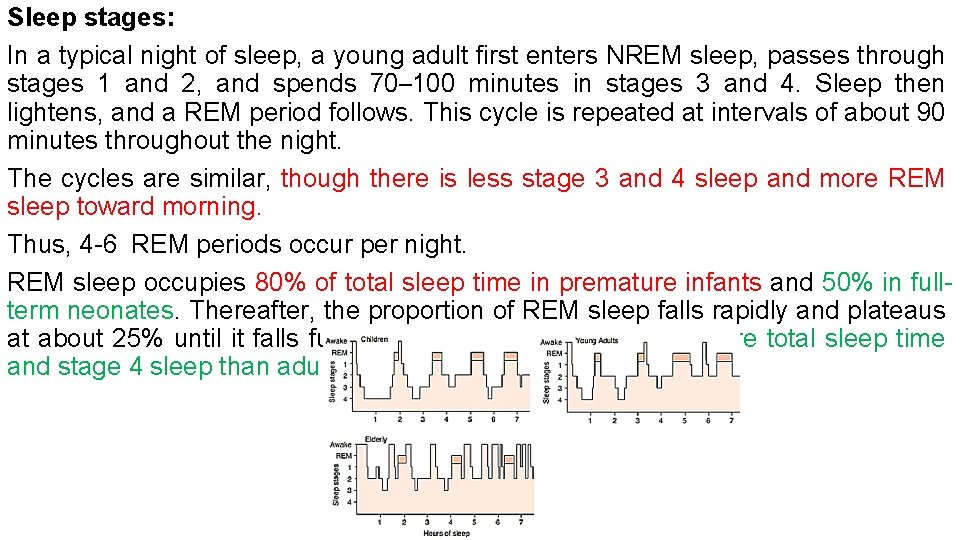
Sleep stages: In a typical night of sleep, a young adult first enters NREM sleep, passes through stages 1 and 2, and spends 70– 100 minutes in stages 3 and 4. Sleep then lightens, and a REM period follows. This cycle is repeated at intervals of about 90 minutes throughout the night. The cycles are similar, though there is less stage 3 and 4 sleep and more REM sleep toward morning. Thus, 4 6 REM periods occur per night. REM sleep occupies 80% of total sleep time in premature infants and 50% in full term neonates. Thereafter, the proportion of REM sleep falls rapidly and plateaus at about 25% until it falls further in old age. Children have more total sleep time and stage 4 sleep than adults.
Babylonian medical treatise that dates back to 1067 1046 B. C. , which calls it miqtu (disease that makes one fall) and accurately describes its main clinical expressions Seizures and Epilepsy Seizures are temporary disruptions of brain function caused by uncontrolled excessive neuronal activity. Depending on the distribution of neuronal discharges, seizure manifestations can range from experiential phe nomena that are barely noticeable to dramatic convulsions. Approximately 5 to 10 percent of the population will have at least one seizure in their lifetim Secondary Epilepsy can be caused by multiple neurological or medical conditions, such as acute electrolyte disorders, hypoglycemia, drugs (e. g. , cocaine), eclampsia, kidney failure, hypertensive encephalopathy, meningitis, and so
Primary Epilepsy is a chronic condition of recurrent seizures that can also vary from brief and nearly undetectable symptoms to periods of vig orous shaking and convulsions. Epilepsy is not a single disease. Epilepsy clinical symptoms are heterogeneous and reflect multiple underlying causes and pathophysiological mecha nismsthat cause cerebral dysfunction and injury, such as trauma, tumors, infection, or degenerative changes. Hereditary factors appear to be important, although a spe cific cause cannot be identified in many patients and several factors may coexist, reflecting an acquired brain pathology and genetic predisposition. Epilepsy is estimated to affect approximately 1 percent of the population, or 65 million people worldwide. Pathophysiology At a basic level an epileptic seizure is caused by a disrup tion of the normal balance between inhibitory and excit atory currents or transmission in one or more regions of the brain. Drugs or pathological factors that increase neu ronal excitation or impair inhibition tend to be eliptogenic (i. e. , predisposing a person to
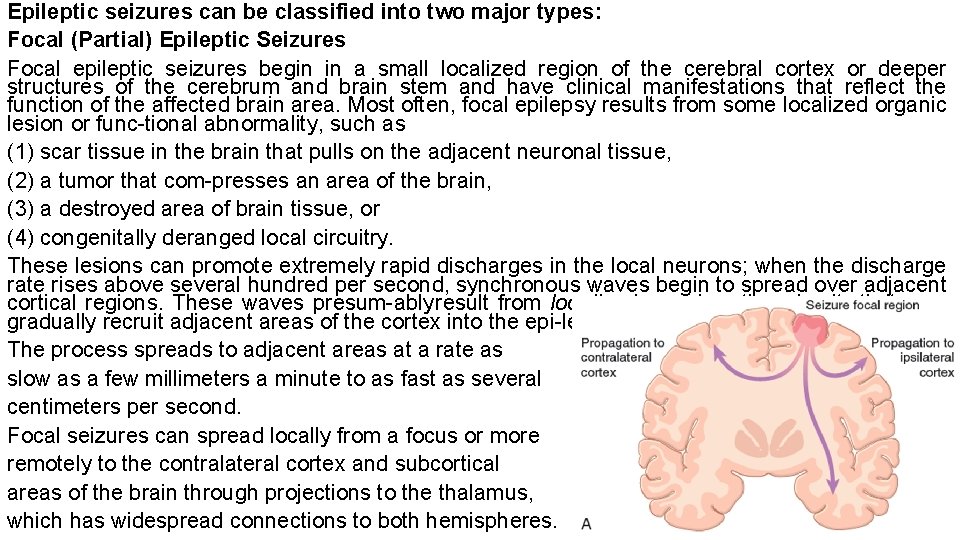
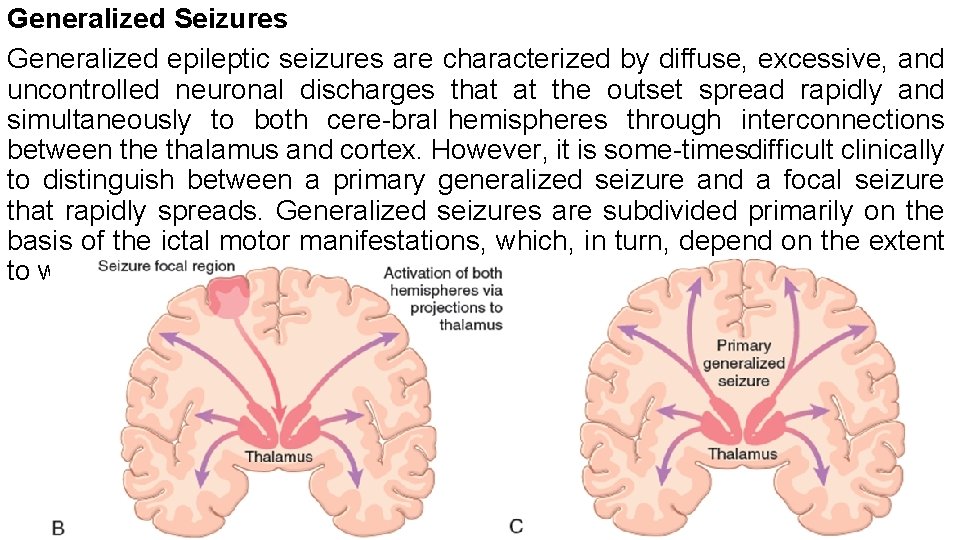
Epileptic seizures can be classified into two major types: Focal (Partial) Epileptic Seizures Focal epileptic seizures begin in a small localized region of the cerebral cortex or deeper structures of the cerebrum and brain stem and have clinical manifestations that reflect the function of the affected brain area. Most often, focal epilepsy results from some localized organic lesion or func tional abnormality, such as (1) scar tissue in the brain that pulls on the adjacent neuronal tissue, (2) a tumor that com presses an area of the brain, (3) a destroyed area of brain tissue, or (4) congenitally deranged local circuitry. These lesions can promote extremely rapid discharges in the local neurons; when the discharge rate rises above several hundred per second, synchronous waves begin to spread over adjacent cortical regions. These waves presum ably result from localized reverberating circuits that may gradually recruit adjacent areas of the cortex into the epi leptic discharge zone. The process spreads to adjacent areas at a rate as slow as a few millimeters a minute to as fast as several centimeters per second. Focal seizures can spread locally from a focus or more remotely to the contralateral cortex and subcortical areas of the brain through projections to the thalamus, which has widespread connections to both hemispheres.
When such a wave of excitation spreads over the motor cortex, it causes a progressive “march” of muscle contractions throughout the opposite side of the body, beginning most characteristically in the mouth region and marching progressively downward to the legs but at other times marching in the opposite direction. This phenome non is calledjacksonian march. Focal seizures are often classified as simple partial when there is no major change in consciousness or as complex partial when consciousness is impaired. Simple partial sei zures may be preceded by an aura, with sensations such as fear, followed by motor signs, such as rhythmic jerking or tonic stiffening movements of a body part. A focal epileptic attack may remain confined to a single area of the brain, often the temporal lobe, but in some instances strong signals spread from the focal region and the person may lose consciousness. Complex partial seizures may also begin with an aura followed by impaired consciousness and strange repetitive movements (automatisms), such as chewing or lip smacking. After recovery from the seizure the person may have no memory of the attack, except for the aura. The time after the seizure, prior to the return of normal neurological function,
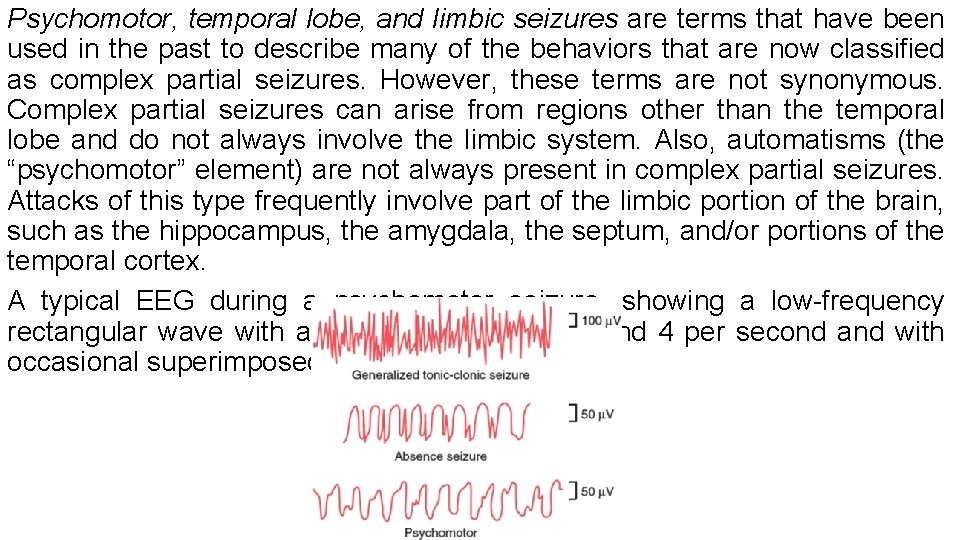
Psychomotor, temporal lobe, and limbic seizures are terms that have been used in the past to describe many of the behaviors that are now classified as complex partial seizures. However, these terms are not synonymous. Complex partial seizures can arise from regions other than the temporal lobe and do not always involve the limbic system. Also, automatisms (the “psychomotor” element) are not always present in complex partial seizures. Attacks of this type frequently involve part of the limbic portion of the brain, such as the hippocampus, the amygdala, the septum, and/or portions of the temporal cortex. A typical EEG during a psychomotor seizure, showing a low frequency rectangular wave with a frequency between 2 and 4 per second and with occasional superimposed 14 per second waves.
Generalized Seizures Generalized epileptic seizures are characterized by diffuse, excessive, and uncontrolled neuronal discharges that at the outset spread rapidly and simultaneously to both cere bral hemispheres through interconnections between the thalamus and cortex. However, it is some timesdifficult clinically to distinguish between a primary generalized seizure and a focal seizure that rapidly spreads. Generalized seizures are subdivided primarily on the basis of the ictal motor manifestations, which, in turn, depend on the extent to which subcortical and brain stem regions participate in the seizure.
Generalized Tonic-Clonic (Grand Mal) Seizures) 1. Tonic clonic: Characterized by: The duration of the seizure is usually 1 to 3 minutes. These seizures are often described as “grand mal. ” The seizures are divided into two phases, the tonic phase and theclonic phase, hence the name of the seizure, though a tonic–clonic seizure will often be preceded by an aura. Aura The person may feel lightheadedness and/or dizziness, unusual (and possibly inappropriate) emotions, intense feelings of discomfort or foreboding, altered vision and hearing (which may or may not include hallucinations) An aura may last as little as a few minutes or as long as several hours, though some withepilepsy do not experience them at all. Many auras are followed by a tonic–clonic seizure.
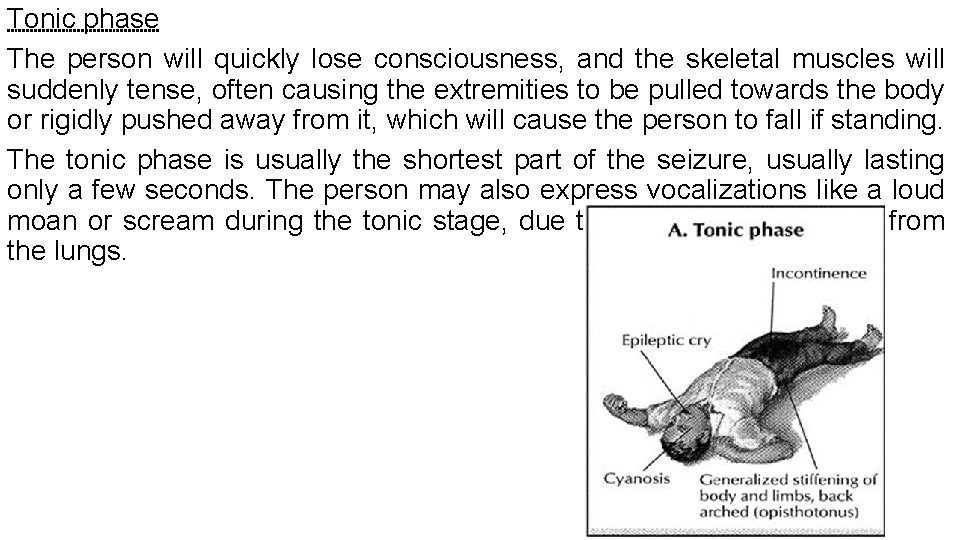
Tonic phase The person will quickly lose consciousness, and the skeletal muscles will suddenly tense, often causing the extremities to be pulled towards the body or rigidly pushed away from it, which will cause the person to fall if standing. The tonic phase is usually the shortest part of the seizure, usually lasting only a few seconds. The person may also express vocalizations like a loud moan or scream during the tonic stage, due to air forcefully expelled from the lungs.
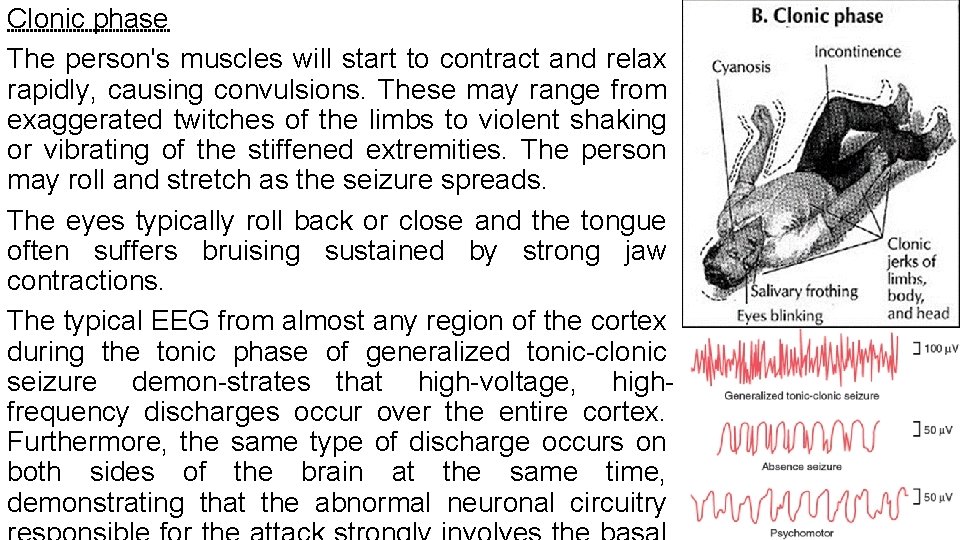
Clonic phase The person's muscles will start to contract and relax rapidly, causing convulsions. These may range from exaggerated twitches of the limbs to violent shaking or vibrating of the stiffened extremities. The person may roll and stretch as the seizure spreads. The eyes typically roll back or close and the tongue often suffers bruising sustained by strong jaw contractions. The typical EEG from almost any region of the cortex during the tonic phase of generalized tonic clonic seizure demon strates that high voltage, high frequency discharges occur over the entire cortex. Furthermore, the same type of discharge occurs on both sides of the brain at the same time, demonstrating that the abnormal neuronal circuitry
What Initiates a Generalized Tonic-Clonic Seizure? The majority of generalized seizures are idiopathic, which means that the cause is unknown. Many people who have generalized tonic clonic attacks have a hereditary predis positionto epilepsy, a predisposition that occurs in about 1 of every 50 to 100 persons. In these people, factors that can increase the excitability of the abnormal “epilepto genic”circuitry enough to precipitate attacks include (1) strong emotional stimuli, (2) alkalosis caused by over breathing, (3) drugs, (4) fever, and (5) loud noises or flash ing lights. Even in people who are not genetically predisposed, certain types of traumatic lesions in almost any part of the brain cause excess excitability of local brain areas, as we discuss shortly; these local brain areas also sometimes transmit signals into the activating systems of the brain to elicit tonic clonic seizures. What Stops the Generalized Tonic-Clonic Attack? The extreme neuronal overactivity during a tonic clonic attack is presumed to be caused by massive simultaneous activa tion of many reverberating
Absence Seizures (Petit Mal Seizures) Absence seizures, formerly called petit mal seizures, usually begin in childhood or early adolescence and account for 15 to 20 percent of epilepsy cases in children. Absence sei zures almost certainly involve thalamocortical brain activating system. They are usually characterized by 3 to 30 seconds of unconsciousness or diminished consciousness, during which time the person often stares and has twitch like contractions of muscles, usually in the head region, especially blinking of the eyes; this phase is followed by a rapid return of consciousness and resumption of previous activities. This total sequence is called the absence syn drome or absence epilepsy. The patient may have one such attack in many months or, in rare instances, may have a rapid series of attacks, one after the other. The usual course is for the absence seizures to appear first during childhood or adolescence and then to disappear by the age of 30 years. On occasion, an absence seizure will initiate a generalized tonic clonic (grand mal) attack.
3. Myoclonic(infantile spasm): Seen in children or infants, caused by cerebral pathology, often with mental retardation Infantile spasms usually disappear by age 4, but child may develop other types of seizures. Characterized by: A. Single and very brief jerks of all major muscle groups. It is of two types: Extensor type – infant extends head, spreads arms out, bend body backward in “spread eagle” position. Mixed flexor and extensor types may occur in clusters or alternate. B. May cause children to drop or throw something. C. Infant may cry out, grunt ﺍﻟﺑﺎﻉ ﻭﻫﻮ ﺻﻮﺕ ﺍﻟﺨﻨﺰﻳﺮ , grimace ﻳﻜ ﺭ ﺃﻮ ﻳﻠﻮﻱ ﻗﺴﻤﺎﺕ ﻭﺟﻬﺔ ﻹﺿﺤﺎﻙ ﺍﻵﺨﺮﻳﻦ , laugh, or appear fearful during an attack. D. Patients with these may not lose consciousness, due to the seizure lasting less than 3 to 4 seconds. E. Patients may describe these seizures as shoulder shrugs or spinal chills. F. Myoclonic seizures may cluster and build into a generalized tonic clonic seizure.
4. Atonic: Characterized by: A. The patient loses consciousness and muscle tone. B. No muscle movements are typically noted, and the patient will fall when they are not lying down or sitting in a chair. C. These seizures may be described as “falling out. ” D. Usually accruing in children, this type is associated with complete loss of consciousness and muscle tone.