
2 Measurements Orbits and Launching Methods Contents Different
2. Measurements (Orbits and Launching Methods)
Contents • • • • Different Types of orbit Satellite Orbits & Relative Periods GEO View & Coverage from GEO Some GEO Characteristics of GEO Transfer Orbit C & Ku Bands Satellites in Orbit Mega LEO, MEO, HEO & GEO Projects The Future Broadband LEO Launching Launch Vehicle Summary of Launchers Types of Launches
Different Types of Orbits • Circular orbits are simplest • Inclined orbits are useful for coverage of equatorial regions • Elliptical orbits can be used to give quasi(half) stationary behaviour viewed from earth - using 3 or 4 satellites • Orbit changes can be used to extend the life of satellites
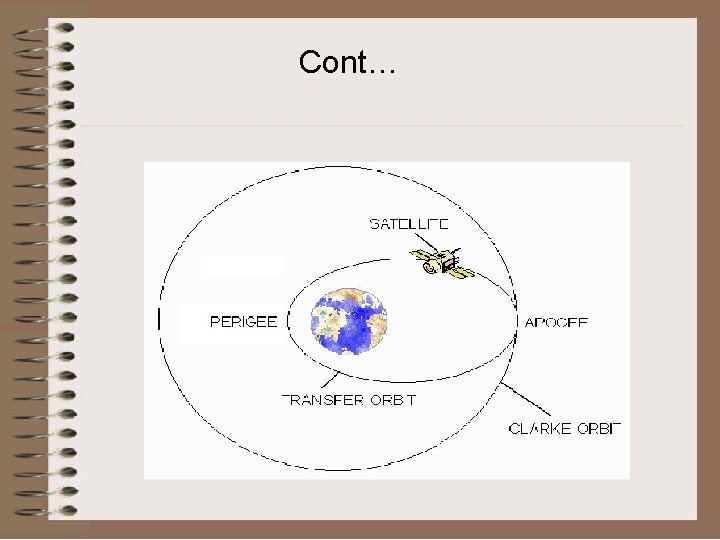
Cont… Several types • LEOs - Low Earth Orbit • MEOs - Medium Earth Orbit • HEOs - Highly Elliptical Orbit • GSO - Geostationary Earth Orbit
Cont…
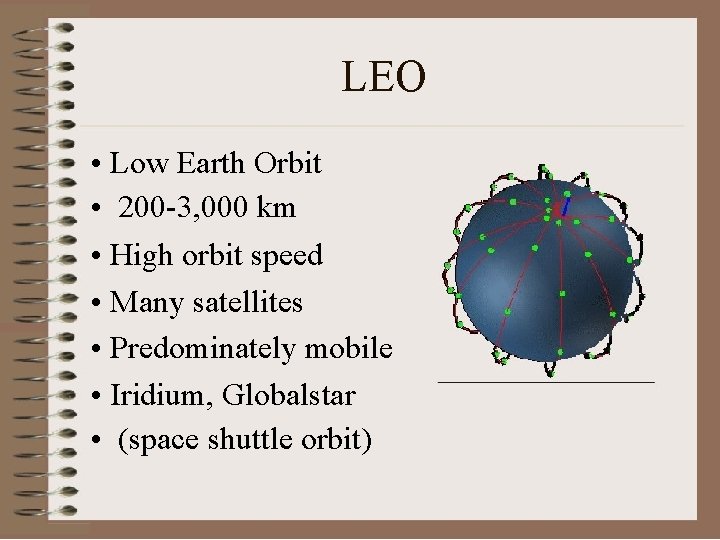
LEO • Low Earth Orbit • 200 -3, 000 km • High orbit speed • Many satellites • Predominately mobile • Iridium, Globalstar • (space shuttle orbit)
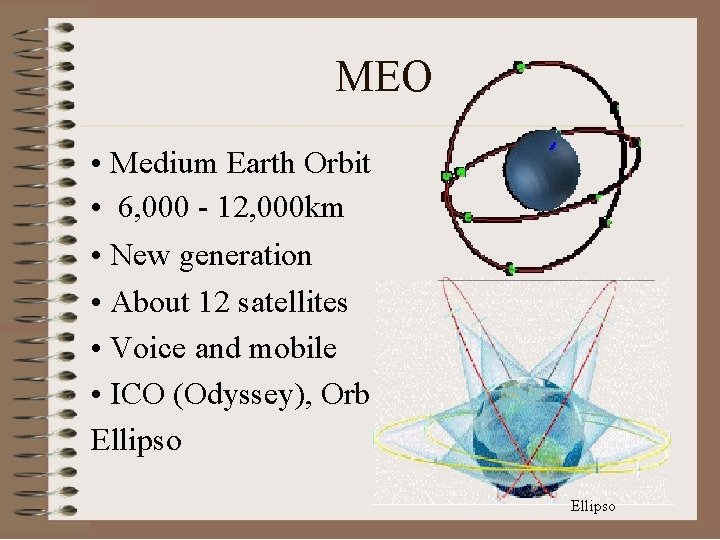
MEO • Medium Earth Orbit • 6, 000 - 12, 000 km • New generation • About 12 satellites • Voice and mobile • ICO (Odyssey), Orb Ellipso
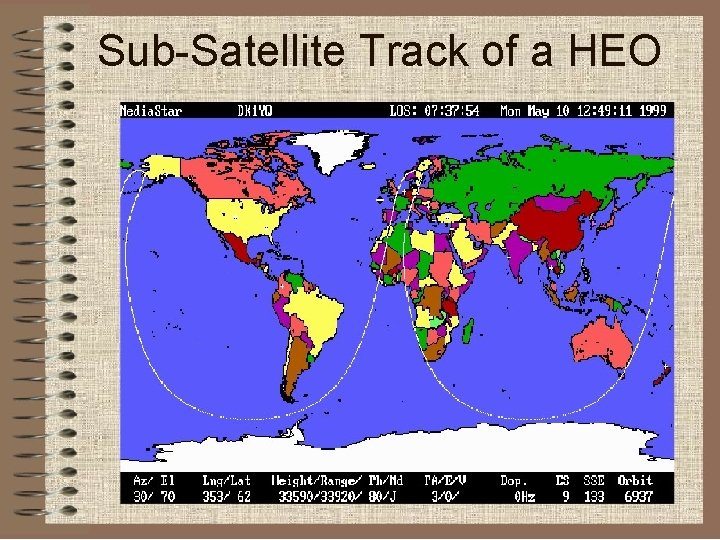
Sub-Satellite Track of a HEO
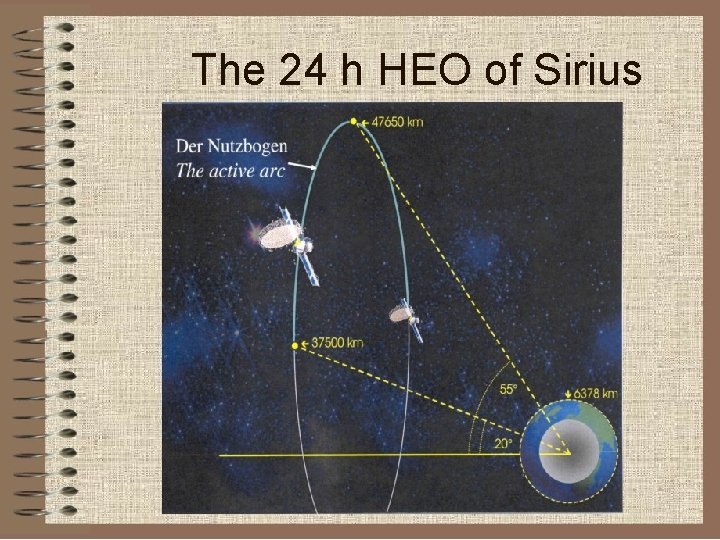
The 24 h HEO of Sirius
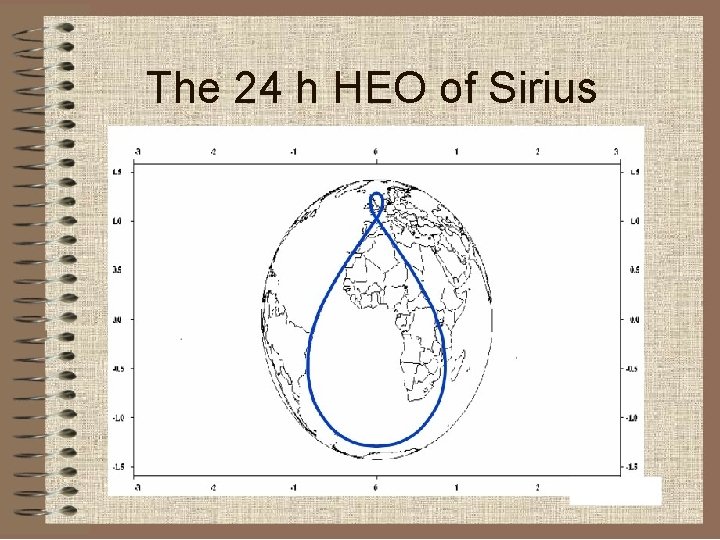
The 24 h HEO of Sirius
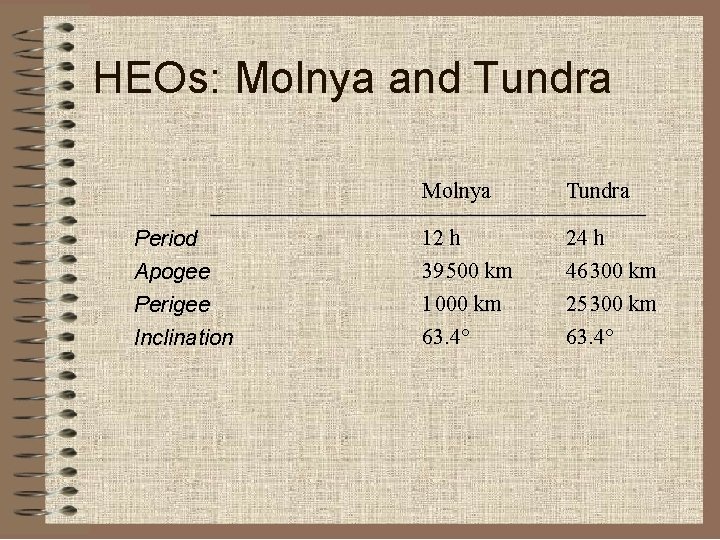
HEOs: Molnya and Tundra Molnya Tundra Period 12 h 24 h Apogee Perigee Inclination 39 500 km 1 000 km 63. 4° 46 300 km 25 300 km 63. 4°
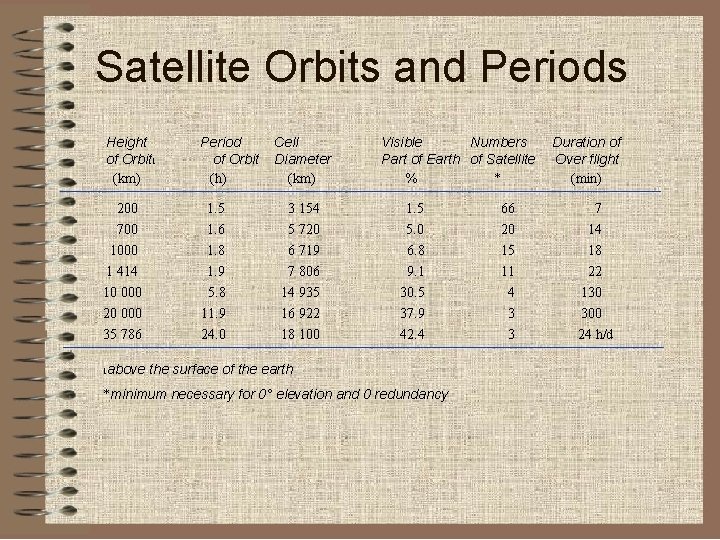
Satellite Orbits and Periods Height of Orbit 1 (km) Period of Orbit (h) 200 700 1000 1 414 10 000 20 000 35 786 1. 5 1. 6 1. 8 1. 9 5. 8 11. 9 24. 0 Cell Diameter (km) 3 154 5 720 6 719 7 806 14 935 16 922 18 100 Visible Numbers Part of Earth of Satellite % * 1. 5 5. 0 6. 8 9. 1 30. 5 37. 9 42. 4 above the surface of the earth 1 *minimum necessary for 0° elevation and 0 redundancy 66 20 15 11 4 3 3 Duration of Over flight (min) 7 14 18 22 130 300 24 h/d
GEOs • Originally proposed by Arthur C. Clarke • Circular orbits above the equator • Angular separation about 2 degrees allows 180 satellites • Orbital height above the earth about 23000 miles/35786. 16 km • Round trip time to satellite about 0. 24 seconds
GEOs (2) • GEO satellites require more power for communications • The signal to noise ratio for GEOs is worse because of the distances involved • A few GEOs can cover most of the surface of the earth • Note that polar regions cannot be “seen” by GEOs
GEOs (3) • Since they appear stationary, GEOs do not require tracking • GEOs are good for broadcasting to wide areas • Currently 329 GEO are in orbit (ref: web site provided by Johnston)
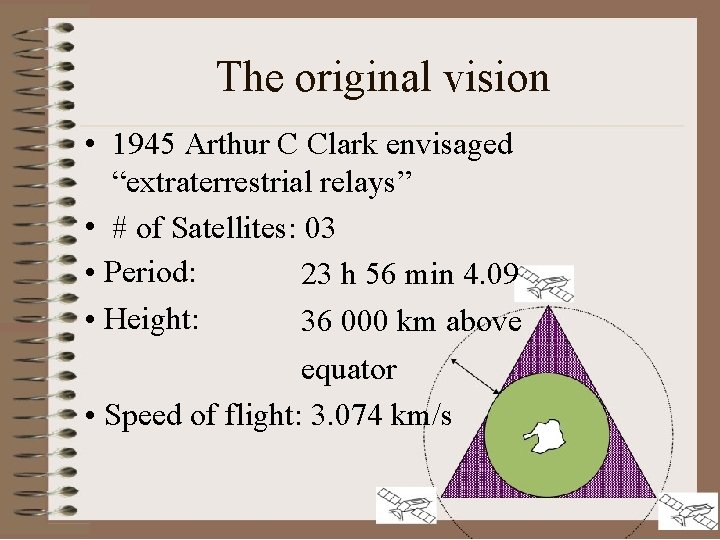
The original vision • 1945 Arthur C Clark envisaged “extraterrestrial relays” • # of Satellites: 03 • Period: 23 h 56 min 4. 09 • Height: 36 000 km above equator • Speed of flight: 3. 074 km/s
and then. . • 1957 Sputnik • a rush of experimental satellites in many orbits • Intelsat 1965 - 1 st commercial GEO service • over 800 objects registered so far
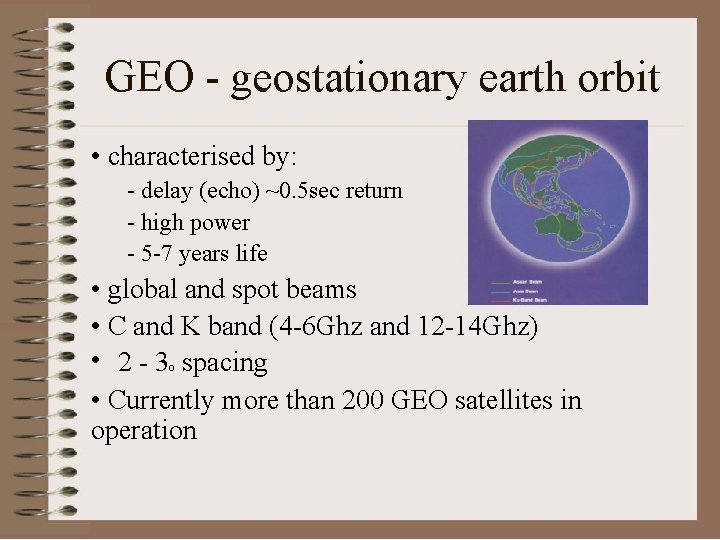
GEO - geostationary earth orbit • characterised by: - delay (echo) ~0. 5 sec return - high power - 5 -7 years life • global and spot beams • C and K band (4 -6 Ghz and 12 -14 Ghz) • 2 - 3 o spacing • Currently more than 200 GEO satellites in operation
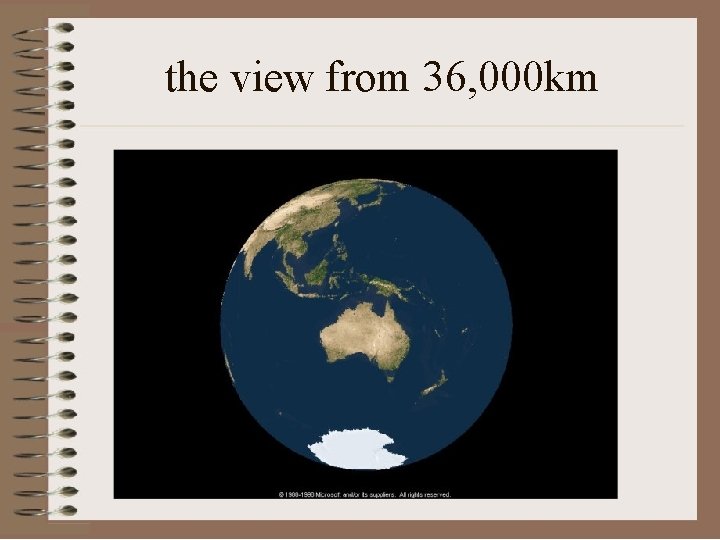
the view from 36, 000 km
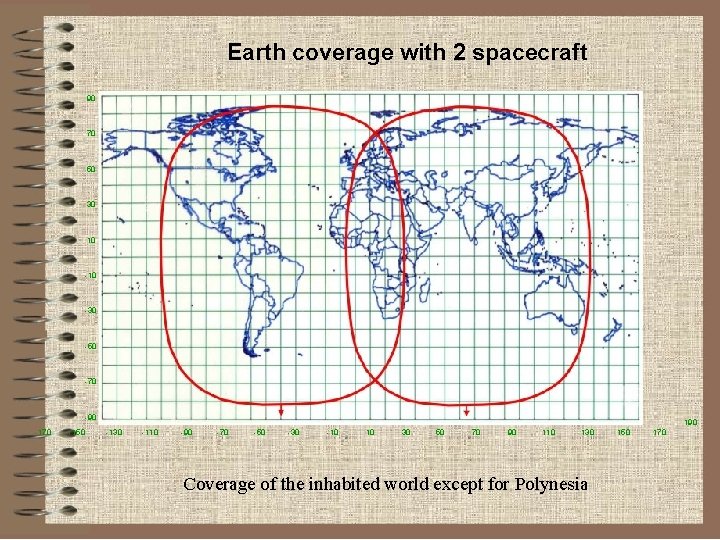
Earth coverage with 2 spacecraft 90 70 50 30 10 -30 -50 -70 -90 -170 -150 190 -130 -110 -90 -70 -50 -30 -10 10 30 50 70 90 110 130 Coverage of the inhabited world except for Polynesia 150 170
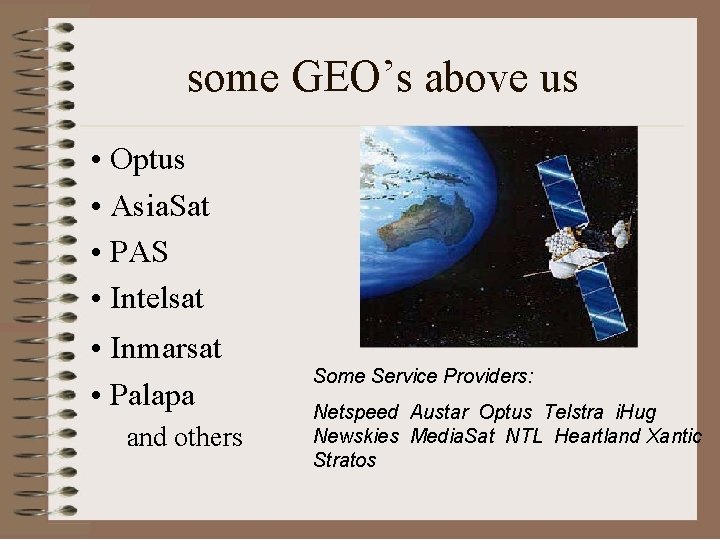
some GEO’s above us • Optus • Asia. Sat • PAS • Intelsat • Inmarsat • Palapa and others Some Service Providers: Netspeed Austar Optus Telstra i. Hug Newskies Media. Sat NTL Heartland Xantic Stratos
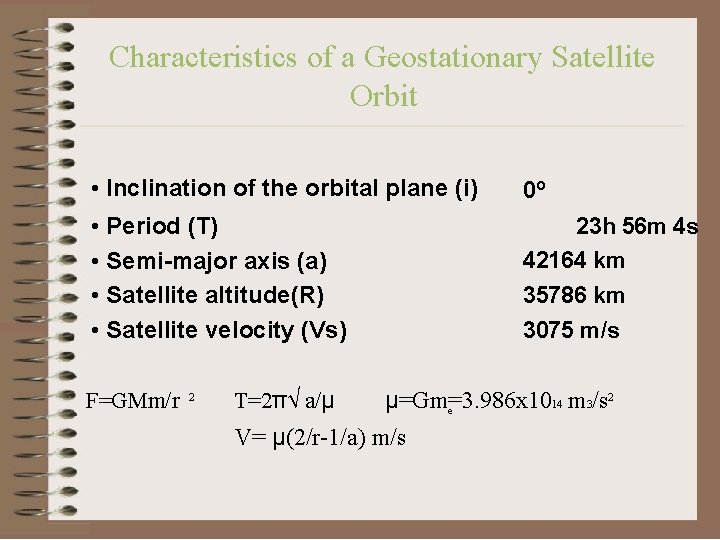
Characteristics of a Geostationary Satellite Orbit • Inclination of the orbital plane (i) 0º • Period (T) • Semi-major axis (a) • Satellite altitude(R) • Satellite velocity (Vs) 23 h 56 m 4 s 42164 km F=GMm/r 2 T=2π√ a/µ 35786 km 3075 m/s 2 µ=Gm=3. 986 x 10 14 m 3/s e V= µ(2/r-1/a) m/s
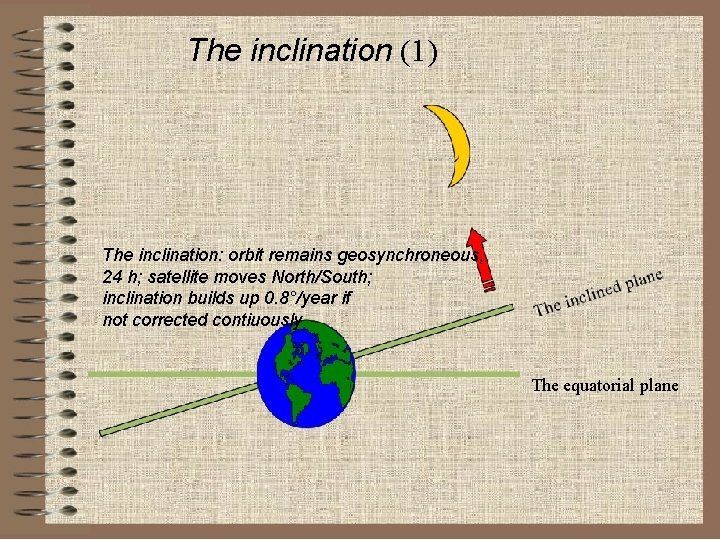
The inclination (1) The inclination: orbit remains geosynchroneous, 24 h; satellite moves North/South; inclination builds up 0. 8°/year if not corrected contiuously The equatorial plane
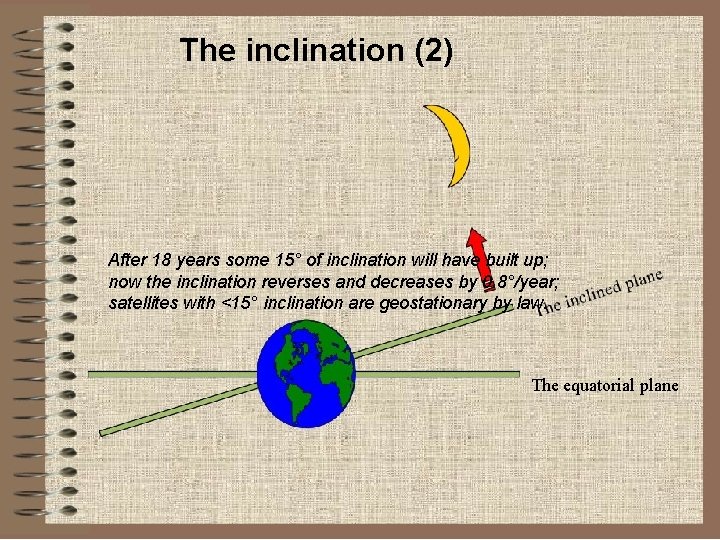
The inclination (2) After 18 years some 15° of inclination will have built up; now the inclination reverses and decreases by 0. 8°/year; satellites with <15° inclination are geostationary by law. The equatorial plane
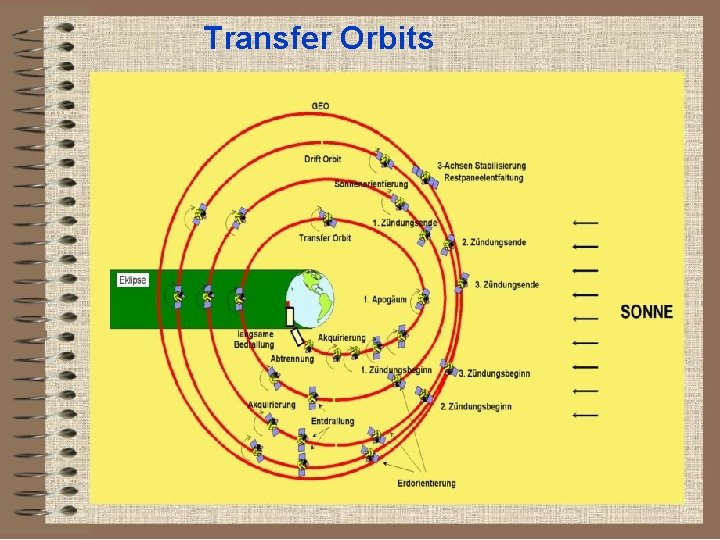
Transfer Orbits
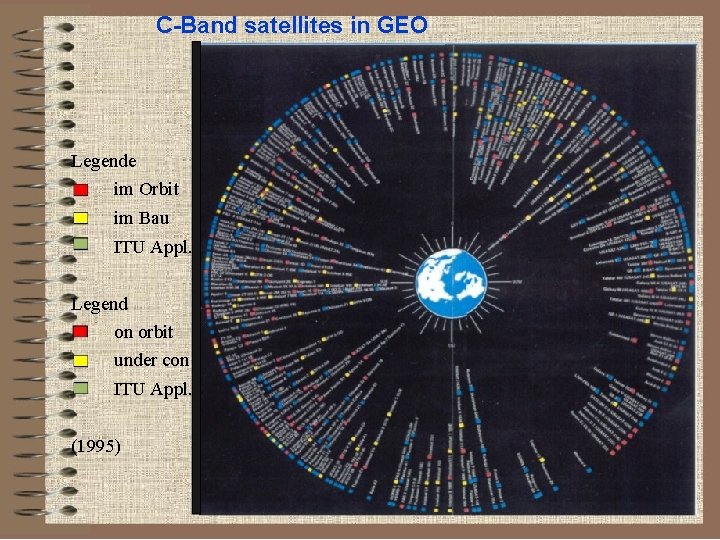
C-Band satellites in GEO Legende im Orbit im Bau ITU Appl. Legend on orbit under con ITU Appl. (1995)
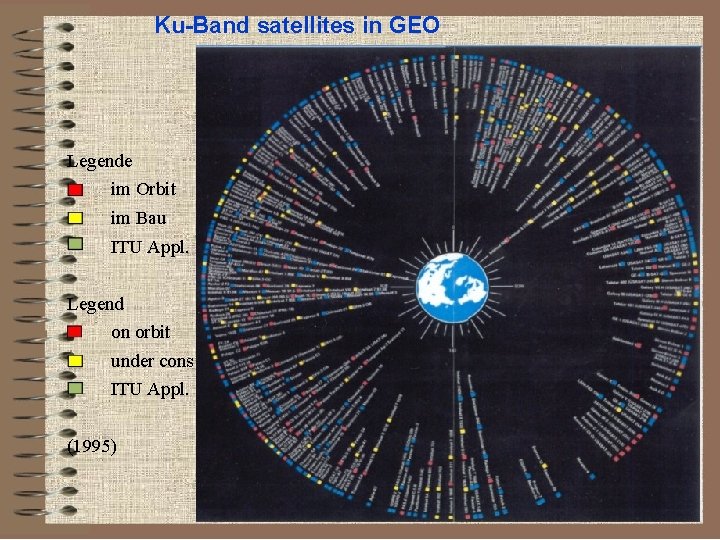
Ku-Band satellites in GEO Legende im Orbit im Bau ITU Appl. Legend on orbit under cons ITU Appl. (1995)
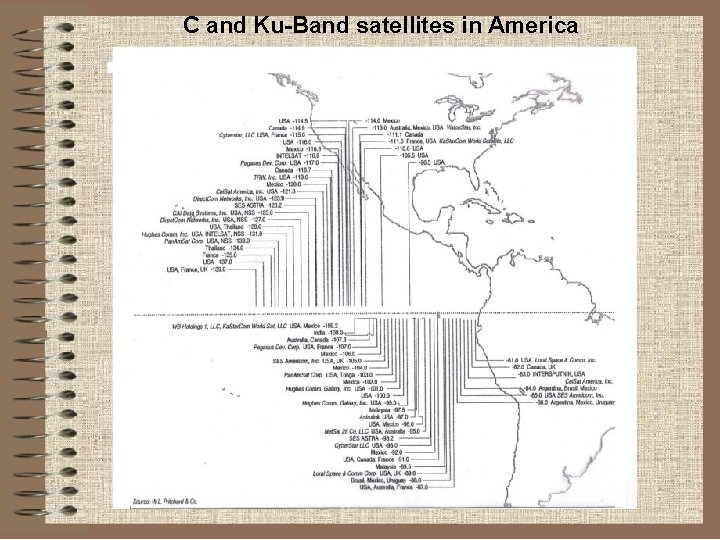
C and Ku-Band satellites in America
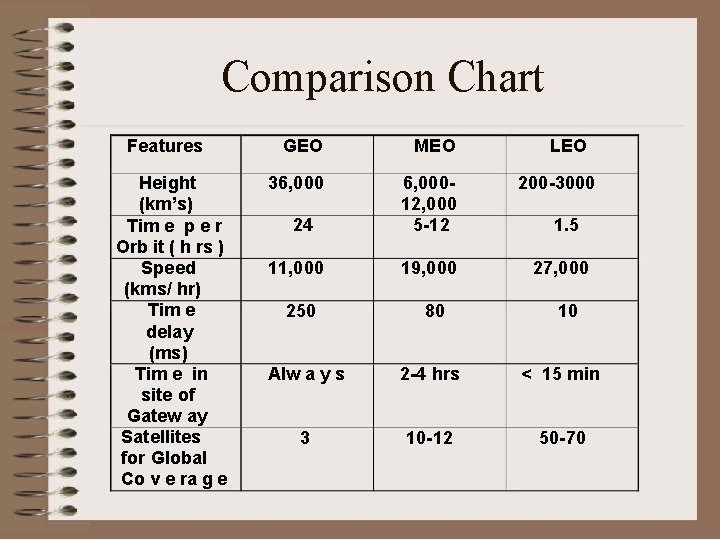
Comparison Chart Features Height (km’s) Tim e p e r Orb it ( h rs ) Speed (kms/ hr) Tim e delay (ms) Tim e in site of Gatew ay Satellites for Global Co v e ra g e GEO MEO 36, 00012, 000 5 -12 200 -3000 19, 000 27, 000 24 11, 000 250 80 LEO 1. 5 10 Alw a y s 2 -4 hrs < 15 min 3 10 -12 50 -70
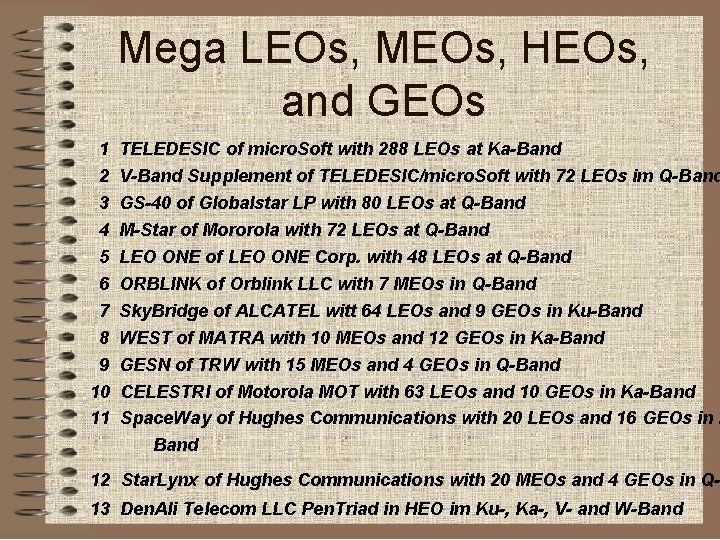
Mega LEOs, MEOs, HEOs, and GEOs 1 2 3 4 5 6 7 8 9 10 11 TELEDESIC of micro. Soft with 288 LEOs at Ka-Band V-Band Supplement of TELEDESIC/micro. Soft with 72 LEOs im Q-Band GS-40 of Globalstar LP with 80 LEOs at Q-Band M-Star of Mororola with 72 LEOs at Q-Band LEO ONE of LEO ONE Corp. with 48 LEOs at Q-Band ORBLINK of Orblink LLC with 7 MEOs in Q-Band Sky. Bridge of ALCATEL witt 64 LEOs and 9 GEOs in Ku-Band WEST of MATRA with 10 MEOs and 12 GEOs in Ka-Band GESN of TRW with 15 MEOs and 4 GEOs in Q-Band CELESTRI of Motorola MOT with 63 LEOs and 10 GEOs in Ka-Band Space. Way of Hughes Communications with 20 LEOs and 16 GEOs in K Band 12 Star. Lynx of Hughes Communications with 20 MEOs and 4 GEOs in Q-B 13 Den. Ali Telecom LLC Pen. Triad in HEO im Ku-, Ka-, V- and W-Band
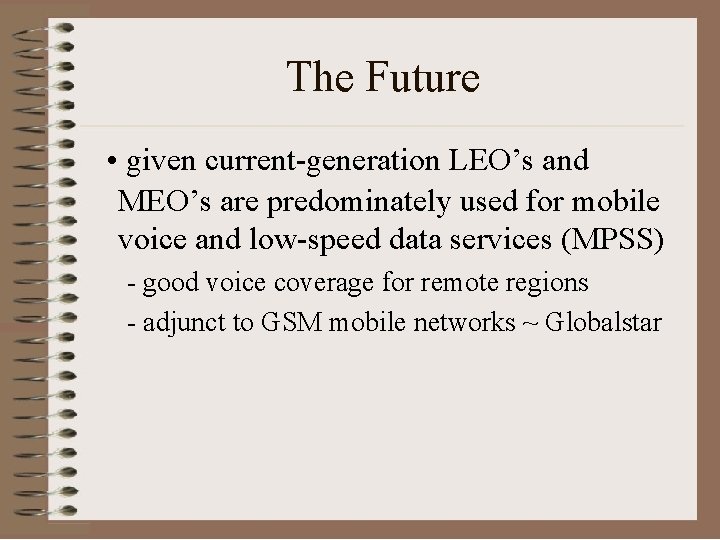
The Future • given current-generation LEO’s and MEO’s are predominately used for mobile voice and low-speed data services (MPSS) - good voice coverage for remote regions - adjunct to GSM mobile networks ~ Globalstar
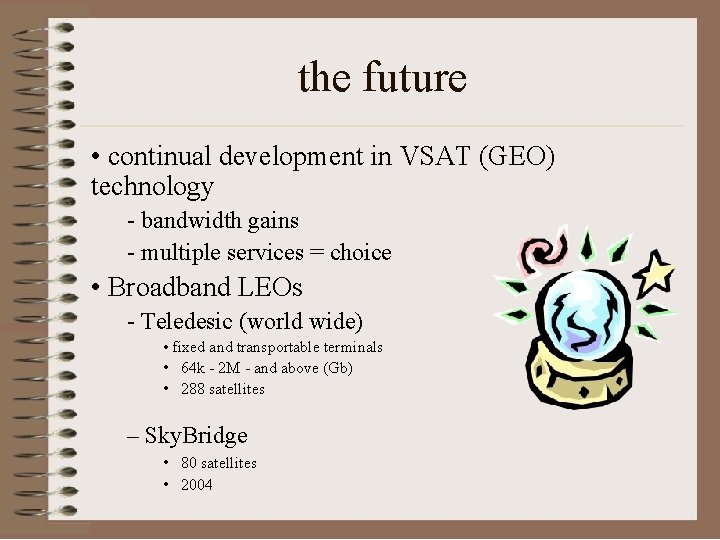
the future • continual development in VSAT (GEO) technology - bandwidth gains - multiple services = choice • Broadband LEOs - Teledesic (world wide) • fixed and transportable terminals • 64 k - 2 M - and above (Gb) • 288 satellites – Sky. Bridge • 80 satellites • 2004
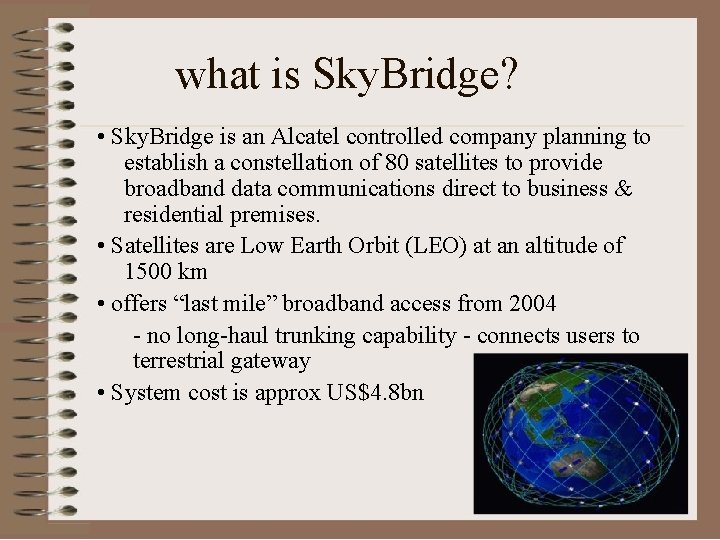
what is Sky. Bridge? • Sky. Bridge is an Alcatel controlled company planning to establish a constellation of 80 satellites to provide broadband data communications direct to business & residential premises. • Satellites are Low Earth Orbit (LEO) at an altitude of 1500 km • offers “last mile” broadband access from 2004 - no long-haul trunking capability - connects users to terrestrial gateway • System cost is approx US$4. 8 bn
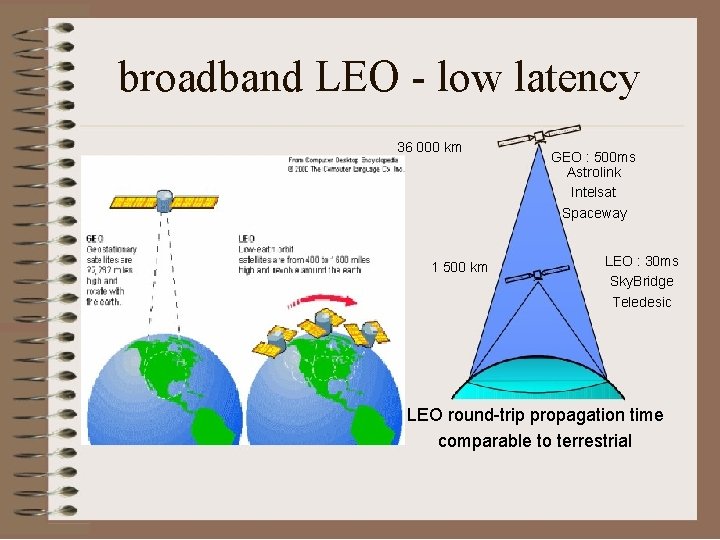
broadband LEO - low latency 36 000 km 1 500 km GEO : 500 ms Astrolink Intelsat Spaceway LEO : 30 ms Sky. Bridge Teledesic LEO round-trip propagation time comparable to terrestrial
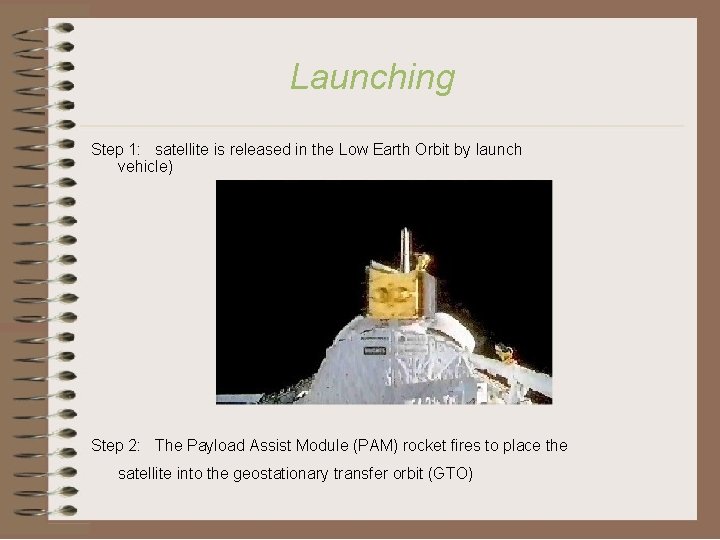
Launching Step 1: satellite is released in the Low Earth Orbit by launch vehicle) Step 2: The Payload Assist Module (PAM) rocket fires to place the satellite into the geostationary transfer orbit (GTO)
Launching (Continued) Step 3: Several days after the satellite gets into the GTO the Apogee Kick Motor (AKM) fires to put the satellite into a nearly circular orbit.
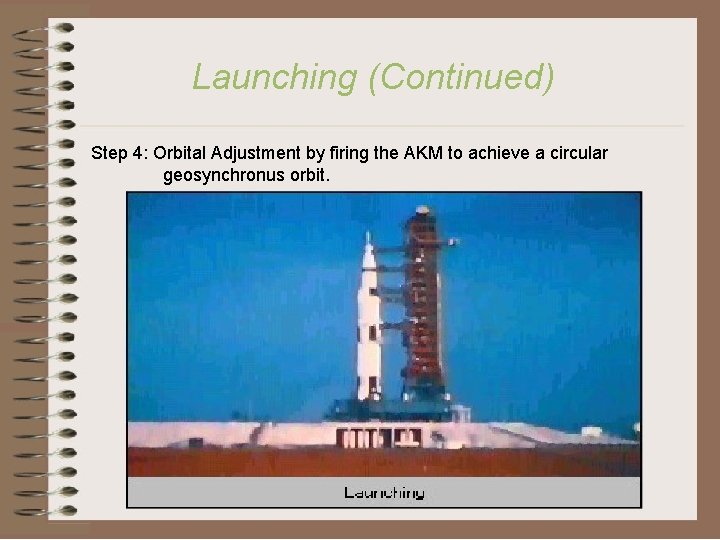
Launching (Continued) Step 4: Orbital Adjustment by firing the AKM to achieve a circular geosynchronus orbit.
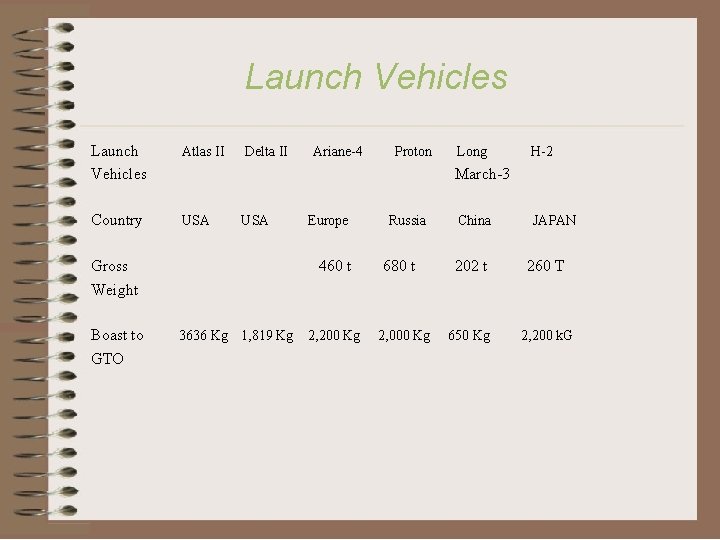
Launch Vehicles Atlas II Country USA Delta II Proton Long H-2 March-3 USA Gross Weight Boast to GTO Ariane-4 Europe 460 t 3636 Kg 1, 819 Kg 2, 200 Kg Russia 680 t 2, 000 Kg China JAPAN 202 t 260 T 650 Kg 2, 200 k. G
Launch Vehicle
Launch Vehicle
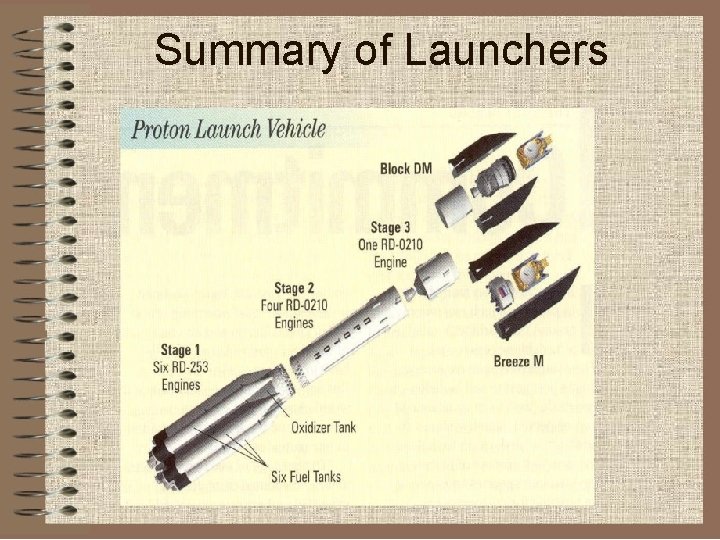
Summary of Launchers
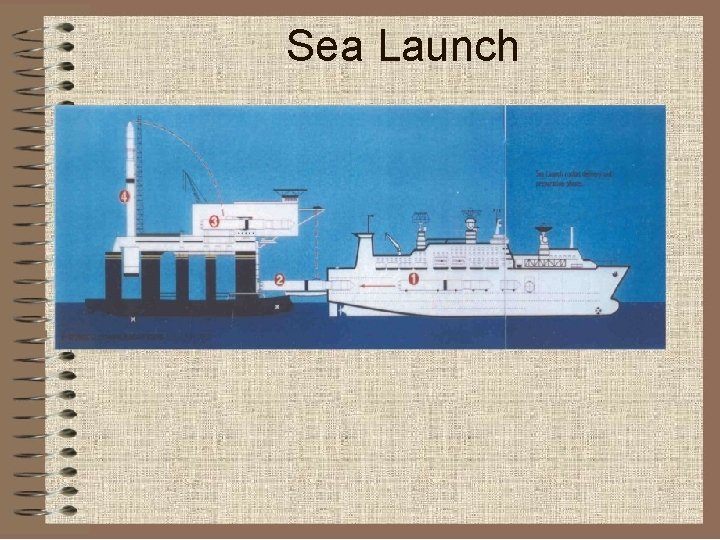
Sea Launch
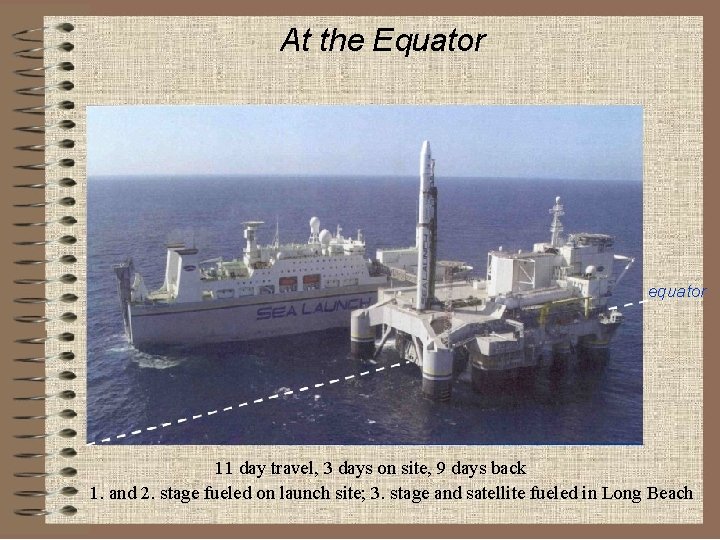
At the Equator equator 11 day travel, 3 days on site, 9 days back 1. and 2. stage fueled on launch site; 3. stage and satellite fueled in Long Beach
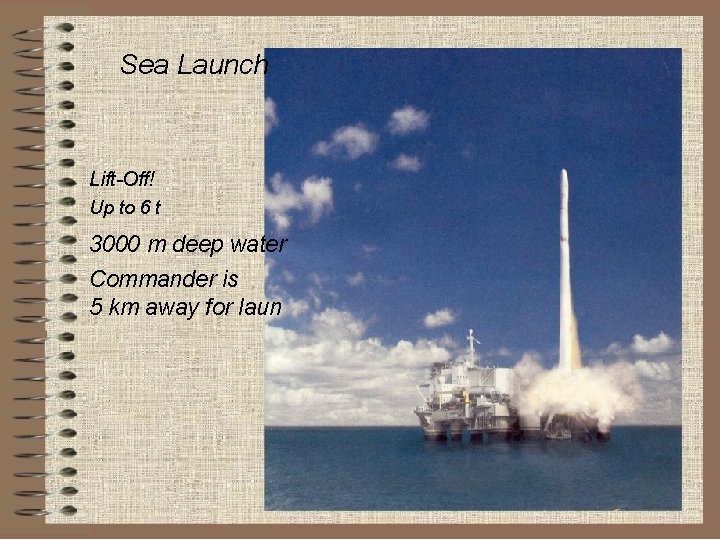
Sea Launch Lift-Off! Up to 6 t 3000 m deep water Commander is 5 km away for laun
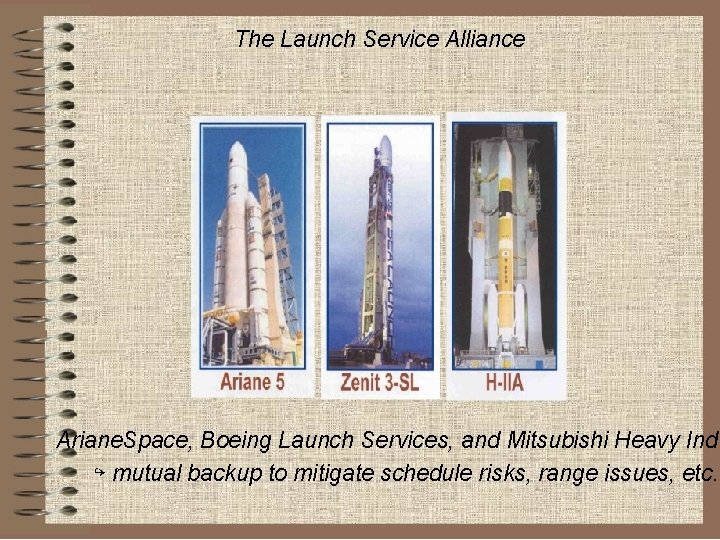
The Launch Service Alliance Ariane. Space, Boeing Launch Services, and Mitsubishi Heavy Indu ↪ mutual backup to mitigate schedule risks, range issues, etc.
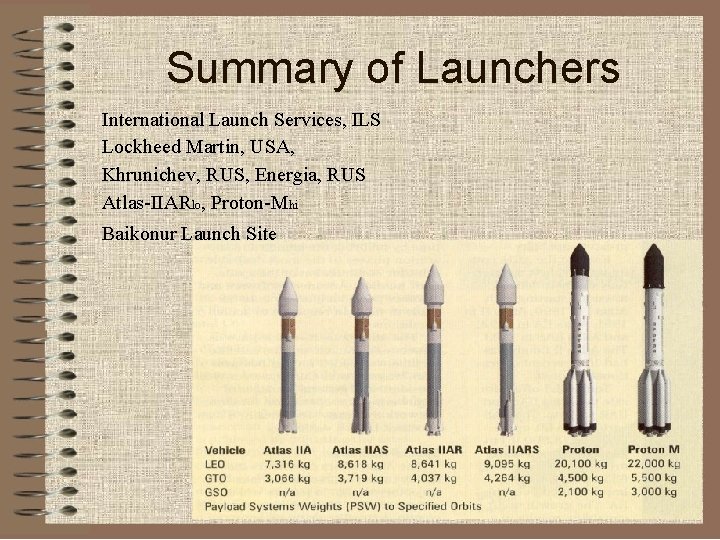
Summary of Launchers International Launch Services, ILS Lockheed Martin, USA, Khrunichev, RUS, Energia, RUS Atlas-IIARlo, Proton-Mhi Baikonur Launch Site
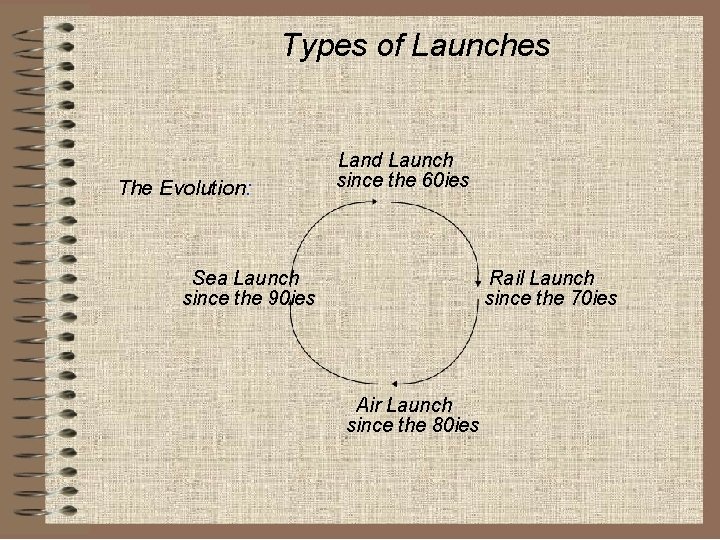
Types of Launches The Evolution: Land Launch since the 60 ies Sea Launch since the 90 ies Rail Launch since the 70 ies Air Launch since the 80 ies
Anatomy of a Satellite A communication satellite consists of the following subsystems: • Antenna_For receiving and transmitting signals. • Transponder_It contains the electronics for receiving the signals, amplifying them, changing their frequency and retransmitting them. • Power Generation and conditioning subsystem_For creating power and converting the generated power into a usable form to operate the satellite. • Command Telemetry_For transmitting data about the satellite (status, health etc. ) to the earth and receiving commands from earth. • Thrust subsystem_For making the adjustments to the satellite orbital position and altitude. • Stabilization subsystem_For keeping the satellite antennas pointing in exactly the right direction.
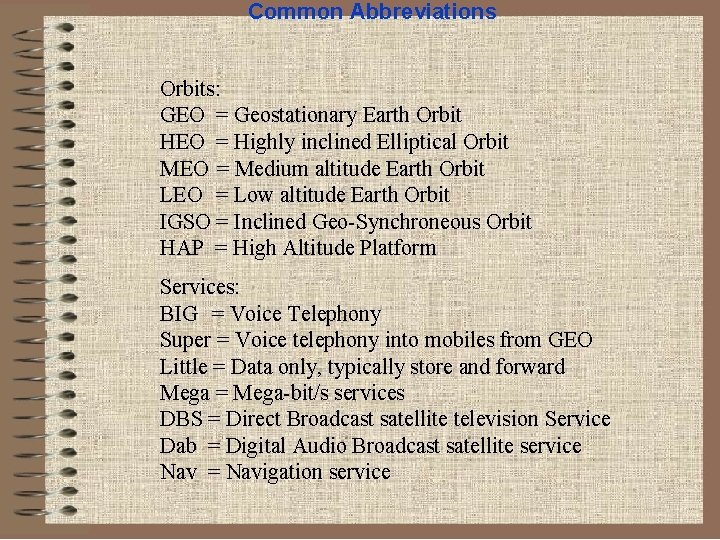
Common Abbreviations Orbits: GEO = Geostationary Earth Orbit HEO = Highly inclined Elliptical Orbit MEO = Medium altitude Earth Orbit LEO = Low altitude Earth Orbit IGSO = Inclined Geo-Synchroneous Orbit HAP = High Altitude Platform Services: BIG = Voice Telephony Super = Voice telephony into mobiles from GEO Little = Data only, typically store and forward Mega = Mega-bit/s services DBS = Direct Broadcast satellite television Service Dab = Digital Audio Broadcast satellite service Nav = Navigation service
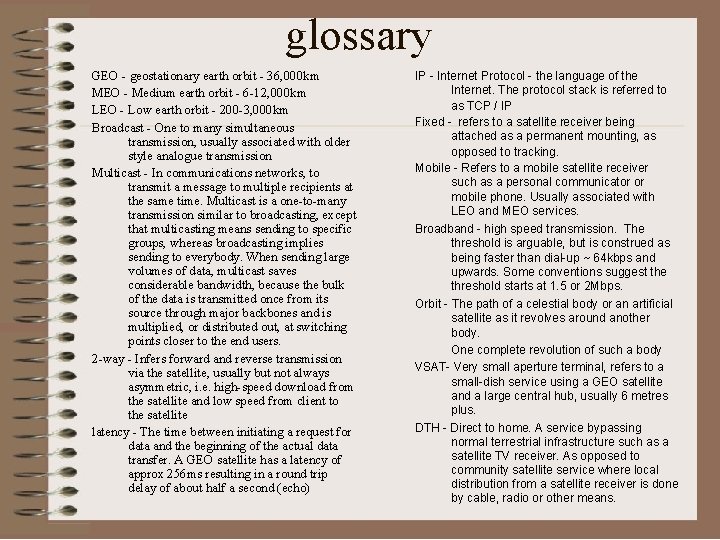
glossary GEO - geostationary earth orbit - 36, 000 km MEO - Medium earth orbit - 6 -12, 000 km LEO - Low earth orbit - 200 -3, 000 km Broadcast - One to many simultaneous transmission, usually associated with older style analogue transmission Multicast - In communications networks, to transmit a message to multiple recipients at the same time. Multicast is a one-to-many transmission similar to broadcasting, except that multicasting means sending to specific groups, whereas broadcasting implies sending to everybody. When sending large volumes of data, multicast saves considerable bandwidth, because the bulk of the data is transmitted once from its source through major backbones and is multiplied, or distributed out, at switching points closer to the end users. 2 -way - Infers forward and reverse transmission via the satellite, usually but not always asymmetric, i. e. high-speed download from the satellite and low speed from client to the satellite latency - The time between initiating a request for data and the beginning of the actual data transfer. A GEO satellite has a latency of approx 256 ms resulting in a round trip delay of about half a second (echo) IP - Internet Protocol - the language of the Internet. The protocol stack is referred to as TCP / IP Fixed - refers to a satellite receiver being attached as a permanent mounting, as opposed to tracking. Mobile - Refers to a mobile satellite receiver such as a personal communicator or mobile phone. Usually associated with LEO and MEO services. Broadband - high speed transmission. The threshold is arguable, but is construed as being faster than dial-up ~ 64 kbps and upwards. Some conventions suggest the threshold starts at 1. 5 or 2 Mbps. Orbit - The path of a celestial body or an artificial satellite as it revolves around another body. One complete revolution of such a body VSAT- Very small aperture terminal, refers to a small-dish service using a GEO satellite and a large central hub, usually 6 metres plus. DTH - Direct to home. A service bypassing normal terrestrial infrastructure such as a satellite TV receiver. As opposed to community satellite service where local distribution from a satellite receiver is done by cable, radio or other means.
- Slides: 50