
2 Kohlbergs theory of moral development DEVELOPMENTAL PSYCHOLOGY
2. Kohlberg’s theory of moral development. DEVELOPMENTAL PSYCHOLOGY
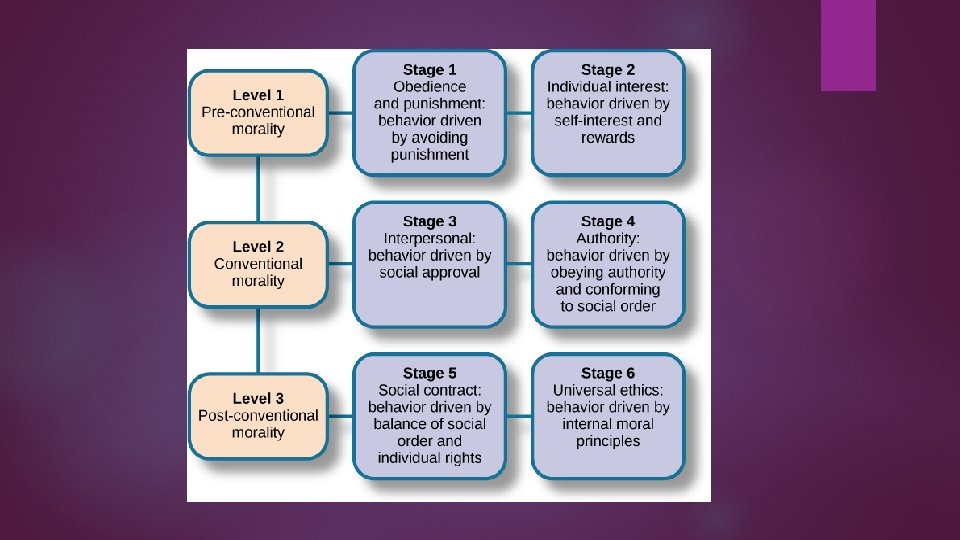
Kohlberg. Believed there was a universal sequence to the development of morality. Proposed 6 stages of moral development. His model was based on children’s responses to various moral dilemmas. Each child was asked what they would do in a given moral dilemma. Kohlberg classified the reasons given for each choice and identified three levels of moral development. Each is NOT based on the choices made, but on the reasoning used to arrive at a choice. Theory has 3 levels, made up of 6 stages in total.
Moral dilemma question 1. “Heinz dilemma” Heinz’s wife was dying from a particular type of cancer. Doctors said a new drug might save her. The drug had been discovered by a local chemist and the Heinz tried desperately to buy some, but the chemist was charging ten times the money it cost to make the drug and this was much more than the Heinz could afford. Heinz could only raise half the money, even after help from family and friends. He explained to the chemist that his wife was dying and asked if he could have the drug cheaper or pay the rest of the money later. The chemist refused, saying that he had discovered the drug and was going to make money from it. The husband was desperate to save his wife, so later that night he broke into the chemist’s and stole the drug.
Moral dilemma question 1. “Heinz dilemma” 1. Should Heinz have stolen the drug? Why/why not? 2. Would it change anything if Heinz did not love his wife? 3. What if the person dying was a stranger, would it make any difference? 4. It is against the law for Heinz to steal. Does that make it morally wrong? 5. In general, should people try to do everything they can to obey the law?
Moral dilemma question 2. Joe is a fourteen-year-old boy who wanted to go to camp very much. His father promised him he could go if he saved up the money for it himself. Joe worked hard at his paper route and saved up the forty dollars it cost to go to camp, and a little more besides. But just before camp was going to start, his father changed his mind. Some of his friends decided to go on a special fishing trip, and Joe's father was short of the money it would cost. He told Joe to give him the money he had saved from the paper route. Joe didn't want to give up going to camp, so he thinks of refusing to give his father the money.
Moral dilemma question 2. 1. Should Joe refuse to give his father the money? 2. Does the father have the right to tell Joe to give him the money? 3. Does giving the money have anything to do with being a good son? 4. Is the fact that Joe earned the money himself important in this situation?
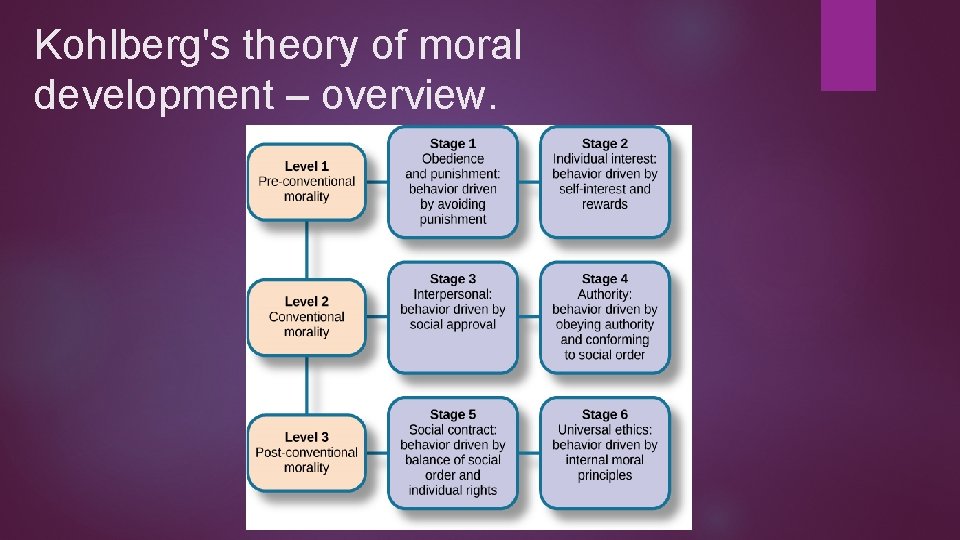
Kohlberg's theory of moral development – overview.
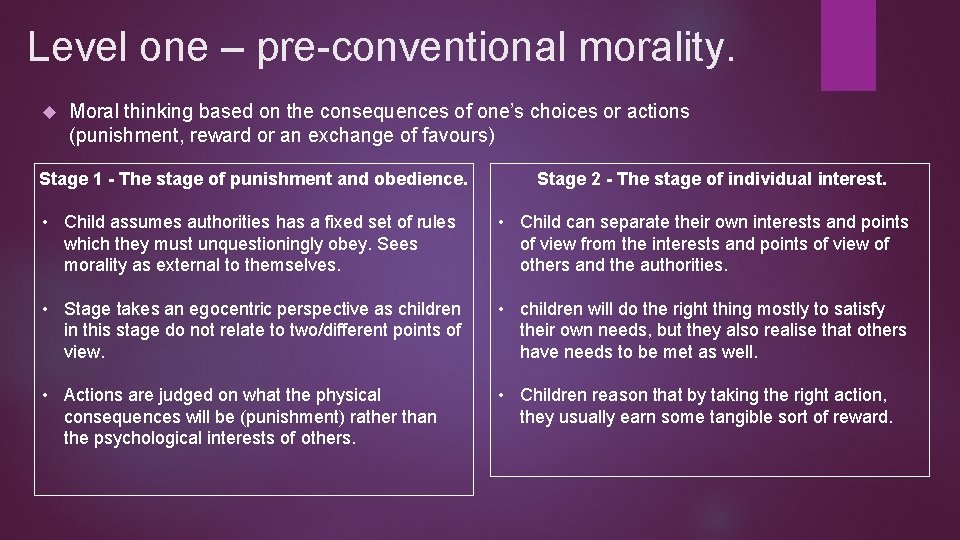
Level one – pre-conventional morality. Moral thinking based on the consequences of one’s choices or actions (punishment, reward or an exchange of favours) Stage 1 - The stage of punishment and obedience. Stage 2 - The stage of individual interest. • Child assumes authorities has a fixed set of rules which they must unquestioningly obey. Sees morality as external to themselves. • Child can separate their own interests and points of view from the interests and points of view of others and the authorities. • Stage takes an egocentric perspective as children in this stage do not relate to two/different points of view. • children will do the right thing mostly to satisfy their own needs, but they also realise that others have needs to be met as well. • Actions are judged on what the physical consequences will be (punishment) rather than the psychological interests of others. • Children reason that by taking the right action, they usually earn some tangible sort of reward.
Lawrence Kohlberg – Moral Development Stage one (punishment & obedience): Heinz should not steal the drug • He will be put in prison • Which means he’s a mean bad person. Or: Heinz should steal the drug • it is only worth $200 • Heinz had even offered to pay & wouldn’t steal anything else.
Lawrence Kohlberg – Moral Development Stage two (reward & self-interest): Heinz should not steal the drug • Prison is awful a jail cell is worse than his wife's death. Or: Heinz should steal the drug • he will be much happier if he saves his wife
Level two – conventional morality. Moral thinking based on a desire to please others or to follow accepted rules and values. Stage 3. The stage of mutual interpersonal expectations, relationships and conformity. Stage 4. The stage of authority. • Significant amount of conformity at this stage. Children will lean that they must live up to rules in order to get praise or approval from others. • Individual will start to feel more like it is their duty to uphold the rules of the social system in which they live so as to maintain the welfare of the whole society or group. • They are better at being able to put themselves in others shoes (less egocentric) – more aware of shared feelings, agreements and expectations. • Instead of a couple of people being in agreement, the persons conscience in this stage looks at the societal point of view to maintain order. • We all have to do what is right for our society.
Lawrence Kohlberg – Moral Development Stage three (conformity – good-boy/nice girl ): Heinz should not steal the drug • Stealing is bad & he’s not a criminal • He tried without breaking the law, you can’t blame him. Or: Heinz should steal the drug • His wife expects it; • He wants to be a good husband.
Lawrence Kohlberg – Moral Development Heinz should not steal the medicine because the law prohibits stealing, making it illegal. Or: Heinz should steal the drug for his wife but also take the prescribed punishment for the crime as well as paying the druggist what he is owed. Criminals cannot just run around without regard for the law; actions have consequences.
Level three – post-conventional morality. Moral thinking based on carefully examined and self chosen moral principles. Kohlberg estimated that only 20% of adults achieve postconventional morality. Stage 5. the stage of social contact. • The person will uphold the basic rights, values and legal contracts of a society, even when they are not in accordance with the rules and laws of the group. • Stage where the laws or rules governing society is upheld and when emotional bonds and relationships are put aside. • A person will recognise the legal point of view and the moral point of view and they will recognise the conflict and then find it difficult to integrate them. Stage 6. The stage of universal ethical principles. • Individual moral standard is based on human rights that all cultures of societies would agree to. • High value is placed on justice, dignity and equality.
Lawrence Kohlberg – Moral Development Stage five (human rights): Heinz should not steal the drug • The scientist has a right to fair compensation. • His wife’s illness it does not make his actions right. Or: Heinz should steal the drug • Everyone has a right to choose life, regardless of the law.
Lawrence Kohlberg – Moral Development Stage six (universal human ethics): Heinz should not steal the drug • Others may need the drug just as badly & their lives are equally significant. Or: Heinz should steal the drug • Saving a human life is a more fundamental value than the property rights of another person.
Evaluation of Kohlberg. STRENGTHS Other studies have found a strong correlation between age and moral reasoning (in both cross sectional and longitudinal designs), and that the steps of moral development do follow this sequence.
Evaluation of Kohlberg. WEAKNESSES Narrow sample in original research Culture bias – another experiment presented the Heinz dilemma to a orthodox Hindu teacher, who’s Hindu religion strictly forbids stealing under any circumstances. The teacher says that Heinz shouldn’t steal because it is a sin which places him around stage 3 -4 according to Kohlberg’s theory. It is argued that theory doesn’t take into account the reasoning of a man with a sophisticated understanding of his own culture. (Shweder, 1991) Gender bias - females typically reach stage 3, and males stage 4. Maybe not due to males being more morally advanced, instead due to different socialisation and different values. Males are socialised into being independent/achievement orientated = develop morality of justice (stage 4). Females are bought up to be socially responsible/nurturing = develop morality of care (stage 3). Therefor, female reasoning is not inferior, just different. (Gilligan, 1982)
Evaluation of Kohlberg. WEAKNESSES The dilemmas are artificial. Many scenarios provided are unfamiliar to most people. i. e. Heinz scenario, participants were 10 -16. Never been married etc. Kohlberg’s theory refers to people’s reasoning assuming that this is directly related to their behaviour, but did not assess actual behaviour. Kohlberg’s theory was developed based on cross-sectional rather than longitudinal research, which does not allow assessment of an individual’s moral reasoning over time.
- Slides: 20