
2 IS 55 Software Evolution Architecture Evolution Alexander

- Slides: 42
2 IS 55 Software Evolution Architecture Evolution Alexander Serebrenik
Assignment 2: Reminder • Deadline: Today, 23: 59 • Individual • PDF • How to submit: Peach • http: //peach. win. tue. nl/ • Assignment 3 • Is already open • Deadline: March 8, 23: 59 • Groups: 1 -2 students / SET / W&I 13 -6 -2021 PAGE 1
Sources Architecture reconstruction slides Rainer Koschke (in German) http: //www. informatik. unibremen. de/st/lehredetails. php? id=3&lehre_id=3 09 / SET / W&I 13 -6 -2021 PAGE 2
Where are we now? • Last week: requirements • This week: architecture • [IEEE Std. 1471 -2000] Software architecture is the fundamental organization of a system embodied in • its components, • their relationships to each other and to the environment, • and the principles guiding its design and evolution. / SET / W&I 13 -6 -2021 PAGE 3
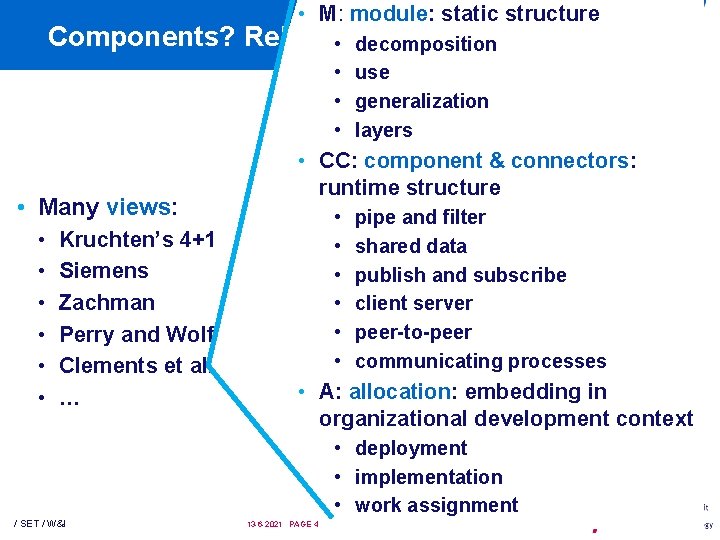
• M: module: static structure Components? Relations? • decomposition • use • generalization • layers • Many views: • • • Kruchten’s 4+1 Siemens Zachman Perry and Wolf Clements et al. … • CC: component & connectors: runtime structure • • • pipe and filter shared data publish and subscribe client server peer-to-peer communicating processes • A: allocation: embedding in organizational development context • deployment • implementation • work assignment / SET / W&I 13 -6 -2021 PAGE 4
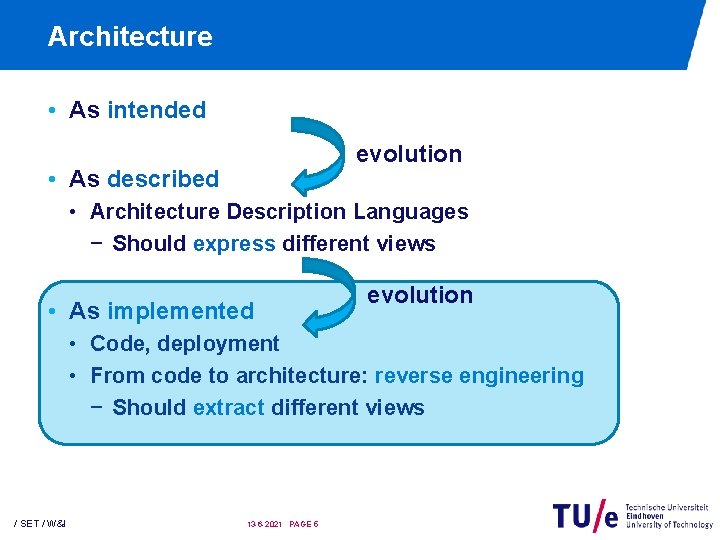
Architecture • As intended evolution • As described • Architecture Description Languages − Should express different views • As implemented evolution • Code, deployment • From code to architecture: reverse engineering − Should extract different views / SET / W&I 13 -6 -2021 PAGE 5
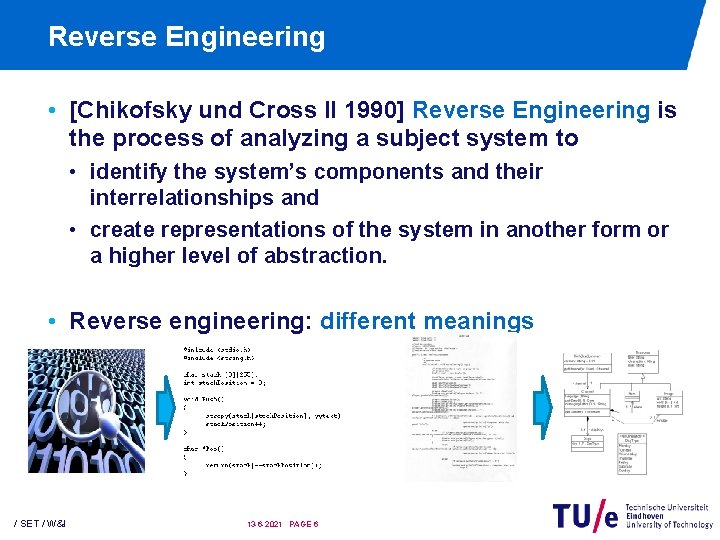
Reverse Engineering • [Chikofsky und Cross II 1990] Reverse Engineering is the process of analyzing a subject system to • identify the system’s components and their interrelationships and • create representations of the system in another form or a higher level of abstraction. • Reverse engineering: different meanings / SET / W&I 13 -6 -2021 PAGE 6
Our Reverse Engineering • [Koschke 2008] Architecture reconstruction is the process of analyzing a subject system to reconstruct architectural views. • Different views require different architecture reconstruction techniques! • No silver bullets! / SET / W&I 13 -6 -2021 PAGE 7
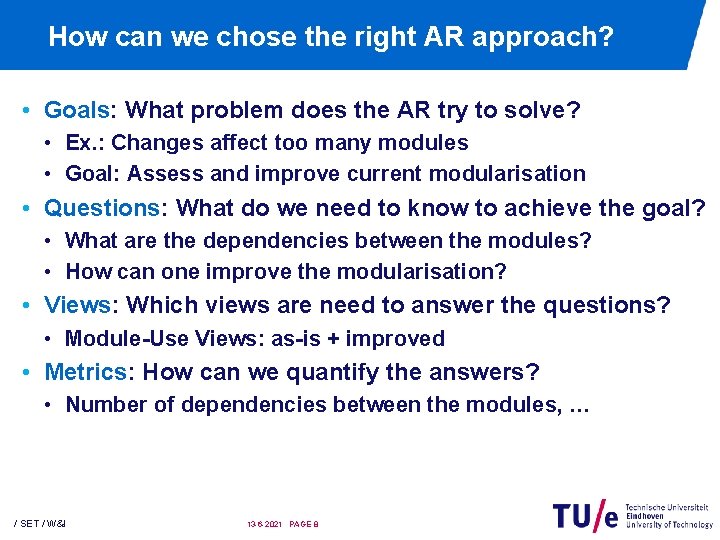
How can we chose the right AR approach? • Goals: What problem does the AR try to solve? • Ex. : Changes affect too many modules • Goal: Assess and improve current modularisation • Questions: What do we need to know to achieve the goal? • What are the dependencies between the modules? • How can one improve the modularisation? • Views: Which views are need to answer the questions? • Module-Use Views: as-is + improved • Metrics: How can we quantify the answers? • Number of dependencies between the modules, … / SET / W&I 13 -6 -2021 PAGE 8
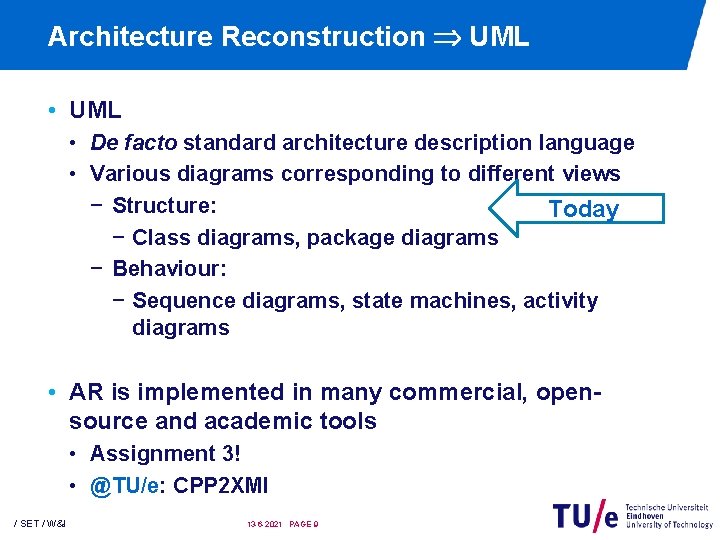
Architecture Reconstruction UML • De facto standard architecture description language • Various diagrams corresponding to different views − Structure: Today − Class diagrams, package diagrams − Behaviour: − Sequence diagrams, state machines, activity diagrams • AR is implemented in many commercial, opensource and academic tools • Assignment 3! • @TU/e: CPP 2 XMI / SET / W&I 13 -6 -2021 PAGE 9
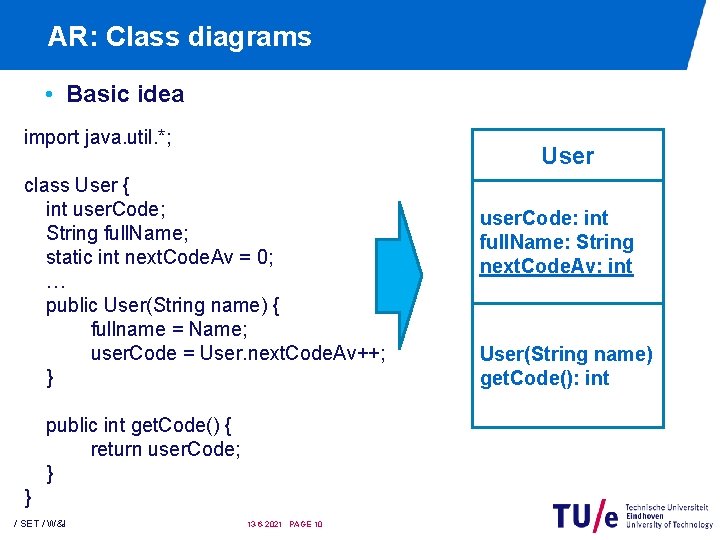
AR: Class diagrams • Basic idea import java. util. *; User class User { int user. Code; String full. Name; static int next. Code. Av = 0; … public User(String name) { fullname = Name; user. Code = User. next. Code. Av++; } public int get. Code() { return user. Code; } } / SET / W&I 13 -6 -2021 PAGE 10 user. Code: int full. Name: String next. Code. Av: int User(String name) get. Code(): int
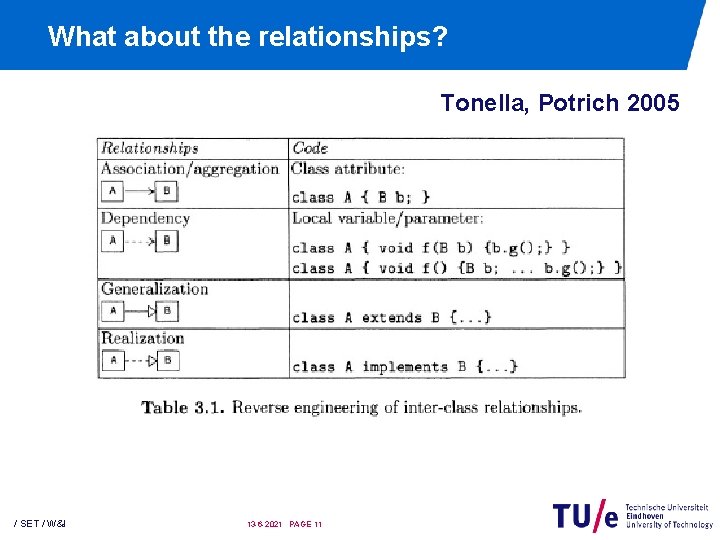
What about the relationships? Tonella, Potrich 2005 / SET / W&I 13 -6 -2021 PAGE 11
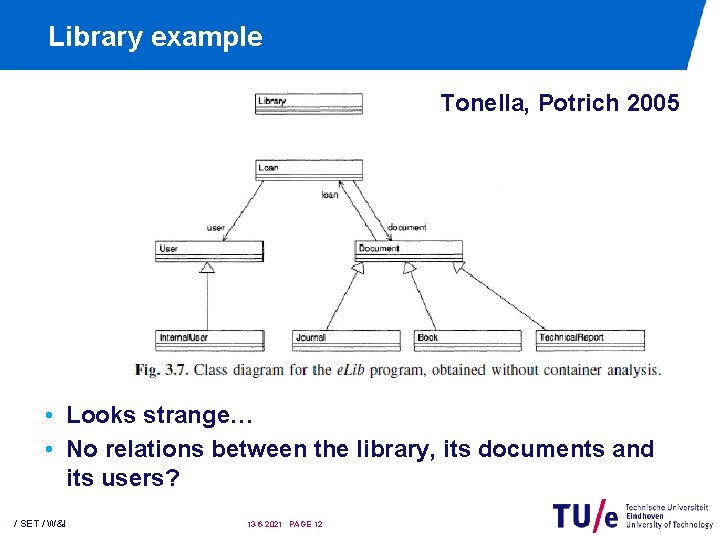
Library example Tonella, Potrich 2005 • Looks strange… • No relations between the library, its documents and its users? / SET / W&I 13 -6 -2021 PAGE 12
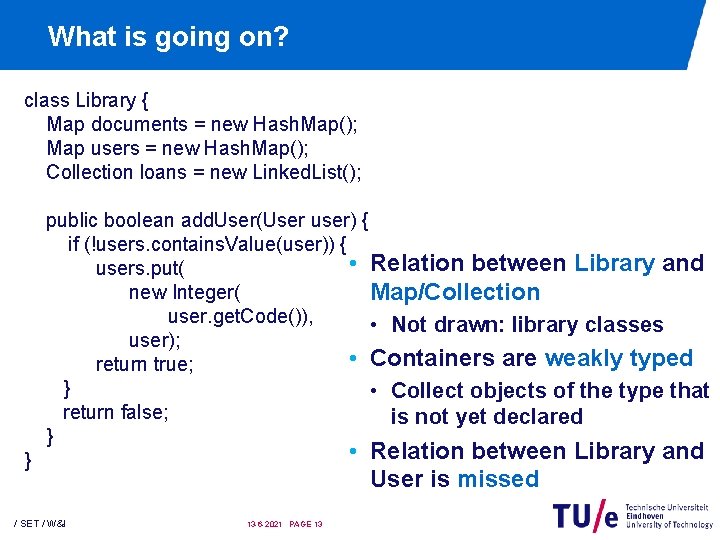
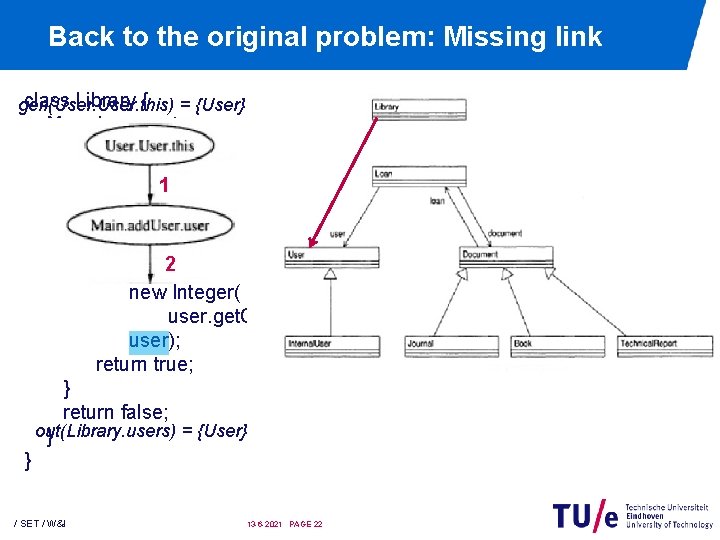
What is going on? class Library { Map documents = new Hash. Map(); Map users = new Hash. Map(); Collection loans = new Linked. List(); public boolean add. User(User user) { if (!users. contains. Value(user)) { • Relation between Library and users. put( new Integer( Map/Collection user. get. Code()), • Not drawn: library classes user); • Containers are weakly typed return true; } • Collect objects of the type that return false; is not yet declared } • Relation between Library and User is missed } / SET / W&I 13 -6 -2021 PAGE 13
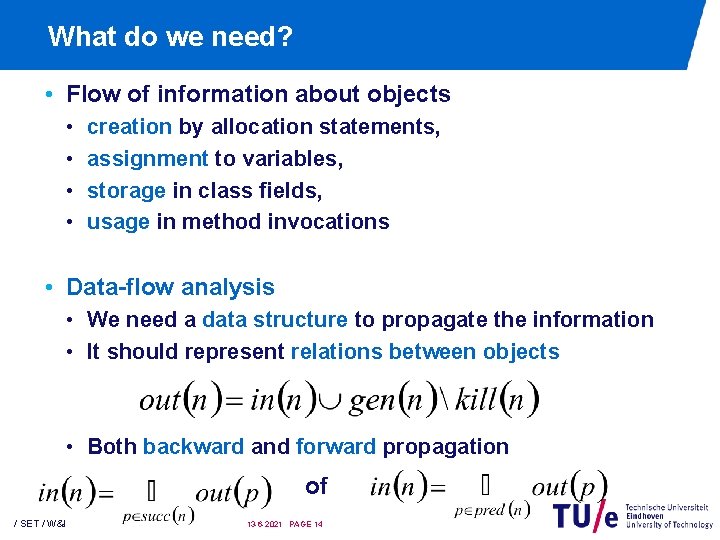
What do we need? • Flow of information about objects • • creation by allocation statements, assignment to variables, storage in class fields, usage in method invocations • Data-flow analysis • We need a data structure to propagate the information • It should represent relations between objects • Both backward and forward propagation of / SET / W&I 13 -6 -2021 PAGE 14
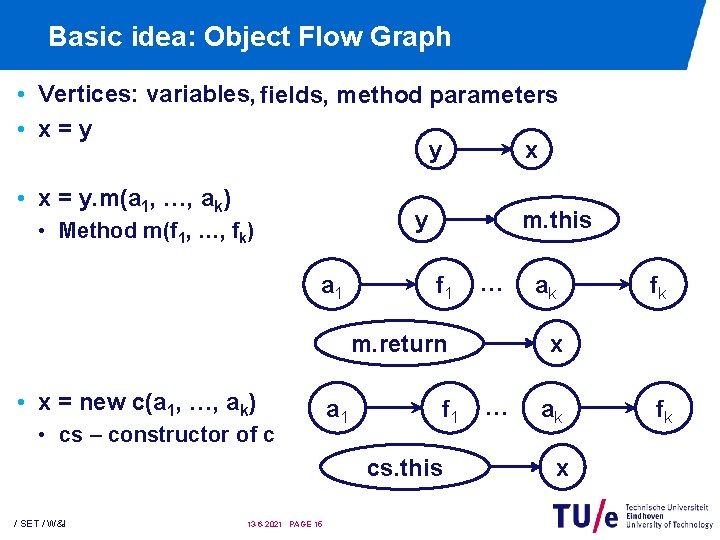
Basic idea: Object Flow Graph • Vertices: variables, fields, method parameters • x=y y x • x = y. m(a 1, …, ak) y • Method m(f 1, …, fk) a 1 m. this f 1 … m. return • x = new c(a 1, …, ak) • cs – constructor of c a 1 f 1 cs. this / SET / W&I 13 -6 -2021 PAGE 15 ak fk x … ak x fk
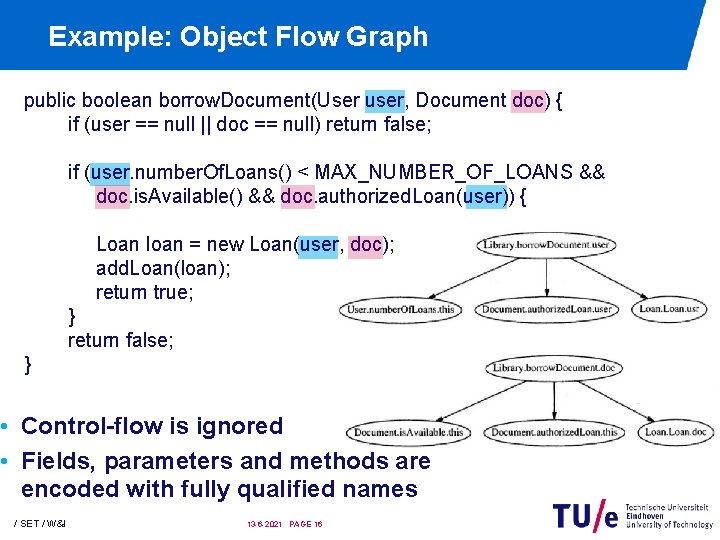
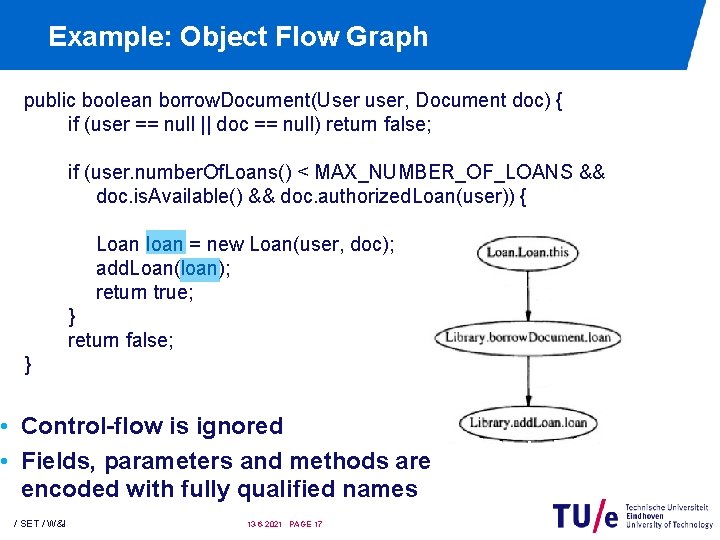
Example: Object Flow Graph public boolean borrow. Document(User user, Document doc) { if (user == null || doc == null) return false; if (user. number. Of. Loans() < MAX_NUMBER_OF_LOANS && doc. is. Available() && doc. authorized. Loan(user)) { Loan loan = new Loan(user, doc); add. Loan(loan); return true; } return false; } • Control-flow is ignored • Fields, parameters and methods are encoded with fully qualified names / SET / W&I 13 -6 -2021 PAGE 16
Example: Object Flow Graph public boolean borrow. Document(User user, Document doc) { if (user == null || doc == null) return false; if (user. number. Of. Loans() < MAX_NUMBER_OF_LOANS && doc. is. Available() && doc. authorized. Loan(user)) { Loan loan = new Loan(user, doc); add. Loan(loan); return true; } return false; } • Control-flow is ignored • Fields, parameters and methods are encoded with fully qualified names / SET / W&I 13 -6 -2021 PAGE 17
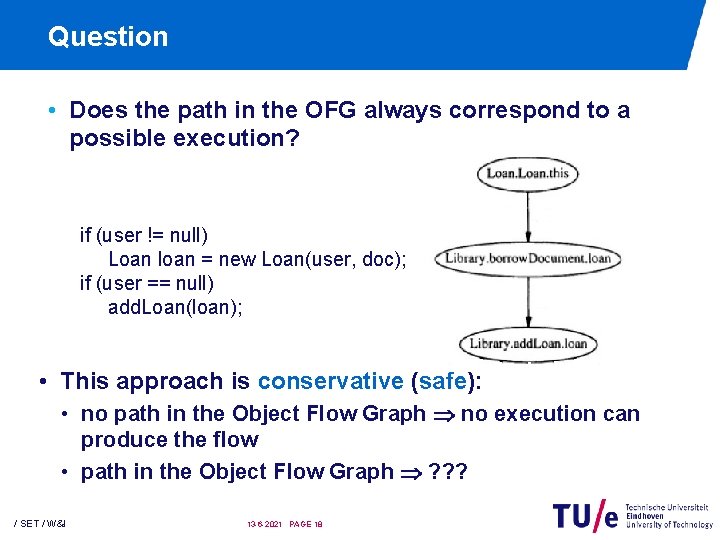
Question • Does the path in the OFG always correspond to a possible execution? if (user != null) Loan loan = new Loan(user, doc); if (user == null) add. Loan(loan); • This approach is conservative (safe): • no path in the Object Flow Graph no execution can produce the flow • path in the Object Flow Graph ? ? ? / SET / W&I 13 -6 -2021 PAGE 18
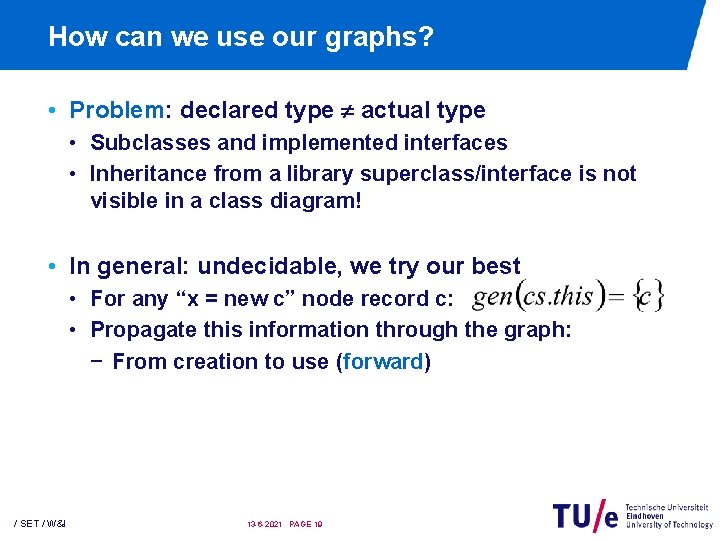
How can we use our graphs? • Problem: declared type actual type • Subclasses and implemented interfaces • Inheritance from a library superclass/interface is not visible in a class diagram! • In general: undecidable, we try our best • For any “x = new c” node record c: • Propagate this information through the graph: − From creation to use (forward) / SET / W&I 13 -6 -2021 PAGE 19
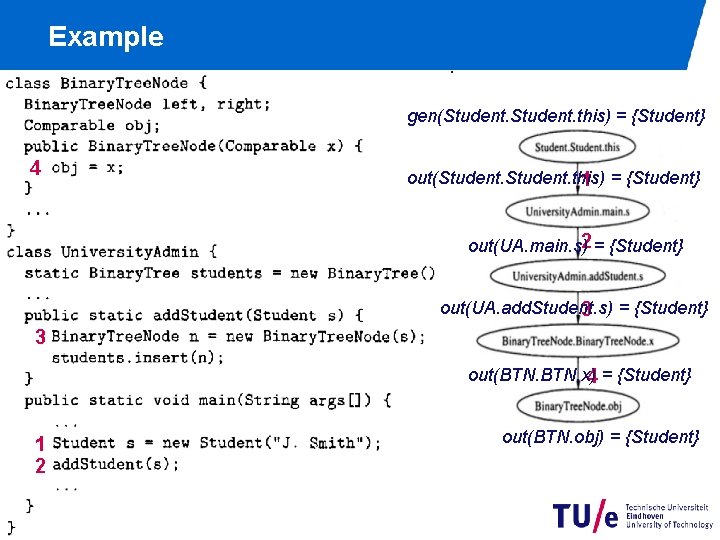
Example gen(Student. this) = {Student} 4 out(Student. this) 1 = {Student} out(UA. main. s)2 = {Student} out(UA. add. Student. s) 3 = {Student} 3 out(BTN. x) 4 = {Student} out(BTN. obj) = {Student} 1 2 / SET / W&I 13 -6 -2021 PAGE 20
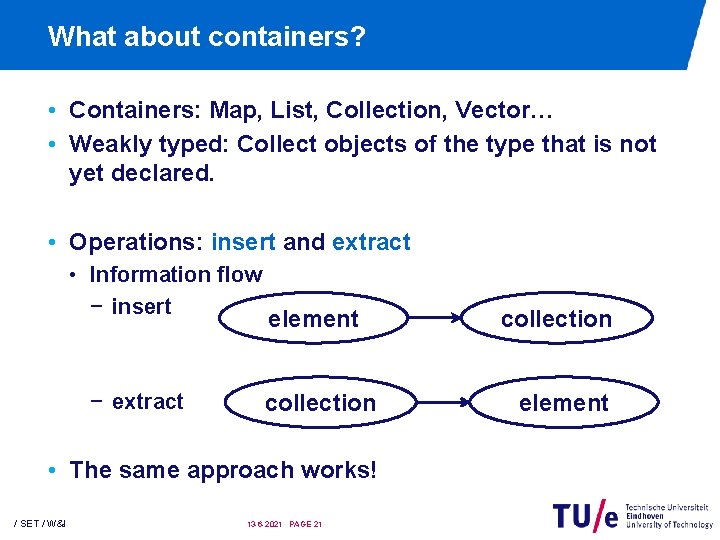
What about containers? • Containers: Map, List, Collection, Vector… • Weakly typed: Collect objects of the type that is not yet declared. • Operations: insert and extract • Information flow − insert − extract element collection element • The same approach works! / SET / W&I 13 -6 -2021 PAGE 21
Back to the original problem: Missing link class Library { gen(User. this) = {User} class Main { Map documents = new Hash. Map(); static Library lib = new Library(); Map users = new Hash. Map(); … Collection loans = new Linked. List(); public static void add. User(String cmd) { 1 … public boolean add. User(User user) { user = new User(args[0], args[1]) 1 User if (!users. contains. Value(user))2 { lib. add. User(user); 2 users. put( … new Integer( } user. get. Code()), } user); return true; } return false; out(Library. users) = {User} } } / SET / W&I 13 -6 -2021 PAGE 22
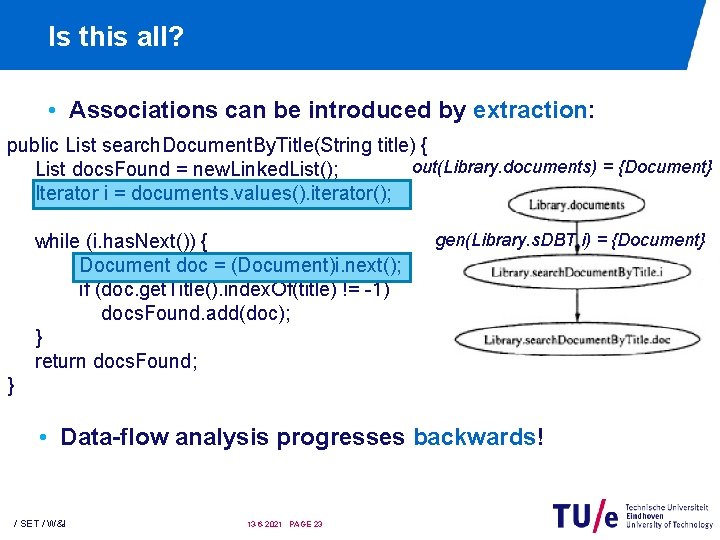
Is this all? • Associations can be introduced by extraction: public List search. Document. By. Title(String title) { out(Library. documents) = {Document} List docs. Found = new. Linked. List(); Iterator i = documents. values(). iterator(); while (i. has. Next()) { Document doc = (Document)i. next(); if (doc. get. Title(). index. Of(title) != -1) docs. Found. add(doc); } return docs. Found; gen(Library. s. DBT. i) = {Document} } • Data-flow analysis progresses backwards! / SET / W&I 13 -6 -2021 PAGE 23
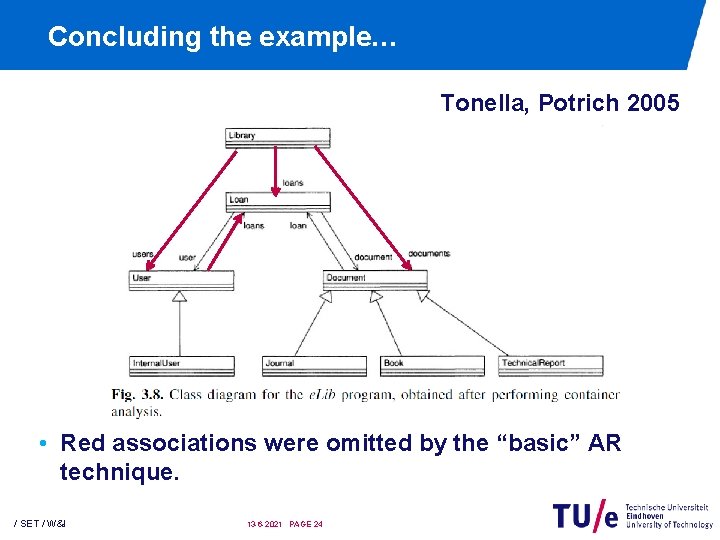
Concluding the example… Tonella, Potrich 2005 • Red associations were omitted by the “basic” AR technique. / SET / W&I 13 -6 -2021 PAGE 24
Summary so far: AR – Class diagrams • Implemented in many tools • How precise? Depends on the tool… • Basic technique is very simple but imprecise • Improving precision necessitates data-flow analysis / SET / W&I 13 -6 -2021 PAGE 25
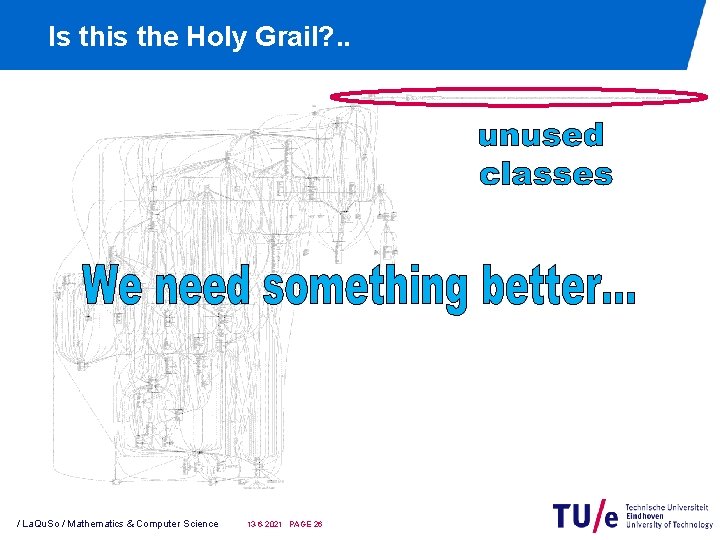
Is this the Holy Grail? . . / La. Qu. So / Mathematics & Computer Science 13 -6 -2021 PAGE 26
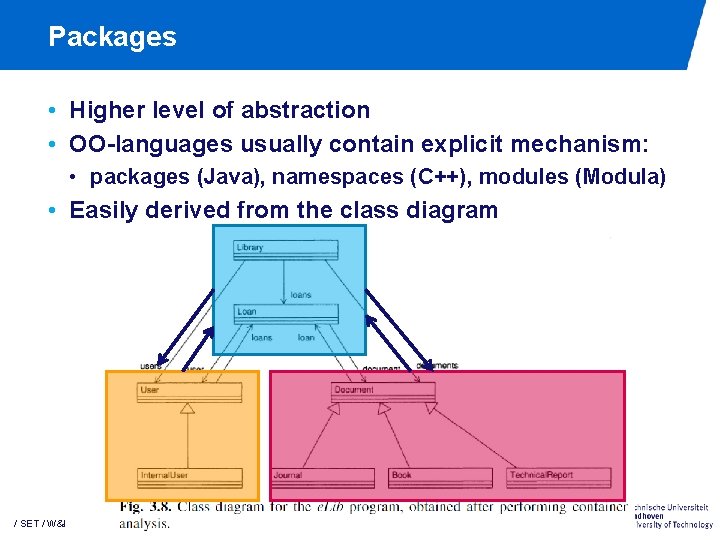
Packages • Higher level of abstraction • OO-languages usually contain explicit mechanism: • packages (Java), namespaces (C++), modules (Modula) • Easily derived from the class diagram / SET / W&I 13 -6 -2021 PAGE 27
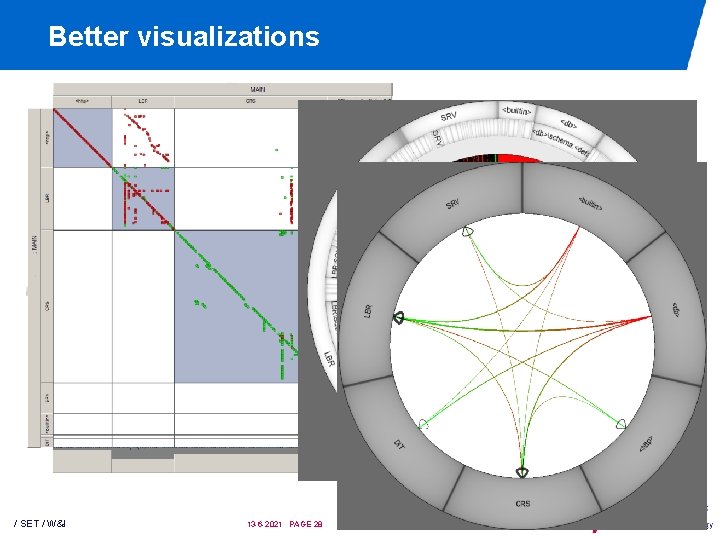
Better visualizations / SET / W&I 13 -6 -2021 PAGE 28
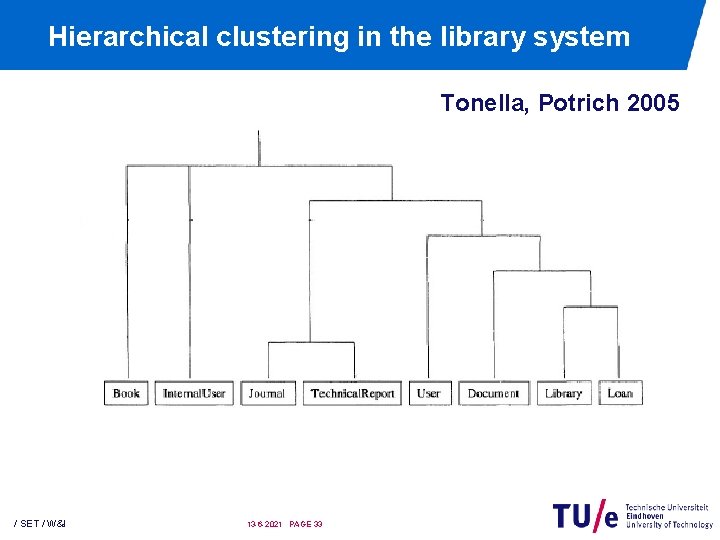
What if the packages are unknown? • When can it happen? • Suitability for evolution − Packaging is being assessed for appropriateness • Implementation of evolution − Legacy language with no “packaging” − Inappropriate packaging • What can we do? • Let the user do it her/himself! • Do it automatically: − Join “similar” classes together: clustering − Packages can be composed into larger packages: − Hierarchical clustering / SET / W&I 13 -6 -2021 PAGE 29
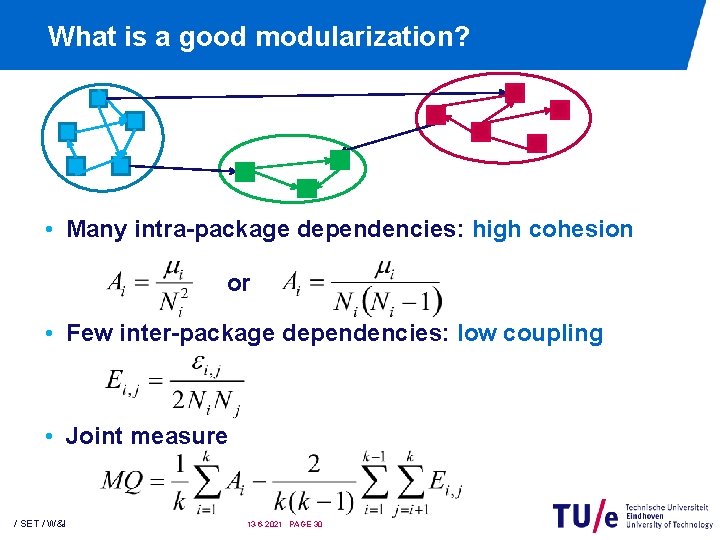
What is a good modularization? • Many intra-package dependencies: high cohesion or • Few inter-package dependencies: low coupling • Joint measure / SET / W&I 13 -6 -2021 PAGE 30
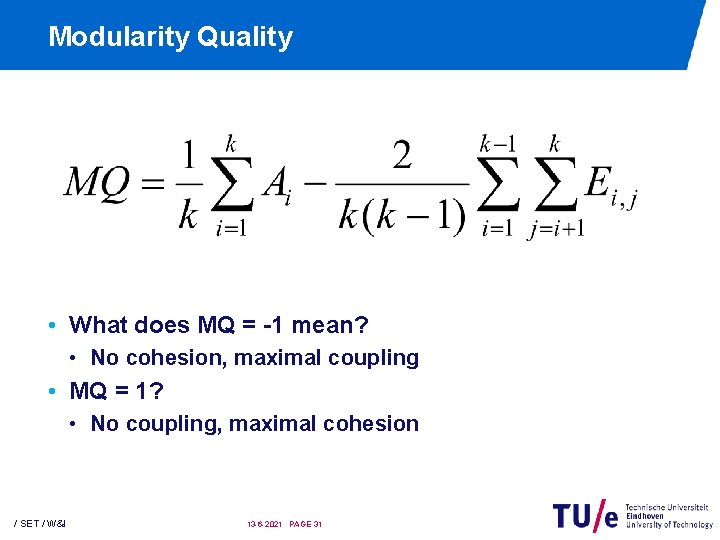
Modularity Quality • What does MQ = -1 mean? • No cohesion, maximal coupling • MQ = 1? • No coupling, maximal cohesion / SET / W&I 13 -6 -2021 PAGE 31
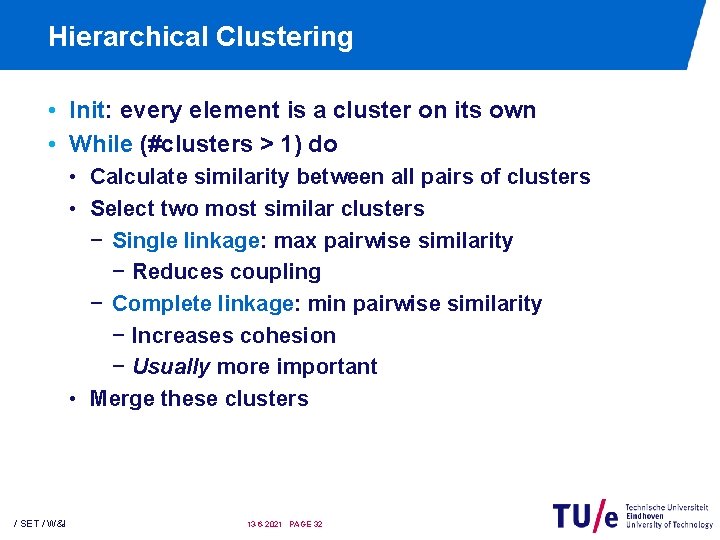
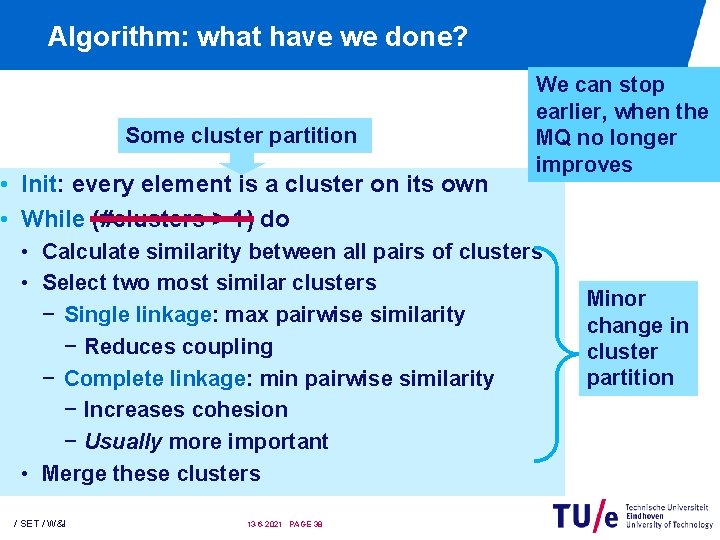
Hierarchical Clustering • Init: every element is a cluster on its own • While (#clusters > 1) do • Calculate similarity between all pairs of clusters • Select two most similar clusters − Single linkage: max pairwise similarity − Reduces coupling − Complete linkage: min pairwise similarity − Increases cohesion − Usually more important • Merge these clusters / SET / W&I 13 -6 -2021 PAGE 32
Hierarchical clustering in the library system Tonella, Potrich 2005 / SET / W&I 13 -6 -2021 PAGE 33
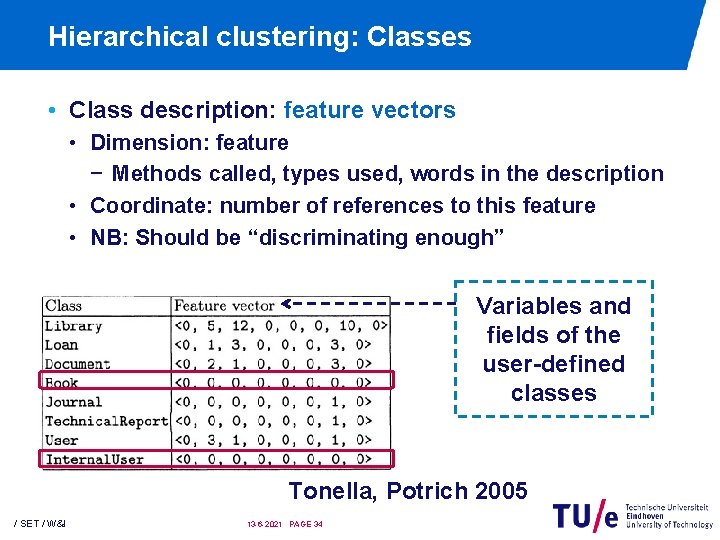
Hierarchical clustering: Classes • Class description: feature vectors • Dimension: feature − Methods called, types used, words in the description • Coordinate: number of references to this feature • NB: Should be “discriminating enough” Variables and fields of the user-defined classes Tonella, Potrich 2005 / SET / W&I 13 -6 -2021 PAGE 34
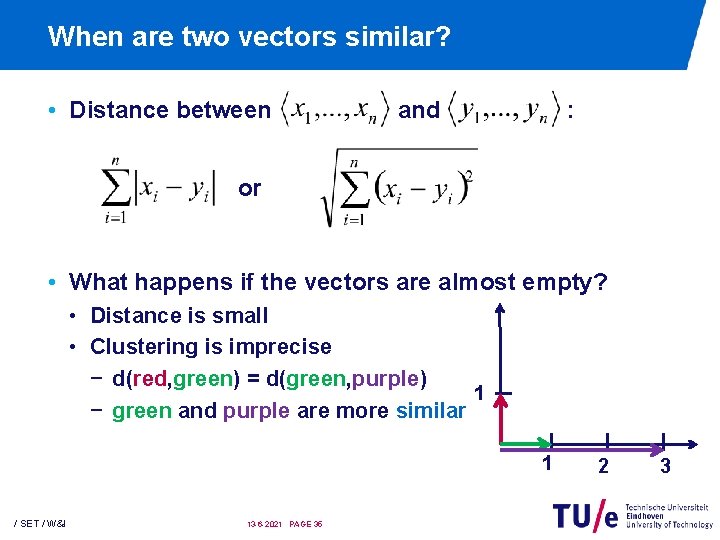
When are two vectors similar? • Distance between and : or • What happens if the vectors are almost empty? • Distance is small • Clustering is imprecise − d(red, green) = d(green, purple) 1 − green and purple are more similar 1 / SET / W&I 13 -6 -2021 PAGE 35 2 3
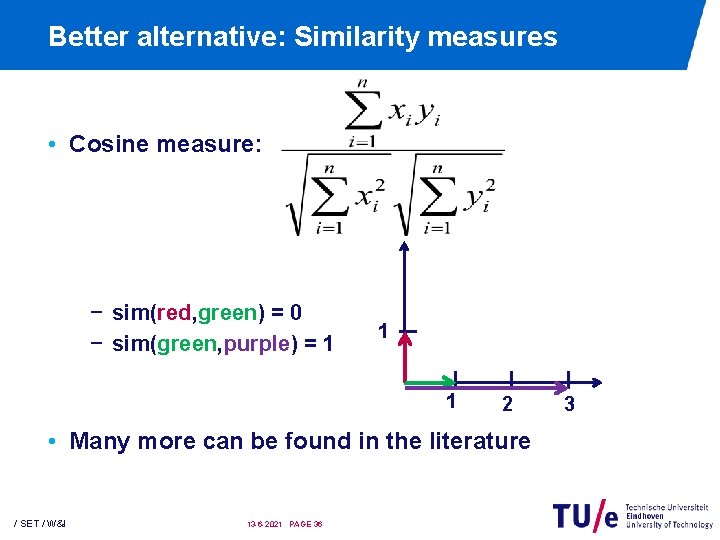
Better alternative: Similarity measures • Cosine measure: − sim(red, green) = 0 − sim(green, purple) = 1 1 1 2 • Many more can be found in the literature / SET / W&I 13 -6 -2021 PAGE 36 3
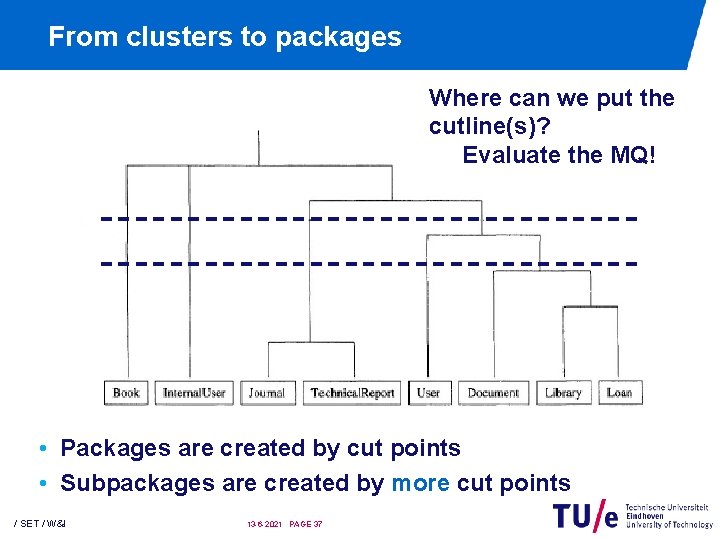
From clusters to packages Where can we put the cutline(s)? Evaluate the MQ! • Packages are created by cut points • Subpackages are created by more cut points / SET / W&I 13 -6 -2021 PAGE 37
Algorithm: what have we done? Some cluster partition • Init: every element is a cluster on its own • While (#clusters > 1) do We can stop earlier, when the MQ no longer improves • Calculate similarity between all pairs of clusters • Select two most similar clusters − Single linkage: max pairwise similarity − Reduces coupling − Complete linkage: min pairwise similarity − Increases cohesion − Usually more important • Merge these clusters / SET / W&I 13 -6 -2021 PAGE 38 Minor change in cluster partition
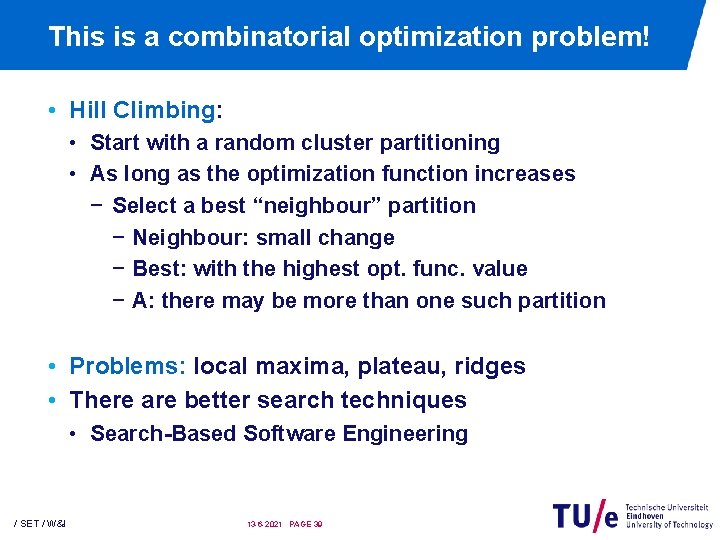
This is a combinatorial optimization problem! • Hill Climbing: • Start with a random cluster partitioning • As long as the optimization function increases − Select a best “neighbour” partition − Neighbour: small change − Best: with the highest opt. func. value − A: there may be more than one such partition • Problems: local maxima, plateau, ridges • There are better search techniques • Search-Based Software Engineering / SET / W&I 13 -6 -2021 PAGE 39
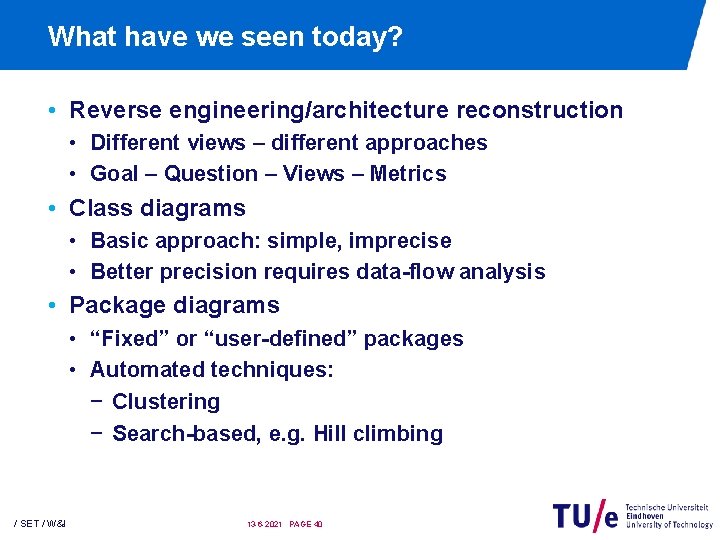
What have we seen today? • Reverse engineering/architecture reconstruction • Different views – different approaches • Goal – Question – Views – Metrics • Class diagrams • Basic approach: simple, imprecise • Better precision requires data-flow analysis • Package diagrams • “Fixed” or “user-defined” packages • Automated techniques: − Clustering − Search-based, e. g. Hill climbing / SET / W&I 13 -6 -2021 PAGE 40
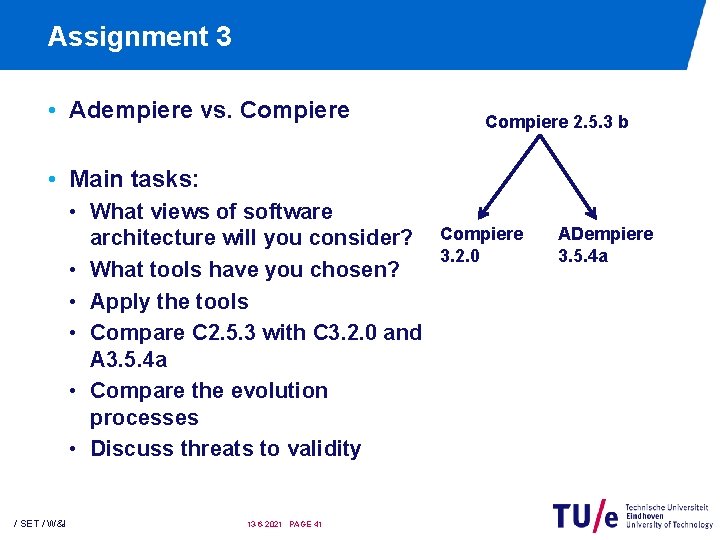
Assignment 3 • Adempiere vs. Compiere 2. 5. 3 b • Main tasks: • What views of software architecture will you consider? • What tools have you chosen? • Apply the tools • Compare C 2. 5. 3 with C 3. 2. 0 and A 3. 5. 4 a • Compare the evolution processes • Discuss threats to validity / SET / W&I 13 -6 -2021 PAGE 41 Compiere 3. 2. 0 ADempiere 3. 5. 4 a