
2 HUMAN ANATOMY Power Point Lecture Slides prepared



- Slides: 13
2 HUMAN ANATOMY Power. Point® Lecture Slides prepared by Leslie Hendon, University of Alabama, Birmingham PART 1 Cells: The Living Units fifth edition MARIEB | MALLATT | WILHELM Copyright © 2008 Pearson Education, Inc. , publishing as Benjamin Cummings
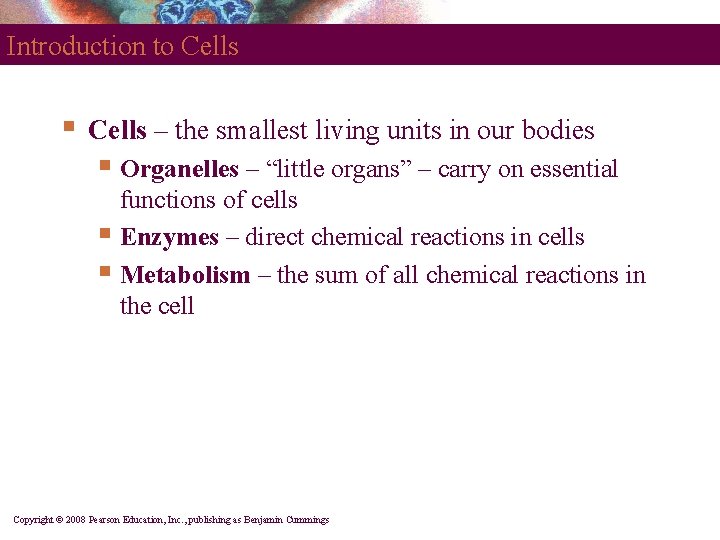
Introduction to Cells § Cells – the smallest living units in our bodies § Organelles – “little organs” – carry on essential functions of cells § Enzymes – direct chemical reactions in cells § Metabolism – the sum of all chemical reactions in the cell Copyright © 2008 Pearson Education, Inc. , publishing as Benjamin Cummings
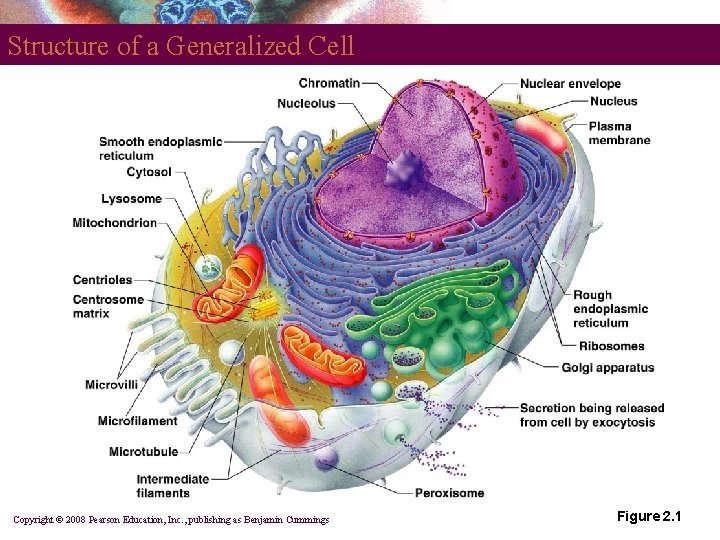
Introduction to Cells § Cells have three main components § Plasma membrane § Cytoplasm § Nucleus Copyright © 2008 Pearson Education, Inc. , publishing as Benjamin Cummings
Structure of a Generalized Cell Copyright © 2008 Pearson Education, Inc. , publishing as Benjamin Cummings Figure 2. 1
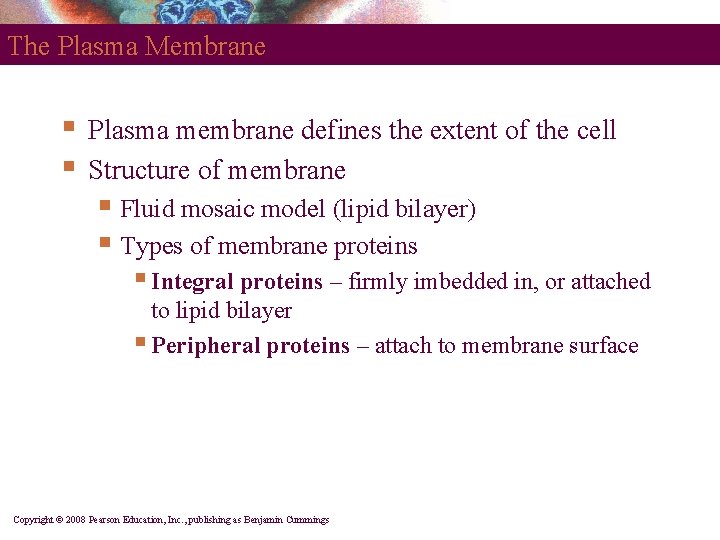
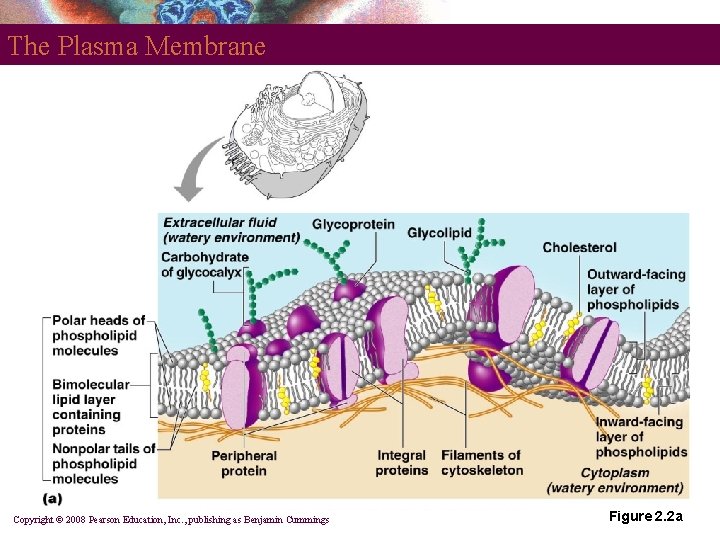
The Plasma Membrane § § Plasma membrane defines the extent of the cell Structure of membrane § Fluid mosaic model (lipid bilayer) § Types of membrane proteins § Integral proteins – firmly imbedded in, or attached to lipid bilayer § Peripheral proteins – attach to membrane surface Copyright © 2008 Pearson Education, Inc. , publishing as Benjamin Cummings
The Plasma Membrane Copyright © 2008 Pearson Education, Inc. , publishing as Benjamin Cummings Figure 2. 2 a
The Plasma Membrane Monday § Functions – relate to location at the interface of cell’s exterior and interior § Provides barrier against substances outside cell § Some plasma membranes act as receptors Copyright © 2008 Pearson Education, Inc. , publishing as Benjamin Cummings
The Plasma Membrane § Determines which substances enter or leave the cell § Membrane is selectively permeable § Diffusion – molecules move from a region where they are more concentrated to an area where they are less concentrated § Osmosis – the diffusion of water across a membrane PLAY Membrane Structure Copyright © 2008 Pearson Education, Inc. , publishing as Benjamin Cummings
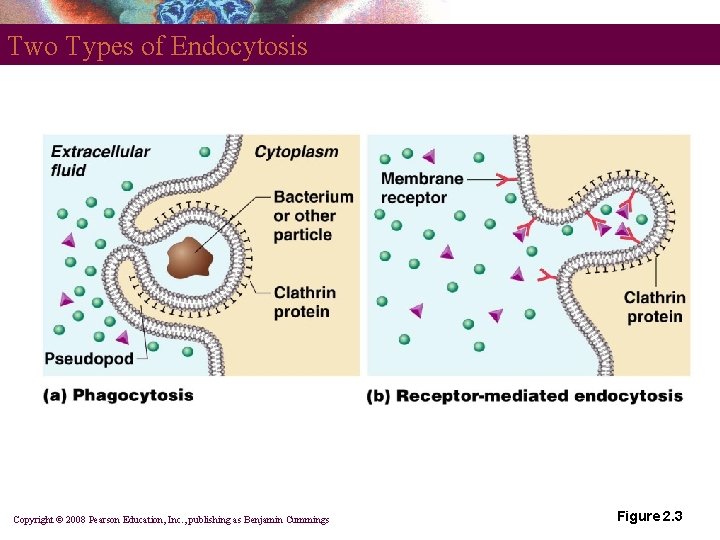
Endocytosis § Mechanism by which particles enter cells § Phagocytosis – “cell eating” § Pinocytosis – “cell drinking” § NOTE: Clathrin is a protein that causes bending of the cell membrane in order for a molecule to be captured by endocytosis Copyright © 2008 Pearson Education, Inc. , publishing as Benjamin Cummings
Receptor-mediated Endocytosis § Receptor-mediated endocytosis § Plasma proteins bind to certain molecules § Invaginates and forms a coated pit § Pinches off to become a coated vesicle § NOTE: This is the method by which insulin and cholesterol enter cells! Copyright © 2008 Pearson Education, Inc. , publishing as Benjamin Cummings
Two Types of Endocytosis Copyright © 2008 Pearson Education, Inc. , publishing as Benjamin Cummings Figure 2. 3
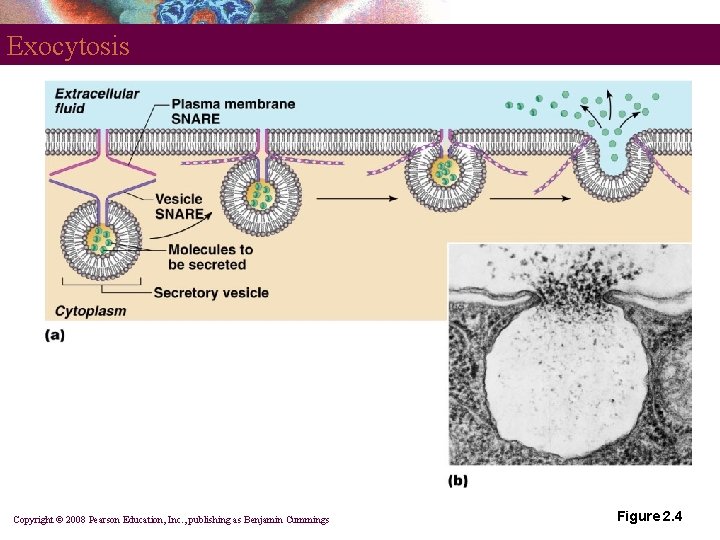
Exocytosis § Exocytosis – a mechanism that moves substances out of the cell § § Substance is enclosed in a vesicle The vesicle migrates to the plasma membrane Proteins from the vesicles (v-SNAREs) bind with membrane proteins (t-SNAREs) The lipid layers from both membranes bind, and the vesicle releases its contents to the outside of the cell Copyright © 2008 Pearson Education, Inc. , publishing as Benjamin Cummings
Exocytosis Copyright © 2008 Pearson Education, Inc. , publishing as Benjamin Cummings Figure 2. 4